
|
시장보고서
상품코드
2125257
아시아태평양의 인적 자본 관리 소프트웨어 : 시장 점유율 분석, 업계 동향 및 통계, 성장 예측(2026-2031년)Asia-Pacific Human Capital Management Software - Market Share Analysis, Industry Trends & Statistics, Growth Forecasts (2026 - 2031) |
||||||
 Mordor Intelligence
Mordor Intelligence에 의하면, 아시아태평양의 인적 자본 관리 소프트웨어 시장 규모는 2025년 88억 7,000만 달러로 평가되었습니다. 2026년에는 97억 1,000만 달러로 확대되어 2026-2031년에 걸쳐 CAGR 7.47%로 성장을 지속하여, 2031년에는 139억 2,000만 달러에 이를 것으로 예측됩니다.
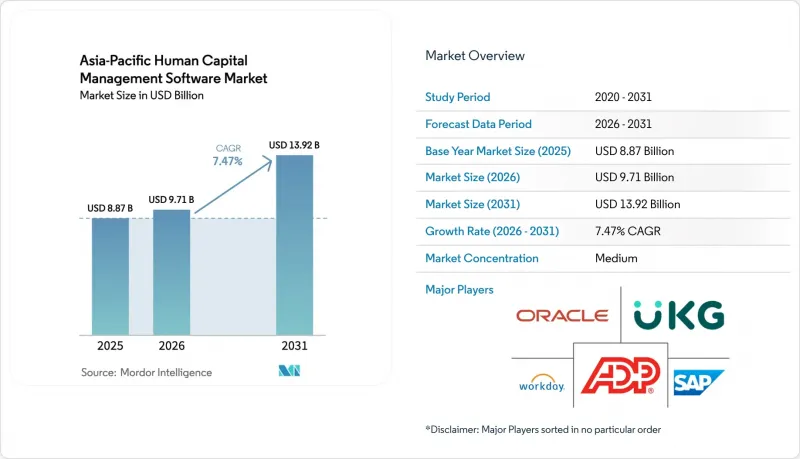
본 보고서는 배포 방식별(클라우드 기반 및 On-Premise), 용도별(핵심 HR, 급여 관리, 기타), 조직 규모별(중소기업(SME) 및 대기업), 제공 형태별(소프트웨어 및 서비스), 최종 사용자 산업별(IT 및 통신, 소매 및 전자상거래, 기타), 지역별로 분류되어 있습니다. 시장 예측은 금액(달러) 기준으로 제시되어 있습니다.
아시아태평양의 인적 자본 관리 소프트웨어 시장 동향 및 인사이트
아시아태평양 기업들의 클라우드 도입 가속화
기업들은 총 소유 비용(TCO)을 절감하고 혁신 주기를 가속화하기 위해 자본 집약적인 On-Premise 시스템을 구독형 클라우드 제품군으로 대체하고 있습니다. 시드니, 싱가포르, 도쿄, 뭄바이의 지역 데이터센터 확장에 따라, 벤더들은 엄격한 데이터 상주 규정을 준수하면서도 릴리스 주기를 단축하는 최신 마이크로서비스 아키텍처를 제공할 수 있게 되었습니다. 클라우드 도입으로 전담 IT 인력이나 서버실이 불필요해지고, 직원 수 증가에 맞추어 확장 가능한 모델이 지원되므로 중견 기업의 구매자들이 가장 큰 혜택을 보고 있습니다. 한때 에어 갭 환경을 필수로 요구했던 규제 산업조차 현재는 기밀성이 높은 마스터 데이터를 On-Premise에 보관하면서, 분석 처리는 클라우드에서 실행하는 하이브리드 스택을 시범 운영하고 있습니다. 플랫폼을 재구축하지 않고도 프라이빗 클라우드와 퍼블릭 클라우드 간에 워크로드를 전환할 수 있는 기능은 중요한 선정 기준이 되고 있으며, 컨테이너화된 서비스나 스테이트리스 통합 게이트웨이를 제공하는 벤더가 우위를 점하고 있습니다.
디지털 급여 계산의 규정 준수 관련 규제 의무
인도네시아의 CORETAX 도입부터 베트남의 전자 사회보험 장부에 이르기까지, 잇달아 이루어지는 법 개정에 대응하기 위해서는 연간 업그레이드가 아닌 분기별 컨텐츠 팩을 제공하는 급여 계산 엔진이 필요합니다. 사내에 규정 준수 팀을 보유하고 각국별 로드맵을 갖춘 벤더는 정부가 세율 구분, 수당 또는 기여금 산정 공식을 개정할 때에도 ‘도입 첫날부터 대응 가능’한 체제를 제공함으로써 타사와의 차별화를 꾀하고 있습니다. 2025년까지 단계적으로 도입된 홍콩의 eMPF 플랫폼이 그 대표적인 예입니다. 공급업체는 기여금 제출용 API와 포트폴리오 전환 워크플로를 통합해야 하며, 그렇지 않을 경우 고객 이탈을 초래할 위험이 있습니다. 실시간 급여 계산 보고를 요구하는 세무 당국이 늘어남에 따라, 마이크로 배치 제출 및 감사 수준의 데이터 추적을 지원하는 클라우드 아키텍처가 더욱 탄력을 받고 있습니다.
기존 ERP 시스템군과의 통합 복잡성
많은 은행과 제조업체는 대폭 맞춤화된 SAP ECC 및 Oracle E-Business Suite 인스턴스를 운영하고 있으며, 이를 하룻밤 사이에 폐지할 수는 없습니다. 조직 계층, 비용 센터, 맞춤형 급여 계산 로직을 차세대 클라우드 제품군과 동기화하려면 대부분의 경우 미들웨어, 데이터 정제, 18개월 이상에 걸친 단계적 도입이 필요합니다. Workday와 SAP SuccessFactors는 스타터 커넥터를 공개하고 있지만, 틈새 시장의 현지 급여 계산 엔진이나 정부 제출 포털에는 여전히 맞춤형 API가 필요하여 프로젝트 범위를 확대시키고 있습니다. 컨설팅에 대한 의존도가 높은 프로젝트는 총 소유 비용(TCO)을 상승시켜 예산에 제약이 있는 고객을 멀어지게 하고, 시장 전체의 전환을 지연시키고 있습니다. 이전 가속기나 미리 매핑된 데이터 모델을 함께 제공하는 벤더는 이러한 마찰을 완화하지만, 레거시 시스템의 복잡성은 여전히 도입 속도를 가장 크게 저해하는 요인으로 남아 있습니다.
부문별 분석
2025년, 아시아태평양의 인적 자본 관리 소프트웨어 시장에서 클라우드 기반 솔루션은 매출 점유율의 78.03%를 차지했으며, 이 부문은 2031년까지 연평균 성장률(CAGR) 7.51%로 성장할 것입니다. 각 벤더는 데이터 상주에 관한 법률을 준수하기 위해 국가별 클라우드 리전을 추가하고 있으며, 이를 통해 과거 기밀성이 높은 산업이 On-Premise 운영을 강요받았던 역사적 장벽이 제거되고 있습니다. 주요 은행들은 여전히 특정 급여 계산 엔진을 규제 대상 데이터센터 내에 보유하고 있지만, 이 핵심 시스템과 클라우드 분석을 결합하여 보상 시나리오를 거의 실시간으로 모델링하는 사례가 증가하고 있습니다. On-Premise 및 하이브리드 환경은 여전히 중요하지만, 그 로드맵에서는 풀스택 업그레이드가 아닌 단계적 전환을 가능하게 하는 API 게이트웨이가 중시되고 있습니다.
중견 기업들은 구독형 가격 책정을 통해 고정된 하드웨어 비용이 변동적인 운영 비용으로 전환되어, 분석 및 학습 모듈에 예산을 배정할 수 있게 됨으로써 가장 큰 혜택을 누리고 있습니다. Zoho의 걸프협력회의(GCC) 국가에서의 사업 확장과 Darwinbox의 동남아시아에서의 템플릿 기반 도입은 사전 구성된 클라우드 스택이 몇 분기가 아닌 몇 주 만에 가동을 시작할 수 있음을 보여줍니다. 규제가 엄격한 기업을 위해 싱글 테넌트 옵션을 제공하면서, 기타 사용자를 위해 멀티 테넌트의 핵심 기능을 유지하는 벤더는 단일 코드베이스 내에서 다양한 구매자의 선호도를 반영할 수 있으며, 이러한 전략으로 인해 2031년까지 아시아태평양의 클라우드 기반 인사 관리 소프트웨어 시장 점유율이 80%를 넘어설 것으로 예측됩니다.
모든 도입은 직원 마스터 파일과 규정 준수 워크플로우에서 시작되므로, 2025년 용도별 매출의 29.77%는 핵심 HR이 차지했습니다. 직무 그리드에서 스킬 그래프로의 전환을 원동력으로, 성과 및 인적 자본 관리는 연평균 성장률(CAGR) 7.84%를 기록하며 가장 빠르게 성장하는 용도가 될 전망입니다. Workday Skills Cloud 및 SAP Opportunity Marketplace를 기반으로 한 사내 인재 시장을 통해 CFO는 외부 채용 비용을 들이지 않고도 엔지니어를 우선순위가 높은 프로젝트에 재배치하여 투자 회수 기간을 단축할 수 있습니다.
급여 계산은 여전히 규제상 필수 기능이지만, 차별화의 초점은 초과 근무 시간의 급증이나 임금 격차를 예측하는 관련 분석 기능으로 이동하고 있습니다. 인력 관리 모듈은 소매 산업에서 스케줄링과 POS 데이터를 통합하는 한편, 학습 플랫폼에는 역량 강화의 ROI를 검증하기 위한 마이크로 크레덴셜 기능이 통합되었습니다. 한때 사일로화되어 있던 이러한 용도들이 공통 데이터 모델로 통합됨에 따라, 아시아태평양의 인적 자본 관리 소프트웨어 시장에서 베스트 오브 브리드(Best-of-Breed)형 포인트 솔루션에 할당되는 시장 규모는 축소되고, 통합형 제품군에 대한 지출이 집중될 것으로 예측됩니다.
기타 혜택
- 엑셀 형식 시장 예측(ME) 시트
- 3개월간의 애널리스트 지원
목차
제1장 서론
제2장 조사 방법
제3장 주요 요약
제4장 시장 구도
제5장 시장 규모 및 성장 예측
제6장 경쟁 구도
제7장 시장 기회 및 향후 전망
KTHAccording to Mordor Intelligence, the Asia-Pacific human capital management software market size is expected to grow from USD 8.87 billion in 2025 to USD 9.71 billion in 2026 and is forecast to reach USD 13.92 billion by 2031 at 7.47% CAGR over 2026-2031.
This report is Segmented by Deployment (Cloud-Based, and On-Premise), Application (Core HR, Payroll Management, and More), Organization Size (Small and Medium-Sized Enterprises, and Large Enterprises), Offering (Software, and Services), End-User Industry (IT and Telecom, Retail and E-Commerce, and More), and Geography. The Market Forecasts are Provided in Terms of Value (USD).
Asia-Pacific Human Capital Management Software Market Trends and Insights
Accelerated Cloud Adoption Across Asia-Pacific Enterprises
Enterprises are replacing capital-intensive on-premise systems with subscription-priced cloud suites to reduce total cost of ownership and accelerate innovation cycles. Regional data-center expansions in Sydney, Singapore, Tokyo, and Mumbai allow vendors to address strict residency rules while offering modern micro-services architectures that shorten release cadences. Mid-market buyers benefit most because cloud deployments remove the need for dedicated IT staff and server rooms, supporting scale-as-you-grow head-count models. Even regulated industries that once demanded air-gapped environments now pilot hybrid stacks that pin sensitive master data on-premise but run analytics in the cloud. The ability to toggle workloads between private and public clouds without re-platforming has become a key selection criterion, favoring vendors with containerized services and stateless integration gateways.
Regulatory Mandates for Digital Payroll Compliance
Rapid-fire statutory changes, from Indonesia's CORETAX rollout to Vietnam's electronic social-insurance books, require payroll engines that ship quarterly content packs rather than annual upgrades. Vendors with in-house compliance teams and country-specific roadmaps differentiate by offering "day-one readiness" whenever governments revise brackets, allowances, or contribution formulas. Hong Kong's eMPF platform, launching in phases through 2025, is a case in point: providers must embed contribution-submission APIs and portfolio-switch workflows or risk client attrition. As more tax authorities demand real-time payroll reporting, cloud architectures that support micro-batch submissions and audit-quality data trails gain further momentum.
Integration Complexity with Legacy ERP Stacks
Many banks and manufacturers run heavily customized SAP ECC or Oracle E-Business Suite instances that cannot be retired overnight. Synchronizing organizational hierarchies, cost centers, and custom payroll logic with a next-generation cloud suite often requires middleware, data-clean-up, and staged rollouts that stretch beyond 18 months. While Workday and SAP SuccessFactors publish starter connectors, niche local payroll engines and government submission portals still demand bespoke APIs, inflating project scope. Consulting-heavy engagements raise the total cost of ownership, deterring budget-constrained clients and slowing overall market conversion. Vendors that bundle migration accelerators and pre-mapped data models reduce this friction, but legacy complexity remains the single biggest drag on implementation velocity.
Other drivers and restraints analyzed in the detailed report include:
- Localization of AI-Driven Multilingual HR Chatbots for Mid-Market Firms
- Integration of Cross-Border Gig-Workforce Platforms
- Privacy and Security Concerns
For complete list of drivers and restraints, kindly check the Table Of Contents.
Segment Analysis
Cloud-based solutions held 78.03% revenue share of the Asia-Pacific human capital management software market in 2025, and the segment is expanding at 7.51% CAGR through 2031. Vendors are adding sovereign cloud regions to satisfy residency laws, which removes the historical barrier that once forced sensitive industries to remain on-premise. Large banks still keep certain payroll engines inside regulated data centers, yet they increasingly pair this core with cloud analytics to model compensation scenarios in near real time. On-premise and hybrid footprints remain relevant, but their road-maps now emphasize API gateways that allow phased migration rather than full-stack upgrades.
Mid-market firms are the biggest beneficiaries because subscription pricing converts fixed hardware cost into variable operating expense, freeing budget for analytics and learning modules. Zoho's expansion across the Gulf Cooperation Council and Darwinbox's template-driven roll-outs in Southeast Asia demonstrate that pre-configured cloud stacks can go live in weeks instead of quarters. Vendors that offer single-tenant options for highly regulated entities while keeping a multi-tenant core for everyone else capture divergent buyer preferences within one code base, a strategy expected to propel cloud's Asia-Pacific human capital management software market share beyond 80% by 2031.
Core HR generated 29.77% of 2025 application revenue as every deployment begins with an employee master file and compliance workflows. Performance and talent management is set to be the fastest-growing application at 7.84% CAGR, driven by the pivot from job grids to skills graphs. Internal talent marketplaces built on Workday Skills Cloud or SAP Opportunity Marketplace let CFOs redeploy engineers to high-priority projects without external hiring fees, accelerating pay-back periods.
Payroll remains a regulatory must-have, but differentiation is shifting to adjacent analytics that predict overtime spikes or pay-equity gaps. Workforce-management modules integrate scheduling with point-of-sale data in retail, while learning stacks now embed micro-credentialing to verify upskilling ROI. As these formerly siloed applications converge on a common data model, the Asia-Pacific human capital management software market size allocated to best-of-breed point solutions is expected to shrink, consolidating spend inside unified suites.
Complete Report Scope:
- By Deployment
- Cloud-Based
- On-Premise
- By Application
- Core HR
- Payroll Management
- Compensation Management
- Workforce Management
- Performance and Talent Management
- E-Learning and E-Recruiting
- Enterprise GRC (eGRC)
- By Organization Size
- Small and Medium-Sized Enterprises (SMEs)
- Large Enterprises
- By Offering
- Software
- Core Platforms
- Point Solutions and Add-Ons
- Services
- Implementation and Integration
- Support and Maintenance
- Software
- By End-User Industry
- Banking, Financial Services, and Insurance (BFSI)
- IT and Telecom
- Retail and E-Commerce
- Manufacturing
- Healthcare and Life-Sciences
- Government and Public Sector
- Other End-User Industries
- By Geography
- China
- Japan
- India
- South Korea
- Australia
- Singapore
- Indonesia
- Malaysia
- Rest of Asia-Pacific
List of Companies Covered in this Report:
- Workday Inc.
- SAP SE
- Oracle Corporation
- Automatic Data Processing, Inc. (ADP)
- UKG Inc.
- Cornerstone OnDemand, Inc.
- PeopleStrong Technologies Pvt. Ltd.
- Infor, Inc.
- Darwinbox Digital Solutions Pvt. Ltd.
- Ceridian HCM Holding Inc. (Dayforce)
- Ramco Systems Limited
- Zoho Corporation Pvt. Ltd.
- The Sage Group plc (Sage People)
- Beisen Cloud Computing Co., Ltd.
- SumTotal Systems LLC
- HiBob Inc.
- WorkForce Software, LLC
- Rippling People Center Inc.
- SmartHR, Inc.
Additional Benefits:
- The market estimate (ME) sheet in Excel format
- 3 months of analyst support
TABLE OF CONTENTS
1 INTRODUCTION
- 1.1 Study Assumptions and Market Definition
- 1.2 Scope of the Study
2 RESEARCH METHODOLOGY
3 EXECUTIVE SUMMARY
4 MARKET LANDSCAPE
- 4.1 Market Overview
- 4.2 Market Drivers
- 4.2.1 Growing Demand for Mobile HCM Applications
- 4.2.2 Increase in Demand for Talent Mobility
- 4.2.3 Accelerated Cloud Adoption Across Asia-Pacific Enterprises
- 4.2.4 Regulatory Mandates for Digital Payroll Compliance
- 4.2.5 Localization of AI-Driven Multilingual HR Chatbots for Mid-Market Firms
- 4.2.6 Integration of Cross-Border Gig-Workforce Platforms
- 4.3 Market Restraints
- 4.3.1 Privacy and Security Concerns
- 4.3.2 Integration Complexity with Legacy ERP Stacks
- 4.3.3 Fragmented Asia-Pacific Labor-Law Landscape
- 4.3.4 Scarcity of HR-Analytics Talent Pool
- 4.4 Industry Value Chain Analysis
- 4.5 Regulatory Landscape
- 4.6 Technological Outlook
- 4.7 Porter's Five Forces Analysis
- 4.7.1 Threat of New Entrants
- 4.7.2 Bargaining Power of Buyers
- 4.7.3 Bargaining Power of Suppliers
- 4.7.4 Threat of Substitutes
- 4.7.5 Intensity of Competitive Rivalry
- 4.8 Impact of Macroeconomic Factors on the Market
5 MARKET SIZE AND GROWTH FORECASTS (VALUE)
- 5.1 By Deployment
- 5.1.1 Cloud-Based
- 5.1.2 On-Premise
- 5.2 By Application
- 5.2.1 Core HR
- 5.2.2 Payroll Management
- 5.2.3 Compensation Management
- 5.2.4 Workforce Management
- 5.2.5 Performance and Talent Management
- 5.2.6 E-Learning and E-Recruiting
- 5.2.7 Enterprise GRC (eGRC)
- 5.3 By Organization Size
- 5.3.1 Small and Medium-Sized Enterprises (SMEs)
- 5.3.2 Large Enterprises
- 5.4 By Offering
- 5.4.1 Software
- 5.4.1.1 Core Platforms
- 5.4.1.2 Point Solutions and Add-Ons
- 5.4.2 Services
- 5.4.2.1 Implementation and Integration
- 5.4.2.2 Support and Maintenance
- 5.4.1 Software
- 5.5 By End-User Industry
- 5.5.1 Banking, Financial Services, and Insurance (BFSI)
- 5.5.2 IT and Telecom
- 5.5.3 Retail and E-Commerce
- 5.5.4 Manufacturing
- 5.5.5 Healthcare and Life-Sciences
- 5.5.6 Government and Public Sector
- 5.5.7 Other End-User Industries
- 5.6 By Geography
- 5.6.1 China
- 5.6.2 Japan
- 5.6.3 India
- 5.6.4 South Korea
- 5.6.5 Australia
- 5.6.6 Singapore
- 5.6.7 Indonesia
- 5.6.8 Malaysia
- 5.6.9 Rest of Asia-Pacific
6 COMPETITIVE LANDSCAPE
- 6.1 Market Concentration
- 6.2 Strategic Moves
- 6.3 Market Share Analysis
- 6.4 Company Profiles (includes Global Level Overview, Market Level Overview, Core Segments, Financials as available, Strategic Information, Market Rank/Share, Products and Services, Recent Developments)
- 6.4.1 Workday Inc.
- 6.4.2 SAP SE
- 6.4.3 Oracle Corporation
- 6.4.4 Automatic Data Processing, Inc. (ADP)
- 6.4.5 UKG Inc.
- 6.4.6 Cornerstone OnDemand, Inc.
- 6.4.7 PeopleStrong Technologies Pvt. Ltd.
- 6.4.8 Infor, Inc.
- 6.4.9 Darwinbox Digital Solutions Pvt. Ltd.
- 6.4.10 Ceridian HCM Holding Inc. (Dayforce)
- 6.4.11 Ramco Systems Limited
- 6.4.12 Zoho Corporation Pvt. Ltd.
- 6.4.13 The Sage Group plc (Sage People)
- 6.4.14 Beisen Cloud Computing Co., Ltd.
- 6.4.15 SumTotal Systems LLC
- 6.4.16 HiBob Inc.
- 6.4.17 WorkForce Software, LLC
- 6.4.18 Rippling People Center Inc.
- 6.4.19 SmartHR, Inc.
7 MARKET OPPORTUNITIES AND FUTURE OUTLOOK
- 7.1 White-Space and Unmet-Need Assessment