
|
시장보고서
상품코드
2122643
인력 분석 시장 : 시장 점유율 분석, 업계 동향 및 통계, 성장 예측(2026-2031년)Workforce Analytics - Market Share Analysis, Industry Trends & Statistics, Growth Forecasts (2026 - 2031) |
||||||
 Mordor Intelligence
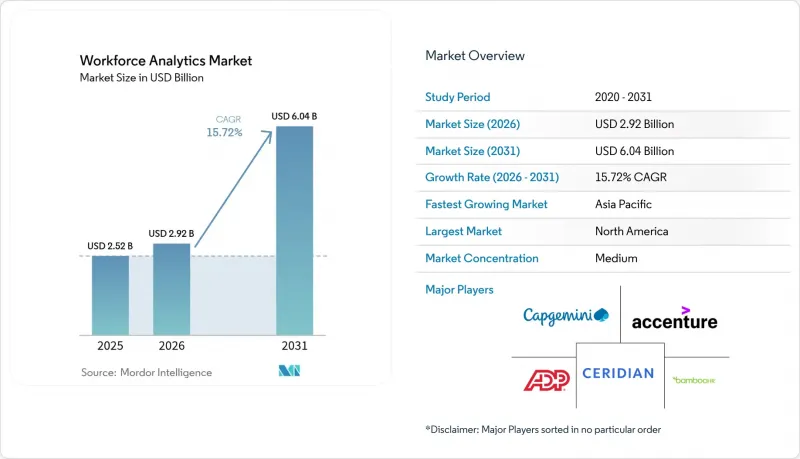
Mordor Intelligence에 의하면, 2026년 인력 분석 시장 규모는 29억 2,000만 달러로 추정되고, 2025년 25억 2,000만 달러에서 확대해, 2031년에는 60억 4,000만 달러에 이를 것으로 예측됩니다.
2026-2031년 연평균 성장률(CAGR)은 15.72%가 될 것으로 전망됩니다.
본 보고서는 구성 요소별(솔루션, 서비스), 배포 유형별(클라우드, 온프레미스), 조직 규모별(대기업, 중소기업), 최종 사용자 산업별(은행, 금융서비스 및 보험(BFSI), 제조업, IT 및 통신, 의료, 소매, 정부 기관, 에너지·유틸리티 등), 지역별로 분류되어 있습니다. 시장 전망은 금액(달러) 기준으로 제시됩니다.
세계의 인력 분석 시장 동향 및 인사이트
AI를 활용한 예측 분석이 인재 관리 의사결정을 혁신
기업 내 머신러닝 모델 도입을 통해 인사 부서는 인재 부족을 예측하고, 배치를 최적화하며, 이직률을 개선할 수 있게 됩니다. 존슨앤드존슨의 AI 스킬 추론 프레임워크는 분류 체계 구축과 수동적 평가를 통해 학습 내용의 일관성과 채용 정확도를 향상시켰습니다. 제조업에서는 그 시급성이 두드러집니다. 공장의 42%가 5년 이내에 AI/ML 활용을 확대할 계획이며, 50%는 내년도 중에 품질 관리용 AI를 도입할 예정입니다. 관리직의 역할도 변화하고 있으며, 70%가 인재 변혁을 실적에 있어 매우 중요하게 여기고 있습니다. 이러한 요인들이 복합적으로 작용하여 인력 분석 시장 전체에서 기업 수요를 자극하고 있습니다.
클라우드 HCM 통합이 데이터 확산과 분석 도입을 촉진
Oracle Fusion HCM Analytics나 SAP SuccessFactors Workforce Analytics와 같은 클라우드 HCM 제품군은 인력 구성, 보상, 역량에 관한 실시간 지표를 제공하여 인사 담당자가 인재의 역량을 비즈니스 목표에 부합시킬 수 있도록 지원합니다. ‘One Model’과 같은 통합 플랫폼은 여러 HCM 소스의 데이터를 표준화하고, 이직률이나 임금 격차에 대한 예측 인사이트를 통해 데이터를 보강합니다. 지방자치단체의 도입 사례는 그 규모를 여실히 보여주고 있습니다. 예를 들어, 로스앤젤레스시는 5만 명의 직원을 대상으로 Workday를 도입하여 AI가 이력서 심사 및 기술 태그 지정을 지원하고 있습니다. 이처럼 클라우드의 보급으로 인해 인력 분석 시장 전반에서 활용 사례가 빠르게 증가하고 있습니다.
데이터 개인정보 보호 및 규제 준수의 복잡성이 시장 성장을 제약
2024년 8월에 시행되는 EU AI법은 많은 인사 AI 용도를 ‘고위험’으로 지정하고, 위험 평가와 투명성을 요구하고 있습니다. 기업들이 대규모 언어 모델을 통합함에 따라 GDPR(EU 개인정보보호규정) 의무는 더욱 엄격해졌으며, 설명 가능한 AI와 ‘프라이버시 바이 디자인’ 워크플로가 의무화되었습니다. 북미에서는 CCPA 및 각 주의 AI 관련 법안으로 인해 인사 담당자의 42%가 규정 준수에 대한 우려를 품고 있습니다. 이러한 중복된 규제 요건은 의사 결정 주기를 지연시키고, 인력 분석 시장의 총 소유 비용(TCO)을 상승시키고 있습니다.
부문 분석
2025년, 인력 분석 시장의 64.92%를 솔루션이 차지했으며, 이는 예측 알고리즘을 통합한 종합적인 플랫폼에 대한 광범위한 수요를 반영합니다. 기업들이 기술 격차를 해소함에 따라, 인재 확보 및 육성 최적화 솔루션은 강력한 성장세를 보이고 있습니다. 헌팅턴 잉걸스 인더스트리즈(Huntington Ingalls Industries)는 AI 기반 도구를 도입한 결과 채용 속도가 25% 향상되고 이직률이 30% 감소했다고 보고했습니다. 엘 카미노 헬스(El Camino Health)가 간호사(RN) 이직률을 7포인트 낮추고 연간 84만 달러의 비용 절감을 달성함에 따라, 성과 및 참여도 분석 분야도 확대되고 있습니다. 서비스 부문은 규모는 작지만, 기업들이 도입 지원, 관리형 서비스 및 교육 지원을 확보함에 따라 연평균 성장률(CAGR) 16.74%로 성장을 지속하고, 있습니다. 프로페셔널 서비스는 복잡한 데이터 마이그레이션을 지원하며, 매니지드 서비스를 통해 인사 팀은 전략 수립에 집중할 수 있게 됩니다. Visier사의 ‘Vee’와 같은 생성형 AI 어시스턴트의 도입은 경쟁사와의 차별화를 명확히 하고 솔루션의 성장을 지속시킵니다.
교육 및 지원에 대한 관심이 높아지고 있습니다. 제조업체의 31%가 분석 이니셔티브를 실현하기 위해 기술 향상의 필요성을 꼽고 있습니다. 학습 모듈과 변경 관리 모듈을 결합한 서비스를 제공하는 업체들은 이를 통해 인력 분석 시장 내 점유율을 확대되고 있습니다.
클라우드 플랫폼은 2025년에 58.62%의 점유율을 차지했으며, 조직들이 초기 비용 절감과 원활한 업그레이드를 추구하는 가운데 연평균 성장률(CAGR) 15.86%를 나타낼 것으로 예측됩니다. ‘One Model’은 Workday나 SAP SuccessFactors의 데이터를 분석 대응 프레임워크로 추상화함으로써 그 가치를 입증하고 있습니다. 로스앤젤레스 등 대규모 공공 부문 고객들은 클라우드 스택 상에서 수만 명의 직원을 관리할 때 그 규모와 보안을 입증하고 있습니다.
데이터 주권이 요구되는 분야, 특히 금융 및 보험·증권(BFSI) 및 국방 분야에서는 온프레미스 방식이 여전히 중요성을 유지하고 있습니다. 하이브리드 배포는 기밀 데이터를 로컬에 저장하면서 분석 처리는 클라우드에서 실행하는 타협안으로 부상하고 있습니다. 각 벤더사는 암호화 및 접근 권한 모델을 강화하고 있으며, SAP와 Oracle은 모두 역할 기반 제어 기능과 규정 준수 인증 기능을 추가하고 있습니다. 따라서 인력 분석 시장은 온프레미스 모델을 포기하지 않으면서도 결정적으로 클라우드로 기울고 있습니다.
지역별 분석
북미는 2025년 인력 분석 시장의 25.45%를 차지했습니다. 이는 세분화된 인력 지표를 의무화하는 SEC(미국 증권거래위원회)의 공시 요건에 힘입은 결과입니다. 로스앤젤레스시는 Workday의 AI 기능을 활용하여 5만 명의 직원 채용 및 급여 계산을 자동화하고 처리 시간을 대폭 단축함으로써 높은 성숙도를 보여주고 있습니다. 캐나다는 공공 부문의 디지털화를, 멕시코는 니어쇼어링을 활용하여 제조업 인사 프로그램에 분석 기능을 통합하고 있습니다.
아시아태평양은 2031년까지 연평균 성장률(CAGR) 16.05%로 가장 높은 성장률을 보이고 있습니다. 인도의 타타 스틸 칼링가나갈 공장에서는 130명의 직원에게 분석 기술을 교육시켜 작업 성공률을 60%에서 90%로 높임으로써 연간 400만 달러의 비용 절감을 실현했습니다. 중국은 자동화와 직원의 재교육을 연계하기 위해 적극적으로 투자하고 있는 반면, 일본과 한국은 분석을 활용하여 고령화되는 노동력에 대한 대응책을 마련하고 있습니다. 호주 및 뉴질랜드에서는 비대도시권에서 2년 이상 근무하는 의료 종사자가 고작 41%에 그치는 상황에 대응하여, 애널리틱스를 활용하여 인재의 정착을 도모하고 있습니다.
유럽에서는 투명성이 높은 알고리즘과 인간의 감독을 의무화하는 GDPR(EU 개인정보보호규정) 및 AI 법의 뒷받침을 받아 꾸준한 성장을 이루고 있습니다. 독일, 영국, 프랑스에서는 대규모 도입이 진행되고 있으며, 프랑스의 스타트업 기업들은 Visier와 Le Lab RH의 협력을 통해 혜택을 보고 있습니다. 네덜란드에서는 다국적 기업들 사이에서 꾸준한 도입이 진행되고 있는 반면, 남유럽에서는 분석 인력공급이 제한적이어서 도입이 지연되고 있습니다. 중동 및 아프리카는 초기 단계의 기회를 내포하고 있습니다. UAE와 사우디아라비아는 애널리틱스를 ‘비전 2030’ 프로그램에 포함시켰으며, 남아프리카공화국에서는 기술 매핑에 초점을 맞춘 공공 부문 시범 사업이 시작되었습니다.
기타 혜택 :
- 엑셀 형식 시장 예측(ME) 시트
- 3개월간의 애널리스트 지원
자주 묻는 질문
목차
제1장 서론
제2장 조사 방법
제3장 주요 요약
제4장 시장 구도
제5장 시장 규모 및 성장 예측
제6장 경쟁 구도
제7장 시장 기회 및 향후 전망
AJY 26.09.09According to Mordor Intelligence, the workforce analytics market size in 2026 is estimated at USD 2.92 billion, growing from 2025 value of USD 2.52 billion with 2031 projections showing USD 6.04 billion, growing at 15.72% CAGR over 2026-2031.
This report is Segmented by Component (Solutions, Services), Deployment Type (Cloud, On-Premises), Organization Size (Large Enterprises, Smes), End-User Industry (BFSI, Manufacturing, IT and Telecom, Healthcare, Retail, Government, Energy and Utilities and More), and by Geography. The Market Forecasts are Provided in Terms of Value (USD)
Global Workforce Analytics Market Trends and Insights
AI-Powered Predictive Analytics Transforms Workforce Decision-Making
Enterprise adoption of machine-learning models allows HR teams to predict talent gaps, refine allocation, and lift retention. Johnson & Johnson's AI skills-inference framework, which builds taxonomies and passive assessments, improved learning alignment and hiring accuracy. Manufacturing illustrates urgency: 42% of plants plan to raise AI/ML use within five years, with 50% deploying quality-control AI in the coming year. Managers shift roles as 70% view workforce transformation as critical to performance. These factors collectively stimulate enterprise demand across the workforce analytics market.
Cloud HCM Integration Drives Data Proliferation and Analytics Adoption
Cloud HCM suites such as Oracle Fusion HCM Analytics and SAP SuccessFactors Workforce Analytics offer real-time metrics on composition, compensation, and skills, empowering HR leaders to match capabilities to business goal. Integration platforms like One Model standardize data from multiple HCM sources and enrich it with predictive insights on attrition and pay equity. Municipal deployments highlight scale: the City of Los Angeles runs Workday for 50,000 staff, with AI guiding resume screening and skill tagging. Cloud ubiquity therefore accelerates use-case volume across the workforce analytics market.
Data Privacy and Regulatory Compliance Complexity Constrains Market Growth
The EU AI Act, effective August 2024, designates many HR-AI applications high-risk, demanding risk assessments and transparency. GDPR obligations deepen as firms integrate large language models, mandating explainable AI and privacy-by-design workflows. In North America, CCPA and state AI laws leave 42% of HR managers uncertain about compliance. These overlapping mandates slow decision cycles and elevate total cost of ownership for the workforce analytics market.
Other drivers and restraints analyzed in the detailed report include:
- Skills-Based Talent Marketplace Evolution Requires Advanced Capability Mapping
- Economic Uncertainty Accelerates Workforce Cost Optimization Strategies
- High Implementation Costs and Change Management Complexity Limit Adoption
For complete list of drivers and restraints, kindly check the Table Of Contents.
Segment Analysis
Solutions represented 64.92% of the workforce analytics market in 2025, reflecting pervasive demand for comprehensive platforms that embed predictive algorithms. Talent acquisition and development optimization solutions enjoy strong momentum as enterprises fill skills gaps; Huntington Ingalls Industries recorded 25% faster hiring and 30% higher retention by deploying AI-native tools. Performance and engagement analytics also expand as El Camino Health reduced RN turnover by 7 points, saving USD 840,000 annually. Services, although smaller, post 16.74% CAGR as firms secure implementation, managed-service, and training support. Professional services guide complex data migrations, while managed services allow HR teams to focus on strategy. The introduction of generative AI assistants such as Visier's "Vee" sharpens competitive differentiation and sustains solution growth.
Training and support fetch mounting interest: 31% of manufacturers cite upskilling needs to realize analytics initiatives. Providers that bundle learning and change-management modules thereby capture incremental share within the workforce analytics market.
Cloud platforms held 58.62% share in 2025 and will grow at 15.86% CAGR as organizations chase lower upfront costs and seamless upgrades. One Model proves value by abstracting data from Workday and SAP SuccessFactors into analytics-ready frameworks. Large public-sector clients such as Los Angeles showcase scale and security when managing tens of thousands of employees on cloud stacks.
On-premises retains relevance where data sovereignty dictates, especially in BFSI and defense. Hybrid deployment emerges as a compromise, storing sensitive data locally while running analytics compute in the cloud. Vendors strengthen encryption and permission models: SAP and Oracle both add role-based controls and compliance attestations. The workforce analytics market therefore skewers decisively toward cloud without abandoning localized models.
Complete Report Scope:
- By Component Type
- Solutions
- Talent Acquisition and Development Optimization
- Payroll and Workforce Monitoring
- Performance and Engagement Analytics
- Turnover and Retention Analytics
- Risk and Compliance Analytics
- Services
- Professional Services
- Managed Services
- Training and Support Services
- Solutions
- By Deployment Type
- Cloud
- On-premises
- By Organization Size
- Large Enterprises
- Small and Medium-sized Enterprises (SMEs)
- By End-user Industry
- Banking, Financial Services and Insurance (BFSI)
- Manufacturing
- IT and Telecom
- Healthcare and Life Sciences
- Retail and e-Commerce
- Government and Public Sector
- Energy and Utilities
- Transportation and Logistics
- Other Industries
- By Geography
- North America
- United States
- Canada
- Mexico
- South America
- Brazil
- Argentina
- Rest of South America
- Europe
- Germany
- United Kingdom
- France
- Netherlands
- Rest of Europe
- Asia_Pacific
- China
- Japan
- India
- South Korea
- Australia and New Zealand
- Rest of Asia-Pacific
- Middle East and Africa
- Middle East
- United Arab Emirates
- Saudi Arabia
- Turkey
- Rest of Middle East
- Africa
- South Africa
- Nigeria
- Rest of Africa
- Middle East
- North America
Geography Analysis
North America held 25.45% of the workforce analytics market in 2025, supported by SEC disclosure mandates that push granular workforce metrics. The City of Los Angeles demonstrates advanced maturity by automating hiring and payroll for 50,000 staff through Workday's AI features, lowering processing times materially. Canada capitalizes on public-sector digitization, while Mexico rides near-shoring to embed analytics in manufacturing HR programs.
Asia-Pacific shows the fastest 16.05% CAGR through 2031. India's Tata Steel Kalinganagar plant saved USD 4 million annually by training 130 staff in analytics and boosting strike rates from 60% to 90%. China invests aggressively to align automation and worker reskilling, while Japan and South Korea blend analytics with aging-workforce strategies. Australia and New Zealand apply analytics to retain healthcare professionals, where only 41% stay more than two years in non-metro areas.
Europe grows steadily on the back of GDPR and the AI Act, which both demand transparent algorithms and human oversight. Germany, the United Kingdom, and France implement at scale, with French start-ups benefiting from Visier and Le Lab RH collaboration. The Netherlands sees robust adoption among multinationals, whereas Southern Europe lags because of limited analytics talent supply. Middle East and Africa constitute early-stage opportunities: UAE and Saudi Arabia weave analytics into Vision 2030 programs, and South Africa begins public-sector pilots focused on skills mapping.
- Accenture plc
- ADP, Inc.
- BambooHR LLC
- Capgemini SE
- Ceridian HCM Holding Inc.
- ChartHop, Inc.
- Cisco Systems, Inc.
- CultureAmp Pty Ltd
- Darwinbox Digital Solutions Pvt. Ltd.
- Eightfold AI, Inc.
- Gusto, Inc.
- IBM Corporation
- Infor, Inc.
- Kronos-UKG, Inc.
- Lattice, Inc.
- Microsoft Corp. (Viva Insights)
- Namely, Inc.
- Oracle Corporation
- Peoplestreme Pty Ltd (Ascender)
- SAP SE
- Skillsoft Corp. (SumTotal Systems)
- Tableau Software LLC
- Visier, Inc.
- Workday, Inc.
- Zoho Corporation (Zoho People Analytics)
Additional Benefits:
- The market estimate (ME) sheet in Excel format
- 3 months of analyst support
TABLE OF CONTENTS
1 INTRODUCTION
- 1.1 Study Assumptions and Market Definition
- 1.2 Scope of the Study
2 RESEARCH METHODOLOGY
3 EXECUTIVE SUMMARY
4 MARKET LANDSCAPE
- 4.1 Market Overview
- 4.2 Market Drivers
- 4.2.1 Growing need for data-driven talent decisions in hybrid workplaces
- 4.2.2 Proliferation of HR data from cloud HCM suites
- 4.2.3 Adoption of AI/ML for predictive people analytics
- 4.2.4 Workforce cost-optimization amid economic uncertainty
- 4.2.5 Shift to skills-based talent marketplaces requiring capability mapping
- 4.2.6 ESG and diversity-reporting mandates accelerating analytics roll-outs
- 4.3 Market Restraints
- 4.3.1 Data-privacy and compliance complexity (GDPR, CCPA, AI Acts)
- 4.3.2 High implementation cost and change-management burden
- 4.3.3 Algorithmic-bias and ethics concerns in AI-driven analytics
- 4.3.4 Fragmented data silos in gig/flexible-work ecosystems
- 4.4 Supply-Chain Analysis
- 4.5 Regulatory Landscape
- 4.6 Technological Outlook
- 4.7 Porter's Five Forces
- 4.7.1 Threat of New Entrants
- 4.7.2 Bargaining Power of Buyers
- 4.7.3 Bargaining Power of Suppliers
- 4.7.4 Threat of Substitutes
- 4.7.5 Competitive Rivalry
- 4.8 Assesment of Macroeconomic Factors on the Market
5 MARKET SIZE AND GROWTH FORECASTS (VALUE)
- 5.1 By Component Type
- 5.1.1 Solutions
- 5.1.1.1 Talent Acquisition and Development Optimization
- 5.1.1.2 Payroll and Workforce Monitoring
- 5.1.1.3 Performance and Engagement Analytics
- 5.1.1.4 Turnover and Retention Analytics
- 5.1.1.5 Risk and Compliance Analytics
- 5.1.2 Services
- 5.1.2.1 Professional Services
- 5.1.2.2 Managed Services
- 5.1.2.3 Training and Support Services
- 5.1.1 Solutions
- 5.2 By Deployment Type
- 5.2.1 Cloud
- 5.2.2 On-premises
- 5.3 By Organization Size
- 5.3.1 Large Enterprises
- 5.3.2 Small and Medium-sized Enterprises (SMEs)
- 5.4 By End-user Industry
- 5.4.1 Banking, Financial Services and Insurance (BFSI)
- 5.4.2 Manufacturing
- 5.4.3 IT and Telecom
- 5.4.4 Healthcare and Life Sciences
- 5.4.5 Retail and e-Commerce
- 5.4.6 Government and Public Sector
- 5.4.7 Energy and Utilities
- 5.4.8 Transportation and Logistics
- 5.4.9 Other Industries
- 5.5 By Geography
- 5.5.1 North America
- 5.5.1.1 United States
- 5.5.1.2 Canada
- 5.5.1.3 Mexico
- 5.5.2 South America
- 5.5.2.1 Brazil
- 5.5.2.2 Argentina
- 5.5.2.3 Rest of South America
- 5.5.3 Europe
- 5.5.3.1 Germany
- 5.5.3.2 United Kingdom
- 5.5.3.3 France
- 5.5.3.4 Netherlands
- 5.5.3.5 Rest of Europe
- 5.5.4 Asia_Pacific
- 5.5.4.1 China
- 5.5.4.2 Japan
- 5.5.4.3 India
- 5.5.4.4 South Korea
- 5.5.4.5 Australia and New Zealand
- 5.5.4.6 Rest of Asia-Pacific
- 5.5.5 Middle East and Africa
- 5.5.5.1 Middle East
- 5.5.5.1.1 United Arab Emirates
- 5.5.5.1.2 Saudi Arabia
- 5.5.5.1.3 Turkey
- 5.5.5.1.4 Rest of Middle East
- 5.5.5.2 Africa
- 5.5.5.2.1 South Africa
- 5.5.5.2.2 Nigeria
- 5.5.5.2.3 Rest of Africa
- 5.5.5.1 Middle East
- 5.5.1 North America
6 COMPETITIVE LANDSCAPE
- 6.1 Market Concentration
- 6.2 Strategic Moves
- 6.3 Market Share Analysis
- 6.4 Company Profiles (includes Global-level Overview, Market-level Overview, Core Segments, Financials as available, Strategic Information, Market Rank/Share for key companies, Products and Services, Recent Developments)
- 6.4.1 Accenture plc
- 6.4.2 ADP, Inc.
- 6.4.3 BambooHR LLC
- 6.4.4 Capgemini SE
- 6.4.5 Ceridian HCM Holding Inc.
- 6.4.6 ChartHop, Inc.
- 6.4.7 Cisco Systems, Inc.
- 6.4.8 CultureAmp Pty Ltd
- 6.4.9 Darwinbox Digital Solutions Pvt. Ltd.
- 6.4.10 Eightfold AI, Inc.
- 6.4.11 Gusto, Inc.
- 6.4.12 IBM Corporation
- 6.4.13 Infor, Inc.
- 6.4.14 Kronos-UKG, Inc.
- 6.4.15 Lattice, Inc.
- 6.4.16 Microsoft Corp. (Viva Insights)
- 6.4.17 Namely, Inc.
- 6.4.18 Oracle Corporation
- 6.4.19 Peoplestreme Pty Ltd (Ascender)
- 6.4.20 SAP SE
- 6.4.21 Skillsoft Corp. (SumTotal Systems)
- 6.4.22 Tableau Software LLC
- 6.4.23 Visier, Inc.
- 6.4.24 Workday, Inc.
- 6.4.25 Zoho Corporation (Zoho People Analytics)
7 MARKET OPPORTUNITIES AND FUTURE OUTLOOK
- 7.1 White-space and Unmet-need Assessment