

|
시장보고서
상품코드
2122653
히알루론산 제품 시장 : 시장 점유율 분석, 업계 동향 및 통계, 성장 예측(2026-2031년)Hyaluronic Acid Products - Market Share Analysis, Industry Trends & Statistics, Growth Forecasts (2026 - 2031) |
||||||
 Mordor Intelligence
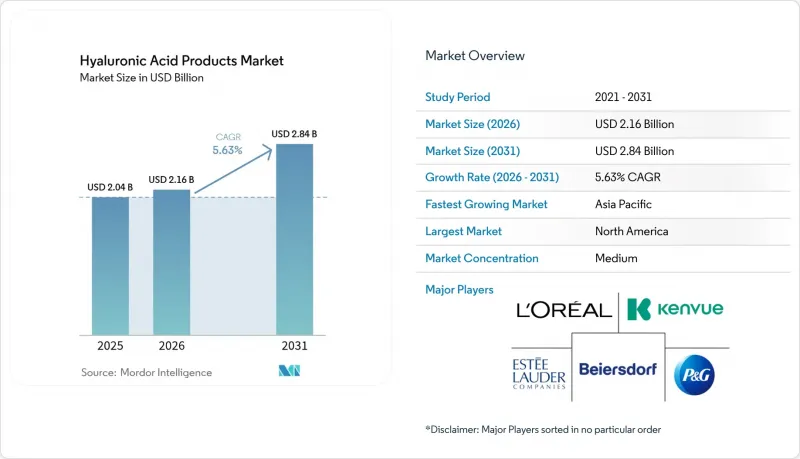
Mordor Intelligence에 의하면, 히알루론산 제품 시장 규모는 2025년 20억 4,000만 달러로 평가되었고, 2026년 21억 6,000만 달러에서 2031년까지 28억 4,000만 달러로 확대될 것으로 예측되며, 2026-2031년 연평균 복합 성장률(CAGR)은 5.63%를 나타낼 전망입니다.
본 보고서는 제품 유형별(페이셜 케어 제품, 아이 케어 제품 등), 가격대별(대중 시장용 및 프리미엄 시장용), 유통 채널별(슈퍼마켓 및 하이퍼마켓, 전문점 등), 그리고 지역별(북미, 유럽, 아시아태평양, 남미, 중동 및 아프리카)로 분류되어 있습니다. 시장 전망은 금액(달러) 기준으로 제시되어 있습니다.
세계의 히알루론산 제품 시장 동향 및 인사이트
민감성 피부 및 건조함에 대한 우려 증가
민감성 피부와 건조한 피부가 증가함에 따라 전 세계적으로 히알루론산 함유 제품에 대한 수요가 증가하고 있습니다. PubMed Central에 게재된 2024년 동남아시아 조사 결과에 따르면, 태국 소비자의 86.9%가 민감성 피부라고 응답했으며, 그중 57.5%는 중등도에서 중증의 민감성 피부라고 설명했습니다. 이러한 민감성 피부는 강력한 유효 성분의 빈번한 사용으로 인한 피부 장벽 손상으로 인해 발생하는 경우가 많으며, 그 결과 피부에 자극이 적고 보습 효과가 있는 솔루션에 대한 수요가 높아지고 있습니다. 히알루론산은 자체 무게의 최대 1,000배에 달하는 수분을 유지할 수 있고 자극이 적은 것으로 알려져 있어, 일상적인 스킨케어 및 시술 후 관리 제품에서 중요한 성분으로 자리 잡고 있습니다. 저가 브랜드부터 프리미엄 브랜드에 이르기까지, 페이셜 세럼 및 피부 장벽 복원 제품에 히알루론산의 사용이 증가하고 있는 것은 그 중요성이 커지고 있음을 보여주며, 다양한 지역과 소득 수준에 걸친 전 세계 히알루론산 제품 시장의 꾸준한 성장을 뒷받침하고 있습니다.
피부, 입술, 모발의 노화 방지, 탄력 향상, 매끄러움을 주는 효과에 대한 인지도
특히 여드름과 관련된 피부 트러블의 유병률이 높다는 점을 감안할 때, 히알루론산의 노화 방지, 탄력 증진, 피부 트러블 개선 효과에 대한 인지도가 높아지고 있습니다. 2024년, 『International Journal of Pharmaceutical and Clinical Research』지는 남성의 68.5%, 여성의 59.6%가 여드름을 경험하고 있으며, 이것이 피부 장벽 기능 손상, 염증, 건조로 이어질 가능성이 있다고 보고했습니다. 이에 따라 모공을 막거나 여드름을 악화시키지 않으면서 피부에 수분을 공급하고 매끄럽게 가꿔주는 히알루론산에 대한 수요가 높아지고 있습니다. 주사제로서의 유효성이 입증됨에 따라, 외용 제품에 대한 기대감도 높아지고 있습니다. 여드름을 고려한 에센스, 립 케어 제품, 두피 케어 제품에서 히알루론산의 사용 확대는 그 범용성을 입증하고 있습니다. 소비자들이 주름 개선에 그치지 않고 피부 회복 및 피부 질 개선과 같은 이점을 인식함에 따라, 히알루론산은 대중용 제품부터 프리미엄 미용 제품에 이르기까지 주요 성분으로 자리 잡고 있습니다.
프리미엄 제품 및 고분자량 히알루론산 제품에 수반되는 높은 배합 및 시험 비용
복잡한 제형 공정과 엄격한 규제 시험 요건이 전 세계 히알루론산 제품 시장, 특히 프리미엄 및 고분자량 제품의 성장을 둔화시키고 있습니다. 국제표준화기구(ISO) 22716의 우수 제조 기준(GMP)을 충족하기 위해 제조업체는 고도의 정제 기술, 분자량 프로파일링 및 내독소 관리에 투자해야 합니다. 이러한 공정은 개발 기간과 비용을 크게 증가시킵니다. 가교형이나 고성능 제품의 경우 철저한 안전성 및 성능 검증이 필요하며, 많은 경우 제3자 기관에 의한 임상시험이 수반됩니다. 이로 인해 추가적인 재정적 및 운영상의 부담이 발생합니다. 이러한 과제는 신규 시장 진출기업에게 큰 장벽이 되어, 소규모 기업이 경쟁하기 어렵게 만듭니다. 대기업은 장기적으로 규모의 경제나 외주화의 혜택을 누릴 수 있겠지만, 단기적인 수익성에 미치는 영향은 여전히 업계의 우려 사항으로 남아 있습니다.
부문 분석
2025년, 히알루론산 제품 시장을 주도한 것은 페이셜 케어 제품으로, 전체 시장의 81.47% 점유율을 차지했습니다. 이 압도적인 점유율은 보습, 안티에이징, 피부 장벽 기능 회복과 같은 주요 과제를 해결하는 에센스, 보습제, 마스크, 세안제 등의 제품에 히알루론산이 널리 사용되고 있기 때문입니다. 매일 높은 사용 빈도, 피부과 전문의의 강력한 추천, 그리고 다양한 분자량 배합에 대한 지속적인 발전 덕분에 페이셜 케어는 가장 중요한 부문으로서의 입지를 확고히 하고 있습니다. 대중 브랜드와 프리미엄 브랜드 모두 소비자의 요구에 부응하기 위해 이 분야에서 혁신을 이어가고 있습니다.
헤어케어 제품은 히알루론산 제품 시장에서 가장 빠르게 성장하는 부문으로, 2031년까지 연평균 성장률(CAGR)이 6.14%를 나타낼 것으로 예측됩니다. 이러한 성장은 두피 건강, 보습, 곱슬머리 관리에 대한 소비자의 관심이 높아진 데 힘입은 것으로, 특히 샴푸, 컨디셔너, 두피 세럼, 린스형 트리트먼트 등의 제품을 통해 두드러지게 나타나고 있습니다. 스킨케어 원리를 헤어케어에 접목하는 추세와 프리미엄 두피 관리 제품의 확충이 시장 확대를 뒷받침하고 있습니다. 또한, 페이셜 케어에 비해 헤어케어 제품 시장 침투율이 상대적으로 낮기 때문에 향후 몇 년 동안 큰 성장 기회가 있을 것으로 전망됩니다.
지역별 분석
북미는 계속해서 히알루론산 제품 시장을 주도하고 있으며, 2025년에는 시장 점유율의 41.25%를 차지한 것으로 평가되었습니다. 이러한 우위는 스킨케어 및 미용 솔루션에 대한 소비자의 높은 인식과 더불어, 퍼스널케어 제품에 대한 막대한 지출에 힘입은 것입니다. 이 지역은 확립된 클리닉 네트워크와 선진적인 D2C(소비자 직접 판매) 채널의 혜택을 받고 있으며, 이러한 요소들이 프리미엄 제품의 보급을 뒷받침하고 있습니다. 또한, 대형 유통점 및 온라인 플랫폼을 통해 일반 소비자를 위한 제품을 널리 구할 수 있어 폭넓은 소비자층에 도달할 가능성이 있습니다.
아시아태평양은 2031년까지 연평균 성장률(CAGR)이 6.53%를 나타낼 것으로 예측되어, 가장 빠른 성장을 이룰 지역이 될 것으로 전망됩니다. 이 지역의 성장은 미용 및 퍼스널케어 제품 처방의 급속한 발전과 더불어, 화장품 및 웰니스 제품에서 히알루론산 사용이 확대됨에 따라 견인되고 있습니다. 이 지역의 주요 제조 거점 또한 활발한 수출 활동을 주도하고 있습니다. 또한 중국과 인도 등 주요 경제국의 가처분 소득 증가와 디지털 상거래의 인기가 높아지면서 대중 시장 제품과 프리미엄 제품 모두에 대한 수요가 증가하고 있습니다.
유럽, 남미, 중동 및 아프리카를 포함한 기타 지역도 꾸준한 시장 성장에 기여하고 있습니다. 유럽 시장은 제품 개발 및 출시 일정에 영향을 미치는 엄격한 규제 요건이 특징입니다. 남미에서는 합리적인 가격의 화장품에 대한 수요가 높으며, 중동 및 아프리카에서는 기후 관련 요구와 도시 지역의 소매 네트워크 확장으로 인해 스킨케어 제품에 대한 관심이 높아지고 있습니다. 이러한 지역들은 시장의 세계 기업과 지역 기업 모두에게 성장 기회를 제공합니다.
기타 혜택 :
- 엑셀 형식 시장 예측(ME) 시트
- 3개월간의 애널리스트 지원
자주 묻는 질문
목차
제1장 서론
제2장 조사 방법
제3장 주요 요약
제4장 시장 구도
제5장 시장 규모 및 성장 예측
제6장 경쟁 구도
제7장 시장 기회 및 향후 전망
AJY 26.09.09According to Mordor Intelligence, the hyaluronic acid products market size is projected to expand from USD 2.04 billion in 2025 and USD 2.16 billion in 2026 to USD 2.84 billion by 2031, registering a 5.63% CAGR between 2026 and 2031.

This report is Segmented by Product Type (Facial Care Products, Eye Care Products, and More), Price Range (Mass and Premium), Distribution Channel (Supermarkets/Hypermarkets, Specialty Stores, and More), and Geography (North America, Europe, Asia-Pacific, South America, Middle East, and Africa). The Market Forecasts are Provided in Terms of Value (USD).
Global Hyaluronic Acid Products Market Trends and Insights
Rising prevalence of sensitive skin and dryness-related concerns
The rising prevalence of sensitive, dry skin is driving global demand for hyaluronic acid-based products. A 2024 study in Southeast Asia found that 86.9% of Thai consumers reported having sensitive skin, with 57.5% describing it as moderate to severe, according to a study published in PubMed Central. This sensitivity is often caused by damage to the skin barrier from frequent use of strong active ingredients, leading to a need for gentle, hydrating solutions. Hyaluronic acid, known for holding up to 1,000 times its weight in water and being non-irritating, has become a key ingredient in daily skincare and post-procedure products. Its increasing use in facial serums and barrier repair products across both affordable and premium brands shows its growing importance and supports the steady growth of the global hyaluronic acid products market across different regions and income levels.
Awareness of anti-aging, plumping, and smoothing benefits across skin, lips, and hair
Awareness of hyaluronic acid's anti-aging, plumping, and smoothing benefits is growing, especially given the high prevalence of acne-related skin issues. In 2024, the International Journal of Pharmaceutical and Clinical Research reported that 68.5% of males and 59.6% of females experience acne, which can lead to barrier damage, inflammation, and dehydration. This has increased the demand for hyaluronic acid, which hydrates and smooths the skin without clogging pores or worsening breakouts. Its proven effectiveness in injectable treatments has raised expectations for topical products. The growing use of hyaluronic acid in acne-friendly serums, lip care products, and scalp treatments underscores its versatility. As consumers recognize its benefits beyond wrinkle reduction, such as skin recovery and texture improvement, hyaluronic acid is becoming a key ingredient in both mass and premium beauty products.
Higher formulation and testing costs associated with premium or multi-molecular-weight hyaluronic acid variants
Complex formulation processes and stringent regulatory testing requirements are slowing the growth of the global hyaluronic acid products market, particularly for premium and multi-molecular-weight variants. To meet the International Organization for Standardization (ISO) 22716 Good Manufacturing Practice standards, manufacturers must invest in advanced purification techniques, molecular weight profiling, and endotoxin control. These processes significantly increase development time and costs. Cross-linked and high-performance variants require thorough safety and performance validation, often involving third-party clinical testing, which adds further financial and operational burdens. These challenges create significant barriers for new entrants, making it difficult for smaller players to compete. While larger companies may benefit from economies of scale and outsourcing in the long term, the short-term impact on profitability remains a concern for the industry.
Other drivers and restraints analyzed in the detailed report include:
- Preference for ingredient-led and science-backed beauty formulations
- Growth of men's grooming and unisex beauty categories
- Consumer skepticism around exaggerated or unclear efficacy claims
For complete list of drivers and restraints, kindly check the Table Of Contents.
Segment Analysis
Facial care products led the hyaluronic acid products market in 2025, capturing 81.47% of the total market share. This dominance is due to the widespread use of hyaluronic acid in products like serums, moisturizers, masks, and cleansers, which address key concerns such as hydration, anti-aging, and skin barrier repair. The high frequency of daily use, strong recommendations from dermatologists, and ongoing advancements in multi-molecular weight formulations have solidified facial care as the most significant segment. Both mass-market and premium brands continue to innovate in this space to meet consumer demands.
Hair care products are the fastest-growing segment in the hyaluronic acid products market, with a projected CAGR of 6.14% through 2031. This growth is fueled by rising consumer interest in scalp health, moisture retention, and frizz management, particularly through products such as shampoos, conditioners, scalp serums, and leave-in treatments. The trend of incorporating skincare principles into hair care, along with the expansion of premium scalp care offerings, is driving adoption. Additionally, the relatively lower market penetration of hair care products compared to facial care suggests significant growth opportunities in the coming years.
Complete Report Scope:
- By Product Type
- Facial Care Products
- Face Serums
- Cleansers
- Others
- Eye Care Products
- Lip Care Products
- Hair Care Products
- Shampoo
- Conditioner
- Others
- Other Product Types
- Facial Care Products
- By Price Range
- Mass
- Premium
- By Distribution Channel
- Supermarkets/Hypermarkets
- Specialty Stores
- Online Retail Stores
- Other Channels
- By Geography
- North America
- United States
- Canada
- Mexico
- Rest of North America
- South America
- Brazil
- Argentina
- Rest of South America
- Europe
- United Kingdom
- Germany
- Spain
- France
- Italy
- Netherlands
- Rest of Europe
- Asia-Pacific
- China
- Japan
- India
- Australia
- South Korea
- Rest of Asia-Pacific
- Middle East and Africa
- South Africa
- Saudi Arabia
- United Arab Emirates
- Rest of Middle East and Africa
- North America
Geography Analysis
North America continues to lead the hyaluronic acid products market, holding 41.25% of the market share in 2025. This dominance is driven by high consumer awareness of skincare and aesthetic solutions, as well as significant spending on personal care products. The region benefits from a well-established network of clinics and advanced direct-to-consumer channels, which support the adoption of premium products. Additionally, mass-market offerings remain widely accessible through organized retail stores and online platforms, ensuring a broad consumer reach.
Asia-Pacific is expected to be the fastest-growing region, with a projected CAGR of 6.53% through 2031. The region's growth is fueled by rapid advancements in beauty and personal care formulations, as well as the increasing use of hyaluronic acid in cosmetics and wellness products. Key manufacturing hubs in the region also drive strong export activity. Furthermore, rising disposable incomes and the growing popularity of digital commerce in major economies like China and India are boosting demand for both mass-market and premium products.
Other regions, including Europe, South America, and the Middle East and Africa, contribute to steady market growth. Europe's market is shaped by strict regulatory requirements, which influence product development and launch timelines. In South America, there is a strong demand for affordable cosmetic applications, while the Middle East and Africa see growing interest in skincare products due to climate-related needs and expanding urban retail networks. These regions collectively offer growth opportunities for both global and regional players in the market.
- Kenvue Inc.
- Procter & Gamble Company
- L'Oreal S.A.
- Beiersdorf AG
- The Estee Lauder Companies
- Shiseido Company
- Unilever plc
- Coty Inc.
- Henkel AG
- Kose Corporation
- Amorepacific Corporation
- Anveya Living Private Limited
- Lifevision Skincare
- Bloomage Biotech
- Bioderma (NAOS)
- Pixi Beauty
- Rohto Pharmaceutical
- Re'equil India Private Limited
- Medik8
- High Nature Co., Ltd.
Additional Benefits:
- The market estimate (ME) sheet in Excel format
- 3 months of analyst support
TABLE OF CONTENTS
1 INTRODUCTION
- 1.1 Study Assumptions and Market Definition
- 1.2 Scope of the Study
2 RESEARCH METHODOLOGY
3 EXECUTIVE SUMMARY
4 MARKET LANDSCAPE
- 4.1 Market Overview
- 4.2 Market Drivers
- 4.2.1 Rising prevalence of sensitive skin and dryness-related concerns
- 4.2.2 Awareness of anti-aging, plumping, and smoothing benefits across skin, lips, and hair
- 4.2.3 Growing exposure to harsh environmental conditions
- 4.2.4 Preference for ingredient-led and science-backed beauty formulations
- 4.2.5 Expansion of premium, dermatologist-recommended, and salon-inspired product lines
- 4.2.6 Growth of men's grooming and unisex beauty categories
- 4.3 Market Restraints
- 4.3.1 Higher formulation and testing costs associated with premium or multi-molecular-weight hyaluronic acid variants
- 4.3.2 Consumer skepticism around exaggerated or unclear efficacy claims
- 4.3.3 Price sensitivity in mass and emerging markets
- 4.3.4 Availability of alternative hydrating ingredients such as glycerin, ceramides, and panthenol
- 4.4 Consumer Behaviour Analysis
- 4.5 Regulatory Outlook
- 4.6 Porter's Five Forces
- 4.6.1 Threat of New Entrants
- 4.6.2 Bargaining Power of Buyers
- 4.6.3 Bargaining Power of Suppliers
- 4.6.4 Threat of Substitute Products
- 4.6.5 Intensity of Competitive Rivalry
5 MARKET SIZE AND GROWTH FORECASTS (VALUE)
- 5.1 By Product Type
- 5.1.1 Facial Care Products
- 5.1.1.1 Face Serums
- 5.1.1.2 Cleansers
- 5.1.1.3 Others
- 5.1.2 Eye Care Products
- 5.1.3 Lip Care Products
- 5.1.4 Hair Care Products
- 5.1.4.1 Shampoo
- 5.1.4.2 Conditioner
- 5.1.4.3 Others
- 5.1.5 Other Product Types
- 5.1.1 Facial Care Products
- 5.2 By Price Range
- 5.2.1 Mass
- 5.2.2 Premium
- 5.3 By Distribution Channel
- 5.3.1 Supermarkets/Hypermarkets
- 5.3.2 Specialty Stores
- 5.3.3 Online Retail Stores
- 5.3.4 Other Channels
- 5.4 By Geography
- 5.4.1 North America
- 5.4.1.1 United States
- 5.4.1.2 Canada
- 5.4.1.3 Mexico
- 5.4.1.4 Rest of North America
- 5.4.2 South America
- 5.4.2.1 Brazil
- 5.4.2.2 Argentina
- 5.4.2.3 Rest of South America
- 5.4.3 Europe
- 5.4.3.1 United Kingdom
- 5.4.3.2 Germany
- 5.4.3.3 Spain
- 5.4.3.4 France
- 5.4.3.5 Italy
- 5.4.3.6 Netherlands
- 5.4.3.7 Rest of Europe
- 5.4.4 Asia-Pacific
- 5.4.4.1 China
- 5.4.4.2 Japan
- 5.4.4.3 India
- 5.4.4.4 Australia
- 5.4.4.5 South Korea
- 5.4.4.6 Rest of Asia-Pacific
- 5.4.5 Middle East and Africa
- 5.4.5.1 South Africa
- 5.4.5.2 Saudi Arabia
- 5.4.5.3 United Arab Emirates
- 5.4.5.4 Rest of Middle East and Africa
- 5.4.1 North America
6 COMPETITIVE LANDSCAPE
- 6.1 Market Concentration
- 6.2 Strategic Moves
- 6.3 Market Positioning Analysis
- 6.4 Company Profiles (includes Global-level Overview, Market-level Overview, Core Segments, Financials (if available), Strategic Information, Market Rank/Share, Products and Services, Recent Developments)
- 6.4.1 Kenvue Inc.
- 6.4.2 Procter & Gamble Company
- 6.4.3 L'Oreal S.A.
- 6.4.4 Beiersdorf AG
- 6.4.5 The Estee Lauder Companies
- 6.4.6 Shiseido Company
- 6.4.7 Unilever plc
- 6.4.8 Coty Inc.
- 6.4.9 Henkel AG
- 6.4.10 Kose Corporation
- 6.4.11 Amorepacific Corporation
- 6.4.12 Anveya Living Private Limited
- 6.4.13 Lifevision Skincare
- 6.4.14 Bloomage Biotech
- 6.4.15 Bioderma (NAOS)
- 6.4.16 Pixi Beauty
- 6.4.17 Rohto Pharmaceutical
- 6.4.18 Re'equil India Private Limited
- 6.4.19 Medik8
- 6.4.20 High Nature Co., Ltd.


