|
시장보고서
상품코드
2122665
케이블 커넥터 시장 : 시장 점유율 분석, 업계 동향 및 통계, 성장 예측(2026-2031년)Cable Connector - Market Share Analysis, Industry Trends & Statistics, Growth Forecasts (2026 - 2031) |
||||||
 Mordor Intelligence
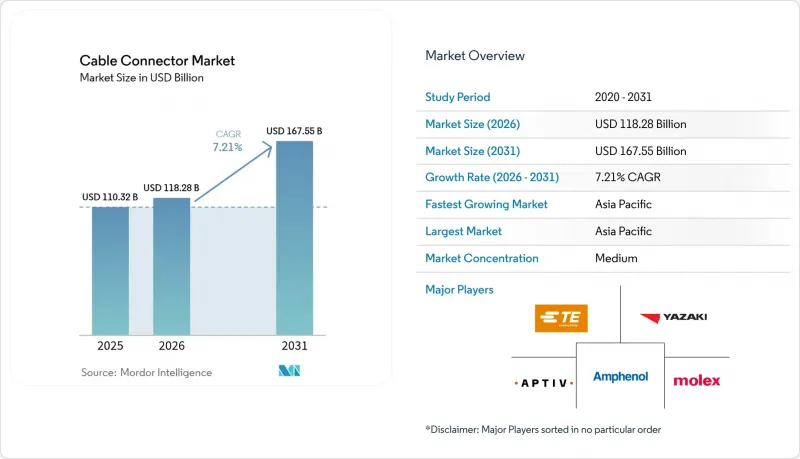
Mordor Intelligence에 의하면, 케이블 커넥터 시장 규모는 2025년 1,103억 2,000만 달러로 평가되었고, 2026년에는 1,182억 8,000만 달러로 추정되고, 2026-2031년 CAGR 7.21%로 성장을 지속할 전망이며, 2031년에는 1,675억 5,000만 달러에 이를 것으로 예측됩니다.
본 보고서는 커넥터 유형별(PCB 커넥터, 원형 및 직사각형 커넥터 등), 장착 구성별(기판 간 연결, 와이어-투-보드 등), 최종 사용자 산업별(IT 및 통신, 기타), 데이터 전송 속도 등급별(10 Gbps 이하 규격, 기타), 재질별(구리 합금, 기타), 지역별(북미, 유럽, 기타)로 분류되어 있습니다. 시장 예측은 금액(달러) 기준으로 제시되어 있습니다.
세계의 케이블 커넥터 시장 동향 및 인사이트
5G 확산 및 광 백홀의 고밀도화
세계 5G 확산에는 mm파 대역에서 신호의 무결성을 유지하면서, 실외의 가혹한 환경과 온도 변화를 견딜 수 있는 고주파 커넥터가 요구되고 있습니다. 새로운 5G 매크로 사이트 한 곳당 기존 4G 사이트에 비해 3-4배의 광섬유 회선이 통합되어 있어, 이에 따라 광 커넥터 수요가 급격히 증가하고 있습니다. 도심 지역의 스몰 셀 고밀도화는 현장에서 신속한 설치가 가능한 밀폐형 IP67/IP68 규격 준수 커넥터에 대한 수요를 더욱 부추기고 있습니다. 공장 내 사설 5G 네트워크에서는 오일 미스트, 진동, 열 사이클을 견딜 수 있는 견고한 커넥터가 요구되고 있습니다. 고밀도화가 가속화되는 가운데, 낮은 삽입 손실과 공구 없이 단말 처리가 가능한 광 커넥터 공급업체는 가격 면에서 우위를 점하고 있습니다.
전자 기기의 소형화
스마트폰, 웨어러블 기기, 산업용 센서, 의료용 패치는 더 좁은 케이스에 더 많은 기능을 통합하는 추세입니다. 0.5mm 미만의 피치 간격과 1mm 미만의 높이 프로파일이 표준 설계 규칙이 되어감에 따라, 커넥터 제조업체들은 정밀 성형, 비전 가이드 방식의 픽 앤 플레이스, 레이저 용접을 통한 차폐 기술에 대한 투자를 서둘러야 하는 상황입니다. 고성능 카메라나 VR 헤드셋에는 힌지의 반복적인 동작을 견디고 통신 단절이 발생하지 않는 핀 수가 많은 기판 간 커넥터가 요구됩니다. 산업용 IoT 도입에서도 이와 같은 소형화가 요구되지만, -40°C에서 125°C의 온도 환경을 견뎌야 합니다. 미니 LED 백라이트 및 접이식 기기의 로드맵에 부합하는 공급업체는 제품 수명 주기 전반에 걸쳐 수요를 확보할 수 있는 수년에 걸친 설계 채택을 확보하고 있습니다.
구리 및 귀금속 가격 변동
2024-2025년 구리 가격은 톤당 8,000달러에서 11,000달러 사이를 오갔고, 금 도금 가격은 전년 대비 40% 급등하여 비용에 민감한 표준 커넥터의 이익률이 압박을 받았습니다. 선택적 도금이나 합금 대체를 통해 가격 변동의 일부는 상쇄되었지만, 장기 고정 가격 계약의 경우 원자재 헤지가 시장 동향과 일치하지 않을 때 중견 공급업체는 손실을 입게 됩니다. 대형 벤더는 규모의 이점을 활용하여 변동 가격 조항을 협상하지만, 중소기업은 분기별 가격 변동을 흡수하는 데 어려움을 겪고 있습니다. 최종 사용자는 추가 요금 지불에 거부감을 보이고 있어, 비용 전가가 지연되고 현금 전환 주기가 장기화되고 있습니다.
부문 분석
커넥터 유형별로 보면, PCB용 커넥터는 소비자용, 통신용, 산업용 전자기기의 모든 분야에서 널리 채택되고 있어 2025년에도 케이블 커넥터 시장에서 24.58%의 점유율을 유지한 것으로 평가되었습니다. 이 부문의 매출액은 피치 축소 기술 혁신과 핀 밀도 향상에 힘입어 케이블 커넥터 시장 전체와 유사한 속도, 즉 한 자릿수 중반의 연평균 성장률(CAGR)을 기록했습니다. 원형 및 직사각형 커넥터는 신뢰성 인증을 통해 높은 가격 책정 및 장기 계약이 정당화됨에 따라 항공우주 및 방위 분야에서 견고한 입지를 유지했습니다. 광섬유 인터페이스는 데이터센터 및 5G 프론트홀에 대한 투자 확대에 따라 성장을 이루었습니다. 삽입 손실 저감 및 실외 내구성이 인프라 투자를 촉진하고 있습니다. I/O 및 RF 동축 설계는 테스트 장비 및 계측 기기 분야에서 단순한 생산량보다 재현성이 중시됨에 따라 틈새 시장에서의 입지를 강화했습니다. 특히 눈부신 성장을 보이고 있는 분야는 전원 및 고전압 전기차용 커넥터로, 2031년까지 연평균 성장률(CAGR)은 8.52%로 예측됩니다. 이 분야는 800V 아키텍처가 필수인 새로운 배터리 전기차 플랫폼과 초고속 충전 수요의 혜택을 받고 있으며, 케이블 커넥터 시장 내에서 가장 빠르게 성장하고 있는 분야입니다.
세계 OEM의 인증 기준에서는 아크 억제 기능, 감전 방지 하우징, 그리고 접합부 온도를 모니터링하기 위한 열전대 통합이 요구되고 있습니다. 이러한 설계 요건은 인증 공급업체의 수를 제한하는 한편, 평균 판매 가격을 끌어올리고 있습니다. 자동차용 커넥터 분야의 유서 깊은 전문 제조업체들은 캐비티 프리 오버몰딩 등의 공정 기술을 활용하여 저항 손실을 최소화하고 있는 반면, 신규 진출기업들은 인도 및 동남아시아의 이륜차 전기화를 목표로 비용 절감형 제품을 선보이고 있습니다. IEC 62196 등의 국제 표준과 지역별 충전 프로토콜을 조화시킬 수 있는 해당 부문의 선도 기업들은 다년간의 조달 계약을 확보하고 있습니다. 이러한 시너지 효과로 인해, 예측 기간 동안 전원 커넥터 부문은 케이블 커넥터 시장 규모 확대에 가장 크게 기여할 것으로 전망됩니다.
2025년에는 모바일 기기, 노트북, 첨단 운전자 보조 시스템(ADAS)의 특징인 복잡한 멀티보드 전자 아키텍처에 힘입어 기판 간(B2B) 조립이 케이블 커넥터 시장 규모의 35.62%를 차지했습니다. OEM 업체들은 낙하 시 발생하는 비틀림 응력을 견딜 수 있는 초슬림 스태킹 커넥터를 선호합니다. 와이어-투-보드(WTB) 유형은 공장 자동화 패널 등 내부 공간 제약보다 현장에서의 교체성이 우선시되는 시장에서 여전히 채택되고 있습니다. 케이블-투-케이블(CTB) 유형은 배선 경로 변경의 유연성이 가장 중요한 모듈식 로봇 팔이나 재생에너지용 컴바이너 박스에서 뛰어난 성능을 발휘합니다.
패널형 및 피드스루형 솔루션은 시장 점유율은 작지만, 엣지 컴퓨팅용 캐비닛, 실외용 5G 무선 장비, 배터리 저장용 인클로저에서 기밀 밀봉과 신속한 연결이 요구되기 때문에 2031년까지 연평균 성장률(CAGR) 8.78%를 나타낼 것으로 예측됩니다. IP67 및 IP68 규격 준수는 재료 층의 추가나 개스킷의 복잡화를 수반하여 제품 가격 상승으로 이어집니다. 전원 및 신호를 통합한 하이브리드형 피드스루 모델은 단일 구멍을 통한 설치를 가능하게 하여, 타워 등반이나 스키드 마운트 설치 시 작업 시간을 단축합니다. EMC 차폐 및 결로 배기 기능을 사전에 통합한 공급업체들은 통신 타워 OEM 제조업체들로부터 해당 사양 채택을 확보하고 있습니다. 그 결과, 케이블 커넥터 시장에서 패널형 구성이 점유율을 확대하고 있는 점이 두드러집니다.
지역별 분석
아시아태평양은 중국, 일본, 한국이 반도체, 스마트폰, 전기차(EV) 생산을 통합된 공급망 생태계에 집약함에 따라 2025년에도 42.05%의 점유율을 유지했습니다. 이 지역의 연평균 성장률(CAGR)은 국내 5G 기지국 구축과 현지 전기차 브랜드에 대한 정부의 장려책에 힘입어 7.88%로 예측됩니다. 지역적인 인건비 급등과 지정학적 불확실성을 배경으로 다국적 기업들은 베트남과 인도에 대체 생산 능력을 확충하고 있지만, 입지상의 이점과 확립된 금형 네트워크 덕분에 대규모 생산은 여전히 중국에 집중되어 있습니다. 각국 정부는 밸류체인의 업스트림로 이동하고 수입 의존도를 낮추기 위해 국산 커넥터 연구 개발에 대한 보조금을 확대되고 있습니다.
북미는 AI 및 머신러닝 서비스를 뒷받침하는 데이터센터 건설을 배경으로 매출액 기준 2위를 차지하고 있습니다. 하이퍼스케일 사업자들은 800G 광 링크 및 12 VHPWR 전력 공급을 요구하고 있으며, 이로 인해 현지 수탁 제조업체들은 새로운 커넥터 제품의 인증 획득을 서둘러야 하는 상황에 놓여 있습니다. 미국의 ‘CHIPS and Science Act’는 고속 상호 연결용 국내 금형 제조에 보조금을 지급하고 있는 반면, 캐나다의 자동차 산업 클러스터는 밀폐형 고전류 커넥터를 대량으로 소비하는 전기차(EV) 조립으로 무게중심을 옮기고 있습니다. 멕시코는 각 OEM 업체들이 동아시아에 대한 의존 위험을 헤지하는 가운데, 니어쇼어화된 조립 생산량을 흡수하고 있습니다.
유럽에서는 자동차의 전동화와 산업용 자동화에 대한 투자에 힘입어 꾸준한 확대세가 나타나고 있습니다. 독일의 공작기계 제조업체들은 10g의 진동 프로파일을 견딜 수 있는 M12 및 푸시-풀 커넥터를 지정하고 있으며, 견고해진 규격에 대한 고가 주문이 지속되고 있습니다. 유럽연합(EU)의 전략적 자립 정책은 커넥터 제조에 대한 보조금을 유도하고 있으며, 이탈리아와 폴란드의 중견 공급업체들을 뒷받침하고 있습니다. 영국의 데이터센터 확장 및 해상 풍력 발전소 설치는 각각 광섬유 커넥터와 해저 커넥터에 대한 수요를 끌어올려, 케이블 커넥터 시장의 성장에 다양한 동력을 제공합니다.
기타 혜택 :
- 엑셀 형식 시장 예측(ME) 시트
- 3개월간의 애널리스트 지원
자주 묻는 질문
목차
제1장 서론
제2장 조사 방법
제3장 주요 요약
제4장 시장 구도
제5장 시장 규모 및 성장 예측
제6장 경쟁 구도
제7장 시장 기회 및 향후 전망
AJY 26.09.07According to Mordor Intelligence, the cable connector market size is expected to grow from USD 110.32 billion in 2025 to USD 118.28 billion in 2026 and is forecast to reach USD 167.55 billion by 2031 at 7.21% CAGR over 2026-2031.
This report is Segmented by Connector Type (PCB Connectors, Circular and Rectangular Connectors, and More), Mounting Configuration (Board-To-Board, Wire-To-Board, and More), End-User Industry (IT and Telecom, and More), Data-Rate Class (<=10 Gbps Standard, and More), Material (Copper-Alloy, and More), and Geography (North America, Europe, and More). The Market Forecasts are Provided in Terms of Value (USD).
Global Cable Connector Market Trends and Insights
5G Roll-out and Fiber Backhaul Densification
Global 5G deployment demands high-frequency connectors that preserve signal integrity at millimeter-wave bands while tolerating outdoor stressors and temperature swings. Each new 5G macro site integrates three to four times more fiber runs than legacy 4G sites, multiplying optical connector volume. Small-cell densification in urban cores further boosts demand for sealed, IP67/IP68 connectors capable of rapid field installation. Private 5G networks inside factories extend requirements to ruggedized connectors that resist oil mist, vibration, and thermal cycling. As densification accelerates, optical-connector suppliers that can combine low insertion loss with tool-less termination gain pricing leverage.
Miniaturization of Electronics
Smartphones, wearables, industrial sensors, and medical patches now integrate more functionality in tighter envelopes. Pitch distances below 0.5 mm and height profiles under 1 mm are becoming default design rules, pushing connector makers to invest in precision molding, vision-guided pick-and-place, and laser-welded shielding. Advanced cameras and VR headsets demand high-pin-count board-to-board connectors that withstand repeated hinge movement without intermittency. Industrial IoT deployments require similar compactness yet must survive -40 °C to 125 °C temperatures. Vendors that align with mini-LED backlighting and foldable-device roadmaps secure multi-year design wins that lock in demand over product lifecycles.
Volatility of Copper and Precious-Metal Prices
Copper traded between USD 8,000 and USD 11,000 per ton during 2024-2025, and gold plating jumped 40% year on year, slicing margins for cost-sensitive standard connectors. Selective plating and alloy substitution offset some swings, but long-term fixed-price contracts expose mid-tier suppliers to losses when raw-material hedges misalign. Larger vendors use scale to negotiate variable pricing clauses, but smaller firms struggle to absorb quarterly shocks. End customers push back on surcharges, slowing pass-through, and elongating cash-conversion cycles.
Other drivers and restraints analyzed in the detailed report include:
- Rapid EV Production Ramp-up
- Co-Packaged Optics Adoption
- Alignment Tolerances Below 0.5 mm Pitch
For complete list of drivers and restraints, kindly check the Table Of Contents.
Segment Analysis
The connector-type landscape shows PCB connectors retaining 24.58% cable connector market share in 2025, thanks to their omnipresence across consumer, telecom, and industrial electronics. Revenue in this segment stayed on pace with the overall cable connector market at a mid-single-digit CAGR, aided by shrinking pitch innovations and higher pin densities. Circular and rectangular connectors maintained solid positions in aerospace and defense as reliability certifications justify premium pricing and lengthy contracts. Fiber-optic interfaces prospered alongside data-center and 5G fronthaul investments, where reduced insertion loss and outdoor durability attract infrastructure spending. I/O and RF coaxial designs reinforced their niches in test equipment and instrumentation, where repeatability counts more than sheer volume. The standout growth story resides in power and high-voltage EV connectors, projected at an 8.52% CAGR through 2031. They benefit from every new battery-electric platform that mandates 800 V architectures and ultrafast charging demand, creating the fastest-moving pocket of the cable connector market.
Global OEM qualification criteria demand arc-suppression, touch-proof enclosures, and thermocouple integration to monitor junction temperatures. These design layers inflate the average selling price even as they limit qualified supplier pools. Established automotive-grade connector specialists leverage process technologies such as cavity-free over-molding to minimize resistive losses, while new entrants target cost-down variants for two-wheel electrification in India and Southeast Asia. Segment leaders that can harmonize international standards like IEC 62196 with regional charging protocols win multi-year sourcing deals. The combined effect positions the power connector segment as the largest contributor to incremental cable connector market size over the forecast horizon.
Board-to-board assemblies dominated 35.62% of the cable connector market size in 2025, underpinned by complex multi-board electronics architectures that characterize mobile devices, laptops, and advanced driver-assistance systems. OEMs favor ultra-low-profile stacking connectors that survive torsional stress during drop events. Wire-to-board variants persist in markets where field-service interchangeability trumps internal space constraints, such as factory automation panels. Cable-to-cable links excel in modular robotic arms and renewable-energy combiner boxes where re-routing flexibility is paramount.
Panel or feed-through solutions, while representing a smaller base, chart a 8.78% CAGR into 2031 as edge-computing cabinets, outdoor 5G radios, and battery-storage enclosures require hermetic seals and rapid mating. IP67 and IP68 compliance add material layers and gasketing complexity that increase ticket prices. Hybrid power-and-signal feed-through models enable single-hole installations that trim labor time during tower climbs or skid-mount deployments. Vendors that pre-integrate EMC shielding and condensation venting capture specification wins among telecom tower OEMs. Consequently, panel configurations stand out as share-gainers in the cable connector market.
Complete Report Scope:
- By Connector Type
- PCB Connectors
- Circular and Rectangular Connectors
- Fiber-Optic Connectors
- I/O and RF/Coaxial Connectors
- Power and High-Voltage EV Connectors
- By Mounting Configuration
- Board-to-Board
- Wire-to-Board
- Cable-to-Cable
- Panel/Feed-through
- By End-user Industry
- IT and Telecom
- Automotive and Transportation
- Consumer Electronics
- Industrial Automation
- Energy, Power and Sub-sea
- By Data-Rate Class
- Less than 10 Gbps Standard
- 10-25 Gbps High-Speed
- Greater than equal to 25 Gbps Ultra-High-Speed / PAM4
- By Material
- Copper-Alloy
- Aluminum and Lightweight Alloys
- Engineering Plastics and Composites
- Precious-Metal-Plated (Gold, Palladium)
- By Geography
- North America
- United States
- Canada
- Mexico
- South America
- Brazil
- Argentina
- Rest of South America
- Europe
- Germany
- United Kingdom
- France
- Italy
- Rest of Europe
- Asia-Pacific
- China
- Japan
- South Korea
- India
- Rest of Asia-Pacific
- Middle East
- Saudi Arabia
- United Arab Emirates
- Rest of Middle East
- Africa
- South Africa
- Rest of Africa
- North America
Geography Analysis
Asia-Pacific retained a 42.05% share in 2025 as China, Japan, and South Korea clustered semiconductor, smartphone, and EV production in integrated supply ecosystems. Regional CAGR is forecast at 7.88%, buoyed by domestic 5G base-station rollouts and state incentives for local EV brands. Growing regional wage costs and geopolitical uncertainty prompt multinationals to add second-source capacity in Vietnam and India, yet proximity advantages and established tooling networks continue to anchor large production runs within China. Governments add grants for indigenous connector R&D to climb the value chain and reduce import reliance.
North America ranks second in revenue on the back of data-center construction that supports AI and machine-learning services. Hyperscale operators stipulate 800G optical links and 12 VHPWR power delivery, pushing local contract manufacturers to qualify new connector lines. The United States CHIPS and Science Act subsidizes on-shore tooling for high-speed interconnects, while Canada's automotive clusters pivot toward EV assembly that consumes large numbers of sealed, high-current connectors. Mexico absorbs near-shored assembly volumes as OEMs hedge East-Asian exposure.
Europe posts steady expansion driven by automotive electrification and industrial automation investment. Germany's machine-tool builders specify M12 and Push-Pull connectors that withstand 10 g vibration profiles, sustaining premium orders for ruggedized formats. The European Union's strategic-autonomy policies channel grants toward connector manufacturing, boosting mid-size suppliers in Italy and Poland. United Kingdom data-center expansion and offshore wind installations lift demand for fiber-optic and subsea connectors, respectively, giving diverse avenues for cable connector market growth.
- TE Connectivity Ltd.
- Amphenol Corporation
- Molex LLC (Koch Industries)
- Aptiv PLC
- Yazaki Corporation
- Foxconn Interconnect Technology Ltd.
- Hirose Electric Co., Ltd.
- Japan Aviation Electronics Industry, Ltd.
- Rosenberger Hochfrequenztechnik GmbH & Co. KG
- Samtec, Inc.
- Luxshare Precision Industry Co., Ltd.
- J.S.T. Mfg. Co., Ltd.
- HARTING Technology Group
- Sumitomo Electric Industries, Ltd.
- Phoenix Contact GmbH & Co. KG
- Huber+Suhner AG
- Nexans S.A.
- Prysmian Group S.p.A.
- Fujitsu Limited
- Huawei Technologies Co., Ltd.
Additional Benefits:
- The market estimate (ME) sheet in Excel format
- 3 months of analyst support
TABLE OF CONTENTS
1 INTRODUCTION
- 1.1 Study Assumptions and Market Definition
- 1.2 Scope of the Study
2 RESEARCH METHODOLOGY
3 EXECUTIVE SUMMARY
4 MARKET LANDSCAPE
- 4.1 Market Overview
- 4.2 Market Drivers
- 4.2.1 5G roll-out and fibre backhaul densification
- 4.2.2 Miniaturisation of electronics across consumer and industrial devices
- 4.2.3 Rapid EV production ramp-up requiring high-voltage, high-current connectors
- 4.2.4 Co-packaged optics (CPO) driving demand for ultra-short copper and optical I/O connectors
- 4.2.5 PCIe Gen5/Gen6 12 VHPWR GPU power spec becoming de-facto in data-centre servers
- 4.2.6 Government incentives for resilient, on-shore connector manufacturing (US and EU CHIPS-style acts)
- 4.3 Market Restraints
- 4.3.1 Volatility of copper and precious-metal plating prices
- 4.3.2 Design complexity and alignment tolerances below 0.5 mm pitch
- 4.3.3 High scrap and rework rates (>7 %) for ultra-fine-pitch SMT connectors
- 4.3.4 IP-rated sealing requirements raising BOM cost in edge/IIoT deployments
- 4.4 Industry Value Chain Analysis
- 4.5 Regulatory Landscape
- 4.6 Technological Outlook
- 4.7 Porter's Five Forces Analysis
- 4.7.1 Threat of New Entrants
- 4.7.2 Bargaining Power of Suppliers
- 4.7.3 Bargaining Power of Buyers
- 4.7.4 Threat of Substitutes
- 4.7.5 Intensity of Competitive Rivalry
5 MARKET SIZE AND GROWTH FORECASTS (VALUE)
- 5.1 By Connector Type
- 5.1.1 PCB Connectors
- 5.1.2 Circular and Rectangular Connectors
- 5.1.3 Fiber-Optic Connectors
- 5.1.4 I/O and RF/Coaxial Connectors
- 5.1.5 Power and High-Voltage EV Connectors
- 5.2 By Mounting Configuration
- 5.2.1 Board-to-Board
- 5.2.2 Wire-to-Board
- 5.2.3 Cable-to-Cable
- 5.2.4 Panel/Feed-through
- 5.3 By End-user Industry
- 5.3.1 IT and Telecom
- 5.3.2 Automotive and Transportation
- 5.3.3 Consumer Electronics
- 5.3.4 Industrial Automation
- 5.3.5 Energy, Power and Sub-sea
- 5.4 By Data-Rate Class
- 5.4.1 Less than 10 Gbps Standard
- 5.4.2 10-25 Gbps High-Speed
- 5.4.3 Greater than equal to 25 Gbps Ultra-High-Speed / PAM4
- 5.5 By Material
- 5.5.1 Copper-Alloy
- 5.5.2 Aluminum and Lightweight Alloys
- 5.5.3 Engineering Plastics and Composites
- 5.5.4 Precious-Metal-Plated (Gold, Palladium)
- 5.6 By Geography
- 5.6.1 North America
- 5.6.1.1 United States
- 5.6.1.2 Canada
- 5.6.1.3 Mexico
- 5.6.2 South America
- 5.6.2.1 Brazil
- 5.6.2.2 Argentina
- 5.6.2.3 Rest of South America
- 5.6.3 Europe
- 5.6.3.1 Germany
- 5.6.3.2 United Kingdom
- 5.6.3.3 France
- 5.6.3.4 Italy
- 5.6.3.5 Rest of Europe
- 5.6.4 Asia-Pacific
- 5.6.4.1 China
- 5.6.4.2 Japan
- 5.6.4.3 South Korea
- 5.6.4.4 India
- 5.6.4.5 Rest of Asia-Pacific
- 5.6.5 Middle East
- 5.6.5.1 Saudi Arabia
- 5.6.5.2 United Arab Emirates
- 5.6.5.3 Rest of Middle East
- 5.6.6 Africa
- 5.6.6.1 South Africa
- 5.6.6.2 Rest of Africa
- 5.6.1 North America
6 COMPETITIVE LANDSCAPE
- 6.1 Market Concentration
- 6.2 Strategic Moves
- 6.3 Market Share Analysis
- 6.4 Company Profiles (includes Global level Overview, Market level overview, Core Segments, Financials as available, Strategic Information, Market Rank/Share for key companies, Products and Services, and Recent Developments)
- 6.4.1 TE Connectivity Ltd.
- 6.4.2 Amphenol Corporation
- 6.4.3 Molex LLC (Koch Industries)
- 6.4.4 Aptiv PLC
- 6.4.5 Yazaki Corporation
- 6.4.6 Foxconn Interconnect Technology Ltd.
- 6.4.7 Hirose Electric Co., Ltd.
- 6.4.8 Japan Aviation Electronics Industry, Ltd.
- 6.4.9 Rosenberger Hochfrequenztechnik GmbH & Co. KG
- 6.4.10 Samtec, Inc.
- 6.4.11 Luxshare Precision Industry Co., Ltd.
- 6.4.12 J.S.T. Mfg. Co., Ltd.
- 6.4.13 HARTING Technology Group
- 6.4.14 Sumitomo Electric Industries, Ltd.
- 6.4.15 Phoenix Contact GmbH & Co. KG
- 6.4.16 Huber+Suhner AG
- 6.4.17 Nexans S.A.
- 6.4.18 Prysmian Group S.p.A.
- 6.4.19 Fujitsu Limited
- 6.4.20 Huawei Technologies Co., Ltd.
7 MARKET OPPORTUNITIES AND FUTURE OUTLOOK
- 7.1 White-space and Unmet-need Assessment