

|
시장보고서
상품코드
2122707
일회용 바이오리액터 : 시장 점유율 분석, 업계 동향 및 통계, 성장 예측(2026-2031년)Single-use Bioreactor - Market Share Analysis, Industry Trends & Statistics, Growth Forecasts (2026 - 2031) |
||||||
 Mordor Intelligence
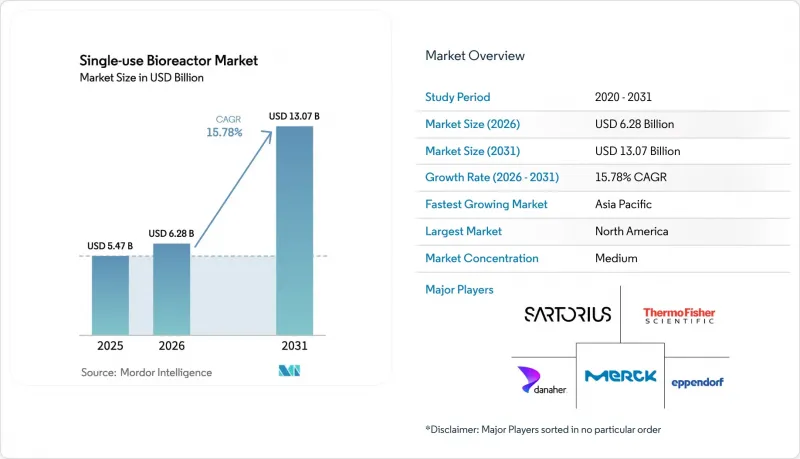
Mordor Intelligence에 의하면, 일회용 바이오리액터 시장 규모는 2025년에 54억 7,000만 달러로 평가되었습니다. 2026년에 62억 8,000만 달러에 달하고, 2031년까지 130억 7,000만 달러에 이를 것으로 예측되며, 2026-2031년에 걸쳐 CAGR 15.78%로 성장할 전망입니다.

본 보고서는 제품 유형(교반조형, 파동유도형, 고정층형, 궤도 진동형 및 기타 SUB), 용량 범위(100L 미만, 100-500L, 기타), 용도(연구·공정 개발, 기타), 최종 사용자(제약 및 바이오의약품 기업, 기타),지역(북미, 유럽, 기타)별로 분류되어 있습니다. 시장 예측은 금액(달러) 기준으로 제시되어 있습니다.
세계의 일회용 바이오리액터 시장 동향 및 인사이트
스테인리스 스틸에서 일회용 바이오프로세싱 시스템으로의 전환 가속화
각 제약사는 세척 검증 절차가 필요 없고, 물 사용량을 최대 80% 절감하며, 턴어라운드 주기를 수 주에서 수일로 단축할 수 있는 일회용 플랫폼을 도입하기 위해 기존 스테인리스 스틸 설비를 단계적으로 폐지하고 있습니다. Danaher의 Cytiva 사업부는 2024년 하반기 일회용 소모품 매출이 회복되었다고 보고했으며, 백 어셈블리 및 센서에 대한 의존도가 높다는 점이 부각되었습니다. 사르토리우스(Sartorius)는 바이오프로세스 솔루션 부문 매출의 75%가 소모품에서 비롯된다는 점을 제시하며, 검증 완료 후 고객의 락인(lock-in) 효과를 강조했습니다. 또한, 증기 멸균 및 문서화에 소요되는 인건비도 유럽 및 미국 시장에서는 사전 멸균된 백의 경제적 우위를 높여주고 있지만, 인도와 중국의 바이오시밀러 기업들은 수입 관세로 인해 소모품 비용이 상승하고 있어 여전히 하이브리드 플랜트를 선호하고 있습니다.
세포 및 유전자 치료의 급속한 성장에 따른 유연한 소량 생산에 대한 수요 증가
자가 유래 CAR-T 치료에는 50mL-10L의 배치 생산이 필요하지만, 이 용량은 500L 스테인리스 스틸 리액터로는 대응할 수 없습니다. 브리스톨-마이어스 스퀴브(Bristol-Myers Squibb)는 2024년, 일회용 바이오리액터와 밀폐형 세포 처리 하드웨어를 결합한 자동화된 ‘셀 셔틀(Cell Shuttle)’ 플랫폼을 위해 셀라레스(Cellares)와 3억 8,000만 달러 규모의 생산 능력을 확보했습니다. 2024년부터 2025년에 걸쳐 여러 CAR-T 콘젤에 대한 FDA 승인 및 FDA의 ‘첨단 제조 기술(Advanced Manufacturing Technologies)’ 패스웨이를 통해 종양 센터 인근에서의 분산형 제조가 촉진되고 있습니다. 유니버셀즈의 50L ‘NevoLine’ 시스템은 컨테이너를 통해 원격지의 클리닉으로 운송이 가능하여 모듈식 도입을 뒷받침하고 있습니다.
용출물 및 추출물 규정 준수 관련 불확실성
다층 폴리에틸렌 필름에서는 가소제가 용출될 가능성이 있어, 이것이 승인 지연으로 이어질 우려가 있습니다. FDA와 EMA는 조립체 1대당 0.5-100만 달러의 비용이 드는 최장 18개월간의 검사를 요구하고 있습니다. 고효능 제품의 경우 위험이 높아지기 때문에 일부 일본 스폰서들은 시판용 로트에 스테인리스 스틸 탱크를 계속 사용하고 있습니다.
부문별 분석
교반조 시스템은 2025년 매출의 57.26%를 차지하며, 포유류 세포 배양의 주력으로서의 입지를 공고히 했습니다. 교반조형 일회용 바이오리액터 시장 규모는 5g/L를 초과하는 항체 역가에 의해 뒷받침되고 있습니다. 궤도 진동식 용기는 학술 연구실에서의 도입으로 연평균 18.68%의 속도로 확대되고 있는 반면, 파동 유도형 설계는 시드 트레인 및 바이러스 벡터 연구에 활용되고 있습니다. PBS BioTech의 수직 휠 방식은 전단력을 줄이면서 산소 전달 효율을 향상시킵니다. 서모피셔(Thermo Fisher)사의 센서 내장형 ‘DynaDrive’는 디지털 모니터링을 벤치탑 규모까지 확대되고 있습니다.
도입 패턴은 검증의 엄격성을 반영하고 있습니다. 상업적 항체 제조업체는 교반조에서 얻은 실적 데이터를 중시하는 반면, 초기 단계의 유전자 치료 팀은 바이오세이프티 캐비닛 내에 들어갈 수 있는 궤도식 교반조를 선호합니다. 고정층 반응기는 퍼퓨전 부문의 틈새 시장을 채우고 있는 반면, 일회용 바이오리액터 산업에서는 배지 사용량을 줄이는 퍼퓨전/피드배치 하이브리드 모델에 대한 검토가 계속되고 있습니다.
500-2,000L 용량 대는 2025년 매출의 43.72%를 차지하며, CDMO 서비스의 핵심으로 자리 잡았습니다. 이 용량 범위의 일회용 바이오리액터 시장 점유율은 1회 가동으로 5-10kg을 생산하는 3상 임상시험의 배치 크기와 일치합니다. 다나하(Danaher)사의 500L 및 2,000L X 플랫폼 모델은 설치 기간을 8주로 단축하여 고객의 도입을 가속화합니다.
100L 이하 시스템의 경우, CAR-T 제조업체와 대학들이 벤치탑형 도구를 도입함에 따라 19.42%의 성장이 예상됩니다. 반면, 2,000L를 초과하는 설계에는 기술적 제약이 있으며, 실험 단계에 있는 4,000L 백은 여전히 구하기 어렵고 가격이 비싸기 때문에 대규모 바이오시밀러에 대한 수요가 있음에도 불구하고 성장에는 상한선이 설정되어 있습니다.
지역별 분석
북미는 2025년 매출의 36.11%를 차지했으며, 미국에 본사를 둔 기업들과 첨단 제조 기술 심사를 신속화하는 FDA의 프로그램에 힘입고 있습니다. 생산 능력이 포화 상태에 도달함에 따라 성장이 정체되고 있으며, 공급업체들은 아시아태평양으로 무게 중심을 옮기고 있습니다. 이 지역은 2031년까지 연평균 17.02%의 성장이 예상됩니다. 서모피셔사가 2025년에 싱가포르와 상하이에 개설할 설계 센터는 이러한 변화를 반영한 것입니다.
유럽은 2위를 차지하고 있으며, 독일, 스위스, 영국이 주도하고 있습니다. 이들 국가에서는 물 사용에 관한 규제로 인해 일회용 시스템의 도입이 촉진되고 있습니다. Merck KGaA가 3억 유로를 투자한 다름슈타트 거점과, 살토리아스의 소모품 중심 비즈니스 모델은 고수익률 공급품에 주력하고 있음을 보여줍니다. 브렉시트 이후의 이중 승인 절차는 다소 복잡성을 수반하지만, 상호 승인 제도를 통해 무역은 원활하게 이루어지고 있습니다.
아시아태평양 각국 정부는 자국 내 생산을 추진하고 있습니다. 한국의 삼성바이오로직스는 2024년에 33억 달러 규모의 계약을 체결했으며, 중국 쑤저우 클러스터에서는 국내용 바이오시밀러 생산을 위해 일회용 설비의 규모를 확대되고 있습니다. 인도의 세람 인스티튜트는 아프리카 공급과 관련해 WHO의 사전 인증 기준을 충족하기 위해 일회용 생산 라인을 도입하고 있습니다.
중동 및 아프리카와 남미에서는 컨테이너형 시설 구축이 진행되고 있습니다. 남아프리카와 아르헨티나의 WHO 허브는 모듈식 리액터를 채택하고 있으며, 브라질의 파르망기뉴스는 일회용 장비를 사용하여 백신을 현지에서 생산하고 있습니다. 아랍에미리트의 바이오테크놀러지 프리존도 유사한 움직임을 보이고 있어, 이러한 추세가 앞으로도 확산될 것으로 예측됩니다.
기타 혜택
- 엑셀 형식 시장 예측(ME) 시트
- 3개월간의 애널리스트 지원
자주 묻는 질문
목차
제1장 서론
제2장 조사 방법
제3장 주요 요약
제4장 시장 구도
제5장 시장 규모 및 성장 예측
제6장 경쟁 구도
제7장 시장 기회 및 향후 전망
KTH 26.09.08According to Mordor Intelligence, the single-use bioreactor market size is projected to be USD 5.47 billion in 2025, USD 6.28 billion in 2026, and reach USD 13.07 billion by 2031, growing at a CAGR of 15.78% from 2026 to 2031.
This report is Segmented by Product Type (Stirred-Tank, Wave-Induced, Fixed-Bed, Orbitally-Shaken & Other SUBs), Volume Range (Less Than 100 L, 100-500 L, and More), Application (Research & Process Development, and More), End-User (Pharmaceutical & Biopharmaceutical Companies, and More), and Geography (North America, Europe, and More). The Market Forecasts are Provided in Terms of Value (USD).
Global Single-use Bioreactor Market Trends and Insights
Intensifying Shift From Stainless-Steel to Disposable Bioprocessing Systems
Pharmaceutical manufacturers are retiring legacy stainless trains in favor of single-use platforms that remove cleaning validation, lower water use by up to 80%, and cut turnaround cycles from weeks to days. Danaher's Cytiva division reported resurgent disposable-consumable sales in late 2024, underscoring dependence on bag assemblies and sensors. Sartorius indicated 75% of Bioprocess Solutions revenue stems from consumables, highlighting customer lock-in once validation is complete. Labor costs for steaming and documentation also tilt economics toward pre-sterilized bags in Western markets, although Indian and Chinese biosimilar firms still favor hybrid plants because import tariffs inflate consumable costs.
Rapid Growth of Cell & Gene Therapies Elevating Demand for Flexible Small-Batch Manufacturing
Autologous CAR-T treatments require 50 mL-10 L runs, volumes incompatible with 500 L stainless reactors. Bristol Myers Squibb reserved USD 380 million in capacity with Cellares in 2024 for its automated Cell Shuttle platform that pairs single-use bioreactors with closed cell-processing hardware. FDA approvals for multiple CAR-T constructs in 2024-2025 and the agency's Advanced Manufacturing Technologies pathway spur decentralized manufacturing near oncology centers. Univercells' 50 L NevoLine system can be shipped in a container to remote clinics, reinforcing modular deployments.
Leachables & Extractables Compliance Uncertainty
Multilayer polyethylene films may leach plasticizers that delay approvals. FDA and EMA require up to 18 months of studies costing USD 0.5-1 million per assembly. High-potency products heighten risk, prompting some Japanese sponsors to retain stainless tanks for commercial lots.
Other drivers and restraints analyzed in the detailed report include:
- Cost-Saving Potential in Early-Stage Clinical Production
- Accelerated Vaccine Programs Post-COVID-19
- High Recurring Consumable Costs
For complete list of drivers and restraints, kindly check the Table Of Contents.
Segment Analysis
Stirred-tank systems commanded 57.26% of 2025 revenue, reinforcing their role as the workhorse for mammalian cell culture. The single-use bioreactor market size for stirred-tank units is sustained by antibody titers exceeding 5 g/L. Orbitally-shaken vessels are expanding at 18.68% annually on adoption by academic labs, while wave-induced designs serve seed-train and viral-vector work. PBS Biotech's vertical-wheel approach improves oxygen transfer with lower shear. Thermo Fisher's sensor-embedded DynaDrive extends digital monitoring into benchtop volumes.
Adoption patterns reflect validation stringency. Commercial antibody makers value historical data from stirred tanks, but early-stage gene therapy teams favor orbitals that fit inside biosafety cabinets. Fixed-bed reactors fill perfusion niches, while the single-use bioreactor industry continues to test hybrid perfusion/fed-batch models that reduce media use.
The 500-2,000 L band represented 43.72% of 2025 revenue and remains the core of CDMO offerings. The single-use bioreactor market share for this range aligns with Phase III batch sizes that yield 5-10 kg per run. Danaher's 500 L and 2,000 L X-platform models shorten installation to eight weeks, accelerating client onboarding.
Sub-100 L systems are forecast to grow at 19.42% as CAR-T makers and universities deploy benchtop tools. Conversely, designs above 2,000 L face engineering limits; experimental 4,000 L bags remain scarce and expensive, capping growth despite demand for large-scale biosimilars.
Complete Report Scope:
- By Product Type
- Stirred-Tank SUBs
- Wave-Induced SUBs
- Fixed-Bed SUBs
- Orbitally-Shaken & Other SUBs
- By Volume Range
- Less than 100 L
- 100 - 500 L
- 500 - 2 000 L
- More than 2,000 L
- By Application
- Research & Process Development
- Clinical-Scale Production
- Commercial-Scale Biopharmaceutical Manufacturing
- By End-User
- Pharmaceutical & Biopharmaceutical Companies
- Contract Development & Manufacturing Organisations (CDMOs/CMOs)
- Academic & Research Institutes
- By Geography
- North America
- United States
- Canada
- Mexico
- Europe
- Germany
- France
- United Kingdom
- Italy
- Spain
- Rest of Europe
- Asia-Pacific
- China
- Japan
- India
- South Korea
- Australia
- Rest of Asia-Pacific
- Middle East & Africa
- GCC
- South Africa
- Rest of Middle East & Africa
- South America
- Brazil
- Argentina
- Rest of South America
- North America
Geography Analysis
North America accounted for 36.11% of 2025 revenue, buoyed by U.S. headquarters and an FDA program that expedites advanced manufacturing reviews. Growth is plateauing as capacity saturates, prompting suppliers to pivot to Asia-Pacific, projected to grow at 17.02% through 2031. Thermo Fisher's 2025 design centers in Singapore and Shanghai reflect this tilt.
Europe ranks second, led by Germany, Switzerland, and the UK, where water-usage rules encourage disposable systems. Merck KGaA's EUR 300 million Darmstadt hub and Sartorius' consumable-centric model illustrate the focus on high-margin supplies. Post-Brexit dual approvals add modest complexity, yet mutual recognition eases trade.
Asia-Pacific governments pursue sovereign production. South Korea's Samsung Biologics signed USD 3.3 billion in contracts in 2024, and China's Suzhou cluster scales single-use suites for domestic biosimilars. India's Serum Institute uses disposable lines to meet WHO prequalification for African supply.
Middle East & Africa and South America nurture containerized facilities. WHO hubs in South Africa and Argentina rely on modular reactors, and Brazil's Farmanguinhos uses single-use equipment to localize vaccine output. The United Arab Emirates' biotech free-zones mirror these moves, signaling continued diffusion.
- ABEC
- Bioengineering
- Cellexus
- Celltainer
- CerCell
- Danaher
- Entegris
- Eppendorf
- Getinge
- Meissner Filtration
- Merck
- PBS Biotech
- Pierre Guerin
- Rentschler Biopharma
- Sartorius
- Solaris Biotech
- Thermo Fisher Scientific
- Univercells Technologies
Additional Benefits:
- The market estimate (ME) sheet in Excel format
- 3 months of analyst support
TABLE OF CONTENTS
1 Introduction
- 1.1 Study Assumptions & Market Definition
- 1.2 Scope of the Study
2 Research Methodology
3 Executive Summary
4 Market Landscape
- 4.1 Market Overview
- 4.2 Market Drivers
- 4.2.1 Intensifying Shift from Stainless-Steel to Disposable Bioprocessing Systems
- 4.2.2 Rapid Growth of Cell & Gene Therapies Elevating Demand for Flexible Small-Batch Manufacturing
- 4.2.3 Cost-Saving Potential in Early-Stage Clinical Production
- 4.2.4 Accelerated Vaccine Programs Post-COVID-19
- 4.2.5 Decentralized Micro-Facility Models in Emerging Markets
- 4.2.6 Growing Availability Of Y-Irradiation Capacity Resolving Sterilization Bottlenecks
- 4.3 Market Restraints
- 4.3.1 Leachables & Extractables Compliance Uncertainty
- 4.3.2 High Recurring Consumable Costs
- 4.3.3 PFAS Regulatory Scrutiny on Single-Use Plastics
- 4.3.4 Limited Scalability Beyond 6,000 L Hampering Late-Stage Commercial Runs
- 4.4 Value / Supply-Chain Analysis
- 4.5 Regulatory Landscape
- 4.6 Technological Outlook
- 4.7 Porter's Five Forces Analysis
- 4.7.1 Threat of New Entrants
- 4.7.2 Bargaining Power of Suppliers
- 4.7.3 Bargaining Power of Buyers
- 4.7.4 Threat of Substitutes
- 4.7.5 Intensity of Competitive Rivalry
5 Market Size & Growth Forecasts (Value in USD)
- 5.1 By Product Type
- 5.1.1 Stirred-Tank SUBs
- 5.1.2 Wave-Induced SUBs
- 5.1.3 Fixed-Bed SUBs
- 5.1.4 Orbitally-Shaken & Other SUBs
- 5.2 By Volume Range
- 5.2.1 Less than 100 L
- 5.2.2 100 - 500 L
- 5.2.3 500 - 2 000 L
- 5.2.4 More than 2,000 L
- 5.3 By Application
- 5.3.1 Research & Process Development
- 5.3.2 Clinical-Scale Production
- 5.3.3 Commercial-Scale Biopharmaceutical Manufacturing
- 5.4 By End-User
- 5.4.1 Pharmaceutical & Biopharmaceutical Companies
- 5.4.2 Contract Development & Manufacturing Organisations (CDMOs/CMOs)
- 5.4.3 Academic & Research Institutes
- 5.5 By Geography
- 5.5.1 North America
- 5.5.1.1 United States
- 5.5.1.2 Canada
- 5.5.1.3 Mexico
- 5.5.2 Europe
- 5.5.2.1 Germany
- 5.5.2.2 France
- 5.5.2.3 United Kingdom
- 5.5.2.4 Italy
- 5.5.2.5 Spain
- 5.5.2.6 Rest of Europe
- 5.5.3 Asia-Pacific
- 5.5.3.1 China
- 5.5.3.2 Japan
- 5.5.3.3 India
- 5.5.3.4 South Korea
- 5.5.3.5 Australia
- 5.5.3.6 Rest of Asia-Pacific
- 5.5.4 Middle East & Africa
- 5.5.4.1 GCC
- 5.5.4.2 South Africa
- 5.5.4.3 Rest of Middle East & Africa
- 5.5.5 South America
- 5.5.5.1 Brazil
- 5.5.5.2 Argentina
- 5.5.5.3 Rest of South America
- 5.5.1 North America
6 Competitive Landscape
- 6.1 Market Concentration
- 6.2 Market Share Analysis
- 6.3 Company Profiles (includes Global level Overview, Market level overview, Core Segments, Financials as available, Strategic Information, Market Rank/Share for key companies, Products and Services, and Recent Developments)
- 6.3.1 ABEC
- 6.3.2 Bioengineering AG
- 6.3.3 Cellexus
- 6.3.4 Celltainer
- 6.3.5 CerCell
- 6.3.6 Danaher
- 6.3.7 Entegris
- 6.3.8 Eppendorf AG
- 6.3.9 Getinge
- 6.3.10 Meissner Filtration
- 6.3.11 Merck KGaA
- 6.3.12 PBS Biotech
- 6.3.13 Pierre Guerin
- 6.3.14 Rentschler Biopharma
- 6.3.15 Sartorius Stedim Biotech
- 6.3.16 Solaris Biotech
- 6.3.17 Thermo Fisher Scientific
- 6.3.18 Univercells Technologies
7 Market Opportunities & Future Outlook
- 7.1 White-space & Unmet-Need Assessment


