|
시장보고서
상품코드
2037816
일회용 바이오리액터 시장(제4판) : 업계 동향과 세계 예측(-2035년) : 바이오리액터 유형별, 가동 규모별, 세포배양 유형별, 합성 생물제제 유형별, 최종사용자별 및 지역별Single Use Bioreactors Market (4th Edition): Industry Trends and Global Forecasts, Till 2035: Distribution by Type of Bioreactor, Scale of Operation, Type of Cell Culture, Type of Biologics Synthesized, End Users and Geographical Regions |
||||||

일회용 바이오리액터 시장 - 개요
세계의 일회용 바이오리액터 시장 규모는 2035년까지 CAGR 9.03%로 확대하며, 현재 48억 1,000만 달러에서 2035년에는 104억 8,000만 달러에 달할 것으로 추정되고 있습니다.
일회용 바이오리액터 시장 - 성장과 동향
일회용 바이오리액터(SUB)는 일회용 바이오리액터라고도 불리며, 생물제제 생산에 있으며, 기존의 스테인리스강 배양 용기 대신 일회용 바이오리액터 백을 사용합니다. 이 시스템은 기존 바이오리액터에 비해 약 40%의 비용 절감, 생산 기간 약 35% 단축, 에너지 및 물 소비량 감소(45-50%), 제품 수율 향상, 오염 위험의 대폭 감소 등 여러 가지 이점을 제공합니다.
최근 수년간 생물제제 분야는 괄목할 만한 성장세를 보이고 있으며, 미국 FDA는 170여 종의 생물제제를 승인했고, 현재 1만여 종의 후보 약물이 다양한 개발 단계에 있습니다. 고품질 항체, 세포치료제, 유전자 치료제를 포함한 생물제제에 대한 수요 증가에 대응하기 위해 일회용 바이오리액터 기술을 채택하는 방향으로의 전환이 두드러지게 나타나고 있습니다.
업계의 변화하는 요구에 부응하여 일회용 바이오리액터 제조업체들은 시스템에 첨단 기능을 통합하는 움직임을 가속화하고 있습니다. 여기에는 자동 경고 및 경보, 전자 배치 기록, 내장형 공정 제어 센서, 터치스크린 인터페이스, 원격 모니터링 기능, 강화된 안전 메커니즘 등이 포함되며, 이 모든 것은 전 세계 바이오 제조 애플리케이션의 운영 효율성과 확장성을 향상시키는 것을 목표로 합니다. 지속적인 기술 발전, 특히 개선된 바이오센서 및 일회용 바이오리액터 백의 개발은 생물제제 기업이 연속 바이오프로세싱을 위한 일회용 바이오리액터를 채택하도록 유도할 것으로 예상되며, 이 확대되는 시장에서 사업을 운영하는 기업에게 큰 성장 기회를 창출할 것입니다. 성장 기회를 창출할 것입니다.
성장 요인 - 시장 확대의 전략적 촉진요인
일회용 바이오리액터 시장은 생물제제 산업의 급속한 성장과 단클론 항체, 백신, 세포치료제, 유전자치료제 등 첨단 치료법을 포함한 생물제제에 대한 수요 증가에 힘입어 강력한 성장세를 보이고 있습니다. 또한 유연하고 비용 효율적인 제조 솔루션에 대한 관심이 높아짐에 따라 일회용 시스템의 도입이 가속화되고 있습니다. 이는 대규모 세척 및 멸균의 필요성을 없애고, 설비 투자를 줄이고, 생산 주기를 단축할 수 있기 때문입니다. 또한 특히 맞춤형 의료 분야에서 분산형 및 소량 생산으로의 전환은 일회용 바이오리액터의 보급을 더욱 촉진하고 있습니다. 확장성 향상, 자동화, 디지털 모니터링 시스템과의 통합과 같은 지속적인 기술 발전은 프로세스의 효율성과 신뢰성을 향상시켜 업계 전반의 채택을 촉진하고 있습니다.
시장 과제 - 발전을 가로막는 심각한 장애물
이러한 장점에도 불구하고 시장은 장기적인 성장에 영향을 미칠 수 있는 몇 가지 도전에 직면해 있습니다. 주요 관심사 중 하나는 대규모 상업 생산에서 일회용 바이오 리액터의 확장성 한계이며, 이 분야에서는 여전히 전통적 스테인리스강 시스템이 선호될 수 있습니다. 또한 일회용 재료에서 추출물과 용출물과 관련된 문제는 제품 품질 및 규제 준수에 대한 우려를 야기하고 있습니다. 일회용 플라스틱에 대한 의존도는 특히 환경 규제가 강화되는 상황에서 지속가능성 및 폐기물 관리 문제를 야기하고 있습니다. 또한 특수 부품 및 소모품의 공급망 제약과 플랫폼 간 표준화의 필요성이 보급에 걸림돌이 될 수 있습니다. 이러한 문제를 해결하기 위해서는 지속적인 혁신, 규제 정합성, 그리고 보다 지속가능한 재료와 폐기 방법의 개발이 필요합니다.
일회용 바이오리액터 시장 - 주요 인사이트
이 보고서는 일회용 바이오리액터 시장의 현황을 상세히 분석하고 업계의 잠재적인 성장 기회를 파악합니다. 보고서의 주요 조사 결과는 다음과 같습니다. :
- 현재, 전 세계 다양한 산업 참여 기업에서 260여 종의 일회용 바이오리액터를 제공하고 있습니다. 그 중 약 75%의 바이오리액터가 백신 합성 능력을 가지고 있습니다.
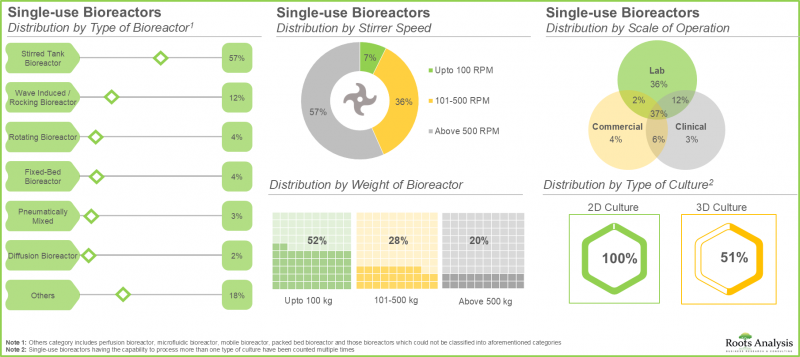
- 일회용 바이오리액터의 약 60%는 교반조형 바이오리액터입니다. 특히 바이오리액터의 40% 가량이 실험실 규모, 임상 규모, 상업적 규모 등 모든 규모에 대응할 수 있는 능력을 갖추고 있습니다.
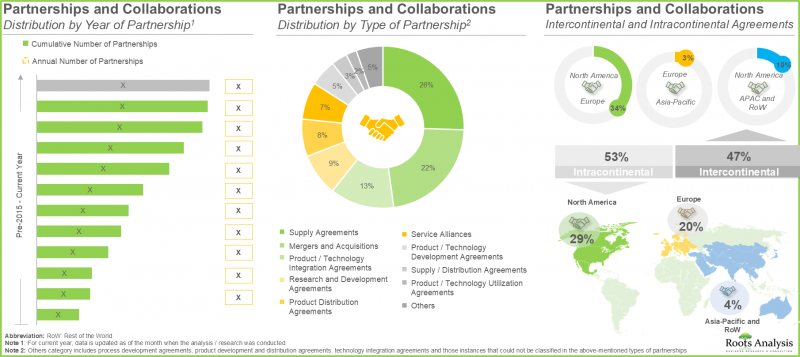
- 최근 수년간 파트너십 활동이 꾸준히 증가하고 있으며, 공급 계약이 가장 두드러진 파트너십 모델로 부상하고 있습니다.
- 2020년 이후, 일회용 바이오리액터 연구개발과 관련하여 약 540건의 특허가 출원 또는 등록되었습니다. 특히 특허 출원인의 대부분은 업계 관계자들입니다.
- 일회용 바이오리액터 시장은 2035년까지 연평균 9.28%의 CAGR로 성장할 것으로 예상됩니다. 현재 시장 점유율의 대부분은 교반조형 바이오리액터별 매출이 차지하고 있습니다.
- 현재 일회용 바이오리액터 시장 점유율의 대부분은 유럽이 차지하고 있지만, 아시아태평양 시장은 가까운 장래에 11% 이상의 높은 CAGR로 성장할 것으로 예상됩니다.
- 생물제제에 대한 수요 증가와 유연하고 확장 가능한 제조 솔루션에 대한 요구가 증가함에 따라 일회용 바이오리액터 시장은 향후 수년간 큰 폭의 성장을 이룰 것으로 예상됩니다.
일회용 바이오리액터 시장
시장 규모 및 기회 분석은 다음 매개 변수를 기반으로 세분화됩니다. :
바이오리액터 유형별
- 교반조형 바이오리액터
- 파동유도형 바이오리액터
- 기타 바이오리액터
가동 규모별
- 전임상 및 임상
- 상업용
세포배양 유형별
- 포유류
- 미생물
- 기타
합성되는 생물제제 유형별
- 백신
- 모노클로널 항체
- 재조합 단백질
- 줄기세포
- 세포치료
- 유전자 치료
최종사용자별
- 생물제제 및 제약 산업
- 학술-연구기관
지역별
- 북미
- 북미
- 아시아태평양
- 라틴아메리카
- 중동 및 북아프리카
일회용 바이오리액터 시장 - 주요 부문
바이오리액터 유형별 시장점유율 - 교반 탱크 시스템이 일회용 바이오리액터 시장을 독점하고 있음
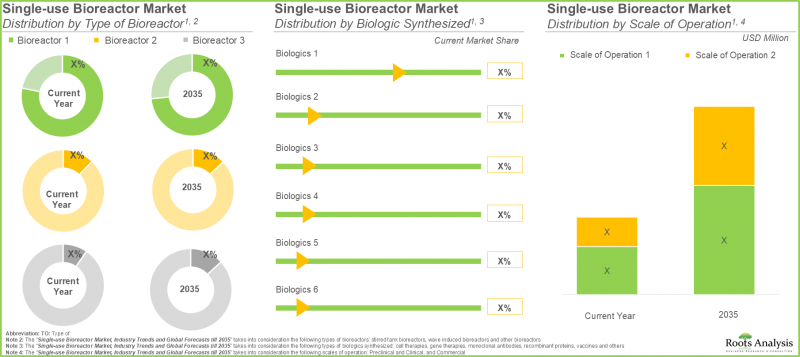
세계의 일회용 바이오리액터 시장은 바이오리액터 유형에 따라 교반 탱크식, 파동식, 기타 시스템 등으로 분류됩니다. 현재 교반형 바이오리액터는 시장 점유율의 약 80%를 차지하고 있으며, 예측 기간 중 비교적 높은 CAGR로 성장할 것으로 예상됩니다. 이러한 장점은 뛰어난 확장성, 효율적인 교반 능력 및 생물제제 제조에 광범위하게 채택된 데 기인합니다. 또한 이 시스템은 전단 응력을 최소화하도록 설계되었으며, 최적화된 블레이드 구성과 제어된 교반 속도를 통해 세포배양에 대한 잠재적 손상을 줄입니다.
가동 규모별 시장 점유율 - 일회용 바이오리액터 분야는 전임상 및 임상 부문이 주도하고 있음
운영 규모에 따라 시장은 전임상 및 임상 부문과 상업 부문으로 분류됩니다. 현재 전임상 및 임상 부문이 가장 큰 비중을 차지하고 있으며, 전체 매출의 60% 이상을 차지하고 있습니다. 이는 주로 일회용 시스템의 운영상 이점 때문입니다. 일회용 시스템은 대규모 세척 및 정비가 필요 없기 때문에 초기 단계의 개발 및 임상 규모의 생산에 특히 적합하며, 비용 효율성이 뛰어납니다.
세포배양 유형별 시장 점유율 - 포유류 세포가 일회용 바이오리액터 시장의 대부분을 차지
시장 세분화는 세포배양 유형에 따라 포유류, 미생물, 기타로 세분화됩니다. 포유류 세포배양 부문이 약 65%의 점유율을 차지하고 있으며, 복잡한 생물제제 제조에 중요한 역할을 하고 있으므로 이러한 추세는 앞으로도 지속될 것으로 예상됩니다. 특히 일회용 바이오리액터의 80% 이상이 포유류 세포 처리에 대응하도록 설계되어 있습니다. 반면, 미생물 부문은 항체 단편 및 단일 도메인 항체 등 더 작고 복잡성이 낮은 바이오로직스 제조에 적합하므로 예측 기간 중 10%의 높은 CAGR로 성장할 것으로 예상됩니다.
바이오로직스 유형별 시장 점유율 - 단일 클론 항체 부문이 일회용 바이오리액터 시장을 주도
생물제제 유형별로는 백신, 모노클로널 항체, 재조합 단백질, 줄기세포, 세포치료제, 유전자치료제 등이 있습니다. 이 중, 모노클로널 항체는 여러 치료 영역에서 광범위하게 사용되는 것을 배경으로 현재 약 35%로 가장 큰 점유율을 차지하고 있습니다. 반면, 세포치료제 부문은 다양한 질병 적응증에 대한 임상 적용 확대에 힘입어 예측 기간 중 13%의 높은 CAGR로 성장할 것으로 예상됩니다.
최종사용자별 시장점유율 - 생물제제 기업이 시장을 독점할 것으로 예상됨
최종사용자별로 보면 시장 세분화에서는 생물제제 및 제약기업과 학술 및 연구기관으로 구분됩니다. 생물제제 및 제약 부문은 약 65%의 압도적인 점유율을 차지하고 있으며, 이는 생물제제 제조에 있으며, 일회용 기술의 높은 채택률과 유연하고 확장 가능한 제조 솔루션에 대한 니즈를 반영합니다.
지역별 시장 점유율 - 아시아태평양이 강력한 성장세를 보이고 있습니다.
지역별로는 북미, 유럽, 아시아태평양, 중동 및 북아프리카, 라틴아메리카에 시장이 분포되어 있습니다. 북미는 첨단인 바이오 제조 인프라와 강력한 산업적 입지를 바탕으로 시장 점유율의 35% 이상을 차지하며 선두를 유지할 것으로 예상됩니다. 그러나 아시아태평양은 투자 증가, 제품 포트폴리오 확대, 장기적인 시장 입지 강화를 위한 지역 기업의 전략적 노력에 힘입어 예측 기간 중 연평균 11%의 성장률을 기록하며 가장 높은 성장세를 보일 것으로 예상됩니다.
일회용 바이오리액터 시장의 주요 기업 예시
- Celartia
- Cell Culture Company
- Cellexus
- Cercell
- Cytiva
- Eppendorf
- Esco Bioengineering
- Getinge
- Merck Millipore
- PBS Biotech
- PerfuseCell
- ProlifeCell
- Sartorius
- Solaris Biotech
- Synthecon
- Thermo Fisher Scientific
일회용 바이오리액터 시장 조사 범위
- 시장 규모 및 기회 분석: 이 보고서는 일회용 바이오리액터 시장에 대한 상세한 분석을 통해 [A] 바이오리액터 유형, [B] 가동 규모, [C] 세포배양 유형, [D] 합성되는 바이오로직 유형, [E] 최종사용자, [F] 지역 등 주요 시장 부문에 초점을 맞추고 있습니다. 주요 시장 부문에 초점을 맞추고 있습니다.
- 일회용 바이오리액터 시장의 시장 상황:[A]바이오리액터 유형,[B]운영 규모,[C]표준 작동 용량,[D]교반 속도,[E]바이오리액터 무게,[F]세포배양 유형,[G]합성되는 생물제제 유형,[H]최종사용자,[I]설립 년도,[J 기업 규모, [K] 본사 소재지.
- 주요 인사이트: [A] 기업 규모 및 본사 소재지, [B] 일회용 바이오리액터 유형 및 가동 모드, [C] 일회용 바이오리액터 유형 및 합성되는 바이오로직스 유형, [D] 가동 규모, 세포배양 유형 및 [E] 합성되는 바이오로직스 유형에 따라 이 보고서에서는 업계 관련 기업의 최신 시장 동향 분석을 실시합니다.
- 기업 경쟁력 분석: [A] 기업의 강점, [B] 포트폴리오의 강점, [C] 제품 포트폴리오의 다양성 등 다양한 관련 파라미터를 기반으로 한 상세한 기업 경쟁력 분석.
- 기업 개요: [A] 설립연도, [B] 본사 소재지, [C] 제품 포트폴리오, [D] 최근 동향, [E] 정보에 입각한 미래 전망 등 여러 매개변수를 기반으로 북미, 유럽, 아시아태평양에 기반을 둔 주요 기업의 상세한 프로필을 제공합니다.
- 제휴 및 공동사업: 일회용 바이오리액터와 관련된 최근 파트너십 및 제휴에 대한 분석입니다. 이는 [A] 계약 연도, 파트너십 유형, [B] 중점 분야, [C] 파트너 유형, [D] 합성되는 생물제제 유형, [E] 관련 바이오리액터 유형, [F] 시설 위치, [G] 확장된 바이오리액터 용량, [H] 가장 활동적인 플레이어 등 몇 가지 매개변수를 기반으로 합니다.
- 제품 경쟁 분석: [A] 공급업체의 강점, [B] 제품 경쟁 등 다양한 관련 파라미터를 기반으로 상세한 제품 경쟁 분석을 수행합니다.
- 브랜드 포지셔닝 분석: [A] 포트폴리오의 강점, [B] 포트폴리오의 다양성 등 몇 가지 관련 매개변수를 기반으로 주요 이해관계자의 각 브랜드에 대한 인기도에 대한 견해.
- 특허 분석: [A] 특허 유형, [B] 공개 연도, [C] 출원 연도, [D] 특허권 및 특허 출원 건수, [E] 특허 관할권, [F] CPC 기호, [G] 특허 경과 기간, [H] 출원인 유형, [I] 개별 특허권자(지적재산권 포트폴리오의 규모 측면에서)와 같은 중요한 매개변수를 기반으로 출원 및 등록된 특허에 대한 상세한 분석.
- 사례 연구 - 일회용 바이오리액터 산업의 주요 혁신: 일회용 바이오리액터 산업에 도입된 [A] 내장형 시스템 제어 센서, [B] 첨단 경보 시스템, [C] 전자 로그 기록, [D] 터치스크린, [E] 실시간 추적, [F] 원격 모니터링, [G] 첨단 혼합 기술에 대한 사례 연구입니다. 원격 모니터링, [G] 첨단 혼합 기술 등 주요 기술 혁신에 대한 사례 연구입니다.
- 사례 연구 - 바이오프로세스 컨트롤러 및 자동화 시스템: 바이오프로세스 컨트롤러 및 자동화 시스템 시장 현황에 대한 사례 연구로, [A] 가동 규모, [B] 주요 기능, [C] 바이오 리액터 시스템과의 호환성, [D] 바이오프로세스 유형, [E] 제어 대상 프로세스 유형에 대한 정보를 제공합니다. E] 제어 대상 공정 유형에 대한 정보를 제공합니다.
- SWOT 분석: SWOT 프레임워크에 따라 산업 발전에 영향을 미칠 수 있는 관련 동향, 주요 촉진요인 및 과제를 살펴봅니다. 여기에는 각 SWOT 매개 변수가 일회용 바이오리액터 산업 전체에 미치는 상대적 영향을 강조하는 하비볼 분석도 포함됩니다.
목차
제1장 서문
제2장 개요
제3장 서론
제4장 시장 구도
제5장 중요 인사이트
제6장 기업의 경쟁력 분석
제7장 북미에서 일회용 바이오리액터 제조업체 : 기업 개요
제8장 유럽, 아시아태평양 및 기타 지역에서 일회용 바이오리액터 제조업체 : 기업 개요
제9장 파트너십과 협력 관계
제10장 제품 경쟁력 분석
제11장 브랜드 포지셔닝 분석
제12장 특허 분석
제13장 시장 예측과 기회 분석
제14장 사례 연구 : 일회용 바이오리액터 산업에서 주요 기술 혁신
제15장 SWOT 분석
제16장 사례 연구 : 바이오프로세스 제어장치와 자동화 시스템
제17장 결론
제18장 경영 임원의 인사이트
제19장 부록 I : 표형식 데이터
제20장 부록 II : 기업 및 조직 리스트
제21장 부록 III : 바이오프로세스를 제공하는 기업 리스트
KSA 26.06.01Single Use Bioreactors Market: Overview
As per Roots Analysis, the global single use bioreactors market is estimated to grow from USD 4.81 billion in the current year to USD 10.48 billion by 2035, at a CAGR of 9.03% during the forecast period, till 2035.
Single Use Bioreactors Market: Growth and Trends
Single-use bioreactors (SUBs), also referred to as disposable bioreactors, utilize single-use bioreactor bags in place of traditional stainless-steel culture vessels for the production of biologics. These systems offer several advantages over conventional bioreactors, including cost savings of approximately 40%, reduced production timelines by nearly 35%, lower energy and water consumption (by 45-50%), improved product yields, and a significantly reduced risk of contamination.
In recent years, the biopharmaceutical sector has experienced substantial growth, with more than 170 biologics approved by the US FDA and over 10,000 candidates currently in various stages of development. To meet the increasing demand for biologics, including high-quality antibodies, cell therapies, and gene therapies, there has been a notable shift toward the adoption of single-use bioreactor technologies.
In response to evolving industry requirements, manufacturers of single-use bioreactors are increasingly integrating advanced features into their systems. These include automated alerts and alarms, electronic batch records, built-in process control sensors, touchscreen interfaces, remote monitoring capabilities, and enhanced safety mechanisms, all aimed at improving operational efficiency and scalability for global biomanufacturing applications. Ongoing technological advances-particularly the development of improved biosensors and single-use bioreactor bags are expected to drive biopharmaceutical companies toward adopting disposable bioreactors for continuous bioprocessing, creating significant growth opportunities for companies operating in this expanding market.
Growth Drivers: Strategic Enablers of Market Expansion
The single-use bioreactors market is experiencing strong growth, driven by the rapid expansion of biopharmaceutical industry and the increasing demand for biologics, including monoclonal antibodies, vaccines, and advanced therapies such as cell and gene therapies. Further, the growing preference for flexible and cost-efficient manufacturing solutions has accelerated the adoption of single-use systems, as they eliminate the need for extensive cleaning and sterilization, reduce capital expenditure, and enable faster turnaround times. Additionally, the shift toward decentralized and small-batch production, particularly for personalized medicines, further supports the uptake of single-use bioreactors. Continuous technological advancements such as improved scalability, automation, and integration with digital monitoring systems are also enhancing process efficiency and reliability, thereby driving broader industry adoption.
Market Challenges: Critical Barriers Impeding Progress
Despite these advantages, the market faces several challenges that may impact long-term growth. One of the primary concerns is the limited scalability of single-use bioreactors for large-volume commercial production, where traditional stainless-steel systems may still be preferred. Additionally, issues related to extractables and leachables from disposable materials raise concerns regarding product quality and regulatory compliance. The dependence on single-use plastics also presents sustainability and waste management challenges, particularly in the context of increasing environmental regulations. Furthermore, supply chain constraints for specialized components and consumables, along with the need for standardization across platforms, can hinder widespread adoption. Addressing these challenges will require continued innovation, regulatory alignment, and the development of more sustainable materials and disposal practices.
Single Use Bioreactors Market: Key Insights
The report delves into the current state of the singe use bioreactors market and identifies potential growth opportunities within industry. Some key findings from the report include:
- Currently, more than 260 single-use bioreactors are being offered by various industry players worldwide; of these, around 75% of bioreactors have the capability to synthesize vaccines.
- Around 60% of the single-use bioreactors are stirred tank bioreactors; notably, nearly 40% of the bioreactors have capability to support all scales including lab, clinical and commercial scale.
- A steady growth in the partnership activity has been observed in the recent years; supply agreements emerged as the most prominent type of partnership model.
- Around 540 patents have been filed / granted for the research and development of single-use bioreactors since 2020; notably majority of the patent applicants are industry players
- The single-use bioreactors market is likely to grow at a CAGR of 9.28%, till 2035; presently, majority of the market share is occupied by revenues generated from stirred tank bioreactors.
- Currently, majority of the single-use bioreactors market share is likely to be occupied by Europe; the market in Asia-Pacific is likely to grow at a higher CAGR of 11% in the foreseen future.
- Given the rising demand for biopharmaceuticals, the need for flexible and scalable manufacturing solutions, the single-use bioreactor market is likely to experience substantial growth in the coming years.
Single Use Bioreactors Market
The market sizing and opportunity analysis has been segmented across the following parameters:
By Type of Bioreactor
- Stirred Tank Bioreactor
- Wave Induced Bioreactor
- Other Bioreactors
By Scale of Operation
- Preclinical and Clinical
- Commercial
By Type of Cell Culture
- Mammalian
- Microbial
- Others
By Type of Biologics Synthesized
- Vaccine
- Monoclonal Antibody
- Recombinant Protein
- Stem Cell
- Cell Therapy
- Gene Therapy
By End Users
- Biopharmaceutical / Pharmaceutical Industries
- Academic / Research Institutes
By Geographical Regions
- North America
- Europe
- Asia-Pacific
- Latin America
- Middle East and North Africa
Single Use Bioreactors Market: Key Segments
Market Share by Bioreactor Type: Stirred Tank Systems Dominate the Single Use Bioreactors Market
The global single-use bioreactors market is segmented by bioreactor type into stirred tank, wave-induced, and other systems. Currently, stirred tank bioreactors account for approximately 80% of the market share and are expected to grow at a relatively higher CAGR over the forecast period. This dominance is attributed to their superior scalability, efficient mixing capabilities, and widespread adoption in biopharmaceutical manufacturing. Additionally, these systems are designed to minimize shear stress, thereby reducing potential damage to cell cultures through optimized blade configurations and controlled agitation speeds.
Market Share by Scale of Operation: Preclinical and Clinical Segments Lead in the Single Use Bioreactors Domain
Based on the scale of operation, the market is categorized into preclinical and clinical, and commercial segments. The preclinical and clinical segment currently holds the largest share, accounting for over 60% of total revenue. This is primarily due to the operational advantages of single-use systems, which eliminate the need for extensive cleaning and maintenance, making them particularly suitable and cost-effective for early-stage development and clinical-scale production.
Market Share by Cell Culture Type: Mammalian Cells Hold Majority of the Single Use Bioreactors Market Share
The market is further segmented by cell culture type into mammalian, microbial, and others. The mammalian cell culture segment dominates with an approximate share of 65%, a trend expected to persist due to its critical role in producing complex biologics. Notably, over 80% of disposable bioreactors are designed to support mammalian cell processing. In contrast, the microbial segment is projected to grow at a higher CAGR of 10% during the forecast period, driven by its suitability for producing smaller and less complex biologics, such as antibody fragments and single-domain antibodies.
Market Share by Biologics Type: Monoclonal Antibodies Segment Leads the Single Use Bioreactors Market
By biologics type, the market includes vaccines, monoclonal antibodies, recombinant proteins, stem cells, cell therapies, and gene therapies. Among these, monoclonal antibodies currently account for the largest share at approximately 35%, supported by their extensive use across multiple therapeutic areas. Meanwhile, the cell therapy segment is expected to grow at a higher CAGR of 13% during the forecast period, driven by expanding clinical applications across a wide range of disease indications.
Market Share by End Users: Biopharmaceutical Companies are likely to Dominate the Market
Based on end users, the market is segmented into biopharmaceutical/pharmaceutical companies and academic/research institutes. The biopharmaceutical and pharmaceutical segment holds a dominant share of approximately 65%, reflecting high adoption rates of single-use technologies for biologics production and the need for flexible, scalable manufacturing solutions.
Market Share by Geography: Asia-Pacific to Exhibit Strong Growth
Geographically, the market spans North America, Europe, Asia-Pacific, the Middle East and North Africa, and Latin America. North America is projected to maintain its leading position, accounting for over 35% of the market share, driven by advanced biomanufacturing infrastructure and strong industry presence. However, the Asia-Pacific region is expected to register the highest growth, with a projected CAGR of 11% during the forecast period, supported by increasing investments, expanding product portfolios, and strategic initiatives by regional players to strengthen long-term market positioning.
Example Players in Single Use Bioreactors Market
- Celartia
- Cell Culture Company
- Cellexus
- Cercell
- Cytiva
- Eppendorf
- Esco Bioengineering
- Getinge
- Merck Millipore
- PBS Biotech
- PerfuseCell
- ProlifeCell
- Sartorius
- Solaris Biotech
- Synthecon
- Thermo Fisher Scientific
Single Use Bioreactors Market Research Coverage
- Market Sizing and Opportunity Analysis: The report features an in-depth analysis of the single use bioreactors market, focusing on key market segments, including [A] type of bioreactor, [B] scale of operation, [C] type of cell culture, [D] type of biologics synthesized,[E] end user, and [F] geographical regions.
- Single Use Bioreactors Market Landscape: A detailed assessment of various single-use bioreactors that are either commercialized or under development based several relevant parameters, such as [A] type of bioreactor, [B] scale of operation, [C] typical working volume, [D] stirrer speed, [E] weight of the bioreactor, [F] type of cell culture, [G] type of biologics synthesized, [H] end-users, [I] year of establishment, [J] company size, and [K] location of headquarters.
- Key Insights: A contemporary market trend analysis of the companies engaged in this industry based on [A] company size and location of headquarters, [B] type of single use bioreactor and mode of operation, [C] type of single use bioreactor and type of biologics synthesized, [D] scale of operation, type of cell culture and [E] type of biologics synthesized.
- Company Competitiveness Analysis: An in-depth company competitiveness analysis based on various relevant parameters, such as [A] company strength, and [B] portfolio strength and [C] product portfolio diversity.
- Company Profiles: In-depth profiles of key companies based in North America, Europe and Asia-Pacific based on several parameters such as [A] year of establishment, [B] location of headquarters, [C] product portfolio, [D] recent developments and [E] an informed future outlook.
- Partnerships and Collaborations: An analysis of the recent partnerships and collaborations related to single-use bioreactors, based on several parameters, such as [A] year of agreement, type of partnership, [B] focus area, [C] type of partner, [D] type of biologics synthesized, [E] type of bioreactor involved, [F] location of facility, [G] expanded bioreactor capacity and [H] most active players.
- Product Competitiveness Analysis: An in-depth product competitiveness analysis based on various relevant parameters, such as [A] supplier strength, and [B] product competitiveness.
- Brand Positioning Analysis: An opinion on the relative popularity of the respective brands of key industry stakeholders based on several relevant parameters, such as [A] portfolio strength, and [B] portfolio diversity.
- Patent Analysis: A detailed analysis of the patents that have been filed / granted based on important parameters such as, [A] type of patent, [B] publication year, [C] application year, [D] number of granted patents and patent applications, [E] patent jurisdiction, [F] CPC symbols, [G] patent age, [H] type of applicant, and [I] individual patent assignees (in terms of size of intellectual property portfolio).
- Case Study - Key Technological Innovations in the Single-Use Bioreactors Industry: A case study on the key technological innovations, such as [A] built-in system control sensors, [B] advanced alarm systems, [C] electronic-log records, [D] touch screens, [E] real-time tracking, [F] remote monitoring and [G] advanced mixing technologies, that have been introduced in the single-use bioreactors industry.
- Case Study - Bioprocess Controllers and Automation Systems: A case study on the market landscape of bioprocess controllers and automation systems, providing information on [A] scale of operation, [B] key features, [C] compatibility with bioreactor system, [D] type of bioprocess, and [E] type of process controlled.
- SWOT Analysis: A discussion on affiliated trends, key drivers and challenges, under a SWOT framework, which are likely to impact the industry's evolution, including a Harvey ball analysis, highlighting the relative effect of each SWOT parameter on the overall single-use bioreactors industry.
Key Questions Answered in this Report
- Which are the leading companies in the single use bioreactors market?
- Which region dominates the single use bioreactors market?
- What are the key trends observed in the single use bioreactors market?
- What factors are likely to influence the evolution of this market?
- What are the primary challenges faced by single use bioreactors providers?
- What is the current and future market size?
- What is the CAGR of this market?
- How is the current and future market opportunity likely to be distributed across key market segments?
Reasons to Buy this Report
- The report provides a comprehensive market analysis, offering detailed revenue projections of the overall market and its specific sub-segments. This information is valuable to both established market leaders and emerging entrants.
- The report offers stakeholders a comprehensive overview of the market, including key drivers, barriers, opportunities, and challenges. This information empowers stakeholders to stay abreast of market trends and make data-driven decisions to capitalize on growth prospects.
- The report can aid businesses in identifying future opportunities in any sector. It also helps in understanding if those opportunities are worth pursuing.
- The report helps in identifying customer demand by understanding the needs, preferences, and behavior of the target audience in order to tailor products or services effectively.
- The report equips new entrants with requisite information regarding a particular market to help them build successful business strategies.
- The report allows for more effective communication with the audience and in building strong business relations.
Additional Benefits
- Complementary PPT Insights Pack
- Complimentary Excel Data Packs for all Analytical Modules in the Report
- 15% Free Content Customization
- Detailed Report Walkthrough Session with Research Team
- Free Updated report if the report is 6-12 months old or older
TABLE OF CONTENTS
1. PREFACE
- 1.1. Introduction
- 1.2. Key Market Insights
- 1.3. Scope of the Report
- 1.4. Research Methodology
- 1.5. Frequently Asked Questions
- 1.6. Chapter Outlines
2. EXECUTIVE SUMMARY
3. INTRODUCTION
- 3.1. Chapter Overview
- 3.2. Overview of Single-use Bioreactors
- 3.2.1. Historical Evolution
- 3.2.2. Single-use versus Traditional Bioreactors
- 3.3. Types of Single-use Bioreactors
- 3.3.1. Based on Cell Culture
- 3.3.2. Based on Agitation Mechanism
- 3.4. Advantages of Single-use Bioreactors
- 3.5. Key Applications Areas
- 3.6. Prevalent Regulatory Standards
- 3.7. Challenges Associated with Single-use Bioreactors
- 3.8. Concluding Remarks
4. MARKET LANDSCAPE
- 4.1. Chapter Overview
- 4.2. Single-use Bioreactors: Overall Market Landscape
- 4.2.1. Analysis by Type of Bioreactor
- 4.2.2. Analysis by Scale of Operation
- 4.2.3. Analysis by Working Volume
- 4.2.4. Analysis by Stirrer Speed
- 4.2.5. Analysis by Weight of Bioreactor
- 4.2.6. Analysis by Advanced Display / Control Features
- 4.2.7. Analysis by Mode of Operation
- 4.2.8. Analysis by Type of Culture
- 4.2.9. Analysis by Type of Cell Culture
- 4.2.10. Analysis by Type of Biologics Synthesized
- 4.2.11. Analysis by End-users
- 4.3. List of Single-use Bioreactor Manufacturers
- 4.3.1. Analysis by Year of Establishment
- 4.3.2. Analysis by Company Size
- 4.3.3. Analysis by Location of Headquarters (Region)
- 4.3.4. Analysis by Location of Headquarters (Country)
- 4.4. Leading Manufacturers: Analysis by Number of Products
5. KEY INSIGHTS
- 5.1. Chapter Overview
- 5.2. Analysis by Company Size and Location of Headquarters
- 5.3. Analysis by Company Size and Type of Single-use Bioreactor
- 5.4. Analysis by Type of Single-use Bioreactor and Mode of Operation
- 5.5. Analysis by Type of Single-use Bioreactor and Type of Biologics Synthesized
- 5.6. Analysis by Scale of Operation, Type of Cell Culture and Type of Biologics Synthesized
- 5.7. Analysis by Location of Headquarters
6. COMPANY COMPETITIVENESS ANALYSIS
- 6.1. Chapter Overview
- 6.2. Methodology
- 6.3. Assumptions / Key Parameters
- 6.4. Single-use Bioreactor Manufacturers: Company Competitiveness Analysis
- 6.4.1. Small Companies
- 6.4.2. Mid-sized Companies
- 6.4.3. Large Companies
7. SINGLE-USE BIOREACTOR MANUFACTURERS IN NORTH AMERICA: COMPANY PROFILES
- 7.1. Chapter Overview
- 7.2. Leading Players based in North America
- 7.2.1. Celartia
- 7.2.1.1. Company Overview
- 7.2.1.2. Product Portfolio
- 7.2.1.3. Recent Developments and Future Outlook
- 7.2.2. Cell Culture Company
- 7.2.2.1. Company Overview
- 7.2.2.2. Product Portfolio
- 7.2.2.3. Recent Developments and Future Outlook
- 7.2.3. Cytiva
- 7.2.3.1. Company Overview
- 7.2.3.2. Product Portfolio
- 7.2.3.3. Recent Developments and Future Outlook
- 7.2.4. Merck Millipore
- 7.2.4.1. Company Overview
- 7.2.4.2. Financial Information
- 7.2.4.3. Product Portfolio
- 7.2.4.4. Recent Developments and Future Outlook
- 7.2.5. Pall Corporation
- 7.2.5.1. Company Overview
- 7.2.5.2. Product Portfolio
- 7.2.5.3. Recent Developments and Future Outlook
- 7.2.6. PBS Biotech
- 7.2.6.1. Company Overview
- 7.2.6.2. Product Portfolio
- 7.2.6.3. Recent Developments and Future Outlook
- 7.2.7. Synthecon
- 7.2.7.1. Company Overview
- 7.2.7.2. Product Portfolio
- 7.2.7.3. Recent Developments and Future Outlook
- 7.2.8. Thermo Fisher Scientific
- 7.2.8.1. Company Overview
- 7.2.8.2. Financial Information
- 7.2.8.3. Product Portfolio
- 7.2.8.4. Recent Developments and Future Outlook
- 7.2.1. Celartia
8. SINGLE-USE BIORECTOR MANUFACTURERS IN EUROPE, ASIA-PACIFIC AND REST OF THE WORLD: COMPANY PROFILES
- 8.1. Chapter Overview
- 8.2. Leading Players based in Europe, Asia-Pacific and Rest of the World
- 8.2.1. Applikon Biotechnology
- 8.2.1.1. Company Overview
- 8.2.1.2. Product Portfolio
- 8.2.1.3. Recent Developments and Future Outlook
- 8.2.2. Cellexus
- 8.2.2.1. Company Overview
- 8.2.2.2. Product Portfolio
- 8.2.2.3. Recent Developments and Future Outlook
- 8.2.3. CerCell
- 8.2.3.1. Company Overview
- 8.2.3.2. Product Portfolio
- 8.2.3.3. Recent Developments and Future Outlook
- 8.2.4. Eppendorf
- 8.2.4.1. Company Overview
- 8.2.4.2. Financial Information
- 8.2.4.3. Product Portfolio
- 8.2.4.4. Recent Developments and Future Outlook
- 8.2.5. PerfuseCell
- 8.2.5.1. Company Overview
- 8.2.5.2. Product Portfolio
- 8.2.5.3. Recent Developments and Future Outlook
- 8.2.6. ProlifeCell
- 8.2.6.1. Company Overview
- 8.2.6.2. Product Portfolio
- 8.2.6.3. Recent Developments and Future Outlook
- 8.2.7. Sartorius Stedim Biotech
- 8.2.7.1. Company Overview
- 8.2.7.2. Financial Information
- 8.2.7.3. Product Portfolio
- 8.2.7.4. Recent Developments and Future Outlook
- 8.2.8. Solaris Biotech
- 8.2.8.1. Company Overview
- 8.2.8.2. Product Portfolio
- 8.2.8.3. Recent Developments and Future Outlook
- 8.2.1. Applikon Biotechnology
- 8.3. Leading Players based in Asia-Pacific and Rest of the World
- 8.3.1. Biolinx Labsystems
- 8.3.1.1. Company Overview
- 8.3.1.2. Product Portfolio
- 8.3.1.3. Recent Developments and Future Outlook
- 8.3.2. CESCO Bioengineering
- 8.3.2.1. Company Overview
- 8.3.2.2. Product Portfolio
- 8.3.2.3. Recent Developments and Future Outlook
- 8.3.1. Biolinx Labsystems
9. PARTNERSHIPS AND COLLABORATIONS
- 9.1. Chapter Overview
- 9.2. Partnership Models
- 9.3. Single-use Bioreactors: List of Partnerships and Collaborations
- 9.3.1. Analysis by Year of Partnership
- 9.3.2. Analysis by Type of Partnership
- 9.3.3. Analysis by Year and Type of Partnership
- 9.3.4. Analysis by Focus Area
- 9.3.5. Analysis by Year of Partnership and Focus Area
- 9.3.6. Analysis by Type of Partner
- 9.3.7. Analysis by Type of Biologics Synthesized
- 9.3.8. Analysis by Type of Bioreactor Involved
- 9.3.9. Analysis by Location of Facility (Country) and Expanded Bioreactor Capacity
- 9.3.10. Most Active Players: Analysis by Number of Partnerships
- 9.3.11. Analysis by Geography
- 9.3.11.1. Local and International Agreements
- 9.3.11.2. Intracontinental and Intercontinental Agreements
10. PRODUCT COMPETITIVENESS ANALYSIS
- 10.1. Chapter Overview
- 10.2. Methodology
- 10.3. Assumptions / Key Parameters
- 10.4. Single-use Bioreactors: Product Competitiveness Analysis
- 10.4.1. Stirred Tank Single-use Bioreactors
- 10.4.1.1. Products Offered by Players based In North America
- 10.4.1.2. Products Offered by Players based In Europe
- 10.4.1.3. Products Offered by Players based In Asia-Pacific and Rest of the World
- 10.4.2. Fixed-Bed Single-use Bioreactors
- 10.4.3. Wave-Induced / Rocking Single-use Bioreactors
- 10.4.4. Other Types of Single-use Bioreactors
- 10.4.4.1. Products Offered by Players based In North America
- 10.4.4.2. Products Offered by Players based In Europe
- 10.4.4.3. Products Offered by Players based In Asia-Pacific and Rest of the World
- 10.4.1. Stirred Tank Single-use Bioreactors
11. BRAND POSITIONING ANALYSIS
- 11.1. Chapter Overview
- 11.2. Methodology
- 11.3. Key Parameters
- 11.4. Brand Positioning Matrix
- 11.5. Brand Positioning Matrix: Pall Corporation
- 11.6. Brand Positioning Matrix: Biolinx Labsystems
- 11.7. Brand Positioning Matrix: Eppendorf
- 11.8. Brand Positioning Matrix: Solaris Biotech
- 11.9. Brand Positioning Matrix: Sartorius Stedim Biotech
- 11.10. Brand Positioning Matrix: Applikon Biotechnology
- 11.11. Brand Positioning Matrix: Cercell
12. PATENT ANALYSIS
- 12.1. Chapter Overview
- 12.2. Scope and Methodology
- 12.3. Single-use Bioreactors: Patent Analysis
- 12.3.1. Analysis by Publication Year
- 12.3.2. Analysis by Application Year
- 12.3.3. Analysis by Type of Patents and Publication Year
- 12.3.4. Analysis by Patent Jurisdiction
- 12.3.5. Analysis by CPC Symbols
- 12.3.6. Analysis by Type of Applicant
- 12.3.7. Leading Industry Players: Analysis by Number of Patents
- 12.3.8. Leading Patent Assignees: Analysis by Number of Patents
- 12.4. Single-use Bioreactors: Patent Benchmarking Analysis
- 12.4.1. Analysis by Patent Characteristics
- 12.5. Single-use Bioreactors: Patent Valuation
- 12.6. Leading Patents by Number of Citations
13. MARKET FORECAST AND OPPORTUNITY ANALYSIS
- 13.1. Chapter Overview
- 13.2. Key Assumptions and Methodology
- 13.3. Global Single-use Upstream Bioprocessing Technology Market, till 2035
- 13.3.1. Global Single-use Upstream Bioprocessing Technology Market: Distribution by Scale of Operation, till 2035
- 13.3.2. Global Single-use Upstream Bioprocessing Technology Market: Distribution by Type of Equipment, till 2035
- 13.3.3. Global Single-use Upstream Bioprocessing Technology Market: Distribution by Geographical Region, till 2035
- 13.4. Global Single-use Bioreactors Market, till 2035
- 13.4.1. Global Single-use Bioreactors Market: Distribution by Type of Bioreactor, till 2035
- 13.4.2. Global Single-use Bioreactors Market: Distribution by Scale of Operation, till 2035
- 13.4.3. Global Single-use Bioreactors Market: Distribution by Type of Cell Culture, till 2035
- 13.4.4. Global Single-use Bioreactors Market: Distribution by Type of Biologics Synthesized, till 2035
- 13.4.5. Global Single-use Bioreactors Market: Distribution by End-users, till 2035
- 13.4.6. Global Single-use Bioreactors Market: Distribution by Geographical Region, till 2035
14. CASE STUDY: KEY TECHNOLOGICAL INNOVATIONS IN THE SINGLE-USE BIOREACTORS INDUSTRY
- 14.1. Chapter Overview
- 14.2. Innovations in Bioreactor Display / Control Features
- 14.2.1. Built-in System Control Sensors
- 14.2.2. Advanced Alarm Systems
- 14.2.3. Electronic-Log Records and Touch Screens
- 14.2.4. Real-Time Tracking and Remote Monitoring
- 14.3. Innovation in Mixing Technologies
- 14.4. Automation in Single-use bioreactors
- 14.5. Concluding Remarks
15. SWOT ANALYSIS
- 15.1. Chapter Overview
- 15.2. Single-use Bioreactors: SWOT Analysis
- 15.3. Strengths
- 15.4. Weaknesses
- 15.5. Opportunities
- 15.6. Threats
- 15.7. Comparison of SWOT Factors
16. CASE STUDY: BIOPROCESS CONTROLLERS AND AUTOMATION SYSTEMS
- 16.1. Chapter Overview
- 16.2. Bioprocess Control Software: Overall Market Landscape
- 16.2.1. Analysis by Scale of Operation
- 16.2.2. Analysis by Key Features
- 16.2.3. Analysis by Compatibility with System
- 16.2.4. Analysis by Type of Process Controlled
- 16.3. Bioprocess Control Software Developers: Overall Market Landscape
- 16.3.1. Analysis by Year of Establishment
- 16.3.2. Analysis by Company Size
- 16.3.3. Analysis by Location of Headquarters
- 16.4. Upstream Controllers: Overall Market Landscape
- 16.4.1. Analysis by Scale of Operation
- 16.4.2. Analysis by Key Features
- 16.4.3. Analysis by Compatibility with Bioreactor System
- 16.4.4. Analysis by Type of Bioprocess
- 16.4.5. Analysis by Type of Process Controlled
- 16.5. Upstream Controller Developers: Overall Market Landscape
- 16.5.1. Analysis by Year of Establishment
- 16.5.2. Analysis by Company Size
- 16.5.3. Analysis by Location of Headquarters
- 16.6. Downstream Controller Systems: Overall Market Landscape
- 16.6.1. Analysis by Scale of Operation
- 16.6.2. Analysis by Key Features
- 16.6.3. Analysis by Type of System
- 16.6.4. Analysis by Type of Bioprocess
- 16.6.5. Analysis by Application Area
- 16.7. Downstream Controller System Developers: Overall Market Landscape
- 16.7.1. Analysis by Year of Establishment
- 16.7.2. Analysis by Company Size
- 16.7.3. Analysis by Location of Headquarters