
|
시장보고서
상품코드
2122723
수의용 백신 보조제 : 시장 점유율 분석, 업계 동향 및 통계, 성장 예측(2026-2031년)Veterinary Vaccine Adjuvants - Market Share Analysis, Industry Trends & Statistics, Growth Forecasts (2026 - 2031) |
||||||
 Mordor Intelligence
Mordor Intelligence에 의하면, 수의용 백신 보조제 시장 규모는 2025년에 4억 7,552만 달러로 평가되었습니다. 2026년 5억 1,773만 달러에서 2031년까지 7억 9,208만 달러에 이를 것으로 예상되며, 예측 기간(2026-2031년) CAGR은 8.88%를 나타낼 전망입니다.

본 보고서는 유형(명반·칼슘염, 유성 에멀젼계 보조제, 기타), 투여 경로(근육 내, 피하, 피내, 비강 내·점막, 경구), 동물 유형(가축, 가금류, 반려동물, 수산 양식),지역(북미, 유럽, 아시아태평양, 중동 및 아프리카, 남미)별로 분류되어 있습니다. 시장 예측은 금액(달러) 기준으로 제시되어 있습니다.
세계의 수의용 백신 보조제 시장 동향 및 인사이트
전 세계 동물성 단백질 소비량 확대
세계 육류 생산량은 2024년부터 2034년 사이에 12% 증가할 것으로 예측되며, 이에 따라 사육 밀도가 높아지고 백신에 대한 의존도도 높아질 것으로 전망됩니다. 인도의 52억 마리에 달하는 가금류 군은 현재 뉴캐슬병 예방 접종이 의무화되어 있으며, 대규모 육계 사육 시설에서 ‘몬타나이드 ISA 71 VG’는 명반에 비해 사망률을 18% 포인트 낮췄습니다. 동남아시아의 수산 양식업자들은 키토산을 보조제로 사용한 침지 백신을 채택하여 효능을 45%에서 70%로 향상시켰습니다. 이는 규제상의 차이에도 불구하고 보조제의 가치를 입증하는 것입니다.
신흥 및 재유행 가축 질병의 발생률 상승
2024년에 발생한 H5N1으로 인해 명반 기반 백신 접종만으로는 바이러스 배출을 억제할 수 없었기 때문에 9,800만 달러 규모의 긴급 백신 조달이 이루어졌습니다. 유성 에멀젼과 TLR7/8 작용제의 병용은 실험용 소에서 비강 내 바이러스 역가를 2.3 log10 감소시켰습니다. 한편, 2025년 유럽에서 발생한 구제역 대유행으로 인해 유성 보조제 배합 백신 450만 회분을 구매할 수밖에 없었습니다. 아프리카 돼지열병의 지속적인 발생으로 인해, 현재 2상 임상시험 단계에 있는 사포닌 보조제 함유 아단위 백신의 개발이 가속화되고 있습니다.
유성 아쥬반트에 따른 유해 반응 및 안전성 우려
EMA의 모니터링 데이터에 따르면, 2024년에 Montanide ISA 206을 접종한 소에서 127건의 육아종 사례가 기록되었으며, 이로 인해 1두당 도체 가치가 45-60유로 하락했기 때문에 보호 기간이 짧음에도 불구하고,생산자들은 명반계 어쥬반트로 전환할 수밖에 없는 상황입니다. 반려동물 수의사에 따르면, 유성 아쥬반트를 포함한 렙토스피라증 백신을 접종한 개에서 무균성 농양의 발생률은 14%인 반면, 명반계 아쥬반트를 포함한 백신에서는 2%에 그치고 있어, 이것이 구매 결정 방식에 변화를 주고 있습니다.
부문별 분석
명반과 칼슘염은 1회당 0.08-0.12달러의 비용과 확실한 안전성 실적을 바탕으로 2025년 매출의 46.55%를 차지했습니다. 입자 및 나노 입자 시스템은 주사 부위 반응을 최소화한 제제에 대한 반려동물 시장 수요에 힘입어 연평균 성장률(CAGR) 10.85%로 확대될 것으로 예측됩니다. Montanide 및 Emulsigen과 같은 유성 에멀젼 제품은 강력한 세포성 면역이 필요한 불활성화 바이러스 백신에 여전히 필수적입니다. Quil-A나 신흥 플랫폼인 Matrix-M과 같은 사포닌 플랫폼은 프리미엄 대안을 추가하고 있지만, 병원체 유래 CpG 및 MPLA 보조제는 제조 비용 문제로 인해 여전히 틈새 시장 수준에 머물러 있습니다. 복합 접근법, 즉 알루미늄과 TLR 작용제의 조합은 Ingelvac CircoFLEX의 두 자릿수 성장에 힘입어 가장 빠르게 부상하고 있습니다. 그러나 폴리머 계열의 경우, 2024년 FDA의 경고를 초래했던 내독소 혼입 사고라는 과제를 극복해야 합니다. 벤처 캐피탈의 지원을 받는 스타트업들은 내열성 바이러스 유사 입자(VLP)에 자금을 투자하고 있으며, 규모 확대의 장벽을 극복한다면 향후 알루미늄과 동등한 비용 수준에 도달할 가능성을 시사하고 있습니다.
지역별 분석
북미는 2025년 매출의 37.21%를 차지하며 시장을 주도했습니다. 이는 미국 농무부(USDA)의 신속 대응형 조달과 2024-2025년에 걸쳐 14유형의 신규 보조제를 승인한 FDA-CVM의 조건부 승인 채널에 힘입은 결과입니다. H5N1 비상사태는 국내 생산의 유효성을 입증했습니다. 조에티스(Zoetis)와 엘란코(Elanco)는 자사 내 유화제 제조 설비를 갖춘 공장을 확장하여 공급망의 안정화를 도모했습니다. 캐나다의 연구 중심 대학들은 나노입자 과학 분야에서 규모 이상의 성과를 거두고 있는 반면, 민영화가 진행 중인 멕시코의 백신 시장은 온난한 지역에 적합한 내열성 보조제에 대해 5,500만 달러 규모 시장 기회를 제공합니다.
연평균 성장률(CAGR) 9.89%의 성장이 예상되는 아시아태평양은 2029년까지 북미를 추월할 전망입니다. 중국의 양식업 보조금 제도에서는 유성 에멀젼 백신의 비용 60%가 보조되며, 첫해에만 2,200만 회분의 접종분이 추가되었습니다. 인도의 ‘국가 가축 미션(National Livestock Mission)’은 아쥬반트 조달 및 콜드체인 구축에 자금을 지원하고 있으며, 이에 따라 주(州) 차원의 수의용 백신 아쥬반트 시장이 확대되고 있습니다. 일본과 한국에서는 지질 나노입자 아쥬반트가 함유된 개용 백신이 승인되어 프리미엄화 조짐이 보이는 반면, 호주에서는 조에티스(Zoetis)사가 3억 5,000만 호주 달러를 투자해 공장을 확장하며 해당 지역의 수출 역량을 공고히 하고 있습니다.
유럽은 여전히 큰 시장 점유율을 유지하고 있지만, EMA(유럽의약품청)가 2025년부터 도입하는 유성 에멀전 관련 모니터링 규정에 따라 규정 준수 비용 증가에 직면해 있습니다. 불가리아와 루마니아에서 구제역이 긴급 발생함에 따라 유성 보조제 배합 백신 450만 회분이 급속히 소진되었으며, 동유럽 국가들의 콜드체인 미비점이 부각되었습니다. ISO 14001 인증을 획득한 세바(Seba)사의 프랑스 신공장은 유럽 대륙 내 식물 유래 스쿠알렌으로의 전환을 주도하고 있습니다. 남미에서는 신청 서류 간소화가 진행되고 있습니다. 브라질은 미국 또는 EU에서 심사를 마친 보조제에 대한 승인 기간을 18개월로 단축하여, 2027년까지 2,000만 달러의 수입 증가가 예상됩니다. 중동 및 아프리카에서는 미충족 수요가 가장 큰 것으로 나타났습니다. 25℃에서 보관되는 열안정성 카보머 백신은 케냐에서 실시된 임상시험에서 74%의 유효성을 보였으며, 이는 명반 제제보다 22% 포인트 높은 수치로, 가격이 합리적으로 책정된다면 잠재적 수요가 크게 늘어날 가능성을 시사하고 있습니다.
기타 혜택
- 엑셀 형식 시장 예측(ME) 시트
- 3개월간의 애널리스트 지원
자주 묻는 질문
목차
제1장 서론
제2장 조사 방법
제3장 주요 요약
제4장 시장 구도
제5장 시장 규모 및 성장 예측
제6장 경쟁 구도
제7장 시장 기회 및 향후 전망
KTH 26.09.08According to Mordor Intelligence, the veterinary vaccine adjuvants market size was valued at USD 475.52 million in 2025 and estimated to grow from USD 517.73 million in 2026 to reach USD 792.08 million by 2031, at a CAGR of 8.88% during the forecast period (2026-2031).
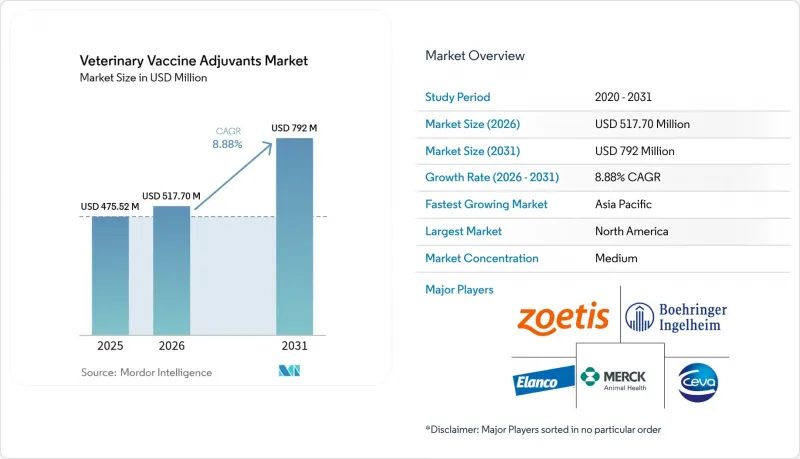
This report is Segmented by Type (Alum & Calcium Salts, Oil-Emulsion Adjuvants, and More), Route of Administration (Intramuscular, Subcutaneous, Intradermal, Intranasal/Mucosal, Oral), Animal Type (Livestock, Poultry, Companion Animals, Aquaculture), and Geography (North America, Europe, Asia-Pacific, Middle East & Africa, South America). The Market Forecasts are Provided in Terms of Value (USD).
Global Veterinary Vaccine Adjuvants Market Trends and Insights
Expanding Global Animal Protein Consumption
Global meat output is projected to climb by 12% between 2024 and 2034, boosting stocking densities and reliance on vaccines. India's 5.2 billion-bird poultry flock now adheres to mandatory Newcastle disease immunization, and Montanide ISA 71 VG cut mortality by 18 percentage points versus alum in large broiler houses. Southeast Asian aquaculture producers adopt chitosan-adjuvanted immersion vaccines, raising efficacy to 70% from 45%, underscoring the adjuvant's value despite regulatory fragmentation.
Rising Incidence of Emerging and Re-Emerging Livestock Diseases
The 2024 H5N1 incursion into 129 U.S. dairy herds triggered USD 98 million in emergency vaccine procurement after alum-based shots failed to curb shedding. Oil-emulsion plus TLR7/8 agonist combinations lowered nasal viral titers by 2.3 log10 in experimental cattle, while Europe's 2025 foot-and-mouth flare-up compelled purchase of 4.5 million oil-adjuvanted doses. Persistent African swine fever outbreaks are accelerating the development of saponin-adjuvanted subunit vaccines now in Phase II trials.
Adverse Reactions and Safety Concerns with Oil-Based Adjuvants
EMA surveillance recorded 127 granuloma cases in cattle vaccinated with Montanide ISA 206 during 2024, slicing carcass value by EUR 45-60 per head and driving producers toward alum despite shorter protection. Companion-animal veterinarians cite a 14% sterile abscess rate in dogs receiving oil-adjuvanted leptospirosis vaccines, versus 2% with alum-adjuvanted vaccines, reshaping purchasing decisions.
Other drivers and restraints analyzed in the detailed report include:
- Strengthening Government Immunization Mandates and Subsidies
- Growing Focus on One-Health & Zoonosis Prevention
- Complex and Fragmented Regulatory Approval Pathways
For complete list of drivers and restraints, kindly check the Table Of Contents.
Segment Analysis
Alum and calcium salts held 46.55% of 2025 revenue, supported by USD 0.08-0.12 per-dose costs and a robust safety record. Particulate and nanoparticle systems are forecast to advance at a 10.85% CAGR, supported by companion-animal demand for formulations with minimal injection-site reactions. Oil-emulsion products such as Montanide and Emulsigen remain essential for inactivated viral vaccines that require strong cell-mediated immunity. Saponin platforms like Quil-A and the emerging Matrix-M add premium options, while pathogen-derived CpG and MPLA adjuvants remain niche due to manufacturing cost. Combination approaches-alum plus TLR agonists are emerging fastest, propelled by Ingelvac CircoFLEX's double-digit growth. Polymer systems, however, must overcome endotoxin contamination incidents that led to FDA warnings in 2024. Venture-backed startups are funneling capital into thermostable virus-like particles, hinting at future cost parity with alum if scale hurdles are overcome.
Complete Report Scope:
- By Type
- Alum & Calcium Salts
- Oil-Emulsion Adjuvants (W/O, O/W, W/O/W)
- Saponin-based (Quil A, QS-21, flavonoid)
- Pathogen-derived (MPLA, CpG, TLR agonists)
- Particulate / Nanoparticle (liposomes, Nano-11, VLPs)
- Polymer & Carbomer Systems
- Combination / Next-Gen Emulsions
- Other Types
- By Route of Administration
- Intramuscular
- Subcutaneous
- Intradermal
- Intranasal / Mucosal
- Oral
- By Animal Type
- Livestock
- Cattle & Buffalo
- Sheep & Goat
- Swine
- Poultry
- Companion Animals
- Canine
- Feline
- Equine
- Aquaculture
- Livestock
- Geography
- North America
- United States
- Canada
- Mexico
- Europe
- Germany
- United Kingdom
- France
- Italy
- Spain
- Rest of Europe
- Asia-Pacific
- China
- Japan
- India
- Australia
- South Korea
- Rest of Asia-Pacific
- Middle East and Africa
- GCC
- South Africa
- Rest of Middle East & Africa
- South America
- Brazil
- Argentina
- Rest of South America
- North America
Geography Analysis
North America led with 37.21% of 2025 revenue, underpinned by USDA's rapid-response procurement and FDA-CVM's conditional-license pathway that cleared 14 novel adjuvants during 2024-2025. The H5N1 emergency validated domestic manufacturing: Zoetis and Elanco expanded plants with in-house emulsion suites, insulating the supply chain. Canada's research universities punch above their weight in nanoparticle science, while Mexico's privatizing vaccine market offers a USD 55 million window for thermostable adjuvants suited to warm regions.
Asia-Pacific, forecast to grow at 9.89% CAGR, is on track to surpass North America by 2029. China's aquaculture subsidy reimburses 60% of oil-emulsion vaccines, adding 22 million doses in its first year. India's National Livestock Mission funds adjuvant procurement and cold-chain upgrades, thereby expanding the veterinary vaccine adjuvant market at the state level. Japan and South Korea approve liposome-adjuvanted canine vaccines, signaling premiumization, while Australia's A$350 million Zoetis plant expansion cements regional export capacity.
Europe maintains a significant share but faces higher compliance costs after EMA's 2025 surveillance rule for oil-emulsions. Emergency FMD outbreaks in Bulgaria and Romania sparked a rapid draw-down of 4.5 million oil-adjuvanted doses, spotlighting cold-chain gaps in Eastern states. Ceva's new French plant, ISO-14001 certified, anchors the continent's shift toward plant-derived squalene. South America streamlines dossiers Brazil cut approval time to 18 months for adjuvants vetted in the U.S. or EU potentially lifting imports by USD 20 million by 2027. The Middle East and Africa show the greatest unmet need; thermostable carbomer vaccines stored at 25 °C posted 74% efficacy in Kenyan trials, 22 percentage points above alum, hinting at latent demand once affordability improves.
- Bioveta
- Boehringer Ingelheim
- Ceva Sante Animale
- Croda International (Avanti / Brenntag Biosector)
- Elanco
- Merck
- OZ Biosciences
- Phibro Animal Health
- SEPPIC (Air Liquide)
- SPI Pharma
- Thermo Fisher Scientific
- Vaxine Pty
- VaxLiant
- Zoetis
Additional Benefits:
- The market estimate (ME) sheet in Excel format
- 3 months of analyst support
TABLE OF CONTENTS
1 Introduction
- 1.1 Study Assumptions & Market Definition
- 1.2 Scope of the Study
2 Research Methodology
3 Executive Summary
4 Market Landscape
- 4.1 Market Overview
- 4.2 Market Drivers
- 4.2.1 Expanding Global Animal Protein Consumption
- 4.2.2 Rising Incidence of Emerging and Re-Emerging Livestock Diseases
- 4.2.3 Strengthening Government Immunization Mandates and Subsidies
- 4.2.4 Shift Toward High-Value Subunit and mRNA Veterinary Vaccines
- 4.2.5 Growing Focus on One Health and Zoonosis Prevention
- 4.2.6 Intensifying Commercial Livestock Intensification in Developing Regions
- 4.3 Market Restraints
- 4.3.1 Adverse Reactions and Safety Concerns with Oil-Based Adjuvants
- 4.3.2 Complex and Fragmented Regulatory Approval Pathways
- 4.3.3 High Development and Scale-Up Costs for Novel Adjuvants
- 4.3.4 Dependency on Limited Sources for Critical Raw Materials
- 4.4 Regulatory Landscape
- 4.5 Porter's Five Forces Analysis
- 4.5.1 Threat of New Entrants
- 4.5.2 Bargaining Power of Buyers
- 4.5.3 Bargaining Power of Suppliers
- 4.5.4 Threat of Substitutes
- 4.5.5 Intensity of Rivalry
5 Market Size & Growth Forecasts (Value, USD)
- 5.1 By Type
- 5.1.1 Alum & Calcium Salts
- 5.1.2 Oil-Emulsion Adjuvants (W/O, O/W, W/O/W)
- 5.1.3 Saponin-based (Quil A, QS-21, flavonoid)
- 5.1.4 Pathogen-derived (MPLA, CpG, TLR agonists)
- 5.1.5 Particulate / Nanoparticle (liposomes, Nano-11, VLPs)
- 5.1.6 Polymer & Carbomer Systems
- 5.1.7 Combination / Next-Gen Emulsions
- 5.1.8 Other Types
- 5.2 By Route of Administration
- 5.2.1 Intramuscular
- 5.2.2 Subcutaneous
- 5.2.3 Intradermal
- 5.2.4 Intranasal / Mucosal
- 5.2.5 Oral
- 5.3 By Animal Type
- 5.3.1 Livestock
- 5.3.1.1 Cattle & Buffalo
- 5.3.1.2 Sheep & Goat
- 5.3.1.3 Swine
- 5.3.2 Poultry
- 5.3.3 Companion Animals
- 5.3.3.1 Canine
- 5.3.3.2 Feline
- 5.3.3.3 Equine
- 5.3.4 Aquaculture
- 5.3.1 Livestock
- 5.4 Geography
- 5.4.1 North America
- 5.4.1.1 United States
- 5.4.1.2 Canada
- 5.4.1.3 Mexico
- 5.4.2 Europe
- 5.4.2.1 Germany
- 5.4.2.2 United Kingdom
- 5.4.2.3 France
- 5.4.2.4 Italy
- 5.4.2.5 Spain
- 5.4.2.6 Rest of Europe
- 5.4.3 Asia-Pacific
- 5.4.3.1 China
- 5.4.3.2 Japan
- 5.4.3.3 India
- 5.4.3.4 Australia
- 5.4.3.5 South Korea
- 5.4.3.6 Rest of Asia-Pacific
- 5.4.4 Middle East and Africa
- 5.4.4.1 GCC
- 5.4.4.2 South Africa
- 5.4.4.3 Rest of Middle East & Africa
- 5.4.5 South America
- 5.4.5.1 Brazil
- 5.4.5.2 Argentina
- 5.4.5.3 Rest of South America
- 5.4.1 North America
6 Competitive Landscape
- 6.1 Market Concentration
- 6.2 Market Share Analysis
- 6.3 Company Profiles (includes Global level Overview, Market level overview, Core Business Segments, Financials, Headcount, Key Information, Market Rank, Market Share, Products and Services, and analysis of Recent Developments)
- 6.3.1 Bioveta AS
- 6.3.2 Boehringer Ingelheim Vetmedica
- 6.3.3 Ceva Sante Animale
- 6.3.4 Croda International (Avanti / Brenntag Biosector)
- 6.3.5 Elanco Animal Health
- 6.3.6 Merck Animal Health
- 6.3.7 OZ Biosciences
- 6.3.8 Phibro Animal Health
- 6.3.9 SEPPIC (Air Liquide)
- 6.3.10 SPI Pharma
- 6.3.11 Thermo Fisher Scientific
- 6.3.12 Vaxine Pty
- 6.3.13 VaxLiant
- 6.3.14 Zoetis
7 Market Opportunities & Future Outlook
- 7.1 White-space & Unmet-Need Assessment