

|
시장보고서
상품코드
2122806
지오텍스타일 : 시장 점유율 분석, 업계 동향 및 통계, 성장 예측(2026-2031년)Geotextile - Market Share Analysis, Industry Trends & Statistics, Growth Forecasts (2026 - 2031) |
||||||
 Mordor Intelligence
지오텍스타일 시장 규모는 2025년 42억 9,000만 달러로 평가되었습니다. 2026년에는 47억 4,000만 달러로 확대되어 2026년부터 2031년에 걸쳐 CAGR 10.39%로 성장을 지속하여, 2031년에는 77억 7,000만 달러에 이를 것으로 예측됩니다.

본 보고서는 소재(폴리프로필렌, 폴리에스터 등), 직물 유형(직물, 부직포, 니트),기능(분리, 배수, 여과 등), 용도(도로 건설·포장 보수, 침식 방지 등), 지역(아시아태평양, 북미, 유럽, 남미, 중동 및 아프리카)별로 분류되어 있습니다. 시장 예측은 금액(달러) 기준으로 제시되어 있습니다.
세계의 지오텍스타일 시장 동향 및 인사이트
도로 및 고속도로 인프라 프로젝트에서의 채택 확대
2026 회계연도 미국 연방 예산에서는 고속도로에 1,113억 달러가 배정되었으며, 이 중 72억 달러가 교량 재건축에 할당되었습니다. 이에 따라 분리용 및 보강용 지오텍스타일에 대한 다년간 수요가 확고해졌습니다. 인도에서는 2025년에 8,500킬로미터의 국도 건설 계약이 체결되었으며, 몬순 지역의 지반 침하를 억제하기 위해 지오텍스타일 층이 포함되었습니다. 중국에서는 2026년 초에 4,200킬로미터의 고속도로가 승인되었으며, 현재 장쑤성과 저장성의 연질 점토 지대 노선에서는 지반 보강용 지오신세틱의 사용이 의무화되어 있습니다. 아세안 전역에서는 교통 회랑에서 자갈 노반 아래에 부직포 여과층을 사용하여 미세 입자의 이동을 억제하고 있습니다. 계약 형태는 최저가 입찰에서 보증 및 원격 모니터링을 결합한 성능 기반 계약으로 전환되고 있으며, 통합 설계 플랫폼을 보유한 공급업체가 유리한 입장에 있습니다.
수자원 관리 시설에서의 여과 및 배수 수요 증가
2025년, EU의 유틸리티자들은 빗물 처리 시설 개보수에 180억 유로를 투자했으며, 독일 및 네덜란드의 배수 기준에 따라 내구 연한을 50년으로 연장하기 위해 지오텍스타일로 피복된 천공 파이프의 사용이 규정되었습니다. 미국 환경보호청(EPA)은 2025년 ‘깨끗한 물 주 순환 기금(Clean Water State Revolving Fund)’을 통해 68억 달러를 지출했습니다. 많은 처리 시설에서는 부유 물질 제한치를 충족하기 위해 인공 습지에 지오텍스타일 재질의 여과층을 채택하고 있습니다. 인도의 ‘잘 지반 미션(Jal Jivan Mission)’에서는 건조한 주 전역에서 지오텍스타일로 보강된 침투 갤러리의 규모를 확대하고 있는 반면,호주 머레이-달링 강 유역 현대화 사업에서는 염분 농도 상승을 억제하기 위해 니들펀치 원단으로 감싼 지하 배수관 설치에 자금이 투입되고 있습니다. 이러한 프로그램을 통해 지오텍스타일은 단순한 범용 섬유 소재가 아니라, 측정 가능한 운영 비용(OPEX) 절감을 실현하는 공학적 시스템으로 재정의되고 있습니다.
원유 가격에 연동되는 폴리프로필렌 및 폴리에스터 가격 변동
OPEC+의 감산으로 나프타 공급이 부족해짐에 따라, 2026년 1분기 아시아의 폴리프로필렌 가격은 톤당 1,150달러로 예측되며, 이는 2025년 4분기 대비 18% 상승한 수치입니다. 유럽의 폴리에스터 단섬유는 정유시설의 가동 중단과 가스 가격 급등으로 인해 톤당 1,420유로(1,530달러)에 달했습니다. 가공업체들은 고객에 대한 판매 가격을 12-18개월 동안 고정하고 있지만, 수지 조달은 매월 이루어지기 때문에 가격 급등이 15%를 초과하면 이익률이 압박을 받게 됩니다. 헤지 수단이 없는 중소 가공업체들은 현금 흐름의 압박에 직면하고 있으며, 이로 인해 프로젝트 지연이나 원단 사양 하향 조정이 발생하고 있습니다.
부문별 분석
폴리프로필렌은 2025년 매출의 57.38%를 차지했으며, 교통 부문이 재활용 함량보다 알칼리성 토양에 대한 내성을 우선시함에 따라 2031년까지 연평균 성장률(CAGR) 11.33%로 성장하고 있습니다. 폴리에스터는 rPET 공급 부족으로 제약을 받고 있지만, 광미 댐 보강재와 같이 높은 인장 강도가 요구되는 용도에서는 여전히 필수적입니다. 폴리에틸렌은 자외선이 강한 매립지 덮개 시장에서 틈새 시장을 차지하고 있으며, 그 높은 성형성 덕분에 프리미엄 가격이 정당화되고 있습니다. 코코넛 섬유나 황마와 같은 천연섬유는 남아시아 및 동아프리카에서 단기적인 침식 방지 대책으로 활용되고 있습니다. 바이오 폴리프로필렌 시범 프로젝트에서는 2028년까지 재생 가능 원료 비율을 30%로 높이는 것을 목표로 하고 있으나, 본격적인 확대 적용을 위해서는 25%의 비용 격차를 해소해야 합니다.
폴리프로필렌의 소수성 덕분에 습기로 인한 노반의 약화를 방지할 수 있어, 중국과 인도의 고속도로에서는 포장 수명을 최대 20년까지 연장하고 있습니다. 폴리에스테르의 파단 성장률이 50%를 초과하기 때문에 극심한 변형 흡수가 요구되는 성토층에서 견인력을 유지합니다. 폴리에틸렌의 자외선 저항성 덕분에, 내구 연한이 50년을 초과하는 노출된 해안 호안에서의 사용이 보장됩니다. 천연섬유는 완만한 사면에서 생분해성 요건을 충족하지만, 인장 강도가 20 kN/m 미만이라는 한계가 있습니다.
2025년에는 1,400 N 이상의 그랩 인장 강도가 필요한 비포장 도로 및 철도 노반의 고하중 보강 용도에서 직물 제품이 매출의 45.26%를 차지했습니다. 부직포는 2031년까지 연평균 성장률(CAGR) 11.54%로 가장 빠르게 성장하고 있으며, 1×10-³m/s 이상의 투수성이 필요한 매립지 및 배수 사양을 충족합니다. 니트 지오텍스타일은 3차원적인 상호 연결을 통해 토양의 유지력을 높이는 특수한 호안 공사에 사용됩니다. 또한, 직물 재질의 실 격자와 부직포 재질의 필터 웹을 결합한 하이브리드 제품이 등장하여, 밸러스트와 연약 지반이라는 두 가지 요건을 동시에 충족시키고 있습니다.
EU의 매립지 복토 관련 규제는 사실상 부직포 재질의 배수층 사용을 의무화하고 있어, 2030년까지 꾸준한 수요를 창출하고 있습니다. 아시아태평양의 광산 업체에서는 광미 댐용으로 100 kN/m 이상의 강도를 가진 직물로 업그레이드가 진행되고 있으며, 이는 표준 니들펀치 부직포로는 달성할 수 없는 강도입니다. 한편, 인도의 2025년 포장 지침에서는 교통량이 적은 도로에서 스펀본드 부직포의 사용이 허용되어, 지방 도로망에서 비용 절감 움직임이 가속화되었습니다.
지역별 분석
아시아태평양은 2025년 매출의 39.58%를 차지하며, 중국의 고속도로 건설 붐과 폴리프로필렌 분리층의 표준화를 추진하는 인도의 ‘바라트마라’ 건설 프로젝트를 배경으로 연평균 성장률(CAGR) 11.89%를 기록하며 다른 지역을 앞질렀습니다. 동남아시아에서는 2025년에 국경을 넘는 고속도로 건설에 180억 달러를 투자하고, 미세 입자의 이동을 최소화하기 위해 부직포 여과재의 사용을 지정했습니다. 일본과 한국은 신규 개발 부지가 제한적이기 때문에 고강도 폴리에스터 직물을 선호하는 개보수 공사나 해안 침식 방지 공사로 중점을 옮기고 있습니다.
북미에서는 ‘인프라 투자 및 고용법’과 캐나다의 335억 캐나다 달러 예산 배정이 시장을 뒷받침하고 있습니다. 2026 회계연도 예산에서는 미국 고속도로에 1,113억 달러가 배정되어 있으며, 인력 부족 및 인허가 절차 지연으로 인해 일부 조달이 2027년까지 미뤄지더라도 장기적인 수요는 유지될 전망입니다. 멕시코에서는 연방 간선 도로의 공사 기간을 단축하기 위해 지오텍스타일 공급을 턴키 방식의 EPC 계약에 포함시키고 있습니다.
유럽에서는 2030년까지 4,000만-5,000만 m²의 배수층 설치가 의무화되어 있습니다. 독일의 UBA(연방환경청)는 투수성 기준치를 강화하고 있으며, 이에 따라 수요는 니들펀치 부직포로 이동하고 있습니다. 한편, 영국에서는 나무 뿌리나 설치류의 천공을 방지하기 위한 보호층 설치가 의무화되어 있습니다. 남미에서는 브라질의 450억 레알 규모의 PAC 도로 및 연안 항만 사업이 주도적인 역할을 하고 있습니다. 중동 및 아프리카에서는 사우디아라비아의 NEOM 고속도로망과 UAE의 사막 도로 안정화 공사가 견인 역할을 하고 있습니다.
기타 혜택 :
- 엑셀 형식 시장 예측(ME) 시트
- 3개월간의 애널리스트 지원
자주 묻는 질문
목차
제1장 서론
제2장 조사 방법
제3장 주요 요약
제4장 시장 구도
제5장 시장 규모 및 성장 예측
제6장 경쟁 구도
제7장 시장 기회 및 향후 전망
KTH 26.09.08According to Mordor Intelligence, the geotextile market size is expected to grow from USD 4.29 billion in 2025 to USD 4.74 billion in 2026 and is forecast to reach USD 7.77 billion by 2031 at 10.39% CAGR over 2026-2031.
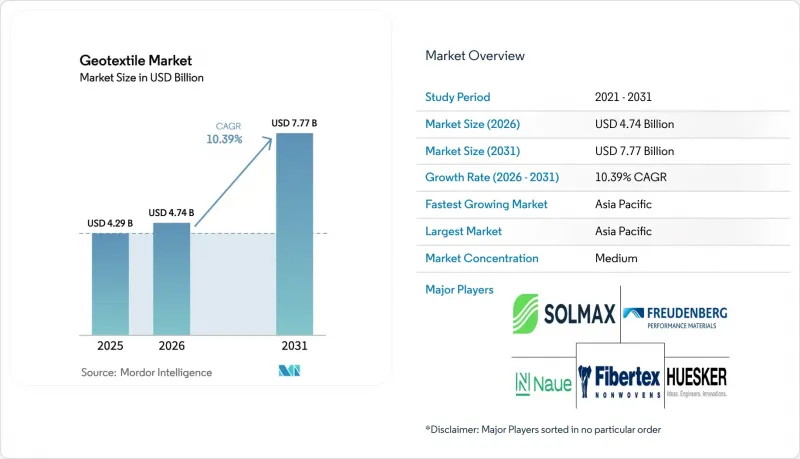
This report is Segmented by Material (Polypropylene, Polyester, and More), Fabric Type (Woven, Non-Woven, and Knitted), Function (Separation, Drainage, Filtration, and More), Application (Road Construction and Pavement Repair, Erosion, and More), and Geography (Asia-Pacific, North America, Europe, South America, and Middle-East and Africa). The Market Forecasts are Provided in Terms of Value (USD).
Global Geotextile Market Trends and Insights
Growing Adoption in Road and Highway Infrastructure Projects
The FY2026 U.S. federal budget earmarks USD 111.3 billion for highways, including USD 7.2 billion for bridge replacement, cementing a multi-year pull for separation and reinforcement fabrics. India awarded 8,500 kilometers of national highways during 2025, embedding geotextile layers to curb settlement in monsoon regions. China cleared 4,200 kilometers of expressways in early 2026 and now mandates soil-reinforcement geosynthetics for soft-clay corridors in Jiangsu and Zhejiang. Across ASEAN, connectivity corridors use non-woven filtration layers beneath crushed-stone bases to stem fines migration. Contracts have shifted from lowest bid to performance-based deals that bundle warranties and remote monitoring, favoring suppliers with integrated design platforms.
Rising Demand for Filtration and Drainage in Water-Management Assets
EU utilities spent EUR 18 billion on stormwater upgrades in 2025, codifying geotextile-wrapped perforated pipes in German and Dutch drainage norms to prolong service life to 50 years. The U.S. EPA disbursed USD 6.8 billion under the Clean Water State Revolving Fund in 2025, with many plants adopting geotextile filtration layers in constructed wetlands to meet suspended-solids limits. India's Jal Jeevan Mission scales infiltration galleries lined with geotextiles across arid states, while Australia's Murray-Darling Basin modernization finances subsurface drains wrapped in needle-punched fabrics to curb salinity. These programs reposition geotextiles as engineered systems that deliver measurable OPEX reductions rather than generic textile inputs.
Crude-Oil-Linked Volatility in Polypropylene and Polyester Prices
Polypropylene is projected at USD 1,150/ton in Asia during Q1 2026, 18% above Q4 2025 after OPEC+ cuts squeezed naphtha supply. European polyester staple fiber hit EUR 1,420/ton (USD 1,530) on refinery outages and high gas prices. Fabricators lock customer prices for 12-18 months but procure resin monthly, eroding margins when spikes exceed 15%. Smaller converters without hedging instruments face cash-flow stress, leading to project delays or downgraded fabric specs.
Other drivers and restraints analyzed in the detailed report include:
- Stricter Global Landfill and Wastewater Regulations
- Accelerating Investment in Mining Tailings-Dam De-Risking
- rPET Diversion to Beverage Packaging Tightening PET Supply
For complete list of drivers and restraints, kindly check the Table Of Contents.
Segment Analysis
Polypropylene held 57.38% of 2025 revenue and is growing at an 11.33% CAGR to 2031 as transportation agencies prioritize alkaline-soil resistance over recycled content. Polyester is constrained by rPET scarcity and remains indispensable for high-tensile applications like tailings-dam reinforcement. Polyethylene occupies niche in UV-intensive landfill caps where conformability justifies its premium. Natural fibers such as coir and jute fill in short-term erosion control across South Asia and East Africa. Bio-based polypropylene pilots target 30% renewable feedstock by 2028, yet must close a 25% cost gap before scaling.
Polypropylene's hydrophobicity prevents moisture-induced subgrade weakening, extending pavement life by up to 20 years on Chinese and Indian motorways. Polyester's elongation at break above 50% retains traction in embankment lifts requiring extreme strain absorption. Polyethylene's UV stability secures use in exposed coastal revetments where service life exceeds 50 years. Natural fibers meet biodegradable mandates on gentle slopes but remain limited by tensile ceilings below 20 kN/m.
Woven commanded 45.26% revenue in 2025 for high-load reinforcement of unpaved roads and rail beds that demand more than 1,400 N grab tensile strength. Non-wovens are the fastest risers at 11.54% CAGR through 2031, answering landfill and drainage specs that require more than 1X10⁻³ m/s permeability. Knitted geotextiles handle specialized revetments where 3-D interlocking boosts soil retention. Hybrid lines combining woven yarn grids with non-woven filter webs emerge to meet ballast and soft-soil dual requirements.
EU landfill caps effectively prescribe non-woven drainage layers, creating sticky demand through 2030. Asia-Pacific miners are upgrading to woven fabrics rated at >=100 kN/m for tailings dams, a strength unattainable for standard needle-punched webs. India's 2025 pavement guidance, however, opens light-traffic roads to spunbond non-wovens, triggering a cost-down swing for rural corridors.
Complete Report Scope:
- By Material
- Polypropylene
- Polyester
- Polyethylene
- Other Materials
- By Fabric Type
- Woven
- Non-woven
- Knitted
- By Function
- Separation
- Drainage
- Filtration
- Reinforcement
- Protection
- By Application
- Road Construction and Pavement Repair
- Erosion
- Drainage
- Railworks
- Agriculture
- Other Applications (Mining Operations, Coastal and Waterway Protection, etc.)
- By Geography
- Asia-Pacific
- China
- India
- Japan
- South Korea
- Thailand
- Malaysia
- Indonesia
- Vietnam
- Rest of Asia-Pacific
- North America
- United States
- Canada
- Mexico
- Europe
- Germany
- France
- United Kingdom
- Italy
- Spain
- NORDIC Countries
- Rest of Europe
- South America
- Brazil
- Argentina
- Colombia
- Rest of South America
- Middle-East and Africa
- Saudi Arabia
- United Arab Emirates
- Qatar
- South Africa
- Nigeria
- Egypt
- Rest of Middle-East and Africa
- Asia-Pacific
Geography Analysis
Asia-Pacific generated 39.58% of 2025 revenue and is outpacing peers at 11.89% CAGR on China's expressway surge and India's Bharatmala builds that standardize polypropylene separation layers. Southeast Asia invested USD 18 billion in 2025 for cross-border highways, specifying non-woven filtration fabrics to minimize fines migration. Japan and South Korea, with limited greenfield land, pivot to rehabilitation and coastal erosion works that prefer high-strength woven polyester.
North America is buoyed by the Infrastructure Investment and Jobs Act and Canada's CAD 33.5 billion allocation. FY2026 budgets earmark USD 111.3 billion for U.S. highways, sustaining long-cycle demand despite labor and permitting delays that push some procurement into 2027. Mexico bundles geotextile supply into turnkey EPC deals to compress timelines on federal corridors.
Europe mandates add 40-50 million m2 of drainage layers through 2030. Germany's UBA pushes permeability thresholds that tilt demand toward needle-punched webs, while the UK enforces protection layers to block root and rodent puncture. South America is led by Brazil's BRL 45 billion PAC roads and coastal ports. The Middle-East and Africa is paced by Saudi Arabia's NEOM highway grid and UAE desert road stabilization.
- ACE Geosynthetics
- AFITEXINOV
- AGRU America Inc.
- Amcor plc
- Asahi Kasei Advance Corporation
- Carthage Mills
- CMC
- Fibertex Nonwovens A/S
- Freudenberg Performance Materials
- HUESKER International
- Industrial Fabrics, Inc.
- KayTech
- Mattex Geosynthetics
- Naue GmbH & Co. KG
- Officine Maccaferri Spa
- Owens Corning
- Solmax
- Thrace Group
Additional Benefits:
- The market estimate (ME) sheet in Excel format
- 3 months of analyst support
TABLE OF CONTENTS
1 Introduction
- 1.1 Study Assumptions and Market Definition
- 1.2 Scope of the Study
2 Research Methodology
3 Executive Summary
4 Market Landscape
- 4.1 Market Overview
- 4.2 Market Drivers
- 4.2.1 Growing Adoption in Road and Highway Infrastructure Projects
- 4.2.2 Rising Demand for Filtration and Drainage in Water-Management Assets
- 4.2.3 Stricter Global Landfill and Wastewater Regulations
- 4.2.4 Accelerating Investment in Mining Tailings-Dam De-Risking
- 4.2.5 Mandatory Capping Layers Under EU Landfill Directive
- 4.3 Market Restraints
- 4.3.1 Crude Oil Linked Volatility in Polypropylene and Polyester Prices
- 4.3.2 rPET Diversion to Beverage Packaging Tightening PET Supply
- 4.3.3 Design-Engineering Talent Gap in Emerging Markets
- 4.4 Value Chain Analysis
- 4.5 Porter's Five Forces Analysis
- 4.5.1 Bargaining Power of Suppliers
- 4.5.2 Bargaining Power of Buyers
- 4.5.3 Threat of New Entrants
- 4.5.4 Threat of Substitutes
- 4.5.5 Degree of Competition
5 Market Size and Growth Forecasts (Value)
- 5.1 By Material
- 5.1.1 Polypropylene
- 5.1.2 Polyester
- 5.1.3 Polyethylene
- 5.1.4 Other Materials
- 5.2 By Fabric Type
- 5.2.1 Woven
- 5.2.2 Non-woven
- 5.2.3 Knitted
- 5.3 By Function
- 5.3.1 Separation
- 5.3.2 Drainage
- 5.3.3 Filtration
- 5.3.4 Reinforcement
- 5.3.5 Protection
- 5.4 By Application
- 5.4.1 Road Construction and Pavement Repair
- 5.4.2 Erosion
- 5.4.3 Drainage
- 5.4.4 Railworks
- 5.4.5 Agriculture
- 5.4.6 Other Applications (Mining Operations, Coastal and Waterway Protection, etc.)
- 5.5 By Geography
- 5.5.1 Asia-Pacific
- 5.5.1.1 China
- 5.5.1.2 India
- 5.5.1.3 Japan
- 5.5.1.4 South Korea
- 5.5.1.5 Thailand
- 5.5.1.6 Malaysia
- 5.5.1.7 Indonesia
- 5.5.1.8 Vietnam
- 5.5.1.9 Rest of Asia-Pacific
- 5.5.2 North America
- 5.5.2.1 United States
- 5.5.2.2 Canada
- 5.5.2.3 Mexico
- 5.5.3 Europe
- 5.5.3.1 Germany
- 5.5.3.2 France
- 5.5.3.3 United Kingdom
- 5.5.3.4 Italy
- 5.5.3.5 Spain
- 5.5.3.6 NORDIC Countries
- 5.5.3.7 Rest of Europe
- 5.5.4 South America
- 5.5.4.1 Brazil
- 5.5.4.2 Argentina
- 5.5.4.3 Colombia
- 5.5.4.4 Rest of South America
- 5.5.5 Middle-East and Africa
- 5.5.5.1 Saudi Arabia
- 5.5.5.2 United Arab Emirates
- 5.5.5.3 Qatar
- 5.5.5.4 South Africa
- 5.5.5.5 Nigeria
- 5.5.5.6 Egypt
- 5.5.5.7 Rest of Middle-East and Africa
- 5.5.1 Asia-Pacific
6 Competitive Landscape
- 6.1 Market Concentration
- 6.2 Strategic Moves
- 6.3 Market Share/Ranking Analysis
- 6.4 Company Profiles (includes Global-level Overview, Market-level Overview, Core Segments, Financials as available, Strategic Information, Market Rank/Share, Products and Services, and Recent Developments)
- 6.4.1 ACE Geosynthetics
- 6.4.2 AFITEXINOV
- 6.4.3 AGRU America Inc.
- 6.4.4 Amcor plc
- 6.4.5 Asahi Kasei Advance Corporation
- 6.4.6 Carthage Mills
- 6.4.7 CMC
- 6.4.8 Fibertex Nonwovens A/S
- 6.4.9 Freudenberg Performance Materials
- 6.4.10 HUESKER International
- 6.4.11 Industrial Fabrics, Inc.
- 6.4.12 KayTech
- 6.4.13 Mattex Geosynthetics
- 6.4.14 Naue GmbH & Co. KG
- 6.4.15 Officine Maccaferri Spa
- 6.4.16 Owens Corning
- 6.4.17 Solmax
- 6.4.18 Thrace Group
7 Market Opportunities and Future Outlook
- 7.1 White-space and Unmet-Need Assessment
- 7.2 Rising Awareness about Water Conservation in the Manufacturing Sector


