

|
시장보고서
상품코드
2122823
치과용 시멘트 : 시장 점유율 분석, 업계 동향 및 통계, 성장 예측(2026-2031년)Dental Cement - Market Share Analysis, Industry Trends & Statistics, Growth Forecasts (2026 - 2031) |
||||||
 Mordor Intelligence
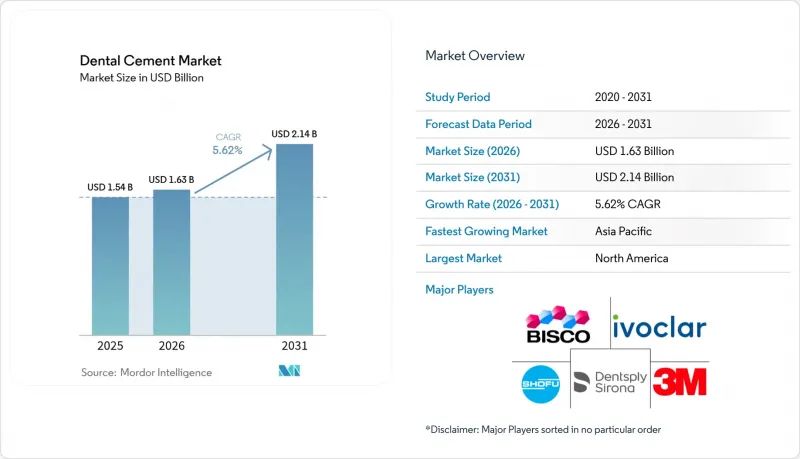
치과용 시멘트 시장 규모는 2026년에 16억 3,000만 달러로 추정되고 2025년 15억 4,000만 달러에서 성장하여 2031년에는 21억 4,000만 달러에 이를 것으로 예측됩니다.
2026년부터 2031년까지의 연평균 성장률(CAGR)은 5.62%가 될 것으로 전망됩니다.

본 보고서에서는 업계를 제품 유형별(임시 치아용 및 영구 치아용), 재료 유형별(글라스 아이오노머, 산화아연·유제놀,인산아연 등), 용도별(치수 보호, 시멘트 고정·접착 등), 최종 사용자별(병원, 치과, 기타 최종 사용자), 지역별(북미, 유럽, 아시아태평양 등)로 분류하고 있습니다. 시장 예측은 금액(달러) 기준으로 제시되어 있습니다.
세계의 치과용 시멘트 시장 동향 및 인사이트
충치 및 무치악 유병률 증가
2024년에는 치료받지 않은 충치 환자가 약 35억 명에 달할 것으로 예상되며, 이는 치과용 시멘트 시장을 뒷받침하는 지속적인 임상 업무량을 창출하고 있습니다. 인구 고령화에 따라 무치악 비율이 증가하고 있어, 고강도 영구 시멘트를 사용한 내구성이 뛰어난 보철 솔루션에 대한 수요가 높아지고 있습니다. 전 세계적인 경제적 부담(직접 비용 3,870억 달러, 간접 비용 3,230억 달러)은 재치료 주기를 최소화하는 시멘트의 필요성을 더욱 강조하고 있습니다. 생체 활성, 불소 방출 및 워크플로우 간소화를 실현하는 제조업체는 치과 시멘트 시장에서 비용에 민감한 의료 제공업체들 사이에서 채택이 확대되고 있습니다.
교정 및 보철 치과 치료 건수 증가
조사에 따르면, 젊은 성인의 20.6%가 얼라이너 치료를 받을 의향을 나타내고 있어, 세라믹 브라켓 및 투명 얼라이너용 어태치먼트와 호환되는 시멘트에 대한 수요가 증가하고 있습니다. CAD/CAM 및 3D 프린팅의 보급으로 진료 시간이 단축되고 심미성이 향상됨에 따라 보철 분야가 확대되고 있으며, 지르코니아, 리튬 디실리케이트 및 폴리머 침투형 세라믹에 접착하는 시멘트에 대한 수요가 증가하고 있습니다. 보철 분야에서의 로봇 공학 및 AI 도입으로 인해 접착 강도와 치은 밀착성에 관한 성능 기준이 높아지고 있습니다. 이러한 요인들이 치과용 시멘트 시장의 장기적인 수요 증가를 뒷받침하고 있습니다.
소규모 치과 병원의 높은 가격 민감도
2024년에는 독립 치과 진료소의 95%가 자재비 급등을 보고했으며, 2018년부터 2023년에 걸쳐 치과위생사의 임금이 26.6% 상승함에 따라 이익률이 압박받고 있습니다. 이러한 치과에서는 고가의 생체활성 시멘트를 저비용 대체품으로 교체하는 경우가 많아, 가격 탄력성이 높은 지역에서 시장 침투가 둔화되고 있습니다. 보험 환급 상한선은 조달상의 상충 관계를 심화시켜, 진료소가 시멘트 시스템을 선정할 때 치료의 총비용을 평가하도록 유도하고 있습니다. 신흥 시장에서는 이러한 동향이 첨단 배합 제품의 판매량 증가를 억제하여, 치과용 시멘트 시장 전체의 확장을 둔화시키고 있습니다.
부문별 분석
2025년, 영구용 제품은 치과 시멘트 시장 점유율의 71.80%를 차지했으며, 최종 크라운, 브릿지, 임플란트 수복에서 수행하는 역할로 인해 전체 매출을 지탱했습니다. ACTIVA BioACTIVE와 같은 강화된 생체활성 제제는 불소, 칼슘,인산 이온을 방출하여 재석회화를 촉진함과 동시에 2차 우식 위험을 경감시킵니다. 범용 자가접착형 시멘트는 별도의 프라이머가 필요하지 않아 임상 워크플로우를 간소화하고, 환자 수가 많은 진료소에서 의자 시간을 단축시킵니다.
임시 시멘트의 경우, 매출 규모는 작지만 다단계 임플란트 사례와 복잡한 수복 치료가 증가함에 따라 연평균 성장률(CAGR) 6.15%로 확대될 것으로 예측됩니다. 또한, 최종 장착 전 교합 확인을 위해 임시 치아를 사용하는 ‘당일 CAD/CAM 워크플로우’의 보급으로 수요가 더욱 촉진되고 있습니다. 오이게놀 무첨가 및 수지 강화형 임시 치아용 시멘트의 혁신으로, 제거 용이성을 저해하지 않으면서 안정성이 향상되어 치과용 시멘트 시장에서 환자 경험과 진료소의 효율성이 개선되고 있습니다.
지역별 분석
2025년에는 북미가 치과용 시멘트 시장 점유율의 39.05%를 차지하며 시장을 주도했습니다. 이는 선진적인 치과 인프라, 높은 보험 보급률, 그리고 디지털 치과의 광범위한 도입에 힘입은 결과입니다. 치과 서비스 조직의 확장으로 조달 프로토콜이 표준화되었으며, 프리미엄 생체활성 시스템의 도입이 가속화되고 있습니다. FDA의 510(k) 승인 절차를 통한 규제 명확화는 요건이 엄격해졌음에도 불구하고, 특히 범용 접착제 및 듀얼-큐어 제품에서 조기 시장 출시를 촉진하고 있습니다.
아시아태평양은 중산층 인구 증가와 인식 제고 캠페인의 강화에 힘입어 6.90%라는 가장 높은 연평균 성장률(CAGR)을 기록하고 있습니다. 인도에는 약 65,000개의 치과 병원이 있으며, 17억 달러 규모의 치과 생태계가 형성되어 있어 성능과 합리적인 가격의 균형을 갖춘 수복 재료에 대한 수요를 견인하고 있습니다. 중국에서는 급속한 도시화에 따라 수복 시술 건수가 증가하고 있는 반면, 일본과 한국은 첨단 재료 혁신과 고령자 돌봄에 대한 보험 지원을 통해 시장에 기여하고 있습니다. 그러나 치과 시멘트 시장에서 진료소들이 프리미엄 기능과 예산 제약을 저울질하기 때문에 가격에 대한 민감성으로 인해 다층적인 포트폴리오 전략이 필요합니다.
유럽에서는 2025년 1월 수은 아말감 사용 금지에 따라 재료 전환이라는 시급한 과제에 직면했으며, 이로 인해 수은을 포함하지 않는 불소 방출형 시멘트의 채택이 가속화되었습니다. 독일, 프랑스, 영국에서는 충실한 보철 치과 연수 프로그램과 심미 치료를 선호하는 소비자 경향에 힘입어 수요가 견인되고 있습니다. ISO 106 치과 규격에 따른 규제 조화로 제품 품질 기준이 높아지고 있으며, 생체 적합성이 입증되고 장기적인 임상 데이터를 보유한 제조업체가 유리한 입장에 있습니다.
기타 혜택 :
- 엑셀 형식 시장 예측(ME) 시트
- 3개월간의 애널리스트 지원
자주 묻는 질문
목차
제1장 서론
제2장 조사 방법
제3장 주요 요약
제4장 시장 구도
제5장 시장 규모 및 성장 예측
제6장 경쟁 구도
제7장 시장 기회 및 향후 전망
KTH 26.09.08According to Mordor Intelligence, dental cement market size in 2026 is estimated at USD 1.63 billion, growing from 2025 value of USD 1.54 billion with 2031 projections showing USD 2.14 billion, growing at 5.62% CAGR over 2026-2031.
This report Segments the Industry Into by Product Type (Temporary and Permanent ), by Material Type (Glass Ionomer, Zinc Oxide Eugenol, Zinc Phosphate and More), by Application (Pulpal Protection, Luting & Bonding and More), by End User (Hospitals, Dental Clinics, Other End Users), and Geography (North America, Europe, Asia-Pacific and More). The Market Forecasts are Provided in Terms of Value (USD).
Global Dental Cement Market Trends and Insights
Rising Prevalence of Dental Caries and Edentulism
Untreated dental caries affected nearly 3.5 billion people in 2024, establishing a persistent clinical workload that sustains the dental cement market. Aging demographics elevate edentulism rates and heighten demand for durable prosthodontic solutions that rely on high-strength permanent cements. The global economic burden-USD 387 billion in direct costs and USD 323 billion in indirect costs-reinforces the need for cements that minimize retreatment cycles. Manufacturers that demonstrate bio-activity, fluoride release, and simplified workflows strengthen adoption among cost-sensitive providers within the dental cement market.
Increasing Orthodontic & Prosthodontic Procedure Volumes
Surveys indicate 20.6% of young adults intend to pursue aligner therapy, intensifying demand for cements compatible with ceramic brackets and clear-aligner attachments. Prosthodontics is scaling as CAD/CAM and 3-D printing shorten chair time and elevate aesthetics, driving need for cements that bond to zirconia, lithium-disilicate, and polymer-infiltrated ceramics. Integration of robotics and AI in prosthodontics raises performance benchmarks for bond strength and marginal integrity. These factors reinforce long-term demand trajectories in the dental cement market.
High Price Sensitivity Among Small Dental Clinics
Ninety-five percent of independent practices reported higher supply costs in 2024, while hygienist wages increased 26.6% between 2018 and 2023, eroding margins. These clinics often substitute premium bio-active cements with lower-cost alternatives, slowing penetration in price-elastic regions. Insurance reimbursement ceilings exacerbate procurement trade-offs, prompting practices to evaluate total cost of care when selecting cement systems. In emerging markets, the dynamic limits volume growth for advanced formulations, moderating overall expansion in the dental cement market.
Other drivers and restraints analyzed in the detailed report include:
- Growth of Cosmetic / Aesthetic Dentistry
- Regulatory Push Toward Mercury-Free, Fluoride-Releasing Restoratives
- Stringent ISO 4049 & FDA 510(k) Performance Validations
For complete list of drivers and restraints, kindly check the Table Of Contents.
Segment Analysis
Permanent products held 71.80% of the dental cement market share in 2025, anchoring overall revenue due to their role in definitive crowns, bridges, and implant restorations. Enhanced bio-active formulations such as ACTIVA BioACTIVE release fluoride, calcium, and phosphate ions, promoting remineralization and mitigating secondary caries risk. Universal self-adhesive chemistries simplify clinical workflows by eliminating separate primers, reducing chair time for high-volume practices.
Temporary cements, although smaller in revenue, are forecast to expand at a 6.15% CAGR as multi-stage implant cases and complex rehabilitations proliferate. Demand is further buoyed by the rise of same-day CAD/CAM workflows that use temporary restorations for occlusal verification before final placement. Innovations in eugenol-free, resin-reinforced temporary cements improve stability without compromising retrievability, enhancing patient experience and clinic efficiency within the dental cement market.
Complete Report Scope:
- By Type
- Permanent
- Temporary
- By Material
- Zinc-Oxide Eugenol
- Zinc Phosphate
- Polycarboxylate
- Glass Ionomer
- Resin-Based
- Others
- By Application
- Pulpal Protection
- Luting & Bonding
- Restorations
- Surgical Dressing
- By Geography
- North America
- United States
- Canada
- Mexico
- Europe
- Germany
- United Kingdom
- France
- Italy
- Spain
- Rest of Europe
- Asia-Pacific
- China
- Japan
- India
- South Korea
- Australia
- Rest of Asia-Pacific
- Middle East and Africa
- GCC
- South Africa
- Rest of Middle East and Africa
- South America
- Brazil
- Argentina
- Rest of South America
- North America
Geography Analysis
North America led with 39.05% of the dental cement market share in 2025, underpinned by advanced dental infrastructure, high insurance penetration, and widespread adoption of digital dentistry. Expansion of dental service organizations is standardizing procurement protocols and accelerating uptake of premium bio-active systems. Regulatory clarity provided by FDA 510(k) pathways, despite added stringency, encourages early commercial launches, particularly for universal adhesive and dual-cure products.
Asia-Pacific delivers the fastest 6.90% CAGR, propelled by growing middle-class populations and heightened awareness campaigns. India hosts roughly 65,000 dental clinics and a USD 1.7 billion dental ecosystem, fuelling demand for restorative materials that balance performance with affordability. China's rapid urbanization raises restorative procedure volumes, while Japan and South Korea contribute through advanced materials innovation and insurance support for geriatric care. Nonetheless, price sensitivity dictates tiered portfolio strategies as clinics weigh premium features against budget constraints in the dental cement market.
Europe confronts immediate material transition challenges following the January 2025 mercury amalgam ban, instigating accelerated adoption of mercury-free, fluoride-releasing cements environment. Germany, France, and the United Kingdom spearhead demand given robust prosthodontic training programs and consumer preference for aesthetic treatments. Regulatory harmonization via ISO 106 dentistry standards elevates product quality thresholds, favoring manufacturers with documented biocompatibility and long-term clinical data.
- 3M
- Dentsply Sirona
- Danaher (Envista - Kerr)
- Ivoclar Vivadent
- GC Corporation
- SHOFU Dental
- Coltene Holding
- Kuraray Noritake Dental
- BISCO
- Medental International
- VOCO
- Tokuyama Dental
- Ultradent Products
- Septodont
- SDI
- Pulpdent
- DenMat Holdings
- DMG Chem-Pharma
- FGM Dental
- Kuraray America
Additional Benefits:
- The market estimate (ME) sheet in Excel format
- 3 months of analyst support
TABLE OF CONTENTS
1 Introduction
- 1.1 Study Assumptions & Market Definition
- 1.2 Scope of the Study
2 Research Methodology
3 Executive Summary
4 Market Landscape
- 4.1 Market Overview
- 4.2 Market Drivers
- 4.2.1 Rising prevalence of dental caries and edentulism
- 4.2.2 Increasing orthodontic & prosthodontic procedure volumes
- 4.2.3 Growth of cosmetic / aesthetic dentistry
- 4.2.4 Regulatory push toward mercury-free, fluoride-releasing restoratives (under-reported)
- 4.2.5 Rapid emergence of bio-active & nano-hybrid cement technologies (under-reported)
- 4.3 Market Restraints
- 4.3.1 High price sensitivity among small dental clinics
- 4.3.2 Stringent ISO 4049 & FDA 510(k) performance validations
- 4.3.3 Supply-chain crunch in specialty monomers & rare-earth fillers (under-reported)
- 4.3.4 Environmental scrutiny on eugenol & Bis-GMA disposal (under-reported)
- 4.4 Value / Supply-Chain Analysis
- 4.5 Regulatory Landscape
- 4.6 Technological Outlook
- 4.7 Porter's Five Forces
- 4.7.1 Threat of New Entrants
- 4.7.2 Bargaining Power of Suppliers
- 4.7.3 Bargaining Power of Buyers
- 4.7.4 Threat of Substitutes
- 4.7.5 Competitive Rivalry
5 Market Size & Growth Forecasts
- 5.1 By Type
- 5.1.1 Permanent
- 5.1.2 Temporary
- 5.2 By Material
- 5.2.1 Zinc-Oxide Eugenol
- 5.2.2 Zinc Phosphate
- 5.2.3 Polycarboxylate
- 5.2.4 Glass Ionomer
- 5.2.5 Resin-Based
- 5.2.6 Others
- 5.3 By Application
- 5.3.1 Pulpal Protection
- 5.3.2 Luting & Bonding
- 5.3.3 Restorations
- 5.3.4 Surgical Dressing
- 5.4 By Geography
- 5.4.1 North America
- 5.4.1.1 United States
- 5.4.1.2 Canada
- 5.4.1.3 Mexico
- 5.4.2 Europe
- 5.4.2.1 Germany
- 5.4.2.2 United Kingdom
- 5.4.2.3 France
- 5.4.2.4 Italy
- 5.4.2.5 Spain
- 5.4.2.6 Rest of Europe
- 5.4.3 Asia-Pacific
- 5.4.3.1 China
- 5.4.3.2 Japan
- 5.4.3.3 India
- 5.4.3.4 South Korea
- 5.4.3.5 Australia
- 5.4.3.6 Rest of Asia-Pacific
- 5.4.4 Middle East and Africa
- 5.4.4.1 GCC
- 5.4.4.2 South Africa
- 5.4.4.3 Rest of Middle East and Africa
- 5.4.5 South America
- 5.4.5.1 Brazil
- 5.4.5.2 Argentina
- 5.4.5.3 Rest of South America
- 5.4.1 North America
6 Competitive Landscape
- 6.1 Market Concentration
- 6.2 Market Share Analysis
- 6.3 Company Profiles (includes Global level Overview, Market level overview, Core Segments, Financials as available, Strategic Information, Market Rank/Share for key companies, Products & Services, and Recent Developments)
- 6.3.1 3M
- 6.3.2 Dentsply Sirona
- 6.3.3 Danaher (Envista - Kerr)
- 6.3.4 Ivoclar Vivadent
- 6.3.5 GC Corporation
- 6.3.6 SHOFU Dental
- 6.3.7 Coltene Holding
- 6.3.8 Kuraray Noritake Dental
- 6.3.9 BISCO
- 6.3.10 Medental International
- 6.3.11 VOCO GmbH
- 6.3.12 Tokuyama Dental
- 6.3.13 Ultradent Products
- 6.3.14 Septodont
- 6.3.15 SDI Limited
- 6.3.16 Pulpdent
- 6.3.17 DenMat Holdings
- 6.3.18 DMG Chem-Pharma
- 6.3.19 FGM Dental
- 6.3.20 Kuraray America
7 Market Opportunities & Future Outlook
- 7.1 White-space & Unmet-need Assessment


