

|
시장보고서
상품코드
2122865
광섬유 케이블 : 시장 점유율 분석, 업계 동향 및 통계, 성장 예측(2026-2031년)Fiber Optic Cable - Market Share Analysis, Industry Trends & Statistics, Growth Forecasts (2026 - 2031) |
||||||
 Mordor Intelligence
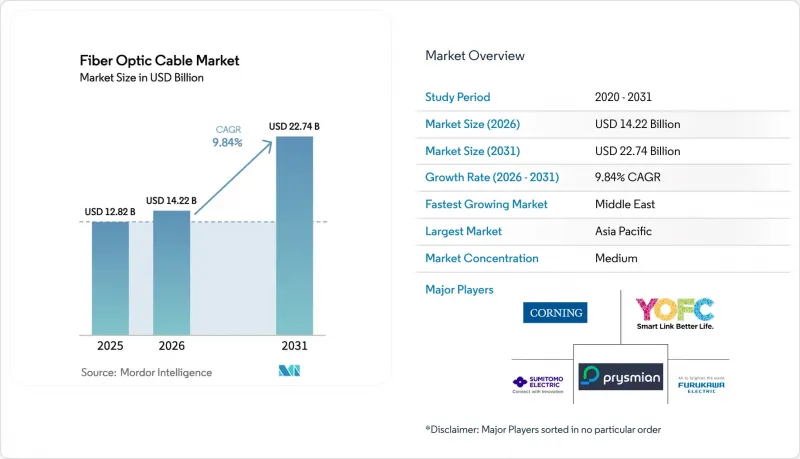
광섬유 케이블 시장 규모는 2025년에 128억 2,000만 달러로 평가되었습니다. 2026년 142억 2,000만 달러에서 2031년까지 227억 4,000만 달러에 이를 것으로 예상되며, 예측 기간(2026-2031년) CAGR은 9.84%를 나타낼 전망입니다.

본 보고서는 케이블 유형(기갑 케이블, 비기갑 케이블 등), 광섬유 모드(단일 모드 광섬유, 다중 모드 광섬유 등), 설치 방식(가공·가선, 지하·매설 등), 최종 사용자 산업(통신, 전력·스마트 그리드 등) 및 지역별로 분류되어 있습니다. 시장 예측은 금액(달러) 기준으로 제시되어 있습니다.
세계의 광섬유 케이블 시장 동향 및 인사이트
고속 인터넷의 보급과 데이터 트래픽의 급증
세계 IP 트래픽은 2025년에 4.8 제타바이트에 도달했고, 2028년까지 7.2 제타바이트를 넘어설 것으로 예상되며, 이는 기존 구리선 루프의 처리 능력을 압도하여 라스트 마일에서 광섬유로의 전환을 가속화하고 있습니다. 일본 가정의 광섬유 보급률은 2025년에 85%를 넘어섰으며, 이에 따라 통신 사업자들은 건물 내 병목 현상을 해소하기 위해 ‘Fiber-to-the-Room(FTTR)’으로의 개조를 추진하고 있습니다. 텔콤 인도네시아는 2025년에 1,200만 개의 새로운 광섬유 접속선을 설치하고, 모바일 네트워크에서는 원격 근무에 필요한 대역폭을 충족하지 못했던 교외 지역으로 서비스 제공 범위를 확대했습니다. 프리폼의 자동화를 통해 2024년부터 2025년에 걸쳐 제조 비용이 15% 절감되어 프로젝트의 수익성이 향상되고 네트워크 구축이 가속화되었습니다. 유럽 전자통신 규정에 따른 오픈 액세스 의무화로 인해 소규모 ISP의 진입 장벽이 더욱 낮아져 경쟁력 있는 네트워크 구축이 촉진되고 있습니다.
5G 구축 가속화와 파이버 딥 FTTx
미드밴드 5G 무선 장비에는 10밀리초 미만의 백홀 지연 시간이 필요하지만, 이를 제공할 수 있는 것은 전용 광섬유뿐입니다. 차이나모바일은 2025년에 광섬유로 연결된 5G 기지국 120만 곳을 가동하고, 각 기지국에서 500미터 이내에 광설비를 설치했습니다. T-Mobile USA의 지역 메트로 광섬유망 인수로 인해 임대된 다크 파이버 비용이 20% 절감되었으며, 그 자금을 지방 지역의 5G 확장에 재투자할 수 있게 되었습니다. 파이버 딥 아키텍처는 고비용의 리피터를 제거하고 운영을 간소화하기 위해, 혼잡한 도심 지역에서 분산 안테나 시스템을 대체하고 있습니다. 한국과 싱가포르의 건축 기준에서는 현재 신축 주택의 최소 기준으로 ‘FTTC(Fiber to the Curve)’가 규정되어 있어, 이를 통해 장기적인 안정적인 수요가 확보되고 있습니다.
높은 토목 공사비와 토지 임베디드의 복잡성
도시 지역의 광섬유 프로젝트 예산 중 최대 75%를 도랑 파기 및 도관 공사가 차지하고 있으며, 인력 부족으로 인해 2025년 뉴욕시에서 허가를 취득하기까지의 기간은 평균 14개월로 늘어났습니다. 마이크로 트렌칭은 40% 저렴하지만, 도로의 안전성에 대한 우려로 인해 유럽의 일부 도시에서 반대에 부딪히고 있어, 사업자들은 더 깊고 비용이 많이 드는 굴착 방식으로 되돌아갈 수밖에 없게 되었습니다. 공중 매설은 비용이 저렴하지만, 미국에서는 2025년에 전신주 설치비가 12% 상승하여 비용 면에서의 우위가 약화되었습니다. 명확한 개방 접근 규정이 없는 시장에서는 토지 사용권을 둘러싼 소송으로 인해 신규 진입 업체의 사업 개시가 최대 2년까지 지연될 가능성이 있으며, 이로 인해 수익 발생이 늦어지고 이자 부담이 증가하게 됩니다.
부문별 분석
2025년 매출액 중 34.11%를 방호형 설계가 차지했습니다. 이는 해상 풍력 발전소, 전력 송전 회랑, 해저 연결에서 기계적 보호가 요구되었기 때문이며, 내구성이 강화된 제품이 광섬유 케이블 시장에서 최대 점유율을 확보했습니다. 한편, 리본형 아키텍처는 데이터센터 사업자들이 연결 시간 단축과 도관 충전 효율 향상을 추구하고 있기 때문에 연평균 성장률(CAGR) 10.58%로 확대될 것으로 예측되며, 이는 광섬유 케이블 시장 전체를 크게 웃도는 속도입니다. 코닝사의 감을 수 있는 리본 케이블은 2인치 덕트 내에 3,456개의 광섬유를 수용할 수 있어, 혼잡한 도시 지역의 경로에 획기적인 변화를 가져옵니다. 일괄 융착 접속을 통해 작업 시간을 70% 단축할 수 있으며, 이는 만성적인 기술자 부족 상황에서 매우 중요한 지표가 됩니다. 또한, 굽힘에 강한 싱글모드 유리는 고밀도 매설 시 단선 위험을 줄여줍니다.
하이퍼스케일 환경에 그치지 않고, 리본 설계는 엄격한 기한이 정해진 보조금을 통한 자금 조달로 공사 기간을 단축한 건설을 희망하는 시공사들이 많은 지방 프로젝트에서도 도입이 확대되고 있습니다. 한편, 장갑형 케이블은 해저나 가혹한 지형에서 여전히 필수적인 존재입니다. 넥산스(Nexans)는 2025년, 트롤 어선의 충돌이나 해저 마모를 견디기 위해 북해 풍력 발전 허브에 450km의 이중 장갑 케이블을 공급했습니다. 그 결과, 장갑형 광섬유 케이블 시장 규모는 고밀도 리본 케이블만큼은 아니지만, 앞으로도 계속 확대될 전망입니다.
2025년, 싱글모드는 전 세계 출하량의 72.38%를 차지하며, 장거리, 메트로 및 FTTP(Fiber-to-the-Premises) 프로젝트의 주력 제품으로서의 입지를 확고히 했습니다. 방대한 도입 실적을 바탕으로 레거시 트랜시버와의 하위 호환성이 확보되어, 광섬유 케이블 시장에서 큰 점유율을 유지하고 있습니다. 그러나 연구 단계에 있는 멀티코어 및 다중 모드 스트랜드는 10.21%의 연평균 성장률(CAGR)을 기록하고 있으며, 이는 혼잡한 회선 구간에서 파장 업그레이드를 미루기 위한 통신 사업자들의 시험을 반영한 것입니다. NTT는 2025년, 4코어 유리를 사용하여 도쿄-오사카 간에서 1페타비트/초의 실증 시험에 성공하며, 그 확장성의 가능성을 입증했습니다.
다중 모드는 계속해서 단거리 캠퍼스 내 링크에 사용되고 있지만, 400G 및 800G 광 모듈의 경우 데이터센터 내에서도 단일 모드가 점점 더 선호되고 있어, 다중 모드의 장기적인 점유율은 축소되고 있습니다. 플라스틱 광섬유는 대역폭은 제한적이지만 전자기 내성이 뛰어나기 때문에 자동차용 LiDAR 및 공장 자동화 분야에서 틈새 역할을 유지하고 있습니다. 전반적으로 2031년까지는 싱글모드가 주류를 유지할 것으로 보이지만, 공간 분할 다중화(SDM) 시범 테스트를 통해 초대용량 백본에서 멀티코어 채택을 향한 진화의 방향성이 제시되고 있습니다.
지역별 분석
아시아태평양은 중국의 ‘Fiber-to-the-Room(FtR)’ 의무화, 인도의 ‘BharatNet’ 확장, 그리고 일본의 실내 회선 업그레이드로 인해 대규모 수요가 지속되면서 2025년 매출의 35.84%를 차지해 여전히 최대 지역으로 자리매김했습니다. 차이나 모바일(China Mobile)이 120만 곳의 광섬유 연결 5G 기지국을 구축한 것은 이 지역의 통신 사업자들이 누리는 규모의 경제를 여실히 보여줍니다. BharatNet의 마을 간 연결로 인해 키오스크의 평균 가동 중단 시간이 단축되고 프로젝트의 ROI가 강화될 뿐만 아니라, 주 정부에 의한 추가 예산 배정도 촉진되고 있습니다.
중동은 2031년까지 연평균 성장률(CAGR)이 10.91%에 달하고, 가장 빠르게 성장하는 지역으로 자리매김하고 있습니다. 사우디아라비아의 ‘NEOM’ 및 더 광범위한 ‘비전 2030’ 프로그램,아랍에미리트(UAE)의 ‘Fiber-to-the-Unit’ 의무화, 그리고 이집트에서 부상하고 있는 데이터센터 클러스터 덕분에 2025년에는 45만 건의 신규 광섬유 연결 건물이 창출되었습니다. 컴스코프(CommScope)의 리야드 조립 공장 합작 사업은 이러한 급증하는 수요에 대응하기 위한 공급망 현지화를 구현하는 좋은 사례입니다.
북미와 유럽에서는 한 자릿수 중반의 성장이 예상됩니다. 인구 밀집 도시 지역의 포화 상태는 미국 농무부(USDA)의 ‘ReConnect’ 보조금과 동유럽의 ‘기가비트 인프라법’에 기반한 프로젝트를 통해 상쇄되고 있습니다. 2025년, 미국 농촌 지역의 도입 비용은 가구당 평균 8,500달러로, 경쟁 관계에 있는 무선 및 위성 통신 옵션보다 수명 주기 비용이 낮았습니다. 남미에서는 브라질과 아르헨티나에 집중되어 있으며, 도시 지역의 ‘Fiber-to-the-Building(FTTB)’ 업그레이드를 통해 동축 케이블 네트워크가 대체되고 있습니다. Vivo사만 해도 2025년에 800만 회선의 FTTH 회선을 추가했습니다.
아프리카의 확산은 새로운 해저 케이블과 내륙의 백홀 회랑에 좌우됩니다. ‘2Africa’ 시스템을 통해 도매 가격이 최대 60% 인하됨에 따라, 현지 ISP는 서비스 계층을 확대할 수 있게 되었으며, 해안 상륙 지점에서 시작되는 육상 회선망 구축이 촉진되고 있습니다. 모든 지역에서 광섬유 케이블 시장은 디지털 포용과 데이터 주권 요건을 위한 정책 지원의 결합으로부터 혜택을 받고 있습니다.
기타 혜택 :
- 엑셀 형식 시장 예측(ME) 시트
- 3개월간의 애널리스트 지원
자주 묻는 질문
목차
제1장 서론
제2장 조사 방법
제3장 주요 요약
제4장 시장 구도
제5장 시장 규모 및 성장 예측
제6장 경쟁 구도
제7장 시장 기회 및 향후 전망
KTH 26.09.08According to Mordor Intelligence, the fiber optic cable market size was valued at USD 12.82 billion in 2025 and is estimated to grow from USD 14.22 billion in 2026 to reach USD 22.74 billion by 2031, at a CAGR of 9.84% during the forecast period (2026-2031).
This report is Segmented by Cable Type (Armored Cable, Non-Armored Cable, and More), Fiber Mode (Single-Mode Fiber, Multi-Mode Fiber, and More), Installation Type (Aerial/Overhead, Underground/Buried, and More), End-User Industry (Telecommunication, Power Utilities and Smart Grid, and More), and Geography. The Market Forecasts are Provided in Terms of Value (USD).
Global Fiber Optic Cable Market Trends and Insights
High-Speed Internet Penetration and Data-Traffic Surge
Global IP traffic climbed to 4.8 zettabytes in 2025 and is on pace to exceed 7.2 zettabytes by 2028, overwhelming legacy copper loops and fueling last-mile fiber conversions. Japan's household fiber penetration surpassed 85% in 2025, prompting operators to pursue fiber-to-the-room retrofits to eliminate in-building bottlenecks. Telkom Indonesia deployed 12 million new fiber drops in 2025, extending reach to suburban zones where mobile networks could not satisfy remote-work bandwidth needs. Preform automation trimmed manufacturing costs by 15% between 2024 and 2025, improving project returns and accelerating network rollouts. Open-access mandates under the European Electronic Communications Code further lower barriers for smaller ISPs, fostering competitive build-outs.
Accelerated 5G Roll-Outs and Fiber-Deep FTTx
Mid-band 5G radios require sub-10-millisecond backhaul latency that only dedicated fiber can supply. China Mobile activated 1.2 million fiber-fed 5G sites in 2025, placing optical plant within 500 meters of each tower. T-Mobile USA's acquisition of regional metro fiber trimmed leased-dark-fiber costs by 20%, reallocating capital toward rural 5G expansion. Fiber-deep architectures are displacing distributed-antenna systems in crowded downtowns because they remove costly repeaters and simplify operations. Building codes in South Korea and Singapore now specify fiber-to-the-curb as a minimum standard for new housing, locking in steady long-range demand.
High Civil-Works Cost and Right-of-Way Complexity
Trenching and conduit work represent up to 75% of urban fiber project budgets, and labor shortages pushed New York City permit cycles to an average 14 months in 2025. Micro-trenching, though 40% cheaper, faces opposition in several European cities over road-integrity concerns, forcing operators back to deeper, costlier digs. Aerial deployment is cheaper but pole-attachment fees in the United States rose 12% in 2025, eroding cost advantages. Right-of-way litigation can stall competitive entrants for up to two years in markets that lack clear open-access rules, delaying revenue and inflating interest costs.
Other drivers and restraints analyzed in the detailed report include:
- Hyperscale Data-Center Interconnect Demand
- Government-Backed Rural Broadband Programs
- Raw-Material Price Volatility and Helium Supply
For complete list of drivers and restraints, kindly check the Table Of Contents.
Segment Analysis
Armored designs held 34.11% of 2025 revenue as offshore wind farms, utility corridors, and subsea links demanded mechanical protection, securing the largest fiber optic cable market share for ruggedized products. Ribbon architectures, however, are forecast to expand at a 10.58% CAGR, well above the overall fiber optic cable market, as data-center operators chase splice-time savings and conduit-fill efficiency. Corning's rollable ribbon enables 3,456 fibers within a 2-inch duct, a game-changer for congested metro pathways. Mass-fusion splicing trims labor hours by 70%, a critical metric amid chronic technician shortages, while bend-insensitive single-mode glass reduces break risk during high-density pulls.
Beyond hyperscale environments, ribbon designs are winning rural projects where contractors prefer time-compressed builds financed by tight-deadline grants. Meanwhile, armored variants remain irreplaceable undersea and in harsh terrains; Nexans supplied 450 km of double-armored cable to the North Sea Wind Power Hub in 2025 to withstand trawler strikes and seabed abrasion. As a result, the fiber optic cable market size for armored lines will keep expanding, though at a slower rate than high-density ribbon.
Single-mode maintained 72.38% of global shipments in 2025, cementing its status as the workhorse for long-haul, metro, and fiber-to-the-premises projects. The enormous installed base safeguards backward compatibility with legacy transceivers, preserving its large fiber optic cable market share. Research-stage multi-core and few-mode strands, however, are recording a 10.21% CAGR, reflecting operator trials aimed at postponing wavelength upgrades on congested corridors. NTT achieved a 1-petabit-per-second field trial on a Tokyo-Osaka route using 4-core glass in 2025, underscoring the scalability path.
Multi-mode continues to serve short-reach campus links, but 400G and 800G optics increasingly favor single-mode even inside data halls, narrowing multi-mode's long-term footprint. Plastic optical fiber retains niche roles in automotive lidar and factory automation, prized for electromagnetic immunity despite limited bandwidth. Overall, single-mode will stay dominant through 2031, but spatial-division multiplexing pilots indicate an evolutionary path toward multi-core adoption in ultra-capacity backbones.
Complete Report Scope:
- By Cable Type
- Armored Cable
- Non-Armored Cable
- Ribbon Cable
- Other Cable Type
- By Fiber Mode
- Single-Mode Fiber
- Multi-Mode Fiber
- Plastic Optical Fiber
- By Installation Type
- Aerial / Overhead
- Underground / Buried
- Submarine / Under-Water
- Indoor / Drop Cables
- By End-User Industry
- Telecommunications
- Data Centers and Cloud Providers
- Power Utilities and Smart Grid
- Defense and Aerospace
- Industrial Automation and Control
- Healthcare and Medical
- Oil and Gas and Offshore
- Other End-User Industry
- By Geography
- North America
- United States
- Canada
- Mexico
- South America
- Brazil
- Argentina
- Rest of South America
- Europe
- Germany
- United Kingdom
- France
- Italy
- Spain
- Rest of Europe
- Asia Pacific
- China
- Japan
- India
- South Korea
- Rest of Asia Pacific
- Middle East
- Saudi Arabia
- United Arab Emirates
- Turkey
- Rest of Middle East
- Africa
- South Africa
- Nigeria
- Egypt
- Rest of Africa
- North America
Geography Analysis
Asia Pacific remained the largest region at 35.84% of 2025 revenue as China's fiber-to-the-room mandates, India's BharatNet expansion, and Japan's in-building upgrades sustained large volume pulls. China Mobile's deployment of 1.2 million fiber-connected 5G sites underscores the scale advantage enjoyed by the region's carriers. BharatNet's village links have reduced average kiosk downtime, reinforcing project ROI and encouraging additional state allocations.
The Middle East ranks as the fastest-growing geography at a 10.91% CAGR to 2031. Saudi Arabia's NEOM and broader Vision 2030 programs, the UAE's fiber-to-the-unit mandate, and Egypt's emerging data-center clusters created 450,000 new fiber premises in 2025. CommScope's joint venture for a Riyadh assembly plant exemplifies supply-chain localization to serve this demand burst.
North America and Europe exhibit mid-single-digit growth. Saturation in dense metros is balanced by USDA ReConnect grants and Eastern European Gigabit Infrastructure Act projects. Rural U.S. deployments averaged USD 8,500 per premise in 2025, offering lower lifecycle cost than competing wireless or satellite options. South America concentrates in Brazil and Argentina where urban fiber-to-the-building upgrades displace coax networks; Vivo alone added 8 million FTTH lines in 2025.
Africa's trajectory hinges on new wet cables and inland backhaul corridors. The 2Africa system cut wholesale prices by up to 60%, enabling local ISPs to expand service tiers and stimulating terrestrial build-outs from coastal landing points. Across all regions, the fiber optic cable market benefits from converging policy support for digital inclusion and data-sovereignty requirements.
- Prysmian Group
- Corning Inc.
- Sumitomo Electric Industries Ltd.
- Furukawa Electric Co., Ltd.
- Yangtze Optical Fiber and Cable (YOFC)
- CommScope Holding Company Inc.
- Fujikura Ltd.
- Nexans S.A.
- LS Cable and System Ltd.
- OFS Fitel LLC
- Sterlite Technologies Ltd.
- Hengtong Optic-Electric Co. Ltd.
- ZTT Group
- Proterial Ltd.
- Finolex Cables Ltd.
- Belden Inc.
- General Cable Corp.
- Hexatronic Group AB
- HMN Tech Co., Ltd.
- Taihan Fiberoptics Co., Ltd.
Additional Benefits:
- The market estimate (ME) sheet in Excel format
- 3 months of analyst support
TABLE OF CONTENTS
1 INTRODUCTION
- 1.1 Study Assumptions and Market Definition
- 1.2 Scope of the Study
2 RESEARCH METHODOLOGY
3 EXECUTIVE SUMMARY
4 MARKET LANDSCAPE
- 4.1 Market Overview
- 4.2 Market Drivers
- 4.2.1 Increasing Penetration of High-Speed Internet and Global Data-Traffic Surge
- 4.2.2 Accelerated 5G Roll-outs and Fiber-Deep FTTx Deployments
- 4.2.3 Expanding Hyperscale Data-Center Interconnect Demand
- 4.2.4 Government-Backed Rural Broadband and Digital-Inclusion Programs
- 4.2.5 Sub-Sea Route Diversification for Geopolitical Resiliency
- 4.2.6 Sustainability Push Replacing Copper with Low-Carbon Glass Fiber
- 4.3 Market Restraints
- 4.3.1 High Civil-Works Cost and Right-of-Way Complexities
- 4.3.2 Price Volatility in Raw Materials and Helium Supply Constraints
- 4.3.3 Delays in Environmental Permitting for Submarine Routes
- 4.3.4 Plateauing Telco Capex in Saturated Metro Markets
- 4.4 Industry Value-Chain Analysis
- 4.5 Regulatory Landscape
- 4.6 Technological Outlook
- 4.6.1 Multi-Core and Hollow-Core Fiber Roadmap
- 4.6.2 Integrated Photonics and Silicon-Photonics Transceiver Integration
- 4.7 Pricing Analysis
- 4.8 Porter's Five Forces Analysis
- 4.8.1 Threat of New Entrants
- 4.8.2 Bargaining Power of Buyers
- 4.8.3 Bargaining Power of Suppliers
- 4.8.4 Threat of Substitute Products
- 4.8.5 Intensity of Competitive Rivalry
- 4.9 Impact of Macroeconomic Factors on the Market
- 4.10 Investment Analysis
5 MARKET SIZE AND GROWTH FORECASTS (VALUE)
- 5.1 By Cable Type
- 5.1.1 Armored Cable
- 5.1.2 Non-Armored Cable
- 5.1.3 Ribbon Cable
- 5.1.4 Other Cable Type
- 5.2 By Fiber Mode
- 5.2.1 Single-Mode Fiber
- 5.2.2 Multi-Mode Fiber
- 5.2.3 Plastic Optical Fiber
- 5.3 By Installation Type
- 5.3.1 Aerial / Overhead
- 5.3.2 Underground / Buried
- 5.3.3 Submarine / Under-Water
- 5.3.4 Indoor / Drop Cables
- 5.4 By End-User Industry
- 5.4.1 Telecommunications
- 5.4.2 Data Centers and Cloud Providers
- 5.4.3 Power Utilities and Smart Grid
- 5.4.4 Defense and Aerospace
- 5.4.5 Industrial Automation and Control
- 5.4.6 Healthcare and Medical
- 5.4.7 Oil and Gas and Offshore
- 5.4.8 Other End-User Industry
- 5.5 By Geography
- 5.5.1 North America
- 5.5.1.1 United States
- 5.5.1.2 Canada
- 5.5.1.3 Mexico
- 5.5.2 South America
- 5.5.2.1 Brazil
- 5.5.2.2 Argentina
- 5.5.2.3 Rest of South America
- 5.5.3 Europe
- 5.5.3.1 Germany
- 5.5.3.2 United Kingdom
- 5.5.3.3 France
- 5.5.3.4 Italy
- 5.5.3.5 Spain
- 5.5.3.6 Rest of Europe
- 5.5.4 Asia Pacific
- 5.5.4.1 China
- 5.5.4.2 Japan
- 5.5.4.3 India
- 5.5.4.4 South Korea
- 5.5.4.5 Rest of Asia Pacific
- 5.5.5 Middle East
- 5.5.5.1 Saudi Arabia
- 5.5.5.2 United Arab Emirates
- 5.5.5.3 Turkey
- 5.5.5.4 Rest of Middle East
- 5.5.6 Africa
- 5.5.6.1 South Africa
- 5.5.6.2 Nigeria
- 5.5.6.3 Egypt
- 5.5.6.4 Rest of Africa
- 5.5.1 North America
6 COMPETITIVE LANDSCAPE
- 6.1 Market Concentration
- 6.2 Strategic Moves
- 6.3 Market Share Analysis
- 6.4 Company Profiles (includes Global Level Overview, Market Level Overview, Core Segments, Financials as Available, Strategic Information, Market Rank/Share for Key Companies, Products and Services, and Recent Developments)
- 6.4.1 Prysmian Group
- 6.4.2 Corning Inc.
- 6.4.3 Sumitomo Electric Industries Ltd.
- 6.4.4 Furukawa Electric Co., Ltd.
- 6.4.5 Yangtze Optical Fiber and Cable (YOFC)
- 6.4.6 CommScope Holding Company Inc.
- 6.4.7 Fujikura Ltd.
- 6.4.8 Nexans S.A.
- 6.4.9 LS Cable and System Ltd.
- 6.4.10 OFS Fitel LLC
- 6.4.11 Sterlite Technologies Ltd.
- 6.4.12 Hengtong Optic-Electric Co. Ltd.
- 6.4.13 ZTT Group
- 6.4.14 Proterial Ltd.
- 6.4.15 Finolex Cables Ltd.
- 6.4.16 Belden Inc.
- 6.4.17 General Cable Corp.
- 6.4.18 Hexatronic Group AB
- 6.4.19 HMN Tech Co., Ltd.
- 6.4.20 Taihan Fiberoptics Co., Ltd.
7 MARKET OPPORTUNITIES AND FUTURE OUTLOOK
- 7.1 White-Space and Unmet-Need Assessment


