

|
시장보고서
상품코드
2122869
가로등 및 도로 조명 시장 : 시장 점유율 분석, 업계 동향 및 통계, 성장 예측(2026-2031년)Street And Roadway Lighting - Market Share Analysis, Industry Trends & Statistics, Growth Forecasts (2026 - 2031) |
||||||
 Mordor Intelligence
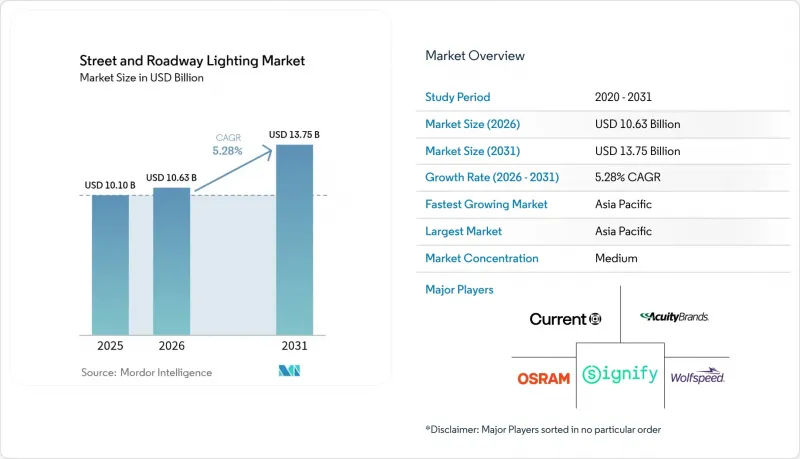
Mordor Intelligence에 의하면, 2026년 가로등 및 도로 조명 시장 규모는 106억 3,000만 달러로 추정되고, 2025년 101억 달러에서 확대해, 2031년에는 137억 5,000만 달러에 이를 것으로 예측됩니다.
2026-2031년 연평균 성장률(CAGR) 5.28%로 성장할 것으로 전망됩니다.
본 보고서는 조명 유형별(기존, 스마트/커넥티드), 광원별(LED, 형광등, HID), 제공 형태별(하드웨어, 소프트웨어/서비스), 전력 범위별(50W 미만, 50-150W, 150W 이상), 용도별(고속도로, 시가지, 터널, 주차장), 연결 방식별(유선, 무선), 지역별(북미, 남미 등)로 분류되어 있습니다. 시장 예측은 금액(달러) 기준으로 제시되어 있습니다.
세계의 가로등 및 도로 조명 시장 동향과 인사이트
가속화되는 LED 개조 프로그램
지자체들의 LED 도입 이니셔티브에서는 현재 센서 네트워크, 적응형 제어, 전력망 현대화 목표를 결합함으로써 이산화탄소 배출량 감축과 운영·유지보수(O&M) 비용의 추가 절감을 실현하고 있습니다. 뉴욕 전력 공사(NYPA)의 ‘Smart Street Lighting NY’는 수요 반응(Demand Response)과 스펙트럼 튜닝을 LED 업그레이드에 통합함으로써 이 모델을 입증하고 있습니다. 아일랜드의 1,750만 유로 규모의 농촌 지역 전환 계획 역시 미래의 V2I 통신에 대응 가능한 조명 기구를 우선시하고 있으며, 이는 도시 지역에서 ‘향후 업그레이드에 대응 가능한’ 사양이 점점 더 많이 수립되고 있음을 보여줍니다. 자금 조달 수단, 에너지 서비스 계약, 그린본드, 인프라 펀드를 통해 접근성이 확대되고 수명 주기 비용이 절감되며, 대상인 가로등 및 도로 조명 시장이 확대되고 있습니다.
커넥티드/IoT 지원 가로등의 도입 확대
세부적인 자산 데이터의 가치가 부각됨에 따라, 각 도시는 시범 사업을 거쳐 가로등 전체 규모로 커넥티드 조명을 확대해 나가고 있습니다. 시그니파이(Signify)는 2024년에 1억 4,400만 개의 관리 대상 커넥티드 조명 지점을 보고하며 플랫폼의 확장성을 입증했습니다. NB-IoT 및 LoRaWAN과 같은 저전력 광역 통신 기술 덕분에 연결 비용이 절감되어 지방 도시에서도 스마트 조명을 도입할 수 있게 되었습니다. 코펜하겐의 4만 4,000개 노드로 구성된 네트워크에서는 조명 기구에 대기질 센서가 내장되어 있어, 환경 규제 준수 분석을 통해 지자체에 새로운 수익원을 창출하고 있습니다. 에너지 절약에서 데이터 수익화로의 이러한 전환은 전환 장벽을 높이고 공급업체와의 계약 기간을 장기화함으로써 장기적인 성장을 뒷받침하고 있습니다.
대규모 조명 교체에 수반되는 고액의 초기 설비 투자
커넥티드 시스템의 총 소유 비용은 1대당 500달러를 초과하기도 하는데, 이는 기본적인 LED 교체 비용의 3배에 해당합니다. 따라서 지자체는 ESCO를 통한 자금 조달이나 PPP(민관 협력) 구조를 모색할 수밖에 없으며, 그 결과 조달 주기가 최대 18개월까지 연장됩니다. 자본 개선 예산이 없는 소규모 도시는 가장 심각한 자금난에 직면해 있어, 장기적인 절감 효과가 매력적임에도 불구하고 즉각적인 도입 규모가 제한되고 있습니다. 보조금 프로그램은 자금 부족을 부분적으로 보충해 주지만, 많은 경우 상세한 측정·검증(M&V) 문서가 요구되어 도입을 지연시키는 행정적 부담이 되고 있습니다.
부문 분석
스마트/커넥티드 솔루션은 연평균 성장률(CAGR) 6.82%를 기록할 전망이지만, 2025년 매출의 56.15%는 여전히 기존 조명 기구가 차지했습니다. 이러한 공존 상황은 자산의 갱신 주기가 단계적으로 진행되고 있음을 나타내며, 기본적인 조명 용도에서는 기존 옵션이 여전히 유효함을 뒷받침합니다. 대도시권의 행정 기관은 데이터 분석을 통해 높은 가격 책정을 정당화할 수 있는 우선 순위 경로를 따라 커넥티드 시스템을 도입하고 있는 반면, 소규모 관할 구역에서는 업그레이드 지원 노드를 갖춘 패시브 LED로 교체하는 것을 선호하고 있습니다. 어느 경로를 따르든, 구형 고강도 방전 램프가 꾸준히 퇴출됨에 따라 가로등 및 도로 조명 시장은 그 혜택을 누리고 있습니다. 시그니파이(Signify)사의 1억 4,400만 개에 달하는 조명 포인트 도입 실적은 플랫폼의 확장성을 입증함과 동시에 벤더 종속성을 강화하고 있습니다.
표준화 기구가 미래의 에너지 효율 기준에 연결성을 포함시키고, 설비 투자를 디지털 조명 기기로 전환함에 따라 이러한 추세는 계속되고 있습니다. 벤더의 로드맵에 따르면, 엣지 AI 비전 센서가 조명 기구에 통합되고 있으며, 이를 통해 적응형 조광 및 상황 인식이 가능해짐에 따라 공공 안전에 대한 가치 제안이 향상될 것으로 기대됩니다. 예측 기간 동안 스마트 플랫폼의 성장률은 기존보다 3배에 달할 것으로 예상되며, 이는 가로등 및 도로 조명 업계 전체의 서비스 모델을 재정의하게 될 것입니다.
LED는 2025년에 83.55%의 점유율을 차지했으며, 발광 효율이 200 lm/W를 약간 상회함에 따라 2031년까지 그 우위를 유지할 전망입니다. 틈새 시장인 형광등 및 HID 대체품은 주로 산업용 부지에 남아 있으며, 예산 주기가 도래하기를 기다리고 있습니다. 야행성 야생동물을 보호하기 위해 연안 지역에서는 590 nm의 호박색 패키지가 보급되고 있는 반면, 생체 리듬을 고려한 따뜻한 색감의 백색 조명은 주거 지역에서 지지를 얻고 있습니다. LED 기반 시스템의 가로등 및 도로 조명 시장 규모는 1루멘당 비용 감소와 스펙트럼 맞춤화의 고도화에 힘입어 연평균 성장률(CAGR) 6.52%로 확대될 것으로 예측됩니다.
드라이버 IC의 집적화와 방열 경로의 개선으로 정격 수명은 10만 시간에 가까워졌으며, 램프 교체를 위한 출장 횟수가 감소하고 있습니다. 특수 IC공급 부족은 여전히 병목 현상으로 작용하고 있으며, 고급 조광 컨트롤러의 납기 기간은 최대 52주에 달할 전망입니다. 그럼에도 불구하고, 수년에 걸친 프레임워크 계약과 지역별 재고 거점이 세계 공급업체들이 공급 충격을 완화하는 데 도움이 되고 있어, LED는 여전히 중심적인 위치를 유지하고 있습니다.
지역별 분석
아시아태평양은 2025년 매출의 36.85%를 차지했으며, 중국, 인도, 아세안(ASEAN) 국가들의 대규모 도시화를 배경으로 2031년까지 연평균 성장률(CAGR) 6.12%로 성장할 전망입니다. 베이징의 저탄소 구역에서는 새로운 조명 기구에 대기질 센서가 내장되어 있는 반면, 인도의 ‘스마트 시티 미션’에서는 100개 지자체에서 LED 조명의 표준화가 진행되고 있으며, 이러한 움직임이 해당 지역의 가로등 및 도로 조명 시장을 견인하고 있습니다. 현지 생산 능력 덕분에 리드타임이 단축되어, 투자 회수 기간을 4년 미만으로 단축하는 적극적인 보조금 프로그램을 뒷받침하고 있습니다.
북미는 시장 규모 면에서 2위를 차지하고 있으며, 교통사고 감소 프로젝트를 위한 조명에 자금을 할당하는 9억 8,200만 달러 규모의 SS4A 메커니즘과 같은 연방 정부의 자금 지원 제도에 힘입고 있습니다. 뉴욕, 포틀랜드, 로스앤젤레스의 ‘비전 제로(Vision Zero)’ 행동 계획은 보행자의 가시성을 높이는 적응형 광학 시스템으로의 사양 전환을 추진하고 있습니다. 그러나 전신주 인프라가 유틸리티자의 소유이기 때문에 조정상의 문제가 발생하여, 때때로 LED로의 전환이 지연되기도 합니다. 그럼에도 불구하고, 전기 안전 기준의 상향 조정과 탄소 회계 체계로 인해 대응이 늦어지고 있는 지자체에 대한 압박은 계속되고 있습니다.
유럽에서는 LED 보급이 성숙 단계에 접어든 지역에서도 EU 그린 딜(Green Deal) 및 EN-13201 규격 개정을 계기로 한 스마트 제어를 통한 업그레이드가 지속적으로 진행되고 있습니다. 지자체에서 시행하는 다크 스카이 조례는 빛 공해를 억제하기 위한 정밀 광학 시스템 및 초온색계 CCT에 대한 수요를 촉진하고 있으며, 가로등 및 도로 조명 시장의 프리미엄 평균 판매 가격(ASP)을 지탱하고 있습니다. 스칸디나비아 및 DACH 시장의 혁신 보조금은 야생동물 친화적 스펙트럼이나 V2I(차량 대 인프라) 회랑 조명을 모색하는 시범 프로젝트를 지원하며, 수출 기회를 노리는 공급업체에게 실증의 장을 제공합니다.
기타 혜택 :
- 엑셀 형식 시장 예측(ME) 시트
- 3개월간의 애널리스트 지원
자주 묻는 질문
목차
제1장 서론
제2장 조사 방법
제3장 주요 요약
제4장 시장 구도
제5장 시장 규모 및 성장 예측
제6장 경쟁 구도
제7장 시장 기회 및 향후 전망
AJY 26.09.07According to Mordor Intelligence, the street and roadway lighting market size in 2026 is estimated at USD 10.63 billion, growing from 2025 value of USD 10.10 billion with 2031 projections showing USD 13.75 billion, growing at 5.28% CAGR over 2026-2031.

This report is Segmented by Lighting Type (Conventional, Smart/Connected), Light Source (LEDs, Fluorescent, HID), Offering (Hardware, Software/Services), Power Range (Below 50W, 50-150W, Above 150W), Application (Highways, Streets, Tunnels, Parking), Connectivity (Wired, Wireless), and Geography (North America, South America, and More). The Market Forecasts are Provided in Terms of Value (USD).
Global Street And Roadway Lighting Market Trends and Insights
Accelerated LED Retrofit Programs
Municipal LED initiatives now bundle sensor networks, adaptive controls, and grid modernization objectives to unlock deeper carbon and O&M savings. New York Power Authority's Smart Street Lighting NY illustrates the model by folding demand-response and spectral tuning into LED upgrades. Ireland's EUR 17.5 million rural conversion plan likewise favors fixtures capable of future V2I communication, indicating that cities increasingly write "upgrade-ready" specifications. Financing tools, energy-service contracts, green bonds, and infrastructure funds are widening access and lowering lifecycle costs, expanding the addressable street and roadway lighting market.
Rising Deployment of Connected/IoT-Enabled Street Lights
Cities are moving from pilots to fleet-scale connected lighting roll-outs as the value of granular asset data becomes clear. Signify reported 144 million managed connected light points in 2024, demonstrating platform scalability. Low-power wide-area technologies like NB-IoT and LoRaWAN have cut connectivity costs, enabling secondary cities to embrace smart lighting. Copenhagen's 44,000-node network folds air-quality sensing into luminaires, creating new municipal revenue streams from environmental compliance analytics. This pivot from energy savings to data monetization raises switching barriers and lengthens vendor contracts, reinforcing long-term growth.
High Upfront Capex for Large-Scale Conversions
Total cost of ownership for connected systems can surpass USD 500 per fixture, triple a basic LED swap, forcing municipalities to seek ESCO financing or PPP structures that prolong procurement cycles by up to 18 months. Smaller cities without capital-improvement budgets face the sharpest squeeze, constraining immediate conversion volumes despite compelling long-term savings. Grant programs partially bridge the gap but often require detailed M&V documentation, adding an administrative burden that delays deployment.
Other drivers and restraints analyzed in the detailed report include:
- Government Carbon-Reduction Mandates and Funding
- Cyber-Security and Data-Privacy Vulnerabilities
For complete list of drivers and restraints, kindly check the Table Of Contents.
Segment Analysis
Smart/connected solutions recorded a 6.82% CAGR outlook, yet conventional fixtures still comprised 56.15% of 2025 revenue. This coexistence underscores staggered asset-replacement cycles that keep legacy options viable for basic illumination. Metropolitan agencies deploy connected systems along priority corridors where data analytics can justify premium pricing, whereas smaller jurisdictions favor passive LED swaps with upgrade-ready nodes. The street and roadway lighting market benefits as both pathways steadily erode outdated high-intensity discharge stock. Signify's 144 million light-point footprint validates platform scalability while reinforcing vendor lock-in.
Momentum continues as standards bodies embed connectivity in future efficiency codes, redirecting capex toward digital luminaires. Vendor roadmaps show edge-AI vision sensors migrating onboard fixtures, promising adaptive dimming and situational awareness that elevate public-safety value propositions. Over the forecast horizon, smart platforms are expected to outpace conventional growth threefold, redefining service models in the wider street and roadway lighting industry.
LEDs captured 83.55% share in 2025 and will retain hegemony through 2031 as efficacy inches past 200 lm/W. Niche fluorescent and HID replacements linger primarily in industrial yards, awaiting budget cycles. Amber 590 nm packages are gaining coastal traction to safeguard nocturnal wildlife, while circadian-friendly warm whites appeal to residential precincts. The street and roadway lighting market size for LED-based systems is projected to compound at a 6.52% CAGR, supported by falling per-lumen costs and higher spectral customization.
Driver IC integration and improved thermal paths now push rated lifetimes toward 100,000 hours, reducing relamping truck rolls. Supply tightness in specialty ICs remains a bottleneck, with delivery times extending up to 52 weeks for advanced dimming controllers. Nevertheless, multiyear framework contracts and localized inventory hubs are helping global vendors buffer shocks, sustaining LED's centrality.
Complete Report Scope:
- By Lighting Type
- Conventional Lighting
- Smart / Connected Lighting
- By Light Source
- LEDs
- Fluorescent Lamps
- High-Intensity Discharge Lamps
- By Offering
- Hardware
- Lights and Bulbs
- Luminaires
- Control Systems
- Software and Services
- Hardware
- By Power Range (Wattage)
- Below 50 W
- 50 - 150 W
- Above 150 W
- By Application
- Highways
- Streets and Urban Roads
- Tunnels and Underpasses
- Parking and Public Areas
- By Connectivity Technology
- Wired (PLC, DALI, PoE)
- Wireless (Zigbee, NB-IoT, LoRa, 5G)
- By Geography
- North America
- United States
- Canada
- Mexico
- South America
- Brazil
- Argentina
- Rest of South America
- Europe
- Germany
- United Kingdom
- France
- Italy
- Rest of Europe
- Asia-Pacific
- China
- Japan
- South Korea
- India
- Rest of Asia-Pacific
- Middle East
- Saudi Arabia
- United Arab Emirates
- Rest of Middle East
- Africa
- South Africa
- Rest of Africa
- North America
Geography Analysis
Asia-Pacific commanded 36.85% of 2025 revenue and is poised for a 6.12% CAGR through 2031 on the back of large-scale urbanization in China, India, and ASEAN. Beijing's low-carbon districts embed air-quality sensors in new luminaires, while India's Smart Cities Mission is standardizing LED nodes across 100 municipalities, propelling the regional street and roadway lighting market. Local manufacturing capacity shortens lead times and underpins aggressive subsidy programs that compress payback periods below four years.
North America ranks second by value, buoyed by federal funding enclaves like the USD 982 million SS4A mechanism that earmarks lighting for crash-reduction projects. Vision Zero action plans in New York, Portland, and Los Angeles are shifting specifications toward adaptive optics that boost pedestrian visibility. Utilities' ownership of pole infrastructure, however, introduces alignment challenges that occasionally delay conversions. Still, rising electrical-safety standards and carbon accounting frameworks keep pressure on lagging jurisdictions.
Europe exhibits mature LED penetration yet continues to upgrade via smart controls driven by the EU Green Deal and EN-13201 revisions. Municipal dark-sky ordinances are fueling demand for precision optics and ultra-warm CCTs to curb light pollution, sustaining premium ASPs in the street and roadway lighting market. Innovation grants in Scandinavia and DACH markets sponsor pilot projects exploring wildlife-friendly spectra and V2I corridor lighting, providing test beds for vendors targeting export opportunities.
- Signify N.V.
- OSRAM GmbH
- Current Lighting Solutions, LLC
- Wolfspeed Inc. (Cree LED)
- Acuity Brands Inc.
- Hubbell Inc.
- Zumtobel Group AG
- Schreder S.A.
- Eaton Corporation plc (Cooper Lighting Solutions)
- Valmont Industries Inc.
- Telensa Ltd.
- Silver Spring Networks Inc.
- Wipro Lighting (Wipro Enterprises)
- Nichia Corporation
- Dialight plc
- LED Roadway Lighting Ltd.
- Kingsun Optoelectronic Co.
- Syska LED Lights Pvt Ltd.
- DCD Technologies ME FZCO
- Itron Inc.
Additional Benefits:
- The market estimate (ME) sheet in Excel format
- 3 months of analyst support
TABLE OF CONTENTS
1 INTRODUCTION
- 1.1 Study Assumptions and Market Definition
- 1.2 Scope of the Study
2 RESEARCH METHODOLOGY
3 EXECUTIVE SUMMARY
4 MARKET LANDSCAPE
- 4.1 Market Overview
- 4.2 Market Drivers
- 4.2.1 Accelerated LED retrofit programs
- 4.2.2 Rising deployment of connected/IoT-enabled street lights
- 4.2.3 Government carbon-reduction mandates and funding
- 4.2.4 Rapid smart-city roll-outs in emerging economies
- 4.2.5 Edge-AI adaptive dimming for wildlife-safe corridors
- 4.2.6 Vehicle-to-Infrastructure (V2I) integration for C-V2X corridors
- 4.3 Market Restraints
- 4.3.1 High upfront capex for large-scale conversions
- 4.3.2 Cyber-security and data-privacy vulnerabilities
- 4.3.3 Utility-ownership mis-alignment delaying upgrades
- 4.3.4 Supply-chain volatility in LED driver ICs
- 4.4 Industry Value Chain Analysis
- 4.5 Regulatory Landscape
- 4.6 Technological Outlook
- 4.7 Porter's Five Forces Analysis
- 4.7.1 Threat of New Entrants
- 4.7.2 Threat of Substitutes
- 4.7.3 Bargaining Power of Buyers
- 4.7.4 Bargaining Power of Suppliers
- 4.7.5 Intensity of Competitive Rivalry
5 MARKET SIZE AND GROWTH FORECASTS (VALUE)
- 5.1 By Lighting Type
- 5.1.1 Conventional Lighting
- 5.1.2 Smart / Connected Lighting
- 5.2 By Light Source
- 5.2.1 LEDs
- 5.2.2 Fluorescent Lamps
- 5.2.3 High-Intensity Discharge Lamps
- 5.3 By Offering
- 5.3.1 Hardware
- 5.3.1.1 Lights and Bulbs
- 5.3.1.2 Luminaires
- 5.3.1.3 Control Systems
- 5.3.2 Software and Services
- 5.3.1 Hardware
- 5.4 By Power Range (Wattage)
- 5.4.1 Below 50 W
- 5.4.2 50 - 150 W
- 5.4.3 Above 150 W
- 5.5 By Application
- 5.5.1 Highways
- 5.5.2 Streets and Urban Roads
- 5.5.3 Tunnels and Underpasses
- 5.5.4 Parking and Public Areas
- 5.6 By Connectivity Technology
- 5.6.1 Wired (PLC, DALI, PoE)
- 5.6.2 Wireless (Zigbee, NB-IoT, LoRa, 5G)
- 5.7 By Geography
- 5.7.1 North America
- 5.7.1.1 United States
- 5.7.1.2 Canada
- 5.7.1.3 Mexico
- 5.7.2 South America
- 5.7.2.1 Brazil
- 5.7.2.2 Argentina
- 5.7.2.3 Rest of South America
- 5.7.3 Europe
- 5.7.3.1 Germany
- 5.7.3.2 United Kingdom
- 5.7.3.3 France
- 5.7.3.4 Italy
- 5.7.3.5 Rest of Europe
- 5.7.4 Asia-Pacific
- 5.7.4.1 China
- 5.7.4.2 Japan
- 5.7.4.3 South Korea
- 5.7.4.4 India
- 5.7.4.5 Rest of Asia-Pacific
- 5.7.5 Middle East
- 5.7.5.1 Saudi Arabia
- 5.7.5.2 United Arab Emirates
- 5.7.5.3 Rest of Middle East
- 5.7.6 Africa
- 5.7.6.1 South Africa
- 5.7.6.2 Rest of Africa
- 5.7.1 North America
6 COMPETITIVE LANDSCAPE
- 6.1 Market Concentration
- 6.2 Strategic Moves
- 6.3 Market Share Analysis
- 6.4 Company Profiles (includes Global level Overview, Market level overview, Core Segments, Financials as available, Strategic Information, Market Rank/Share for key companies, Products and Services, and Recent Developments)
- 6.4.1 Signify N.V.
- 6.4.2 OSRAM GmbH
- 6.4.3 Current Lighting Solutions, LLC
- 6.4.4 Wolfspeed Inc. (Cree LED)
- 6.4.5 Acuity Brands Inc.
- 6.4.6 Hubbell Inc.
- 6.4.7 Zumtobel Group AG
- 6.4.8 Schreder S.A.
- 6.4.9 Eaton Corporation plc (Cooper Lighting Solutions)
- 6.4.10 Valmont Industries Inc.
- 6.4.11 Telensa Ltd.
- 6.4.12 Silver Spring Networks Inc.
- 6.4.13 Wipro Lighting (Wipro Enterprises)
- 6.4.14 Nichia Corporation
- 6.4.15 Dialight plc
- 6.4.16 LED Roadway Lighting Ltd.
- 6.4.17 Kingsun Optoelectronic Co.
- 6.4.18 Syska LED Lights Pvt Ltd.
- 6.4.19 DCD Technologies ME FZCO
- 6.4.20 Itron Inc.
7 MARKET OPPORTUNITIES AND FUTURE OUTLOOK
- 7.1 White-space and Unmet-need Assessment


