

|
시장보고서
상품코드
2124950
유럽의 가로등 : 시장 점유율 분석, 업계 동향 및 통계, 성장 예측(2026-2031년)Europe Street Lighting - Market Share Analysis, Industry Trends & Statistics, Growth Forecasts (2026 - 2031) |
||||||
 Mordor Intelligence
Mordor Intelligence에 의하면, 유럽의 가로등 시장 규모는 2025년에 33억 3,000만 달러로 평가되었습니다. 2026년에 35억 9,000만 달러에 달하고, 2031년까지 50억 9,000만 달러에 이를 것으로 예측되며, 2026-2031년에 걸쳐 CAGR 7.23%로 성장할 전망입니다.
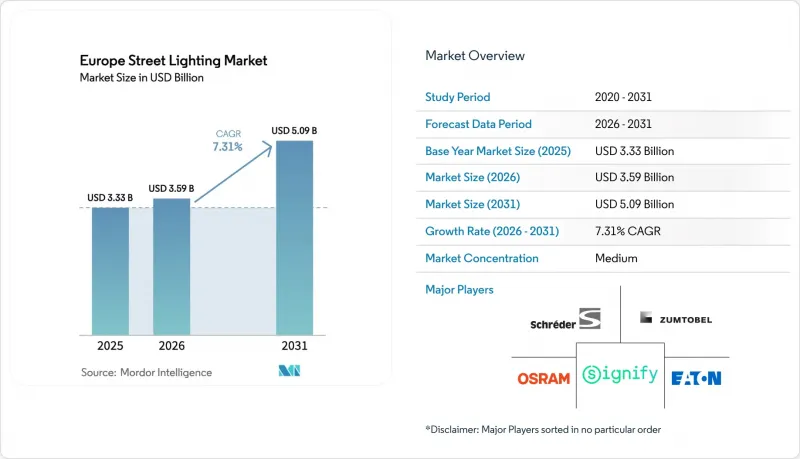
본 보고서는 조명 유형(기존 조명, 스마트 조명), 광원(LED, 형광등, HID 램프), 제공 형태(하드웨어, 소프트웨어, 서비스), 연결 기술(유선, 무선), 설치 유형(신규 도입, 개보수 설치), 국가(독일, 영국, 프랑스, 기타)별로 분류되어 있습니다. 시장 전망은 금액(달러) 기준으로 제시되어 있습니다.
유럽의 가로등 시장 동향 및 인사이트
EU의 형광등 사용 금지 및 에코디자인 목표 강화
유럽연합 집행위원회의 수은 규제(2024/1849)는 2025년 12월까지 소형 형광등을, 2026년 12월까지 직관형 형광등을 완전히 단계적으로 폐지할 것을 의무화했으며, 수은을 함유한 광원에 관한 마지막 허점을 메우는 조치입니다. 규정 준수 기한이 다가옴에 따라, 지자체는 노후화된 재고를 교체하고 LED 진단에 관한 작업자 재교육을 서두르면서 입찰 건수가 급증하고 있습니다. 프랑스에서는 규제 준수를 조건으로 15억 유로(16억 1,000만 달러) 규모의 지자체 보조금을 마련해 놓았으며, 이로 인해 소규모 마을에서의 도입이 가속화되고 있습니다. 구형 안정기의 감가상각 및 재활용 의무화는 단기적으로는 예산에 부담을 주지만, 한편으로는 갱신된 에코디자인 효율 기준을 충족하는 커넥티드 LED 시스템에 대해 수년에 걸친 수요를 창출하게 될 것입니다.
스마트 시티 추진과 시범 사업 확대의 기세
‘Horizon Europe’은 2024년, 103개 도시를 기후 중립 실증 도시로 지정하고, 조명이 디지털 기반이 되는 통합형 시범 사업에 4,100만 유로(4,390만 달러)를 배정했습니다. 독일의 100억 유로(107억 달러) 규모 기후 기금은 프로젝트에 교통 센서나 대기질 측정 노드가 포함된 경우, 개조 비용의 최대 50%를 보조하고 있어 중규모 지자체에서의 보급을 뒷받침하고 있습니다. ‘RESONANCE’ 프로젝트는 아이슬란드에서 에너지 사용량을 35%, 현장 대응 횟수를 42% 줄인 것으로 입증된 LoRaWAN 기반 아키텍처를 확대되고 있습니다. 자금 조달의 안정성과 공개된 모범 사례 가이드북 덕분에 의사 결정 주기가 지속적으로 단축되고 있으며, 이는 유럽의 가로등 시장을 플랫폼 모델로 전환하는 데 기여하고 있습니다.
소규모 지자체에서 스마트 개조를 위한 초기 설비 투자(CAPEX)가 높은 점
네트워크 연결형 LED 유닛의 가격은 300-500유로인 반면, 비연결형 교체용 LED는 150유로입니다. 이는 연간 예산이 500만 유로(593만 달러) 미만인 도시에게는 장벽이 되고 있습니다. ELENA 기금은 2009년 이후 기술 지원을 위해 11억 유로(13억 1,000만 달러)를 동원해 왔지만, 남유럽과 동유럽에 대한 지원 범위는 여전히 고르지 않은 상태입니다. 프랑스의 ‘France 2030’ 계획은 조명을 광범위한 인프라 갱신과 통합한 사업으로 규정하고 있어, 자금 조달에 어려움을 겪는 지자체의 단독 입찰은 사실상 배제되고 있습니다. 보조금 모집 기간이 주기적으로 설정되어 있는 점도 도입을 더욱 지연시키고 있으며, 유럽의 가로등 시장의 초기 수요 증가를 제약하고 있습니다.
부문별 분석
스마트 플랫폼은 2025년 매출의 52.67%를 차지했으며, 이는 유럽의 가로등 시장이 단순한 범용 램프 교체에서 네트워크 인텔리전스로 꾸준히 전환되고 있음을 보여줍니다. 원격 진단 및 적응형 조광을 통해 수명 주기 비용이 절감되는 한편, 가로등 기둥에 설치된 무선 기기는 교통 분석 및 환경 모니터링과 같은 부가 서비스를 지원하고 있습니다. 5G 스몰 셀과의 지자체 번들 계약은 추가적인 임대 수입을 창출하여 플랫폼의 경제성을 강화하고 있습니다. 부채 부담 능력이 제한적인 농촌 지역에서는 기존 가로등이 여전히 중요하지만, 부품 가격 하락과 보조금 접근성 확대로 인해 2030년까지 해당 시장 규모는 축소될 전망입니다.
‘Horizon Europe’의 지속적인 지원과 LORIOT가 아이슬란드에서 6,000노드 규모로 도입한 시범 사업 실적 등을 통해 에너지 및 유지보수 비용 절감 효과가 입증되었으며, 투자 회수 기간은 4년 미만으로 단축되었습니다. 각 도시가 조명 네트워크를 활용한 오픈 데이터 대시보드를 공개함에 따라 센서 통합에 대한 시민의 관심이 높아지고 있으며, 향후 조달 사양은 스마트 인프라를 강력히 지지하는 방향으로 정착되고 있습니다.
2025년에는 LED가 86.58%의 점유율을 차지하며, 유럽의 가로등 시장 규모가 솔리드 스테이트 광원으로 전면적으로 전환된 가운데, 2031년까지 연평균 성장률(CAGR) 8.33%로 성장을 이어가고 있습니다. 수은 규제 2024/1849에 따라 2026년 이후부터는 형광등 구매가 불법이 되지만, 고압 나트륨 램프의 경우 조광 호환성이 낮아 그 폐지는 완만한 속도로 진행되고 있습니다. 초기형 LED의 2차 교체로 인해 새로운 가로등 기둥을 설치하지 않고도 판매 대수가 더욱 증가하고 있습니다.
칩 스케일 패키징 및 실리콘 카바이드(SiC) 드라이버의 기술 발전으로 고온 환경에서의 수명이 연장되어, 드라이버의 열 고장이라는 주요 제약 요인이 직접적으로 해소되고 있습니다. 구형 램프용 안정기 재고와 기술자의 전문 지식이 고갈됨에 따라, 2026년 이후의 입찰에서는 LED 전용 솔루션이 지정될 것으로 예상되며, 이 기술의 거의 완전한 지배력이 확고해질 것으로 보입니다.
기타 혜택
- 엑셀 형식 시장 예측(ME) 시트
- 3개월간의 애널리스트 지원
자주 묻는 질문
목차
제1장 서론
제2장 조사 방법
제3장 주요 요약
제4장 시장 구도
제5장 시장 규모 및 성장 예측
제6장 경쟁 구도
제7장 시장 기회 및 향후 전망
KTH 26.09.14According to Mordor Intelligence, the Europe street lighting market size is projected to be USD 3.33 billion in 2025, USD 3.59 billion in 2026 and reach USD 5.09 billion by 2031, growing at a CAGR of 7.23% from 2026 to 2031.

This report is Segmented by Lighting Type (Conventional Lighting, and Smart Lighting), Light Source (LEDs, Fluorescent Lamps, and HID Lamps), Offering (Hardware, and Software, and Services), Connectivity Technology (Wired, and Wireless), Installation Type (New Installation, and Retrofit), and Country (Germany, United Kingdom, France, and More). The Market Forecasts are Provided in Terms of Value (USD).
Europe Street Lighting Market Trends and Insights
EU Ban on Fluorescent Lamps and Stricter Ecodesign Targets
The European Commission's Mercury Regulation 2024/1849 mandates a complete phase-out of compact fluorescent lamps by December 2025 and linear fluorescent lamps by December 2026, closing the final loophole for mercury-containing sources. Compliance deadlines have triggered a surge in tender releases as municipalities rush to replace obsolete inventories and retrain crews on LED diagnostics. France has tied EUR 1.5 billion (USD 1.61 billion) of municipal grants to adherence, accelerating take-up in smaller towns. Obsolete ballast write-offs and mandatory recycling add near-term budget pressure, yet they open multiyear demand for connected LED systems that meet updated Ecodesign efficacy thresholds.
Smart-City Stimulus and Pilot Replication Momentum
Horizon Europe labeled 103 cities as climate-neutral demonstrators in 2024 and allocated EUR 41 million (USD 43.9 million) for integrated pilots where lighting forms the digital backbone. Germany's EUR 10 billion (USD 10.7 billion) climate fund reimburses up to 50% of retrofit costs when projects embed traffic sensing and air-quality nodes, spurring replication in mid-sized municipalities. The RESONANCE project is scaling LoRaWAN-based architectures proven to cut energy use 35% and truck-rolls 42% in Iceland. Funding consistency and published best-practice playbooks continue to shrink decision cycles, propelling the Europe street lighting market toward platform models.
High Up-Front CAPEX for Smart Retrofits in Small Municipalities
A networked LED unit costs EUR 300-500 versus EUR 150 for a non-connected replacement, a hurdle for towns with annual budgets under EUR 5 million (USD 5.93 million). While the ELENA facility has mobilized EUR 1.1 billion (USD 1.31 billion) for technical assistance since 2009, coverage remains uneven in Southern and Eastern Europe. France's France 2030 plan bundles lighting with broader infrastructure upgrades, effectively sidelining stand-alone bids from cash-strapped communes. Cyclic grant windows further delay adoption, constraining early volume in the Europe street lighting market.
Other drivers and restraints analyzed in the detailed report include:
- Declining Total Cost of Ownership for LED and Connectivity
- EU Recovery and Resilience Facility E-Mobility Corridors
- LED Driver Reliability and Thermal Ageing Failures
For complete list of drivers and restraints, kindly check the Table Of Contents.
Segment Analysis
Smart platforms accounted for 52.67% of 2025 revenue, demonstrating that the Europe street lighting market is steadily migrating from commodity lamp replacement to network intelligence. Remote diagnostics and adaptive dimming lower lifecycle costs, while pole-mounted radios support add-on services such as traffic analytics and environmental monitoring. Municipal bundling with 5G small cells opens incremental lease income, reinforcing platform economics. Conventional lighting retains relevance in rural zones where debt capacity is limited, yet declining component prices and widening grant access are set to narrow its addressable pocket by 2030.
Continued stimulus from Horizon Europe and evidence from pilots such as LORIOT's 6,000-node Iceland deployment have validated energy and maintenance savings, shortening payback periods below four years. As cities publish open-data dashboards powered by lighting networks, civic appetite for sensor integration is rising, anchoring future procurement specifications firmly in favor of smart infrastructure.
LEDs commanded an 86.58% share in 2025 and are advancing at an 8.33% CAGR to 2031 as the Europe street lighting market size shifts wholesale toward solid-state sources. Mercury Regulation 2024/1849 makes the purchase of fluorescent lamps illegal after 2026, while high-pressure sodium remains in slow retirement due to poor dimming compatibility. Secondary replacement of early LED vintages further lifts unit volumes without adding new poles.
Advances in chip-scale packaging and silicon-carbide drivers are extending usable life under high-ambient conditions, directly addressing the primary restraint of thermal driver failures. As ballast inventories and technician skill sets for legacy lamps vanish, post-2026 tenders are expected to specify LED-only solutions, cementing the technology's near-total dominance.
Complete Report Scope:
- By Lighting Type
- Conventional Lighting
- Smart Lighting
- By Light Source
- LEDs
- Fluorescent Lamps
- HID Lamps
- By Offering
- Hardware
- Lights and Bulbs
- Luminaires
- Control Systems
- Software and Services
- Hardware
- By Connectivity Technology
- Wired (PLC, DALI, Ethernet)
- Wireless (Zigbee, LoRa-WAN, NB-IoT, 5G)
- By Installation Type
- New Installation
- Retrofit, Secondary Replacement
- By Country
- Germany
- United Kingdom
- France
- Italy
- Rest of Europe
List of Companies Covered in this Report:
- Signify N.V.
- Zumtobel Group AG
- Schreder SA
- Eaton Corporation plc
- OSRAM GmbH
- Acuity Brands Inc.
- Cree Lighting (IDEAL Industries)
- Itron Inc.
- Telensa Ltd.
- Sensus (Xylem)
- Flashnet SRL (InteliLIGHT)
- Lucy Zodion Ltd.
- Fagerhult Group
- Thorn Lighting Ltd.
- Le-Tehnika d.o.o. (Luxtella)
- Hubbell Incorporated
- Urban Control Ltd.
- AEC Illuminazione Srl
- Fagerhults Belysning AB
- Cisco Systems - Smart Lighting
Additional Benefits:
- The market estimate (ME) sheet in Excel format
- 3 months of analyst support
TABLE OF CONTENTS
1 INTRODUCTION
- 1.1 Study Assumptions and Market Definition
- 1.2 Scope of the Study
2 RESEARCH METHODOLOGY
3 EXECUTIVE SUMMARY
4 MARKET LANDSCAPE
- 4.1 Market Overview
- 4.2 Market Drivers
- 4.2.1 EU Ban on Fluorescent Lamps and Stricter Ecodesign Targets
- 4.2.2 Smart-City Stimulus and Pilot Replication Momentum
- 4.2.3 Declining Total Cost of Ownership for LED and Connectivity
- 4.2.4 EU Recovery and Resilience Facility E-Mobility Corridors
- 4.2.5 Secondary-Replacement Wave for First-Gen LEDs (2024-2030)
- 4.2.6 Street-Light Poles Monetised as Edge-IoT Real-Estate
- 4.3 Market Restraints
- 4.3.1 High Up-Front CAPEX for Smart Retrofits in Small Municipalities
- 4.3.2 LED Driver Reliability and Thermal Ageing Failures
- 4.3.3 Cyber-Security and GDPR Compliance Burden
- 4.3.4 Semiconductor-Component Supply Volatility
- 4.4 Industry Value, Supply-Chain Analysis
- 4.5 Regulatory Landscape
- 4.6 Technological Outlook
- 4.7 Porter's Five Forces Analysis
- 4.7.1 Bargaining Power of Suppliers
- 4.7.2 Bargaining Power of Consumers
- 4.7.3 Threat of New Entrants
- 4.7.4 Threat of Substitutes
- 4.7.5 Intensity of Competitive Rivalry
- 4.8 Impact of Macroeconomic Factors on the Market
5 MARKET SIZE AND GROWTH FORECASTS (VALUE)
- 5.1 By Lighting Type
- 5.1.1 Conventional Lighting
- 5.1.2 Smart Lighting
- 5.2 By Light Source
- 5.2.1 LEDs
- 5.2.2 Fluorescent Lamps
- 5.2.3 HID Lamps
- 5.3 By Offering
- 5.3.1 Hardware
- 5.3.1.1 Lights and Bulbs
- 5.3.1.2 Luminaires
- 5.3.1.3 Control Systems
- 5.3.2 Software and Services
- 5.3.1 Hardware
- 5.4 By Connectivity Technology
- 5.4.1 Wired (PLC, DALI, Ethernet)
- 5.4.2 Wireless (Zigbee, LoRa-WAN, NB-IoT, 5G)
- 5.5 By Installation Type
- 5.5.1 New Installation
- 5.5.2 Retrofit, Secondary Replacement
- 5.6 By Country
- 5.6.1 Germany
- 5.6.2 United Kingdom
- 5.6.3 France
- 5.6.4 Italy
- 5.6.5 Rest of Europe
6 COMPETITIVE LANDSCAPE
- 6.1 Market Concentration
- 6.2 Strategic Moves
- 6.3 Market Share Analysis
- 6.4 Company Profiles (Includes Global Level Overview, Market Level Overview, Core Segments, Financials as Available, Strategic Information, Market Rank/Share for Key Companies, Products and Services, and Recent Developments)
- 6.4.1 Signify N.V.
- 6.4.2 Zumtobel Group AG
- 6.4.3 Schreder SA
- 6.4.4 Eaton Corporation plc
- 6.4.5 OSRAM GmbH
- 6.4.6 Acuity Brands Inc.
- 6.4.7 Cree Lighting (IDEAL Industries)
- 6.4.8 Itron Inc.
- 6.4.9 Telensa Ltd.
- 6.4.10 Sensus (Xylem)
- 6.4.11 Flashnet SRL (InteliLIGHT)
- 6.4.12 Lucy Zodion Ltd.
- 6.4.13 Fagerhult Group
- 6.4.14 Thorn Lighting Ltd.
- 6.4.15 Le-Tehnika d.o.o. (Luxtella)
- 6.4.16 Hubbell Incorporated
- 6.4.17 Urban Control Ltd.
- 6.4.18 AEC Illuminazione Srl
- 6.4.19 Fagerhults Belysning AB
- 6.4.20 Cisco Systems - Smart Lighting
7 MARKET OPPORTUNITIES AND FUTURE OUTLOOK
- 7.1 White-Space and Unmet-Need Assessment


