|
시장보고서
상품코드
2122911
스마트 카드 시장 : 시장 점유율 분석, 업계 동향 및 통계, 성장 예측(2026-2031년)Smart Card - Market Share Analysis, Industry Trends & Statistics, Growth Forecasts (2026 - 2031) |
||||||
 Mordor Intelligence
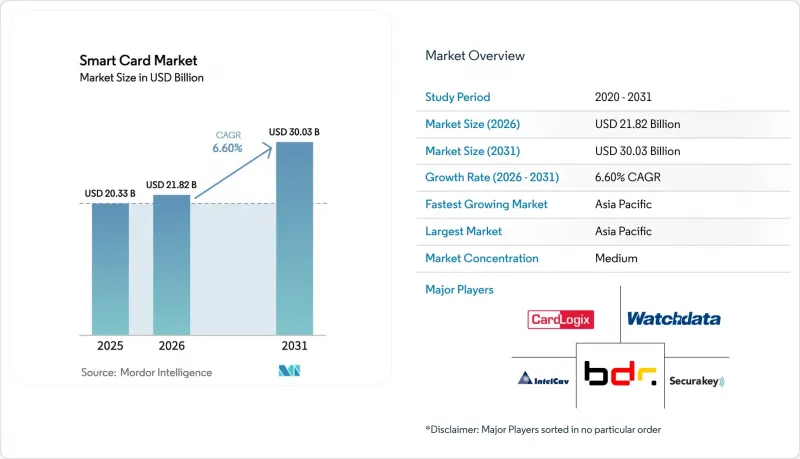
Mordor Intelligence에 의하면, 스마트 카드 시장 규모는 2026년에 218억 2,000만 달러로 추정되고, 2031년에는 300억 3,000만 달러에 이를 것으로 예측되며, 2026-2031년 CAGR 6.6%를 기록할 전망입니다.
본 보고서는 인터페이스 유형별(접촉식, 비접촉식, 듀얼 인터페이스, 하이브리드), 카드 칩 유형별(메모리, 마이크로컨트롤러, 보안 요소), 소재별(PVC, 폴리카보네이트,ABS, PETG, 금속), 기능별(결제, 접근 제어, 통신 등), 최종 사용자별(은행, 금융서비스 및 보험(BFSI), IT, 정부 기관, 운송, 의료, 소매, 교육), 지역별로 분류되어 있습니다. 시장 예측은 금액(달러) 기준으로 제시되어 있습니다.
세계의 스마트 카드 시장 동향 및 인사이트
아시아 신흥 경제국에서의 비접촉식 EMV로의 전환
인도, 인도네시아, 필리핀, 베트남의 규제 당국은 발급 기관에 수억 장에 달하는 기존 마그네틱 스트라이프 카드를 비접촉식 듀얼 인터페이스 카드로 교체하도록 촉구하는 엄격한 기한을 설정하고 있습니다. 인도만 해도 2026년 12월까지 4억 5,000만 장의 RuPay 직불카드를 업그레이드할 예정이며, 이는 카드 사용을 보장하는 POS 단말기 의무화와 연계되어 있습니다. 인도네시아와 필리핀에서도 유사한 움직임이 나타나고 있으며, 규제적 강제 조치와 금전적 인센티브를 결합함으로써 발행사의 도입률은 신규 카드의 60%를 초과하고 있습니다. 베트남의 은행들은 2027년 정부의 기한을 앞당기기 위해 2025년 3분기에 3,500만 장의 비접촉식 카드를 선주문했습니다. 이러한 규제는 수요량을 가속화하여 안테나 및 인레이공급망을 유지하고, 현지에서 개인화 서비스를 함께 제공할 수 있는 제조업체에 유리하게 작용합니다. 그 결과, 예측 가능한 수년에 걸친 수요 곡선이 형성되어 스마트 카드 시장의 기준선 수요량을 끌어올리고 있습니다.
EU 및 GCC 국가들의 국민용 전자 신분증 및 디지털 헬스 카드 도입
유럽의 eIDAS 2.0 규정에 따라 모든 회원국은 2026년까지 디지털 지갑을 발급해야 하며, 독일과 프랑스 등에서는 생체 인증 기능이 통합된 폴리카보네이트 카드 배포가 진행되고 있습니다. 독일은 4,500만 장의 카드 갱신을 계획하고 있으며, 프랑스는 IDEMIA사와 3,000만 장의 카드 공급 계약을 체결했습니다. 걸프협력회의(GCC)에서는 사우디아라비아가 2025년에 1,200만 장의 ‘Absher’ 디지털 ID 카드를 발급할 예정이며, 아랍에미리트(UAE)는 850만 장의 다기능 ‘에미레이트 ID’를 출하했습니다. 이러한 프로그램에서는 결제, 의료, 여행에 필요한 인증 정보를 단일 보안 요소에 통합하고 있으며, 이를 통해 고부가가치 부품 비용이 고정되고 8-10년의 갱신 주기가 확립됩니다. 이미 커먼 크리테리아 인증을 획득한 벤더는 선구자로서의 우위를 확보하고 있지만, 후발 벤더는 긴 인증 기간에 직면하게 될 것입니다.
토큰화된 가상 카드의 부상으로 인해 실물 카드 수요가 감소
Visa, Mastercard, American Express 각사는 2025년에 가상 전용 법인 카드 부문에서 두 자릿수 성장을 보고했으며, Amex의 경우 처음으로 물리적 법인 카드보다 가상 카드 발급 건수가 더 많아졌습니다. 여행 및 조달 플랫폼에서는 실시간 지출 관리를 위해 일회용 토큰이 선호되고 있어, 플라스틱 카드의 대량 발급 필요성이 줄어들고 있습니다. 소비자용 카드 재발급은 여전히 규제되고 있지만, 한때 발급사의 발급량의 20%를 차지했던 법인용 카드 발급량은 성숙 시장에서 연간 8-12%의 속도로 감소하고 있습니다. 이에 대응해 발행사는 실물 카드에 토큰 발급 기능을 통합하고 있으나, 이러한 하이브리드 모델은 카드의 수명을 연장시켜 재주문 시기를 늦추는 결과를 낳고 있습니다. 북미 및 유럽의 법인용 카드 발행에 크게 의존하는 벤더들은 발급 건수 감소가 가장 두드러지게 나타나고 있습니다.
부문 분석
2025년, 비접촉식 카드는 스마트 카드 시장에서 56.78%의 점유율을 차지하며 시장을 휩쓸었습니다. 듀얼 인터페이스형은 연평균 성장률(CAGR) 6.82%로 증가하고 있으며, 이는 동유럽, 남미 및 아시아 일부 지역에서 발행사가 접촉식 전용 단말기와의 하위 호환성을 필요로 하고 있음을 반영합니다. 은행들이 여전히 칩 및 PIN 리더기에 의존하고 있는 가맹점에서 발생하는 거래 실패를 방지하기 위해, 듀얼 인터페이스 제품의 스마트 카드 시장 규모는 꾸준히 확대될 것으로 예측됩니다. 독일의 스파크아센과 일본의 메가뱅크는 인프라 격차를 해소하기 위해 2025년에 4,000만 장 이상의 듀얼 인터페이스 카드를 발주했습니다. 제조업체들은 15-20%의 비용 증가를 상회하는 25-35%의 가격 프리미엄을 누리며, 이를 통해 매출 총이익률을 높이고 있습니다. 접촉식 전용 카드는 틈새 복지 프로그램이나 폐쇄형 루프 프로그램으로 한정되어 있으며, 연평균 성장률(CAGR) 2.1%로 계속 감소할 전망입니다. 결제, 접근, IT 인증을 통합한 하이브리드 카드는 4.2%의 점유율을 차지하며 연평균 성장률(CAGR) 5.8%로 성장하고 있어, 여러 서비스에 대해 단일 인증 정보를 요구하는 법인 고객에게 계속해서 매력적인 선택지가 되고 있습니다.
정부 및 국방 분야에서는 물리적 인터페이스가 릴레이 공격에 대한 추가 보안 계층을 제공하기 때문에 발급 사업자들의 접촉식 카드에 대한 수요가 여전히 지속되고 있습니다. 단일 기판에 여러 기술을 통합한 하이브리드 카드는 논리적 접근과 물리적 접근의 통합을 요구하는 틈새 기업들의 요건을 충족시키고 있습니다. 따라서 경쟁의 초점은 단순한 인터페이스 유형에서 생체 인식의 카드 내 대조 및 발급 후 개인화 같은 부가가치 기능으로 이동하고 있으며, 이러한 주제는 공급업체가 스마트 카드 시장에서 이익률을 유지할 수 있게 해줍니다.
2025년에는 마이크로컨트롤러 카드가 66.59%의 시장 점유율을 차지했으나, 한국에서 생체 인증이 의무화되고 유럽 전역에서도 보급이 확대됨에 따라 보안 요소(Secure Element) 및 시스템 온 카드(System-on-Card) 설계는 연평균 성장률(CAGR) 7.21%로 확대되고 있습니다. 시큐어 엘리먼트의 스마트카드 시장 점유율이 상승하고 있는 이유는 카드 내부에서 FIDO2 준수 지문 대조가 가능해져 백엔드에서의 검증이 필요 없어졌기 때문입니다. 프랑스의 ‘카르트 비탈 2’와 한국의 주민등록카드는 서버 의존형 아키텍처에서 벗어나고 있음을 상징합니다. 보안 수준이 낮은 로열티 프로그램이 모바일 앱으로 전환됨에 따라 메모리 카드의 점유율은 하락하고 있습니다. 인피니온이나 삼성 등 파운드리 생산 능력을 보유한 칩 벤더들은 포스트 양자암호화 로드맵과 실리콘 공급 보장을 결합함으로써 타사를 압도하는 가치를 확보하고 있습니다.
메모리 전용 카드는 처리 능력의 필요성보다 비용 효율성이 우선시되는 대중교통이나 선불 기프트 용도에서 여전히 중요한 역할을 수행하고 있습니다. NXP의 MOB10과 같은 초박형 모듈은 굽힘 응력에 대한 내구성을 향상시킴으로써 여권 용도의 새로운 가능성을 열어가고 있습니다. 전반적으로, 보안 요소(Secure Element)로의 제품 구성 전환은 공통 기준(Common Criteria) 인증을 획득한 제품 라인을 보유한 반도체 공급업체에 이익을 가져다주며, 스마트카드 시장에서 기술 주도적인 경쟁 우위를 유지하고 있습니다.
지역별 분석
2025년, 아시아태평양은 스마트 카드 시장 매출의 54.11%를 차지했으며, 연평균 성장률(CAGR) 7.44%로 성장하고 있습니다. 인도의 카드 보유 수는 10억 8,000만 장에 달하며, 신규 발급의 64%를 비접촉식 카드가 차지하고 있습니다. 중국에서는 5G 네트워크 인증을 위해 4억 2,000만 장의 SIM 카드를 보안 요소(Secure Element)로 업그레이드했습니다. 일본에서는 2,200만 장의 듀얼 인터페이스 은행 카드가 발행되었으며, 한국에서는 2027년까지 생체 인증 지원 결제 카드의 도입이 의무화되었습니다. 이러한 성장 궤도를 뒷받침하는 것은 자발적인 지출이 아니라 규제에 따른 의무화입니다.
유럽은 2025년에 23.7%의 점유율을 차지한 것으로 평가되었으며, eIDAS 2.0이 디지털 지갑의 보편적인 지원을 의무화함에 따라 연평균 성장률(CAGR) 6.8%로 확대되고 있습니다. 독일에서는 2025년에 1,200만 장의 전자 신분증이 제조되었고, 프랑스에서는 3,000만 장의 전자 신분증이 발급되었으며, 영국에서는 920만 장의 생체 인증이 적용된 거주 허가증이 발급되었습니다. 동유럽 국가들은 EU의 결속 기금의 혜택을 받고 있으며, 이로 인해 EMV로의 전환이 가속화되고 듀얼 인터페이스 카드의 생산량이 증가하고 있습니다. 높은 보안 기준과 폴리카보네이트 소재의 채택으로 인해 평균 판매 가격이 상승하고 있습니다.
북미는 2025년에 매출 점유율의 14.8%를 차지한 것으로 평가되었으며, 연평균 성장률(CAGR)은 5.9%로 완만한 성장세를 보일 전망입니다. 미국은 10년 전에 EMV 전환을 완료했기 때문에 현재 카드 갱신은 기술 업그레이드가 아닌 카드 유효기간 만료에 따라 이루어지고 있습니다. 캐나다에서는 이미 비접촉식 결제 보급률이 87%에 달하고,, 더 이상의 성장에는 한계가 있습니다. 멕시코에서는 2025년을 비접촉식 결제 도입 마감 시한으로 정하고 있어, 지역 전체 수요는 안정적인 양상을 보이고 있습니다. 남미, 중동 및 아프리카의 합산 점유율은 현재 10% 미만이지만, SIM 카드 교체 및 전자 신분증(eID) 프로그램이 경제적 역풍을 상쇄하고 있어 성장을 이어가고 있습니다.
기타 혜택 :
- 엑셀 형식 시장 예측(ME) 시트
- 3개월간의 애널리스트 지원
자주 묻는 질문
목차
제1장 서론
제2장 조사 방법
제3장 주요 요약
제4장 시장 구도
제5장 시장 규모 및 성장 예측
제6장 경쟁 구도
제7장 시장 기회 및 향후 전망
AJY 26.09.07According to Mordor Intelligence, the smart cards market size is USD 21.82 billion in 2026 and is projected to reach USD 30.03 billion in 2031, registering a 6.6% CAGR during 2026-2031.
This report is Segmented by Interface Type (Contact, Contactless, Dual Interface, Hybrid), Card Chip Type (Memory, Microcontroller, Secure Element), Material (PVC, Polycarbonate, ABS, PETG, Metal), Function (Payment, Access Control, Telecom, and More), End-User (BFSI, IT, Government, Transportation, Healthcare, Retail, Education), and Geography. The Market Forecasts are Provided in Terms of Value (USD).
Global Smart Card Market Trends and Insights
Contactless EMV Migration in Emerging Asian Economies
Regulators in India, Indonesia, the Philippines, and Vietnam have set hard deadlines that push issuers to replace hundreds of millions of legacy magnetic-stripe cards with contactless dual-interface variants. India alone is upgrading 450 million RuPay debit cards by December 2026, synchronized with point-of-sale terminal mandates that guarantee acceptance. Similar moves in Indonesia and the Philippines pair regulatory compulsion with financial incentives, driving issuer adoption rates beyond 60% of new cards. Vietnam's banks pre-ordered 35 million contactless cards in Q3 2025 to front-run a 2027 government deadline. These mandates accelerate volume demand, sustain antenna and inlay supply chains, and favor manufacturers that can bundle personalization services locally. The result is a predictable multi-year demand curve that lifts baseline volumes for the smart cards market.
EU & GCC National eID and Digital Health Card Roll-outs
Europe's eIDAS 2.0 regulation requires every member state to issue digital wallets by 2026, pushing Germany, France, and others to distribute polycarbonate cards with embedded biometrics. Germany plans 45 million replacements, while France has a 30 million-card contract with IDEMIA. In the Gulf Cooperation Council, Saudi Arabia issued 12 million Absher Digital ID cards in 2025, and the United Arab Emirates shipped 8.5 million multi-application Emirates IDs. These programs embed payment, health, and travel credentials on a single secure element, locking in higher-value bill-of-materials and creating 8- to 10-year replacement cycles. Vendors that already hold Common Criteria certifications capture the first mover advantage, while laggards face long qualification timelines.
Rise of Tokenised Virtual Cards Reducing Physical Demand
Visa, Mastercard, and American Express each reported double-digit growth in virtual-only commercial cards during 2025, with Amex issuing more virtual than physical corporate cards for the first time. Travel and procurement platforms prefer single-use tokens for real-time spend controls, reducing the need for bulk plastic. While consumer reissuance remains regulated, commercial volumes once 20% of issuer output are shrinking 8-12% annually in mature markets. Issuers counter by embedding token provisioning inside physical cards, yet that hybrid model extends card life, delaying reorders. Vendors that rely heavily on North American and European corporate issuance face the steepest volume erosion.
Other drivers and restraints analyzed in the detailed report include:
- Pre-paid SIM Expansion Driving Secure Elements in Latin America
- EU eIDAS-2.0 digital wallet regulation adoption
- Secure MCU Supply-chain Volatility
For complete list of drivers and restraints, kindly check the Table Of Contents.
Segment Analysis
Contactless cards dominated the smart cards market with a 56.78% share in 2025. Dual-interface variants are rising at a 6.82% CAGR, reflecting issuers' need for backward compatibility with contact-only terminals in Eastern Europe, South America, and parts of Asia. The smart cards market size for dual-interface products is forecast to climb steadily as banks avoid transaction failures at merchants that still rely on chip-and-PIN readers. Germany's Sparkassen and Japan's megabanks ordered more than 40 million dual-interface cards in 2025 to straddle the infrastructure divide. Manufacturers benefit from 25-35% price premiums that outpace the 15-20% cost increase, thereby improving their gross margins. Contact-only cards are locked into niche welfare or closed-loop programs and will continue falling at a 2.1% CAGR. Hybrid cards used for converged payment, access, and IT authentication hold a 4.2% share and grow at a 5.8% CAGR, remaining attractive to corporate buyers that seek a single credential for multiple services.
The issuer's appetite for contact-only cards persists in government and defense, where a physical interface adds a security layer against relay attacks. Hybrid cards, embedding multiple technologies on a single substrate, satisfy niche enterprise requirements for logical and physical access convergence. The competitive narrative, therefore, shifts from mere interface type to value-added capabilities, such as biometric match-on-card and post-issuance personalization, themes that enable vendors to defend their margins in the smart card market.
Microcontroller cards commanded 66.59% market share in 2025, but secure-element and system-on-card designs are expanding at 7.21% CAGR as biometric authentication becomes mandatory in South Korea and popular across Europe. The smart cards market share for secure elements rises because they enable FIDO2-compliant fingerprint matching inside the card, avoiding backend verification. France's Carte Vitale 2 and South Korea's resident registration card exemplify migration away from server-dependent architectures. Memory cards decline as low-security loyalty programs move to mobile apps. Chip vendors that own foundry capacity, such as Infineon and Samsung, capture disproportionate value by bundling post-quantum cryptography roadmaps with silicon supply guarantees.
Memory-only cards remain relevant for mass transit and prepaid gift applications where cost sensitivity outweighs processing needs. Ultra-thin modules such as NXP's MOB10 unlock new passport applications by improving durability against bending stress. Overall, the product-mix shift toward secure elements benefits semiconductor suppliers with certified Common Criteria product lines, sustaining a technology-led competitive moat within the smart card market.
Complete Report Scope:
- By Interface Type
- Contact
- Contactless
- Dual Interface
- Hybrid
- By Card Chip Type
- Memory
- Microcontroller
- Secure Element/System-on-Card
- By Material
- PVC
- Polycarbonate (PC)
- ABS
- PETG and Bio-based Plastics
- Metal and Composite
- By Function/Application
- Payment and Banking
- Identification and eID
- Access Control and Physical Security
- Telecom and SIM
- Transportation Ticketing
- Healthcare and Insurance
- Retail and Loyalty
- By End-user Industry
- BFSI
- IT and Telecommunications
- Government and Public Sector
- Transportation and Logistics
- Healthcare
- Retail and Hospitality
- Education and Others
- By Geography
- North America
- United States
- Canada
- Mexico
- Europe
- United Kingdom
- Germany
- France
- Italy
- Rest of Europe
- Asia-Pacific
- China
- India
- Japan
- South Korea
- Rest of Asia-Pacific
- South America
- Brazil
- Argentina
- Rest of South America
- Middle East
- GCC
- Turkey
- Rest of Middle East
- Africa
- South Africa
- Nigeria
- Kenya
- Rest of Africa
- North America
Geography Analysis
Asia-Pacific accounted for 54.11% of the smart card market revenue in 2025 and is growing at a 7.44% CAGR. India's card base hit 1.08 billion, with contactless representing 64% of new issues. China upgraded 420 million SIM cards to secure elements to authenticate 5G networks. Japan processed 22 million dual-interface bank cards, and South Korea mandated biometric payment cards by 2027. Regulatory mandates, not discretionary spend, underpin this trajectory.
Europe accounted for a 23.7% share in 2025, advancing at a 6.8% CAGR as eIDAS 2.0 mandates universal digital wallet support. Germany produced 12 million eID cards in 2025, France issued 30 million eID cards, and the United Kingdom issued 9.2 million biometric residence permits. Eastern Europe benefits from EU cohesion funds, which accelerate EMV migration and lift dual-interface volumes. High security standards and the adoption of polycarbonate enhance average selling prices.
North America delivered 14.8% revenue share in 2025 and is forecast at a modest 5.9% CAGR. The United States completed EMV migration a decade earlier, so replacement now hinges on card expiration rather than technology upgrades. Canada already logs 87% contactless penetration, capping incremental growth. Mexico's 2025 contactless deadline keeps regional demand steady. South America, the Middle East, and Africa collectively contribute less than 10% today, yet they are growing, as SIM churn and eID programs offset economic headwinds.
- Thales Group (Gemalto)
- IDEMIA
- Giesecke and Devrient GmbH
- Infineon Technologies AG
- HID Global (Assa Abloy AB)
- NXP Semiconductors N.V.
- CPI Card Group Inc.
- Watchdata Technologies
- Bundesdruckerei GmbH
- Fingerprint Cards AB
- Samsung Electronics Co., Ltd.
- KONA I Co., Ltd.
- CardLogix Corporation
- IntelCav
- Secura Key
- Alioth LLC
- Eastcompeace Technology Co., Ltd.
- American Banknote Corporation (ABCorp)
- Paragon ID (ASK)
- Shenzhen Hengbao Co., Ltd.
- VALID S.A.
Additional Benefits:
- The market estimate (ME) sheet in Excel format
- 3 months of analyst support
TABLE OF CONTENTS
1 INTRODUCTION
- 1.1 Study Assumptions and Market Definition
- 1.2 Scope of the Study
2 RESEARCH METHODOLOGY
3 EXECUTIVE SUMMARY
4 MARKET LANDSCAPE
- 4.1 Market Overview
- 4.2 Market Drivers
- 4.2.1 Contactless EMV Migration in Emerging Asian Economies
- 4.2.2 EU and GCC National eID and Digital Health Card Roll-outs
- 4.2.3 Pre-paid SIM Expansion Driving Secure Elements in LATAM
- 4.2.4 EU eIDAS-2.0 Digital Wallet Regulation Adoption
- 4.2.5 Sustainability-Driven Shift to Recycled and Bio-Plastic Cards
- 4.2.6 Biometric FIDO2 On-card Authentication Uptake in Nordics
- 4.3 Market Restraints
- 4.3.1 Rise of Tokenised Virtual Cards Reducing Physical Demand
- 4.3.2 Secure MCU Supply-Chain Volatility
- 4.3.3 GDPR-Driven Delays in Cross-border Issuance Platforms
- 4.3.4 Fraud Migration to CNP Channels Curtailing NA Card Upgrades
- 4.4 Supply Chain Analysis
- 4.5 Regulatory and Technological Outlook
- 4.6 Porter's Five Forces Analysis
- 4.6.1 Bargaining Power of Suppliers
- 4.6.2 Bargaining Power of Buyers
- 4.6.3 Threat of New Entrants
- 4.6.4 Threat of Substitutes
- 4.6.5 Intensity of Competitive Rivalry
- 4.7 Vendor Positioning Analysis
- 4.8 Investment Analysis
5 MARKET SIZE AND GROWTH FORECASTS (VALUE)
- 5.1 By Interface Type
- 5.1.1 Contact
- 5.1.2 Contactless
- 5.1.3 Dual Interface
- 5.1.4 Hybrid
- 5.2 By Card Chip Type
- 5.2.1 Memory
- 5.2.2 Microcontroller
- 5.2.3 Secure Element/System-on-Card
- 5.3 By Material
- 5.3.1 PVC
- 5.3.2 Polycarbonate (PC)
- 5.3.3 ABS
- 5.3.4 PETG and Bio-based Plastics
- 5.3.5 Metal and Composite
- 5.4 By Function/Application
- 5.4.1 Payment and Banking
- 5.4.2 Identification and eID
- 5.4.3 Access Control and Physical Security
- 5.4.4 Telecom and SIM
- 5.4.5 Transportation Ticketing
- 5.4.6 Healthcare and Insurance
- 5.4.7 Retail and Loyalty
- 5.5 By End-user Industry
- 5.5.1 BFSI
- 5.5.2 IT and Telecommunications
- 5.5.3 Government and Public Sector
- 5.5.4 Transportation and Logistics
- 5.5.5 Healthcare
- 5.5.6 Retail and Hospitality
- 5.5.7 Education and Others
- 5.6 By Geography
- 5.6.1 North America
- 5.6.1.1 United States
- 5.6.1.2 Canada
- 5.6.1.3 Mexico
- 5.6.2 Europe
- 5.6.2.1 United Kingdom
- 5.6.2.2 Germany
- 5.6.2.3 France
- 5.6.2.4 Italy
- 5.6.2.5 Rest of Europe
- 5.6.3 Asia-Pacific
- 5.6.3.1 China
- 5.6.3.2 India
- 5.6.3.3 Japan
- 5.6.3.4 South Korea
- 5.6.3.5 Rest of Asia-Pacific
- 5.6.4 South America
- 5.6.4.1 Brazil
- 5.6.4.2 Argentina
- 5.6.4.3 Rest of South America
- 5.6.5 Middle East
- 5.6.5.1 GCC
- 5.6.5.2 Turkey
- 5.6.5.3 Rest of Middle East
- 5.6.6 Africa
- 5.6.6.1 South Africa
- 5.6.6.2 Nigeria
- 5.6.6.3 Kenya
- 5.6.6.4 Rest of Africa
- 5.6.1 North America
6 COMPETITIVE LANDSCAPE
- 6.1 Market Concentration
- 6.2 Strategic Moves
- 6.3 Market Share Analysis
- 6.4 Vendor Positioning Analysis
- 6.5 Company Profiles (includes Global level Overview, Market level overview, Core Segments, Financials as available, Strategic Information, Market Rank/Share for key companies, Products and Services, and Recent Developments)
- 6.5.1 Thales Group (Gemalto)
- 6.5.2 IDEMIA
- 6.5.3 Giesecke and Devrient GmbH
- 6.5.4 Infineon Technologies AG
- 6.5.5 HID Global (Assa Abloy AB)
- 6.5.6 NXP Semiconductors N.V.
- 6.5.7 CPI Card Group Inc.
- 6.5.8 Watchdata Technologies
- 6.5.9 Bundesdruckerei GmbH
- 6.5.10 Fingerprint Cards AB
- 6.5.11 Samsung Electronics Co., Ltd.
- 6.5.12 KONA I Co., Ltd.
- 6.5.13 CardLogix Corporation
- 6.5.14 IntelCav
- 6.5.15 Secura Key
- 6.5.16 Alioth LLC
- 6.5.17 Eastcompeace Technology Co., Ltd.
- 6.5.18 American Banknote Corporation (ABCorp)
- 6.5.19 Paragon ID (ASK)
- 6.5.20 Shenzhen Hengbao Co., Ltd.
- 6.5.21 VALID S.A.
7 MARKET OPPORTUNITIES AND FUTURE OUTLOOK
- 7.1 White-space and Unmet-Need Assessment