|
시장보고서
상품코드
2124902
스마트카드 MCU : 시장 점유율 분석, 업계 동향 및 통계, 성장 예측(2026-2031년)Smartcard MCU - Market Share Analysis, Industry Trends & Statistics, Growth Forecasts (2026 - 2031) |
||||||
 Mordor Intelligence
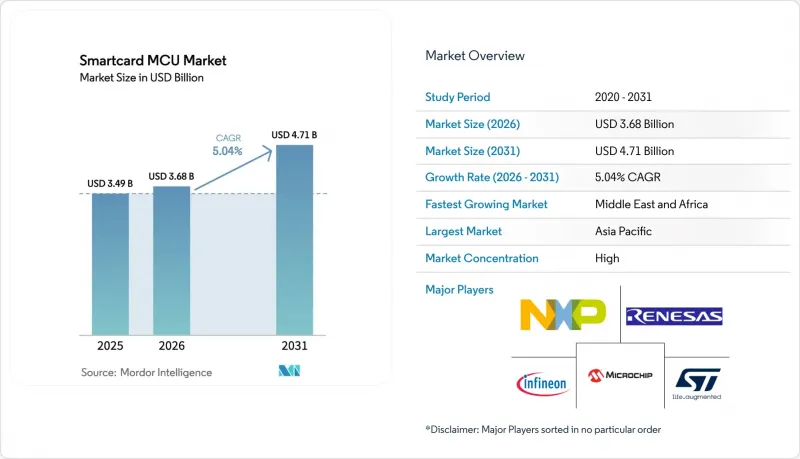
Mordor Intelligence에 의하면, 스마트카드 MCU 시장 규모는 2025년에 34억 9,000만 달러로 평가되었습니다. 2026년에 36억 8,000만 달러에 달하고, 2031년까지 47억 1,000만 달러에 이를 것으로 예측되며, 2026-2031년에 걸쳐 CAGR 5.04%로 성장할 전망입니다.
본 보고서는 제품별(8비트, 16비트, 32비트), 기능별(트랜잭션, 통신, 보안 및 접근 제어), 최종 사용자 산업별(은행, 금융서비스 및 보험(BFSI), 통신, 정부·의료, 교육, 소매, 기타),보안 인증 수준별(커먼 크라이테리아 EAL4+, 기타), 메모리 밀도별(16KB 이하, 32KB, 기타), 지역별로 분류되어 있습니다. 시장 예측은 금액(달러)으로 제시되어 있습니다.
세계의 스마트카드 MCU 시장 동향 및 인사이트
EMV 준수 결제 카드로의 전환
브라질, 멕시코, 걸프협력회의(GCC) 회원국 대부분에서 칩 탑재가 의무화됨에 따라 수천만 건의 직불카드 및 신용카드 계좌가 자기 스트라이프 매체에서 전환되었습니다. 카드 발급 은행은 동적 암호문을 저장하기 위해 EEPROM 용량이 큰 듀얼 인터페이스 보안 요소를 표준화하고 있으며, 그 결과 광범위한 가격 하락에도 불구하고 단위당 실리콘 사용량이 증가하여 카드 1장당 평균 판매 가격(ASP)이 상승하고 있습니다.
각국의 전자 신분증 및 전자 여권 도입
EU의 디지털 ID 규정에 따라 회원국은 생체 인증 이미지를 저장하고 전자 서명을 가능하게 하는 EAL6+ 준수 보안 요소로 업그레이드해야 할 의무가 부과되었으며, 10년에서 15년의 갱신 주기가 정착되었습니다. 인도의 Aadhaar 제도 확대와 일본의 마이넘버 제도 재검토에 따라, 카드 내 공개 키 인프라(PKI)와 멀티 용도 파티셔닝을 통합한 보안 요소의 수주가 급증하고 있으며, 인증을 획득한 공급업체의 수익원이 확대되고 있습니다.
모바일 지갑으로의 급속한 전환
2024년에 모바일 결제가 1조 달러라는 이정표를 맞이한다는 것은 북미와 서유럽에서 ‘탭 투 페이(Tap-to-Pay)’ 방식의 지갑이 선호되고 있음을 보여줍니다. 기본적인 직불카드 포트폴리오에서는 카드 발행 건수가 감소하고 있지만, 스마트폰에 내장된 보안 요소가 실리콘 수요의 일부를 보충하고 있어 총 잠재 시장 규모가 사라지는 것이 아니라 폼 팩터의 구성이 변화하고 있는 상황입니다.
부문별 분석
32비트 디바이스는 2025년 매출의 62.01%를 차지했으며, 거래 지연 및 암호화 처리 능력에 대한 요구 사항이 높아짐에 따라 이 부문은 연평균 성장률(CAGR) 5.62%로 성장할 전망입니다. 이러한 주도적인 입지 덕분에, 특히 EMV 듀얼 인터페이스 카드, eSIM, 정부 발행 전자 ID 인증 정보 분야에서 32비트가 스마트카드 MCU 시장 규모를 지배하고 있습니다. NXP의 SmartMX3와 Infineon의 SLC38은 AES, RSA, ECC 엔진을 통합하고 있으며, 소비 전력이 100mW 미만임에도 불구하고 EMV 레벨 1 비접촉식 카드에 대한 제한 사항을 충족합니다. 격자 연산은 16비트 대체 제품의 명령어 실행 여력을 능가하기 때문에 포스트 양자 알고리즘은 32비트의 우위를 더욱 공고히 하고 있습니다.
생체 인증 도입이 가속화되고 있습니다. ‘카드 상의 대조(Match-on-card)’ 알고리즘에는 40-60KB의 플래시 메모리와 1초 이하의 템플릿 검증이 요구되므로, 이에 따라 발급 사업자들은 128KB 이상의 구성을 채택하고 있습니다. 2025년 초 IDEMIA F.CODE의 출하 실적은 프리미엄 제품군이 현재 요구하는 성능 기준을 입증하고 있습니다. 선진국에서는 모바일 지갑으로의 전환으로 인해 최초 발급 매수가 감소하고 있지만, 200억 장에 달하는 결제 카드의 도입 기반을 통해 견조한 갱신 수요가 확보되고 있습니다. 이에 따라 갱신 주기가 3년에서 5년으로 연장되어 듀얼 인터페이스의 비용을 상쇄할 수 있게 되었습니다.
보안 및 접근 제어 부문은 2025년 매출의 44.34%를 차지했으며, 기업들이 도어 컨트롤러 및 논리적 접근 시스템을 스마트카드와 생체 인증을 결합한 다중 요소 인증 흐름으로 업데이트함에 따라 6.02%의 성장 궤도를 타고 있습니다. 2024년 10월에 발효된 유럽연합(EU)의 NIS2 지침에 따라, 중요 인프라 사업자는 하드웨어 기반 인증 정보의 도입이 의무화되어 EAL5+ 인증 칩에 대한 수요가 증가하고 있습니다. 주로 결제 카드로 대표되는 트랜잭션 기능은 스마트카드 MCU 시장 전체의 연평균 성장률(CAGR)과 비슷한 수준이지만, 모바일 지갑에 의한 수요 흡수로 인해 그 성장에는 한계가 보입니다. eSIM을 포함한 통신 모듈은 5G의 기세를 타고 성장을 가속화하고 있습니다. GSMA SGP.32의 원격 프로비저닝 규정에 따라 무선 경로를 통한 메모리 오버헤드가 증가하여 메모리 밀도가 32KB에서 64KB로 높아지고 있습니다.
기능 통합이 가속화되고 있습니다. 교통 요금 매체는 현재 로열티 및 ID 애플릿과 단일 칩 상에 공존하고 있으며, 국가 전자 신분증에는 전자정부 서비스를 위한 디지털 서명 기능이 내장되어 있습니다. 128KB EEPROM과 샌드박스화된 애플릿 도메인을 탑재한 STMicroelectronics의 ST31P450은 발행자가 부가가치 서비스를 통해 여유 용량을 수익화할 수 있는 플랫폼 접근 방식의 전형적인 예입니다.
지역별 분석
아시아태평양은 2025년 매출의 37.82%를 차지했으며, 그 규모는 인도의 ‘Aadhaar’ 결제 인프라와 중국의 보안 요소(secure element) 자급자족 추진에 힘입어 뒷받침되고 있습니다. 중국 공안부는 14억 장 규모의 국민 신분증 시장을 위해 CEC Huada와 베이징 푸단 마이크로일렉트로닉스의 부품을 인증했으며, 이로 인해 유럽 및 미국 공급업체들은 최대 규모의 인증 정보 풀 중 하나에서 배제되었습니다. 인도의 통합 결제 인터페이스(UPI)는 2025년 12월 167억 건의 거래를 처리했으며, 중국에서 진출한 기업들이 가격 경쟁을 시도하고 있는 상황에서도 국내에서 제조된 RuPay 듀얼 인터페이스 카드에 대한 수요를 뒷받침하고 있습니다. 일본과 한국은 각각 양자 기술 대응 여권으로의 업그레이드와 완전 비접촉식 결제 의무화를 통해 지역 전체의 총량에 기여하고 있습니다.
중동 및 아프리카는 6.74%라는 가장 높은 연평균 성장률(CAGR)을 기록하고 있습니다. 사우디아라비아의 ‘Absher’ 플랫폼과 아랍에미리트의 생체 인증 기능이 탑재된 ‘Emirates ID’는 전자정부 및 교통 신분증에 보안 요소를 통합하고 있으며, 각국의 사이버 보안 기관은 EAL5+ 이상의 기준을 의무화하고 있습니다. 튀르키예에서는 eSIM의 보안 요소를 활용한 모바일 디지털 ID 시범 운영이 진행되고 있어, 하이브리드형 신분증 체계에 대한 지역적 수요가 높음을 알 수 있습니다.
유럽에서는 2026년까지 회원국에 발급을 의무화하는 ‘디지털 ID 지갑’ 규제의 혜택을 받고 있습니다. 독일의 전자 환자 카드와 프랑스의 생체 인증 지원 ‘카르트 비탈(Carte Vitalle)’의 갱신에 따라 공공 부문의 수주가 확대되고 있습니다. 북미에서는 공적 ID 보급 속도에 비해 뒤처지고 있지만, 결제 카드 갱신 및 산업용 시큐어 부트에 대한 수요는 견조하게 유지되고 있습니다. 라틴아메리카에서는 EMV 도입이 진행되고 있지만, 도시 지역에서는 지갑 이용이 감소하는 경향을 보이고 있습니다. 한편, 아프리카에서의 도입은 남아프리카공화국과 나이지리아에 집중되어 있으며, 이들 국가에서는 금융 포용 프로젝트에서 보안과 단위당 경제성을 양립시키기 위해 EAL4+ 칩이 활용되고 있습니다.
기타 혜택
- 엑셀 형식 시장 예측(ME) 시트
- 3개월간의 애널리스트 지원
자주 묻는 질문
목차
제1장 서론
제2장 조사 방법
제3장 주요 요약
제4장 시장 구도
제5장 시장 규모 및 성장 예측
제6장 경쟁 구도
제7장 시장 기회 및 향후 전망
KTH 26.09.14According to Mordor Intelligence, the smartcard MCU market size is projected to be USD 3.49 billion in 2025, USD 3.68 billion in 2026, and reach USD 4.71 billion by 2031, growing at a CAGR of 5.04% from 2026 to 2031.
This report is Segmented by Product (8-Bit, 16-Bit, and 32-Bit), Functionality (Transaction, Security and Access Control and More), End-User Industry (BFSI, Telecommunications, Government and Healthcare, Education, Retail, and More), Security Certification Level (Common Criteria EAL4+, and More), Memory Density (<=16 KB, 32 KB, and More), and Geography. The Market Forecasts are Provided in Terms of Value (USD).
Global Smartcard MCU Market Trends and Insights
Migration to EMV-compliant payment cards
Mandated chip enablement in Brazil, Mexico, and most Gulf Cooperation Council states moved tens of millions of debit and credit accounts away from magnetic stripe media. Card-issuing banks are standardizing on dual-interface secure elements with larger EEPROM footprints to store dynamic cryptograms, thereby increasing silicon content per unit and raising the per-card ASP despite broader price erosion.
National e-ID and e-passport roll-outs
The EU Digital Identity Regulation obligates member states to upgrade credentials to EAL6+ secure elements that store biometric images and enable electronic signatures, locking in 10- to 15-year replacement cycles. India's Aadhaar expansion and Japan's My Number revamp trigger orders for secure elements that integrate on-card Public Key Infrastructure and multi-application partitioning, widening revenue streams for certification-ready suppliers.
Rapid shift toward mobile wallets
The USD 1 trillion mobile payment milestone in 2024 signals wallet preference for tap-to-pay in North America and Western Europe. Card volumes slide on basic debit portfolios; however, embedded secure elements in phones reclaim part of the silicon demand, altering form-factor mix rather than erasing total addressable volume.
Other drivers and restraints analyzed in the detailed report include:
- SIM swap to 5G eSIM form-factors
- Contactless transit fare-collection upgrades
- ASP pressure from Chinese fabs
For complete list of drivers and restraints, kindly check the Table Of Contents.
Segment Analysis
32-bit devices accounted for 62.01% of 2025 revenue, and the segment is set to expand at a 5.62% CAGR as transaction latency and cryptographic-throughput requirements climb. This leadership underpins 32-bit control of the Smartcard MCU market size, especially in EMV dual-interface cards, eSIMs, and government e-ID credentials. NXP SmartMX3 and Infineon SLC38 integrate AES, RSA, and ECC engines that clear EMV Level 1 contactless limits while drawing under 100 mW. Post-quantum algorithms further lock in 32-bit supremacy, since lattice math outstrips the instruction headroom of 16-bit alternatives.
Biometric rollouts quicken the pace. Match-on-card algorithms demand 40-60 KB flash and sub-one-second template verification, driving issuers toward >=128 KB configurations. IDEMIA F.CODE shipments in early 2025 demonstrate the performance bar premium portfolios now expect. Although mobile-wallet substitution trims first-issue volumes in developed economies, the installed base of 20 billion payment cards ensures a resilient replacement flow, stretching refresh cycles from three to five years to defray dual-interface costs.
Security and Access Control claimed 44.34% of 2025 revenue, rising at a 6.02% trajectory as enterprises retrofit door-controllers and logical-access systems with smartcard-plus-biometric multi-factor flows. The European Union's NIS2 directive, effective October 2024, obliges critical-infrastructure operators to deploy hardware-rooted credentials, elevating demand for EAL5+-certified chips. Transaction functionality, largely payment cards, matches the overall Smartcard MCU market CAGR, its upside capped by mobile-wallet cannibalization. Communication modules, including eSIMs, accelerate on 5G momentum; GSMA SGP.32 remote-provisioning rules add over-the-air memory overheads that nudge densities from 32 KB to 64 KB.
Functional convergence gathers speed. Transit fare media now co-reside with loyalty and ID applets on a single chip, and national e-ID cards embed digital-signature capabilities for e-government services. STMicroelectronics ST31P450, packing 128 KB EEPROM and sandboxed applet domains, typifies the platform approach that lets issuers monetize spare capacity via value-added services.
Complete Report Scope:
- By Product
- 8-bit
- 16-bit
- 32-bit
- By Functionality
- Transaction
- Communication
- Security and Access Control
- By End-User Industry
- Banking, Financial Services and Insurance (BFSI)
- Telecommunications
- Government and Healthcare
- Education
- Retail
- Transportation
- Other End-User Industries
- By Security Certification Level
- Common Criteria EAL4+
- EAL5+
- EAL6+
- EAL7
- By Memory Density
- <=16 FB
- 32 KB
- 64 KB
- >=128 KB
- By Geography
- North America
- United States
- Canada
- Mexico
- South America
- Brazil
- Argentina
- Rest of South America
- Europe
- Germany
- United Kingdom
- France
- Italy
- Spain
- Russia
- Rest of Europe
- Asia Pacific
- China
- Japan
- India
- South Korea
- Rest of Asia Pacific
- Middle East
- Saudi Arabia
- United Arab Emirates
- Turkey
- Rest of Middle East
- Africa
- South Africa
- Nigeria
- Rest of Africa
- North America
Geography Analysis
Asia Pacific controlled 37.82% of 2025 revenue, its scale anchored by India's Aadhaar payments rail and China's secure-element self-reliance push. China's Ministry of Public Security endorses CEC Huada and Beijing Fudan Microelectronics parts for a market of 1.4 billion national IDs, locking Western vendors out of one of the largest credential pools. India's Unified Payments Interface processed 16.7 billion transactions in December 2025, reinforcing demand for domestic-fabricated RuPay dual-interface cards, even as Chinese entrants test price competitiveness. Japan and South Korea add to the regional total with post-quantum passport upgrades and full contactless mandates, respectively.
The Middle East and Africa posts the highest 6.74% CAGR. Saudi Arabia's Absher platform and the UAE's biometric Emirates ID bundle secure elements across e-government and transit credentials, with national cybersecurity agencies stipulating EAL5+ minimums. Turkey pilots mobile digital IDs that lean on eSIM secure elements, illustrating regional appetite for hybrid credential schemes.
Europe benefits from the Digital Identity Wallet regulation that compels member-state issuance by 2026. Germany's e-patient cards and France's biometric Carte Vitale updates amplify public-sector orders. North America trails on public-ID momentum yet records steady payment-card replacement and industrial secure-boot demand. Latin America shows high EMV thesis but faces wallet erosion in urban hubs, while Africa's adoption concentrates in South Africa and Nigeria, where financial-inclusion projects rely on EAL4+ chips to balance security with unit economics.
- NXP Semiconductors N.V.
- Infineon Technologies AG
- STMicroelectronics N.V.
- Samsung Electronics Co., Ltd.
- Renesas Electronics Corporation
- Microchip Technology Incorporated
- IDEMIA Group S.A.S.
- Thales Group (Gemalto Division)
- Giesecke+Devrient GmbH
- Zilog, Inc.
- Beijing Fudan Microelectronics Group Co., Ltd.
- EM Microelectronic-Marin SA
- CEC Huada Electronic Design Co., Ltd.
- Shanghai Huahong Integrated Circuit Co., Ltd.
- Watchdata Technologies Co., Ltd.
- Wuhan Tianyu Information Industry Co., Ltd.
- Valid S.A.
- Siltech Corporation
- Hengbao Co., Ltd.
- CPI Card Group Inc.
Additional Benefits:
- The market estimate (ME) sheet in Excel format
- 3 months of analyst support
TABLE OF CONTENTS
1 INTRODUCTION
- 1.1 Study Assumptions and Market Definition
- 1.2 Scope of the Study
2 RESEARCH METHODOLOGY
3 EXECUTIVE SUMMARY
4 MARKET LANDSCAPE
- 4.1 Market Overview
- 4.2 Market Drivers
- 4.2.1 Migration to EMV-Compliant Payment Cards
- 4.2.2 National e-ID and e-Passport Roll-Outs
- 4.2.3 SIM Swap to 5G-Enabled eSIM Form-Factors
- 4.2.4 Contactless Transit Fare-Collection Upgrades
- 4.2.5 Post-Quantum-Ready Secure Element Roadmaps
- 4.2.6 Pay-TV Smart-Card Refresh in Emerging Markets
- 4.2.7 Rise of Biometric Dual-Interface Cards
- 4.2.8 Mandated Cyber-Resilience for Critical Infrastructure Credentials
- 4.3 Market Restraints
- 4.3.1 Rapid Shift Toward Mobile Wallets
- 4.3.2 ASP Pressure From Chinese Fabs
- 4.3.3 Shortage of Certified Testing Capacity (CC, FIPS)
- 4.3.4 Geopolitical Export-Control Restrictions
- 4.3.5 Adverse Carbon-Footprint Regulations on Legacy 8-inch Fabs
- 4.4 Industry Value-Chain Analysis
- 4.5 Regulatory Landscape
- 4.6 Technological Outlook
- 4.7 Impact of Macroeconomic Factors on the Market
- 4.8 Porter's Five Forces Analysis
- 4.8.1 Bargaining Power of Suppliers
- 4.8.2 Bargaining Power of Consumers
- 4.8.3 Threat of New Entrants
- 4.8.4 Intensity of Competitive Rivalry
- 4.8.5 Threat of Substitutes
5 MARKET SIZE AND GROWTH FORECASTS (VALUE)
- 5.1 By Product
- 5.1.1 8-bit
- 5.1.2 16-bit
- 5.1.3 32-bit
- 5.2 By Functionality
- 5.2.1 Transaction
- 5.2.2 Communication
- 5.2.3 Security and Access Control
- 5.3 By End-User Industry
- 5.3.1 Banking, Financial Services and Insurance (BFSI)
- 5.3.2 Telecommunications
- 5.3.3 Government and Healthcare
- 5.3.4 Education
- 5.3.5 Retail
- 5.3.6 Transportation
- 5.3.7 Other End-User Industries
- 5.4 By Security Certification Level
- 5.4.1 Common Criteria EAL4+
- 5.4.2 EAL5+
- 5.4.3 EAL6+
- 5.4.4 EAL7
- 5.5 By Memory Density
- 5.5.1 <=16 FB
- 5.5.2 32 KB
- 5.5.3 64 KB
- 5.5.4 >=128 KB
- 5.6 By Geography
- 5.6.1 North America
- 5.6.1.1 United States
- 5.6.1.2 Canada
- 5.6.1.3 Mexico
- 5.6.2 South America
- 5.6.2.1 Brazil
- 5.6.2.2 Argentina
- 5.6.2.3 Rest of South America
- 5.6.3 Europe
- 5.6.3.1 Germany
- 5.6.3.2 United Kingdom
- 5.6.3.3 France
- 5.6.3.4 Italy
- 5.6.3.5 Spain
- 5.6.3.6 Russia
- 5.6.3.7 Rest of Europe
- 5.6.4 Asia Pacific
- 5.6.4.1 China
- 5.6.4.2 Japan
- 5.6.4.3 India
- 5.6.4.4 South Korea
- 5.6.4.5 Rest of Asia Pacific
- 5.6.5 Middle East
- 5.6.5.1 Saudi Arabia
- 5.6.5.2 United Arab Emirates
- 5.6.5.3 Turkey
- 5.6.5.4 Rest of Middle East
- 5.6.6 Africa
- 5.6.6.1 South Africa
- 5.6.6.2 Nigeria
- 5.6.6.3 Rest of Africa
- 5.6.1 North America
6 COMPETITIVE LANDSCAPE
- 6.1 Market Concentration
- 6.2 Strategic Moves
- 6.3 Market Share Analysis
- 6.4 Company Profiles (includes Global Level Overview, Market Level Overview, Core Segments, Financials as Available, Strategic Information, Market Rank/Share for Key Companies, Products and Services, and Recent Developments)
- 6.4.1 NXP Semiconductors N.V.
- 6.4.2 Infineon Technologies AG
- 6.4.3 STMicroelectronics N.V.
- 6.4.4 Samsung Electronics Co., Ltd.
- 6.4.5 Renesas Electronics Corporation
- 6.4.6 Microchip Technology Incorporated
- 6.4.7 IDEMIA Group S.A.S.
- 6.4.8 Thales Group (Gemalto Division)
- 6.4.9 Giesecke+Devrient GmbH
- 6.4.10 Zilog, Inc.
- 6.4.11 Beijing Fudan Microelectronics Group Co., Ltd.
- 6.4.12 EM Microelectronic-Marin SA
- 6.4.13 CEC Huada Electronic Design Co., Ltd.
- 6.4.14 Shanghai Huahong Integrated Circuit Co., Ltd.
- 6.4.15 Watchdata Technologies Co., Ltd.
- 6.4.16 Wuhan Tianyu Information Industry Co., Ltd.
- 6.4.17 Valid S.A.
- 6.4.18 Siltech Corporation
- 6.4.19 Hengbao Co., Ltd.
- 6.4.20 CPI Card Group Inc.
7 MARKET OPPORTUNITIES AND FUTURE OUTLOOK
- 7.1 White-Space and Unmet-Need Assessment