|
시장보고서
상품코드
2124946
중동의 스마트 카드 : 시장 점유율 분석, 업계 동향과 통계, 성장 예측(2026-2031년)Middle East Smart Card - Market Share Analysis, Industry Trends & Statistics, Growth Forecasts (2026 - 2031) |
||||||
 Mordor Intelligence
Mordor Intelligence에 의하면, 중동의 스마트 카드 시장 규모는 2025년 10억 7,000만 달러에서 2026년에는 11억 6,000만 달러에 이르고, 2026-2031년 CAGR 8.79%로 성장을 지속하여 2031년에는 17억 7,000만 달러에 달할 것으로 예측됩니다.
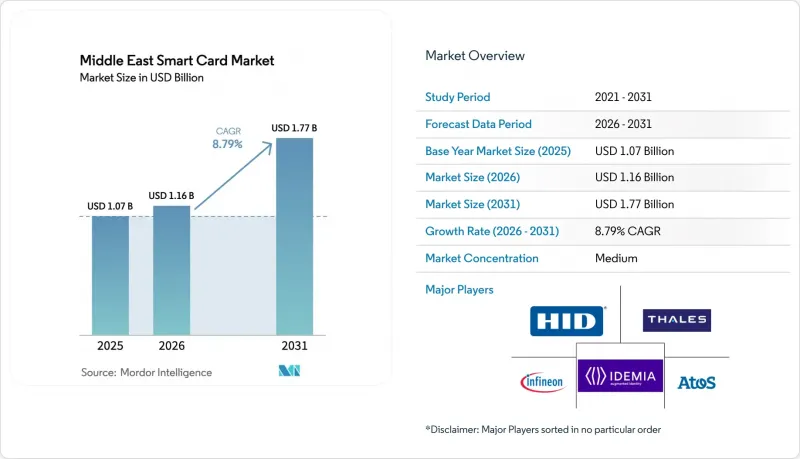
본 보고서는 인터페이스 유형(접촉식, 비접촉식, 듀얼 인터페이스), 칩 유형(메모리형 스마트카드, 마이크로컨트롤러형 스마트카드 등),기능·용도(결제·은행 업무, 본인 확인·인증 등), 최종 사용자 산업(은행, 금융서비스 및 보험(BFSI), IT 및 통신, 정부 기관 등), 국가별로 분류되어 있습니다. 시장 예측은 금액(달러) 기준으로 제시되어 있습니다.
중동 스마트카드 시장 동향 및 인사이트
GCC 국가들의 국가 전자 신분증 및 전자 여권 도입
GCC 국가 정부들은 생체 인증을 통한 시민 ID를 디지털 공공 서비스 제공의 핵심으로 삼고 있습니다. UAE에서는 2025년 말까지 물리적 에미레이트 ID 카드의 운영을 종료하고, 안전한 모바일 지갑을 통해 이용 가능한 얼굴 인식 및 지문 인식을 통한 디지털 인증 정보로의 전환을 추진할 예정입니다. 오만에서는 이미 탈레스(Thales)가 제공하는 다기능 스마트 ID를 통해 인구의 100%를 커버하고 있습니다. 쿠웨이트의 ‘MY KUWAIT ID’ 앱에는 70개 이상의 전자정부 서비스에 대한 접근성을 강화하는 추가 인증 계층이 통합되어 있습니다. 각 부처가 국경을 초월한 인증이 가능한 상호운용성 솔루션을 요구하는 가운데, 이러한 프로그램들이 판매량을 끌어올리며 중동 스마트카드 시장을 주도하고 있습니다.
사우디아라비아 및 UAE의 ‘비전 2030’ 주도 무현금 결제 의무화
사우디아라비아의 ‘Mada’ 네트워크 확대와 두바이가 2026년까지 무현금 거래 비율을 90%로 끌어올리겠다는 목표는 소매, 교통, 행정 서비스 결제 분야에서 카드 기반 결제를 제도화하고 있습니다. 동시에, UAE 중앙은행은 2025년 하반기에 ‘디지털 딜함’을 도입할 예정이며, 여기에는 토큰화 및 스마트 계약 기능이 통합되어 있어 첨단 카드 하드웨어와 원활하게 연동되어야 합니다. 중동·북아프리카(MENA) 지역의 대금 상환 이용률은 2020년 41%에서 2023년 20%로 절반으로 감소했으며, 이는 비접촉식 카드 인프라를 선호하는 행동 변화를 여실히 보여주고 있습니다.
GCC와 레반트 지역 카드 표준 간의 상호 운용성 격차
GCCNET이 ATM 결제 처리를 통합하고 있는 반면, 카드 인증 프로토콜은 인근 시장 간에 여전히 분절되어 있어, 이로 인해 발행사는 여러 제품 SKU를 취급할 수밖에 없으며, 국경을 넘는 서비스의 조화가 지연되고 있습니다. 레바논이 국경 관리를 위해 대체 생체 인증 표준을 채택하고 있는 것은 인증 비용과 복잡성을 가중시키는 기술적 차이의 대표적인 예입니다.
부문 분석
기존 은행 및 전자 ID 프로그램의 영향으로 접촉형 인증 수단이 여전히 주류를 이루고 있지만, 비접촉형의 물결은 부인할 수 없는 사실입니다. 2025년에는 비접촉형 카드 발행 비율이 48.00%에 달하며, 연평균 성장률(CAGR) 9.41%로 확대되고 있습니다. 중동의 비접촉식 플랫폼용 스마트 카드 시장 규모는 교통 사업자와 소매업체가 NFC 리더기를 사후 도입함에 따라 2026-2031년 2억 5,860만 달러 증가할 것으로 예측됩니다. 듀얼 인터페이스 카드는 두 가지 모드를 모두 통합함으로써 전환 위험을 완화하고 있으며, 이미 신규 발행량의 19.00%를 차지하고 있습니다.
교통 기관은 승객의 흐름을 원활하게 하고 다중 모드 통합을 지원한다는 점에서 비접촉 방식을 선호합니다. 소매 체인은 팬데믹 기간 동안 지역에서 채택된 사회적 거리두기 추세에 부응하기 위해 ‘탭 투 페이(Tap-to-Pay)’를 도입하고 있습니다. 한편, 손바닥 정맥 인증 및 얼굴 인식과 같은 생체 인증 기술의 조합이 고액 비접촉 결제 한도를 확보하기 시작하면서 마찰 없는 결제에 대한 신뢰를 높이고 있습니다. 이러한 요인들로 인해 비접촉식 결제 부문은 2031년보다 훨씬 앞서 접촉식 결제 시장 점유율을 추월하며, 중동 스마트카드 시장의 장기적인 성장 동력으로서의 입지를 공고히할 것입니다.
마이크로컨트롤러 유닛은 확립된 인증 실적과 결제, 통신, ID 분야에서의 폭넓은 용도로 인해 2025년에는 65.28%의 점유율을 차지하며 현재 시장을 독점하고 있습니다. 그럼에도 불구하고, SoC 아키텍처는 CPU, 보안 요소, 무선 인터페이스를 하나의 다이에 통합함으로써 BOM(부품 원가)과 실적를 줄일 수 있어 연평균 성장률(CAGR) 11.06%라는 가장 빠른 성장세를 보이고 있습니다. 중동 스마트카드 시장에서 SoC 플랫폼 시장 규모는 2031년까지 2억 2,340만 달러에 달할 것으로 전망됩니다.
사우디아라비아의 10억 사우디 리얄(2억 6,600만 달러) 규모의 ‘내셔널 세미컨덕터 허브’에서 볼 수 있듯이, 지역 정부의 반도체 설계 허브에 대한 투자는 향후 국내 지적 재산(IP) 및 패키징 역량으로의 전환이 진행될 것임을 시사합니다. 이에 대응하여 유럽의 주요 기술 기업들은 밸류체인의 현지화를 통해 대응하고 있습니다. IDEMIA는 GCC(걸프협력회의)의 데이터 보호 요건을 충족하면서도 유럽산이라는 추적성을 보장하는 생산 능력에 2,000만 유로(2,160만 달러)를 투자했습니다. 인피니온의 ‘SECORA Pay Green’은 동시에 요구되는 지속가능성 노력을 구현하고 있으며, 버진 플라스틱과 CO2를 60% 절감하고 있습니다.
기타 혜택:
- 엑셀 형식 시장 예측(ME) 시트
- 3개월간의 애널리스트 지원
자주 묻는 질문
목차
제1장 서론
제2장 조사 방법
제3장 주요 요약
제4장 시장 구도
제5장 시장 규모와 성장 예측
제6장 경쟁 구도
제7장 시장 기회와 향후 전망
LSH 26.09.14According to Mordor Intelligence, the Middle East smart card market size is expected to grow from USD 1.07 billion in 2025 to USD 1.16 billion in 2026 and is forecast to reach USD 1.77 billion by 2031 at 8.79% CAGR over 2026-2031.
This report is Segmented by Interface Type (Contact-Based, Contactless, Dual-Interface), Chip Type (Memory Smart Cards, Microcontroller Smart Cards, and More), Function/Application (Payment and Banking, Identification and Authentication, and More), End-User Vertical (BFSI, IT and Telecommunication, Government, and More), and by Country. The Market Forecasts are Provided in Terms of Value (USD).
Middle East Smart Card Market Trends and Insights
National e-ID & e-Passport Roll-outs across GCC
GCC governments have made biometric civil ID a centrepiece of digital public-service delivery. The UAE will decommission physical Emirates ID cards by late 2025, transitioning to face- and fingerprint-verified digital credentials that remain accessible through secure mobile wallets. Oman already maintains 100% population coverage with multi-application smart IDs supplied by Thales. Kuwait's MY KUWAIT ID app embeds additional verification layers that strengthen access to more than 70 e-government services. Such programmes elevate unit volumes and drive the Middle East smart card market as ministries demand interoperable solutions capable of cross-border authentication.
Vision-2030-Led Cashless Payment Mandates in Saudi Arabia & UAE
Saudi Arabia's Mada network expansion and Dubai's target of 90% cashless transactions by 2026 institutionalise card-based payments across retail, transport, and government service payments. Simultaneously, the Central Bank of the UAE will introduce the Digital Dirham in late 2025, embedding tokenisation and smart-contract capabilities that must interface seamlessly with advanced card hardware. Cash-on-delivery usage in MENA halved from 41% in 2020 to 20% in 2023, underscoring behavioural shifts favouring contactless card infrastructure.
Interoperability Gaps between GCC & Levant Card Standards
While GCCNET unifies ATM clearing, card certification protocols remain fragmented across neighbouring markets, forcing issuers to carry multiple product SKUs and slowing cross-border service harmonisation. Lebanon's adoption of alternate biometric standards for border control exemplifies the technical divergence that elevates certification cost and complexity.
Other drivers and restraints analyzed in the detailed report include:
- Mass-Transit Smart-Ticketing for Mega-Projects
- 5G SIM Replacement Cycle Boosting High-End Micro-controller Cards
- Mobile-Wallet Cannibalisation in Affluent Gulf States
For complete list of drivers and restraints, kindly check the Table Of Contents.
Segment Analysis
Contact-based credentials remain dominant due to legacy bank and e-ID programmes, yet the contactless wave is unmistakable. In 2025, contactless cards represented 48.00% issuance and are advancing at 9.41% CAGR. The Middle East smart card market size for contactless platforms is forecast to add USD 258.6 million between 2026 and 2031 as transit operators and retailers retrofit NFC readers. Dual-interface cards mitigate migration risk by embedding both modes and already account for 19.00% of new volumes.
Transit agencies favour contactless because it speeds passenger flow and supports multi-modal integration. Retail chains deploy tap-to-pay because it aligns with regional social-distancing preferences adopted during the pandemic. Meanwhile, biometric overlays-such as palm-vein or facial match-are beginning to secure high-value contactless limits, reinforcing confidence in frictionless payment. These factors ensure the contactless segment will overtake contact-based share well before 2031, cementing its status as the long-term growth engine of the Middle East smart card market.
Microcontroller units currently dominate with a share of 65.28% in 2025 due to established certification pedigree and broad application across payments, telecom, and ID. Nevertheless, SoC architectures are growing fastest at 11.06% CAGR because they consolidate CPU, secure element, and wireless interface in one die, reducing BOM and footprint. The Middle East smart card market size for SoC platforms is poised to reach USD 223.4 million by 2031.
Regional sovereign investment in semiconductor design hubs-exemplified by Saudi Arabia's SAR 1 billion (USD 266 million) National Semiconductor Hub-signals a future shift toward domestic IP and packaging capacity. European technology leaders respond by localising value chains; IDEMIA invested EUR 20 million (USD 21.6 million) in capacity that guarantees European source traceability while serving GCC data-protection mandates. Infineon's SECORA Pay Green exemplifies the parallel sustainability imperative, cutting virgin plastic and CO2 by 60%
Complete Report Scope:
- By Interface Type
- Contact-Based
- Contactless
- Dual-Interface
- By Chip Type
- Memory Smart Cards
- Micro-controller Smart Cards
- System-on-Chip and Others
- By Function / Application
- Payment and Banking
- Identification and Authentication
- SIM and Telecommunications
- Transit and Ticketing
- Healthcare
- IoT and Other Niche Uses
- By End-User Vertical
- BFSI
- IT and Telecommunications
- Government and Public Sector
- Transportation and Logistics
- Healthcare
- Retail and Loyalty
- Others
- By Country
- United Arab Emirates
- Saudi Arabia
- Qatar
- Kuwait
- Oman
- Bahrain
- Israel
- Rest of Middle-East
List of Companies Covered in this Report:
- Thales Group
- IDEMIA
- Eviden (Atos Group)
- Giesecke + Devrient GmbH
- NXP Semiconductors N.V.
- Infineon Technologies AG
- HID Global Corporation
- Secura Key
- Eastcompeace Smart Card Co. Ltd.
- CPI Card Group Inc.
- Watchdata Technologies Pte Ltd.
- Muehlbauer Group
- Mastercard Inc.
- Visa Inc.
- Samsung Electronics Co. Ltd.
- Cardz Group ME LLC
- OT-Morpho (Gemalto)
- Zwipe AS
Additional Benefits:
- The market estimate (ME) sheet in Excel format
- 3 months of analyst support
TABLE OF CONTENTS
1 INTRODUCTION
- 1.1 Study Assumptions and Market Definition
- 1.2 Scope of the Study
2 RESEARCH METHODOLOGY
3 EXECUTIVE SUMMARY
4 MARKET LANDSCAPE
- 4.1 Market Overview
- 4.2 Market Drivers
- 4.2.1 National e-ID and e-Passport Roll-outs across GCC
- 4.2.2 Vision-2030 led Cashless Payment Mandates in Saudi Arabia and UAE
- 4.2.3 Mass-Transit Smart-Ticketing for Mega-Projects
- 4.2.4 5G SIM Replacement Cycle Boosting High-End Micro-controller Cards
- 4.2.5 Smart Hajj/Umrah ID Initiatives Driving High-Volume Issuance Peaks
- 4.3 Market Restraints
- 4.3.1 Inter-operability Gaps between GCC and Levant Card Standards
- 4.3.2 Grey-Market Counterfeit Card Inflows Undermining Security Trust
- 4.3.3 Imported IC Shortages due to Global Export Controls and Logistics
- 4.3.4 Mobile-Wallet Cannibalisation in Affluent Gulf States
- 4.4 Value / Supply-Chain Analysis
- 4.5 Regulatory Landscape
- 4.6 Technological Outlook (NFC, Biometric, Metal and Eco Materials)
- 4.7 Porter's Five Forces Analysis
- 4.7.1 Bargaining Power of Suppliers
- 4.7.2 Bargaining Power of Buyers
- 4.7.3 Threat of New Entrants
- 4.7.4 Threat of Substitutes
- 4.7.5 Intensity of Competitive Rivalry
5 MARKET SIZE AND GROWTH FORECASTS (VALUE)
- 5.1 By Interface Type
- 5.1.1 Contact-Based
- 5.1.2 Contactless
- 5.1.3 Dual-Interface
- 5.2 By Chip Type
- 5.2.1 Memory Smart Cards
- 5.2.2 Micro-controller Smart Cards
- 5.2.3 System-on-Chip and Others
- 5.3 By Function / Application
- 5.3.1 Payment and Banking
- 5.3.2 Identification and Authentication
- 5.3.3 SIM and Telecommunications
- 5.3.4 Transit and Ticketing
- 5.3.5 Healthcare
- 5.3.6 IoT and Other Niche Uses
- 5.4 By End-User Vertical
- 5.4.1 BFSI
- 5.4.2 IT and Telecommunications
- 5.4.3 Government and Public Sector
- 5.4.4 Transportation and Logistics
- 5.4.5 Healthcare
- 5.4.6 Retail and Loyalty
- 5.4.7 Others
- 5.5 By Country
- 5.5.1 United Arab Emirates
- 5.5.2 Saudi Arabia
- 5.5.3 Qatar
- 5.5.4 Kuwait
- 5.5.5 Oman
- 5.5.6 Bahrain
- 5.5.7 Israel
- 5.5.8 Rest of Middle-East
6 COMPETITIVE LANDSCAPE
- 6.1 Market Concentration
- 6.2 Strategic Moves
- 6.3 Market Share Analysis
- 6.4 Company Profiles {(includes Global level Overview, Market level overview, Core Segments, Financials as available, Strategic Information, Market Rank/Share for key companies, Products and Services, and Recent Developments)}
- 6.4.1 Thales Group
- 6.4.2 IDEMIA
- 6.4.3 Eviden (Atos Group)
- 6.4.4 Giesecke + Devrient GmbH
- 6.4.5 NXP Semiconductors N.V.
- 6.4.6 Infineon Technologies AG
- 6.4.7 HID Global Corporation
- 6.4.8 Secura Key
- 6.4.9 Eastcompeace Smart Card Co. Ltd.
- 6.4.10 CPI Card Group Inc.
- 6.4.11 Watchdata Technologies Pte Ltd.
- 6.4.12 Muehlbauer Group
- 6.4.13 Mastercard Inc.
- 6.4.14 Visa Inc.
- 6.4.15 Samsung Electronics Co. Ltd.
- 6.4.16 Cardz Group ME LLC
- 6.4.17 OT-Morpho (Gemalto)
- 6.4.18 Zwipe AS
7 MARKET OPPORTUNITIES AND FUTURE OUTLOOK
- 7.1 White-space and Unmet-Need Assessment