

|
시장보고서
상품코드
2122917
헬스케어 분야 블록체인 : 시장 점유율 분석, 업계 동향 및 통계, 성장 예측(2026-2031년)Blockchain In Healthcare - Market Share Analysis, Industry Trends & Statistics, Growth Forecasts (2026 - 2031) |
||||||
 Mordor Intelligence
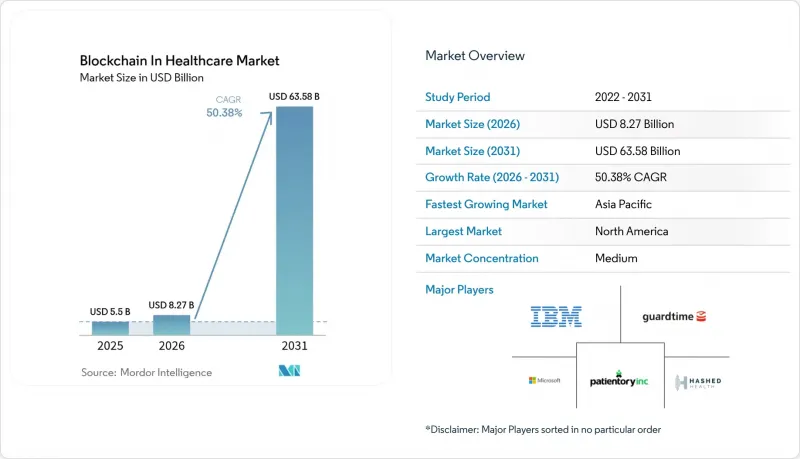
Mordor Intelligence에 의하면, 헬스케어 분야 블록체인 시장 규모는 2025년 55억 달러로 평가되었습니다. 2026년에는 82억 7,000만 달러로 확대되어 2026-2031년에 걸쳐 CAGR 50.38%로 성장하여 2031년에는 635억 8,000만 달러에 이를 것으로 예측됩니다.

본 보고서는 용도별(임상 데이터 교환, 청구 및 보험금 지급 심사, 기타), 최종 사용자별(의료 제공업체(병원, 클리닉), 제약·의료 기술 제조업체, 기타), 블록체인 유형별(프라이빗·허가형, 컨소시엄, 퍼블릭), 지역별로 분류되어 있습니다.
세계의 헬스케어 분야 블록체인 시장 동향 및 인사이트
사이버 공격으로 인한 피해액 증가로 인해 CIO의 예산이 블록체인 보안으로 전환되고 있습니다.
2020년 이후 의료 분야의 정보 유출로 인해 5억 건 이상의 기록이 유출되었으며, 2024년에는 건당 평균 비용이 1,093만 달러에 달했습니다. 2024년 2월 발생한 Change Healthcare에 대한 공격에서는 하루에 2,200만 달러 상당의 보험금 청구 처리가 중단되고, 2,200만 달러 상당의 비트코인을 요구하는 랜섬웨어 공격이 발생하여 중앙 집중형 시스템의 취약성이 부각되었습니다. 분산 원장 기술은 변조 방지 기능을 갖춘 감사 추적, 데이터 출처 추적, 미국 보건복지부(HHS)의 자발적인 ‘사이버 보안 성과 목표(CPG)’를 충족하는 다자간 검증을 제공함으로써 제로 트러스트 아키텍처에 적합합니다. 보험사들이 인수 기준을 엄격히 하고, 규제 당국이 중요 데이터의 무결성을 확보하는 수단으로 블록체인을 중시하는 가운데, CIO들은 현재 블록체인에 대한 예산을 혁신 거점에 대한 지출이 아닌 핵심 사이버 보안 비용으로 계상하고 있습니다. 이러한 변화로 인해 의료 제공업체 시스템 및 보험사 클리어링하우스 전반에 걸친 본격적인 네트워크 도입이 가속화되고 있습니다.
미국 및 EU의 DSCSA/FMD 일련 번호 부여 기한에 따라 의약품의 종단간 추적 가능성이 의무화되었습니다.
의약품 공급망 보안법(DSCSA)의 강화된 요건은 2026년까지 연장되었지만, 그 기한은 엄격하여 일련번호가 부여된 거래의 도입 기간을 단축시키고 있습니다. FDA가 IBM, KPMG, Merck, Walmart와 공동으로 실시한 파일럿 프로젝트에서는 기존 도구를 사용했을 때 73%였던 추적 가능성이 100%에 달하여 블록체인의 효율성이 입증되었습니다. 유럽의 위조 의약품 지침도 마찬가지로 압박을 가하고 있으며, 일련번호가 부여된 국가 의약품 코드(NDC)에는 끊김 없는 감사 가능성이 요구되고 있습니다. 전자적 연결 환경을 갖추지 못한 거래 파트너는 공급망에서 배제될 위험이 있으며, 이로 인해 의약품 도매업체는 GS1 EPCIS 표준과 스마트 계약을 통합한 허가형 원장의 도입을 강요받고 있습니다. 따라서 전자 페디그리에 관한 규제가 명확해짐에 따라, 블록체인은 단순한 선택지에서 업무상의 필수 요건으로 변화하고 있습니다.
기존 HIS에서 전환하는 데 드는 비용이 높기 때문에 단기적인 도입은 제한되고 있습니다.
대규모 병원 시스템의 경우, 핵심 HIS 전환에 1,500만-2,500만 달러를 지출하고, 여기에 블록체인 지원 미들웨어 및 직원 역량 강화에 500만-800만 달러를 별도로 투자하고 있습니다. 10년 이상 전에 도입된 레거시 EHR 스택에는 최신 API 계층이 부족하여 맞춤형 커넥터 또는 시스템 전체의 전면적인 개편이 필요하지만, 이는 지역 병원에 예산상의 부담이 됩니다. 이전 기간 동안 HIPAA 보안 조치를 유지하는 것은 법적 및 보험상의 책임을 수반하기 때문에 이사회는 이를 부담하는 것을 주저하고 있습니다. ‘체인지 헬스케어’의 데이터 유출 사건은 아무런 조치를 취하지 않을 경우의 위험을 여실히 드러냈지만, 23억 달러에 달하는 배상 청구액은 기술 교체가 수반하는 자본적 부담도 부각시켰습니다. 그 결과, 많은 의료 제공업체들은 보다 광범위한 EHR 업데이트 주기와 연계된 단계적 시범 사업으로 블록체인 도입을 계획하고 있으며, 단기적인 보급은 완만하게 진행되고 있습니다.
부문별 분석
임상 데이터 교환은 2025년 헬스케어 분야 블록체인 시장 점유율의 45.40%를 차지했습니다. 이는 검증 가능한 정보 교환을 의료 서비스 제공업체의 핵심 의무로 규정하는 TEFCA의 의무화 조치에 힘입은 결과입니다. 이 부문은 성숙한 HL7-FHIR 통합과 기록 중복을 최소화하는 안전한 공유 및 조회 워크플로의 혜택을 받고 있습니다. 다음으로, 보험사들이 중복 결제를 680억 달러 줄이기 위해 스마트 계약을 도입함에 따라 ‘청구 및 보험금 지급 심사’ 부문이 그 뒤를 잇습니다. 한편, ‘임상시험·동의 관리’ 부문은 스폰서가 변조 불가능한 동의 로그와 분산형 피험자 모집을 필요로 하고 있기 때문에 2031년까지 연평균 성장률(CAGR)이 71.04%에 달하며 성장을 주도하고 있습니다. 제약 기업들은 블록체인으로 검증된 접근 권한으로 전환한 후, 피험자 등록 기간이 40% 단축되었다고 보고하고 있습니다. DSCSA(의약품 안전 추적법) 준수와 연계된 공급망 및 원산지 추적 솔루션이 스택을 완성하여, 단위 수준까지 일련번호가 부여된 의약품의 가시성을 확보하고 있습니다. 환자 중심의 동의 네트워크에 서비스를 제공하는 용도로, 헬스케어 분야의 블록체인 시장 규모는 2031년까지 연평균 71.04%로 확대될 것으로 예측되며, 이는 임상시험의 경제성과 환자 참여 방식을 재구축할 것으로 보입니다.
AI와 동적 스마트 동의의 융합을 통해 환자는 자동으로 만료되는 시간 제한 또는 조건부 데이터 이용권을 부여할 수 있게 되어 ‘프라이버시 바이 디자인(Privacy by Design)’이 구현됩니다. 자동화된 로열티 프레임워크는 참가자의 데이터가 임상시험의 인사이트로 이어질 때 보상을 지급하지만, 제로 지식 증명을 통해 익명성은 유지됩니다. 이로 인해 병원은 수동적인 기록 보관자에서 능동적인 데이터 브로커로 전환되고 있으며, ‘환자 소유’ 개념을 대규모로 구현하는 플랫폼에 대한 벤처 자금 유입이 증가하고 있습니다. 분산형 임상시험 증거에 대한 FDA의 규제 승인은 그 보급을 더욱 촉진하고, 동의 관리를 분산형 연구 네트워크의 초석으로 만들 것입니다.
지역별 분석
2025년, 북미는 헬스케어 분야 블록체인 시장 점유율의 40.95%를 차지했습니다. 이는 DSCSA(의약품 안전 추적법)에 따른 일련번호 부여, TEFCA(전자 의료 기록 상호 운용성법)에 따른 상호 운용성 요구, 정보 유출 방지 비용의 급등에 힘입은 결과입니다. 2024년 Change Healthcare에 대한 공격으로 인한 하루 2,200만 달러 규모의 업무 중단은 그 심각성을 여실히 드러냈으며, 의료 시스템이 총 IT 예산의 6-10%를 사이버 보안을 중시하는 원장 시스템 도입에 할당하도록 촉구했습니다. 메이요 클리닉(Mayo Clinic) 등의 대규모 병원 체인과 앤섬(Anthem)을 포함한 보험사 그룹은 현재 청구 및 의료 기록 관리에 있어 HL7-FHIR 게이트웨이와 블록체인을 통한 공증을 결합하고 있습니다. 한편, 재향군인부는 환자의 장기적인 지갑에 관한 시범 사업을 실시했습니다. HHS(미국 보건복지부)가 중요한 데이터의 무결성에 관한 권고 사항에서 블록체인을 언급한 연방 정부의 지침은 의료 제공업체와 보험사 각 분야에서 블록체인의 역할을 확고히 하고 있습니다.
아시아태평양은 성장의 핵심으로 부상하고 있으며, 2031년 연평균 성장률(CAGR)은 61.18%를 나타낼 것으로 전망됩니다. 중국의 국가 의료 데이터 플랫폼에서는 블록체인을 통한 데이터 출처 추적이 의무화되어 있으나, 현지화 관련 법률에 따라 노드를 국내에 설치해야 합니다. 일본의 2024년 의료법 개정안에서는 디지털 헬스 기술이 명시적으로 추진되고 있으며, 이에 따라 병원 컨소시엄이 원격의료 및 처방전 검증을 위한 블록체인 시범 사업을 진행하고 있습니다. 인도의 ‘아유슈만 바라트 디지털 미션’은 환자가 관리하는 건강 ID와 샌드박스화된 블록체인 시범 사업을 결합하고 있으며, 조만간 시행될 ‘디지털 개인 데이터 보호법’이 개인정보 보호의 틀을 형성하고 있습니다. 아세안(ASEAN)에서는 블록체인을 의료 관광 회랑에 통합하여, 싱가포르나 태국에서 치료를 받는 국경 간 환자에 대해 진단 영상 및 처방전의 안전한 전송을 보장하고 있습니다.
유럽에서는 GDPR(EU 개인정보보호규정)이 변조가 불가능하면서도 취소 가능한 감사 추적을 의무화하고 있어 꾸준한 모멘텀이 유지되고 있으며, 제로 지식 증명 및 오프체인 스토리지와 같은 하이브리드 기술에 대한 지역 전반의 관심이 높아지고 있습니다. 유럽 블록체인 서비스 인프라(EBSI)는 회원국들이 공통의 동의 기록 및 디지털 서명 기준에 합의할 수 있도록 지원하는 의료 분야에 특화된 지침을 발표했습니다. 독일의 ‘병원의 미래법’은 기록의 출처를 증명하는 블록체인 기술에 자금을 지원하고 있으며, 북유럽 국가들은 전자 처방전 플랫폼을 컨소시엄형 블록체인으로 확대되고 있습니다. 중동 및 아프리카에서는 걸프협력회의(GCC)의 스마트 시티 프로그램이 시민의 헬스 월렛 및 의약품 물류 관리에 블록체인을 통합하고 있으며, 남아프리카공화국에서는 프레일 주립병원에서 분산형 기록의 검사 운영이 이루어지고 있습니다. 이러한 도입 사례는 자원이 제한된 시장이 보안, 신원 확인, 추적성을 통합한 원장 시스템을 도입함으로써 기존 IT를 비약적으로 뛰어넘고 있음을 보여줍니다.
기타 혜택
- 엑셀 형식 시장 예측(ME) 시트
- 3개월간의 애널리스트 지원
자주 묻는 질문
목차
제1장 서론
제2장 조사 방법
제3장 주요 요약
제4장 시장 구도
제5장 시장 규모 및 성장 예측
제6장 경쟁 구도
제7장 시장 기회 및 향후 전망
KTH 26.09.08According to Mordor Intelligence, the blockchain market size In Healthcare market is expected to grow from USD 5.5 billion in 2025 to USD 8.27 billion in 2026 and is forecast to reach USD 63.58 billion by 2031 at 50.38% CAGR over 2026-2031.
This report is Segmented by Application ( Clinical Data Exchange, Billing and Claims Adjudication and More), End-User ( Providers (Hospitals, Clinics), Pharma / Med-Tech Manufacturers and More), Blockchain Type ( Private / Permissioned, Consortium, and Public ) and Geogrpahy.
Global Blockchain In Healthcare Market Trends and Insights
Rising Cyber-Breach Costs Push CIO Budgets Toward Blockchain Security
Healthcare breaches compromised more than 500 million records since 2020, and average incident costs reached USD 10.93 million in 2024. The February 2024 Change Healthcare attack, which halted USD 22 million in daily claims and triggered a USD 22 million bitcoin ransom, underscored centralized system vulnerabilities. Distributed ledgers fit zero-trust architectures by offering tamper-evident audit trails, data provenance, and multi-party verification that satisfy the Department of Health and Human Services' voluntary Cybersecurity Performance Goals. As insurers tighten underwriting criteria and regulators highlight blockchain for critical data integrity, CIOs now budget blockchain as core cybersecurity spend rather than innovation-hub outlay. This shift accelerates full-scale network rollouts across provider systems and payer clearinghouses
US & EU DSCSA / FMD Serialization Deadlines Mandate End-to-End Drug Traceability
The Drug Supply Chain Security Act's enhanced requirements, extended but firm through 2026, compress implementation windows for serialized transactions. An FDA pilot with IBM, KPMG, Merck, and Walmart delivered 100% traceability compared with 73% under legacy tools, proving blockchain efficiency. Europe's Falsified Medicines Directive exerts parallel pressure as serialized National Drug Codes demand unbroken auditability. Trading partners lacking electronic connections risk supply-chain exclusion, pushing pharmaceutical distributors to adopt permissioned ledgers that mesh GS1 EPCIS standards with smart contracts. Regulatory clarity on electronic pedigrees, therefore, moves blockchain from an opportunity choice to an operational prerequisite.
High Migration Cost from Legacy HIS Limits Near-Term Rollouts
Large hospital systems spend USD 15-25 million on core HIS migrations and another USD 5-8 million for blockchain-ready middleware and staff upskilling. Legacy EHR stacks deployed more than a decade ago lack modern API layers, requiring custom connectors or full system overhaul-a budget strain for community hospitals. Maintaining HIPAA safeguards during transition raises legal and insurance liabilities that boards are hesitant to absorb. The Change Healthcare breach clarified the risks of inaction, but its USD 2.3 billion recovery bill also highlighted the capital burden of technology replacement. Consequently, many providers schedule blockchain adoption in phased pilots tied to broader EHR renewal cycles, moderating near-term uptake
Other drivers and restraints analyzed in the detailed report include:
- Payer Pressure to Cut Duplicate Claims Fuels Smart-Contract Adjudication
- Growing EHR Interoperability Projects Accelerate Demand
- Fragmented Global Health-Data Regulations Complicate Cross-Border Chains
For complete list of drivers and restraints, kindly check the Table Of Contents.
Segment Analysis
Clinical Data Exchange secured 45.40% of the blockchain in healthcare market share in 2025, underpinned by TEFCA mandates that make verifiable information exchange a core provider obligation. The segment benefits from mature HL7-FHIR integrations and secure share-and-query workflows that minimize record duplication. Billing & Claims Adjudication follows as insurers implement smart contracts to cut USD 68 billion in duplicate payments. Conversely, Clinical Trials & Consent Management is the growth pacesetter with a 71.04% CAGR to 2031 as sponsors require immutable consent logs and decentralized recruitment. Pharmaceutical firms report 40% shorter enrollment windows after shifting to blockchain-verified permissions. Supply-Chain & Provenance solutions linked to DSCSA compliance round out the stack, ensuring serialized drug visibility down to unit level. The blockchain in healthcare market size for applications serving patient-centric consent networks is projected to expand at 71.04% annually through 2031, reshaping trial economics and patient engagement.
The convergence of AI with dynamic smart consent allows patients to grant time-boxed or condition-based data rights that expire automatically, embedding privacy by design. Automated royalty frameworks pay participants when their data drives trial insights, while zero-knowledge proofs preserve anonymity. Hospitals thereby transition from passive record custodians to active data brokers, and venture funding increasingly flows into platforms that operationalize patient ownership concepts at scale. Regulatory endorsement by the FDA for distributed trial evidence further propels adoption, turning consent management into a cornerstone for decentralized research networks.
Complete Report Scope:
- By Application
- Clinical Data Exchange
- Billing and Claims Adjudication
- Supply-Chain and Provenance
- Clinical Trials and Consent Mgmt
- By End-User
- Providers (Hospitals, Clinics)
- Payers and PBMs
- Pharma / Med-tech Manufacturers
- Patients and Health-Data Brokers
- By Blockchain Type
- Private / Permissioned
- Consortium
- Public
- By Geography
- North America
- United States
- Canada
- South America
- Brazil
- Argentina
- Europe
- Germany
- United Kingdom
- France
- Russia
- Asia-pacific
- China
- Japan
- India
- Middle East and Africa
- GCC
- South Africa
- North America
Geography Analysis
North America accounted for 40.95% of blockchain in healthcare market share in 2025, sustained by DSCSA serialization, TEFCA interoperability demands, and heightened breach-containment costs. The USD 22 million daily disruption from the 2024 Change Healthcare attack underscored the stakes, driving healthcare systems to allocate 6-10% of total IT budgets to cybersecurity-centric ledger deployments. Large hospital chains such as the Mayo Clinic and payer groups, including Anthem, now combine HL7-FHIR gateways with blockchain notarization for claims and medical records, while the Department of Veterans Affairs runs pilots for longitudinal patient wallets. Federal guidance from HHS that cites blockchain in critical-data-integrity recommendations cements its role across provider and payer stacks.
Asia-Pacific is the growth nucleus with a 61.18% CAGR through 2031. China's national health data platform mandates blockchain-anchored data provenance, though localization laws require in-country node residency. Japan's 2024 Medical Law amendments explicitly promote digital-health tech, spurring hospital consortia to pilot blockchain for telemedicine and prescription verification. India's Ayushman Bharat Digital Mission combines patient-controlled health IDs with sandboxed blockchain pilots, while the forthcoming Digital Personal Data Protection Act shapes privacy overlays. ASEAN nations integrate blockchain into medical-tourism corridors, ensuring secure transfer of diagnostic images and prescriptions for cross-border patients seeking treatment in Singapore and Thailand.
Europe maintains steady momentum as GDPR necessitates immutable but revocable audit trails, prompting region-wide interest in zero-knowledge proofs and off-chain storage hybrids. The European Blockchain Service Infrastructure publishes healthcare-specific guidelines that help member states converge on common consent receipts and digital signing standards. Germany's Hospital Future Act funds blockchain proofs of record provenance, and the Nordics extend e-prescription platforms onto consortium chains. In the Middle East & Africa, Gulf Cooperation Council smart-city programs embed blockchain to manage citizen health wallets and pharmaceutical logistics, while South Africa pilots decentralized records at Frere Provincial Hospital. These deployments illustrate how resource-constrained markets leapfrog legacy IT by adopting ledger systems that bundle security, identity, and traceability.
- IBM Corporation
- Microsoft Corporation
- Guardtime
- Hashed Health
- Patientory Inc.
- Factom Inc.
- Oracle Healthcare
- Hyperledger Foundation
- Change Healthcare (Optum)
- BurstIQ
- Chronicled Inc.
- Medicalchain
- Rymedi
- Nebula Genomics
- PokitDok (Change Health)
- Embleema
- Blockpharma
- Solve.Care
- BurstIQ
- GEM Health
Additional Benefits:
- The market estimate (ME) sheet in Excel format
- 3 months of analyst support
TABLE OF CONTENTS
1 INTRODUCTION
- 1.1 Study Assumptions and Market Definition
- 1.2 Scope of the Study
2 RESEARCH METHODOLOGY
3 EXECUTIVE SUMMARY
4 MARKET LANDSCAPE
- 4.1 Market Overview
- 4.2 Market Drivers
- 4.2.1 Rising cyber-breach costs push CIO budgets toward blockchain security
- 4.2.2 US and EU DSCSA / FMD serialisation deadlines mandate end-to-end drug traceability
- 4.2.3 Payer pressure to cut duplicate claims fuels smart-contract-based adjudication
- 4.2.4 Growing EHR interoperability projects (e.g., TEFCA in the US) accelerate demand
- 4.2.5 Tokenised health-data marketplaces create new revenue lines for hospital chains
- 4.2.6 AI-ready federated learning pilots require blockchain-anchored model proofs
- 4.3 Market Restraints
- 4.3.1 High migration cost from legacy HIS limits near-term rollouts
- 4.3.2 Fragmented global health-data regulations complicate cross-border chains
- 4.3.3 Public-cloud carbon-footprint targets delay PoW-based implementations
- 4.4 Value/Supply-Chain Analysis
- 4.5 Regulatory Landscape
- 4.6 Technological Outlook
- 4.7 Porter's Five Forces
- 4.7.1 Threat of New Entrants
- 4.7.2 Bargaining Power of Buyers
- 4.7.3 Bargaining Power of Suppliers
- 4.7.4 Threat of Substitutes
- 4.7.5 Intensity of Competitive Rivalry
5 MARKET SIZE AND GROWTH FORECASTS (VALUE)
- 5.1 By Application
- 5.1.1 Clinical Data Exchange
- 5.1.2 Billing and Claims Adjudication
- 5.1.3 Supply-Chain and Provenance
- 5.1.4 Clinical Trials and Consent Mgmt
- 5.2 By End-User
- 5.2.1 Providers (Hospitals, Clinics)
- 5.2.2 Payers and PBMs
- 5.2.3 Pharma / Med-tech Manufacturers
- 5.2.4 Patients and Health-Data Brokers
- 5.3 By Blockchain Type
- 5.3.1 Private / Permissioned
- 5.3.2 Consortium
- 5.3.3 Public
- 5.4 By Geography
- 5.4.1 North America
- 5.4.1.1 United States
- 5.4.1.2 Canada
- 5.4.2 South America
- 5.4.2.1 Brazil
- 5.4.2.2 Argentina
- 5.4.3 Europe
- 5.4.3.1 Germany
- 5.4.3.2 United Kingdom
- 5.4.3.3 France
- 5.4.3.4 Russia
- 5.4.4 Asia-pacific
- 5.4.4.1 China
- 5.4.4.2 Japan
- 5.4.4.3 India
- 5.4.5 Middle East and Africa
- 5.4.5.1 GCC
- 5.4.5.2 South Africa
- 5.4.1 North America
6 COMPETITIVE LANDSCAPE
- 6.1 Market Concentration
- 6.2 Strategic Moves
- 6.3 Market Share Analysis
- 6.4 Company Profiles (includes Global level Overview, Market level overview, Core Segments, Financials as available, Strategic Information, Market Rank/Share for key companies, Products and Services, and Recent Developments)
- 6.4.1 IBM Corporation
- 6.4.2 Microsoft Corporation
- 6.4.3 Guardtime
- 6.4.4 Hashed Health
- 6.4.5 Patientory Inc.
- 6.4.6 Factom Inc.
- 6.4.7 Oracle Healthcare
- 6.4.8 Hyperledger Foundation
- 6.4.9 Change Healthcare (Optum)
- 6.4.10 BurstIQ
- 6.4.11 Chronicled Inc.
- 6.4.12 Medicalchain
- 6.4.13 Rymedi
- 6.4.14 Nebula Genomics
- 6.4.15 PokitDok (Change Health)
- 6.4.16 Embleema
- 6.4.17 Blockpharma
- 6.4.18 Solve.Care
- 6.4.19 BurstIQ
- 6.4.20 GEM Health
7 MARKET OPPORTUNITIES AND FUTURE OUTLOOK
- 7.1 White-Space and Unmet-Need Assessment


