

|
시장보고서
상품코드
2123029
항공기 랜딩 기어 시스템 시장 : 점유율 분석, 업계 동향과 통계, 성장 예측(2026-2031년)Aircraft Landing Gear Systems - Market Share Analysis, Industry Trends & Statistics, Growth Forecasts (2026 - 2031) |
||||||
 Mordor Intelligence
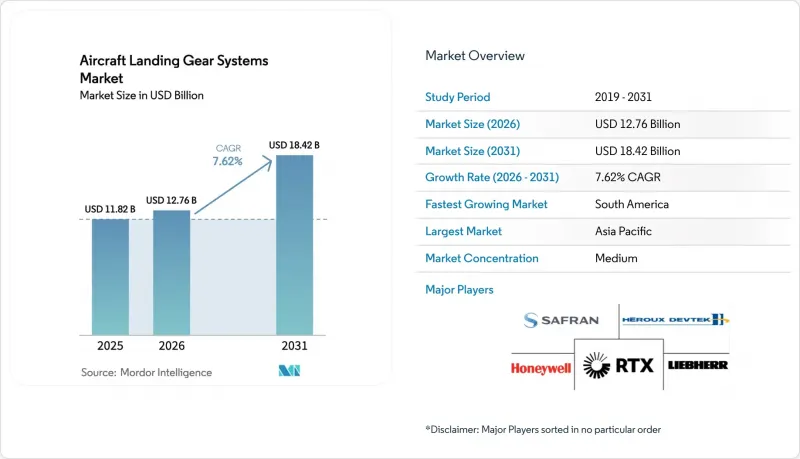
에 의하면, 항공기 랜딩 기어 시스템 시장 규모는 2025년 118억 2,000만 달러에서 2026년에는 127억 6,000만 달러로 확대되어 2026-2031년까지 CAGR 7.62%로 성장을 지속하여, 2031년까지 184억 2,000만 달러에 이를 것으로 예측됩니다.
본 보고서는 항공기 유형(민간 항공, 군용 항공, 일반 항공), 랜딩 기어 위치(전륜, 메인 언더캐리지 랜딩 기어), 소재(고강도 강합금, 기타), 최종 사용자(OEM, MRO), 하위 시스템(작동 시스템, 기타),지역(북미, 유럽, 아시아태평양, 기타)별로 분류되어 있습니다. 시장 전망은 금액(달러) 기준으로 제시되어 있습니다.
전 세계 항공기 랜딩 기어 시스템 시장 동향 및 인사이트
2025년 이후 민간 항공기 생산 확대
에어버스와 보잉은 인디고, 사우스웨스트, 유나이티드 항공으로부터의 확정 주문을 바탕으로 2026년에 총 1,200대의 협폭기 납품을 목표로 하고 있습니다. 각 항공기에는 150만-200만 달러 상당의 랜딩 기어 시스템이 탑재되어 있어, 이를 통해 향후 수년간 수요 전망이 확고해졌습니다. 중국의 COMAC C919 프로그램은 현지 수요 증가가 예상되며, 리브헤르(Liebherr)는 2024년 9월까지 100세트를 납품할 예정입니다. 그러나 주요 1차 공급업체의 티타늄 공급 부족과 기체 품질 결함으로 인해 에어버스의 2025년 목표는 10대 분량만큼 하향 조정되었습니다. 이는 기어 제조업체까지 파급되는 공급망의 취약성을 여실히 드러내고 있습니다.
경량 소재 수요 급증
각 항공기 제조업체들은 ICAO(국제민간항공기구)가 정한 연간 2%의 탄소 강도 감축 목표를 달성하기 위해, 랜딩 기어 어셈블리의 무게를 25%에서 30%까지 줄이는 것을 목표로 하고 있습니다. 크랜필드 대학교는 5만 사이클의 피로 시험에서 강철로 만들어진 기준 부품을 탄소섬유 스트럿으로 대체한 결과, 30%의 질량 감소를 실현했음을 입증했습니다. 미쓰비시 중공업은 토크 링크와 드래그 브레이스에 수지 이송 성형(RTM) 기술을 적용하여 반복 비용을 20% 절감했습니다. 티타늄 합금의 비용은 강철의 4배이지만, 와이드바디 항공기 1대당 수명 주기 전반에 걸쳐 20만 달러의 연료비 절감이 예상되므로, 그 높은 가격은 정당화됩니다. 그러나 제재 조치로 인해 러시아산 티타늄 스폰지공급이 중단됨에 따라, 리드타임이 18개월이 소요되는 일본 및 카자흐스탄산 대체품의 인증이 시급해졌으며, 이러한 전환이 공급망에 부담을 주고 있습니다.
티타늄 및 복합재료 공급망의 병목 현상
제재로 인해 전 세계 항공우주용 티타늄 스폰지 공급량의 30%가 사라졌고, 합금 가격은 2021년 1kg당 35달러에서 2024년에는 50달러로 상승했습니다. 와이드바디 항공기 랜딩 기어 한 세트의 비용은 현재 15만-25만 달러가 증가했으며, OEM의 이익률은 최대 300베이시스포인트 축소되었습니다. 복합재료 생산도 제약을 받고 있습니다. 석유화학 플랜트의 가동 중단에 따른 수지 공급 부족으로 인해 에어버스 A350의 납품이 지연되고 있습니다. 동시에 오토클레이브 생산 능력의 제약으로 인해 CFRP 스트럿의 생산량은 연간 1,200개에 그치고 있으며, 이는 산업 수요를 밑돌고 있습니다. 4만 톤급 프레스 기계를 보유한 단조 제조업체는 단 12곳에 불과하기 때문에 협폭기용 1,200 유닛을 초과하는 수요가 급증할 경우 할당량 부족의 위험이 발생합니다.
부문 분석
군사 프로그램은 F-35, F-15EX, 기체와 일체형으로 수납되는 스텔스 대응 장비가 필요한 무인 전투 플랫폼에 힘입어 2031년까지 연평균 성장률(CAGR) 11.56%를 기록했습니다. 전투기 부대용 항공기 랜딩 기어 시스템 시장 규모는 2,000 비행 시간마다 정비를 예정하고 있는 수십 년에 걸친 유지 관리 예산에 힘입어 2031년까지 확대될 것으로 예측됩니다. 비전투용 급유기 및 수송기는 비용 절감을 위해 민간기에서 파생된 랜딩 기어를 채택하고 있지만, 불규칙 지형 운용 키트의 경우 여전히 30%의 가격 상승에 직면해 있습니다. 아시아 전역에서는 일본, 인도, 한국이 랜딩 기어 어셈블리에 현지 조달 부품을 지정된 국산 전투기를 도입하고 있어 공급업체 구성이 다양해지고 있습니다.
민간 항공은 2025년에 40.21%의 점유율을 차지하며 계속해서 수익의 주축이 될 것입니다. 협폭 항공기는 인도된 항공기의 75%를 차지하며, 하루 평균 3회의 운항 주기로 인해 브레이크 마모가 가속화되어 애프터마켓을 활성화하고 있습니다. 와이드바디 항공기는 기체당 중량이 협폭 항공기의 3배이지만, 항공사가 장거리 노선 확대보다 기종의 공통성을 우선시하고 있어 그 성장률은 한 자릿수 중반에 그칠 전망입니다. 리저널 제트기 및 터보프롭기는 라틴아메리카와 동남아시아의 지방 도시 노선을 운항하고 있으며, 짧고 고온 고지대의 활주로에 대응하기 위해 강화된 랜딩 기어가 필요합니다. 이로 인해 기체당 단가는 10만 달러 높아집니다.
2025년에는 메인 랜딩 기어 어셈블리가 매출의 72.78%를 차지할 것이며, 와이드바디기와 대형 군용기 프로그램의 회복에 따라 2031년까지 연평균 성장률(CAGR) 10.43%로 확대될 것으로 예측됩니다. B777X의 주 랜딩 기어는 무게가 1만 2,000파운드에 달하며, 판매 가격은 250만-300만 달러입니다. 이는 50만 파운드의 하중을 견딜 수 있도록 인증받은 6륜식 보기와 티타늄 단조 부품의 채택을 반영한 것입니다. 개당 4만-6만 달러에 달하는 카본 세라믹 브레이크 디스크는 2,500회 착륙마다 교체가 필요하며, 25년의 수명 기간 동안 순정 부품(OEM) 매출을 3대 1의 비율로 상회하는 수익성이 높은 애프터마켓 수익원을 확보하고 있습니다.
전륜의 점유율은 27.22%에 그치지만, 조향 및 미끄럼 방지 감지에서의 전략적 역할은 이 수치만으로는 파악할 수 없습니다. Clean Aviation의 eNLG 프로토타입은 전기 기계식 조향 시스템으로 전환하여 무게를 50파운드 줄였고, 그 결과 정비 주기를 12,000시간으로 연장했습니다. 복합재로 제작된 스트럿은 하중이 기체 중량의 불과 15%에 불과한 협폭기(narrow-body)의 앞바퀴에 실용화할 수 있습니다. 그러나 eVTOL 설계에서는 하중 분포가 반대로 바뀌어 지상 운용 시 후방 차축에 하중의 60%가 실리기 때문에 1대당 10만 달러에 가까운 적응형 댐퍼가 필요합니다.
지역별 분석
아시아태평양은 중국과 인도를 필두로 2025년 매출의 34.56%를 차지했습니다. COMAC은 2028년부터 연간 150대의 C919를 납품할 계획이며, 인도의 970대 분량 수주 파이프라인으로 인해 향후 10년간 랜딩 기어 수요가 35억 달러 증가할 것으로 전망됩니다. UDAN(유니버설 에어 액세스 네트워크)에 의한 지역 간 연결 이니셔티브는 터보프롭 항공기의 교체를 촉진하고 있으며, 이를 위해서는 기준 시스템보다 20% 더 비싼 불규칙 지형 운용 키트가 필요합니다. 일본은 B787 및 A350 프로그램을 위해 티타늄 단조품과 복합재 스트럿을 공급하고 있으며, 국내 항공사 수요가 정체되어 있음에도 불구하고 국내 공장의 가동률을 높은 수준으로 유지하고 있습니다.
남미는 2031년까지 연평균 성장률(CAGR)이 14.29%로 가장 빠른 성장이 예상되며, 그 주요 요인은 엠브라에르의 E2 시리즈와 서비스가 부족한 노선에 대한 정부의 보조금입니다. 브라질의 각 항공사는 노후화된 E1 제트기를 E2 시리즈로 교체하고 있으며, 이 기종에는 복합재 토크 링크가 채택되어 오버홀 주기를 1만 2,000사이클까지 연장하고 있습니다. 칠레, 페루, 콜롬비아에서는 고지대 공항 개보수에 투자가 이루어지고 있으며, 이를 위해 강화된 랜딩 기어가 필요하여 기체당 가치를 최대 30%까지 끌어올리고 있습니다.
북미와 유럽은 전 세계 매출의 절반을 차지하며, 한 자릿수 중반대의 성장률을 보이고 있습니다. 3,000대 분량의 협폭기 수주 잔고가 OEM 수요를 뒷받침하고 있지만, 공급 제약으로 인해 매출은 애프터마켓으로 이동하고 있습니다. EASA는 현재 센서가 탑재된 어셈블리에 대한 상태 기반 유지보수를 허용하고 있어, 루프트한자와 에어프랑스-KLM은 이를 통해 정비 주기를 연장할 수 있게 되었으나, FAA는 여전히 혼합적인 접근 방식을 유지하고 있습니다. 중동의 항공기 기단은 최신 기종이 많고 와이드바디기가 중심을 이루고 있어 프리미엄 기어 판매는 견조하지만, 오버홀 활동은 제한적입니다. 아프리카는 여전히 발전 중인 시장이며, 에티오피아 항공이 운항 능력의 대부분을 차지하고 있지만, 비포장 활주로용 견고한 사양의 키트는 규모는 작지만 전략적인 발판이 되고 있습니다.
기타 혜택
- 엑셀 형식 시장 예측(ME) 시트
- 3개월간의 애널리스트 지원
자주 묻는 질문
목차
제1장 서론
제2장 조사 방법
제3장 주요 요약
제4장 시장 구도
제5장 시장 규모와 성장 예측
제6장 경쟁 구도
제7장 시장 기회와 향후 전망
JHS 26.09.09According to Mordor Intelligence, the aircraft landing gear systems market size is expected to grow from USD 11.82 billion in 2025 to USD 12.76 billion in 2026 and is forecasted to reach USD 18.42 billion by 2031 at a 7.62% CAGR over 2026-2031.
This report is Segmented by Aircraft Type (Commercial Aviation, Military Aviation, and General Aviation), Gear Position (Nose Landing Gear and Main Landing Gear), Material (High-Strength Steel Alloys, and More), End-User (OEM and MRO), Subsystem (Actuation System, and More), and Geography (North America, Europe, Asia-Pacific, and More). The Market Forecasts are Provided in Terms of Value (USD).
Global Aircraft Landing Gear Systems Market Trends and Insights
Commercial Aircraft Production Ramp-ups Post-2025
Airbus and Boeing aim for a combined 1,200 narrowbody deliveries in 2026, underpinned by firm orders from IndiGo, Southwest, and United Airlines. Each aircraft embeds landing-gear systems priced between USD 1.5 million and USD 2.0 million, locking in multi-year visibility. China's COMAC C919 program is expected to add localized demand, with Liebherr delivering 100 shipsets by September 2024. However, titanium shortfalls and fuselage-quality defects at key Tier-1 suppliers trimmed Airbus's 2025 target by 10 units, illustrating the fragility of the supply chain that cascades to gear makers.
Lightweight-materials Demand Surge
Airframers target 25% to 30% weight cuts in landing-gear assemblies to meet ICAO's 2% annual carbon-intensity mandate. Cranfield University demonstrated a 30% mass saving when carbon-fiber struts replaced steel baselines during 50,000-cycle fatigue tests. Mitsubishi Heavy Industries applied resin-transfer molding to torque links and drag braces, resulting in a 20% reduction in recurring costs. Although titanium alloys cost four times more than steel, lifecycle fuel savings of USD 200,000 per widebody justify the premium. The shift strains supply chains because sanctions have removed Russian titanium sponge, forcing the qualification of Japanese and Kazakh alternatives that require an 18-month lead time.
Titanium and Composite Supply-chain Bottlenecks
Sanctions removed 30% of global aerospace-grade titanium sponge, driving alloy prices from USD 35/kg in 2021 to USD 50/kg in 2024. Landing-gear shipsets for widebodies now cost USD 150,000 to USD 250,000 more, cutting OEM margins by up to 300 basis points. Composite output is also constrained: resin shortages linked to petrochemical outages have delayed Airbus A350 deliveries. At the same time, autoclave capacity caps CFRP strut output at 1,200 units per year, which is below industry demand. Only 12 forging houses own 40,000-ton presses, so any surge beyond 1,200 narrowbody units risks allocation shortages.
Other drivers and restraints analyzed in the detailed report include:
- OEM Push for Electric/hydraulic-free eBrake Systems
- Digital Twin-Enabled Predictive Maintenance
- Regulatory Certification Delays for Novel Architectures
For complete list of drivers and restraints, kindly check the Table Of Contents.
Segment Analysis
Military programs posted an 11.56% CAGR to 2031, fueled by the F-35, F-15EX, and unmanned combat platforms requiring stealth-compatible gear that retracts flush with the fuselage. The aircraft landing gear systems market size for combat fleets is projected to increase through 2031, driven by multi-decade sustainment budgets that schedule overhauls every 2,000 flight hours. Non-combat tankers and transports adopt civil-derivative gear to curb cost, yet still face 30% price uplifts for rough-field operation kits. Across Asia, Japan, India, and South Korea are inducting indigenous fighters that specify local content in landing-gear assemblies, diversifying the supplier map.
Commercial aviation remains the revenue anchor with a 40.21% share in 2025. Narrowbodies represent 75% of deliveries, averaging three daily cycles that accelerate brake wear and feed the aftermarket. Widebodies carry triple the mass per shipset, yet they grow in mid-single digits, because airlines prioritize fleet commonality over long-haul expansion. Regional jets and turboprops serve secondary-city routes in Latin America and Southeast Asia, necessitating reinforced gear for short, hot-and-high runways, which increases unit prices by USD 100,000 per aircraft.
Main landing-gear assemblies held a 72.78% revenue share in 2025 and are expected to advance at a 10.43% CAGR through 2031, as twin-aisle and heavy-lift military programs recover. A B777X main gear tips the scales at 12,000 pounds and sells for USD 2.5 million to USD 3.0 million, reflecting the use of six-wheel bogies and titanium forgings certified for 500,000-pound loads. Carbon-ceramic brake discs, costing USD 40,000-USD 60,000 each, require replacement every 2,500 landings, securing lucrative aftermarket streams that outstrip original equipment revenue by three-to-one across a 25-year life.
Nose gear's 27.22% share belies its strategic role in steering and anti-skid sensing. Clean Aviation's eNLG prototype reduced weight by 50 pounds by switching to electromechanical steering, thereby extending maintenance intervals to 12,000 hours. Composite struts are viable on narrow-body nose gear because loads represent only 15% of the aircraft's weight. However, eVTOL designs invert load maps, placing 60% of the load on the aft axles during ground operations, which requires adaptive dampers priced at nearly USD 100,000 per shipset.
Complete Report Scope:
- By Aircraft Type
- Commercial Aviation
- Narrowbody Aircraft
- Widebody Aircraft
- Regional Aircraft
- Military Aviation
- Combat Aircraft
- Non-Combat Aircraft
- Helicopters
- General Aviation
- Business Jets
- Turboprop Aircraft
- Piston Aircraft
- Helicopters
- Commercial Aviation
- By Gear Position
- Nose Landing Gear
- Main/Undercarriage Landing Gear
- By Material
- High-Strength Steel Alloys
- Titanium Alloys
- Composites (CFRP/GFRP)
- Aluminum Alloys
- By End User
- Original Equipment Manufacturer (OEM)
- Maintenance, Repair, and Overhaul (MRO)
- By Subsystem
- Actuation System
- Steering System
- Braking System
- Structural System
- Other Sub-Systems
- By Geography
- North America
- United States
- Canada
- Mexico
- Europe
- United Kingdom
- France
- Germany
- Spain
- Russia
- Rest of Europe
- Asia-Pacific
- China
- India
- Japan
- South Korea
- Rest of Asia-Pacific
- South America
- Brazil
- Rest of South America
- Middle East and Africa
- Middle East
- United Arab Emirates
- Saudi Arabia
- Egypt
- Rest of Middle East
- Africa
- South Africa
- Rest of Africa
- Middle East
- North America
Geography Analysis
The Asia-Pacific region owned 34.56% of the 2025 revenue, led by China and India. COMAC plans 150 C919 deliveries per year from 2028, and India's 970-unit order pipeline will add USD 3.5 billion in landing-gear demand this decade. Regional connectivity initiatives under UDAN stimulate turboprop replacements, which require rough-field kits that cost 20% more than baseline systems. Japan supplies titanium forgings and composite struts for the B787 and A350 programs, maintaining high domestic plant utilization despite flat demand from local airlines.
South America is projected to deliver the fastest growth, with a 14.29% CAGR through 2031, primarily driven by Embraer's E2 family and government subsidies for underserved routes. Brazil's carriers are replacing their aging E1 jets with E2 variants, which feature composite torque links that extend overhaul intervals to 12,000 cycles. Chile, Peru, and Colombia invest in high-altitude airport upgrades that require reinforced gear, lifting per-unit value by up to 30%.
North America and Europe account for half of the global revenue, growing at mid-single digits. A 3,000-unit narrowbody backlog sustains OEM demand, yet supply constraints shift revenue into the aftermarket. EASA now allows condition-based maintenance for sensor-equipped assemblies, enabling Lufthansa and Air France-KLM to extend overhaul spacing, whereas the FAA retains a mixed approach. Middle East fleets are young and widebody-heavy, supporting premium gear sales but limited overhaul activity. Africa remains a nascent market; Ethiopian Airlines dominates capacity, and ruggedized kits for unpaved runways offer a small but strategic foothold.
- Safran SA
- Collins Aerospace (RTX Corporation)
- Liebherr Group
- Heroux-Devtek Inc.
- Triumph Group, Inc.
- GKN Aerospace Services Limited
- Honeywell International, Inc.
- Eaton Corporation plc
- Magellan Aerospace Corporation
- Whippany Actuation Systems LLC (TransDigm Group)
- CIRCOR International, Inc.
- Parker-Hannifin Corporation
- SPP Canada Aircraft, Inc.
- Singapore Technologies Engineering Ltd.
Additional Benefits:
- The market estimate (ME) sheet in Excel format
- 3 months of analyst support
TABLE OF CONTENTS
1 INTRODUCTION
- 1.1 Study Assumptions and Market Definition
- 1.2 Scope of the Study
2 RESEARCH METHODOLOGY
3 EXECUTIVE SUMMARY
4 MARKET LANDSCAPE
- 4.1 Market Overview
- 4.2 Market Drivers
- 4.2.1 Commercial aircraft production ramp-ups post-2025
- 4.2.2 Lightweight-materials demand surge
- 4.2.3 OEM push for electric/hydraulic-free eBrake systems
- 4.2.4 Digital twin-enabled predictive maintenance
- 4.2.5 MRO outsourcing and exchange-service adoption
- 4.2.6 Urban air mobility (eVTOL/air-taxi) landing-gear volumes
- 4.3 Market Restraints
- 4.3.1 Titanium and composite supply-chain bottlenecks
- 4.3.2 Regulatory certification delays for novel architectures
- 4.3.3 High capex and eight-to-ten-year overhaul costs
- 4.3.4 OEM-airline power-by-the-hour dominance squeezing independents
- 4.4 Value Chain Analysis
- 4.5 Regulatory Landscape
- 4.6 Technological Outlook
- 4.7 Porter's Five Forces Analysis
- 4.7.1 Threat of New Entrants
- 4.7.2 Bargaining Power of Buyers
- 4.7.3 Bargaining Power of Suppliers
- 4.7.4 Threat of Substitutes
- 4.7.5 Competitive Rivalry
5 MARKET SIZE AND GROWTH FORECASTS (VALUE)
- 5.1 By Aircraft Type
- 5.1.1 Commercial Aviation
- 5.1.1.1 Narrowbody Aircraft
- 5.1.1.2 Widebody Aircraft
- 5.1.1.3 Regional Aircraft
- 5.1.2 Military Aviation
- 5.1.2.1 Combat Aircraft
- 5.1.2.2 Non-Combat Aircraft
- 5.1.2.3 Helicopters
- 5.1.3 General Aviation
- 5.1.3.1 Business Jets
- 5.1.3.2 Turboprop Aircraft
- 5.1.3.3 Piston Aircraft
- 5.1.3.4 Helicopters
- 5.1.1 Commercial Aviation
- 5.2 By Gear Position
- 5.2.1 Nose Landing Gear
- 5.2.2 Main/Undercarriage Landing Gear
- 5.3 By Material
- 5.3.1 High-Strength Steel Alloys
- 5.3.2 Titanium Alloys
- 5.3.3 Composites (CFRP/GFRP)
- 5.3.4 Aluminum Alloys
- 5.4 By End User
- 5.4.1 Original Equipment Manufacturer (OEM)
- 5.4.2 Maintenance, Repair, and Overhaul (MRO)
- 5.5 By Subsystem
- 5.5.1 Actuation System
- 5.5.2 Steering System
- 5.5.3 Braking System
- 5.5.4 Structural System
- 5.5.5 Other Sub-Systems
- 5.6 By Geography
- 5.6.1 North America
- 5.6.1.1 United States
- 5.6.1.2 Canada
- 5.6.1.3 Mexico
- 5.6.2 Europe
- 5.6.2.1 United Kingdom
- 5.6.2.2 France
- 5.6.2.3 Germany
- 5.6.2.4 Spain
- 5.6.2.5 Russia
- 5.6.2.6 Rest of Europe
- 5.6.3 Asia-Pacific
- 5.6.3.1 China
- 5.6.3.2 India
- 5.6.3.3 Japan
- 5.6.3.4 South Korea
- 5.6.3.5 Rest of Asia-Pacific
- 5.6.4 South America
- 5.6.4.1 Brazil
- 5.6.4.2 Rest of South America
- 5.6.5 Middle East and Africa
- 5.6.5.1 Middle East
- 5.6.5.1.1 United Arab Emirates
- 5.6.5.1.2 Saudi Arabia
- 5.6.5.1.3 Egypt
- 5.6.5.1.4 Rest of Middle East
- 5.6.5.2 Africa
- 5.6.5.2.1 South Africa
- 5.6.5.2.2 Rest of Africa
- 5.6.5.1 Middle East
- 5.6.1 North America
6 COMPETITIVE LANDSCAPE
- 6.1 Market Concentration
- 6.2 Strategic Moves
- 6.3 Market Share Analysis
- 6.4 Company Profiles (includes Global level Overview, Market level overview, Core Segments, Financials as available, Strategic Information, Market Rank/Share for key companies, Products and Services, and Recent Developments)
- 6.4.1 Safran SA
- 6.4.2 Collins Aerospace (RTX Corporation)
- 6.4.3 Liebherr Group
- 6.4.4 Heroux-Devtek Inc.
- 6.4.5 Triumph Group, Inc.
- 6.4.6 GKN Aerospace Services Limited
- 6.4.7 Honeywell International, Inc.
- 6.4.8 Eaton Corporation plc
- 6.4.9 Magellan Aerospace Corporation
- 6.4.10 Whippany Actuation Systems LLC (TransDigm Group)
- 6.4.11 CIRCOR International, Inc.
- 6.4.12 Parker-Hannifin Corporation
- 6.4.13 SPP Canada Aircraft, Inc.
- 6.4.14 Singapore Technologies Engineering Ltd.
7 MARKET OPPORTUNITIES AND FUTURE OUTLOOK
- 7.1 White-space and Unmet-Need Assessment


