|
시장보고서
상품코드
2123046
저장 곡물용 살충제 시장 : 시장 점유율 분석, 업계 동향 및 통계, 성장 예측(2026-2031년)Stored Grain Insecticides - Market Share Analysis, Industry Trends & Statistics, Growth Forecasts (2026 - 2031) |
||||||
 Mordor Intelligence
Mordor Intelligence에 의하면, 저장 곡물용 살충제 시장 규모는 2025년 19억 달러로 평가되었고, 2026년에는 20억 1,000만 달러로 추정되고, 2026-2031년 CAGR 5.72%로 성장을 지속할 전망이며, 2031년에는 26억 5,000만 달러에 이를 것으로 예측됩니다.
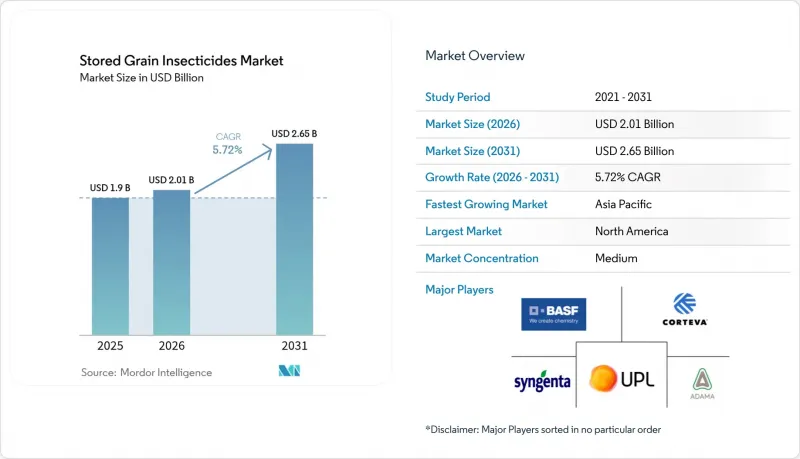
본 보고서는 제품 유형별(피레스로이드계, 훈증제 등), 용도별(종자 저장 등), 제형별(액상 농축액, 에어로졸 등), 작용기전별(전신성 유효 성분, 훈증 가스 등), 유통 채널별(농가에 대한 직접 판매 등), 지역별(북미, 유럽, 아시아태평양 등)로 분류되어 있습니다. 시장 예측은 금액(달러) 기준으로 제시되어 있습니다.
세계의 저장 곡물용 살충제 시장 동향 및 인사이트
전 세계 곡물 생산량의 급증과 상업용 사일로 용량 확대
기록적인 수확량과 엘리베이터 건설 가속화는 화학 약품 수요 증가로 직결되고 있습니다. 2024년에는 옥수수만 12억 톤을 넘어섰으나, 저장 용량 확대는 수확량 증가분의 5분의 1 수준에 그치고 있어, 이로 인해 저장 기간이 길어지고 해충 피해가 증가할 수밖에 없습니다. 앤더슨스는 2024년 11월 스카이랜드 그레인(Skyland Grain) 인수를 통해 1억 7,400만 부셸의 저장 용량을 추가하며, 업계 재편이 농약 프로그램의 규모 확대로 이어진다는 점을 보여주었습니다. 상업 운영자들은 비용이 많이 드는 재훈증 주기를 피하기 위해 90일간의 잔효성을 지닌 제제를 점점 더 선호하고 있습니다. 그 결과, 저장 곡물용 살충제 시장은 전문 취급 업체들 사이에서 안정적인 지출 기반을 확보하고 있습니다.
전 세계 최대 잔류 기준(MRL)의 강화
규제 당국은 현재 선적 물량의 규정 준수 여부를 그 어느 때보다 엄격하게 심사하고 있습니다. 호주의 GRDC는 단 한 건의 화물 반송만으로도 수백만 달러 규모의 이익 손실이 발생할 수 있다고 경고하고 있으며, 이러한 현실이 곡물 저장업자들에게 잔류물을 최적화한 고품질 제품의 선택을 촉진하고 있습니다. SGS에 따르면, 2020년 이후 수입국의 개별 MRL 수준이 40% 상승하여 농약 선정이 더욱 복잡해지고 있습니다. 따라서 잔류물 축적을 억제하는 복합 제품은 프리미엄 가격에 판매되고 있으며, 저장 곡물용 살충제 시장의 장기적인 가치를 뒷받침하고 있습니다.
고독성 유기인계 농약 규제에 따른 단계적 폐지
2024년 12월 미국 환경보호청(EPA)이 클로르피리포스의 식품 용도 대부분을 철회하는 제안을 함에 따라, 해당 제품의 기존 사용량의 약 70%가 감축될 전망입니다. 캐나다와 유럽에서도 유사한 움직임이 나타나고 있으며, 제제 제조업체들은 더 비싼 대체품으로 전환할 수밖에 없는 상황에 놓여 있습니다. 이로 인해 가격이 15-25% 상승했고, 수주 사이클이 일시적으로 둔화되고 있습니다. 규제 개혁은 궁극적으로 혁신을 촉진하지만, 단기적인 마찰로 인해 저장 곡물용 살충제 시장의 성장은 둔화되고 있습니다.
부문 분석
2025년에도 유기인계 살충제는 42.12%의 점유율을 유지했으며, 저장 곡물용 살충제 시장에서 확고한 입지를 입증하고 있습니다. 생물 유래 살충제는 ESG 자금과 유리한 규제의 뒷받침을 받아 연평균 성장률(CAGR) 12.44%를 나타낼 것으로 예측됩니다. 곤충 성장 조절제는 시장 점유율이 2.33%에 그치지만, 내성 관리 프로그램과 호환성이 좋아 빠르게 성장하고 있습니다.
각 기업이 듀얼 모드 복합제를 출시함에 따라 이 부문의 경쟁은 격화되고 있습니다. 코르테바(Corteva)사의 ‘Conserve Plus’는 스피노사드와 S-메토프렌을 조합하여 내성 해충을 표적으로 삼으면서도 잔류물 규제를 고려한 제품입니다. 벤처 자금은 RNAi 및 미생물 경로 연구에 집중되고 있으며, 내성 시계를 재설정할 가능성이 있는 새로운 작용기전이 기대되고 있습니다. 기존 제품과 혁신적인 제품 라인의 균형을 잘 맞추고 있는 공급업체는 저장 곡물용 살충제 시장에서 입지를 굳건히 지킬 것입니다.
통합된 취급 체인에서 예방적 처리가 정착됨에 따라, 농장 외 엘리베이터가 수요의 37.65%를 차지하고 있습니다. 잔류 기준 준수로 인해 각국의 다양한 규제치를 충족하는 고품질 제품이 요구됨에 따라, 수출 출하량은 연평균 성장률(CAGR) 9.58%로 가장 빠르게 증가하고 있습니다. 수출 경로와 관련된 저장 곡물용 살충제 시장 규모는 2026년 3억 7,260만 달러에서 2031년에는 5억 8,940만 달러 가까이까지 확대될 것으로 예측됩니다. 소규모 농가의 사일로가 증가함에 따라, 농장 내 저장용 수요도 탄력을 받고 있습니다.
통합된 공급망에서 운송 거리가 길어짐에 따라 해충에 노출되는 시간이 길어지고, 그 결과 잔효성이 긴 제제에 대한 수요가 증가하고 있습니다. 운송 컨테이너 및 철도 화물차 내에서의 정밀 살포도 증가하고 있으며, 그 양은 적지만 부가가치를 창출하고 있습니다. 따라서 수출 부문은 저장 곡물용 살충제 시장에서 새로운 복합 제품을 제공하는 데 있어 계속해서 주목을 받고 있습니다.
지역별 분석
북미는 2025년 매출 점유율 31.45%에 힘입어 지역별 최대 시장 지위를 유지하고 있습니다. 곡물 저장 시설 운영업체 간의 통합으로 인해 농약 조달에 있어 규모의 경제가 창출되고 있습니다. 앤더슨스(Anderson’s)사의 스카이랜드 그레인(Skyland Grain)사 인수는 체계적인 보호가 필요한 인프라의 확장을 여실히 보여주고 있습니다. EPA의 단계적 폐지 조치는 독성이 낮은 혼합제로의 전환을 촉진하여 프리미엄 수익원을 유지하고 있습니다. 또한, IoT 도입률은 미국과 캐나다에서 가장 높아, 저장 곡물용 살충제 시장의 프리미엄화 추세를 뒷받침하고 있습니다.
아시아태평양은 밀폐형 사일로 설치가 급증하고 포스핀 내성이 확산됨에 따라, 2031년까지 연평균 성장률(CAGR) 6.82%로 가장 빠르게 성장하는 지역이 될 전망입니다. 조사에 따르면, 케냐에서는 금속 사일로 사용으로 곡물 저장 기간이 1.8개월 연장되는 것이 확인되었으며, 이러한 경향은 인도와 필리핀에서도 마찬가지로 나타납니다. 내성이 확산됨에 따라 사용자들은 듀얼 모드 제품으로 전환하고 있어 시장 규모가 확대되고 있습니다. 각국의 식량 안보 프로그램에 따라 현대적인 저장 시설에 대한 보조금이 더욱 확대되면서, 저장 곡물용 살충제 시장의 침투가 깊어지고 있습니다.
유럽은 GWP(지구온난화지수)가 높은 훈증제에 벌칙을 부과하는 지속가능성 관련 규제의 영향으로 연평균 성장률(CAGR) 3.74%를 기록하며 성장하고 있습니다. 독일의 플루오로설플릴 감축 지침은 이러한 규제 방향을 보여주는 대표적인 사례입니다. 남미는 연평균 성장률(CAGR) 5.69%로 성장하고 있으며, 브라질과 아르헨티나에서는 대두 및 옥수수 수출을 위한 엘리베이터 수용 능력이 확대되고 있습니다. 하천 물류에 대한 투자로 인해 운송 기간이 길어지면서 내구성이 뛰어난 보호 대책이 필요해지고 있습니다.
기타 혜택 :
- 엑셀 형식 시장 예측(ME) 시트
- 3개월간의 애널리스트 지원
자주 묻는 질문
목차
제1장 서론
제2장 조사 방법
제3장 주요 요약
제4장 시장 구도
제5장 시장 규모 및 성장 예측
제6장 경쟁 구도
제7장 시장 기회 및 향후 전망
AJY 26.09.07According to Mordor Intelligence, the stored grain insecticide market size is expected to grow from USD 1.90 billion in 2025 to USD 2.01 billion in 2026 and is forecast to reach USD 2.65 billion by 2031 at 5.72% CAGR over 2026-2031.
This report is Segmented by Product Type (Pyrethroids, Fumigants, and More), Application (Seed Storage, and More), Formulation (Liquid Concentrate, Aerosol, and More), Mode of Action (Systemic Active, Fumigant Gases, and More), Distribution Channel (Direct-To-Farm Sales, and More), and Geography (North America, Europe, Asia-Pacific, and More). The Market Forecasts are Provided in Terms of Value (USD).
Global Stored Grain Insecticides Market Trends and Insights
Surging Global Grain Output and Larger Commercial Silo Capacity
Record crop volumes and faster elevator buildouts translate directly into higher chemical demand. Maize alone topped 1.2 billion tons in 2024, while storage capacity expansion trails harvest growth by nearly one-fifth, forcing longer hold periods and increased pest pressure. The Andersons added 174 million bushels of capacity through its November 2024 Skyland Grain purchase, demonstrating how consolidation scales chemical programs. Commercial operators increasingly favor residual formulations with ninety-day efficacy to avoid costly re-fumigation cycles. Consequently, the stored grain insecticide market gains a stable spending base among professional handlers.
Mandatory Maximum Residue Limits (MRLs) Tightening Worldwide
Regulators now scrutinize shipment compliance more closely than ever. The Australian GRDC warns that single cargo rejections can erase multimillion-dollar margins, a reality prompting elevators to choose premium, residue-optimized products. SGS notes a 40% rise in distinct MRL levels across importing nations since 2020, complicating chemical selection. Combination products that suppress residue build-up, therefore command premium pricing, supporting the long-term value of the stored grain insecticide market.
Regulatory Phase-Outs of High-Toxicity Organophosphates
The December 2024 EPA proposal to revoke most chlorpyrifos food uses removes roughly 70% of its former volume. Similar moves in Canada and Europe drive formulators toward costlier replacements, raising prices 15-25% and temporarily slowing order cycles. While reforms ultimately push innovation, near-term friction trims growth in the stored grain insecticide market.
Other drivers and restraints analyzed in the detailed report include:
- Escalating Phosphine Resistance is Accelerating Combination Chemistries
- Rapid Adoption of On-Farm Sealed Storage in the Asia-Pacific Smallholder Sector
- Cross-Resistance to Multiple Pyrethroids Reducing Product Life Cycles
For complete list of drivers and restraints, kindly check the Table Of Contents.
Segment Analysis
Organophosphates retained a 42.12% share in 2025, underlining their entrenched role within the stored grain insecticide market. Bio-insecticides are forecast at a 12.44% CAGR, fueled by ESG funding and favorable regulation. Insect growth regulators, although at a 2.33% share, grow briskly due to compatibility with resistance stewardship programs.
The segment's competitive intensity heightens as firms launch dual-mode blends. Corteva's Conserve Plus unites spinosad with S-methoprene, targeting resistant insects while remaining residue-friendly. Venture money channels into RNAi and microbial pathways, promising fresh modes of action that may reset resistance clocks. Suppliers balancing legacy volumes with innovative lines will defend their position in the stored grain insecticide market.
Off-farm elevators account for 37.65% of demand as integrated handling chains institutionalize prophylactic treatments. Export shipments grow the fastest at 9.58% CAGR because residue compliance dictates premium products that clear diverse national limits. The stored grain insecticide market size tied to export channels is projected to climb from USD 372.6 million in 2026 to nearly USD 589.4 million in 2031. On-farm storage demand gains momentum as smallholder silos multiply.
Longer transit distances in consolidated supply chains increase insect exposure time, thereby elevating demand for extended residual formulations. Precision fogging inside shipping containers and railcars also rises, adding value despite modest volume. The export segment, therefore, remains a focal point for new combination offerings within the stored grain insecticide market.
Complete Report Scope:
- By Product Type
- Organophosphates
- Pyrethroids
- Fumigants (Metal Phosphides, Sulfuryl Fluoride)
- Bio-insecticides
- Insect Growth Regulators
- Synergized Combination Products
- Others
- By Application
- On-farm Storage
- Off-farm Commercial Elevators
- Export Shipments
- Integrated Logistics and Transit
- Seed Storage/Seed Banks
- Emergency Rescue Treatments
- By Formulation
- Liquid Concentrate
- Dust and Dry Flowables
- Aerosol/Fogging Agents
- Tablets & Pellets
- Suspension Concentrate
- Micro-encapsulated
- By Mode of Action
- Contact Neurotoxins
- Systemic Actives
- Fumigant Gases
- Juvenile Hormone Analogs (IGRs)
- By Distribution Channel
- Direct-to-Farm Sales
- Ag Retailers and Cooperatives
- Grain Elevator Service Providers
- Online Ag Input Platforms
- By Geography
- North America
- United States
- Canada
- Mexico
- Rest of North America
- South America
- Brazil
- Argentina
- Rest of South America
- Europe
- Germany
- France
- United Kingdom
- Spain
- Italy
- Russia
- Rest of Europe
- Asia-Pacific
- China
- India
- Japan
- Australia
- Rest of Asia-Pacific
- Middle East
- Turkey
- Saudi Arabia
- Rest of Middle East
- Africa
- South Africa
- Nigeria
- Rest of Africa
- North America
Geography Analysis
North America retains the largest regional position supported by 31.45% revenue share in 2025. Consolidation among elevator operators creates scale economies in chemical purchasing. The Andersons' acquisition of Skyland Grain underscores infrastructure expansion that demands systematic protection. EPA phase-outs encourage shifts to lower-toxicity blends, keeping premium revenue streams alive. IoT adoption is also highest in the United States and Canada, reinforcing the premiumization trend in the stored grain insecticide market.
Asia-Pacific represents the fastest-growing geography at 6.82% CAGR through 2031, thanks to booming sealed silo installations and widespread phosphine resistance. Research confirms 1.8 additional months of grain security from metal silos in Kenya, a pattern repeated in India and the Philippines. As resistance spreads, users gravitate toward dual-mode products, expanding market value. National food security programs further subsidize modern storage, deepening penetration of the stored grain insecticide market.
Europe grows at a 3.74% CAGR, driven by sustainability mandates that penalize high-GWP fumigants. Germany's guidance on sulfuryl fluoride reductions exemplifies regulatory direction. South America advances 5.69% CAGR, with Brazil and Argentina adding elevator capacity for soybean and corn exports. Investments in river logistics translate into longer transit windows that need durable protection.
- Syngenta AG
- Corteva Agriscience
- UPL Limited
- BASF SE
- Adama Agricultural Solutions Ltd.
- Nufarm Limited
- Envu GmbH
- Degesch America Inc.
- Douglas Products & Packaging Co., LLC
- FMC Corporation
- Sumitomo Chemical Co., Ltd.
- Central Life Sciences, Inc.
- AMVAC Chemical Corporation
- Rentokil Initial plc
- Industrial Fumigant Company, LLC
Additional Benefits:
- The market estimate (ME) sheet in Excel format
- 3 months of analyst support
TABLE OF CONTENTS
1 Introduction
- 1.1 Study Assumptions and Market Definition
- 1.2 Scope of the Study
2 Research Methodology
3 Executive Summary
4 Market Landscape
- 4.1 Market Overview
- 4.2 Market Drivers
- 4.2.1 Surging global grain output and larger commercial silo capacity
- 4.2.2 Mandatory maximum residue limits (MRLs) tightening worldwide
- 4.2.3 Escalating phosphine resistance accelerating combination chemistries
- 4.2.4 Rapid adoption of on-farm sealed storage in Asia-Pacific smallholder sector
- 4.2.5 IoT-enabled storage monitoring driving demand for data-linked protectants
- 4.2.6 ESG investment flows into bio-insecticide R&D and commercialization
- 4.3 Market Restraints
- 4.3.1 Regulatory phase-outs of high-toxicity organophosphates
- 4.3.2 Cross-resistance to multiple pyrethroids reducing product life cycles
- 4.3.3 Predictive sensor analytics lowering prophylactic chemical applications
- 4.3.4 Carbon-footprint audits penalizing fumigants with high GHG load
- 4.4 Regulatory Landscape
- 4.5 Technological Outlook
- 4.6 Porter's Five Forces
- 4.6.1 Bargaining Power of Suppliers
- 4.6.2 Bargaining Power of Buyers
- 4.6.3 Threat of New Entrants
- 4.6.4 Threat of Substitutes
- 4.6.5 Intensity of Competitive Rivalry
5 Market Size and Growth Forecasts (Value)
- 5.1 By Product Type
- 5.1.1 Organophosphates
- 5.1.2 Pyrethroids
- 5.1.3 Fumigants (Metal Phosphides, Sulfuryl Fluoride)
- 5.1.4 Bio-insecticides
- 5.1.5 Insect Growth Regulators
- 5.1.6 Synergized Combination Products
- 5.1.7 Others
- 5.2 By Application
- 5.2.1 On-farm Storage
- 5.2.2 Off-farm Commercial Elevators
- 5.2.3 Export Shipments
- 5.2.4 Integrated Logistics and Transit
- 5.2.5 Seed Storage/Seed Banks
- 5.2.6 Emergency Rescue Treatments
- 5.3 By Formulation
- 5.3.1 Liquid Concentrate
- 5.3.2 Dust and Dry Flowables
- 5.3.3 Aerosol/Fogging Agents
- 5.3.4 Tablets & Pellets
- 5.3.5 Suspension Concentrate
- 5.3.6 Micro-encapsulated
- 5.4 By Mode of Action
- 5.4.1 Contact Neurotoxins
- 5.4.2 Systemic Actives
- 5.4.3 Fumigant Gases
- 5.4.4 Juvenile Hormone Analogs (IGRs)
- 5.5 By Distribution Channel
- 5.5.1 Direct-to-Farm Sales
- 5.5.2 Ag Retailers and Cooperatives
- 5.5.3 Grain Elevator Service Providers
- 5.5.4 Online Ag Input Platforms
- 5.6 By Geography
- 5.6.1 North America
- 5.6.1.1 United States
- 5.6.1.2 Canada
- 5.6.1.3 Mexico
- 5.6.1.4 Rest of North America
- 5.6.2 South America
- 5.6.2.1 Brazil
- 5.6.2.2 Argentina
- 5.6.2.3 Rest of South America
- 5.6.3 Europe
- 5.6.3.1 Germany
- 5.6.3.2 France
- 5.6.3.3 United Kingdom
- 5.6.3.4 Spain
- 5.6.3.5 Italy
- 5.6.3.6 Russia
- 5.6.3.7 Rest of Europe
- 5.6.4 Asia-Pacific
- 5.6.4.1 China
- 5.6.4.2 India
- 5.6.4.3 Japan
- 5.6.4.4 Australia
- 5.6.4.5 Rest of Asia-Pacific
- 5.6.5 Middle East
- 5.6.5.1 Turkey
- 5.6.5.2 Saudi Arabia
- 5.6.5.3 Rest of Middle East
- 5.6.6 Africa
- 5.6.6.1 South Africa
- 5.6.6.2 Nigeria
- 5.6.6.3 Rest of Africa
- 5.6.1 North America
6 Competitive Landscape
- 6.1 Market Concentration
- 6.2 Strategic Moves
- 6.3 Market Share Analysis
- 6.4 Company Profiles (Includes Global level Overview, Market level overview, Core Segments, Financials as available, Strategic Information, Market Rank/Share, Products and Services, Recent Developments)
- 6.4.1 Syngenta AG
- 6.4.2 Corteva Agriscience
- 6.4.3 UPL Limited
- 6.4.4 BASF SE
- 6.4.5 Adama Agricultural Solutions Ltd.
- 6.4.6 Nufarm Limited
- 6.4.7 Envu GmbH
- 6.4.8 Degesch America Inc.
- 6.4.9 Douglas Products & Packaging Co., LLC
- 6.4.10 FMC Corporation
- 6.4.11 Sumitomo Chemical Co., Ltd.
- 6.4.12 Central Life Sciences, Inc.
- 6.4.13 AMVAC Chemical Corporation
- 6.4.14 Rentokil Initial plc
- 6.4.15 Industrial Fumigant Company, LLC