

|
시장보고서
상품코드
2123108
중국의 핵의학 영상 시장 : 점유율 분석, 산업 동향 및 통계 데이터, 성장 예측(2026-2031년)China Nuclear Imaging - Market Share Analysis, Industry Trends & Statistics, Growth Forecasts (2026 - 2031) |
||||||
 Mordor Intelligence
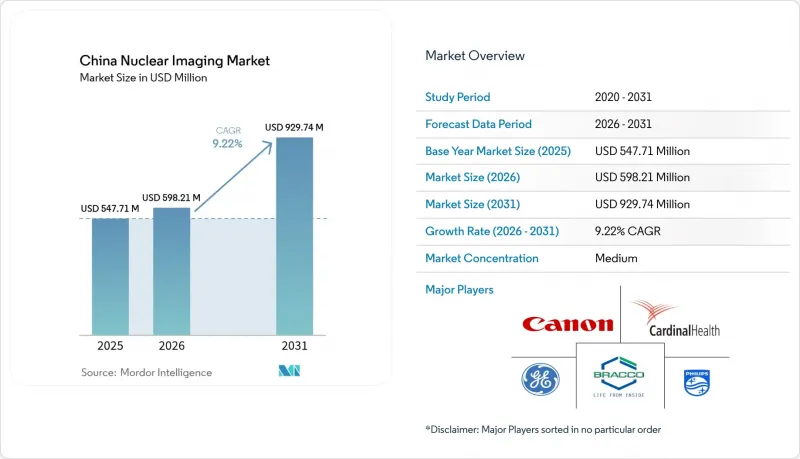
Mordor Intelligence에 의하면, 중국 핵의학 영상 시장 규모는 2025년 5억 4,771만 달러에서 2026년에는 5억 9,821만 달러로 확대되어 2026년부터 2031년까지 CAGR 9.22%로 성장을 지속하여, 2031년에는 9억 2,974만 달러에 이를 것으로 예측됩니다.
본 보고서는 제품별(장비, 방사성 동위원소 (SPECT용 방사성 동위원소, PET용 방사성 동위원소)), 용도별(순환기, 신경, 갑상선, 종양, 기타), 최종 사용자별(병원, 영상진단센터, 학술기관 및 연구기관)로 분류되어 있습니다. 시장 예측은 금액(달러) 기준으로 제시되어 있습니다.
중국 핵의학 영상 시장 동향 및 인사이트
암 및 순환기 질환의 질병 부담 증가
중국에서는 2022년에 482만 건의 신규 암 사례와 257만 명의 사망자가 기록되어, 중국 핵의학 영상 시장 수요 양상을 완전히 바꿔 놓았습니다. 폐암만 해도 106만 건의 진단이 보고되었으며, 흉부 종양학 분야에서 PET/CT의 이용이 지속적으로 확대될 것으로 확실시되고 있습니다. 2024년 임상시험에서 넥틴-4 추적자 (68Ga)Ga-N188이 삼중 음성 유방암에서 18F-FDG와 동등한 감도를 유지하면서 특이도를 향상시킨다는 사실이 밝혀져, 추적자의 다양화가 진행되고 있음을 시사했습니다. 심장학 분야의 영상 진단은 여전히 발전 단계에 있지만, HFpEF 환자의 68.2%에서 잠재적인 관상동맥 질환이 확인된다는 부검 데이터에 따라 SPECT 및 PET 관류 검사 프로토콜에 대한 수요 증가가 예상됩니다. SPECT 심근 관류 영상 검사를 1차 진단법으로 권장하는 임상 지침에 더해, 심근섬유증 진단에 사용되는 68Ga-FAPI의 등장으로 검사 건수는 더욱 증가하고 있습니다. 이러한 질환 동향이 맞물려, 핵의학 검사의 연간 보급률은 2024년에 기록된 0.28%라는 기준치를 상회할 것으로 예측됩니다.
전국적인 의료 개혁 및 정책 지원
2024년 12월 통지 제53호에 따라, 시범 시행 성에서 임상시험 심사 기간이 30일로 단축되었으며, 환급 평가 기준이 비용 대비 효과 중심으로 전환되었습니다. 그 결과, 국가의약품감독관리국(NMPA)의 방사성 의약품 승인 건수는 2022년 약 30개에서 2025년에는 40개 이상으로 증가했습니다. 제4류 사용 시설에 대한 신속 허가 제도도 병원의 도입 장벽을 완화했으나, 2025년 시점에서 이 허가를 취득한 기관은 65개 기관에 그쳤습니다. 『의료용 동위원소 중장기 발전 계획(2021-2035년)』에서는 총 2,749개의 3급 병원에 더해, 추가로 2,000곳에 핵의학 부서 설치를 의무화하고 있으며, 이로 인해 중국 핵의학 영상 시장의 잠재적 대상 범위는 사실상 2배로 확대되었습니다. 보험 환급 제도는 여전히 분산되어 있지만, 현재는 비용-효용 지표가 고려되게 되었으며, 각 성에서 전신 PET 등 고가의 검사법에 대한 보험 적용을 시범적으로 도입하도록 권장되고 있습니다.
고액의 설비 투자와 보험 환급의 제약
전신 PET 장치의 가격은 7,000만-1억 위안(980만-1,400만 달러)으로, 기존 PET/CT의 약 3배에 달할 전망입니다. 한편, 각 성의 보험 적용 목록에 포함된 검사 단가는 여전히 6,000-9,000 위안 수준에 머물러 있어 병원의 설비 투자 주기에 부담을 주고 있습니다. 수량 기준 조달로 인해 2022년부터 2024년까지 18F-FDG 단가가 33% 더 하락했으며, 장비 투자 회수 기간은 8년 이상으로 장기화되고 있습니다. 40만-45만 위안이라는 고액의 본인 부담 상한액으로 인해, 여러 주기에 걸친 177Lu 치료가 억제되어 소모품 판매의 견인력이 약화되고 있습니다. 독립 영상진단센터는 18개월이 소요될 수도 있는 여러 기관에 의한 인허가 절차를 거치고 있으며, 이로 인해 수익 실현이 지연되어 중국 핵의학 영상 시장의 연평균 성장률(CAGR)이 1.4포인트 하락했습니다.
부문별 분석
2025년, 중국 핵의학 영상 시장에서 장비 부문은 시장 점유율의 64.23%를 차지했습니다. 이는 전신 PET 장비 도입 대수가 약 20대에 달한 점과 광자 계수형 CT의 출시가 뒷받침된 결과입니다. 그러나 친산(Qinshan)의 Lu-177 및 향후 Mo-99 원자로가 공급을 뒷받침함에 따라, 방사성 동위원소 분야는 2031년까지 연평균 성장률(CAGR) 11.54%를 나타낼 것으로 전망됩니다. 그 결과, 중국 핵의학 영상 시장의 소모품 시장 규모는 2029년까지 장비 매출액을 넘어설 것으로 예측됩니다. 경쟁 환경은 국영 기업인 중국핵공업집단(CNNC)과 학술 기관과 장기 공급 계약을 체결한 급성장 중인 민간 기업에 유리하게 작용하고 있습니다.
소모재 주도형 모델로의 전환이 예상에 따라 지속적인 수익원이 확보되어, 스캐너 가격 하락에도 불구하고 수익성이 안정될 것으로 전망됩니다. Y-90 유리 마이크로스피어의 도입 및 Ac-225 관련 제휴를 통해 고수익률의 치료용 동위원소가 추가됨에 따라 선도 기업의 경쟁 우위가 더욱 강화될 것입니다. 유나이티드 이미징의 전략은 현재 하드웨어와 추적자에 의존하지 않는 서비스 번들을 결합한 것으로, 중국의 핵의학 영상 시장이 동위원소 주도형 성장으로 전환되는 가운데 합리적인 리스크 헤지 수단이 되고 있습니다.
기타 혜택:
- 엑셀 형식 시장 예측(ME) 시트
- 3개월간의 애널리스트 지원
자주 묻는 질문
목차
제1장 서론
제2장 분석 방법
제3장 주요 요약
제4장 시장 구도
제5장 시장 규모와 성장 예측
제6장 경쟁 구도
제7장 시장 기회와 향후 전망
JHS 26.09.09According to Mordor Intelligence, the China nuclear imaging market size is expected to grow from USD 547.71 million in 2025 to USD 598.21 million in 2026 and is forecast to reach USD 929.74 million by 2031 at 9.22% CAGR over 2026-2031.
This report is Segmented by Product (Equipment and Radio-Isotope [SPECT Radio-Isotopes and PET Radio-Isotopes]), Application (Cardiology, Neurology, Thyroid, Oncology, and Other Applications), and End User (Hospitals, Diagnostic Imaging Centres, and Academic & Research Institutes). Market Forecasts are Provided in Terms of Value (USD).
China Nuclear Imaging Market Trends and Insights
Increasing Oncology and Cardiology Disease Burden
China registered 4.82 million new cancer cases and 2.57 million deaths in 2022, reshaping demand for the China nuclear imaging market. Lung cancer alone contributed 1.06 million diagnoses, ensuring sustained PET/CT utilization for thoracic oncology. A 2024 trial showed that the nectin-4 tracer [68Ga]Ga-N188 matched 18F-FDG sensitivity while improving specificity for triple-negative breast cancer, signaling the diversification of tracers. Cardiology imaging remains nascent, yet autopsy data indicating 68.2% latent coronary disease in HFpEF patients position SPECT and PET perfusion protocols for growth. Clinical guidelines that endorse SPECT myocardial perfusion imaging as a first-line diagnosis, plus the emergence of 68Ga-FAPI for cardiac fibrosis, add incremental volume. Combined, these disease trends are expected to lift annual nuclear medicine exam penetration above the 0.28% baseline recorded in 2024.
National Healthcare Reform and Policy Support
The December 2024 Circular No. 53 cut clinical-trial review windows to 30 days in pilot provinces and shifted reimbursement assessment toward cost-effectiveness. As a result, NMPA approvals for radiopharmaceuticals rose from ≈30 agents in 2022 to >40 by 2025. Fast-track licensing for Class IV user facilities also eased hospital entry barriers, although only 65 institutions held these permits in 2025. The Mid- and Long-Term Development Plan for Medical Isotopes (2021-2035) mandates nuclear medicine departments across all 2,749 Class 3 hospitals plus 2,000 additional sites, effectively doubling the addressable footprint for the China nuclear imaging market. While fragmented, reimbursement now accommodates cost-utility metrics, encouraging provinces to pilot coverage for expensive modalities such as total-body PET.
High Capital Expenditure and Reimbursement Constraints
Total-body PET units cost RMB 70-100 million (USD 9.8-14 million), roughly triple the cost of conventional PET/CT, straining hospital capex cycles when provincial reimbursement lists still price scans at RMB 6,000-9,000. Volume-based purchasing further squeezed 18F-FDG tariffs by 33% between 2022 and 2024, stretching equipment payback to eight-plus years. Catastrophic out-of-pocket ceilings of RMB 400,000-450,000 discourage multi-cycle 177Lu therapies, muting consumable pull-through. Independent imaging centers navigate multi-agency licensing that may take 18 months, delaying revenue realization and trimming the CAGR of the China nuclear imaging market by 1.4 percentage points.
Other drivers and restraints analyzed in the detailed report include:
- Demographic Aging and Rising Healthcare Expenditure
- Expansion of Domestic Radioisotope Production Capacity
- Logistical Challenges of Short-Half-Life Isotopes
For complete list of drivers and restraints, kindly check the Table Of Contents.
Segment Analysis
Equipment generated 64.23% of the China nuclear imaging market share in 2025, buoyed by ≈20 total-body PET installations and photon-counting CT launches. However, radioisotopes are on track for an 11.54% CAGR through 2031 as Qinshan's Lu-177 and future Mo-99 reactors underpin supply. Consequently, the China nuclear imaging market size for consumables is expected to surpass equipment sales by 2029. Competitive dynamics favor state-owned CNNC and growing private players that secure long-term supply contracts with academic centers.
The projected shift toward a consumables-driven model supports recurring revenue streams, stabilizing profitability despite price compression in scanners. Y-90 glass microsphere rollouts and Ac-225 partnerships add high-margin therapy isotopes that deepen the moat for early movers. United Imaging's strategy now pairs hardware with tracer-agnostic service bundles, a logical hedge as the China nuclear imaging market transitions to isotope-led growth.
Complete Report Scope:
- By Product
- Equipment
- Radio-isotope
- SPECT Radio-isotopes
- Technetium-99m (TC-99m)
- Thallium-201 (TI-201)
- Gallium (Ga-67)
- Iodine (I-123)
- Other SPECT Radioisotopes
- PET Radio-isotopes
- Fluorine-18 (F-18)
- Rubidium-82 (RB-82)
- Other PET Radioisotopes
- SPECT Radio-isotopes
- By Application
- Cardiology
- Neurology
- Thyroid
- Oncology
- Other Applications
- By End User
- Hospitals
- Diagnostic Imaging Centres
- Academic & Research Institutes
List of Companies Covered in this Report:
- Advanced Accelerator Applications
- Canon
- China Isotope & Radiation Corporation
- China National Nuclear Corporation
- Curium Pharma
- Eckert & Ziegler Strahlen
- GE Healthcare
- Jiangsu Atom High Tech
- Jubilant Group
- Mindray Bio-Medical Electronics
- Neusoft Medical Systems
- Koninklijke Philips
- Positron
- Shanghai YZ Radiopharma
- Shenzhen Anke High-Tech
- Siemens Healthineers
- United Imaging Healthcare
Additional Benefits:
- The market estimate (ME) sheet in Excel format
- 3 months of analyst support
TABLE OF CONTENTS
1 Introduction
- 1.1 Study Assumptions & Market Definition
- 1.2 Scope of the Study
2 Research Methodology
3 Executive Summary
4 Market Landscape
- 4.1 Market Overview
- 4.2 Market Drivers
- 4.2.1 Increasing Oncology and Cardiology Disease Burden
- 4.2.2 National Healthcare Reform and Policy Support
- 4.2.3 Demographic Aging and Rising Healthcare Expenditure
- 4.2.4 Expansion of Domestic Radioisotope Production Capacity
- 4.2.5 Technological Advancements in Nuclear Imaging Modalities
- 4.2.6 Export-Oriented Government Incentives for Radiopharmaceuticals
- 4.3 Market Restraints
- 4.3.1 High Capital Expenditure and Reimbursement Constraints
- 4.3.2 Logistical Challenges of Short-Half-Life Isotopes
- 4.3.3 Regulatory Bottlenecks for Cyclotron Commissioning
- 4.3.4 Shortage of Skilled Nuclear Medicine Workforce
- 4.4 Value / Supply-Chain Analysis
- 4.5 Regulatory Landscape
- 4.6 Technological Outlook
- 4.7 Porter's Five Forces Analysis
- 4.7.1 Threat of New Entrants
- 4.7.2 Bargaining Power of Buyers
- 4.7.3 Bargaining Power of Suppliers
- 4.7.4 Threat of Substitutes
- 4.7.5 Industry Rivalry
5 Market Size & Growth Forecasts (Value, USD)
- 5.1 By Product
- 5.1.1 Equipment
- 5.1.2 Radio-isotope
- 5.1.2.1 SPECT Radio-isotopes
- 5.1.2.1.1 Technetium-99m (TC-99m)
- 5.1.2.1.2 Thallium-201 (TI-201)
- 5.1.2.1.3 Gallium (Ga-67)
- 5.1.2.1.4 Iodine (I-123)
- 5.1.2.1.5 Other SPECT Radioisotopes
- 5.1.2.2 PET Radio-isotopes
- 5.1.2.2.1 Fluorine-18 (F-18)
- 5.1.2.2.2 Rubidium-82 (RB-82)
- 5.1.2.2.3 Other PET Radioisotopes
- 5.1.2.1 SPECT Radio-isotopes
- 5.2 By Application
- 5.2.1 Cardiology
- 5.2.2 Neurology
- 5.2.3 Thyroid
- 5.2.4 Oncology
- 5.2.5 Other Applications
- 5.3 By End User
- 5.3.1 Hospitals
- 5.3.2 Diagnostic Imaging Centres
- 5.3.3 Academic & Research Institutes
6 Competitive Landscape
- 6.1 Market Concentration
- 6.2 Market Share Analysis
- 6.3 Company Profiles {(Includes Global Level Overview, Market Level Overview, Core Segments, Financials As Available, Strategic Information, Market Rank/Share For Key Companies, Products & Services, And Recent Developments)}
- 6.3.1 Advanced Accelerator Applications
- 6.3.2 Canon Medical Systems
- 6.3.3 China Isotope & Radiation Corporation
- 6.3.4 China National Nuclear Corporation
- 6.3.5 Curium Pharma
- 6.3.6 Eckert & Ziegler Strahlen
- 6.3.7 GE Healthcare
- 6.3.8 Jiangsu Atom High Tech
- 6.3.9 Jubilant Pharma
- 6.3.10 Mindray Bio-Medical Electronics
- 6.3.11 Neusoft Medical Systems
- 6.3.12 Philips Healthcare
- 6.3.13 Positron Corporation
- 6.3.14 Shanghai YZ Radiopharma
- 6.3.15 Shenzhen Anke High-Tech
- 6.3.16 Siemens Healthineers
- 6.3.17 United Imaging Healthcare
7 Market Opportunities & Future Outlook
- 7.1 White-Space & Unmet-Need Assessment


