|
시장보고서
상품코드
2123109
데이터센터 가속기 시장 : 점유율 분석, 산업 동향 및 통계 데이터, 성장 예측(2026-2032년)Data Center Accelerator - Market Share Analysis, Industry Trends & Statistics, Growth Forecasts (2026 - 2032) |
||||||
 Mordor Intelligence
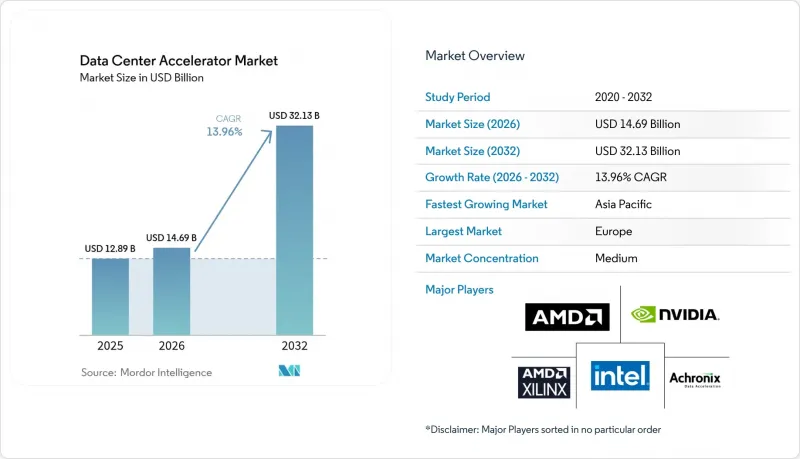
Mordor Intelligence에 의하면, 2026년 데이터센터 가속기 시장 규모는 146억 9,000만 달러로 추정되고 있어 2025년 128억 9,000만 달러에서 성장하여 2032년에는 321억 3,000만 달러에 이를 것으로 예측됩니다.
2026년부터 2032년까지의 연평균 성장률(CAGR)은 13.96%를 나타낼 전망입니다.
본 보고서는 프로세서 유형(CPU 등), 용도(고성능 컴퓨팅(HPC) 등), 배포 방식(On-Premise, 코로케이션 등), 최종 사용자 산업(IT 및 통신 등), 지역(북미 등)별로 분류되어 있습니다. 시장 예측은 달러(USD)로 제시되어 있습니다.
세계 데이터센터 가속기 시장 동향 및 인사이트
하이퍼스케일 데이터센터 내 AI/ML 훈련 워크로드의 급증
하이퍼스케일 사업자들은 현재, 기존의 엔터프라이즈 워크로드보다 10-100배 높은 연산 밀도를 필요로 하는 AI 전용으로 설계된 데이터홀을 도입하고 있습니다. Meta의 8억 달러 규모의 인디애나주 캠퍼스는 멀티 페타플롭급 GPU 클러스터를 지원하기 위해 수냉식 랙을 표준화하고 있으며, 이는 이러한 변화를 상징합니다. 마이크로소프트는 2025 회계연도에 미국 내 AI 시설에 800억 달러 이상을 배정하고 있어, 훈련 인프라의 지리적 집중화를 여실히 보여주고 있습니다. 아마존의 1,000억 달러 규모에 달하는 여러 주에 걸친 확장은 클라우드 하이퍼스케일러가 규모의 경제를 추구하고 있음을 더욱 시사하지만, 새로 추가되는 1메가와트마다 사내 재생에너지 기준을 충족해야 합니다. 기업들이 프로토타입 모델에서 추론 파이프라인으로 전환함에 따라, GPU, CPU, ASIC 노드를 통합한 보다 이종 혼합형 랙 설계가 주류를 이루고 있어 균형을 맞출 필요성이 높아지고 있습니다. 금융 기관들은 이러한 이중 구조를 구현하고 있으며, 실시간 부정 감지에는 디스크리트 GPU 클러스터를 할당하는 한편, 규제 보고용 CPU를 많이 사용하는 분석 팜을 유지하고 있습니다.
GPU 공급 부족이 클라우드 기반 가속기 대여를 촉진
고성능 GPU의 만성적인 부족을 배경으로, 하드웨어 소유와 이용을 분리하는 ‘GPU-as-a-Service’ 플랫폼이 등장하고 있습니다. Oracle Cloud Infrastructure의 슈퍼클러스터는 16,384대의 AMD Instinct MI300X GPU를 지원하며, 종량제 웹 포털을 제공함으로써 조달 리드타임을 수개월에서 수분으로 단축하고 있습니다. 북미와 유럽에서 용도가 변경된 가상화폐 채굴 시설은 전력 밀도가 높은 시설로 활용되어, 사업자는 유휴 전력 용량을 수익화할 수 있게 되었습니다. 이 임대 모델을 통해 그동안 최고 수준의 가속기에 대한 설비 투자를 정당화할 수 없었던 중소규모 조직에서도 접근 기회가 확대되고 있습니다. 또한, 서비스 제공업체는 벤더와의 할당 협상에서 우위를 점할 수 있으며, 단일 공급업체에 의존함으로써 발생하는 제약에 대한 내성을 높일 수 있습니다.
고급 패키징용 기판의 전 세계적 공급 부족
HBM 스택 및 치플렛을 통합하는 가속기는 아지노모토의 빌드업 필름 및 CoWoS 패키징에 의존하고 있지만, 이러한 소재는 현재 1년이나 되는 리드 타임을 필요로 합니다. 공급업체들은 수익성이 높은 SKU를 우선시하고 있기 때문에 소규모 벤더들은 제한된 할당량을 놓고 치열한 경쟁을 벌일 수밖에 없습니다. 유기 인터포저를 활용한 실험이 진행 중이지만, 적어도 두 번의 생산 주기가 지나기 전까지는 공급 제약을 실질적으로 완화할 수 없을 것입니다. 대만과 한국은 기판 생산 능력의 적극적인 확대를 발표하고 있지만, 생산 확대 시기는 현재 수요의 전환점을 이미 지나버린 상태입니다.
부문 분석
GPU 프로세서는 2025년에도 73.20%의 점유율을 유지하고 있으며, 이는 모델 학습과 추론 두 가지 작업 모두에서 보여지는 범용성을 반영합니다. 그러나 기업들이 정상 상태의 추론 워크로드에서 저전력화를 도모함에 따라, ASIC 출하량은 2032년까지 연평균 성장률(CAGR) 15.42%로 증가할 것으로 예측됩니다. 구글이 사내에서 개발한 TPU v6는 성능과 비용의 균형을 중시하는 자체 개발 실리콘의 동향을 상징합니다. 한편, AMD의 Instinct MI350 제품군은 HBM 용량을 288GB로 확장하여 메모리 제약이 심한 트랜스포머 모델을 대상으로 하고 있습니다. CPU 소켓은 여전히 I/O 및 하우스키핑 작업을 총괄하고 있으며, FPGA 카드는 결정론적 지연 시간이 요구되는 통신 에지 노드에서 그 중요성을 유지하고 있습니다.
ASIC의 성장은 구매자의 우선순위가 변화하고 있음을 보여줍니다. 코로케이션 시설 내의 전력 예산은 랙 밀도에 비례하여 선형적으로 증가하는 경우가 드물기 때문에 사업자들은 TOPS/와트라는 지표를 중시하게 되었습니다. 고객 지원용 챗봇이나 실시간 개인화 엔진 등 추론 처리가 집중되는 SaaS 서비스에는 예측 가능한 지연 시간이 요구되는데, 이는 현재 ASIC 설계를 통해 실현되고 있습니다. 훈련 워크로드는 여전히 멀티 GPU 클러스터에 집중되지만, 연산 사이클의 일부는 차세대 GPU에 통합된 전용 텐서 엔진으로 이전되고 있어 카테고리 간의 경계가 모호해지고 있습니다. 전반적으로 프로세서의 다양화는 벤더 간의 경쟁을 심화시켜, 구매자에게는 가격 협상 및 안정적인 공급 측면에서 유리하게 작용합니다.
2025년에는 데이터센터 가속기 시장 매출의 49.30%를 AI 훈련이 차지했지만, 2032년까지는 추론 워크로드가 15.55%라는 더 높은 연평균 성장률(CAGR)을 보일 것으로 전망됩니다. 예전에는 파일럿 프로젝트에 만족하던 기업들도 현재는 챗봇, 추천 모델, 이미지 분석 서비스 등을 실제 운영 환경에 도입하고 있으며, 이 경우 지연 시간의 악화는 고객 이탈로 직결됩니다. 고성능 컴퓨팅은 기상 모델링, 유전체학, 전산 유체 역학을 중심으로 한 안정적인 틈새 시장으로 남아 있으며, 순수한 ASIC이 아닌 더 대규모의 HBM 스택을 갖춘 GPU에 의존하고 있습니다.
추론의 성장은 하드웨어 선정에도 파급되고 있습니다. 배치 크기의 변동과 엄격한 서비스 수준 계약(SLA)으로 인해, 원시 부동소수점 연산 처리량보다 메모리 대역폭을 최적화하는 가속기가 요구되고 있습니다. 의료 기관에서는 추론에 최적화된 보드를 도입하여 진료 현장에서 영상 진단을 수행함으로써, 뇌졸중 등의 질환 진단까지 걸리는 시간을 단축하고 있습니다. 금융 기관 역시 실시간 리스크 스코어링에 가속기를 활용하고, 규제 준수를 위해 프라이빗 클라우드 환경 내에 연산 노드를 구축하고 있습니다. 용도의 다양화가 진행됨에 따라 구매 기준도 더욱 다양해질 것입니다. 그리고 소프트웨어 생태계의 성숙도가 구매 결정에 점점 더 큰 영향을 미치게 될 것입니다.
지역별 분석
북미는 아마존, 마이크로소프트, 구글의 하이퍼스케일 설비 투자 계획에 힘입어 여전히 최대의 구매 시장으로 자리 잡고 있습니다. 마이크로소프트만 해도 2025년에는 국내 시설에 대한 투자액이 800억 달러를 넘어설 전망입니다. 캐나다와 멕시코는 북미의 규제 체계 범위 내에 머물면서도, 전력 비용과 지연 시간의 균형을 고려한 니어쇼어 거점으로 부상하고 있습니다.
아시아태평양(APAC)은 소버린 클라우드 의무화 및 한국의 350억 달러 규모 복합 시설과 같은 거대 캠퍼스 건설에 힘입어 가장 높은 연평균 성장률(CAGR)을 나타낼 전망입니다. 중국은 수출 규제의 제약을 극복하기 위해 화웨이의 ‘Ascend’ 시리즈와 같은 국산 가속기 개발을 추진하고 있습니다. 일본의 Rapidus 컨소시엄과 소프트뱅크의 반도체 칩 관련 노력은 공공 자금의 지원을 받아 반도체 제조 분야에서 입지를 회복하는 것을 목표로 하고 있습니다.
유럽의 ‘GAIA-X’ 및 ‘IPCEI-CIS’ 프로그램은 국경을 초월한 데이터 주권형 클라우드 구축을 촉진하고 있습니다. 블랙스톤이 영국 데이터센터에 130억 달러 규모로 투자한 것은 해당 지역의 AI 수요에 대한 투자자들의 신뢰를 뒷받침하고 있습니다. 중동 및 아프리카의 성장은 국부펀드의 지원에 달려 있으며, 에너지 가격의 우위가 UAE와 사우디아라비아의 전력 소비량이 많은 시설을 뒷받침하고 있습니다.
기타 혜택:
- Excel 형식 시장 전망(ME) 시트
- 3개월간의 애널리스트 지원
자주 묻는 질문
목차
제1장 서론
제2장 분석 방법
제3장 주요 요약
제4장 시장 구도
제5장 시장 규모 및 성장률 예측
제6장 경쟁 구도
제7장 시장 기회와 향후 전망
JHS 26.09.09According to Mordor Intelligence, data center accelerator market size in 2026 is estimated at USD 14.69 billion, growing from 2025 value of USD 12.89 billion with 2032 projections showing USD 32.13 billion, growing at 13.96% CAGR over 2026-2032.
This report is Segmented by Processor Type (CPU and More), Application (High-Performance Computing, and More), Deployment Model (On-Premise, Colocation, and More), End-User Industry (IT and Telecom, and More), and Geography (North America and More). The Market Forecasts are Provided in (USD).
Global Data Center Accelerator Market Trends and Insights
Surging AI/ML Training Workloads in Hyperscale Data Centers
Hyperscale operators now deploy data halls purpose-built for AI that demand 10-100 times more compute density than legacy enterprise workloads. Meta's USD 800 million Indiana campus exemplifies the shift as it standardizes liquid-cooled racks to accommodate multi-petaflop GPU clusters. Microsoft earmarked more than USD 80 billion for U.S. AI facilities in fiscal-year 2025, underscoring the geographic clustering of training infrastructure. Amazon's USD 100 billion multistate expansion further signals that cloud hyperscalers are pursuing scale economics, but every new megawatt must meet internal renewable-energy thresholds. A balancing act is emerging as enterprises move from prototype models to inference pipelines, resulting in more heterogeneous rack designs that integrate GPU, CPU, and ASIC nodes. Financial institutions exemplify this dual-track buildout, allocating discrete GPU clusters for real-time fraud detection while maintaining CPU-heavy analytics farms for regulatory reporting.
GPU Scarcity Driving Cloud-Based Accelerator Rentals
Chronic shortages of premium GPUs have spawned GPU-as-a-Service platforms that decouple hardware ownership from usage. Oracle Cloud Infrastructure's supercluster supports 16,384 AMD Instinct MI300X GPUs and offers consumption-based web portals, reducing procurement lead times from months to minutes. Re-purposed cryptocurrency-mining sites in North America and Europe contribute power-dense real estate, allowing operators to monetize stranded electrical capacity. The rental model democratizes access for small and midsize organizations that could not previously justify the capital outlay for top-tier accelerators. Service providers also gain leverage when negotiating vendor allocations, enhancing resilience against single-supplier constraints.
Tight Global Supply of Advanced Packaging Substrates
Accelerators that integrate HBM stacks and chiplets rely on Ajinomoto Build-Up Film and CoWoS packaging, materials now subject to year-long lead times. Suppliers prioritize high-margin SKUs, leaving smaller vendors scrambling for limited allocations. Organic-interposer experimentation is underway but will not meaningfully ease constraints for at least two production cycles. Taiwan and South Korea have announced aggressive substrate-capacity expansions, yet the ramp window extends beyond current demand inflection points.
Other drivers and restraints analyzed in the detailed report include:
- Rapid Adoption of Generative AI in SaaS Platforms
- Quantum-Inspired Algorithms Demanding Heterogeneous Accelerators
- Steep Learning Curve for Heterogeneous Programming Models
For complete list of drivers and restraints, kindly check the Table Of Contents.
Segment Analysis
GPU processors retained a 73.20% stake in 2025, reflecting their versatility across both model-training and inference tasks. ASIC shipments, however, are projected to rise at a 15.42% CAGR to 2032 as enterprises tune for lower power draw during steady-state inference workloads. Google's internally developed TPU v6 exemplifies the in-house silicon trend that balances performance and cost. Meanwhile, AMD's Instinct MI350 family expands HBM capacity to 288 GB, targeting memory-bound transformer models. CPU sockets still orchestrate I/O and housekeeping tasks, while FPGA cards maintain relevance in telecom edge nodes that call for deterministic latency.
ASIC growth illustrates shifting buyer priorities. Power budgets inside co-location cages rarely scale linearly with rack density, driving operators to favor TOPS-per-watt metrics. Inference-dense SaaS offerings, such as customer-support chatbots and real-time personalization engines, require predictable latency that ASIC designs now deliver. Training workloads will still concentrate on multi-GPU clusters, yet a portion of compute cycles migrates to specialized tensor engines integrated into next-gen GPUs, blurring categorical boundaries. Overall, processor diversity strengthens vendor competition, offering buyers leverage on pricing and supply continuity.
AI training accounted for 49.30% of Data Center Accelerator market revenue in 2025, but inference workloads will record a faster 15.55% CAGR through 2032. Businesses once content with pilot projects are now releasing chatbots, recommendation models, and image-analysis services into production, where latency slippage translates directly into customer churn. High-performance computing remains a stable niche centered on weather modeling, genomics, and computational fluid dynamics, relying on GPUs with larger HBM stacks rather than pure ASICs.
Inference growth ripples across hardware selection. Batch-size variability and strict service-level agreements necessitate accelerators that optimize memory bandwidth over raw floating-point throughput. Healthcare providers employ inference-optimized boards to perform diagnostic imaging at the point of care, shortening time to diagnosis for conditions such as stroke. Financial institutions likewise leverage accelerators for real-time risk scoring, embedding compute nodes inside private-cloud environments for regulatory compliance. The expanding application mix will continue to diversify purchase criteria, with software ecosystem maturity increasingly tipping buying decisions.
Complete Report Scope:
- By Processor Type
- CPU
- GPU
- FPGA
- ASIC
- By Application
- High-Performance Computing
- Artificial Intelligence Training
- Artificial Intelligence Inference
- Other Workloads
- By Deployment Model
- On-Premise/ Enteprise/Edge
- Colocation
- Public Cloud
- By End-user Industry
- IT and Telecom
- BFSI
- Healthcare and Life Sciences
- Government and Defense
- Media and Entertainment
- Others End Users
- By Geography
- North America
- United States
- Mexico
- Canada
- South America
- Brazil
- Rest of South America
- Europe
- Germany
- United Kingdom
- France
- Russia
- Rest of Europe
- Asia-Pacific
- China
- Japan
- India
- South Korea
- Rest of Asia-Pacific
- Middle East and Africa
- Middle East
- Saudi Arabia
- UAE
- Turkey
- Africa
- South Africa
- Rest of Africa
- Middle East
- North America
Geography Analysis
North America remains the largest buyer, underpinned by hyperscale capital-expenditure plans from Amazon, Microsoft, and Google. Microsoft's spending alone surpasses USD 80 billion for domestic facilities in 2025. Canada and Mexico emerge as near-shore options that balance power-cost and latency considerations while staying within North American regulatory frameworks.
APAC will post the highest CAGR, buoyed by sovereign-cloud mandates and the construction of enormous campuses such as South Korea's USD 35 billion complex. China advances domestic accelerators like Huawei's Ascend series to navigate export-control limitations. Japan's Rapidus consortium and SoftBank's chip initiatives, aided by public funding, aim to reclaim semiconductor manufacturing relevance.
Europe's GAIA-X and IPCEI-CIS programs foster cross-border data-sovereignty clouds. Blackstone's USD 13 billion UK data-center commitment underscores investor confidence in regional AI demand. Middle East and Africa growth hinges on sovereign wealth-fund backing, with energy-price advantages supporting power-hungry installations in the UAE and Saudi Arabia.
- NVIDIA Corporation
- Intel Corporation
- Advanced Micro Devices Inc.
- Google LLC (TPU)
- Amazon Web Services Inc.
- Qualcomm Technologies Inc.
- Xilinx Inc. (AMD)
- Achronix Semiconductor Corp.
- NEC Corporation
- Dell Technologies Inc.
- IBM Corporation
- Cisco Systems Inc.
- Huawei Technologies Co. Ltd.
- Alibaba Cloud (Hanguang)
- Baidu Inc. (Kunlun)
- Graphcore Ltd.
- Cerebras Systems Inc.
- Tenstorrent Inc.
- Ampere Computing LLC
- Arm Ltd.
- Broadcom Inc.
- Marvell Technology Inc.
- Samsung Electronics Co. Ltd.
- Fujitsu Ltd.
Additional Benefits:
- The market estimate (ME) sheet in Excel format
- 3 months of analyst support
TABLE OF CONTENTS
1 INTRODUCTION
- 1.1 Study Assumptions and Market Definition
- 1.2 Scope of the Study
2 RESEARCH METHODOLOGY
3 EXECUTIVE SUMMARY
4 MARKET LANDSCAPE
- 4.1 Market Overview
- 4.2 Market Drivers
- 4.2.1 Surging AI/ML training workloads in hyperscale data centers
- 4.2.2 GPU scarcity driving cloud-based accelerator rentals
- 4.2.3 Rapid adoption of Generative AI in SaaS platforms
- 4.2.4 Quantum-inspired algorithms demanding heterogeneous accelerators
- 4.2.5 Edge-to-core workload orchestration (5G and telco clouds)
- 4.2.6 Sovereign-cloud programs subsidising domestic accelerator fabs
- 4.3 Market Restraints
- 4.3.1 Tight global supply of advanced packaging substrates
- 4.3.2 Steep learning-curve for heterogenous programming models
- 4.3.3 Rising Scope-3 emission targets constraining mega-GPU clusters
- 4.3.4 Export-control regimes on high-end GPUs/ASICs
- 4.4 Value / Supply-Chain Analysis
- 4.5 Regulatory Landscape
- 4.6 Technological Outlook
- 4.7 Porter's Five Forces
- 4.7.1 Threat of New Entrants
- 4.7.2 Bargaining Power of Suppliers
- 4.7.3 Bargaining Power of Buyers
- 4.7.4 Threat of Substitutes
- 4.7.5 Competitive Rivalry
5 MARKET SIZE AND GROWTH FORECASTS (VALUE)
- 5.1 By Processor Type
- 5.1.1 CPU
- 5.1.2 GPU
- 5.1.3 FPGA
- 5.1.4 ASIC
- 5.2 By Application
- 5.2.1 High-Performance Computing
- 5.2.2 Artificial Intelligence Training
- 5.2.3 Artificial Intelligence Inference
- 5.2.4 Other Workloads
- 5.3 By Deployment Model
- 5.3.1 On-Premise/ Enteprise/Edge
- 5.3.2 Colocation
- 5.3.3 Public Cloud
- 5.4 By End-user Industry
- 5.4.1 IT and Telecom
- 5.4.2 BFSI
- 5.4.3 Healthcare and Life Sciences
- 5.4.4 Government and Defense
- 5.4.5 Media and Entertainment
- 5.4.6 Others End Users
- 5.5 By Geography
- 5.5.1 North America
- 5.5.1.1 United States
- 5.5.1.2 Mexico
- 5.5.1.3 Canada
- 5.5.2 South America
- 5.5.2.1 Brazil
- 5.5.2.2 Rest of South America
- 5.5.3 Europe
- 5.5.3.1 Germany
- 5.5.3.2 United Kingdom
- 5.5.3.3 France
- 5.5.3.4 Russia
- 5.5.3.5 Rest of Europe
- 5.5.4 Asia-Pacific
- 5.5.4.1 China
- 5.5.4.2 Japan
- 5.5.4.3 India
- 5.5.4.4 South Korea
- 5.5.4.5 Rest of Asia-Pacific
- 5.5.5 Middle East and Africa
- 5.5.5.1 Middle East
- 5.5.5.1.1 Saudi Arabia
- 5.5.5.1.2 UAE
- 5.5.5.1.3 Turkey
- 5.5.5.2 Africa
- 5.5.5.2.1 South Africa
- 5.5.5.2.2 Rest of Africa
- 5.5.5.1 Middle East
- 5.5.1 North America
6 COMPETITIVE LANDSCAPE
- 6.1 Market Share Analysis
- 6.2 Company Profiles (includes Global level Overview, Market level overview, Core Segments, Financials as available, Strategic Information, Market Rank/Share for key companies, Products and Services, and Recent Developments)
- 6.2.1 NVIDIA Corporation
- 6.2.2 Intel Corporation
- 6.2.3 Advanced Micro Devices Inc.
- 6.2.4 Google LLC (TPU)
- 6.2.5 Amazon Web Services Inc.
- 6.2.6 Qualcomm Technologies Inc.
- 6.2.7 Xilinx Inc. (AMD)
- 6.2.8 Achronix Semiconductor Corp.
- 6.2.9 NEC Corporation
- 6.2.10 Dell Technologies Inc.
- 6.2.11 IBM Corporation
- 6.2.12 Cisco Systems Inc.
- 6.2.13 Huawei Technologies Co. Ltd.
- 6.2.14 Alibaba Cloud (Hanguang)
- 6.2.15 Baidu Inc. (Kunlun)
- 6.2.16 Graphcore Ltd.
- 6.2.17 Cerebras Systems Inc.
- 6.2.18 Tenstorrent Inc.
- 6.2.19 Ampere Computing LLC
- 6.2.20 Arm Ltd.
- 6.2.21 Broadcom Inc.
- 6.2.22 Marvell Technology Inc.
- 6.2.23 Samsung Electronics Co. Ltd.
- 6.2.24 Fujitsu Ltd.
7 MARKET OPPORTUNITIES AND FUTURE OUTLOOK
- 7.1 White-space and Unmet-Need Assessment