
|
시장보고서
상품코드
2123248
복강경 기기 시장 : 시장 점유율 분석, 업계 동향 및 통계, 성장 예측(2026-2031년)Laparoscopy Devices - Market Share Analysis, Industry Trends & Statistics, Growth Forecasts (2026 - 2031) |
||||||
 Mordor Intelligence
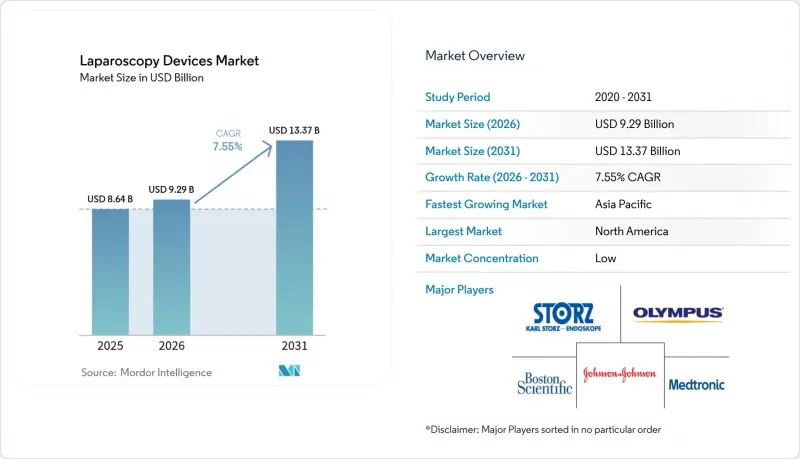
Mordor Intelligence에 의하면, 2026년 복강경 기기 시장 규모는 92억 9,000만 달러로 추정되고, 2025년 86억 4,000만 달러에서 확대해, 2031년에는 133억 7,000만 달러에 이를 것으로 예측됩니다.
2026-2031년 연평균 성장률(CAGR) 7.55%로 성장할 것으로 전망됩니다.
본 보고서는 제품별(에너지 디바이스, 복강경 등), 용도별(일반외과, 비만 외과 등), 연령대별(성인, 소아 등), 최종 사용자별(병원, 외래수술센터(ASC) 등) 및 지역별(북미, 유럽, 아시아태평양, 중동 및 아프리카, 남미)로 분류되어 있습니다. 시장 규모 및 전망은 금액(달러) 기준으로 제시되어 있습니다.
세계의 복강경 기기 시장 동향 및 인사이트
저침습 수술에 대한 수요 증가
선택적 수술이나 응급 수술에서 평균 입원 일수가 2-3일 단축되고, 수술 후 회복이 빨라짐에 따라 복강경 수술이 점점 더 선호되고 있습니다. 병원 측은 재입원율 감소라는 이점을 누릴 수 있는 반면, 환자들로부터는 수술 후 통증이 줄어들고 직장 복귀가 빨라졌습니다는 반응이 이어지고 있습니다. 또한, 최소 침습 수술 펠로우십 등록자 수가 증가함에 따라 숙련된 의료진의 안정적인 공급이 확보되고 있습니다. 환자의 선호도, 보험사의 지원, 그리고 외과의사의 역량 향상이라는 선순환이 복강경 의료기기 시장의 성장을 지속적으로 뒷받침하고 있습니다.
4K/3D/AR 및 AI 비전을 포함한 기술의 비약적 발전
새로운 영상 처리 기술로 인해 해상도가 4배 향상되고 깊이감이 더해져, 복잡한 해부학적 조작 시 오류율이 감소합니다. ‘다빈치 5(da Vinci 5)’와 같은 AI 탑재 시스템은 기구의 궤적을 예측하는 분석 기능을 제공하여, 외과의사가 중요한 해부학적 구조를 더 빨리 파악할 수 있도록 지원합니다. 증강현실(AR) 오버레이 기능을 통해 수술 전 스캔 이미지와 실제 해부학적 구조를 대조할 수 있어, 수술 시간을 단축하고 수술실 회전율을 향상시킵니다.
높은 초기 투자 비용과 유지비
풀 스펙 로봇 수술실의 도입 비용은 200만-300만 달러에 달하며, 연간 20만 달러를 초과하는 지속적인 서비스 요금이 발생하기 때문에 중규모 병원에서는 도입이 미뤄지고 있습니다. 공급망 혼란으로 인해 물류 비용이 상승하고 있어, 의료 기관들은 총 소유 비용을 엄격히 검토하고 있습니다. 이러한 장벽을 해소하기 위해 종량제 금융 및 공유 소유 모델이 등장하고 있습니다.
부문 분석
2025년, 복강경 의료기기 시장에서 에너지 기기가 27.12%로 가장 큰 점유율을 차지했습니다. 이는 거의 모든 수술에서 전기 메스나 조직 실링이 필요하기 때문입니다. 로봇 보조 시스템은 절대 수량으로는 작지만, 2031년까지 연평균 성장률(CAGR) 8.27%를 나타낼 것으로 예측됩니다. 이러한 확장에 따라 로봇 수술실용 복강경 기기 시장 규모는 향후 10년 말까지 기준으로 두 자릿수 수십억 달러 규모에 달할 전망입니다. 차세대 복강경에는 4K/3D 광학 시스템, 자동 화이트 밸런스, 그리고 안정적인 복강 내 기압을 유지하는 누출 방지 트로카 씰이 통합되어 있습니다. 휴대용 기구에는 장시간에 걸친 비만 수술 중 외과의사의 피로를 줄여주는 햅틱 피드백 모터가 채택되어 있습니다. 일회용 트로카는 환경 목표를 충족하기 위해 식물 유래 또는 재활용 가능한 소재로의 전환이 진행되고 있습니다. 또한, 각 제조업체는 기구의 마모를 예측하는 서비스 분석 기능을 함께 제공함으로써 예기치 않은 가동 중단 시간을 최소화하고 있습니다.
일회용 기구로의 전환은 흡입·세척 장치 및 스테이플러 제품 라인으로도 빠르게 확산되고 있습니다. 이는 병원 측이 재처리 비용이 개당 200달러를 초과할 가능성이 있다는 추산을 내리고 있기 때문입니다. 스마트 에너지 디바이스에는 조직 접촉 센서가 탑재되어 열 확산을 억제함으로써 좁은 공간에서의 안전성이 향상되고 있습니다. 이처럼 프리미엄 액세서리 제품 라인은 지속적인 수익원이 되어 자본 설비에 대한 가격 압박을 완화하고 있습니다.
2025년 복강경 기기 시장에서 일반외과는 담낭 절제술 및 역류 방지술의 수술 건수가 많아 29.52%라는 최대 점유율을 차지했습니다. 한편, 산부인과는 로봇 보조 자궁 적출술의 도입이 확대됨에 따라 8.05%라는 가장 높은 연평균 성장률(CAGR)을 보이고 있습니다. 이러한 추세에 따라 2031년까지 산부인과 복강경 기기 시장 점유율은 현저히 상승할 전망입니다.
대장·직장 외과 및 비뇨기과 분야에서는 AI 탑재 카메라가 임상의가 크리티컬 뷰(critical view) 기준을 확실하게 달성할 수 있도록 지원하여 수술 중 손상을 대폭 줄이고 있습니다. 비만 증가에 따라 체중 감량 수술 건수는 꾸준히 증가하고 있으며, 로봇 플랫폼 도입으로 입원 기간이 더욱 단축되고 있습니다. 흉부외과 및 소아외과 부문은 여전히 규모는 작지만, 기구의 소형화로 인해 성장세가 가속화되고 있습니다.
지역별 분석
북미는 도입 대수가 많고 유리한 보험 환급 제도의 뒷받침을 받아 2025년에는 전 세계 매출의 40.05%를 차지했습니다. 미국에서는 ‘다빈치 5(da Vinci 5)’ 출시 이후, 로봇을 이용한 일반외과 수술 건수가 두 자릿수 성장을 기록했습니다. 캐나다 병원에서는 주 정부의 자금 지원 제도를 통해 유사한 성과를 거두고 있으며, 멕시코에서는 국경을 넘어 방문하는 의료 관광객을 수용하기 위해 민간 부문에서의 도입이 진행되고 있습니다.
아시아태평양은 8.22%라는 가장 높은 연평균 성장률(CAGR)을 나타낼 전망입니다. 중국 병원에서는 대규모 설비 확충이 계속되고 있으며, 최근 국내 승인을 받아 비용 최적화된 로봇 수술 플랫폼의 현지 생산이 가속화되고 있습니다. 일본과 한국은 영상 진단 분야의 전문 지식을 활용하여 고해상도 카메라 스택을 수출하고 있습니다. 인도의 주요 도시에서는 견조한 수요가 나타나고 있지만, 자금 면의 제약으로 인해 지방에서의 도입은 여전히 완만한 속도에 그치고 있습니다. 태국과 말레이시아의 의료 관광 회랑은 환자 수를 더욱 끌어올리고 있습니다. 유럽의 성장은 국민건강보험 및 외과 의사 연수 네트워크에 힘입어 안정적입니다. 다만, 예산 상한선으로 인해 북유럽 이외 지역에서의 로봇 시스템 광범위한 도입이 지연될 가능성이 있습니다. 지역 내 노력을 통해 탈탄소화 목표에 부합하는 재사용 가능한 기구의 조달이 진행되고 있습니다. 중동 및 아프리카에서는 걸프협력회의(GCC) 회원국들이 플래그십 의료 도시에 투자함에 따라 도입이 확대되고 있는 반면, 사하라 이남 아프리카에서는 기부금에 의한 복강경 수술(MIS) 프로그램에 대한 의존도가 높아지고 있습니다. 남미에서는 브라질의 민간 보험사 및 아르헨티나 공공 부문의 현대화를 중심으로 완만한 성장세가 나타나고 있습니다.
기타 혜택 :
- 엑셀 형식 시장 예측(ME) 시트
- 3개월간의 애널리스트 지원
자주 묻는 질문
목차
제1장 서론
제2장 조사 방법
제3장 주요 요약
제4장 시장 구도
제5장 시장 규모 및 성장 예측
제6장 경쟁 구도
제7장 시장 기회 및 향후 전망
AJY 26.09.07According to Mordor Intelligence, laparoscopic devices market size in 2026 is estimated at USD 9.29 billion, growing from 2025 value of USD 8.64 billion with 2031 projections showing USD 13.37 billion, growing at 7.55% CAGR over 2026-2031.
This report is Segmented by Product (Energy Devices, Laparoscopes, and More), Application (General Surgery, Bariatric Surgery, and More), Age Group (Adults, Pediatric, and More), End User (Hospitals, Ambulatory Surgical Centers (ASCs) and More), and Geography (North America, Europe, Asia-Pacific, Middle East and Africa, and South America). The Market and Forecasts are Provided in Terms of Value (USD).
Global Laparoscopy Devices Market Trends and Insights
Rising Demand for Minimally-Invasive Procedures
Elective and acute surgeries increasingly favor laparoscopic techniques because average hospital stays fall by 2-3 days, and postsurgical recovery accelerates. Hospitals benefit from lower readmission rates, while patients report less postoperative pain and faster return to work. Fellowship enrollments in minimally invasive surgery have risen, ensuring a steady pipeline of skilled practitioners. The virtuous cycle of patient preference, payer support, and surgeon competency continues to lift the laparoscopic devices market.
Technological Leaps Including 4K/3D/AR and AI Vision
New imaging stacks quadruple resolution and add depth perception that reduces error rates in intricate dissections. AI-enabled systems such as the da Vinci 5 supply predictive analytics that anticipate instrument trajectory, helping surgeons identify critical structures sooner. Augmented reality overlays align preoperative scans with live anatomy and shorten operative times, improving operating-room turnover.
High Capital & Maintenance Outlay
Fully-featured robotic suites can cost USD 2-3 million with ongoing service fees topping USD 200,000 annually, delaying purchases by mid-tier hospitals. Supply chain turbulence has lifted logistics costs, causing providers to scrutinize total cost of ownership. Pay-per-use financing and shared-ownership models have emerged to counterbalance these barriers.
Other drivers and restraints analyzed in the detailed report include:
- Growing Prevalence of Obesity & Metabolic Disease
- Rapid Ambulatory Surgical Centers Build-Out in High-Income Economies
- Shortage of Advanced-Skill Laparoscopic Surgeons
For complete list of drivers and restraints, kindly check the Table Of Contents.
Segment Analysis
Energy instruments held the largest slice of the laparoscopic devices market at 27.12% in 2025 because almost every procedure requires electrosurgery or tissue sealing. Robotic-assisted systems, while smaller in absolute volume, are forecast to post an 8.27% CAGR through 2031. That expansion will lift the laparoscopic devices market size for robotic suites to USD-denominated double-digit billions by decade-end. Next-generation laparoscopes integrate 4K/3D optics, automated white-balance, and leak-proof trocar seals that maintain stable pneumoperitoneum. Hand instruments adopt haptic feedback motors that lessen surgeon fatigue during lengthy bariatric cases. Disposable trocars continue shifting toward plant-based or recyclable materials to address environmental targets. Manufacturers also bundle service analytics that predict instrument wear, limiting unplanned downtime.
The pivot to single-use instruments spreads quickly across suction-irrigation and stapler lines because hospitals calculate that reprocessing costs can surpass USD 200 per item. Smart energy devices now feature tissue-contact sensors that moderate thermal spread, improving safety in confined spaces. Premium accessory lines thus supply recurring revenue that softens pricing pressure on capital equipment.
General surgery contributed the largest 29.52% slice of the laparoscopic devices market in 2025, owing to high volumes of cholecystectomy and anti-reflux procedures. Gynecology, however, shows the highest 8.05% CAGR as robotic hysterectomy adoption widens. That trajectory will lift gynecology's laparoscopic devices market share notably by 2031.
In colorectal and urological surgery, AI-enabled cameras help clinicians consistently achieve critical-view benchmarks, slashing intraoperative injuries. Bariatric volumes rise steadily with obesity growth, while robotic platforms further shorten hospital stays. Thoracic and pediatric segments remain smaller yet gain momentum from tool miniaturization.
Complete Report Scope:
- By Product
- Energy Devices
- Electrosurgical / Bipolar Generators
- Ultrasonic & RF Energy Systems
- Laparoscopes
- Video Laparoscopes (HD/4K/3D)
- Fibre-optic Laparoscopes
- Insufflation & Access Devices
- CO2 Insufflators
- Trocars & Cannulas
- Handheld Instruments
- Graspers & Dissectors
- Scissors & Shears
- Suction / Irrigation Devices
- Robotic-Assisted Laparoscopy Systems
- Accessories & Consumables
- Energy Devices
- By Application
- General Surgery
- Bariatric Surgery
- Gynecological Surgery
- Urological Surgery
- Colorectal Surgery
- Other Applications
- By Age Group
- Adults
- Pediatric
- Geriatric
- By End User
- Hospitals
- Ambulatory Surgical Centers (ASCs)
- Others
- By Geography
- North America
- United States
- Canada
- Mexico
- Europe
- Germany
- United Kingdom
- France
- Italy
- Spain
- Rest of Europe
- Asia-Pacific
- China
- Japan
- India
- South Korea
- Australia
- Rest of Asia-Pacific
- Middle East and Africa
- GCC
- South Africa
- Rest of Middle East and Africa
- South America
- Brazil
- Argentina
- Rest of South America
- North America
Geography Analysis
North America controlled 40.05% of global revenue in 2025, anchored by dense installed bases and favorable reimbursement. United States facilities logged double-digit growth in robotic general surgery cases after the da Vinci 5 launch. Canadian hospitals replicate performance through provincial funding schemes, while Mexico increases private-sector adoption to serve cross-border medical tourists.
Asia-Pacific is forecast to post the fastest 8.22% CAGR. Chinese hospitals continue large-scale build-outs and accelerate local production of cost-optimized robotic platforms following recent domestic approvals. Japan and South Korea leverage their imaging expertise to export high-resolution camera stacks. India's tier-one cities witness robust demand, though rural uptake remains slower due to capital limitations. Medical-tourism corridors in Thailand and Malaysia further boost case volumes. European growth is stable, supported by national health insurance and surgeon training networks. Budget caps, however, can delay broad robotic acquisition outside Northern Europe. Intra-region initiatives promote reusable instrument procurement to align with decarbonization goals. The Middle East and Africa observe rising adoption in Gulf Cooperation Council states investing in flagship medical cities, whereas sub-Saharan Africa relies heavily on donor-funded MIS programs . South America sees moderate gains centered on Brazil's private insurers and Argentina's public-sector modernization.
- Olympus
- Medtronic
- Johnson & Johnson
- Karl Storz
- Stryker
- Boston Scientific
- B. Braun
- Conmed
- Richard Wolf
- Smiths Group
- Intuitive Surgical
- Teleflex
- Applied Medical Resources
- Erbe Elektromedizin
- Genicon
- Microline Surgical
- Ackermann Instrumente
- Genesis MedTech
- Endoso Life
- Akino Medical
Additional Benefits:
- The market estimate (ME) sheet in Excel format
- 3 months of analyst support
TABLE OF CONTENTS
1 Introduction
- 1.1 Study Assumptions & Market Definition
- 1.2 Scope of the Study
2 Research Methodology
3 Executive Summary
4 Market Landscape
- 4.1 Market Overview
- 4.2 Market Drivers
- 4.2.1 Rising demand for minimally-invasive procedures
- 4.2.2 Technological leaps including 4K/3D/AR and AI vision
- 4.2.3 Growing prevalence of obesity & metabolic disease
- 4.2.4 Rapid Ambulatory Surgical Centers build-out in high-income economies
- 4.2.5 Shift to single-use laparoscopic instruments
- 4.2.6 AI-enabled intra-operative analytics & pay-per-use models
- 4.3 Market Restraints
- 4.3.1 High capital & maintenance outlay
- 4.3.2 Shortage of advanced-skill laparoscopic surgeons
- 4.3.3 Sustainability backlash on disposable plastics
- 4.3.4 Endoluminal therapies cannibalising laparoscopic surgery volumes
- 4.4 Value / Supply-Chain Analysis
- 4.5 Regulatory Landscape
- 4.6 Technological Outlook
- 4.7 Porter's Five Forces Analysis
- 4.7.1 Threat of New Entrants
- 4.7.2 Bargaining Power of Buyers
- 4.7.3 Bargaining Power of Suppliers
- 4.7.4 Threat of Substitutes
- 4.7.5 Competitive Rivalry
5 Market Size & Growth Forecasts (Value, USD)
- 5.1 By Product
- 5.1.1 Energy Devices
- 5.1.1.1 Electrosurgical / Bipolar Generators
- 5.1.1.2 Ultrasonic & RF Energy Systems
- 5.1.2 Laparoscopes
- 5.1.2.1 Video Laparoscopes (HD/4K/3D)
- 5.1.2.2 Fibre-optic Laparoscopes
- 5.1.3 Insufflation & Access Devices
- 5.1.3.1 CO2 Insufflators
- 5.1.3.2 Trocars & Cannulas
- 5.1.4 Handheld Instruments
- 5.1.4.1 Graspers & Dissectors
- 5.1.4.2 Scissors & Shears
- 5.1.5 Suction / Irrigation Devices
- 5.1.6 Robotic-Assisted Laparoscopy Systems
- 5.1.7 Accessories & Consumables
- 5.1.1 Energy Devices
- 5.2 By Application
- 5.2.1 General Surgery
- 5.2.2 Bariatric Surgery
- 5.2.3 Gynecological Surgery
- 5.2.4 Urological Surgery
- 5.2.5 Colorectal Surgery
- 5.2.6 Other Applications
- 5.3 By Age Group
- 5.3.1 Adults
- 5.3.2 Pediatric
- 5.3.3 Geriatric
- 5.4 By End User
- 5.4.1 Hospitals
- 5.4.2 Ambulatory Surgical Centers (ASCs)
- 5.4.3 Others
- 5.5 By Geography
- 5.5.1 North America
- 5.5.1.1 United States
- 5.5.1.2 Canada
- 5.5.1.3 Mexico
- 5.5.2 Europe
- 5.5.2.1 Germany
- 5.5.2.2 United Kingdom
- 5.5.2.3 France
- 5.5.2.4 Italy
- 5.5.2.5 Spain
- 5.5.2.6 Rest of Europe
- 5.5.3 Asia-Pacific
- 5.5.3.1 China
- 5.5.3.2 Japan
- 5.5.3.3 India
- 5.5.3.4 South Korea
- 5.5.3.5 Australia
- 5.5.3.6 Rest of Asia-Pacific
- 5.5.4 Middle East and Africa
- 5.5.4.1 GCC
- 5.5.4.2 South Africa
- 5.5.4.3 Rest of Middle East and Africa
- 5.5.5 South America
- 5.5.5.1 Brazil
- 5.5.5.2 Argentina
- 5.5.5.3 Rest of South America
- 5.5.1 North America
6 Competitive Landscape
- 6.1 Market Concentration
- 6.2 Market Share Analysis
- 6.3 Company Profiles (includes Global level Overview, Market level overview, Core Segments, Financials as available, Strategic Information, Market Rank/Share, Products & Services, Recent Developments)
- 6.3.1 Olympus Corporation
- 6.3.2 Medtronic plc
- 6.3.3 Johnson & Johnson (Ethicon)
- 6.3.4 Karl Storz SE & Co. KG
- 6.3.5 Stryker Corporation
- 6.3.6 Boston Scientific Corporation
- 6.3.7 B. Braun SE
- 6.3.8 CONMED Corporation
- 6.3.9 Richard Wolf GmbH
- 6.3.10 Smith & Nephew plc
- 6.3.11 Intuitive Surgical Inc.
- 6.3.12 Teleflex Incorporated
- 6.3.13 Applied Medical Resources
- 6.3.14 Erbe Elektromedizin GmbH
- 6.3.15 Genicon Inc.
- 6.3.16 Microline Surgical
- 6.3.17 Ackermann Instrumente GmbH
- 6.3.18 Genesis MedTech
- 6.3.19 Endoso Life
- 6.3.20 Akino Medical
7 Market Opportunities & Future Outlook
- 7.1 White-space & Unmet-need Assessment