|
시장보고서
상품코드
2123338
BOPP 필름 시장 : 점유율 분석, 업계 동향과 통계, 성장 예측(2026-2031년)BOPP Films - Market Share Analysis, Industry Trends & Statistics, Growth Forecasts (2026 - 2031) |
||||||
 Mordor Intelligence
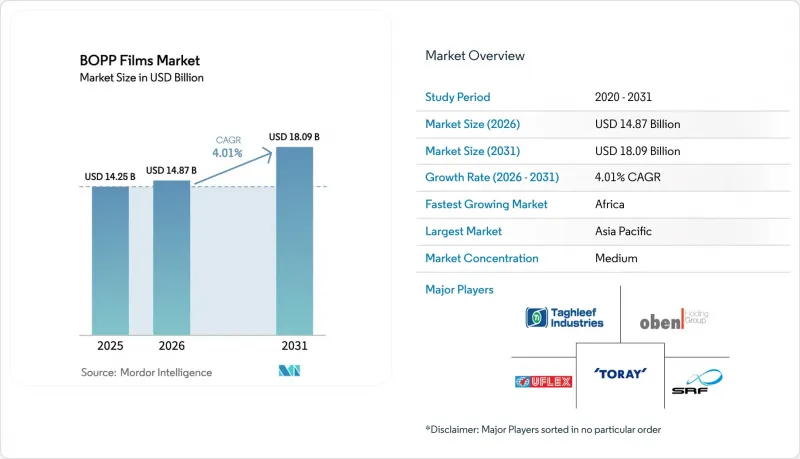
Mordor Intelligence에 의하면, BOPP 필름 시장 규모는 2025년 142억 5,000만 달러에서 2026년에는 148억 7,000만 달러로 확대되어 2031년까지 180억 9,000만 달러에 이를 것으로 예상되고 있어 2026년부터 2031년까지 CAGR 4.01%로 성장할 전망입니다.
본 보고서는 필름 유형(투명, 메탈라이즈, 불투명/백색, 펄), 두께(15 Mm 미만, 15-30 Mm, 30-45 Mm, 45 Mm 이상), 용도(포장, 라벨·랩핑, 기타),최종 사용자 산업 분야(식품, 음료, 의약품 및 의료, 퍼스널케어 및 화장품, 산업), 지역별로 분류되어 있습니다. 시장 전망은 금액(달러) 기준으로 제시되어 있습니다.
전 세계 BOPP 필름 시장 동향 및 인사이트
신흥 경제국에서 고투명도 스낵 포장재에 대한 수요 급증
동남아시아, 인도, 사하라 이남 아프리카의 가처분 소득 증가에 따라 소비 경향이 대량 판매되는 생활 필수품에서 소매점에서 제품의 신선도를 강조하기 위해 광택도 85% 이상, 헤이즈 3% 이하의 투명 필름이 필요한 브랜드 제품의 1회분 스낵으로 전환되고 있습니다. 투명한 BOPP 등급은 캐스트 폴리프로필렌이나 저밀도 폴리에틸렌보다 우수한 광학적 투명성을 제공하기 때문에 가공업체는 2차 포장용 골판지를 생략하여 포장 무게를 최대 30%까지 줄일 수 있습니다. 코스모 퍼스트(Cosmo First)는 2025년 6월, 수증기 투과율이 5g/m²/일 미만이어야 하는 인도의 과자 및 남킨(스낵) 브랜드에 대응하기 위해 연간 8만 1,200미터톤의 생산 능력을 갖춘 생산 라인의 가동을 시작했습니다. 아프리카의 각 컨버터 기업들은 현재 수입된 폴리에틸렌 포장 필름을 현지에서 압출 성형된 BOPP로 대체하고 있으며, 이를 통해 외화 절감을 실현하는 동시에 나이지리아, 남아프리카공화국, 케냐에서 도입되고 있는 확대 생산자 책임(EPR) 규제에 대응하고 있습니다. 중국 수출품에 부과된 반덤핑 관세는 이러한 지역적 다각화를 가속화하며, 전 세계 수지 공급업체와의 위탁 가공 제휴의 여지를 넓히고 있습니다.
브랜드 소유주들은 지속가능성 목표 달성을 위해 PVC 포장에서 BOPP로의 전환을 추진하고 있습니다.
소매업체와 소비재 기업들은 소각 시 염산이 생성되고, PVC가 기계적 재활용을 어렵게 만든다는 점 때문에 염소계 플라스틱의 단계적 폐지를 추진하고 있습니다. 유럽연합(EU)의 ‘포장 및 포장 폐기물에 관한 규정’에서는 재활용 가능성 및 재생 재료 함유율에 관한 기준이 정해져 있으며, PVC는 이러한 기준을 충족할 수 없습니다. 이에 따라 각 슈퍼마켓 체인사는 2027년까지 PVC가 포함되지 않은 자사 브랜드 포장재 사용을 요구하기 시작했습니다. BOPP는 유럽 내 사용 후 플라스틱 폐기물의 약 5분의 1을 이미 회수하고 있는 폴리프로필렌의 재활용 흐름과 일치합니다. Innovia Films사와 Taghleef Industries사는 2024년, 밀봉층, 차단층, 인쇄면을 단일 폴리머 계열로 통합하고, 폴리에틸렌 테레프탈레이트(PET) 및 알루미늄 포일 층을 배제한 단일 소재 BOPP 라미네이트를 상품화했습니다. 초기 도입 기업들은 15-25%의 추가 비용을 부담했으나, 압출 성형용 금형의 감가상각이 진행되고 수지 공급업체들이 대량 도입을 장려함에 따라 이러한 가격 차이는 점차 줄어들고 있습니다.
폴리프로필렌 수지 가격의 변동
폴리프로필렌은 BOPP의 현금 원가의 약 3분의 2를 차지하기 때문에 원유 가격이 급등하거나 프로파일렌 크래커가 예정에 없던 유지보수로 가동이 중단되면 필름의 이익률은 크게 변동합니다. 2025년 초, 현물 수지 가격은 미국에서 톤당 1,371달러, 동남아시아에서 톤당 1,010달러에 달했으며, 연간 고정 가격 계약을 체결한 컨버터들은 손실을 감수하거나, 어려움 조항에 근거하여 재협상을 할 수밖에 없었습니다. 북미 및 유럽 이외의 지역에서는 선물 헤지 상품의 유동성이 여전히 낮아, 원유와 프로파일렌 간의 베이시스 리스크가 완전한 원가 보전을 방해하고 있습니다. 통합형 생산자는 이러한 변동을 견뎌내는 반면, 단독 전환업체는 불안정한 현금 흐름에 직면하여 생산성을 향상시킬 수 있는 설비 투자 시행이 지연되는 상황에 처해 있습니다.
부문별 분석
2025년 BOPP 필름 시장에서는 스낵 포장지, 접착 테이프 기판, 꽃용 슬리브 등의 용도를 반영하여 투명 필름이 시장 가치의 43.50%를 차지하며 시장을 장악했습니다. 한편, 의약품 블리스터 포장용 뚜껑 소재나 고급 스낵용 소포장 봉지에서는 산소 투과율이 5 cc/m2/일 미만이어야 하므로, 금속 증착 필름은 2031년까지 연평균 성장률(CAGR) 7.90%를 나타낼 것으로 예측됩니다. 30-50 nm의 금속 증착 두께로 인해 알루미늄 포일 라미네이트에 비해 재료 비용을 최대 30% 절감하면서도, 포장을 폴리프로필렌 재활용 흐름에 통합할 수 있습니다. 불투명 및 펄 유형의 제품군은 불투명도, 표면 광택 또는 시각적 효과가 요구되는 라벨 및 선물 용도의 틈새 시장을 충족시키며, 범용 투명 등급에 비해 40-60%의 프리미엄 가격이 책정되어 있습니다.
메탈라이즈드 BOPP의 성장은 차단 성능을 저해하지 않으면서 유럽의 재활용 기준을 충족하는 단일 소재 포장으로의 광범위한 전환을 촉진하고 있습니다. 제약 제조업체들은 이 변화를 환영하고 있는데, 그 이유는 이 필름이 USP <661.1>의 추출물 한도 및 유럽의약품청(EMA)의 수분 기준을 준수하기 때문입니다. 각 공급업체들은 생산 능력에 대한 투자를 통해 이에 대응하고 있습니다. SRF Limited는 식품 포장 용도보다 30-40% 높은 마진을 얻을 수 있는 수출 시장을 목표로, 2025년 초 인돌 공장에서 1만 5,000톤의 생산 능력 확장을 실시할 것이라고 발표했습니다. 이러한 움직임들이 맞물려, 스낵, 커피, 일반의약품용 배리어 포장에 대한 수요 증가에 메탈라이즈드 필름의 생산량이 확실히 따라갈 수 있을 것으로 보장됩니다.
2025년 시점에서 두께가 15-30마이크로미터인 필름은 BOPP 필름 시장 전체의 51.03%를 차지하고 있으며, 범용 포장 분야에서 기계적 강도와 비용 효율성의 균형을 잘 맞추고 있습니다. 그러나 15 마이크로미터 미만의 필름은 2031년까지 연평균 성장률(CAGR) 8.40%를 나타낼 것으로 예측되며, 이는 패키지당 버진 플라스틱 사용량을 5분의 1로 줄이려는 브랜드 소유자의 노력을 반영한 것입니다. 15 마이크로미터 미만의 두께를 실현하기 위해서는 정밀한 이축 연신비와, 폭 10미터에 달하는 웹 전체에서 두께 편차를 ±0.3 마이크로미터 이내로 억제하는 고도의 라인 제어가 필요합니다. 브루크너 마시넨바우(Bruckner Maschinenbau)로부터 라이선스를 부여받은 동시 연신 기술은 진달 폴리 필름(Sindal Poly Films) 및 코스모 필름(Cosmo Films)의 최근 설비 도입의 기반이 되고 있습니다.
30-45 마이크로미터 필름에 대한 수요는 강성과 치수 안정성이 중시되는 감압 테이프의 기재나 커패시터의 유전체 분야에서 여전히 지속되고 있습니다. 45 마이크로미터를 초과하는 BOPP는 합성지나 가혹한 환경에서 사용되는 라벨에 사용되고 있지만, 이 틈새 시장의 성장률은 연간 고작 3-4%에 그치고 있습니다. 규제 체계는 주로 재활용 가능성에 중점을 두고 있어 두께 자체에는 그다지 주목하고 있지 않지만, 유럽에서 필름의 최소 두께를 의무화하는 지침이 도입된다면 경량화 추세가 주춤해지고, 더 두꺼운 필름을 사용한 기능성 배리어 코팅으로의 전환이 촉진될 것입니다.
지역별 분석
2025년, 아시아태평양은 세계 생산량의 59.40%를 차지할 것으로 보이며, 그 원동력은 300만 톤을 넘는 중국의 생산량과 지속적으로 확대되고 있는 인도의 컨버터 기반에 있습니다. 과잉 생산 능력이 있음에도 불구하고, 스낵 식품 시장의 성장, 전자상거래용 포장, 그리고 단일 소재의 재활용 가능성을 요구하는 규제의 추진에 힘입어 이 지역 수요는 견조한 추세를 보이고 있습니다. 중국, 인도, 중동의 통합형 복합 시설은 전가 할인이 적용된 가격으로 수지를 공급하고 있으며, 이로 인해 해당 지역의 BOPP 필름 시장은 비용 경쟁력을 유지하고 있습니다. 한편, 잉여 생산량의 수출은 전 세계적인 가격 급등을 억제하는 요인이 되고 있습니다.
아프리카는 식품 및 음료 유통업체들이 BOPP의 기밀성과 인쇄 적합성이라는 장점을 활용한 유연한 파우치로 경질 용기에서 전환하고 있어, 2031년까지 연평균 성장률(CAGR) 7.50%로 가장 빠르게 성장하는 지역입니다. 나이지리아, 남아프리카공화국, 이집트가 투자를 주도하고 있으며, UFlex는 2025년 하반기에 이집트에서 새로운 생산 라인을 가동할 예정으로, 이를 통해 이집트는 지역 내 수출 거점으로서의 위상을 확립하게 될 것입니다. 현지 생산을 통해 브랜드 소유자는 환율 변동이나 수입 관세의 영향을 덜 받게 됩니다. 또한, 신흥국에서 확대된 생산자 책임(EPR) 체계가 정비됨에 따라 각 컨버터 기업들은 단일 소재인 폴리프로필렌 솔루션의 채택을 촉진하고 있습니다.
북미와 유럽은 포장 식품 분야의 성숙한 소비 패턴을 반영하면서도, 의약품 및 전자상거래 용도의 프리미엄 수요에 힘입어 연평균 성장률(CAGR) 2-3%로 꾸준히 성장하고 있습니다. 2026년에 전면 시행될 예정인 ‘탄소 국경 조정 메커니즘(CBAM)’에 따라 수입되는 폴리프로필렌 1톤당 탄소 비용이 추가됨에 따라, 유럽의 구매자들은 지역 내에서 생산되거나 인증을 받은 저탄소 필름으로의 전환을 촉진받게 될 것입니다. 남미는 3-4%의 성장률을 보이고 있지만, 브라질과 아르헨티나의 거시경제 변동으로 인해 자본 집약적인 압출 라인의 자금 조달 비용이 상승하고 있는 것이 성장의 걸림돌이 되고 있습니다.
기타 혜택:
- 엑셀 형식 시장 예측(ME) 시트
- 3개월간의 애널리스트 지원
자주 묻는 질문
목차
제1장 서론
제2장 조사 방법
제3장 주요 요약
제4장 시장 구도
제5장 시장 규모와 성장 예측
제6장 경쟁 구도
제7장 시장 기회와 향후 전망
JHS 26.09.07According to Mordor Intelligence, the BOPP films market size is expected to increase from USD 14.25 billion in 2025 to USD 14.87 billion in 2026 and reach USD 18.09 billion by 2031, growing at a CAGR of 4.01% over 2026-2031.
This report is Segmented by Film Type (Transparent, Metallized, Opaque/White, and Pearlescent), Thickness (Below 15 Mm, 15-30 Mm, 30-45 Mm, and Above 45 Mm), Application (Packaging, Labeling and Wrap-Arounds, and More), End-User Vertical (Food, Beverage, Pharmaceutical and Medical, Personal Care and Cosmetics, and Industrial), and Geography. The Market Forecasts are Provided in Terms of Value (USD).
Global BOPP Films Market Trends and Insights
Surging Demand for High-Clarity Snack Packaging in Developing Economies
Rising disposable incomes across Southeast Asia, India, and Sub-Saharan Africa are shifting consumption from bulk staples toward branded single-serve snacks that require transparent films with gloss above 85% and haze below 3% to display product freshness at retail. Transparent BOPP grades provide better optical clarity than cast polypropylene or low-density polyethylene, enabling converters to drop secondary cartons and trim package mass by up to 30%. Cosmo First commissioned an 81,200-metric-tonne line in June 2025 to serve Indian confectionery and namkeen brands seeking moisture-vapor transmission rates below 5 g/m2/day. African converters now replace imported polyethylene wraps with locally extruded BOPP, capturing foreign-exchange savings and meeting emerging extended-producer-responsibility rules in Nigeria, South Africa, and Kenya. Anti-dumping duties imposed on Chinese exports accelerate this regional diversification and open space for tolling partnerships with global resin suppliers.
Brand-Owner Switch from PVC Wrap to BOPP for Sustainability Goals
Retailers and consumer-goods companies commit to phasing out chlorinated plastics because hydrochloric acid forms during incineration and PVC complicates mechanical recycling. The European Union's Packaging and Packaging Waste Regulation sets recyclability and recycled-content thresholds that PVC cannot meet, prompting supermarket chains to demand PVC-free private-label packaging by 2027. BOPP aligns with polypropylene recycling streams that already capture roughly one-fifth of post-consumer plastic waste in Europe. Innovia Films and Taghleef Industries commercialized mono-material BOPP laminates in 2024 that integrate sealant, barrier, and print surfaces in one polymer family and remove polyethylene terephthalate or aluminum foil layers. Early adopters absorbed a 15-25% cost premium, yet this differential narrows as extrusion tooling is amortized and resin suppliers incentivize volume uptake.
Volatility in Polypropylene Resin Prices
Polypropylene accounts for roughly two-thirds of BOPP cash-costs, so film margins swing sharply when crude prices spike or when propylene crackers go offline for unplanned maintenance. Spot resin touched USD 1,371 per t in the United States and USD 1,010 per t in Southeast Asia in early 2025, forcing converters on annual fixed-price contracts to absorb losses or renegotiate under hardship clauses. Futures hedging instruments remain illiquid outside North America and Europe, and basis risk between crude and propylene undermines perfect cost coverage. Integrated producers withstand the turbulence, whereas stand-alone converters face precarious cash flows and delayed capital upgrades that could otherwise improve productivity.
Other drivers and restraints analyzed in the detailed report include:
- E-Commerce Boom Driving Heat-Sealable Mailer Films
- Rapid Capacity Additions by Integrated Polyolefin Producers
- Under-Utilized Legacy Lines in China Depressing Global Margins
For complete list of drivers and restraints, kindly check the Table Of Contents.
Segment Analysis
Transparent films dominated the BOPP films market in 2025 with 43.50% value, reflecting their role in snack wrappers, adhesive-tape backings, and floral sleeves. Metallized films, however, are tracking a 7.90% CAGR through 2031 as pharmaceutical blister lidding and premium snack sachets demand oxygen transmission rates below 5 cc/m2/day. Metallization thickness of 30-50 nm lowers material cost by up to 30% compared with aluminum-foil laminates while keeping packages in polypropylene recycling streams. Opaque and pearlescent variants fill label and gifting niches where opacity, surface gloss, or visual effects command premiums of 40-60% over commodity transparent grades.
Growth in metallized BOPP supports the broader pivot toward mono-material packaging that satisfies European recyclability criteria without sacrificing barrier performance. Drug makers embrace the shift because the film complies with USP <661.1> extractables limits and European Medicines Agency moisture targets. Suppliers respond with capacity investments: SRF Limited disclosed a 15,000-t expansion at Indore in early 2025 aimed at export markets that pay 30-40% margins above food-wrap applications. Combined, these moves ensure metallized output keeps pace with rising demand for barrier packages in snacks, coffee, and over-the-counter medicines.
The 15-30 micrometer range represented 51.03% of BOPP films market volume in 2025, balancing mechanical strength and cost efficiency for general-purpose packaging. Yet sub-15 micrometer films are projected to log an 8.40% CAGR to 2031, mirroring brand owner commitments to curb virgin plastic per package by one-fifth. Achieving gauges below 15 micrometers requires precise biaxial orientation ratios and advanced line controls that hold gauge variation within +-0.3 micrometers across webs up to 10 m wide. Simultaneous-stretch technology, licensed by Bruckner Maschinenbau, underpins recent installations at Jindal Poly Films and Cosmo Films.
Demand for 30-45 micrometer films persists in pressure-sensitive tape backings and capacitor dielectrics that value stiffness and dimensional stability. Above 45 micrometers, BOPP serves synthetic-paper and harsh-environment labels, although this niche grows only 3-4% annually. Regulatory frameworks focus mainly on recyclability rather than gauge, yet any European directive imposing minimum film thickness would temper the lightweighting trajectory and spur a shift toward functional barrier coatings at higher gauges.
Complete Report Scope:
- By Film Type
- Transparent
- Metallized
- Opaque / White
- Pearlescent
- Other Film Type
- By Thickness
- Less than 15 μm
- 15 - 30 μm
- 30 - 45 μm
- More than 45μm
- By Application
- Packaging
- Labeling and Wrap-Arounds
- Laminating
- Pressure-Sensitive Tapes
- Other Application
- By End-User Vertical
- Food
- Beverage
- Pharmaceutical and Medical
- Personal Care and Cosmetics
- Industrial
- Other End-User Vertical
- By Geography
- North America
- United States
- Canada
- Mexico
- Europe
- Germany
- United Kingdom
- France
- Italy
- Spain
- Russia
- Rest of Europe
- Asia-Pacific
- China
- Japan
- India
- South Korea
- Australia
- Rest of Asia-Pacific
- Middle East
- Saudi Arabia
- United Arab Emirates
- Turkey
- Rest of Middle East
- Africa
- South Africa
- Nigeria
- Rest of Africa
- South America
- Brazil
- Argentina
- Rest of South America
- North America
Geography Analysis
Asia-Pacific accounted for 59.40% of global volume in 2025, anchored by China's output above 3 million t and India's expanding converter base. Despite excess capacity, regional demand remains resilient, supported by snack-food growth, e-commerce packaging, and regulatory pushes for mono-material recyclability. Integrated complexes in China, India, and the Middle East supply resin at transfer discounts that ensure the BOPP films market in the region remains cost-competitive, while export of surplus tonnage tempers global price escalation.
Africa is the fastest-growing region at 7.50% CAGR to 2031 as food and beverage distributors migrate from rigid containers to flexible pouches that exploit BOPP's moisture barrier and printability advantages. Nigeria, South Africa, and Egypt spearhead investment, with UFlex commissioning a new Egyptian line in late 2025 that positions the country as a regional export hub. Localized production insulates brand owners from currency swings and import tariffs, while emerging extended-producer-responsibility frameworks encourage converters to adopt mono-material polypropylene solutions.
North America and Europe advance at a steady 2-3% CAGR, reflecting mature consumption patterns in packaged food but buoyed by premium demand in pharmaceutical and e-commerce applications. The Carbon Border Adjustment Mechanism slated for full implementation in 2026 embeds a carbon cost into every imported tonne of polypropylene, nudging European buyers toward regionally produced or certified low-carbon films. South America grows at 3-4%, constrained by macroeconomic volatility in Brazil and Argentina that raises financing costs for capital-intensive extrusion lines.
- Taghleef Industries
- Jindal Poly Films
- Toray Industries
- SRF Limited
- Uflex Ltd
- Cosmo Films
- Polyplex Corp
- Oben Holding Group
- Treofan Group
- Vacmet India
- NAN YA Plastics
- Mitsui Chemicals Tohcello
- Futamura Chemical
- Innovia Films
- Irplast S.p.A
- Inteplast Group
- Biofilm SA
- Manucor Spa
- Dunmore Corp
- Tatrafan SRO
Additional Benefits:
- The market estimate (ME) sheet in Excel format
- 3 months of analyst support
TABLE OF CONTENTS
1 INTRODUCTION
- 1.1 Study Assumptions and Market Definition
- 1.2 Scope of the Study
2 RESEARCH METHODOLOGY
3 EXECUTIVE SUMMARY
4 MARKET LANDSCAPE
- 4.1 Market Overview
- 4.2 Market Drivers
- 4.2.1 Surging Demand for High-Clarity Snack Packaging in Developing Economies
- 4.2.2 Brand-Owner Switch from PVC Wrap to BOPP for Sustainability Goals
- 4.2.3 E-Commerce Boom Driving Heat-Sealable Mailer Films
- 4.2.4 Rapid Capacity Additions by Integrated Polyolefin Producers
- 4.2.5 Commercialization of Recycle-Ready Mono-Material Laminates
- 4.2.6 AI-Enabled Process Control Lowering Scrap Rates and Energy Use
- 4.3 Market Restraints
- 4.3.1 Volatility in Polypropylene Resin Prices
- 4.3.2 Under-Utilized Legacy Lines in China Depressing Global Margins
- 4.3.3 Competition from Bio-Based Barrier Films in Premium Niches
- 4.3.4 Rising Carbon-Border Tariffs on Conventional Plastics
- 4.4 Industry Value Chain Analysis
- 4.5 Regulatory Landscape
- 4.6 Technological Outlook
- 4.7 Impact of Macroeconomic Factors
- 4.8 Porter's Five Forces Analysis
- 4.8.1 Threat of New Entrants
- 4.8.2 Bargaining Power of Suppliers
- 4.8.3 Bargaining Power of Buyers
- 4.8.4 Threat of Substitutes
- 4.8.5 Competitive Rivalry
5 MARKET SIZE AND GROWTH FORECASTS (VALUE)
- 5.1 By Film Type
- 5.1.1 Transparent
- 5.1.2 Metallized
- 5.1.3 Opaque / White
- 5.1.4 Pearlescent
- 5.1.5 Other Film Type
- 5.2 By Thickness
- 5.2.1 Less than 15 μm
- 5.2.2 15 - 30 μm
- 5.2.3 30 - 45 μm
- 5.2.4 More than 45μm
- 5.3 By Application
- 5.3.1 Packaging
- 5.3.2 Labeling and Wrap-Arounds
- 5.3.3 Laminating
- 5.3.4 Pressure-Sensitive Tapes
- 5.3.5 Other Application
- 5.4 By End-User Vertical
- 5.4.1 Food
- 5.4.2 Beverage
- 5.4.3 Pharmaceutical and Medical
- 5.4.4 Personal Care and Cosmetics
- 5.4.5 Industrial
- 5.4.6 Other End-User Vertical
- 5.5 By Geography
- 5.5.1 North America
- 5.5.1.1 United States
- 5.5.1.2 Canada
- 5.5.1.3 Mexico
- 5.5.2 Europe
- 5.5.2.1 Germany
- 5.5.2.2 United Kingdom
- 5.5.2.3 France
- 5.5.2.4 Italy
- 5.5.2.5 Spain
- 5.5.2.6 Russia
- 5.5.2.7 Rest of Europe
- 5.5.3 Asia-Pacific
- 5.5.3.1 China
- 5.5.3.2 Japan
- 5.5.3.3 India
- 5.5.3.4 South Korea
- 5.5.3.5 Australia
- 5.5.3.6 Rest of Asia-Pacific
- 5.5.4 Middle East
- 5.5.4.1 Saudi Arabia
- 5.5.4.2 United Arab Emirates
- 5.5.4.3 Turkey
- 5.5.4.4 Rest of Middle East
- 5.5.5 Africa
- 5.5.5.1 South Africa
- 5.5.5.2 Nigeria
- 5.5.5.3 Rest of Africa
- 5.5.6 South America
- 5.5.6.1 Brazil
- 5.5.6.2 Argentina
- 5.5.6.3 Rest of South America
- 5.5.1 North America
6 COMPETITIVE LANDSCAPE
- 6.1 Market Concentration
- 6.2 Strategic Moves
- 6.3 Market Share Analysis
- 6.4 Company Profiles (includes Global level Overview, Market level overview, Core Segments, Financials as available, Strategic Information, Market Rank/Share for key companies, Products and Services, and Recent Developments)
- 6.4.1 Taghleef Industries
- 6.4.2 Jindal Poly Films
- 6.4.3 Toray Industries
- 6.4.4 SRF Limited
- 6.4.5 Uflex Ltd
- 6.4.6 Cosmo Films
- 6.4.7 Polyplex Corp
- 6.4.8 Oben Holding Group
- 6.4.9 Treofan Group
- 6.4.10 Vacmet India
- 6.4.11 NAN YA Plastics
- 6.4.12 Mitsui Chemicals Tohcello
- 6.4.13 Futamura Chemical
- 6.4.14 Innovia Films
- 6.4.15 Irplast S.p.A
- 6.4.16 Inteplast Group
- 6.4.17 Biofilm SA
- 6.4.18 Manucor Spa
- 6.4.19 Dunmore Corp
- 6.4.20 Tatrafan SRO
7 MARKET OPPORTUNITIES AND FUTURE OUTLOOK
- 7.1 White-Space and Unmet-Need Assessment