
|
시장보고서
상품코드
2123453
바이오에너지 시장 : 점유율 분석, 업계 동향과 통계, 성장 예측(2026-2031년)Bioenergy - Market Share Analysis, Industry Trends & Statistics, Growth Forecasts (2026 - 2031) |
||||||
 Mordor Intelligence
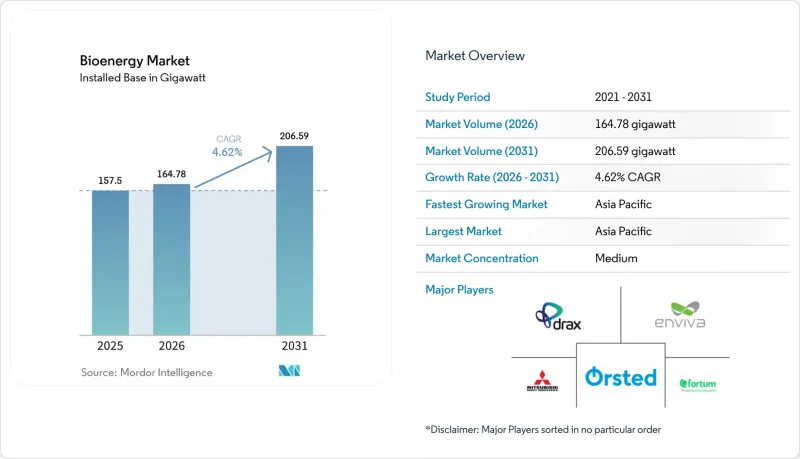
Mordor Intelligence에 의하면, 2026년 바이오에너지 시장 규모는 164.78기가와트로 추정되고 있어 2025년 157.5기가와트에서 확대해, 2031년에는 206.59기가와트에 이를 것으로 예측됩니다.
2026년부터 2031년까지 연평균 성장률(CAGR) 4.62%로 성장할 것으로 전망됩니다.
본 보고서는 유형(고체 바이오매스, 바이오가스, 재생 가능 폐기물, 기타),원료(농업 잔여물, 임업 잔여물 등), 기술(연소, 가스화, 혐기성 소화 등), 용도(열발전, 운송용 연료 등), 최종 사용자(전력 사업자, 상업 및 산업 등), 지역(북미, 유럽, 아시아태평양 등)별로 분류되어 있습니다.
세계 바이오에너지 시장 동향 및 인사이트
넷 제로 목표와 재생에너지 의무화
의무화된 탄소 중립으로 가는 길은 현재 전 세계 GDP의 80% 이상을 차지하고 있으며, EU의 2040년까지 순 배출량 90% 감축 목표,미국의 ‘인플레이션 억제법’에 따른 첨단 연료에 대한 자금 배분, 그리고 인도의 20% 에탄올 혼합 목표가 맞물려 장기적인 수요를 끌어올리고 있습니다. 광범위한 의무화 조치에는 2050년까지 지속 가능한 항공 연료를 70% 사용하도록 요구하는 ‘ReFuelEU’와, 2025년부터 지속 가능한 항공 연료를 2% 사용하도록 의무화하는 영국의 규제 등도 포함됩니다. 이러한 다분야에 걸친 수요 견인 효과로 인해 바이오에너지 시장은 전력, 난방, 운송 각 부문을 동시에 개척할 수 있게 됩니다. 견조한 판매 전망 덕분에 개발 사업자는 15-20년 계약을 체결하고 차입 기간을 연장할 수 있게 됩니다. 간헐적인 재생에너지원이 안정적 공급 의무의 부담을 겪는 가운데, 산업 전반에 걸친 수요는 여전히 명확한 경쟁 우위를 차지하고 있습니다.
풍부한 저비용 농림업 잔여물
미국 에너지부의 최신 ‘10억 톤 보고서’에 따르면, 지속 가능한 원료의 잠재량은 연간 10억 톤을 초과하여 현재 소비량을 훨씬 상회하고 있습니다. 인도만 해도 매년 1억 8,000만 톤의 잔여물을 생산하고 있으며, 2030년까지 원료 수요가 50% 증가할 것으로 예측됩니다. 지정학적 상황의 변동은 자원 리스크의 비대칭성을 부각시키고 있습니다. 러시아 및 벨라루스산 제품에 대한 제재 조치 이후, 유럽의 우드칩 공급이 부족해지면서 기준 가격은 수년 만에 최고치를 기록했습니다. 그 결과, 원료 산지와 가공 거점 간의 지리적 근접성이 프로젝트 총비용의 상당 부분을 좌우하는 요인이 되고 있습니다. 옥수수 줄기와 잎, 볏짚, 팜 잔여물을 드롭인 연료로 변환하는 차세대 전처리 시스템의 라이선스를 보유하고 있는 기업들은 물류 중심의 가치 창출이 자원의 절대적인 풍부함보다 우선시되는 경우가 많음을 보여주고 있습니다.
높은 자본 집약도와 자금 조달의 난관
단일 첨단 바이오 정유 공장을 건설하려면 20억 달러 이상의 자기 자본과 차입 자금이 필요한 경우가 있으며, FID(최종 투자 결정) 전 자금 조달 과정은 수년이 소요됩니다. 장기 오프테이크 계약을 통해 시장 가격 리스크는 완화되지만, 많은 개발도상국에서는 신용 보완 체계가 아직 완전히 정비되지 않아 현지 통화 표시 대출에는 여전히 제약이 있습니다. 바이오매스를 이용한 열병합 발전소의 투자 비용은 1kW당 3,410유로에서 5,970유로 사이로, 가스 화력 발전의 대안에 비해 상당히 높은 임베디드니다. 따라서 후원 기업은 전력 회사, EPC(설계·조달·시공) 기업, 원료 수거 업체와의 합작 투자를 통해 위험을 분산시키는 사례가 늘고 있습니다. 현재 대기업이 자금 조달을 주도하고 있지만, 소규모 개발업체는 특히 탄소 크레딧을 통한 수익을 아직 자금 조달에 활용할 수 없는 상황에서 여전히 큰 장벽에 직면해 있습니다.
부문별 분석
고체 바이오매스는 여전히 가장 큰 비중을 차지하고 있으며, 펠릿 공장, 잔여물 처리 시설, 그리고 신뢰성 높은 연소 플랜트에 대한 수십 년간의 투자 덕분에 2025년에는 전 세계 바이오에너지의 67.25%를 공급했습니다. 임산물에서 전용 재배 작물에 이르기까지, 성숙한 공급망이 모든 주요 지역에서 연료 공급을 뒷받침하고 있습니다. 그러나 현재 가장 빠르게 성장하고 있는 것은 바이오가스입니다. 더 뛰어난 혐기성 소화 기술과 엄격한 새로운 폐기물 재활용 규제의 뒷받침을 받아, 바이오가스 생산량은 2031년까지 연평균 10.1%의 성장률을 보일 것으로 전망됩니다. 독일의 최신 바이오매스 프로그램에서는 첫 번째 보조금이 종료된 후에도 전력망에 계속 전력을 공급할 수 있도록 유연성이 높은 바이오가스 설비를 특히 중시하고 있습니다. 도시 고형 폐기물의 가스화나 매립가스 회수도 더욱 탄력을 받고 있지만, 조류 연료와 같은 초기 단계의 대안은 현재로서는 실험실 단계에 머물러 있습니다. 이러한 변화들을 종합해 보면, 시장은 단순한 연소·비등 시스템에서 유기물 1톤당 더 많은 가치를 창출하는 더 깨끗하고 고부가가치적인 공정으로 전환되고 있음을 알 수 있습니다.
원료 공급의 대부분은 목재 칩과 제재소 잔재물이 차지하고 있으며, 2025년에는 임업 잔재물의 점유율이 39.70%에 달할 전망입니다. 오랜 기간 이어져 온 벌채 관행과 펠릿 물류 체계 덕분에 이 공급원은 신뢰성이 높고 가격 경쟁력도 뛰어납니다. 한편, 농산물 잔여물은 점유율이 가장 빠르게 증가하고 있으며, 작물 폐기물을 밭에서 썩히거나 태우는 대신 에너지로 전환하도록 장려하는 정책에 힘입어 연평균 8.55%의 속도로 확대되고 있습니다. 미국의 ‘10억 톤 보고서’에 따르면, 미활용 바이오매스는 10억 톤을 초과하며, 그 대부분은 옥수수 줄기, 밀짚, 벼 껍질 등으로, 회수되기를 기다리고 있는 상태입니다. 에너지 전용 작물과 선별된 도시 쓰레기가 다양성을 더하고 있지만, 최근 유럽에서 발생한 목재 칩 부족 사태는 지정학적 요인이 확립된 공급망조차도 흔들 수 있음을 보여줍니다. 이러한 현실로 인해 생산자들은 더욱 엄격한 인증과 완벽한 추적성 확보를 요구받고 있으며, 이를 통해 구매자는 각 화물의 원산지와 지속가능성 모두를 신뢰할 수 있게 됩니다.
지역별 분석
아시아태평양은 2025년에 43.30%라는 최대의 지역 점유율을 차지할 뿐만 아니라, 연평균 5.95%라는 가장 높은 성장률을 보이고 있습니다. 인도는 막대한 양의 농작물 잔여물과 명확한 정부 목표를 바탕으로 2020년대 중반까지 바이오연료 사용량을 3배로 늘릴 계획입니다. 중국은 전력, 가스, 액체 연료를 아우르는 종합적인 바이오매스 프로젝트를 전개하고 있습니다. 일본과 한국은 수입 및 첨단 기술에 대한 의존도가 높은 반면, 동남아시아에서는 팜유와 쌀 폐기물을 국내 이용과 수출 양쪽 모두에 활용하고 있습니다. 공통된 주제는 에너지 안보이며, 지역 내 폐기물을 지역 에너지로 전환하면서 석유 수입 비용을 절감하는 것입니다.
유럽은 수십 년에 걸친 기후 목표, 고정가격 임베디드 제도, 그리고 지속가능성 기준의 일관성 덕분에 2025년에도 바이오에너지 시장에서 29.70%라는 압도적인 점유율을 유지했습니다. 독일의 새로운 바이오매스 패키지, 프랑스의 발전 용량 경매, 그리고 네덜란드에서 도입 예정인 BECCS 보조금 등은 투자 모멘텀을 유지하는 일관된 정책 프레임워크의 좋은 예입니다. 그러나 토지 이용 제약이 표면화되고, 목재 칩 수입 규제가 강화되며, 경쟁적인 생태학적 우선순위가 대규모 산림 벌채에 문제를 야기함에 따라 성장은 둔화되고 있습니다. 따라서 시장에 진출한 기업들은 고효율 전환 시스템을 통해 제한된 원료를 최적화하는 음의 배출을 실현하는 발전 및 산업용 열 프로젝트 등 부가가치가 높은 틈새 분야로 무게 중심을 옮기고 있습니다.
북미는 생산 능력 면에서는 3위이지만, 첨단 바이오연료 혁신 분야에서는 주도적인 입지를 차지하고 있습니다. 미국은 옥수수 및 대두 공급망과 연방 정부의 생산 및 혼합 크레딧을 활용하여 전 세계 에탄올 및 재생 가능 디젤 생산량의 대부분을 차지하고 있습니다. 계속 늘어나는 SAF(지속 가능한 항공 연료) 프로젝트 파이프라인 덕분에 미국은 항공 연료의 탈탄소화 분야에서 계속해서 최전선에 서 있습니다. 캐나다는 광대한 임업 자원과 주 정부의 청정 연료 기준을 활용하여, 많은 경우 원주민과의 파트너십을 통해 대규모 가스화 시설 및 RNG(재생 가능 천연가스) 시설을 유치하고 있습니다. 멕시코에서는 새로운 규제의 도입으로 사탕수수 제당 공장에 바가스를 활용한 열병합 발전 설비를 도입할 기회가 생기고 있습니다. 다만, 단기적인 진전 속도는 정책의 명확성에 따라 결정될 것입니다.
기타 혜택:
- 엑셀 형식 시장 예측(ME) 시트
- 3개월간의 애널리스트 지원
자주 묻는 질문
목차
제1장 서론
제2장 조사 방법
제3장 주요 요약
제4장 시장 구도
제5장 시장 규모와 성장 예측
제6장 경쟁 구도
제7장 시장 기회와 향후 전망
JHS 26.09.09According to Mordor Intelligence, bioenergy market size in 2026 is estimated at 164.78 gigawatt, growing from 2025 value of 157.5 gigawatt with 2031 projections showing 206.59 gigawatt, growing at 4.62% CAGR over 2026-2031.
This report is Segmented by Type (Solid Biomass, Biogas, Renewable Waste, and Other Types), Feedstock (Agricultural Residues, Forestry Residues, and More), Technology (Combustion, Gasification, Anaerobic Digestion, and More), Application (Heat Generation, Transportation Fuel, and More), End-User (Power Utilities, Commercial and Industrial, and More), and Geography (North America, Europe, Asia-Pacific, and More).
Global Bioenergy Market Trends and Insights
Net-zero targets & renewable-energy mandates
Mandatory carbon-neutrality trajectories now cover more than 80% of global GDP, with the EU's 90% net-emissions-reduction goal for 2040, the US Inflation Reduction Act's funding tranches for advanced fuels, and India's 20% ethanol blending target converging to lift long-term demand. Broad-based mandates extend to ReFuelEU's 70% sustainable aviation fuel requirement by 2050 and the UK's 2% sustainable aviation fuel obligation from 2025. The resulting multi-sector pull allows the bioenergy market to tap into electricity, heating, and transport segments simultaneously. Strong offtake visibility enables developers to structure 15- to 20-year contracts and improve debt tenors. The cross-industry appeal remains a clear competitive edge where intermittent renewable sources struggle to shoulder firm-capacity obligations.
Abundant low-cost agricultural & forestry residues
The US Department of Energy's latest Billion-Ton Report shows that sustainable feedstock potential exceeds 1 billion t annually, dwarfing current consumption. India alone produces 180 million t of residues each year, with projected feedstock demand growth of 50% by 2030. Evolving geopolitics underline resource-risk asymmetry: Europe's wood-chip supply tightened after sanctions on Russian and Belarusian products, sending benchmark prices to multi-year highs. Consequently, proximity between feedstock clusters and processing hubs now dictates a meaningful share of total project cost. Companies licensing next-generation preprocessing systems to convert corn stover, rice straw, and palm residues into drop-in fuels illustrate how logistics-driven value creation often outranks absolute resource abundance.
High capital intensity & financing hurdles
A single advanced biorefinery can require more than USD 2 billion in equity and debt, making pre-FID capital stacking a multiyear process. Although long-term offtake agreements mitigate merchant-price risks, nascent credit-enhancement frameworks in many developing economies still restrict local-currency debt. Investment costs for combined heat-and-power biomass plants range between EUR 3,410 and EUR 5,970 per kW, significantly higher than those for gas-fired alternatives. Therefore, sponsors increasingly syndicate risk through joint ventures with utilities, EPCs, and feedstock aggregators. Large corporates now anchor equity rounds, but smaller developers continue to face sizable hurdles, especially when carbon-credit revenue is not yet bankable.
Other drivers and restraints analyzed in the detailed report include:
- Technology-driven LCOE decline for advanced bioenergy
- BECCS incentives & negative-emissions revenue streams
- Fragmented feedstock logistics & costs
For complete list of drivers and restraints, kindly check the Table Of Contents.
Segment Analysis
Solid biomass still does most of the heavy lifting, supplying 67.25% of global bioenergy in 2025 thanks to decades of investments in pellet mills, residue-handling equipment, and dependable combustion plants. A mature supply chain, from forestry by-products to purpose-grown crops, keeps fuel flowing in every major region. Yet the fastest mover right now is biogas. Backed by better anaerobic-digestion technology and tough new waste-recycling rules, biogas output is set to grow 10.1% a year through 2031. Germany's latest biomass program even singles out flexible biogas units so they can keep supporting the grid once their first subsidies expire. Municipal solid-waste gasification and landfill-gas capture add more momentum, while early-stage options, such as algae fuels, remain in the lab for now. Together, these shifts show the market tilting from simple burn-and-boil systems toward cleaner, higher-value processes that squeeze more out of every ton of organic material.
Wood chips and sawmill scraps dominate feedstock supply, giving forestry residues a 39.70% share in 2025. Long-standing harvest routines and pellet logistics make this stream reliable and price-competitive. Farm residues, however, are gaining ground the quickest, expanding at an annual rate of 8.55% as policies favor turning crop waste into energy rather than leaving it to rot or burn in the field. The U.S. Billion-Ton Report points to more than 1 billion tons of untapped biomass, much of it corn stalks, wheat straw, and rice husks, waiting to be collected. Dedicated energy crops and sorted municipal waste add diversity, though Europe's recent wood-chip shortage shows how geopolitics can rattle even well-established supply chains. That reality is pushing producers toward stricter certification and full traceability so buyers can trust both the origin and the sustainability of every load.
Complete Report Scope:
- By Type
- Solid Biomass
- Biogas
- Renewable Waste
- Other Types
- By Feedstock
- Agricultural Residues
- Forestry Residues
- Energy Crops
- Municipal Solid Waste
- By Technology
- Combustion
- Gasification
- Fast Pyrolysis
- Anaerobic Digestion
- Fermentation
- Other Technologies
- By Application
- Electricity Generation
- Heat Generation
- Transportation Fuel
- Combined Heat & Power (CHP)
- By End-user
- Power Utilities
- Commercial and Industrial
- Residential
- By Geography
- North America
- United States
- Canada
- Mexico
- Europe
- Germany
- France
- United Kingdom
- Italy
- Sweden
- Finland
- Rest of Europe
- Asia Pacific
- China
- India
- Japan
- South Korea
- ASEAN Countries
- Australia and New Zealand
- Rest of Asia Pacific
- South America
- Brazil
- Chile
- Colombia
- Uruguay
- Rest of South America
- Middle East and Africa
- South Africa
- Ethiopia
- Sudan
- Rest of Middle East and Africa
- North America
Geography Analysis
The Asia-Pacific region not only holds the largest regional share of 43.30% in 2025, but is also the fastest-growing, at a rate of 5.95% per year. India plans to triple biofuel use by the mid-2020s, backed by a vast pool of crop residues and clear government targets. China is rolling out full-suite biomass projects covering power, gas, and liquid fuels. Japan and South Korea rely more heavily on imports and advanced technologies, whereas Southeast Asia utilizes palm and rice waste for both domestic use and exports. The common thread is energy security: turning local waste into local energy while reducing the oil import bill.
Europe maintained a commanding 29.70% share of the bioenergy market in 2025, thanks to a decades-long alignment between climate ambition, feed-in tariffs, and sustainability criteria. Germany's new biomass package, France's capacity auctions, and the Netherlands' incoming BECCS subsidy exemplify cohesive policy frameworks that maintain investment momentum. Yet growth is moderating as land-use constraints take effect, wood-chip imports become more stringent, and competing ecological priorities challenge further large-scale forest harvesting. Market participants, therefore, pivot toward higher-value niches, including negative-emission power and industrial heat projects that optimize limited feedstock through high-efficiency conversion systems.
North America holds third place in terms of capacity, yet leads in advanced biofuel innovation. The United States accounts for the lion's share of global ethanol and renewable-diesel volumes, leveraging its corn and soy supply chains alongside federal production and blending credits. A growing pipeline of SAF projects positions the country to remain at the forefront of aviation-fuel decarbonization. Canada leverages vast forestry resources and provincial clean-fuel standards to attract large-scale gasification and RNG facilities, often in partnership with First Nations. Mexico's emerging mandates create opportunities for retrofitting sugarcane mills with bagasse cogeneration, although policy clarity will determine near-term pace.
- Mitsubishi Heavy Industries Ltd
- MVV Energie AG
- A2A SpA
- Hitachi Zosen Corp
- BTG Biomass Technology Group
- Babcock & Wilcox Volund AS
- Biomass Engineering Ltd
- ?rsted AS
- Enerkem
- Fortum Oyj
- Drax Group plc
- Enviva Inc.
- Veolia Environment SA
- Vattenfall AB
- Abengoa SA
- BIOENERGY DevCo
- Valmet Oyj
- Andritz AG
- Green Plains Inc.
- Anaergia Inc.
- Pacific BioEnergy Corp
Additional Benefits:
- The market estimate (ME) sheet in Excel format
- 3 months of analyst support
TABLE OF CONTENTS
1 Introduction
- 1.1 Study Assumptions & Market Definition
- 1.2 Scope of the Study
2 Research Methodology
3 Executive Summary
4 Market Landscape
- 4.1 Market Overview
- 4.2 Market Drivers
- 4.2.1 Net-zero targets & renewable energy mandates
- 4.2.2 Abundant low-cost agricultural & forestry residues
- 4.2.3 Technology-driven LCOE decline for advanced bioenergy
- 4.2.4 BECCS incentives & negative-emissions revenue streams
- 4.2.5 Industrial off-take demand for dispatchable green heat/power
- 4.2.6 Monetisation of biogenic-CO? credits
- 4.3 Market Restraints
- 4.3.1 High capital intensity & financing hurdles
- 4.3.2 Fragmented feed-stock logistics & costs
- 4.3.3 Stricter ILUC & sustainability criteria
- 4.3.4 Competing low-cost battery storage eroding baseload value
- 4.4 Supply-Chain Analysis
- 4.5 Regulatory Landscape
- 4.6 Technological Outlook & Innovations
- 4.7 Porter's Five Forces
- 4.7.1 Bargaining Power of Suppliers
- 4.7.2 Bargaining Power of Consumers
- 4.7.3 Threat of New Entrants
- 4.7.4 Threat of Substitutes
- 4.7.5 Intensity of Competitive Rivalry
5 Market Size & Growth Forecasts
- 5.1 By Type
- 5.1.1 Solid Biomass
- 5.1.2 Biogas
- 5.1.3 Renewable Waste
- 5.1.4 Other Types
- 5.2 By Feedstock
- 5.2.1 Agricultural Residues
- 5.2.2 Forestry Residues
- 5.2.3 Energy Crops
- 5.2.4 Municipal Solid Waste
- 5.3 By Technology
- 5.3.1 Combustion
- 5.3.2 Gasification
- 5.3.3 Fast Pyrolysis
- 5.3.4 Anaerobic Digestion
- 5.3.5 Fermentation
- 5.3.6 Other Technologies
- 5.4 By Application
- 5.4.1 Electricity Generation
- 5.4.2 Heat Generation
- 5.4.3 Transportation Fuel
- 5.4.4 Combined Heat & Power (CHP)
- 5.5 By End-user
- 5.5.1 Power Utilities
- 5.5.2 Commercial and Industrial
- 5.5.3 Residential
- 5.6 By Geography
- 5.6.1 North America
- 5.6.1.1 United States
- 5.6.1.2 Canada
- 5.6.1.3 Mexico
- 5.6.2 Europe
- 5.6.2.1 Germany
- 5.6.2.2 France
- 5.6.2.3 United Kingdom
- 5.6.2.4 Italy
- 5.6.2.5 Sweden
- 5.6.2.6 Finland
- 5.6.2.7 Rest of Europe
- 5.6.3 Asia Pacific
- 5.6.3.1 China
- 5.6.3.2 India
- 5.6.3.3 Japan
- 5.6.3.4 South Korea
- 5.6.3.5 ASEAN Countries
- 5.6.3.6 Australia and New Zealand
- 5.6.3.7 Rest of Asia Pacific
- 5.6.4 South America
- 5.6.4.1 Brazil
- 5.6.4.2 Chile
- 5.6.4.3 Colombia
- 5.6.4.4 Uruguay
- 5.6.4.5 Rest of South America
- 5.6.5 Middle East and Africa
- 5.6.5.1 South Africa
- 5.6.5.2 Ethiopia
- 5.6.5.3 Sudan
- 5.6.5.4 Rest of Middle East and Africa
- 5.6.1 North America
6 Competitive Landscape
- 6.1 Market Concentration
- 6.2 Strategic Moves (M&A, JVs, Funding, PPAs)
- 6.3 Market Share Analysis (Market Rank/Share for key companies)
- 6.4 Company Profiles (includes Global-level Overview, Market-level Overview, Core Segments, Financials, Strategic Information, Products & Services, Recent Developments)
- 6.4.1 Mitsubishi Heavy Industries Ltd
- 6.4.2 MVV Energie AG
- 6.4.3 A2A SpA
- 6.4.4 Hitachi Zosen Corp
- 6.4.5 BTG Biomass Technology Group
- 6.4.6 Babcock & Wilcox Volund AS
- 6.4.7 Biomass Engineering Ltd
- 6.4.8 ?rsted AS
- 6.4.9 Enerkem
- 6.4.10 Fortum Oyj
- 6.4.11 Drax Group plc
- 6.4.12 Enviva Inc.
- 6.4.13 Veolia Environment SA
- 6.4.14 Vattenfall AB
- 6.4.15 Abengoa SA
- 6.4.16 BIOENERGY DevCo
- 6.4.17 Valmet Oyj
- 6.4.18 Andritz AG
- 6.4.19 Green Plains Inc.
- 6.4.20 Anaergia Inc.
- 6.4.21 Pacific BioEnergy Corp
7 Market Opportunities & Future Outlook
- 7.1 White-space & Unmet-Need Assessment