
|
시장보고서
상품코드
2123494
지속 가능 푸드서비스 포장 시장 : 점유율 분석, 업계 동향과 통계, 성장 예측(2026-2031년)Sustainable Foodservice Packaging - Market Share Analysis, Industry Trends & Statistics, Growth Forecasts (2026 - 2031) |
||||||
 Mordor Intelligence
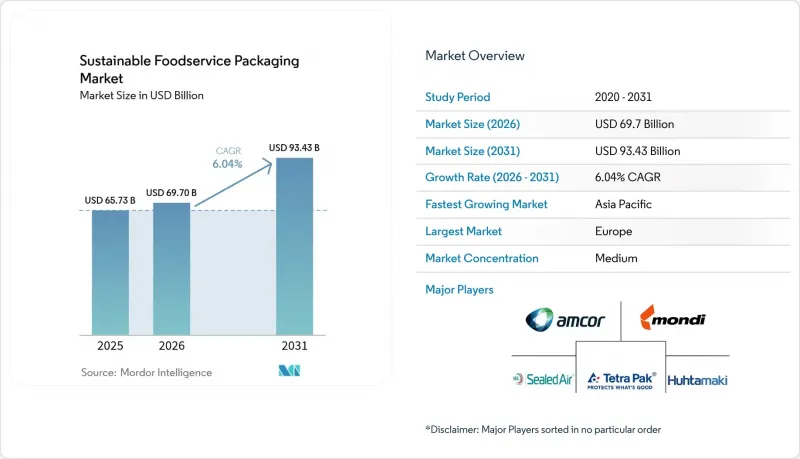
Mordor Intelligence에 의하면, 지속 가능 푸드서비스 포장 시장 규모는 2025년 657억 3,000만 달러에서 2026년에는 697억 달러로 확대되어 2026년부터 2031년까지 CAGR 6.04%로 성장을 지속하여, 2031년에는 934억 3,000만 달러에 이를 것으로 예측됩니다.
본 보고서는 소재 유형(재생지·판지, 바가스 및 기타 농업계 섬유, 폴리젖산(PLA) 등), 제품 유형(골판지 상자·카톤, 트레이 등), 포장 형태(경질, 연질),최종 사용자(퀵서비스 레스토랑(QSR), 풀서비스 레스토랑(FSR) 등), 지역별로 분류되어 있습니다. 시장 예측은 금액(달러) 기준으로 제시되어 있습니다.
전 세계 지속 가능 푸드서비스 포장 시장 동향 및 인사이트
온라인 음식 주문 및 배달 플랫폼의 급증
어그리게이터 앱의 급속한 부상으로 테이크아웃량이 급증했고, 배달 시간이 길어져도 상품의 품질을 유지할 수 있는 표준화된 섬유 기반 트레이, 보울, 단열 포장에 대한 전례 없는 수요가 발생했습니다. 맥도날드는 2024년에 108만 710미터톤의 고객용 포장재를 조달했다고 밝히며, 100% 재생 가능, 재활용 또는 인증된 원자재로 전환이 86.7% 진행되었다고 지적했습니다. 이는 수천 개의 가맹점을 아우르며 그 중요성이 더욱 커지고 있는 이정표입니다. 주문량의 집중으로 인해 가공업체들은 드라이 몰드 섬유 및 PHA 생산 라인에 대한 투자 비용을 상각하는 데 필요한 규모를 확보할 수 있게 되었으며, 그 결과 플라스틱 대체재에 비해 15-40% 높았던 비용 프리미엄이 축소되고 있습니다.
일회용 플라스틱 및 스티로폼에 대한 엄격한 금지 조치
캘리포니아주 SB 54 및 EU 포장 규정은 단계적 감축과 재생 재료 함량 할당을 의무화하고 있어, 수저, 빨대, 스티로폼 대체재와 같은 틈새 시장에서 급속한 ‘종이화’를 촉진하고 있습니다. 맥도날드는 2024년 말까지 고객용 포장재의 99.5%에서 의도적으로 첨가된 PFAS를 제거하여 법정 기한보다 앞당겨 목표를 달성했습니다. 이는 규제 준수에 있어 선구자적인 역할을 하는 공급업체가 누리는 우위를 보여줍니다. 2030년까지 일부 재생 소재 함유율 의무 적용 대상에서 제외된 종이 제품은 원펄프 부족에 따른 비용 상승이라는 역풍을 상쇄할 수 있는 수요 호재를 누리고 있습니다.
기존 대체재에 비해 높은 가격 프리미엄
식물 유래 폴리머와 인증된 섬유는 범용 플라스틱에 비해 15-40% 더 비싼 경우가 많아, 인플레이션 환경에서 QSR(퀵서비스 레스토랑)의 이익률을 압박하고 있습니다. 암코어(Amcor)와 베리 세계(Berry Global)의 합병 계획에서는 단위 비용 절감을 목적으로 연간 6억 5,000만 달러의 시너지 효과가 예상되며, 이러한 움직임으로 인해 24개월 이내에 가격 차이가 축소될 것으로 전망됩니다. 프랜차이즈 체인과 호스피탈리티 그룹 간의 대량 구매 제휴는 수년에 걸친 구매 물량을 보장함으로써 가격 프리미엄을 더욱 억제하고 있습니다.
부문별 분석
재활용 종이 및 재활용 판지는 성숙한 공급망과 재활용 소재 함량에 대한 일시적인 규제 면제를 배경으로, 2025년에는 지속 가능 푸드서비스 포장 시장에서 40.78%의 점유율을 차지하며 샌드위치 랩, 클램쉘 용기, 샐러드 볼에 대한 수요를 공고히 했습니다. 또한, 이 부문은 메차 암콜(Metsa Amcor)의 ‘무오토(Muoto)’ 성형 섬유 제품 출시로 인한 혜택도 누리고 있습니다. 이는 고차단 필름과 섬유 쉘을 결합한 경질 소재로, 80%가 넘는 재활용률을 실현하고 있습니다. 폴리하이드록시알카노에이트(PHA)는 시장 규모는 작지만, 전 세계 쓰레기 문제 해결의 흐름에 부합하는 해양 생분해성이 입증되었기 때문에 연평균 성장률(CAGR) 8.21%로 다른 모든 경쟁 제품을 앞지를 것으로 예측됩니다.
사탕수수 찌꺼기 및 기타 농업 유래 섬유는 기상 조건에 좌우되는 수확량 변동에 직면해 있어, 가공업체들은 연중 원료를 확보하기 위해 건조 및 창고 보관에 대한 투자를 강요받고 있습니다. 폴리젖산(PLA)은 브랜드 인지도는 높지만, 산업용 퇴비화 시설의 가용성에 여전히 제약을 받고 있습니다. 재활용 PET 블렌드는 재활용 소재 함량 주장을 입증하기 위해 물질 수지 방식의 체인 오브 커스터디 감사에 의존하고 있는 반면, 성형 섬유 펄프의 경우 미시간주에 위치한 Dirt Container사의 건식 성형 섬유 생산 라인을 통해 생산 능력이 확대되고 있습니다. 이 라인은 기존 성형 기술에 비해 10배 빠른 속도로 가동되고 있습니다.
트레이와 보울은 2025년 지속 가능 푸드서비스 포장 시장 규모의 37.85%를 차지하며 가장 큰 점유율을 기록했습니다. 이는 누수 방지, 강성, 적재 용이성이 요구되는 밀키트, 샐러드, 메인 요리 배달 분야에서 이들이 기본 선택지로 자리 잡고 있기 때문입니다. 맥도날드는 유럽 일부 지역에서 재생 가능한 소재로 코팅된 샐러드 박스를 시범 도입하여, 이 부문이 섬유계 기판에 의존하고 있음을 부각시켰습니다. 한편, 더운 기후 지역의 차가운 음료 소비량이 증가하고 아시아의 2선 도시로 커피 문화가 확산됨에 따라, 컵 및 뚜껑 시장은 2031년까지 연평균 성장률(CAGR) 7.5%로 업계를 주도할 것으로 예측됩니다. 이에 따라 후타마키사는 2024년 말까지 북아일랜드에서 섬유제 뚜껑의 생산 능력을 3배로 확대할 예정입니다.
골판지 상자는 전자상거래 식품 키트의 ‘종이화’ 추세로 혜택을 보고 있는 반면, 클램쉘 용기는 끊임없이 변화하는 EPS(발포 스티로폼) 금지 조치에 대응하느라 분주합니다. 파우치 및 소형 봉지의 경우, 소스나 조미료용으로 바이오 소재 함유율이 높은 필름의 채택이 진행되고 있으며, OxBarrier사의 산소 흡수형 커피 캡슐과 같은 틈새 용도는 퇴비화 가능한 솔루션이 프리미엄 음료 서비스 분야로 이동하고 있음을 여실히 보여주고 있습니다.
지역별 분석
유럽은 지속 가능 푸드서비스 포장 시장에서 37.92%의 점유율을 차지하며 2025년 매출을 주도했습니다. 이는 수십 년에 걸친 가정 쓰레기 수거 제도와 EU의 ‘포장 및 포장 폐기물 규정’에 따른 임박한 규제를 반영한 것입니다. 스칸디나비아 및 베네룩스 국가 도시들의 퇴비화 가능 폐기물 수거 체계 덕분에, 사탕수수 찌꺼기로 만든 트레이나 PLA로 만든 식기로 비용 부담 없이 전환할 수 있게 되었습니다. 또한, 종이 제품의 경우 재생 재료 함유율 할당 기준에 대해 잠정적인 유예 기간이 인정되어, 2030년 기한을 앞두고 섬유 소재로의 신속한 대체가 촉진되고 있습니다.
아시아태평양은 대도시에서의 스티로폼 클램쉘 용기 사용 금지, 건강 지향성이 높아지는 배달 문화, 그리고 중국의 주요 도시 및 인도의 스마트 시티 회랑에 대한 퇴비화 시설로의 자본 유입에 힘입어 연평균 성장률(CAGR) 8.18%라는 가장 높은 성장률을 기록했습니다. 이 지역에는 바가스나 벼 껍질 등 농업 유래 섬유 원료가 풍부하게 존재하지만, 물류망의 단절로 인해 수확기 이외의 계절에는 회수 비용이 증가하게 됩니다. 북미는 보급률 면에서는 유럽에 뒤처져 있지만, 캘리포니아주의 SB 54 법안과 같은 주 차원의 법규제 및 음식물 쓰레기 재활용 의무화 확대에 따라 퇴비화 가능한 라이너와 성형 섬유 뚜껑에 대한 보조금이 유도되고 있는 혜택을 받고 있습니다. 미시간주 다트(Dart)사의 건식 성형 라인을 대표로 하는 현지에서의 원료 전환은 리드타임을 단축하고, 달러 강세 국면에서의 환율 리스크를 완화합니다. 남미에서는 제당 공장의 잉여 바가스 생산 능력을 활용하고 있지만, 중동 및 아프리카에서는 유기 폐기물 처리 시설이 제한적이고 인증된 섬유 릴에 대한 수입 의존도가 높기 때문에 도입은 여전히 초기 단계에 머물러 있습니다.
기타 혜택:
- 엑셀 형식 시장 예측(ME) 시트
- 3개월간의 애널리스트 지원
자주 묻는 질문
목차
제1장 서론
제2장 조사 방법
제3장 주요 요약
제4장 시장 구도
제5장 시장 규모와 성장 예측
제6장 경쟁 구도
제7장 시장 기회와 향후 전망
JHS 26.09.07According to Mordor Intelligence, the sustainable foodservice packaging market size is expected to grow from USD 65.73 billion in 2025 to USD 69.7 billion in 2026 and is forecast to reach USD 93.43 billion by 2031 at 6.04% CAGR over 2026-2031.
This report is Segmented by Material Type (Recycled Paper and Board, Bagasse and Other Agro-Fibers, Polylactic Acid (PLA), and More), Product Type (Corrugated Boxes and Cartons, Trays, and More), Packaging Format (Rigid, and Flexible), End User (Quick Service Restaurants (QSR), Full-Service Restaurants (FSR), and More) and Geography. The Market Forecasts are Provided in Terms of Value (USD)
Global Sustainable Foodservice Packaging Market Trends and Insights
Surge in Online Food-Ordering and Delivery Platforms
Rapid rise of aggregator apps boosted take-out volumes, funneling unprecedented demand for standardized fiber-based trays, bowls, and insulated wraps that preserve product integrity during longer delivery windows. McDonald's disclosed procurement of 1,080,710 metric tons of guest packaging in 2024, noting 86.7% progress toward 100% renewable, recycled, or certified inputs, a milestone magnified across thousands of franchise outlets. Concentrated ordering volumes give converters the scale needed to amortize investments in dry-molded fiber and PHA lines, thereby eroding the 15-40% cost premium over plastic alternatives
Stringent Bans on Single-Use Plastics and Styrofoam
California's SB 54 and the EU Packaging Regulation impose phased reduction and recycled-content quotas, incentivizing rapid "paperization" in cutlery, straw, and foam-replacement niches. McDonald's eliminated intentionally added PFAS from 99.5% of guest packaging by late-2024, beating statutory deadlines and illustrating first-mover supplier advantages in regulatory compliance. Paper products, exempt from some recycled-content mandates until 2030, enjoy a demand tailwind that offsets cost headwinds tied to virgin-fiber scarcity.
High Price Premium versus Conventional Alternatives
Plant-based polymers and certified fibers often cost 15-40% more than commodity plastics, squeezing QSR margins in inflationary climates. Amcor's planned merger with Berry Global projects USD 650 million in annual synergies aimed at trimming unit costs, a move expected to narrow price gaps within 24 months. Bulk-buying alliances between franchise chains and hospitality groups further temper premiums by guaranteeing multi-year offtake volumes.
Other drivers and restraints analyzed in the detailed report include:
- Corporate ESG Commitments Accelerating Sustainable Procurement
- Advances in Bio-Based Barrier Coatings Improving Shelf Life
- Functional Performance Gaps under High Heat or Grease
For complete list of drivers and restraints, kindly check the Table Of Contents.
Segment Analysis
Recycled paper and board claimed 40.78% sustainable foodservice packaging market share in 2025 on the back of mature supply chains and temporary regulatory exemptions for recycled content, locking in volume for sandwich wraps, clamshells, and salad bowls. The segment also benefits from Metsa-Amcor's Muoto molded-fiber launch, a rigid format that pairs high-barrier film with fiber shells to achieve over 80% recyclability scores. Polyhydroxyalkanoates, while commanding a smaller base, are forecast to outpace all rivals at an 8.21% CAGR because of verified marine biodegradability that aligns with global anti-litter narratives.
Bagasse and other agro-fibers face weather-linked yield volatility, pressing converters to invest in drying and warehousing to secure year-round feedstock. Polylactic acid (PLA) enjoys brand familiarity yet remains constrained by industrial composting availability. Recycled PET blends rely on mass-balance chain-of-custody audits to legitimate recycled-content claims, while molded-fiber pulp receives capacity boosts from Dart Container's dry-molded fiber line in Michigan, which operates 10 times faster than legacy forming technologies.
Trays and bowls held the largest slice of the sustainable foodservice packaging market size 37.85% in 2025 because they are the default choice for meal kits, salads, and entree deliveries that demand leakproof rigidity and stackability. McDonald's piloted renewable-coated salad boxes across parts of Europe, underlining the segment's dependency on fiber substrates. Conversely, cups and lids are projected to pace the field with 7.5% CAGR through 2031 as cold-drink volumes climb in hot-weather regions and coffee culture spreads into tier-two Asian cities, prompting Huhtamaki to triple fiber-lid capacity in Northern Ireland by late-2024.
Corrugated cartons profit from "paperization" in e-commerce food kits, while clamshells scramble to meet evolving EPS bans. Pouches and sachets are exploring high-bio-content films for sauces and condiments, and niche applications such as OxBarrier's oxygen-scavenging coffee capsules highlight the migration of compostable solutions into premium beverage service
Complete Report Scope:
- By Material Type
- Recycled Paper and Board
- Bagasse and Other Agro-fibers
- Polylactic Acid (PLA)
- Polyhydroxyalkanoates (PHA)
- Recycled PET and rPET Blends
- Molded Fiber Pulp
- By Product Type
- Corrugated Boxes and Cartons
- Trays and Bowls
- Clamshells
- Cups and Lids
- Pouches and Sachets
- Other Product Types
- By Packaging Format
- Rigid
- Flexible
- By End User
- Quick Service Restaurants (QSR)
- Full-Service Restaurants (FSR)
- Institutional Catering
- Hospitality and Leisure
- Other End Users
- By Geography
- North America
- United States
- Canada
- Mexico
- South America
- Brazil
- Argentina
- Chile
- Rest of South America
- Europe
- Germany
- United Kingdom
- France
- Italy
- Spain
- Rest of Europe
- Asia-Pacific
- China
- Japan
- India
- South Korea
- Australia
- Rest of Asia-Pacific
- Middle East and Africa
- Middle East
- Saudi Arabia
- United Arab Emirates
- Turkey
- Rest of Middle East
- Africa
- South Africa
- Nigeria
- Kenya
- Rest of Africa
- Middle East
- North America
Geography Analysis
Europe dominated 2025 revenue with a 37.92% share of the sustainable foodservice packaging market, reflecting decades-old curbside recycling schemes and looming mandates under the EU Packaging and Packaging Waste Regulation. Compostable waste pickup in Scandinavia and Benelux cities enables cost-neutral switchovers to bagasse trays and PLA cutlery. Moreover, paper-based items enjoy an interim reprieve from recycled-content quotas, encouraging rapid fiber substitution before the 2030 deadline.
Asia-Pacific logged the highest growth rate 8.18% CAGR propelled by megacity bans on foam clamshells, escalating health-conscious delivery culture, and capital inflows into composting facilities in China's tier-one hubs and India's smart-city corridors. The region also houses abundant agro-fiber feedstock such as bagasse and rice husk, but logistic fragmentation inflates collection costs during off-harvest seasons. North America, while trailing Europe in penetration, benefits from state-level legislation like California SB 54 and expanding organics diversion mandates that direct subsidies toward compostable liners and molded-fiber lids. Local material conversion typified by Dart's dry-molded line in Michigan shortens lead times and cushions currency-risk exposure in a strong-USD scenario. South America leverages surplus bagasse capacity from sugar mills, whereas Middle East and Africa adoption remains nascent because of limited organic-waste processing assets and higher import dependence for certified fiber reels.
- Amcor plc
- Huhtamaki Oyj
- Smurfit WestRock
- Sealed Air Corporation
- Mondi plc
- Tetra Pak International SA
- Sonoco Products Company
- Winpak Ltd.
- Dart Container Corporation
- Graphic Packaging Holding Company
- Novolex Holdings LLC
- Pactiv Evergreen Inc.
- Sabert Corporation
- Genpak LLC
- BioPak Pty Ltd.
- Vegware Ltd.
- Eco-Products Inc.
- Earthpack (Advanced Container Print)
- Amhil North America
Additional Benefits:
- The market estimate (ME) sheet in Excel format
- 3 months of analyst support
TABLE OF CONTENTS
1 INTRODUCTION
- 1.1 Study Assumptions and Market Definition
- 1.2 Scope of the Study
2 RESEARCH METHODOLOGY
3 EXECUTIVE SUMMARY
4 MARKET LANDSCAPE
- 4.1 Market Overview
- 4.2 Market Drivers
- 4.2.1 Surge in online food-ordering and delivery platforms
- 4.2.2 Stringent bans on single-use plastics and styro-foam
- 4.2.3 Corporate ESG commitments accelerating sustainable procurement
- 4.2.4 Advances in bio-based barrier coatings improving shelf-life
- 4.2.5 Expansion of municipal composting infrastructure in tier-1 cities
- 4.2.6 Blockchain-enabled traceability for recycled content verification
- 4.3 Market Restraints
- 4.3.1 High price premium versus conventional alternatives
- 4.3.2 Functional performance gaps under high heat / grease
- 4.3.3 Supply-chain volatility for agro-fiber residues
- 4.3.4 Regulatory scrutiny of PFAS and other barrier chemicals
- 4.4 Industry Value Chain Analysis
- 4.5 Regulatory Landscape
- 4.6 Technological Outlook
- 4.7 Porters Five Forces Analysis
- 4.7.1 Bargaining Power of Suppliers
- 4.7.2 Bargaining Power of Buyers
- 4.7.3 Threat of New Entrants
- 4.7.4 Degree of Competition
- 4.7.5 Threat of Substitutes
- 4.8 The Impact of Macroeconomic Factors on the Market
5 MARKET SIZE AND GROWTH FORECASTS
- 5.1 By Material Type
- 5.1.1 Recycled Paper and Board
- 5.1.2 Bagasse and Other Agro-fibers
- 5.1.3 Polylactic Acid (PLA)
- 5.1.4 Polyhydroxyalkanoates (PHA)
- 5.1.5 Recycled PET and rPET Blends
- 5.1.6 Molded Fiber Pulp
- 5.2 By Product Type
- 5.2.1 Corrugated Boxes and Cartons
- 5.2.2 Trays and Bowls
- 5.2.3 Clamshells
- 5.2.4 Cups and Lids
- 5.2.5 Pouches and Sachets
- 5.2.6 Other Product Types
- 5.3 By Packaging Format
- 5.3.1 Rigid
- 5.3.2 Flexible
- 5.4 By End User
- 5.4.1 Quick Service Restaurants (QSR)
- 5.4.2 Full-Service Restaurants (FSR)
- 5.4.3 Institutional Catering
- 5.4.4 Hospitality and Leisure
- 5.4.5 Other End Users
- 5.5 By Geography
- 5.5.1 North America
- 5.5.1.1 United States
- 5.5.1.2 Canada
- 5.5.1.3 Mexico
- 5.5.2 South America
- 5.5.2.1 Brazil
- 5.5.2.2 Argentina
- 5.5.2.3 Chile
- 5.5.2.4 Rest of South America
- 5.5.3 Europe
- 5.5.3.1 Germany
- 5.5.3.2 United Kingdom
- 5.5.3.3 France
- 5.5.3.4 Italy
- 5.5.3.5 Spain
- 5.5.3.6 Rest of Europe
- 5.5.4 Asia-Pacific
- 5.5.4.1 China
- 5.5.4.2 Japan
- 5.5.4.3 India
- 5.5.4.4 South Korea
- 5.5.4.5 Australia
- 5.5.4.6 Rest of Asia-Pacific
- 5.5.5 Middle East and Africa
- 5.5.5.1 Middle East
- 5.5.5.1.1 Saudi Arabia
- 5.5.5.1.2 United Arab Emirates
- 5.5.5.1.3 Turkey
- 5.5.5.1.4 Rest of Middle East
- 5.5.5.2 Africa
- 5.5.5.2.1 South Africa
- 5.5.5.2.2 Nigeria
- 5.5.5.2.3 Kenya
- 5.5.5.2.4 Rest of Africa
- 5.5.5.1 Middle East
- 5.5.1 North America
6 COMPETITIVE LANDSCAPE
- 6.1 Market Concentration
- 6.2 Strategic Moves
- 6.3 Market Share Analysis
- 6.4 Company Profiles (includes Global level Overview, Market level overview, Core Segments, Financials as available, Strategic Information, Market Rank/Share for key companies, Products and Services, and Recent Developments)
- 6.4.1 Amcor plc
- 6.4.2 Huhtamaki Oyj
- 6.4.3 Smurfit WestRock
- 6.4.4 Sealed Air Corporation
- 6.4.5 Mondi plc
- 6.4.6 Tetra Pak International SA
- 6.4.7 Sonoco Products Company
- 6.4.8 Winpak Ltd.
- 6.4.9 Dart Container Corporation
- 6.4.10 Graphic Packaging Holding Company
- 6.4.11 Novolex Holdings LLC
- 6.4.12 Pactiv Evergreen Inc.
- 6.4.13 Sabert Corporation
- 6.4.14 Genpak LLC
- 6.4.15 BioPak Pty Ltd.
- 6.4.16 Vegware Ltd.
- 6.4.17 Eco-Products Inc.
- 6.4.18 Earthpack (Advanced Container Print)
- 6.4.19 Amhil North America
7 MARKET OPPORTUNITIES AND FUTURE OUTLOOK
- 7.1 White-space and Unmet-Need Assessment