|
시장보고서
상품코드
2123617
면역글로불린 시장 : 시장 점유율 분석, 업계 동향 및 통계, 성장 예측(2026-2031년)Immunoglobulin - Market Share Analysis, Industry Trends & Statistics, Growth Forecasts (2026 - 2031) |
||||||
 Mordor Intelligence
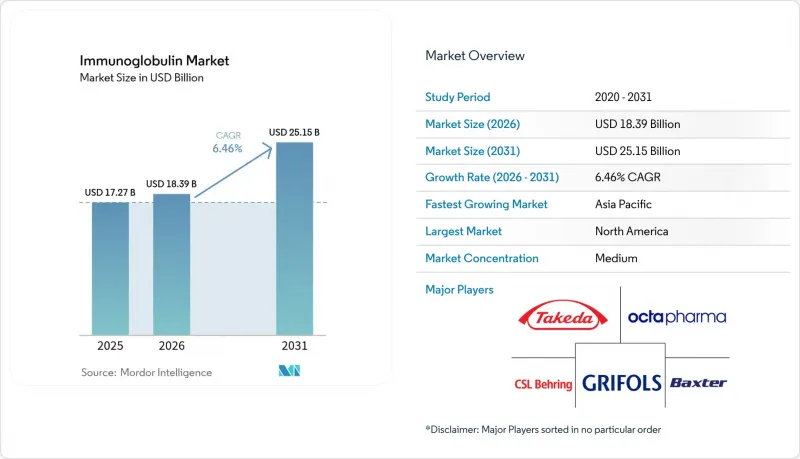
Mordor Intelligence에 의하면, 면역글로불린 시장 규모는 2025년 172억 7,000만 달러로 평가되었고, 2026년 183억 9,000만 달러에서 2031년까지 251억 5,000만 달러로 확대될 전망이며, 2026-2031년 CAGR 6.46%를 나타낼 것으로 예측됩니다.
본 보고서는 제품별(IgG, IgA, IgM, IgE, IgD), 투여 경로별(정맥 내, 피하, 근육 내), 용도별(저감마글로불린혈증, CIDP, 원발성 면역결핍증, 기타), 유통 채널별(병원 약국, 기타), 지역별(북미, 유럽, 아시아태평양, 중동 및 아프리카, 남미)로 분류되어 있습니다. 시장 예측은 금액(달러) 기준으로 제시되어 있습니다.
세계의 면역글로불린 시장 동향 및 인사이트
원발성 면역결핍증 유병률 증가
신생아 선별 검사 및 차세대 염기서열 분석을 통해 기존 추정치보다 40% 더 많은 원발성 면역결핍증 사례가 밝혀지면서, 평생 보충 요법이 필요한 환자층이 확대되고 있습니다. 미국과 서유럽의 보험 적용으로 진단까지 걸리는 기간이 8년에서 18개월 이하로 단축되었으나, 아시아태평양에서는 2029년까지 연간 1만 5,000-2만 건의 신규 진단이 추가될 가능성이 있는 중국의 시범 프로그램에도 불구하고 최대 7년의 지연이 발생하고 있습니다. 조기 발견으로 인해 1회 투여량은 감소하지만, 치료 기간은 장기화되므로 누적 혈장 수요는 확대됩니다. 그 결과 발생하는 부담으로 인해, 상환 제도 변경으로 의료가 병원 밖으로 이전되고 있음에도 불구하고, 제약사들의 채혈 센터에 대한 투자가 강화되고 있습니다. 2028년 이후에도 이러한 성장 요인을 유지할 수 있을지는 유전자 검사 비용의 지속적인 하락과 이에 따른 보험 적용 범위 확대에 달려 있습니다.
신경학 부문에서의 IVIG 사용 확대(CIDP, GBS, MMN)
2025년 초 FDA 가이드라인 개정에 따라, 만성 염증성 탈수초성 다발성 신경염(CIDP), 길랑-바레 증후군(GBS), 다발성 운동 신경 장애(MMN)에서 IVIG가 코르티코스테로이드보다 우선적으로 사용되게 되었습니다. 2024년 12월 일본에서 HYQVIA가 승인됨에 따라, 정맥 내 투여가 필요 없는월1회 재택 투여가 가능해져 신경과 전문의들의 채택이 가속화되고 있습니다. 스티프 퍼슨 증후군이나 자가면역성 뇌염에 대한 적응증 외 사용이 수요를 확대시키고 있지만, 고용량 투여로 인해 혈장 공급을 둘러싼 경쟁이 격화되면서 연간 치료비는 8만-12만 달러로 상승하고 있습니다. 현재 유럽의 보험사들은 릿룩시맙과의 직접 비교 데이터를 요구하고 있으며, 이로 인해 2028년 이후 성장세가 둔화될 가능성이 있습니다. 단기적으로는 신경학 부문이 면역글로불린 시장의 연평균 성장률(CAGR)을 1.5포인트 끌어올리고 있습니다.
높은 치료비와 보험 급여 격차
면역글로불린 요법의 연간 비용은 면역 결핍 유지 요법의 경우 5만 달러에서 고용량 신경 질환 치료의 경우 12만 달러에 달하며, 라틴아메리카와 아시아 일부 지역에서는 대부분의 환자가 보험 적용 대상에서 제외되고 있습니다. 아르헨티나에서는 보험 급여까지 대기 기간이 최대 9개월에 달하며, 브라질에서는 2024-2025년에 걸쳐 공급 부족 사태가 발생했을 때 공급량이 제한되었습니다. 제조 비용의 70%는 최종 충전 및 마무리 공정 이전에 발생하기 때문에 가격 인하는 구조적으로 어렵습니다. 선진국의 보험사들은 현재 시설 이용료를 30-40% 절감하기 위해 재택 정맥주사를 의무화하고 있지만, 근본적인 혈장 비용은 여전히 존재하여 새로운 생산 능력에 대한 투자를 저해하고 있습니다.
부문 분석
IgG는 면역결핍증 및 혈액 질환 분야에서 확고한 사용 실적을 바탕으로 2025년 면역글로불린 시장 점유율의 43.55%를 차지했습니다. ‘Cuvitru’와 같은 고농도 IgG 제제는 점적 시간을 절반으로 줄여, 재택 치료에서의 복약 순응도 향상에 기여하고 있습니다. IgE 요법은 아직 발전 단계에 있지만, 호산구 질환에 대한 새로운 적응증 확대로 인해 연평균 성장률(CAGR) 9.85%를 기록하며 면역글로불린 시장 전체를 상회하는 성장이 예상됩니다. IgA와 IgM은 여전히 틈새 시장이지만, 표준 제품에 내성이 있는 특정 IgA 결핍증 환자군으로부터 혜택을 받고 있습니다. IgE의 치료 종결점에 대한 규제적 명확성이 제한적이기 때문에 단기적인 시장 출시 가능성은 낮습니다.
고도 정제 기술을 보유한 제조업체는 안정성이 높은 20% 제제에 프리미엄 가격을 책정할 수 있지만, 히알루로니다아제 배합으로 인해 1회 투여량당 500-800달러의 비용이 추가되어 지불 주체와의 협상을 복잡하게 만들고 있습니다. 신규 IgE 및 IgM 프로그램의 규제 지연으로 인해 수익 창출은 2029년 이후로 밀릴 가능성이 있으나, 파이프라인의 다양성 덕분에 IgG가 지배적인 현재 상황에서 벗어나 제품 구성이 점차 확대될 전망입니다.
정맥 내 면역글로불린은 수십 년에 걸친 임상의들의 익숙함과 병원의 수액 투여 인프라 덕분에 2025년에도 매출 점유율 64.53%를 유지했습니다. 그럼에도 불구하고, 피하 면역글로불린은 연평균 성장률(CAGR) 10.75%로 확대될 것으로 예측되며, 이는 지급 기관의 시설 비용 절감 압박과 환자의 재택 편의성 지향 경향을 반영한 것입니다. SCIG 관련 면역글로불린 시장 규모는 기기 상호운용성 표준이 성숙해짐에 따라 꾸준히 성장할 전망입니다.
상환 제도의 불일치가 전환을 지연시키고 있습니다. 미국 메디케어에서는 피하 투여 제품에 대한 지급액이 20-30% 낮게 설정되어 있으며, 사전 승인 재설정 절차가 행정 절차의 부담을 가중시키고 있습니다. 또한, 환자의 자가 투여 교육 비용과 실시간 온도 모니터링은 전문 약국의 이익률을 더욱 압박하고 있습니다. 이러한 역풍에도 불구하고, 주 1회 자가 투여가 가능하다는 점과 부작용 발생률이 낮다는 점 등이 투여 방식 전환에 박차를 가하고 있습니다.
지역별 분석
북미는 타 지역을 압도하는 1인당 사용량과 900곳 이상의 승인된 혈장 센터를 배경으로, 2025년에도 매출 점유율 44.55%를 차지하며 여전히 최대의 지역 기여원이 되었습니다. 기증자 포화 상태와 지불 주체의 압박으로 인해 확장이 제약을 받는 가운데, 성장률은 한 자릿수 중반으로 둔화되고 있습니다. 그 다음으로 유럽에서는 EMA가 2024년에 병원체 안전 기준을 상향 조정함에 따라 로트 승인 주기가 최대 6주 연장되었고, 현물 가격이 15-20% 상승했습니다.
아시아태평양은 중국의 새로운 수출 품질 인증과 일본에서 CIDP(만성 염증성 탈수초성 다발성 신경염)에 초점을 맞춘 ‘HYQVIA’의 출시로 뒷받침되어 연평균 성장률(CAGR) 7.72%로 가장 빠르게 성장하고 있는 지역입니다. 인도의 면역글로불린 시장은 인프라 및 가격 격차에 직면해 있어 농촌 지역으로의 보급이 제한되고 있습니다. 호주와 한국은 신생아 선별 검사를 확대하면서 4-5%의 성장률을 기록하며 성숙 시장의 추세를 따르고 있습니다.
남미와 중동은 자금 조달 제약으로 인해 성장이 주춤하고 있습니다. 다만, 걸프협력회의(GCC) 회원국에서는 희귀질환에 대한 예산이 확대되고 있습니다. 브라질과 아르헨티나공급 제한은 비용 측면의 장벽을 부각시키고 있으며, 제조업체의 수직 통합 추진을 정당화하는 요인이 되고 있습니다. 아프리카 수요는 규모는 작지만 증가 추세에 있으며, 중증 복합 면역결핍증에 대응하기 위해 남아프리카공화국과 나이지리아에서 집중적인 노력이 진행되고 있습니다.
기타 혜택
- 엑셀 형식 시장 예측(ME) 시트
- 3개월간의 애널리스트 지원
자주 묻는 질문
목차
제1장 서론
제2장 조사 방법
제3장 주요 요약
제4장 시장 구도
제5장 시장 규모 및 성장 예측
제6장 경쟁 구도
제7장 시장 기회 및 향후 전망
AJY 26.09.11According to Mordor Intelligence, the immunoglobulin market size is projected to expand from USD 17.27 billion in 2025 and USD 18.39 billion in 2026 to USD 25.15 billion by 2031, registering a CAGR of 6.46% between 2026 to 2031.

This report is Segmented by Product (IgG, Iga, Igm, Ige, Igd), Mode of Delivery (Intravenous, Subcutaneous, Intramuscular), Application (Hypogammaglobulinemia, CIDP, Primary Immunodeficiency Disease, and More), Distribution Channel (Hospital Pharmacies and More), and Geography (North America, Europe, Asia-Pacific, Middle East and Africa, South America). The Market Forecasts are Provided in Terms of Value (USD).
Global Immunoglobulin Market Trends and Insights
Rising Prevalence of Primary Immunodeficiency Diseases
Newborn screening and next-generation sequencing are revealing 40% more primary immunodeficiency cases than earlier estimates, expanding the eligible patient pool for lifelong replacement therapy. Insurance mandates in the United States and Western Europe cut time-to-diagnosis from eight years to under 18 months, yet Asia-Pacific lags by up to seven years despite China's pilot programs that may add 15,000-20,000 new diagnoses annually by 2029. Earlier detection lowers per-dose volumes but extends treatment duration, magnifying cumulative plasma demand. The resulting strain reinforces manufacturer investment in collection centers even as reimbursement shifts care out of hospitals. Sustaining this driver beyond 2028 will depend on ongoing declines in genetic testing costs and parallel reimbursement expansion.
Growing IVIG Use in Neurology (CIDP, GBS, MMN)
FDA guideline updates in early 2025 positioned IVIG ahead of corticosteroids for chronic inflammatory demyelinating polyneuropathy, Guillain-Barre syndrome, and multifocal motor neuropathy. Japan's December 2024 approval of HYQVIA enabled monthly home dosing that bypasses intravenous access, accelerating neurologist uptake. Off-label adoption in stiff-person syndrome and autoimmune encephalitis is broadening demand, though high doses intensify plasma-supply competition and elevate annual therapy costs to USD 80,000-120,000. European payers now require head-to-head data versus rituximab, which could temper growth after 2028. Near-term, neurology adds 1.5 percentage points to the Immunoglobulin market CAGR.
High Therapy Cost & Reimbursement Gaps
Annual immunoglobulin therapy costs range from USD 50,000 for maintenance immunodeficiency to USD 120,000 for high-dose neurology, leaving most patients in Latin America and parts of Asia without coverage. Argentina's reimbursement queue stretches up to nine months, and Brazil rationed supply during 2024-2025 shortages. Because 70% of manufacturing expense arises before final fill-finish, price cuts are structurally difficult. Payers in developed markets now mandate home infusion to shave 30-40% off facility fees, but the underlying plasma cost persists, deterring new capacity investment.
Other drivers and restraints analyzed in the detailed report include:
- Expansion of Global Plasma-Fractionation Capacity
- On-Body High-Concentration SCIG Devices for Home Therapy
- Fc-Engineered Monoclonal Antibodies as Therapeutic Substitutes
For complete list of drivers and restraints, kindly check the Table Of Contents.
Segment Analysis
IgG held 43.55% of Immunoglobulin market share in 2025 on the strength of entrenched use across immunodeficiency and hematologic disorders. High-concentration IgG formulations such as Cuvitru reduce infusion time by half, boosting home-based adherence. IgE therapies, though nascent, are projected to outpace the broader Immunoglobulin market at a 9.85% CAGR on emerging eosinophilic applications. IgA and IgM remain niche but benefit from selective IgA deficiency cohorts that cannot tolerate standard products. Limited regulatory clarity for IgE endpoints tempers near-term launch certainty.
Manufacturers with advanced purification can command premium pricing for stable 20% products, yet hyaluronidase co-formulation adds USD 500-800 per dose, complicating payer negotiations. Regulatory lag for novel IgE and IgM programs may delay revenue until after 2029, but pipeline diversity positions the product mix for gradual broadening beyond IgG dominance.
Intravenous immunoglobulin retained 64.53% revenue share in 2025 thanks to decades of clinician familiarity and hospital infusion infrastructure. Nevertheless, subcutaneous immunoglobulin is forecast to expand at 10.75% CAGR, reflecting payer push to lower facility costs and patient preference for at-home convenience. The Immunoglobulin market size linked to SCIG is poised to grow steadily as device interoperability standards mature.
Reimbursement misalignment slows transition: U.S. Medicare pays 20-30% less for subcutaneous products, and prior-authorization resets add bureaucracy. Patient self-training costs and real-time temperature monitoring further squeeze margins for specialty pharmacies. Despite these headwinds, weekly self-administration and lower adverse-event incidence support ongoing mode-shift momentum.
Complete Report Scope:
- By Product
- IgG
- IgA
- IgM
- IgE
- IgD
- By Mode of Delivery
- Intravenous (IVIG)
- Subcutaneous (SCIG)
- Intramuscular
- By Application
- Hypogammaglobulinemia
- Primary Immunodeficiency Disease (PID)
- Chronic Inflammatory Demyelinating Polyneuropathy (CIDP)
- Myasthenia Gravis
- Immune Thrombocytopenia Purpura (ITP)
- Other Applications
- By Distribution Channel
- Hospital Pharmacies
- Specialty / Retail Pharmacies
- Online & Home-Infusion Providers
- Geography
- North America
- United States
- Canada
- Mexico
- Europe
- Germany
- United Kingdom
- France
- Italy
- Spain
- Rest of Europe
- Asia-Pacific
- China
- India
- Japan
- Australia
- South Korea
- Rest of Asia-Pacific
- Middle East and Africa
- GCC
- South Africa
- Rest of Middle East and Africa
- South America
- Brazil
- Argentina
- Rest of South America
- North America
Geography Analysis
North America remained the largest regional contributor with 44.55% revenue share in 2025 on unrivaled per-capita usage and over 900 licensed plasma centers. Growth is moderating to mid-single digits as donor saturation and payer pressure constrain expansion. Europe follows, where EMA's 2024 pathogen-safety upgrade lengthened batch-release cycles by up to six weeks and lifted spot prices 15-20%.
Asia-Pacific is the fastest-growing territory at 7.72% CAGR, propelled by China's new export-quality certifications and Japan's CIDP-focused HYQVIA launch. India's Immunoglobulin market faces infrastructure and affordability gaps, limiting rural reach. Australia and South Korea track mature-market trends at 4-5% growth while expanding newborn screening.
South America and the Middle East trail amid funding constraints, though Gulf Cooperation Council countries are widening rare-disease budgets. Supply rationing in Brazil and Argentina underscores cost barriers and justifies manufacturers' vertical-integration push. Africa's demand is small but rising with concentrated initiatives in South Africa and Nigeria to address severe combined immunodeficiency.
- ADMA Biologics
- Baxter
- Bio Products Laboratory (BPL)
- Biotest
- China Biologic Products
- CSL Behring
- Emergent Bio Solutions
- GC Biopharma
- Green Cross Corp.
- Grifols
- Hualan Biological Engineering
- Kamada Ltd.
- Kedrion Biopharma
- LFB Group
- Octapharma
- Pfizer
- Sanquin
- Shanghai RAAS Blood Products
- Takeda Pharmaceutical Co.
Additional Benefits:
- The market estimate (ME) sheet in Excel format
- 3 months of analyst support
TABLE OF CONTENTS
1 Introduction
- 1.1 Study Assumptions & Market Definition
- 1.2 Scope of the Study
2 Research Methodology
3 Executive Summary
4 Market Landscape
- 4.1 Market Overview
- 4.2 Market Drivers
- 4.2.1 Rising prevalence of primary immunodeficiency diseases
- 4.2.2 Growing IVIG use in neurology (CIDP, GBS, MMN)
- 4.2.3 Expansion of global plasma-fractionation capacity
- 4.2.4 Favourable reimbursement & diagnostics uptake
- 4.2.5 AI-driven plasma-supply & donor-recruitment optimisation
- 4.2.6 On-body high-concentration SCIG devices for home therapy
- 4.3 Market Restraints
- 4.3.1 High therapy cost & reimbursement gaps
- 4.3.2 Stringent donor-screening / pathogen-safety regulations
- 4.3.3 Fc-engineered monoclonal antibodies as therapeutic substitutes
- 4.3.4 Carbon-intensity scrutiny of cold-chain logistics
- 4.4 Supply-Chain Analysis
- 4.5 Regulatory Landscape
- 4.6 Technological Outlook
- 4.7 Porter's Five Forces Analysis
- 4.7.1 Threat of New Entrants
- 4.7.2 Bargaining Power of Buyers
- 4.7.3 Bargaining Power of Suppliers
- 4.7.4 Threat of Substitutes
- 4.7.5 Intensity of Competitive Rivalry
5 Market Size & Growth Forecasts (Value, USD)
- 5.1 By Product
- 5.1.1 IgG
- 5.1.2 IgA
- 5.1.3 IgM
- 5.1.4 IgE
- 5.1.5 IgD
- 5.2 By Mode of Delivery
- 5.2.1 Intravenous (IVIG)
- 5.2.2 Subcutaneous (SCIG)
- 5.2.3 Intramuscular
- 5.3 By Application
- 5.3.1 Hypogammaglobulinemia
- 5.3.2 Primary Immunodeficiency Disease (PID)
- 5.3.3 Chronic Inflammatory Demyelinating Polyneuropathy (CIDP)
- 5.3.4 Myasthenia Gravis
- 5.3.5 Immune Thrombocytopenia Purpura (ITP)
- 5.3.6 Other Applications
- 5.4 By Distribution Channel
- 5.4.1 Hospital Pharmacies
- 5.4.2 Specialty / Retail Pharmacies
- 5.4.3 Online & Home-Infusion Providers
- 5.5 Geography
- 5.5.1 North America
- 5.5.1.1 United States
- 5.5.1.2 Canada
- 5.5.1.3 Mexico
- 5.5.2 Europe
- 5.5.2.1 Germany
- 5.5.2.2 United Kingdom
- 5.5.2.3 France
- 5.5.2.4 Italy
- 5.5.2.5 Spain
- 5.5.2.6 Rest of Europe
- 5.5.3 Asia-Pacific
- 5.5.3.1 China
- 5.5.3.2 India
- 5.5.3.3 Japan
- 5.5.3.4 Australia
- 5.5.3.5 South Korea
- 5.5.3.6 Rest of Asia-Pacific
- 5.5.4 Middle East and Africa
- 5.5.4.1 GCC
- 5.5.4.2 South Africa
- 5.5.4.3 Rest of Middle East and Africa
- 5.5.5 South America
- 5.5.5.1 Brazil
- 5.5.5.2 Argentina
- 5.5.5.3 Rest of South America
- 5.5.1 North America
6 Competitive Landscape
- 6.1 Market Concentration
- 6.2 Market Share Analysis
- 6.3 Company Profiles (includes Global level Overview, Market level overview, Core Segments, Financials as available, Strategic Information, Market Rank/Share for key companies, Products & Services, and Recent Developments)
- 6.3.1 ADMA Biologics
- 6.3.2 Baxter International Inc.
- 6.3.3 Bio Products Laboratory (BPL)
- 6.3.4 Biotest AG
- 6.3.5 China Biologic Products
- 6.3.6 CSL Behring
- 6.3.7 Emergent BioSolutions
- 6.3.8 GC Pharma
- 6.3.9 Green Cross Corp.
- 6.3.10 Grifols S.A.
- 6.3.11 Hualan Biological Engineering
- 6.3.12 Kamada Ltd.
- 6.3.13 Kedrion Biopharma
- 6.3.14 LFB Group
- 6.3.15 Octapharma AG
- 6.3.16 Pfizer Inc.
- 6.3.17 Sanquin
- 6.3.18 Shanghai RAAS Blood Products
- 6.3.19 Takeda Pharmaceutical Co.
7 Market Opportunities & Future Outlook
- 7.1 White-space & Unmet-need Assessment