

|
시장보고서
상품코드
2123719
증식성 당뇨망막병증 시장 : 점유율 분석, 업계 동향과 통계, 성장 예측(2026-2031년)Proliferative Diabetic Retinopathy - Market Share Analysis, Industry Trends & Statistics, Growth Forecasts (2026 - 2031) |
||||||
 Mordor Intelligence
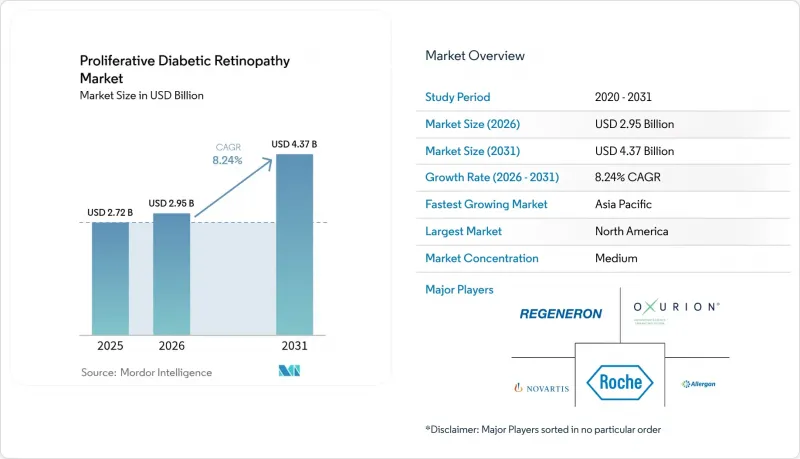
Mordor Intelligence에 의하면, 증식성 당뇨병 망막증 시장 규모는 2025년 27억 2,000만 달러에서 2026년에는 29억 5,000만 달러로 확대되어 2026년부터 2031년까지 CAGR 8.24%로 성장을 지속하여, 2031년에는 43억 7,000만 달러에 이를 것으로 예측됩니다.
본 보고서는 치료법별(항-VEGF제, 코르티코스테로이드, 레이저 수술 등), 투여 경로별(유리체 내 투여, 망막하 투여 등), 최종 사용자별(병원, 안과 클리닉, 외래수술센터(ASC)), 지역별로 분류되어 있습니다. 시장 규모 및 전망은 금액(달러)으로 표시되어 있습니다.
전 세계 증식성 당뇨망막병증 시장 동향 및 인사이트
당뇨병 유병률 상승 및 평균 수명 연장
1990년부터 2022년까지 전 세계 당뇨병 유병률은 2배로 증가했으며, 성인 인구에서 차지하는 비율은 7%에서 14%로 상승했습니다. 평균 수명의 연장으로 인해 환자들은 이 질환을 앓은 채 수십 년을 보내게 되며, 역학 연구에 따르면 당뇨병 발병 후 10년이 지나면 망막병증 발병 위험이 4.36배 높아지는 것으로 나타났습니다. 국제당뇨병연맹(IDF)은 2045년까지 환자 수가 7억 8,320만 명에 달할 것으로 예측하고 있으며, 중소득 국가에서 가장 큰 증가가 예상됩니다. 독일이 그 대표적인 예로, 분석가들은 2040년까지 2형 당뇨병 유병자가 1,420만 명에 달할 것으로 예상하고 있습니다. 유병자가 증가함에 따라, 증식성 당뇨망막병증 시장은 약물 요법과 외과적 치료 모두에서 안정적인 환자 기반을 확보하게 될 것입니다.
유리체 내 항-VEGF 생물학적 제제의 채택 확대
메디케어 청구 데이터에 따르면, 2014년부터 2023년까지 아프리벨셉트 주사 건수는 138% 증가했으며, 이는 항-VEGF 요법에 대한 임상의들의 신뢰를 반영합니다. 2025년 5월, FDA는 제넨텍사의 ‘사스비모’를 당뇨망막병증 치료제로 승인하여, 반기별 처방전 갱신을 통해 지속적인 투여가 가능해졌습니다. 지역별 접근성 격차는 여전히 존재합니다. 의사 밀도에 따라 미국 각 주 간 주사 시행률에 큰 차이가 발생하고 있지만, 2025년에는 ‘예사필리’나 ‘옵비즈’와 같은 바이오시밀러가 등장하며 가격 장벽이 완화되기 시작했습니다. 이란의 ATRIA 임상시험을 통해 확인된 동등한 유효성 데이터는 바이오시밀러의 전망을 더욱 뒷받침하고 있습니다. 바이오의약품의 보급 확대는 치료 대상 환자층의 확대와 치료 기간의 장기화를 촉진함으로써, 증식성 당뇨망막병증 시장을 견인하고 있습니다.
안과용 생물학적 제제의 규제 승인 절차 장기화
신규 진출기업들은 생물학적 동등성, 독성학, 그리고 의료기기 및 의약품 병용에 관한 데이터에 대해 수년 단위의 요건을 부과받고 있습니다. 레제네론사의 ‘아이레아 HD’는 2025년 4월에 우선 심사 지정을 받았으나, 여전히 8월의 심사 결정일을 기다리고 있는 상황입니다. 오큘리스(Oculus)사는 국소 스테로이드 요법의 3상 임상시험 피험자 등록을 완료하는 데 3년 이상이 소요되었습니다. 유전자 치료나 세포 치료에는 개별적인 제조 감사가 필요하며, 이로 인해 심사 주기가 장기화되고 있습니다. 소규모 기업들은 장기간에 걸친 개발 자금을 조달하고 다양한 지역 규제에 대응할 수 있는 기존 기업들에게 시장 점유율을 양보하는 경우가 많아, 시장 전체의 성장을 둔화시키고 있습니다.
부문 분석
매출 기준으로는 2025년에 항-VEGF 생물학적 제제가 증식성 당뇨망막병증 시장 점유율의 66.78%를 차지하며, 이는 시력 유지에 있어 입증된 효능을 반영한 것입니다. 레이저 수술은 조직 손상을 피할 수 있는 임계치 미만의 마이크로 펄스 플랫폼을 바탕으로 연평균 성장률(CAGR) 8.99%로 성장하고 있으며, 가장 빠르게 발전하고 있는 치료법이 되고 있습니다. 코르티코스테로이드는 4-6개월에 걸쳐 약물을 방출하는 ‘오즐덱스’와 같은 임플란트를 통해 여전히 중요한 역할을 하고 있습니다. 유리체 절제술에서는 23게이지 및 25게이지 기구가 채택되어 수술 시간과 회복 기간이 단축되었습니다. 파리시맙과 같은 병용 약물은 VEGF-A와 Ang-2를 모두 표적으로 하며, 실제 임상 연구에서 뛰어난 지속성을 보여주고 있습니다.
서방형 임플란트는 제조업체에 지속적인 수익원을 제공합니다. 2025년에 제넨텍(Genentech)사의 ‘사스비모(Sasvimo)’가 당뇨망막병증으로 적응증을 확대하는 것은 이러한 추세를 뒷받침하는 것이며, 한편 ABBV-RGX-314와 같은 유전자 치료 후보 약물은 제3상 임상시험을 향해 진전되고 있습니다. 혈장 카리크레인 억제를 포함한 새로운 작용기전은 치료 선택의 폭을 넓히고 있습니다. 치료법 전반에 걸쳐 질환의 중증도나 환자의 선호도에 맞춘 맞춤형 치료로의 전환이 진행되고 있으며, 증식성 당뇨망막병증 시장의 잠재적 수요가 확대되고 있습니다.
지역별 분석
북미는 2025년, 광범위한 보험 적용, 신속한 규제 심사 주기, 그리고 서방형 요법의 조기 도입에 힘입어 증식성 당뇨망막병증 시장에서 42.85%의 점유율을 차지했습니다. 그러나 의료 인력 부족은 전략적 장애 요인으로 작용하고 있습니다. 2035년까지 안과 전문공급은 12% 감소하는 반면 수요는 24% 증가할 것으로 예측되며, 이에 따라 이미 업계 재편과 원격 안과 진료 도입이 진행되고 있습니다. AI를 활용한 선별 검사 노력은 현재 92% 이상의 민감도를 기록하고 있으며, 디지털 헬스 통합 분야에서 북미의 리더십을 강화하고 있습니다.
아시아태평양은 가장 빠르게 성장하는 지역으로, 인구 통계학적 변화, 도시화, 소득 증가가 질병 발병률과 치료 접근성을 촉진하여 연평균 성장률(CAGR) 10.15%로 확대되고 있습니다. 중국의 연구에 따르면, 당뇨병으로 진단받은 환자 중 당뇨망막병증의 유병률은 24.7%에서 43.1% 사이인 것으로 나타났습니다. 인도의 ‘SMART DROP’ 프로토콜은 농촌 지역의 발견률을 높이는 확장 가능한 공중보건 접근 방식의 한 예를 보여줍니다. 일본과 한국은 확립된 보험 환급 제도를 활용하여 고가의 임플란트 및 유전자 치료를 도입하고 있는 반면, 동남아시아에서는 이동식 검진 차량 및 생물학적 제제의 보조금 지원 조달에 중점을 두고 있습니다. 이러한 다층적인 전략을 통해 아시아태평양의 다양한 경제권에서 증식성 당뇨망막병증 시장의 타겟층이 확대되고 있습니다.
유럽, 중동 및 아프리카, 남미에서는 각각 다른 추세가 관찰됩니다. 독일에서는 팬데믹 이후의 발병 추세에 따라 2040년까지 당뇨병 환자 수가 1,420만 명에 달할 가능성이 있습니다. 브라질의 1형 당뇨병 등록 데이터에 따르면 망막병증 유병률이 35.7%로 기록되어 있어, 망막 의료 서비스 확충의 여지가 있음을 보여줍니다. 원격 안과 진료는 태평양 도서국 및 지역의 지리적 장벽을 극복하는 데 도움이 되며, 지리적으로 분산된 다른 지역으로의 확대 가능성을 시사하고 있습니다.
기타 혜택:
- 엑셀 형식 시장 예측(ME) 시트
- 3개월간의 애널리스트 지원
자주 묻는 질문
목차
제1장 서론
제2장 조사 방법
제3장 주요 요약
제4장 시장 구도
제5장 시장 규모와 성장 예측
제6장 경쟁 구도
제7장 시장 기회와 향후 전망
JHS 26.09.07According to Mordor Intelligence, the proliferative diabetic retinopathy market size is expected to grow from USD 2.72 billion in 2025 to USD 2.95 billion in 2026 and is forecast to reach USD 4.37 billion by 2031 at 8.24% CAGR over 2026-2031.
This report is Segmented by Treatment Type (Anti-VEGF Agents, Corticosteroids, Laser Surgery, and More), Mode of Administration (Intravitreal, Sub-Retinal, and More), End User (Hospitals, Ophthalmology Clinics, and Ambulatory Surgical Centres), and Geography. The Market Sizes and Forecasts are Provided in Terms of Value (USD).
Global Proliferative Diabetic Retinopathy Market Trends and Insights
Rising Prevalence of Diabetes and Longer Life Expectancy
Global diabetes prevalence doubled between 1990 and 2022, rising from 7% to 14% of the adult population. Longer lifespans mean patients live with the disease for decades, and epidemiologic studies show a 4.36-fold higher retinopathy risk after 10 years of diabetes . The International Diabetes Federation projects 783.2 million cases by 2045, with middle-income economies facing the largest increases. Germany illustrates this path; analysts expect type 2 diabetes prevalence to reach 14.2 million by 2040. As prevalence climbs, the proliferative diabetic retinopathy market gains a stable patient base for both pharmacologic and surgical care.
Increasing Adoption of Intravitreal Anti-VEGF Biologics
Medicare claims show aflibercept injections rose 138% between 2014 and 2023, reflecting clinician confidence in anti-VEGF therapy. In May 2025 the FDA cleared Genentech's Susvimo for diabetic retinopathy, enabling continuous delivery with biannual refills. Regional access remains uneven: physician density drives large differences in injection rates across U.S. states, while biosimilars such as Yesafili and Opuviz began easing price barriers in 2025. Comparable efficacy data from Iran's ATRIA trial further validate the biosimilar pathway. Wider biologic uptake elevates the proliferative diabetic retinopathy market by expanding the treated population and encouraging longer therapy duration.
Extended Regulatory Approval Timelines for Ophthalmic Biologics
New entrants face multiyear data requirements for biologic comparability, toxicology, and device-drug combinations. Regeneron's Eylea HD secured priority review in April 2025 yet still waits for an August action date. Oculis needed more than three years to complete Phase 3 enrollment for a topical steroid therapy. Gene and cell therapies demand bespoke manufacturing audits that lengthen review cycles. Smaller firms often cede ground to incumbents that can finance lengthy development and navigate diverse regional rules, tempering overall market growth.
Other drivers and restraints analyzed in the detailed report include:
- Availability of Minimally Invasive Retinal Laser & Vitrectomy Platforms
- Growing Healthcare Expenditure Boosting Access to Eye-Care Services
- AI-Enabled Screening Programs Enabling Earlier Detection
- Long-Acting Ocular Implants Reducing Treatment Burden
- High Cost of Anti-VEGF Injections Limiting Adherence
For complete list of drivers and restraints, kindly check the Table Of Contents.
Segment Analysis
In revenue terms, anti-VEGF biologics generated 66.78% of proliferative diabetic retinopathy market share in 2025, reflecting proven vision-saving efficacy. Laser surgery has become the fastest-advancing option, growing at 8.99% CAGR on the back of subthreshold micropulse platforms that avoid tissue damage. Corticosteroids remain relevant through implants such as Ozurdex that release medication over four to six months. Vitrectomy is adopting 23-gauge and 25-gauge tools, which shorten procedure time and recovery. Combination agents like faricimab target both VEGF-A and Ang-2, yielding superior durability in real-world studies.
Sustained-release implants position manufacturers for durable revenue streams. Genentech's Susvimo expansion into diabetic retinopathy in 2025 underscores the trend, while gene therapy candidates such as ABBV-RGX-314 advance toward pivotal trials. Novel mechanisms, including plasma kallikrein inhibition, broaden the therapeutic playbook. Across modalities, a shift toward personalized regimens catering to disease severity and patient preferences widens addressable demand in the proliferative diabetic retinopathy market.
Complete Report Scope:
- By Treatment Type
- Anti-VEGF Agents
- Corticosteroids
- Laser Surgery
- Vitrectomy
- Sustained-release Implants
- Others
- By Mode of Administration
- Intravitreal
- Sub-retinal
- Topical & Periocular
- By End-User
- Hospitals
- Ophthalmology Clinics
- Ambulatory Surgical Centres
- By Geography
- North America
- United States
- Canada
- Mexico
- Europe
- Germany
- United Kingdom
- France
- Italy
- Spain
- Rest of Europe
- Asia-Pacific
- China
- Japan
- India
- Australia
- South Korea
- Rest of Asia-Pacific
- Middle East & Africa
- GCC
- South Africa
- Rest of Middle East & Africa
- South America
- Brazil
- Argentina
- Rest of South America
- North America
Geography Analysis
North America captured 42.85% proliferative diabetic retinopathy market share in 2025, supported by broad insurance coverage, fast regulatory cycles, and early adoption of sustained-release therapies. Yet workforce deficits present a strategic obstacle; a 12% decline in ophthalmologist supply against 24% growth in demand through 2035 has already triggered consolidation and tele-ophthalmology rollouts. AI-based screening initiatives now log sensitivities above 92%, reinforcing North America's leadership in digital health integration.
Asia-Pacific is the fastest-growing region, expanding at a 10.15% CAGR as demographic shifts, urbanization, and rising incomes drive disease incidence and treatment access. Chinese studies indicate diabetic retinopathy prevalence between 24.7% and 43.1% among diagnosed diabetics. India's SMART DROP protocol illustrates scalable public-health approaches that raise detection in rural districts. Japan and South Korea leverage established reimbursement systems to absorb premium implants and gene therapies, while Southeast Asia focuses on mobile screening units and subsidized biologic procurement. These layered strategies widen the addressable segment of the proliferative diabetic retinopathy market across diverse APAC economies.
Europe, the Middle East and Africa, and South America show varied trajectories. Germany may see diabetes cases climb to 14.2 million by 2040 because of post-pandemic incidence trends. Brazil's Type 1 diabetes registry recorded a 35.7% retinopathy rate, showing room for expanded retina services. Tele-ophthalmology helps overcome geographic barriers across Pacific Island Countries and Territories, hinting at replication potential for other dispersed geographies.
- F. Hoffmann-La Roche (Genentech)
- Regeneron Pharmaceuticals
- Novartis
- Bayer
- Abbvie
- Oxurion
- Alimera Sciences
- Santen Pharmaceutical
- Kodiak Sciences
- Adverum Biotechnologies
- Clearside Biomedical
- MeiraGTx
- Jiangsu Hansoh Pharma
- Samsung Bioepis
- Bausch + Lomb
- Kowa
- BCN Peptides
- Opthea Ltd
- Glycadia Pharmaceuticals
- EyePoint Pharmaceuticals
Additional Benefits:
- The market estimate (ME) sheet in Excel format
- 3 months of analyst support
TABLE OF CONTENTS
1 Introduction
- 1.1 Study Assumptions & Market Definition
- 1.2 Scope of the Study
2 Research Methodology
3 Executive Summary
4 Market Landscape
- 4.1 Market Overview
- 4.2 Market Drivers
- 4.2.1 Rising Prevalence Of Diabetes And Longer Life Expectancy
- 4.2.2 Increasing Adoption Of Intravitreal Anti-Vegf Biologics
- 4.2.3 Availability Of Minimally-Invasive Retinal Laser & Vitrectomy Platforms
- 4.2.4 Growing Healthcare Expenditure Boosting Access To Eye-Care Services
- 4.2.5 Ai-Enabled Screening Programmes Enabling Earlier Pdr Detection
- 4.2.6 Long-Acting Ocular Implants Reducing Treatment Burden
- 4.3 Market Restraints
- 4.3.1 Extended Regulatory Approval Timelines For Ophthalmic Biologics
- 4.3.2 High Cost Of Anti-Vegf Injections Limiting Adherence
- 4.3.3 Safety Concerns With Repeated Intravitreal Injections
- 4.3.4 Shortage Of Retinal Specialists In LMICS
- 4.4 Value / Supply-Chain Analysis
- 4.5 Regulatory Landscape
- 4.6 Technological Outlook
- 4.7 Porter's Five Forces Analysis
- 4.7.1 Threat of New Entrants
- 4.7.2 Bargaining Power of Buyers
- 4.7.3 Bargaining Power of Suppliers
- 4.7.4 Threat of Substitutes
- 4.7.5 Intensity of Competitive Rivalry
5 Market Size & Growth Forecasts (Value)
- 5.1 By Treatment Type
- 5.1.1 Anti-VEGF Agents
- 5.1.2 Corticosteroids
- 5.1.3 Laser Surgery
- 5.1.4 Vitrectomy
- 5.1.5 Sustained-release Implants
- 5.1.6 Others
- 5.2 By Mode of Administration
- 5.2.1 Intravitreal
- 5.2.2 Sub-retinal
- 5.2.3 Topical & Periocular
- 5.3 By End-User
- 5.3.1 Hospitals
- 5.3.2 Ophthalmology Clinics
- 5.3.3 Ambulatory Surgical Centres
- 5.4 By Geography
- 5.4.1 North America
- 5.4.1.1 United States
- 5.4.1.2 Canada
- 5.4.1.3 Mexico
- 5.4.2 Europe
- 5.4.2.1 Germany
- 5.4.2.2 United Kingdom
- 5.4.2.3 France
- 5.4.2.4 Italy
- 5.4.2.5 Spain
- 5.4.2.6 Rest of Europe
- 5.4.3 Asia-Pacific
- 5.4.3.1 China
- 5.4.3.2 Japan
- 5.4.3.3 India
- 5.4.3.4 Australia
- 5.4.3.5 South Korea
- 5.4.3.6 Rest of Asia-Pacific
- 5.4.4 Middle East & Africa
- 5.4.4.1 GCC
- 5.4.4.2 South Africa
- 5.4.4.3 Rest of Middle East & Africa
- 5.4.5 South America
- 5.4.5.1 Brazil
- 5.4.5.2 Argentina
- 5.4.5.3 Rest of South America
- 5.4.1 North America
6 Competitive Landscape
- 6.1 Market Concentration
- 6.2 Market Share Analysis
- 6.3 Company Profiles (includes Global level Overview, Market level overview, Core Segments, Financials as available, Strategic Information, Market Rank/Share for key companies, Products & Services, and Recent Developments)
- 6.3.1 F. Hoffmann-La Roche (Genentech)
- 6.3.2 Regeneron Pharmaceuticals
- 6.3.3 Novartis AG
- 6.3.4 Bayer AG
- 6.3.5 AbbVie (Allergan)
- 6.3.6 Oxurion NV
- 6.3.7 Alimera Sciences
- 6.3.8 Santen Pharmaceutical
- 6.3.9 Kodiak Sciences
- 6.3.10 Adverum Biotechnologies
- 6.3.11 Clearside Biomedical
- 6.3.12 MeiraGTx
- 6.3.13 Jiangsu Hansoh Pharma
- 6.3.14 Samsung Bioepis
- 6.3.15 Bausch + Lomb
- 6.3.16 Kowa Company Ltd
- 6.3.17 BCN Peptides
- 6.3.18 Opthea Ltd
- 6.3.19 Glycadia Pharmaceuticals
- 6.3.20 EyePoint Pharmaceuticals
7 Market Opportunities & Future Outlook
- 7.1 White-space & Unmet-Need Assessment


