|
시장보고서
상품코드
2123721
배송 드론 시장 : 점유율 분석, 업계 동향과 통계, 성장 예측(2026-2031년)Delivery Drones - Market Share Analysis, Industry Trends & Statistics, Growth Forecasts (2026 - 2031) |
||||||
 Mordor Intelligence
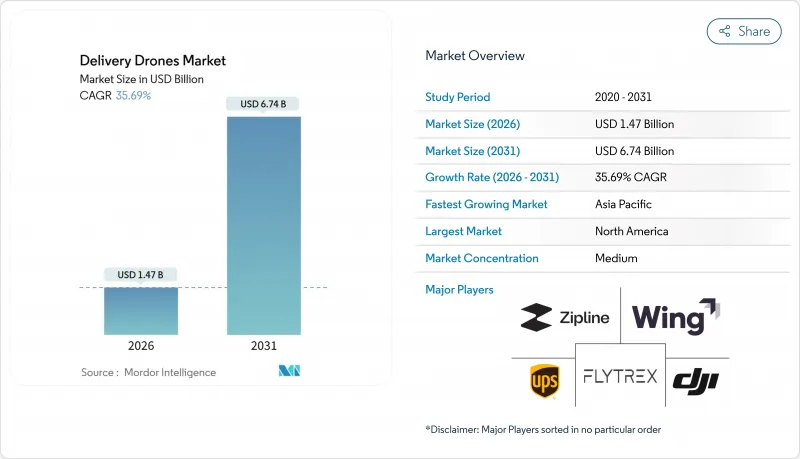
Mordor Intelligence에 의하면, 배송 드론 시장 규모는 2026년에 14억 7,000만 달러에 이르고, 2031년까지 67억 4,000만 달러에 이를 것으로 예측되며, 예측 기간 중 CAGR 35.69%로 성장할 전망입니다.
본 보고서는 드론의 유형(회전익, 고정익), 적재 용량(5kg 미만, 5-10kg, 10kg 초과), 배송 거리(25km 미만, 25-50km, 50km 초과), 최종 사용자 산업(소매 및 전자상거래 등), 지역(북미 등)별로 분류되어 있습니다. 시장 예측은 금액(달러) 기준으로 제시되어 있습니다.
전 세계 배송 드론 시장 동향 및 인사이트
인구 밀집 도시 지역에서의 전자상거래 당일 배송 수요 가속화
도시권 소비자들은 2시간 이내 배송을 점점 더 기대하고 있지만, 이는 교통 체증이 정점에 달했을 때 지상 운송으로는 달성할 수 없는 기준입니다. 드론은 지상의 교통 체증을 피할 수 있으므로, 소매업체는 도심 근처에 위치한 마이크로 풀필먼트 허브에서 상품을 발송할 수 있게 됩니다. 월마트는 2025년 6월, Wing Aviation 프로그램을 미국 내 100개 매장으로 확대했습니다. 이는 항공 물류가 시험 단계에서 핵심 서비스로 전환되었음을 보여줍니다. 배송 드론 군의 밀도가 일정 규모에 도달하면 소포 비용은 개당 2달러 가까이까지 낮아져, 트럭을 이용한 라스트 마일 배송 비용인 13.50달러와 비교했을 때 단위 경제성이 개선됩니다. 특히 임금 수준이 높은 북미나 유럽의 도시에서는 인력 부족이 이러한 우위를 더욱 강화하고 있습니다. 그 결과, 배송 드론 시장은 고객 충성도를 유지하기 위해 옴니채널 소매 전략에 깊이 통합되고 있습니다.
지리적으로 고립된 지역이나 의료 서비스가 미비한 지역에서 신뢰할 수 있는 의료 물자 배송 솔루션에 대한 수요 증가
도로망이 미비하여 지방 진료소로 생명 유지에 필수적인 물자를 운반하는 데 지연이 발생함에 따라, 의료 시스템은 확실하고 신속한 서비스를 위해 드론을 활용하고 있습니다. Zipline사는 자율 비행 횟수가 100만 회를 돌파했으며, 르완다, 가나, 그리고 미국의 외딴 카운티에서 혈액과 백신을 수송하고 있습니다. 2025년 클리블랜드 클리닉과의 제휴를 통해 오하이오주 교외 지역의 환자들에게 처방약 배송 소요 시간이 몇 시간에서 몇 분으로 단축되었습니다. 인도는 ‘드론 규정’에 따라 의료 물자 전용 비행 경로를 지정하고, 접근이 어려운 지역에서의 도입을 가속화하고 있습니다. 이러한 노력은 드론이 제한된 도로 인프라의 제약을 뛰어넘을 수 있음을 보여주며, 이에 따라 신흥 경제국 전반에 걸친 배송 드론 시장의 성장 전망이 더욱 밝아지고 있습니다.
기존 민간 항공 시스템과의 복잡한 공역 통합이 운영의 확장성을 제약하고 있습니다.
무인 항공기 교통 관리는 여전히 시험 운영 단계에 있어, 혼잡한 공항 주변의 항로 밀도를 제한하고 있습니다. FAA(미국 연방항공청)의 ‘동적 비행 회랑’ 개념은 유인 항공기 시스템과의 완전한 상호 운용성이 아직 부족하여, 운영자는 대도시권 공역에서의 운항 빈도를 억제할 수밖에 없는 상황입니다. 유럽항공안전청(EASA)의 U-space 규정에서는 지오펜싱과 충돌 회피 프로토콜의 의무화가 요구되고 있지만, 회원국마다 도입률이 달라 서비스 설계의 단편화를 초래하고 있습니다. NASA의 조사에 따르면, 현재의 알고리즘으로는 동시에 비행하는 드론을 수천 대가 아닌 수백 대만 처리할 수 있는 것으로 나타났습니다. 확장 가능한 UTM 네트워크가 성숙해지기 전까지는 인구 밀집 지역에서의 배송 드론 시장 성장이 그 기술적 잠재력을 따라잡지 못할 것입니다.
부문 분석
2025년에는 화물의 72.56%가 회전익 항공기를 통해 배송되었습니다. 회전익 항공기는 옥상이 하역 장소로도 사용되는 경우나 도로변 공간이 제한된 곳에서 그 진가를 발휘합니다. 한편, 연평균 29.15%의 성장이 예상되는 고정익 항공기는 순항 중에 활공하기 때문에 1킬로미터당 에너지 소비를 대폭 줄입니다. Zipline사의 ‘P2’는 1회 충전으로 100km를 비행할 수 있어, 운영자는 하나의 허브에서 여러 카운티에 서비스를 제공할 수 있습니다. 이러한 항속 거리의 효율성은 운송망이 고르지 않은 아시아태평양에서 매우 중요합니다. 이 지역에서는 JD 로지스틱스가 200개의 지방 노선에서 고정익 드론을 운용하고 있습니다. 규제 당국은 현재 장시간 비행 지속 능력과 자동 감지·회피 기능을 겸비한 설계에 대해 ‘파트 135’ 승인을 집중적으로 부여하고 있습니다. 그 결과, 배송 드론 시장은 회전익을 통한 양력과 고정익을 통한 순항을 융합한 하이브리드 기종으로 기울고 있으며, 도심 블록 간과 멀리 떨어진 진료소 간의 운영상 격차를 좁히고 있습니다.
고정익 기체의 확대는 기체 계획 산정식을 완전히 바꿔 놓을 것입니다. 사업자는 단거리 노선용 거점 몇 곳을 폐지하고, 대신 단일 중앙 이착륙 거점을 운영할 수 있게 됩니다. 이러한 통합을 통해 자금이 확보되어 노선 밀도 향상이나 백신용 콜드체인 포드와 같은 부가가치 서비스에 투자할 수 있게 됩니다. 회전익기 모델은 식당 즉시 배달이나 15분 이내의 도심 배달에서 여전히 주류를 이루고 있으므로, 그 도입은 이분법적인 선택이 아니라 포트폴리오 전체를 고려한 판단이 될 것입니다. 미래 플랫폼 로드맵에는 순수한 호버링 임무를 위해 탈부착 가능한 모듈식 날개가 포함되어 있어, 배송 드론 시장 전체 수요 급증에 유연하게 대응할 수 있는 아키텍처를 시사합니다.
2025년에는 5kg 미만의 배송이 65.71%의 점유율을 차지하며, 이는 표준 날개 수납 공간에 들어갈 수 있는 처방전, 식사 키트, 소형 소비재와 같은 품목에 해당합니다. 함대 관리자들이 이 등급을 선호하는 이유는 배터리, 제어 로직, 투하 장치가 기성품이며, 장기간의 개념 증명(PoC) 단계 없이도 대부분의 항공 당국의 요건을 충족하기 때문입니다. 5-10kg 부문은 식료품 체인이 중형 장바구니 규모의 주문을 시험적으로 도입하고, 포장 기준에 관한 규제가 정비됨에 따라 성장하고 있습니다. 10kg을 초과하는 드론은 낮은 기저 수준에서 연평균 성장률(CAGR) 31.9%로 확대될 전망이며, 기존에는 헬리콥터가 주류를 이루던 해상 시추 시설이나 건설 현장 등에서 활용될 것으로 보입니다.
기술적인 상충 관계는 여전히 두드러집니다. 에너지 밀도가 향상되지 않는 한, 무게가 1kg 증가할 때마다 비행 시간은 단축됩니다. 가솔린·전기 하이브리드 시제기는 개선이 기대되지만, 인증까지의 기간은 장기화될 전망입니다. 따라서 중량물 운송이라는 틈새 시장에서는 높은 유지보수 비용과 위험 보험 비용을 충당하기 위해 서비스 요금에 할증료가 부과되고 있습니다. 향후 파워트레인의 효율이 향상됨에 따라 중량 상한선이 상향 조정되고, 배송 드론 시장 전체에서 중량물 운송이 더욱 널리 보급될 기반이 마련될 것입니다.
지역별 분석
북미는 FAA(연방항공청)의 선진적인 규제, 견조한 개인 소비, 그리고 Amazon Prime Air, Wing, 월마트의 투자 덕분에 2025년 시점에서 42.84%의 점유율을 차지하며 여전히 최대의 지역 시장으로 남아 있습니다. 도시의 건축 구조는 옥상 하역 패드 및 기존 소매점에 통합된 마이크로 풀필먼트 거점의 설치에 대응하고 있습니다. 의료 분야의 활용 사례는 도로 접근이 계절에 따라 제한되는 알래스카, 애팔래치아, 사막 지대의 카운티에서 활발히 이루어지고 있으며, 장거리 배송 수요를 뒷받침하고 있습니다. 벤처 자금은 미국의 기술 허브에 집중되어 있어 하드웨어 및 소프트웨어 개선이 촉진되고 있으며, 그 파급 효과가 전 세계 파트너 기업으로 확산되고 있습니다. 이 지역은 선도적인 위치를 차지하고 있으나, 공역 혼잡으로 인해 비행 경로 승인이 복잡해져 배송 드론 시장의 성장 속도가 둔화되고 있습니다.
아시아태평양은 2031년까지 연평균 성장률(CAGR)이 33.68%에 달하고, 가장 빠른 성장이 예상됩니다. 중국에서는 JD 로지스틱스의 네트워크에 드론이 본격적으로 도입되어 200개 이상의 고정 노선을 통해 농촌 지역의 농장과 도시의 분류 센터를 연결하고 있습니다. 인도의 ‘생산 연계 인센티브(PLI)’ 제도는 현지 제조 및 설계에 대해 보조금을 지급하고 있어, 스타트업 기업들을 농업 자재 배송 등 비용 중심의 틈새 시장으로 끌어들이고 있습니다. 일본에서는 라쿠텐이 여러 현에 걸쳐 사업을 전개하는 것이 승인되었으며, 이는 유럽 및 미국의 안전 기준과의 규제 조화가 진행되고 있음을 시사합니다. 인도네시아와 필리핀의 인프라 부족은 비포장 도로나 섬들을 연결하는 트럭 운송 노선의 대체 수단으로서 드론의 중요성을 더욱 부각시키고 있습니다. 그 결과, 배송 드론 시장에서 아시아태평양은 점진적인 개선 단계를 뛰어넘어, 외딴 지역의 현에서 항공 물류를 최우선 공급망으로 채택하는 움직임이 나타나고 있습니다.
유럽에서는 EASA(유럽항공안전청)의 주도 하에 정책 조화가 이루어지고 있으며, 사업자들이 지역 단위에서 광역 단위로 사업 규모를 확대함에 따라 원활한 국경 간 서비스가 촉진되고 있습니다. Manna사는 미국 FAA(연방항공청)로부터 면제를 획득함으로써 아일랜드 및 영국에서의 사업을 진전시켰고, 대서양을 횡단하는 규제 조화의 이점을 입증했습니다. 환경 정책에 따라 저배출 인증 도입이 가속화되고 있으며, 운송업체들은 이러한 인증을 활용하여 지자체의 화물 입찰을 수주하고 있습니다. 개인정보 보호 운동과 규제가 엄격한 공역의 존재로 인해 성장은 여전히 제한되고 있지만, 높은 1인당 소득이 프리미엄 배송 요금 유지를 뒷받침하고 있습니다. 이러한 동향들이 맞물려 유럽 전역의 배송 드론 시장의 착실하고 신중한 확장을 뒷받침하고 있습니다. 한편, 라틴아메리카, 중동 및 아프리카에서는 의료 분야를 중심으로 소규모 실증 실험이 진행되고 있으며, 규제가 명확해짐에 따라 그 규모가 확대될 전망입니다.
기타 혜택:
- 엑셀 형식 시장 예측(ME) 시트
- 3개월간의 애널리스트 지원
자주 묻는 질문
목차
제1장 서론
제2장 조사 방법
제3장 주요 요약
제4장 시장 구도
제5장 시장 규모와 성장 예측
제6장 경쟁 구도
제7장 시장 기회와 향후 전망
JHS 26.09.07According to Mordor Intelligence, the delivery drones market size reached USD 1.47 billion in 2026 and is projected to attain USD 6.74 billion by 2031, expanding at a 35.69% CAGR through the forecast period.
This report is Segmented by Drone Type (Rotary-Wing, Fixed-Wing), Payload Capacity (Less Than 5 Kg, 5 To 10 Kg, More Than 10 Kg), Delivery Range (Less Than 25 Km, 25 To 50 Km, More Than 50 Km), End-User Industry (Retail and E-Commerce, and More), and Geography (North America, and More). The Market Forecasts are Provided in Terms of Value (USD).
Global Delivery Drones Market Trends and Insights
Accelerating Demand for Same-Day E-Commerce Fulfillment in Densely Populated Urban Centers
Urban consumers increasingly expect delivery within two hours, a benchmark that ground fleets miss during peak congestion. Drones avoid surface traffic, allowing retailers to ship from micro-fulfillment hubs located near downtown districts. Walmart expanded its Wing Aviation program to 100 US stores in June 2025, indicating that aerial logistics has transitioned from a trial to a core service. Unit economics improve as parcel costs fall toward USD 2 once fleet density reaches scale, compared with USD 13.50 for truck-based last-mile routes. Labor shortages amplify this advantage, especially in North American and European cities where wages remain high. As a result, the delivery drones market is integrating deeply into omnichannel retail strategies to safeguard customer loyalty.
Rising Need for Reliable Healthcare Delivery Solutions in Geographically Isolated and Underserved Areas
Road gaps delay life-critical supplies for rural clinics, so health systems turn to drones for predictable, rapid service. Zipline surpassed 1 million autonomous flights, moving blood and vaccines across Rwanda, Ghana, and remote US counties. A 2025 partnership with the Cleveland Clinic reduced prescription lead times from hours to minutes for patients in suburban Ohio. India designated dedicated corridors for medical payloads under its Drone Rules, accelerating adoption in hard-to-reach districts. These programs demonstrate that drones can leapfrog limited road infrastructure, thereby reinforcing growth prospects for the delivery drones market across emerging economies.
Complex Airspace Integration with Existing Civil Aviation Systems Limiting Operational Scalability
Unmanned traffic management remains in pilot testing, constraining route density near busy airports. The FAA's concept of dynamic flight corridors still lacks full interoperability with manned aircraft systems, forcing operators to throttle frequency in metropolitan skies. EASA's U-space rules require geofencing and mandatory collision-avoidance protocols; however, adoption rates differ across member states, resulting in fragmented service design. NASA research indicates that current algorithms can handle only hundreds, not thousands, of simultaneous drone flights. Until scalable UTM networks mature, the growth of the delivery drone market in densely populated regions will lag behind its technical potential.
Other drivers and restraints analyzed in the detailed report include:
- Global Expansion of Regulatory Frameworks Enabling Commercial Delivery Drone Operations
- Operational Cost Reductions Through More Efficient Last-Mile Delivery in High-Traffic Environments
- Low Payload Capacity Restricting Revenue Potential in High-Volume Segments
For complete list of drivers and restraints, kindly check the Table Of Contents.
Segment Analysis
Rotary-wing craft delivered 72.56% of shipments in 2025. They excel where rooftops double as drop zones and curbside space is scarce. Yet, fixed-wing systems, projected to grow at a 29.15% annual rate, glide during cruise, slashing energy use per kilometer. Zipline's P2 travels 100 km on a single charge, allowing operators to serve multiple counties from a single hub. This range economy is critical in Asia-Pacific's patchy transport grid, where JD Logistics uses fixed-wing drones on 200 rural routes. Regulatory bodies are now funneling Part 135 approvals toward designs that combine long endurance and automated detect-and-avoid capabilities. Consequently, the delivery drones market is tilting toward hybrid craft that merge rotary lift with fixed-wing cruise, narrowing the operational gap between city blocks and distant clinics.
Fixed-wing expansion reshapes fleet-planning math. Operators can retire several short-hop bases and instead run a single centralized launch site. This consolidation frees capital for route density and value-added services such as cold-chain pods for vaccines. Rotary-wing models still dominate instant restaurant delivery and under-15-minute urban promises, so adoption becomes a portfolio decision rather than a binary switch. Future platform roadmaps incorporate modular wings that detach for pure hover missions, indicating an adaptable architecture that flexes with demand spikes across the delivery drones market.
Shipments under 5 kg held a 65.71% share in 2025, aligning with prescriptions, meal kits, and small consumer goods that fit within standard wing lockers. Fleet managers favor this class because batteries, control logic, and drop mechanisms are off-the-shelf, and they satisfy most aviation authorities without requiring lengthy proof-of-concept phases. The 5-10 kg band grows as grocery chains experiment with mid-basket orders and as regulations mature around packaging standards. Drones weighing above 10 kg will advance at a 31.9% CAGR, albeit from a lower base, serving offshore rigs or construction sites where helicopters have historically dominated.
Engineering trade-offs remain stark. Every additional kilogram reduces flight time unless energy density increases. Hybrid gasoline-electric prototypes promise relief, although certification timelines are stretched longer. Heavy-lift niches therefore charge a premium for their services, covering higher maintenance and risk insurance costs. Over time, as powertrain efficiency improves, weight ceilings will climb, setting the stage for broader heavy-lift adoption throughout the delivery drones market.
Complete Report Scope:
- By Drone Type
- Rotary-wing
- Fixed-wing
- By Payload Capacity
- Less than 5 kg
- 5 to 10 kg
- More than 10 kg
- By Delivery Range
- Less than 25 km
- 25 to 50 km
- More than 50 km
- By End-User Industry
- Retail and E-commerce
- Food and Grocery
- Healthcare and Pharma Logistics
- Postal and Express Parcel
- Industrial and Construction
- By Geography
- North America
- United States
- Canada
- Mexico
- Europe
- Germany
- United Kingdom
- France
- Italy
- Spain
- Rest of Europe
- Asia-Pacific
- China
- Japan
- India
- South Korea
- Rest of Asia-Pacific
- South America
- Brazil
- Argentina
- Rest of South America
- Middle East and Africa
- Middle East
- United Arab Emirates
- Saudi Arabia
- Rest of Middle East
- Africa
- South Africa
- Rest of Africa
- Middle East
- North America
Geography Analysis
North America remains the largest regional base with a 42.84% share in 2025, thanks to progressive FAA rulings, robust consumer spending, and investments by Amazon Prime Air, Wing, and Walmart. Urban architectures accommodate rooftop drop-off pads and micro-fulfillment nodes integrated into existing retail footprints. Healthcare use cases thrive in Alaska, Appalachia, and desert counties where road access is seasonal, anchoring long-range demand. Venture funding concentrates in US tech hubs, enabling hardware and software iterations that ripple out to global partners. Despite its lead, the region grapples with crowded airspace, which complicates route approvals and moderates the pace of expansion within the delivery drones market.
The Asia-Pacific region is poised for the fastest growth, with a 33.68% CAGR through 2031. China mainstreamed drones into JD Logistics' network, connecting rural farms to city sort centers across more than 200 fixed corridors. India's Production-Linked Incentive scheme offers subsidies for local manufacturing and design, drawing startups into cost-sensitive niches such as agri-input deliveries. Japan green-lit Rakuten's multi-prefecture operations, signaling regulatory convergence with Western safety standards. Infrastructure deficits in Indonesia and the Philippines further spotlight drones as substitutes for unpaved or island-hopping truck routes. Consequently, the delivery drones market sees the APAC leapfrog incremental improvements and adopt aerial logistics as the first-choice supply chain in remote provinces.
Europe enjoys policy alignment under EASA, which facilitates smooth cross-border services as operators scale from local to regional footprints. Manna's operations in Ireland and the UK advanced when it secured a US FAA waiver, illustrating the benefits of transatlantic harmonization. Environmental policy accelerates the adoption of low-emission credentials, with carriers leveraging these credentials to win municipal freight tenders. Growth remains tempered by privacy activism and dense controlled airspace, yet high per-capita income sustains premium delivery fees. Collectively, these dynamics underpin steady but measured expansion for the delivery drones market across Europe. At the same time, Latin America, the Middle East, and Africa progress through smaller healthcare-led pilots that will scale as regulatory clarity improves.
- Prime Air (Amazon.com, Inc.)
- Wing Aviation LLC (Alphabet Inc.)
- United Parcel Service of America, Inc.
- FedEx Corporation
- Airbus SE
- Zipline International Inc.
- SZ DJI Technology Co., Ltd.
- Wingcopter GmbH
- Guangzhou EHang Intelligent Technology Co. Ltd.
- Drone Delivery Canada Corp.
- Flytrex Inc.
- Matternet Inc.
- Kite Aero
- Manna Drone Delivery
- Skyports Drone Services
- Speedbird Aero
- Rakuten Group, Inc.
- JDLogistics, Inc
- DroneUp, LLC
Additional Benefits:
- The market estimate (ME) sheet in Excel format
- 3 months of analyst support
TABLE OF CONTENTS
1 INTRODUCTION
- 1.1 Study Assumptions and Market Definition
- 1.2 Scope of the Study
2 RESEARCH METHODOLOGY
3 EXECUTIVE SUMMARY
4 MARKET LANDSCAPE
- 4.1 Market Overview
- 4.2 Market Drivers
- 4.2.1 Accelerating demand for same-day e-commerce fulfillment in densely populated urban centers
- 4.2.2 Rising need for reliable healthcare delivery solutions in geographically isolated and underserved areas
- 4.2.3 Global expansion of regulatory frameworks enabling commercial drone delivery operations
- 4.2.4 Operational cost reductions through more efficient last-mile delivery in high-traffic environments
- 4.2.5 Increased adoption of sustainable logistics practices driven by corporate and government emissions targets
- 4.2.6 Technological advancements in hybrid VTOL systems enabling longer-range and more flexible delivery missions
- 4.3 Market Restraints
- 4.3.1 Complex airspace integration with existing civil aviation systems limiting operational scalability
- 4.3.2 Low payload capacity restricting revenue potential in high-volume delivery segments
- 4.3.3 Persistent public concerns over privacy and noise in densely populated residential areas
- 4.3.4 High upfront fleet investment requirements posing barriers for small and medium-sized enterprises
- 4.4 Value Chain Analysis
- 4.5 Regulatory Outlook and Technological Outlook
- 4.6 Porter's Five Forces Analysis
- 4.6.1 Bargaining Power of Suppliers
- 4.6.2 Bargaining Power of Buyers
- 4.6.3 Threat of New Entrants
- 4.6.4 Threat of Substitutes
- 4.6.5 Competitive Rivalry
5 MARKET SIZE AND GROWTH FORECASTS (VALUE)
- 5.1 By Drone Type
- 5.1.1 Rotary-wing
- 5.1.2 Fixed-wing
- 5.2 By Payload Capacity
- 5.2.1 Less than 5 kg
- 5.2.2 5 to 10 kg
- 5.2.3 More than 10 kg
- 5.3 By Delivery Range
- 5.3.1 Less than 25 km
- 5.3.2 25 to 50 km
- 5.3.3 More than 50 km
- 5.4 By End-User Industry
- 5.4.1 Retail and E-commerce
- 5.4.2 Food and Grocery
- 5.4.3 Healthcare and Pharma Logistics
- 5.4.4 Postal and Express Parcel
- 5.4.5 Industrial and Construction
- 5.5 By Geography
- 5.5.1 North America
- 5.5.1.1 United States
- 5.5.1.2 Canada
- 5.5.1.3 Mexico
- 5.5.2 Europe
- 5.5.2.1 Germany
- 5.5.2.2 United Kingdom
- 5.5.2.3 France
- 5.5.2.4 Italy
- 5.5.2.5 Spain
- 5.5.2.6 Rest of Europe
- 5.5.3 Asia-Pacific
- 5.5.3.1 China
- 5.5.3.2 Japan
- 5.5.3.3 India
- 5.5.3.4 South Korea
- 5.5.3.5 Rest of Asia-Pacific
- 5.5.4 South America
- 5.5.4.1 Brazil
- 5.5.4.2 Argentina
- 5.5.4.3 Rest of South America
- 5.5.5 Middle East and Africa
- 5.5.5.1 Middle East
- 5.5.5.1.1 United Arab Emirates
- 5.5.5.1.2 Saudi Arabia
- 5.5.5.1.3 Rest of Middle East
- 5.5.5.2 Africa
- 5.5.5.2.1 South Africa
- 5.5.5.2.2 Rest of Africa
- 5.5.5.1 Middle East
- 5.5.1 North America
6 COMPETITIVE LANDSCAPE
- 6.1 Market Concentration
- 6.2 Strategic Moves
- 6.3 Market Share Analysis
- 6.4 Company Profiles (includes global and market overview, core segments, financials, strategic info, market rank/share, products and services, recent developments)
- 6.4.1 Prime Air (Amazon.com, Inc.)
- 6.4.2 Wing Aviation LLC (Alphabet Inc.)
- 6.4.3 United Parcel Service of America, Inc.
- 6.4.4 FedEx Corporation
- 6.4.5 Airbus SE
- 6.4.6 Zipline International Inc.
- 6.4.7 SZ DJI Technology Co., Ltd.
- 6.4.8 Wingcopter GmbH
- 6.4.9 Guangzhou EHang Intelligent Technology Co. Ltd.
- 6.4.10 Drone Delivery Canada Corp.
- 6.4.11 Flytrex Inc.
- 6.4.12 Matternet Inc.
- 6.4.13 Kite Aero
- 6.4.14 Manna Drone Delivery
- 6.4.15 Skyports Drone Services
- 6.4.16 Speedbird Aero
- 6.4.17 Rakuten Group, Inc.
- 6.4.18 JDLogistics, Inc
- 6.4.19 DroneUp, LLC
7 MARKET OPPORTUNITIES AND FUTURE OUTLOOK
- 7.1 White-space and Unmet-Need Assessment