
|
시장보고서
상품코드
2123772
바이오프로세스 기술 시장 : 점유율 분석, 업계 동향과 통계, 성장 예측(2026-2031년)Bioprocess Technology - Market Share Analysis, Industry Trends & Statistics, Growth Forecasts (2026 - 2031) |
||||||
 Mordor Intelligence
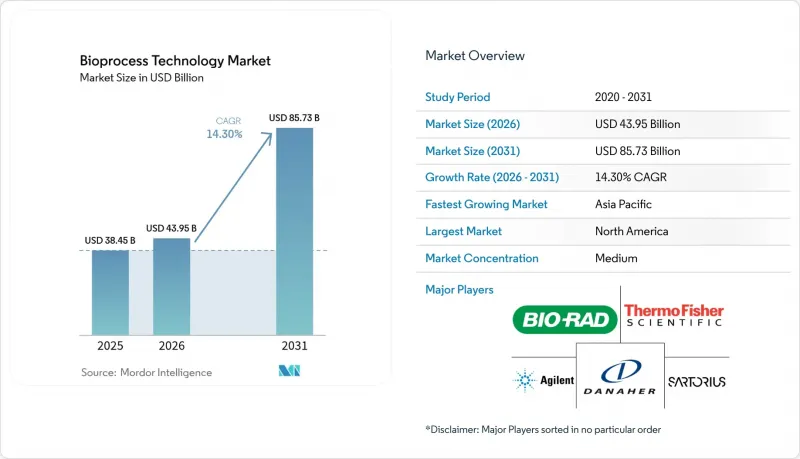
Mordor Intelligence에 의하면, 2026년 바이오프로세스 기술 시장 규모는 439억 5,000만 달러로 추정되고 있어 2025년 384억 5,000만 달러에서 확대되어, 2031년에는 857억 3,000만 달러에 이를 것으로 예측됩니다.
2026년부터 2031년까지 연평균 성장률(CAGR) 14.3%로 성장할 것으로 전망됩니다.
본 보고서는 제품(장비, 소모품 및 부속품), 공정 유형(업스트림 공정 등), 기술(배치 등), 용도(재조합 단백질 등), 최종 사용자(바이오의약품 기업 등), 지역(북미, 유럽, 아시아태평양, 중동 및 아프리카, 남미)별로 분류되어 있습니다. 시장 전망은 금액(달러) 기준으로 제시되어 있습니다.
세계 바이오프로세스 기술 시장 동향 및 인사이트
바이오의약품 업계의 확대
바이오의약품 매출이 증가함에 따라, 전체 의약품 지출에서 바이오의약품이 차지하는 비중은 2024년 41%에서 2028년까지 45%로 상승했습니다. FDA가 2025년 이후 연간 최대 20건의 CGT 승인을 예상하고 있다는 사실은 고정밀도이며 GMP를 준수하는 제조 시설이 필요한 복잡한 치료법의 새로운 물결이 도래하고 있음을 나타냅니다. 삼성바이오로직스의 디지털 트윈 도입 사례는 정교한 모델링을 통해 데이터 무결성을 유지하면서도 검증 기간을 단축할 수 있음을 보여줍니다. 이에 따라 자본 집약적인 설비 갱신은 규제 요건을 저해하지 않으면서도 다양한 치료 기법에 대응할 수 있는 유연한 일회용 구성으로 전환되고 있습니다.
확대되는 의약품 개발·제조 수탁(CDMO) 시장
대형 제약사의 비핵심 제조 자산에 대한 전략적 매각을 배경으로, 바이오의약품 CDMO 부문은 순조롭게 성장하고 있습니다. 삼성바이오로직스의 14억 달러 규모 제5공장 확장 및 론자가 로슈의 바카빌 생산기지(33만 리터)를 12억 달러에 인수한 것은 대규모 생산 능력을 둘러싼 경쟁이 격화되고 있음을 여실히 보여줍니다. ‘BIOSECURE 법’의 제정이 예상에 따라, 중국 공급업체에서 유럽·미국 및 한국공급업체로 수탁 생산량이 이동할 가능성이 있습니다. 2024년 조사 대상 경영진의 49%는 2025년에 수탁 서비스의 성장이 더욱 가속화될 것으로 예상하고 있습니다. 이러한 변화로 인해 바이오프로세스 기술 시장은 전 세계 생산 능력 재편을 가능하게 하는 매우 중요한 요소로서의 입지를 공고히 하고 있습니다.
통합 시스템의 고액 자본 비용
최첨단 시설에 대한 초기 투자액은 5억 달러를 초과할 가능성이 있으며, 차세대 포유류 유래 플랫폼을 목표로 하는 론자의 바카빌(Vaca Ville) 거점 업그레이드 계획이 그 예입니다. 인플레이션 압력으로 인해 2023년 이후 설비 및 클린룸 건설 비용은 두 자릿수 비율로 상승하고 있으며, 중소 바이오기술 기업들은 최신 생산 능력을 활용하기 위해 CDMO에 의존할 수밖에 없는 상황입니다. 연속 생산으로의 전환은 특히 자본 집약적이며, 검증 기간 중에도 병행되는 배치 스위트를 계속 가동해야 하기 때문에 투자 회수 기간이 길어집니다. 그 결과, 기술 도입 주기는 많은 경우 입증 가능한 ROI와 규제 명확성에 좌우되며, 자금 사정이 어려운 지역에서의 보급이 지연됩니다.
부문 분석
2025년 현재, 바이오프로세스 기술 시장 점유율의 60.55%를 소모품 및 부속품이 차지하고 있으며, 2031년까지 연평균 성장률(CAGR) 16.42%로 확대될 것으로 예측됩니다. 이러한 성장에 힘입어 일회용 백, 멸균 커넥터 및 맞춤형 배지가 바이오프로세스 기술 시장에서 지속적인 수익의 주축으로서 확고한 입지를 다지고 있습니다. CGT(세포 및 유전자 치료)에 최적화된 배양 배지는 유전자 치료용 배지에 대한 수요가 증가함에 따라 그 가치 잠재력을 부각시키고 있습니다.
장비 수요는 비교적 안정적이며, 5L DynaDrive 바이오리액터나 자동 세포 증식을 위한 Sartorius사의 BIOSTAT RM TX 플랫폼과 같은 혁신에 힘입고 있습니다. 시설이 연속 워크플로우로 전환됨에 따라, 공정 분석기는 PAT(공정 분석 기술)의 채택 확대에 따른 혜택을 누리고 있습니다. 소모품 수요 증가는 스테인리스 스틸에 대한 의존에서 벗어나는 큰 구조적 변화를 반영하며, 전체 바이오프로세스 기술 시장에서 더 빠른 처리 시간과 자본 부담 경감을 가능하게 하고 있습니다.
2025년에는 다운스트림 공정이 바이오프로세스 기술 시장 규모의 51.20%를 차지했으며, 크로마토그래피, 여과 및 바이러스 제거 솔루션이 이를 주도했습니다. 크로마토그래피는 수지 용량과 완충액의 효율을 회복시키는 멀티컬럼 연속 방식으로 진화하고 있습니다. 업스트림에서는 고세포 밀도 시스템이 부피 생산성을 유지하면서 바이오리액터의 용량 요건을 줄이기 때문에 퍼퓨전 배양의 채택이 연평균 성장률(CAGR) 14.55%를 견인하고 있습니다.
Planova FG1에 비해 7배에 달하는 성능 향상은 바이러스 여과 분야에서의 지속적인 혁신 경쟁을 여실히 보여주고 있습니다. 한편, 삼성바이오로직스가 2,000L 규모로 실증한 퍼퓨전 시스템은 연속식 다운스트림 플랫폼과 원활하게 연동되는 정상 상태 배양을 실현하여 업스트림 분야의 가속화를 구현하고 있습니다. 이러한 동향에 따라 단위 공정 간의 통합이 강화되어, 바이오프로세스 기술 시장 전체에서 시설의 총 처리량이 향상되고 있습니다.
지역별 분석
북미가 38.90%의 시장 점유율로 선두를 차지하고 있는 배경에는 FDA의 치밀한 규제 체제와 확립된 혁신 기업들에 의한 생태계가 있습니다. GSK가 펜실베이니아주에 건설한 1억 2,000만 달러 규모의 일회용 플랜트와, 서모피셔의 Solventum사 인수 건(현재 진행 중)은 국내 생산 능력에 대한 의지를 더욱 공고히 하고 있습니다. 캐나다와 멕시코를 가로지르는 공급망은 USMCA(미국·멕시코·캐나다 협정)의 규정을 활용하여 부품 무역 장벽을 제거하고, 미국의 강점을 보완하고 있습니다.
유럽은 위험 기반의 무균성 보증을 주창하는 EMA(유럽의약품청)의 개정판 부속서 1, 향후 제정될 ATMP(첨단의료제품) 지침과 같은 일관된 규제 체계를 통해 경쟁적 균형을 유지하고 있습니다. 독일, 영국, 프랑스에는 생명공학 클러스터가 밀집해 있는 반면, 폴란드와 체코는 유리한 비용 구조와 EU의 자금 지원을 활용하여 파급 효과를 통한 투자를 유치하고 있습니다.
아시아태평양은 중국과 한국의 대규모 그린필드 건설에 힘입어 연평균 성장률(CAGR) 17.65%로 성장을 주도하고 있습니다. WuXi Biologics의 15,000L 일회용 생산 라인은 기존 스테인리스 설비와 비교해 70%의 비용 절감을 실현했습니다. Cytiva사가 인천에 신설한 6,100제곱미터 규모의 필터 공장과 Samsung Biologics사의 디지털 트윈을 활용한 생산 능력 확대는 한국이 백신 허브가 되고자 한다는 점을 뒷받침하고 있습니다. 인도는 국제적인 GMP 인증 획득을 위해 방향을 전환하고 있지만, 인프라 병목 현상에 직면해 있어 국내 기업들은 현지 시설을 업그레이드하기보다 해외 투자를 우선시하고 있습니다. 중동 및 아프리카, 남미는 여전히 신흥 시장이며, 사우디아라비아와 브라질이 막 시작된 바이오 제조 이니셔티브를 주도하고 있습니다.
기타 혜택:
- 엑셀 형식 시장 예측(ME) 시트
- 3개월간의 애널리스트 지원
자주 묻는 질문
목차
제1장 서론
제2장 조사 방법
제3장 주요 요약
제4장 시장 구도
제5장 시장 규모와 성장 예측
제6장 경쟁 구도
제7장 시장 기회와 향후 전망
JHS 26.09.07According to Mordor Intelligence, bioprocess technology market size in 2026 is estimated at USD 43.95 billion, growing from 2025 value of USD 38.45 billion with 2031 projections showing USD 85.73 billion, growing at 14.3% CAGR over 2026-2031.
This report is Segmented by Product (Instruments, Consumables & Accessories), Process Type (Upstream Processing, and More), Technology (Batch, and More), Application (Recombinant Proteins, and More), End User (Biopharmaceutical Companies, and More), and Geography (North America, Europe, Asia Pacific, Middle East & Africa, South America). The Market Forecasts are Provided in Terms of Value (USD).
Global Bioprocess Technology Market Trends and Insights
Expansion in the Biopharmaceutical Industry
Biopharmaceutical sales climbed lifting biologics' contribution within overall drug spending from 41% in 2024 toward 45% by 2028. FDA projections of up to 20 CGT approvals annually from 2025 underline a new wave of complex modalities that require high-precision, GMP-compliant manufacturing suites. Samsung Biologics' digital-twin deployment demonstrates how advanced modeling can compress validation timelines while maintaining data integrity. Capital-intensive upgrades are therefore migrating toward flexible, single-use configurations that accommodate multiple modalities without compromising regulatory expectations.
Growing Contract Development & Manufacturing Outsourcing
The biologics CDMO segment is on course, fueled by large pharma's strategic divestment of non-core manufacturing assets. Samsung Biologics' USD 1.4 billion Plant 5 expansion and Lonza's USD 1.2 billion acquisition of Roche's Vacaville site (330,000 L) illustrate an arms race for large-scale capacity. Potential passage of the BIOSECURE Act could redirect outsourced volumes from Chinese providers to Western and Korean suppliers; 49% of executives surveyed in 2024 expected stronger contract services growth during 2025. The shift cements the bioprocess technology market as a pivotal enabler of global capacity realignment.
High Capital Cost of Integrated Systems
Up-front investments for state-of-the-art facilities can exceed USD 500 million, exemplified by Lonza's planned Vacaville upgrades that target next-gen mammalian platforms. Inflationary pressures have lifted equipment and clean-room construction costs by double-digit percentages since 2023, forcing smaller biotech firms to lean on CDMOs for access to modern capacity. Continuous-manufacturing conversions are particularly capital heavy because parallel batch suites must stay online during validation, extending payback horizons. As a result, technology adoption cycles often hinge on demonstrable ROI and regulatory clarity, delaying penetration in cash-constrained geographies.
Other drivers and restraints analyzed in the detailed report include:
- Surge in Cell & Gene Therapy Pipelines
- Rising Demand for Single-Use Bioprocessing Systems
- Chronic Skilled-Labor Shortages
For complete list of drivers and restraints, kindly check the Table Of Contents.
Segment Analysis
Consumables and accessories accounted for 60.55% of the bioprocess technology market share in 2025 and are forecast to advance at a 16.42% CAGR through 2031. This growth cements single-use bags, sterile connectors, and custom media as recurring revenue pillars within the bioprocess technology market. Culture media optimized for CGT has underscored value potential, with growing demand for gene-therapy media.
Instrument demand is comparatively steadier, underpinned by innovations such as the 5 L DynaDrive bioreactor and Sartorius' BIOSTAT RM TX platform for automated cell expansion. Process analyzers are benefiting from heightened PAT adoption as facilities transition toward continuous workflows. The consumables boom embodies the larger structural shift away from stainless-steel dependencies, enabling faster turnarounds and lighter capital footprints across the bioprocess technology market.
Downstream operations captured 51.20% of bioprocess technology market size in 2025, led by chromatography, filtration, and viral clearance solutions. Chromatography is evolving toward multi-column continuous formats that reclaim resin capacity and buffer efficiency. Upstream, perfusion culture adoption is propelling a 14.55% CAGR, as high cell-density systems cut bioreactor volume requirements while sustaining volumetric productivity.
Planova FG1's seven-fold performance jump underscores the ongoing innovation race in virus filtration. Yet perfusion systems demonstrated at 2,000 L by Samsung Biologics embody upstream's acceleration by offering steady-state cultures that pair seamlessly with continuous downstream platforms. These dynamics are tightening integration between unit operations, improving overall facility throughput across the bioprocess technology market.
Complete Report Scope:
- By Product
- Instruments
- Bioprocess Analyzers
- Osmometers
- Bioreactors
- Incubators
- Other Instruments
- Consumables & Accessories
- Culture Media
- Reagents
- Other Consumables & Accessories
- Instruments
- By Process Type
- Upstream Processing
- Downstream Processing
- By Technology
- Batch
- Fed-Batch
- Continuous
- By Application
- Recombinant Proteins
- Monoclonal Antibodies
- Cell & Gene Therapy Products
- Antibiotics
- Other Applications
- By End User
- Biopharmaceutical Companies
- Contract Manufacturing Organizations
- Academic & Research Institutes
- Other End Users
- By Geography
- North America
- United States
- Canada
- Mexico
- Europe
- Germany
- United Kingdom
- France
- Italy
- Spain
- Rest of Europe
- Asia Pacific
- China
- Japan
- India
- Australia
- South Korea
- Rest of Asia-Pacific
- Middle East & Africa
- GCC
- South Africa
- Rest of Middle East & Africa
- South America
- Brazil
- Argentina
- Rest of South America
- North America
Geography Analysis
North America's 38.90% market leadership is anchored by FDA regulatory depth and an ecosystem of established innovators. GSK's USD 120 million single-use plant in Pennsylvania and Thermo Fisher's pending Solventum deal reinforce domestic capacity commitments. Canada's and Mexico's cross-border supply chains complement United States strengths, leveraging USMCA provisions for frictionless component trade.
Europe maintains competitive parity through cohesive regulatory frameworks such as the EMA's revised Annex 1 and upcoming ATMP guidelines, which advocate risk-based sterility assurance. Germany, the United Kingdom, and France provide dense biotech clusters, while Poland and the Czech Republic are capturing spill-over investments through favorable cost structures and EU funding.
Asia-Pacific is the growth pacesetter with an 17.65% CAGR, driven by China's and South Korea's extensive greenfield builds. WuXi Biologics' 15,000 L single-use lines delivered 70% cost savings compared with stainless-steel incumbents. Cytiva's new 6,100 m2 filter plant in Incheon and Samsung Biologics' digital-twin capacity expansion underscore South Korea's vaccine hub ambitions. India is pivoting toward global GMP certification but faces infrastructure bottlenecks, prompting domestic firms to invest overseas rather than upgrade local sites. The Middle East, Africa, and South America remain emergent, with Saudi Arabia and Brazil leading nascent biomanufacturing initiatives.
- Sartorius
- Thermo Fisher Scientific
- Danaher
- Merck
- Roche
- Cytiva (GE Healthcare Life Sciences)
- Eppendorf
- Lonza Group
- Bio-Rad Laboratories
- Getinge
- Advanced Instrumentations
- Agilent Technologies
- Repligen Corp.
- PBS Biotech Inc.
- Applikon Biotechnology (IDEX)
- Meissner Filtration Products
- Corning
- Kuhner Shaker AG
- FUJIFILM
- Entegris Inc.
- Solaris Biotech (Donaldson Co.)
Additional Benefits:
- The market estimate (ME) sheet in Excel format
- 3 months of analyst support
TABLE OF CONTENTS
1 Introduction
- 1.1 Study Assumptions & Market Definition
- 1.2 Scope of the Study
2 Research Methodology
3 Executive Summary
4 Market Landscape
- 4.1 Market Overview
- 4.2 Market Drivers
- 4.2.1 Expansion in the Biopharmaceutical Industry
- 4.2.2 Growing Contract Development & Manufacturing Outsourcing
- 4.2.3 Surge in Cell & Gene Therapy Pipelines
- 4.2.4 Rising Demand for Single-Use Bioprocessing Systems
- 4.2.5 Advent of Continuous & Hybrid Bioprocessing Platforms
- 4.2.6 AI-Driven Bioprocess Optimization & Digital Twins
- 4.3 Market Restraints
- 4.3.1 High Capital Cost of Integrated Systems
- 4.3.2 Stringent cGMP & Validation Requirements
- 4.3.3 Chronic Skilled-Labor Shortages
- 4.3.4 Upstream-Downstream Scale-Mismatch Bottlenecks
- 4.4 Regulatory Landscape
- 4.5 Technological Outlook
- 4.6 Porter's Five Forces Analysis
- 4.6.1 Threat of New Entrants
- 4.6.2 Bargaining Power of Buyers
- 4.6.3 Bargaining Power of Suppliers
- 4.6.4 Threat of Substitutes
- 4.6.5 Competitive Rivalry
5 Market Size & Growth Forecasts (Value in USD)
- 5.1 By Product
- 5.1.1 Instruments
- 5.1.1.1 Bioprocess Analyzers
- 5.1.1.2 Osmometers
- 5.1.1.3 Bioreactors
- 5.1.1.4 Incubators
- 5.1.1.5 Other Instruments
- 5.1.2 Consumables & Accessories
- 5.1.2.1 Culture Media
- 5.1.2.2 Reagents
- 5.1.2.3 Other Consumables & Accessories
- 5.1.1 Instruments
- 5.2 By Process Type
- 5.2.1 Upstream Processing
- 5.2.2 Downstream Processing
- 5.3 By Technology
- 5.3.1 Batch
- 5.3.2 Fed-Batch
- 5.3.3 Continuous
- 5.4 By Application
- 5.4.1 Recombinant Proteins
- 5.4.2 Monoclonal Antibodies
- 5.4.3 Cell & Gene Therapy Products
- 5.4.4 Antibiotics
- 5.4.5 Other Applications
- 5.5 By End User
- 5.5.1 Biopharmaceutical Companies
- 5.5.2 Contract Manufacturing Organizations
- 5.5.3 Academic & Research Institutes
- 5.5.4 Other End Users
- 5.6 By Geography
- 5.6.1 North America
- 5.6.1.1 United States
- 5.6.1.2 Canada
- 5.6.1.3 Mexico
- 5.6.2 Europe
- 5.6.2.1 Germany
- 5.6.2.2 United Kingdom
- 5.6.2.3 France
- 5.6.2.4 Italy
- 5.6.2.5 Spain
- 5.6.2.6 Rest of Europe
- 5.6.3 Asia Pacific
- 5.6.3.1 China
- 5.6.3.2 Japan
- 5.6.3.3 India
- 5.6.3.4 Australia
- 5.6.3.5 South Korea
- 5.6.3.6 Rest of Asia-Pacific
- 5.6.4 Middle East & Africa
- 5.6.4.1 GCC
- 5.6.4.2 South Africa
- 5.6.4.3 Rest of Middle East & Africa
- 5.6.5 South America
- 5.6.5.1 Brazil
- 5.6.5.2 Argentina
- 5.6.5.3 Rest of South America
- 5.6.1 North America
6 Competitive Landscape
- 6.1 Market Concentration
- 6.2 Market Share Analysis
- 6.3 Company Profiles (includes Global level Overview, Market level overview, Core Segments, Financials as available, Strategic Information, Market Rank/Share for key companies, Products & Services, and Recent Developments)
- 6.3.1 Sartorius AG
- 6.3.2 Thermo Fisher Scientific Inc.
- 6.3.3 Danaher Corporation
- 6.3.4 Merck KGaA
- 6.3.5 F. Hoffmann-La Roche Ltd
- 6.3.6 Cytiva (GE Healthcare Life Sciences)
- 6.3.7 Eppendorf SE
- 6.3.8 Lonza Group AG
- 6.3.9 Bio-Rad Laboratories Inc.
- 6.3.10 Getinge AB
- 6.3.11 Advanced Instruments LLC
- 6.3.12 Agilent Technologies Inc.
- 6.3.13 Repligen Corp.
- 6.3.14 PBS Biotech Inc.
- 6.3.15 Applikon Biotechnology (IDEX)
- 6.3.16 Meissner Filtration Products
- 6.3.17 Corning Inc.
- 6.3.18 Kuhner Shaker AG
- 6.3.19 Fujifilm Diosynth Biotechnologies
- 6.3.20 Entegris Inc.
- 6.3.21 Solaris Biotech (Donaldson Co.)
7 Market Opportunities & Future Outlook
- 7.1 White-space & Unmet-Need Assessment