

|
시장보고서
상품코드
2121120
바이오프로세스 장비 시장 기회, 성장요인, 업계 동향 분석 및 예측(2026-2035년)Bioprocessing Equipment Market Opportunity, Growth Drivers, Industry Trend Analysis, and Forecast 2026 - 2035 |
||||||

세계의 바이오프로세스 장비 시장은 2025년에 481억 달러 규모에 달하며, CAGR 12.3%로 성장하며, 2035년까지 1,522억 달러에 달할 것으로 추정되고 있습니다.
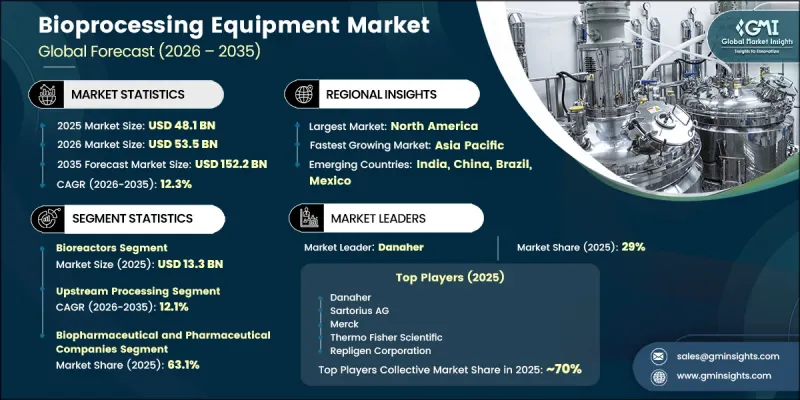
바이오의약품 제조사들이 효율성, 확장성 및 제품 품질 향상을 위해 첨단 생산 기술에 대한 투자를 확대함에 따라 시장은 지속적으로 성장하고 있습니다. 일회용 바이오 공정 시스템의 도입 확대, 바이오의약품 및 바이오시밀러에 대한 수요 증가, 그리고 세포·유전자 치료의 급속한 상용화가 첨단 바이오 공정 장비에 대한 강력한 수요를 창출하고 있습니다. 또한 위탁 제조 기관(CMO) 및 위탁 연구 기관(CRO)의 확대로 인해 설비 조달이 가속화되고, 제조 인프라의 지속적인 업그레이드가 촉진되고 있습니다. 각 기업은 규제 준수를 유지하면서 제조 유연성을 높이기 위해 자동화된 생산 플랫폼, 공정 최적화 기술 및 고성능 설비에 대한 투자를 점점 더 늘리고 있습니다. 바이오 공정 공학의 끊임없는 발전, 연구 활동의 활성화, 그리고 차세대 치료제 제조에 대한 투자 확대가 업계의 전망을 더욱 견고하게 만들고 있습니다. 다나허, 살토리아스 AG, 머크, 서모피셔 사이언티픽, 레플리젠 코퍼레이션을 비롯한 주요 기업은 지속적인 제품 혁신, 연구개발 투자, 글로벌 사업 확장, 그리고 헬스케어 및 생명과학 기관과의 전략적 제휴를 통해 경쟁력을 지속적으로 강화하고 있습니다.
| 시장 범위 | |
|---|---|
| 시작연도 | 2025년 |
| 예측 기간 | 2026-2035년 |
| 개시 금액 | 481억 달러 |
| 예측액 | 1,522억 달러 |
| CAGR | 12.3% |
2025년, 바이오리액터 시장은 133억 달러 규모에 도달했습니다. 바이오리액터는 의약품 제조에 필요한 미생물, 포유류 세포 및 기타 생물학적 물질을 배양하기 위한 정밀하게 제어된 환경을 제공하므로, 현대 바이오 공정에서 가장 필수적인 구성 요소 중 하나로 자리 잡고 있습니다. 바이오의약품, 바이오시밀러, 백신 및 첨단 치료제 생산 확대가 고성능 바이오리액터 시스템에 대한 지속적인 수요를 이끌고 있습니다. 바이오리액터의 설계, 자동화 기능, 공정 모니터링 기술 및 제조 효율의 지속적인 개선은 해당 부문의 성장을 더욱 촉진하는 동시에, 제조업체가 생산 능력을 확대하고 일관된 제품 품질을 유지할 수 있도록 하고 있습니다.
2025년에는 바이오의약품 및 제약 기업 부문이 시장 점유율의 63.1%를 차지했습니다. 이 기업은 바이오의약품, 백신, 바이오시밀러 및 신흥 치료 제품의 생산을 강화하기 위해 첨단 제조 기술에 막대한 투자를 계속하고 있습니다. 제조 효율, 공정 표준화, 규제 준수 및 생산 확장성에 대한 중요성이 높아짐에 따라 제약 제조 시설 전반에 걸쳐 첨단 바이오 공정 장비의 보급이 확대되고 있습니다. 또한 연구개발 활동의 지속적인 확대, 혁신적인 치료법의 상용화 진전, 그리고 현대적인 제조 인프라에 대한 투자 증가로 인해 예측 기간 중 이 최종사용자 부문의 강력한 수요가 지속될 것으로 예상됩니다.
2025년, 북미의 바이오 공정 장비 시장은 38%의 점유율을 차지했습니다. 이 지역은 확립된 바이오의약품 제조 생태계, 첨단 헬스케어 인프라, 그리고 생명공학 연구개발에 대한 투자 확대에 힘입어 계속해서 강력한 성장을 보이고 있습니다. 정부의 우호적인 정책, 바이오의약품 및 첨단 치료제 생산 확대, 그리고 만성질환 유병률의 증가가 이 지역 전반에 걸쳐 현대적인 바이오프로세스 장비의 도입을 가속화하고 있습니다. 또한 바이오 공정 시스템의 지속적인 기술 발전, 자동화 및 일회용 제조 솔루션에 대한 수요 증가, 그리고 주요 제약 및 생명공학 기업의 존재가 큰 성장 기회를 창출하고 있습니다. 생산 능력 확대, 연구 시설, 그리고 차세대 바이오 공정 기술에 대한 지속적인 투자를 통해 예측 기간 중 북미의 바이오 공정 장비 시장내 주도적 지위가 더욱 공고해질 것으로 예상됩니다.
자주 묻는 질문
목차
제1장 조사 방법과 범위
제2장 개요
제3장 업계 인사이트
제4장 경쟁 구도
제5장 시장 추산·예측 : 제품 유형별, 2022-2035년
제6장 시장 추산·예측 : 프로세스별, 2022-2035년
제7장 시장 추산·예측 : 용도별, 2022-2035년
제8장 시장 추산·예측 : 최종 용도별, 2022-2035년
제9장 시장 추산·예측 : 지역별, 2022-2035년
제10장 기업 개요
KSA 26.09.02The Global Bioprocessing Equipment Market was valued at USD 48.1 billion in 2025 and is estimated to grow at a CAGR of 12.3% to reach USD 152.2 billion by 2035.
The market continues to expand as biopharmaceutical manufacturers increase investments in advanced production technologies to improve efficiency, scalability, and product quality. Growing adoption of single-use bioprocessing systems, increasing demand for biologics and biosimilars, and the rapid commercialization of cell and gene therapies are creating strong demand for sophisticated bioprocessing equipment. In addition, the expansion of contract manufacturing organizations (CMOs) and contract research organizations (CROs) is accelerating equipment procurement and encouraging continuous upgrades of manufacturing infrastructure. Companies are increasingly investing in automated production platforms, process optimization technologies, and high-performance equipment to improve manufacturing flexibility while maintaining regulatory compliance. Continuous advancements in bioprocess engineering, increasing research activities, and growing investments in next-generation therapeutic manufacturing are further strengthening the industry's outlook. Leading participants, including Danaher, Sartorius AG, Merck, Thermo Fisher Scientific, and Repligen Corporation, continue to reinforce their competitive position through sustained product innovation, research and development investments, global business expansion, and strategic collaborations with healthcare organizations and life science institutions.
| Market Scope | |
|---|---|
| Start Year | 2025 |
| Forecast Year | 2026-2035 |
| Start Value | $48.1 Billion |
| Forecast Value | $152.2 Billion |
| CAGR | 12.3% |
The bioreactors segment captured USD 13.3 billion in 2025. Bioreactors continue to represent one of the most essential components of modern bioprocessing because they provide highly controlled environments for cultivating microorganisms, mammalian cells, and other biological materials required for pharmaceutical manufacturing. Growing production of biologics, biosimilars, vaccines, and advanced therapeutic products is driving sustained demand for high-performance bioreactor systems. Continuous improvements in bioreactor design, automation capabilities, process monitoring technologies, and manufacturing efficiency are further supporting segment growth while enabling manufacturers to increase production capacity and maintain consistent product quality.
The biopharmaceutical and pharmaceutical companies segment accounted for 63.1% share in 2025. These organizations continue to invest heavily in advanced manufacturing technologies to strengthen the production of biologics, vaccines, biosimilars, and emerging therapeutic products. Increasing emphasis on manufacturing efficiency, process standardization, regulatory compliance, and production scalability is encouraging widespread adoption of advanced bioprocessing equipment across pharmaceutical manufacturing facilities. Furthermore, continuous expansion of research and development activities, increasing commercialization of innovative therapies, and growing investments in modern manufacturing infrastructure are expected to sustain strong demand from this end-user segment throughout the forecast period.
North America Bioprocessing Equipment Market held a 38% share in 2025. The region continues to demonstrate strong growth, supported by its well-established biopharmaceutical manufacturing ecosystem, advanced healthcare infrastructure, and increasing investments in biotechnology research and development. Favorable government initiatives, expanding production of biologics and advanced therapeutics, and the growing prevalence of chronic diseases are accelerating the adoption of modern bioprocessing equipment across the region. In addition, continuous technological advancements in bioprocessing systems, increasing demand for automated and single-use manufacturing solutions, and the presence of leading pharmaceutical and biotechnology companies are creating significant growth opportunities. Ongoing investments in manufacturing capacity expansion, research facilities, and next-generation bioprocessing technologies are expected to further strengthen North America's leadership in the Bioprocessing Equipment Market throughout the forecast period.
Major companies operating in the global bioprocessing equipment market include ABEC Inc., Cellexus Ltd., Danaher, Distek Inc., Eppendorf AG, Getinge AB, Lonza Group, Merck, PBS Biotech Inc., Pierre Guerin Technologies (SPX Flow), Repligen Corporation, Sartorius AG, Single Use Support GmbH, Solaris Biotech (Donaldson), and Thermo Fisher Scientific. Companies operating in the global bioprocessing equipment market are strengthening their competitive position by investing extensively in product innovation, advanced manufacturing technologies, and research and development initiatives. Leading manufacturers are expanding their portfolios with highly automated, scalable, and single-use bioprocessing solutions that improve production efficiency while reducing operational complexity. Strategic partnerships with pharmaceutical companies, biotechnology firms, CMOs, and research institutions are helping organizations strengthen customer relationships and expand their global market presence. Businesses are also investing in digital process monitoring, automation technologies, and smart manufacturing platforms to enhance operational performance and improve process consistency. In addition, companies are expanding production capacity, strengthening global distribution networks, improving technical support services, and developing customized bioprocessing solutions to reinforce their market foothold, enhance competitiveness, and capitalize on the growing demand across the global bioprocessing equipment market.
Table of Contents
Chapter 1 Methodology and Scope
- 1.1 Market scope and definition
- 1.2 Research design
- 1.2.1 Research approach
- 1.2.2 Data collection methods
- 1.3 Data mining sources
- 1.3.1 Global
- 1.3.2 Regional/Country
- 1.4 Base estimates and calculations
- 1.4.1 Base year calculation
- 1.4.2 Key trends for market estimation
- 1.5 Primary research and validation
- 1.5.1 Primary sources
- 1.6 Forecast model
- 1.7 Research assumptions and limitations
Chapter 2 Executive Summary
- 2.1 Industry 360° synopsis
- 2.2 Key market trends
- 2.2.1 Regional trends
- 2.2.2 Product type trends
- 2.2.3 Process trends
- 2.2.4 Application trends
- 2.2.5 End use trends
- 2.3 CXO perspectives: Strategic imperatives
Chapter 3 Industry Insights
- 3.1 Industry ecosystem analysis
- 3.2 Industry impact forces
- 3.2.1 Growth drivers
- 3.2.1.1 Rising demand for biologics and biosimilars
- 3.2.1.2 Growing adoption of single-use bioprocessing systems is reducing capital and contamination risk
- 3.2.1.3 Rapid expansion of cell and gene therapy manufacturing
- 3.2.1.4 Increasing outsourcing to CMOs and CROs accelerating equipment procurement cycles
- 3.2.2 Industry pitfalls and challenges
- 3.2.2.1 High capital investment requirements for bioprocessing facilities
- 3.2.2.2 Stringent regulatory compliance requirements
- 3.2.3 Market opportunities
- 3.2.3.1 Increasing adoption of continuous bioprocessing technologies
- 3.2.3.2 Growing demand for personalized medicine production
- 3.2.1 Growth drivers
- 3.3 Growth potential analysis
- 3.4 Regulatory landscape
- 3.4.1 North America
- 3.4.2 Europe
- 3.4.3 Asia Pacific
- 3.4.4 Latin America
- 3.4.5 Middle East and Africa
- 3.5 Technological advancements
- 3.5.1 Current technological trends
- 3.5.2 Emerging technologies
- 3.6 Pricing trend analysis (Driven by primary research)
- 3.7 Future market trends (Driven by primary research)
- 3.8 Porter's analysis
- 3.9 PESTEL analysis
- 3.10 Gap analysis
- 3.11 Impact of AI and Generative AI on the market (Driven by primary research)
Chapter 4 Competitive Landscape, 2025
- 4.1 Introduction
- 4.2 Company matrix analysis
- 4.3 Company market share analysis (Driven by primary research)
- 4.3.1 Global
- 4.3.2 North America
- 4.3.3 Europe
- 4.3.4 Asia Pacific
- 4.4 Competitive positioning matrix
- 4.5 Competitive analysis of major market players
- 4.6 Key developments
- 4.6.1 Mergers & acquisitions
- 4.6.2 Partnerships & collaborations
- 4.6.3 New product launches
- 4.6.4 Expansion plans
Chapter 5 Market Estimates and Forecast, By Product Type, 2022 - 2035 ($ Mn)
- 5.1 Key trends
- 5.2 Bioreactors
- 5.3 Filtration systems
- 5.4 Chromatography systems
- 5.5 Mixing systems
- 5.6 Centrifuges
- 5.7 Cell culture systems
- 5.8 Control and monitoring systems
- 5.9 Other product types
Chapter 6 Market Estimates and Forecast, By Process, 2022 - 2035 ($ Mn)
- 6.1 Key trends
- 6.2 Upstream processing
- 6.3 Downstream processing
Chapter 7 Market Estimates and Forecast, By Application, 2022 - 2035 ($ Mn)
- 7.1 Key trends
- 7.2 Monoclonal antibodies (mAbs)
- 7.3 Vaccines and immunotherapy
- 7.4 Cell and gene therapy
- 7.5 Recombinant proteins and enzymes
- 7.6 Biosimilars
- 7.7 Other applications
Chapter 8 Market Estimates and Forecast, By End Use, 2022 - 2035 ($ Mn)
- 8.1 Key trends
- 8.2 Biopharmaceutical and pharmaceutical companies
- 8.3 CMOs and CROs
- 8.4 Academic and research institutes
Chapter 9 Market Estimates and Forecast, By Region, 2022 - 2035 ($ Mn)
- 9.1 Key trends
- 9.2 North America
- 9.2.1 U.S.
- 9.2.2 Canada
- 9.3 Europe
- 9.3.1 Germany
- 9.3.2 UK
- 9.3.3 France
- 9.3.4 Spain
- 9.3.5 Italy
- 9.3.6 Netherlands
- 9.4 Asia Pacific
- 9.4.1 China
- 9.4.2 India
- 9.4.3 Japan
- 9.4.4 Australia
- 9.4.5 South Korea
- 9.5 Latin America
- 9.5.1 Brazil
- 9.5.2 Mexico
- 9.5.3 Argentina
- 9.6 Middle East and Africa
- 9.6.1 Saudi Arabia
- 9.6.2 South Africa
- 9.6.3 UAE
Chapter 10 Company Profiles
- 10.1 ABEC Inc.
- 10.2 Cellexus Ltd.
- 10.3 Danaher
- 10.4 Distek Inc.
- 10.5 Eppendorf AG
- 10.6 Getinge AB
- 10.7 Lonza Group
- 10.8 Merck
- 10.9 PBS Biotech Inc.
- 10.10 Pierre Guerin Technologies (SPX Flow)
- 10.11 Repligen Corporation
- 10.12 Sartorius AG
- 10.13 Single Use Support GmbH
- 10.14 Solaris Biotech (Donaldson)
- 10.15 Thermo Fisher Scientific


