
|
시장보고서
상품코드
2123794
아쿠아포닉스 시장 : 점유율 분석, 업계 동향과 통계, 성장 예측(2026-2031년)Aquaponics - Market Share Analysis, Industry Trends & Statistics, Growth Forecasts (2026 - 2031) |
||||||
 Mordor Intelligence
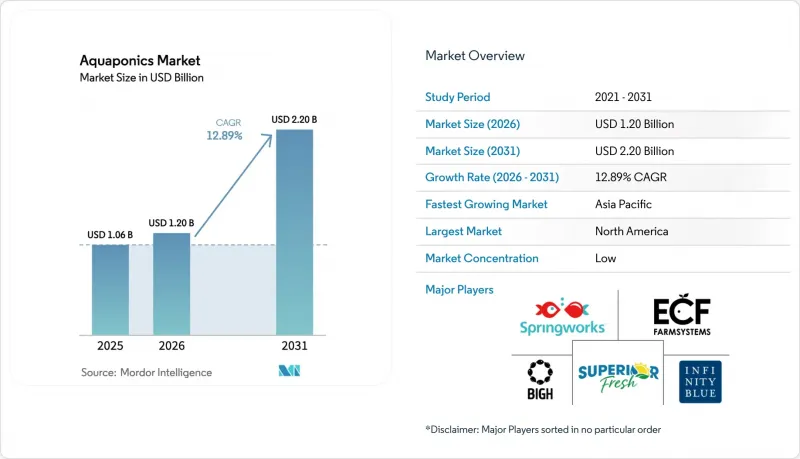
Mordor Intelligence에 의하면, 아쿠아포닉스 시장 규모는 2025년에 10억 6,000만 달러로 평가되었고 2026년 12억 달러에서 2031년까지 22억 달러에 이를 것으로 예측되며, 예측 기간(2026-2031년) CAGR은 12.89%를 나타낼 전망입니다.
본 보고서는 작물 유형(잎채소, 허브 및 마이크로그린, 토마토, 오이, 베리류 등), 어종(틸라피아, 메기, 송어 등), 생산 규모(대규모, 중소규모), 지역(북미, 남미, 유럽, 아시아태평양, 중동 및 아프리카)별로 분류되어 있습니다. 시장 전망은 금액(달러) 기준으로 제시되어 있습니다.
세계 아쿠아포닉스 시장 동향 및 인사이트
지역산 무농약 농산물에 대한 수요 증가
도시 소비자들은 수확 후 24시간 이내에 유통되는 추적 가능한 채소를 점점 더 선호하고 있으며, 아쿠아포닉스에서는 물고기가 순환수 내의 화학 물질 잔류물을 견디지 못하기 때문에 합성 농약의 사용이 필요하지 않습니다. Superior Fresh LLC는 2024년 인디애나주에서 수경 재배 상추 생산을 중단하고 위스콘신주의 통합 시설에 자본을 집중했습니다. 이는 단백질과 농산물을 결합한 모델이 뛰어난 수익률을 창출함을 시사합니다. 소매 가격에 20.0-30.0%의 프리미엄이 가산됨에 따라, 사업자들은 파머스 마켓이나 정기 배송을 통해 도매 유통 경로를 우회하도록 유도되어, 수요가 정점에 달하는 성수기에도 현금 흐름이 안정적입니다.
순환 경제에 기반한 절수 대책 도입
아쿠아포닉스는 시스템 내 물의 약 90.0%를 재활용하고 있어, 유럽연합(EU)의 순환형 경제 지침 및 중동의 가뭄 대책 전략과 완벽하게 부합합니다. 싱가포르 농업·식품·수의국(AVA)은 2025년까지 저수자원형 농업·식품 연구를 지원하기 위해 3억 900만 싱가포르 달러(2억 2,930만 달러)를 예산으로 편성했습니다. 유럽연합(EU)의 ‘LIFE-LEMNERGY’ 프로젝트는 현재 2021년부터 2027년까지의 단계로 진행 중이며, 물풀을 통한 영양염 회수,배수량 감소, 그리고 기후 조절에 드는 에너지 비용을 상쇄하는 바이오가스 생산을 통합함으로써 85.0%를 초과하는 질소 제거율을 달성하고 있습니다.
초기 투자액의 규모 및 운영상의 복잡성
상업용 시설의 설치 비용은 1제곱미터당 500-1,000달러로, 수경 재배의 동급 시설보다 최대 50.0% 더 비쌉니다. 이는 통합 시스템에서 양어조, 바이오 필터 및 기후 관리 시스템을 조화롭게 운영해야 하기 때문입니다. 온대 지역에서는 운영 예산의 최대 40.0%를 에너지 비용이 차지하며, 정전 시 예비 발전기가 작동하지 않으면 물고기가 대량으로 폐사할 우려가 있습니다. 투자 회수 기간은 5년을 초과하는 경우가 많으며, 이러한 장기적인 회수 전망은 기존의 농업 금융 기관이나 벤처 캐피털에게는 매력적이지 않은 요소로 작용하고 있습니다.
부문 분석
2025년에는 잎채소가 매출의 46.3%를 차지했지만, 허브와 마이크로그린은 2031년까지 연평균 성장률(CAGR) 13.7%로 확대되고 있습니다. 허브는 3-6주 만에 수확할 수 있는 반면, 양상추는 8-10주가 걸리기 때문에 허브 쪽이 자금 회전율이 더 빠릅니다. 바질, 민트, 고수(코리앤더)의 도매 가격은 양상추의 2-3배이며, 이는 온도 및 습도가 관리되는 환경에 따른 높은 에너지 비용을 반영한 것입니다. 토마토, 오이, 베리류는 칼슘과 마그네슘의 정확한 균형 조절 및 수분 작업이 필요하고 인건비가 증가하기 때문에 여전히 틈새 시장에 머물러 있습니다. 인삼이나 클라톰과 같은 약용 식물은 라이선싱이나 제3자 기관에 의한 유효 성분 분석이 필요하지만, 제약 기업과 공급 계약이 체결되면 이익률이 60.0%를 넘기도 합니다.
아시아태평양에서는 딸기, 피망, 아시아 특유의 채소로 사업이 더욱 확대되고 있습니다. 이 지역에서는 가처분 소득 증가로 인해 신기함이나 안전 인증에 대한 지불 의향이 높아지고 있습니다. 유럽이나 일본으로의 수출 계약에서는 국제표준화기구(ISO) 22000의 체계가 점점 더 필수 조건으로 규정되고 있습니다. 작물 포트폴리오를 다각화하고 있는 사업자는 시장 변동 위험을 헤지할 수 있지만, 통합 시스템 전체에 파급될 가능성이 있는 영양 결핍을 피하기 위해서는 품종별 영양 흡수량을 적절히 관리해야 합니다.
지역별 분석
2025년, 북미는 아쿠아포닉스 시장을 주도하며 매출 점유율 34.2%를 차지했습니다. 이는 소비자들이 무농약 농산물에 높은 가격을 지불하는 한편, 주 정부의 보조금이 환경 제어 시설의 설비 투자 비용을 보전해 주었기 때문입니다. 활동은 위스콘신주, 캘리포니아주 및 중대서양 연안 지역에 집중되어 있으며, 이들 지역은 도시의 인구 밀도가 높아 유통 반경이 짧게 유지되고 있습니다. 캐나다의 ‘농업 청정 기술 프로그램’은 겨울철 난방비 급등에 특히 큰 영향을 받는 브리티시컬럼비아주와 온타리오주의 시설 개보수를 지원하고 있습니다. 미국 농무부(USDA)가 아쿠아포닉스 생산물의 유기농 표시를 인정하고 있기 때문에 규제 측면에서의 명확성이 장점으로 작용하여 마케팅 및 가격 책정이 간소화되고 있습니다.
아시아태평양은 가장 빠르게 성장하는 지역이며, 메가시티들이 토지 부족 및 식량 안보에 대한 요구 증가에 직면하고 있어 2031년까지 연평균 성장률(CAGR)이 13.1%를 나타낼 것으로 예측됩니다. 중국에서는 유휴 창고를 어류와 식물의 통합 허브로 재활용하고 있는 반면, 일본에서는 지방 도도부현에서 지역 사회의 회복력 향상을 목적으로 한 시범 사업에 자금을 지원하고 있습니다. 인도의 벵갈루루와 뭄바이에 위치한 클러스터는 중산층 소비자들의 식품 안전에 대한 우려에 대응하고 있으며, 호주는 틸라피아가 주류 수입품과 차별화될 수 있도록 바라만디의 보급을 추진하고 있습니다. 한국에서는 서울과 부산에서 옥상 시스템이 검토되고 있으나, 도시 농업 정책은 아직 수립 단계에 있습니다.
유럽의 투자 동향은 순환형 경제에 관한 지침을 따르고 있습니다. 벨기에의 BIGH 옥상 농장은 수확부터 매장에 진열되기까지의 시간이 2시간 미만이어도 수익성이 있음을 입증하고 있습니다. 영국의 Flo-Gro가 개발한 새우 양식 시스템은 양식 대상 종의 선택 폭을 넓히고 있지만, 유기농 인증 기준이 통일되지 않은 점과 에너지 요금 급등이 남유럽 사업자들에게 과제로 대두되고 있습니다. 중동 및 아프리카에서는 희소한 담수 자원을 보전하기 위해 아쿠아포닉스가 활용되고 있습니다. 아랍에미리트와 사우디아라비아에서는 해수 담수화와 태양광 발전을 결합하여 운영 비용 절감을 도모하고 있습니다. 남아프리카공화국은 케이프타운과 요하네스버그에서 Off-grid형 아쿠아포닉스 실증 실험을 진행하고 있는 반면, 브라질과 아르헨티나는 상파울루와 부에노스아이레스에서 초기 단계 도입을 추진하고 있으나, 프로젝트 자금 부족과 규제 불확실성으로 인해 그 진전이 제한되고 있습니다.
기타 혜택:
- 엑셀 형식 시장 예측(ME) 시트
- 3개월간의 애널리스트 지원
자주 묻는 질문
목차
제1장 서론
제2장 조사 방법
제3장 주요 요약
제4장 시장 구도
제5장 시장 규모와 성장 예측
제6장 경쟁 구도
제7장 시장 기회와 향후 전망
JHS 26.09.07According to Mordor Intelligence, the aquaponics market size was valued at USD 1.06 billion in 2025 and estimated to grow from USD 1.20 billion in 2026 to reach USD 2.20 billion by 2031, at a CAGR of 12.89% during the forecast period (2026-2031).
This report is Segmented by Crop Type (Leafy Greens, Herbs and Microgreens, Tomatoes, Cucumbers, Berries, and More), by Fish Species (Tilapia, Catfish, Trout, and More), by Production Scale (Large-Scale and Small and Medium-Scale), and by Geography (North America, South America, Europe, Asia-Pacific, Middle East, and Africa). The Market Forecasts are Provided in Terms of Value (USD).
Global Aquaponics Market Trends and Insights
Rising Demand for Locally Sourced Pesticide-Free Produce
Urban shoppers are increasingly demanding traceable vegetables harvested within 24 hours, and aquaponics eliminates the need for synthetic pesticides because fish cannot tolerate chemical residues in recirculating water. Superior Fresh LLC shuttered its hydroponic lettuce production in Indiana in 2024 to concentrate capital on its integrated Wisconsin complex, signaling that dual protein-and-produce models generate superior margins. Retail premiums of 20.0-30.0% encourage operators to bypass wholesale channels through farmers' markets and subscription deliveries, stabilizing cash cycles during peak demand seasons.
Adoption of Circular-Economy Water-Conservation Practices
Aquaponics recycles approximately 90.0% of the system's water, aligning perfectly with European Union circular economy directives and drought mitigation strategies in the Middle East. Singapore's Agri-Food and Veterinary Authority has earmarked SGD 309 million (USD 229.3 million) to support low-water agrifood research through 2025. The LIFE-LEMNERGY project in the European Union, currently running in the 2021-2027 phase, has achieved nitrogen removal above 85.0% by integrating duckweed nutrient recovery, cutting discharge, and generating biogas that offsets climate-control energy costs.
High Upfront Capital and Operational Complexity
Commercial installations cost USD 500-1,000 per square meter, exceeding hydroponic equivalents by up to 50.0%, because integrated systems must harmonize fish tanks, biofilters, and climate management systems. Energy accounts for as much as 40.0% of operating budgets in temperate zones, and power outages can cause catastrophic fish mortality if backup generators fail. Payback often stretches beyond five years, a horizon that traditional agricultural lenders and venture capital find unattractive.
Other drivers and restraints analyzed in the detailed report include:
- Integration with Vertical Farming for Urban Food Security
- Commercialization of High-Value Medicinal Herbs
- Zoonotic Pathogen Management Risks
For complete list of drivers and restraints, kindly check the Table Of Contents.
Segment Analysis
Leafy greens captured 46.3% of revenue in 2025, while herbs and microgreens are advancing at a 13.7% CAGR through 2031. Herbs mature in three to six weeks, versus eight to ten weeks for head lettuce, enabling faster cash rotation. Wholesale prices for basil, mint, and cilantro are two to three times higher than those for lettuce, reflecting the higher energy costs associated with climate-controlled environments. Tomatoes, cucumbers, and berries remain niche because they require precise calcium-to-magnesium balancing and pollination services, which increase labor inputs. Medicinal botanicals, including ginseng and kratom, require licensing and third-party potency assays, yet their margins can exceed 60.0% when supply contracts with pharmaceutical buyers are secured.
Additional expansion into strawberries, peppers, and Asian specialty vegetables is unfolding in the Asia-Pacific region, where rising disposable income underpins the willingness to pay for novelty and safety certifications. The International Organization for Standardization 22000 framework is increasingly stipulated in export contracts to Europe and Japan. Operators with diversified crop portfolios hedge against market volatility, but they must manage species-specific nutrient uptakes to avert deficiencies that can ripple through the integrated system.
Complete Report Scope:
- By Crop Type
- Leafy Greens
- Herbs and Microgreens
- Tomatoes
- Cucumbers
- Berries
- Other Crops
- By Fish Species
- Tilapia
- Catfish
- Trout
- Other Fish
- By Production Scale
- Large-Scale
- Small and Medium-Scale
- By Geography
- North America
- United States
- Canada
- Rest of North America
- South America
- Brazil
- Argentina
- Rest of South America
- Europe
- Germany
- Netherlands
- France
- United Kingdom
- Italy
- Rest of Europe
- Asia-Pacific
- China
- Japan
- India
- Australia
- South Korea
- Rest of Asia-Pacific
- Middle East
- United Arab Emirates
- Saudi Arabia
- Rest of Middle East
- Africa
- South Africa
- Kenya
- Rest of Africa
- North America
Geography Analysis
North America led the aquaponics market in 2025, with a 34.2% revenue share, as consumers paid premiums for pesticide-free produce and state grants offset capital expenses for controlled-environment facilities. Activity concentrates in Wisconsin, California, and the Mid-Atlantic, where urban density keeps the distribution radius short. Canada's Agricultural Clean Technology Program subsidizes retrofits in British Columbia and Ontario, regions that are particularly affected by high heating costs during the winter. Regulatory clarity is an advantage because the United States Department of Agriculture (USDA) allows organic labeling for aquaponic outputs, simplifying marketing and price positioning.
The Asia-Pacific region is the fastest-growing zone, with a 13.1% CAGR projected to 2031, as megacities face land scarcity and increasing food security mandates. China repurposes idle warehouses for integrated fish and plant hubs, while Japan funds community resilience pilots in rural prefectures. India's clusters in Bangalore and Mumbai respond to food-safety concerns among middle-class consumers, and Australia promotes barramundi to differentiate from tilapia-heavy imports. South Korea is exploring rooftop systems in Seoul and Busan, although its urban agriculture policy is still in formation.
Europe's investment trajectory aligns with the circular economy directives. Belgium's BIGH rooftop farm proves that harvest-to-shelf times under two hours can be profitable. The United Kingdom's Flo-Gro shrimp configuration widens species options, but inconsistent organic certification and elevated energy tariffs challenge Southern European operators. The Middle East and Africa utilize aquaponics to conserve scarce freshwater resources. The United Arab Emirates and Saudi Arabia blend desalination with solar power to reduce operating costs. South Africa pilots off-grid aquaponics in Cape Town and Johannesburg, while Brazil and Argentina nurture early-stage deployments in Sao Paulo and Buenos Aires, tempered by limited project finance and regulatory uncertainty.
- Superior Fresh LLC
- ECF Farmsystems GmbH
- Infinity Blue Barramundi LLC (MainStream Aquaculture Group)
- Traders Hill Farm
- Great Lakes Aquaponics
- Springworks Farm Maine, Inc.
- Bella Vita Farm LLC
- Waterfield Farms Inc.
- AquaSprout Farms, LLC
- Waterwheel Farms
- Victory Farms Ltd.
- Blue Acre Appalachian Aquaponics Center
- WaterFarmers Urban Agriculture (Sustainnovation Inc.)
- BIGH
- Deepwater Farms
Additional Benefits:
- The market estimate (ME) sheet in Excel format
- 3 months of analyst support
TABLE OF CONTENTS
1 Introduction
- 1.1 Study Assumptions and Market Definition
- 1.2 Scope of the Study
2 Research Methodology
3 Executive Summary
4 Market Landscape
- 4.1 Market Overview
- 4.2 Market Drivers
- 4.2.1 Rising demand for locally sourced pesticide-free produce
- 4.2.2 Adoption of circular-economy water conservation practices
- 4.2.3 Integration with vertical farming for urban food security
- 4.2.4 Commercialization of high-value medicinal herbs
- 4.2.5 Government incentives for sustainable agriculture
- 4.2.6 Advances in controlled-environment monitoring
- 4.3 Market Restraints
- 4.3.1 High upfront capital and operational complexity
- 4.3.2 Zoonotic pathogen management risks
- 4.3.3 Limited availability of skilled labor
- 4.3.4 Fragmented regulatory standards across markets
- 4.4 Regulatory Landscape
- 4.5 Technological Outlook
- 4.6 Porter's Five Forces Analysis
- 4.6.1 Threat of New Entrants
- 4.6.2 Bargaining Power of Suppliers
- 4.6.3 Bargaining Power of Buyers
- 4.6.4 Threat of Substitutes
- 4.6.5 Intensity of Competitive Rivalry
5 Market Size and Growth Forecasts (Value)
- 5.1 By Crop Type
- 5.1.1 Leafy Greens
- 5.1.2 Herbs and Microgreens
- 5.1.3 Tomatoes
- 5.1.4 Cucumbers
- 5.1.5 Berries
- 5.1.6 Other Crops
- 5.2 By Fish Species
- 5.2.1 Tilapia
- 5.2.2 Catfish
- 5.2.3 Trout
- 5.2.4 Other Fish
- 5.3 By Production Scale
- 5.3.1 Large-Scale
- 5.3.2 Small and Medium-Scale
- 5.4 By Geography
- 5.4.1 North America
- 5.4.1.1 United States
- 5.4.1.2 Canada
- 5.4.1.3 Rest of North America
- 5.4.2 South America
- 5.4.2.1 Brazil
- 5.4.2.2 Argentina
- 5.4.2.3 Rest of South America
- 5.4.3 Europe
- 5.4.3.1 Germany
- 5.4.3.2 Netherlands
- 5.4.3.3 France
- 5.4.3.4 United Kingdom
- 5.4.3.5 Italy
- 5.4.3.6 Rest of Europe
- 5.4.4 Asia-Pacific
- 5.4.4.1 China
- 5.4.4.2 Japan
- 5.4.4.3 India
- 5.4.4.4 Australia
- 5.4.4.5 South Korea
- 5.4.4.6 Rest of Asia-Pacific
- 5.4.5 Middle East
- 5.4.5.1 United Arab Emirates
- 5.4.5.2 Saudi Arabia
- 5.4.5.3 Rest of Middle East
- 5.4.6 Africa
- 5.4.6.1 South Africa
- 5.4.6.2 Kenya
- 5.4.6.3 Rest of Africa
- 5.4.1 North America
6 Competitive Landscape
- 6.1 Market Concentration
- 6.2 Strategic Moves
- 6.3 Market Share Analysis
- 6.4 Company Profiles (includes Global-Level Overview, Market-Level Overview, Core Segments, Financials as Available, Strategic Information, Market Rank/Share for Key Companies, Products and Services, and Recent Developments)
- 6.4.1 Superior Fresh LLC
- 6.4.2 ECF Farmsystems GmbH
- 6.4.3 Infinity Blue Barramundi LLC (MainStream Aquaculture Group)
- 6.4.4 Traders Hill Farm
- 6.4.5 Great Lakes Aquaponics
- 6.4.6 Springworks Farm Maine, Inc.
- 6.4.7 Bella Vita Farm LLC
- 6.4.8 Waterfield Farms Inc.
- 6.4.9 AquaSprout Farms, LLC
- 6.4.10 Waterwheel Farms
- 6.4.11 Victory Farms Ltd.
- 6.4.12 Blue Acre Appalachian Aquaponics Center
- 6.4.13 WaterFarmers Urban Agriculture (Sustainnovation Inc.)
- 6.4.14 BIGH
- 6.4.15 Deepwater Farms