
|
시장보고서
상품코드
2123982
온라인 복권 시장 : 시장 점유율 분석, 업계 동향 및 통계, 성장 예측(2026-2031년)Online Lottery - Market Share Analysis, Industry Trends & Statistics, Growth Forecasts (2026 - 2031) |
||||||
 Mordor Intelligence
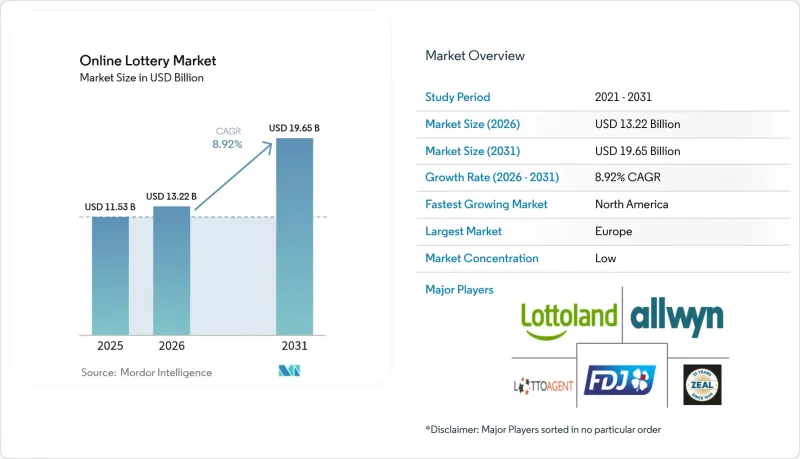
Mordor Intelligence에 의하면, 온라인 복권 시장 규모는 2025년 115억 3,000만 달러로 평가되었고, 2026년 132억 2,000만 달러에서 2031년까지 196억 5,000만 달러로 확대될 것으로 예측되며, 2026-2031년 연평균 복합 성장률(CAGR)은 8.92%를 나타낼 전망입니다.
본 보고서는 플랫폼 유형별(데스크톱, 모바일), 게임 유형별(추첨식 복권, 즉석 복권, 스포츠 복권, 기타), 연령대별(25세 미만, 25-40세, 40-55세, 55세 이상), 최종 사용자별(남성, 여성), 지역별(북미, 유럽, 아시아태평양, 기타 지역)로 분류되어 있습니다. 시장 전망은 금액(달러) 기준으로 제시되어 있습니다.
세계의 온라인 복권 시장 동향 및 인사이트
디지털 지갑 보급률 상승 및 모바일 결제 통합
현재 온라인 복권 거래에서는 디지털 지갑과 모바일 결제 시스템이 주류를 이루고 있어, 결제 포기율을 낮추고 충동 구매를 위한 즉시 입금이 가능해졌습니다. 2025년, 국제전기통신연합(ITU) 보고서에 따르면 전 세계 모바일 머니 계좌 수는 16억 건을 넘어섰고, 거래액은 1조 2,000억 달러를 상회하여, 은행 인프라가 제한된 지역의 복권 사업자들이 시장에 쉽게 접근할 수 있게 되었습니다. IGT의 플랫폼은 Apple Pay, Google Pay는 물론 케냐의 M-Pesa, 인도의 Paytm과 같은 지역별 지갑을 통합하여, 카드 정보를 입력하지 않고도 신속하게 계좌에 입금할 수 있게 되었으며, 베팅 속도도 향상되었습니다. 2024년, Allwyn Entertainment는 영국의 National Lottery 앱에 PayPal과 Klarna를 추가하여 18세에서 34세 사용자층의 모바일 전환율을 23% 향상시켰습니다. 라틴아메리카는 임베디드 파이낸스 분야를 선도하고 있으며,브라질 중앙은행(Banco Central do Brasil)의 PIX 시스템은 2025년에 420억 건의 거래를 처리할 예정이며, 카이샤 에코노미카 페데랄(Caixa Economica Federal)은 PIX를 지원하는 복권 구매 서비스를 시범 도입하고 있습니다. 유럽연합(EU)에서는 개정된 결제 서비스 지침(PSD2)에 따라 강력한 고객 인증이 의무화되는 한편, 오픈 뱅킹 API를 이용할 수 있게 되어 복권 플랫폼이 카드 네트워크를 거치지 않고 은행 계좌에서 직접 결제를 시작할 수 있게 되었으며, 이를 통해 수수료를 절감할 수 있게 되었습니다.
합법화 및 규제 완화
합법적인 온라인 복권 체계가 관할 구역을 확대하고 있는 것은 단기적인 성장의 중요한 원동력이 되고 있으며, 그동안 제한되었던 시장을 개방하고 비공식 복권 활동을 규제된 시스템으로 전환시키고 있습니다. 미국에서는 미시간주의 iLottery 플랫폼이 2025년에 연간 매출 10억 달러를 달성함으로써, 오프라인 매장의 수익을 훼손하지 않으면서도 디지털 채널과 소매 사업이 공존할 수 있음이 부각되었습니다. 전미 도박 주 의원 협의회(NCLGS)는 2024년에 ‘iLottery 모델 법안’을 마련하여, 인가를 검토 중인 주에 입법적 틀을 제공하는 동시에 연령 확인, 위치 정보 확인, 책임감 있는 도박과 같은 과제를 해결하고 있습니다. 유럽에서는 독일의 ‘도박에 관한 주간 조약’에 따라 엄격한 광고 규제 및 기업 보호 규제 하에서 온라인 복권 판매가 허용되고 있습니다. 2025년, 독일 각 주 합동 도박 감독 기관(GGL)은 12건의 신규 라이선스를 발급했으며, Lotto24나 ZEAL Network와 같은 기존 사업자들 간의 경쟁이 격화되었습니다. 마찬가지로 라틴아메리카에서도 자유화가 진행되고 있으며, 아르헨티나 부에노스아이레스 주는 2024년에 온라인 복권을 합법화했고, 브라질 연방 정부는 2026년에 시행될 예정인 iGaming 규정을 최종 확정했습니다. 이로 인해 대상 성인 시장은 총 2억 5,000만 명 이상에 달하게 됩니다.
규제 및 법적 과제
관할 구역별로 분할되어 있고 모순되는 규제 체제는 규정 준수 비용을 증가시키고, 시장 진입을 지연시키며, 제품 혁신을 저해하는 법적 불확실성을 야기하고 있습니다. 미국에서는 2025년 현재 iLottery 판매를 허용하는 주가 11개 주에 불과하며, 39개 주에서는 금지되어 있거나 관련 법규가 마련되어 있지 않아 사업자는 주별로 개별적인 기술 및 마케팅 활동을 관리해야 합니다. 아시아태평양에서는 중국 공안부가 온라인 복권을 불법 도박으로 분류하고 운영자 및 결제 처리 업체를 기소하고 있어, 합법적인 사업자에게는 사실상 시장이 폐쇄된 상태입니다. 인도에서는 1867년 ‘공적 도박법’에 따라 복권 규제가 각 주에 위임되어 있으며, 그 결과 13개 주에서 복권이 운영되고 있지만 온라인 판매를 허용하는 곳은 시킴 주뿐입니다. 또한, 상품·서비스세 위원회는 복권권에 28%의 세금을 부과하고 있는데, 이는 모든 소비재 중에서 가장 높은 세율입니다. 유럽연합(EU)에서는 보완성 원칙에 따라, 회원국이 공공 정책상의 이유로 도박 서비스를 제한하는 것이 허용되고 있습니다. 폴란드나 네덜란드 등의 국가에서는 EU 내 다른 지역에서 인가를 받은 사업자라 하더라도 현지 라이선스를 취득해야 할 의무가 있어, 단일 시장이 더욱 세분화되고 있습니다.
부문 분석
2025년, 모바일은 온라인 복권 시장 점유율의 57.26%를 차지했으며, 연평균 성장률(CAGR) 10.52%로 확대되고 있는 반면, 스마트폰 보급이 진행됨에 따라 데스크톱의 점유율은 축소되고 있습니다. 라이브 추첨이나 AR 스크래치 카드와 같은 리치 미디어를 지원하는 5G 커버리지 확대에 따라, 모바일 거래를 통한 온라인 복권 시장 규모도 마찬가지로 성장할 것으로 예측됩니다. IGT의 생체 인증 지원 미주리주용 앱은 6개월 만에 월간 활성 사용자 수를 38% 증가시켰으며, 원탭 인증이 재구매를 촉진한다는 사실을 보여주고 있습니다. 데스크톱은 여러 장의 티켓 관리나 대형 화면이 필요한 고액 신디케이트에서는 여전히 중요하지만, 점유율은 해마다 감소하고 있습니다. 인도를 포함한 신흥 시장에서는 사용자의 89%가 데스크톱 브라우저를 전혀 사용하지 않기 때문에 사실상 모바일 전용 이용 패턴이 나타나고 있으며, 사업자들은 안드로이드 우선 앱 개발로 방향을 전환하고 있습니다.
모바일은 참여도를 높이는 지오펜싱, 푸시 알림, 게임화 루프를 제공하지만, 사업자들은 앱 스토어 규제, 치솟는 사용자 확보 비용, 복잡한 베팅을 처리하기 위한 화면 공간 제한과 같은 과제에 직면해 있습니다. 프로그레시브 웹 앱(PWA)은 앱 스토어의 규정을 우회할 수 있지만, 네이티브 알림 기능을 이용할 수 없기 때문에 SMS나 이메일을 통한 CRM에 대한 의존도가 높아지게 됩니다. 5G로 인해 지연 시간이 줄어들고 그래픽 성능이 향상됨에 따라, 사업자들은 기존 웹 채널과는 차별화된 몰입형 로비와 라이브 스트리밍을 통한 당첨 발표 도입을 계획하고 있습니다.
추첨형 게임은 매주 정기적으로 플레이되는 행사나 화제가 되는 잭팟을 제공하는 ‘파워볼’이나 ‘유로밀리언즈’와 같은 브랜드에 힘입어 2025년 매출의 34.21%를 계속 차지했습니다. 그러나 즉석 당첨형 타이틀은 연평균 성장률(CAGR) 10.11%로 가장 높은 성장세를 보이고 있으며, 온라인 복권 시장 규모는 캐주얼 모바일 게임을 연상시키는 온디맨드형 엔터테인먼트로 전환되고 있습니다. ‘모노폴리’와 같은 라이선스 IP는 인지도가 높은 테마가 위험 인식을 완화하기 때문에 재구매율과 평균 지출액을 끌어올리고 있습니다. 인스턴트 상품에는 적극적인 컨텐츠 공급이 요구되고 있으며, NeoGames사는 2025년에 120종의 독자적인 eInstant 타이틀을 출시하여 신선함을 유지했습니다.
스포츠 복권이나 키노, 추첨식 게임과 같은 부가적인 게임은 틈새 수요를 충족시키고 위험을 분산시키지만, 잭팟 규모가 지역 평균을 크게 상회하지 않는 한 주류의 관심을 끌기는 어렵습니다. 추첨식 게임은 여전히 장당 비용이 낮고, 평균 주문 금액도 크며, 추첨 빈도가 제한적이기 때문에 상시 이용 가능한 인스턴트 게임 카탈로그에 비해 사용자 참여도가 제한적입니다. 현재 사업자들은 인스턴트 게임을 주로 이용하는 사용자에게 추첨식 게임의 정기 구독을 교차 판매하고, 그 반대의 경우도 수행함으로써 위험을 헤지하고 있으며, 이를 통해 두 분야 모두에서 고객 이탈률을 낮추고 있습니다.
지역별 분석
2025년, 유럽은 전 세계 복권 수익의 46.72%를 차지했습니다. 이는 90% 이상의 인터넷 보급률과 기존 국가 복권의 원활한 온라인 전환에 힘입은 결과로, 이를 통해 소매 매출의 잠식을 성공적으로 피할 수 있었습니다. 영국의 내셔널 로터리(National Lottery)는 2025년 3월 회계연도에 18억 파운드(23억 달러)의 디지털 수익을 기록했습니다. 독일에서는 새로운 라이선싱 물결로 인해 Lotto24와 ZEAL Network 간의 경쟁이 격화되었습니다. 프랑스의 FDJ는 모바일 최적화와 브랜드화된 인스턴트 복권 출시를 활용하여 온라인에서 32억 유로(35억 달러)의 수익을 창출했습니다. 이탈리아에서는 2025년에 Allwyn, Sisal, IGT로 구성된 컨소시엄에 9년간의 로또 운영권이 부여되면서, 고부가가치 남유럽 시장에서 옴니채널형 합작 사업이 선호되는 경향이 부각되었습니다.
북미는 미국 각 주에서 iLottery의 합법화가 확대되고, 캐나다 각 주에서 소매 및 온라인 플레이가 통합됨에 힘입어 연평균 성장률(CAGR) 10.11%라는 가장 높은 성장률을 기록했습니다. 미시간주는 소매 매출을 유지하면서 2025년에 디지털 매출 10억 달러를 돌파했습니다. 2024년 11월에 시작된 뉴욕주의 iLottery는 예상을 뛰어넘는 성과를 거두며, 시작 후 6개월 만에 1억 8,000만 달러의 매출을 기록했는데, 이는 예측치를 22% 상회하는 수치였습니다. 온타리오주의 오픈 게이밍 프레임워크 덕분에 2025년까지 i게이밍 총 매출액은 10억 캐나다 달러(7억 4,000만 달러)에 달했으며, 그중 복권 부문이 15%를 차지했습니다. 멕시코에서는 9,200만 명의 인터넷 사용자를 대상으로 새롭게 도입된 모바일 앱이 첫해에 5,000만 미달러의 매출 달성을 목표로 했습니다.
아시아태평양에서는 중국과 인도의 일부 주, 인도네시아의 규제 영향이 있었음에도 불구하고 디지털 부문은 꾸준한 성장을 보였습니다. 호주의 Lottery Corporation은 2025 회계연도 온라인 수익이 전년 대비 9% 증가한 39억 호주 달러(26억 달러)에 달했다고 보고했습니다. 뉴질랜드에서는 Lotto NZ가 2024년에 6억 8,000만 NZD(4억 2,000만 달러)의 수익을 올렸으며, 그중 72%를 모바일이 차지했습니다. 브라질에서는 2025년에 연방 차원의 iGaming 규제가 확정되어 2026년 시행이 예정되어 있으며, 1억 5,000만 명 이상의 기업을 보유한 시장이 개방될 가능성이 있습니다. 그러나 필리핀과 중동 및 아프리카 전역에서는 규제 당국이 사회적 비용과 세수를 신중하게 비교 검토하고 있어 디지털 복권 도입이 더딘 양상을 보이고 있습니다.
기타 혜택 :
- 엑셀 형식 시장 예측(ME) 시트
- 3개월간의 애널리스트 지원
자주 묻는 질문
목차
제1장 서론
제2장 조사 방법
제3장 주요 요약
제4장 시장 구도
제5장 시장 규모 및 성장 예측
제6장 경쟁 구도
제7장 시장 기회 및 향후 전망
AJYAccording to Mordor Intelligence, the online lottery market size is projected to expand from USD 11.53 billion in 2025 and USD 13.22 billion in 2026 to USD 19.65 billion by 2031, registering a CAGR of 8.92% between 2026 and 2031.
This report is Segmented by Platform Type (Desktop, Mobile), Game Type (Draw-Based Lottery, Instant Lottery, Sports Lottery, Others), Age Group (Below 25 Years, 25-40 Years, 40-55 Years, 55+ Years), End User (Male, Female), and Geography (North America, Europe, Asia-Pacific, Rest of the World). The Market Forecasts are Provided in Terms of Value (USD).
Global Online Lottery Market Trends and Insights
Rising Penetration of Digital Wallets and Mobile Payments Integration
Digital wallets and mobile payment systems now dominate online lottery transactions, reducing checkout abandonment and enabling instant deposits for impulse purchases. In 2025, the International Telecommunication Union reported over 1.6 billion mobile money accounts globally, with transaction values exceeding USD 1.2 trillion, easing access for lottery operators in regions with limited banking infrastructure. IGT's platform integrates Apple Pay, Google Pay, and regional wallets like M-Pesa in Kenya and Paytm in India, allowing quick account funding without card details and speeding up betting. In 2024, Allwyn Entertainment added PayPal and Klarna to its UK National Lottery app, boosting mobile conversion rates by 23% among users aged 18-34. Latin America is leading in embedded finance, with Banco Central do Brasil's PIX system processing 42 billion transactions in 2025, and Caixa Economica Federal piloting PIX-enabled ticket purchases. In the European Union, the revised Payment Services Directive (PSD2) enforces strong customer authentication while enabling open banking APIs, allowing lottery platforms to initiate payments directly from bank accounts, bypassing card networks and reducing fees.
Legalization and Regulatory Liberalization
Jurisdictional expansion of legal online lottery frameworks serves as a significant near-term growth driver, opening previously restricted markets and transitioning informal lottery activities into regulated systems. In the U.S., Michigan's iLottery platform achieved USD 1 billion in annual sales in 2025, highlighting the compatibility of digital channels with retail operations without eroding brick-and-mortar revenue. The National Council of Legislators from Gaming States (NCLGS) introduced a Model iLottery Act in 2024, providing a legislative framework for states exploring authorization while addressing issues like age verification, geolocation, and responsible gaming. In Europe, Germany's Interstate Treaty on Gambling allows online lottery sales under strict advertising and player-protection regulations. In 2025, the Gemeinsame Glucksspielbehorde der Lander (GGL) issued 12 new licenses, intensifying competition among established players such as Lotto24 and ZEAL Network. Similarly, Latin America is experiencing liberalization, with Argentina's Buenos Aires province legalizing online lotteries in 2024 and Brazil's federal government finalizing igaming regulations set to take effect in 2026, creating a combined addressable market of over 250 million adults.
Regulatory and Legal Challenges
Fragmented and contradictory regulatory regimes across jurisdictions increase compliance costs, delay market entry, and create legal uncertainties that hinder product innovation. In the U.S., as of 2025, only 11 states allow iLottery sales, while 39 states either prohibit or lack legislation, requiring operators to manage separate technology and marketing efforts for each state. In Asia-Pacific, China's Ministry of Public Security classifies online lotteries as illegal gambling, prosecuting operators and payment processors, effectively closing the market to legitimate providers. In India, the 1867 Public Gambling Act delegates lottery regulation to states, resulting in 13 states running lotteries, with only Sikkim permitting online sales. Additionally, the Goods and Services Tax Council imposes a 28% tax on lottery tickets, the highest for any consumer product. In the European Union, the principle of subsidiarity allows member states to restrict gambling services for public-policy reasons. Countries like Poland and the Netherlands require local licenses, even for operators authorized elsewhere in the EU, further fragmenting the single market.
Other drivers and restraints analyzed in the detailed report include:
- Increasing Global Internet Penetration
- Cross-Border Jackpot Pooling Boosting Prize Sizes
- App-Store Policy Tightening on Real-Money Gambling
For complete list of drivers and restraints, kindly check the Table Of Contents.
Segment Analysis
Mobile captured 57.26% of the online lottery market share in 2025 and is expanding at a 10.52% CAGR, while desktop erodes as smartphone penetration deepens. The online lottery market size for mobile transactions is predicted to grow in parallel to rising 5G coverage that supports richer media such as live draws and AR scratch cards. IGT's biometric-enabled Missouri app lifted monthly active users by 38% within six months, illustrating that single-tap authentication sparks repeat play. Desktop remains relevant for high-value syndicates that require multi-ticket management and larger screens, but cedes share each year. Emerging markets, including India, exhibit virtually mobile-only usage patterns because 89% of users never touch a desktop browser, pushing operators toward Android-first builds.
Mobile provides geofencing, push alerts, and gamification loops that accelerate engagement, yet operators grapple with app-store restrictions, rising acquisition costs, and limited screen real estate for complex bets. Progressive Web Apps bypass store rules but sacrifice native notifications, forcing heavier CRM reliance through SMS and email. As 5G reduces latency and elevates graphics, operators expect to roll out immersive lobbies and livestreamed prize reveals that differentiate mobile from legacy web channels.
Draw-based games retained 34.21% of 2025 revenue, anchored by brands such as Powerball and EuroMillions that deliver ritualized weekly play and viral jackpots. However, instant-win titles record the fastest 10.11% CAGR, shifting the online lottery market size toward on-demand entertainment that mirrors casual mobile gaming. Licensed IP, such as Monopoly, lifts repeat purchase rates and average spending because recognizable themes reduce perceived risk. Instant products demand aggressive content pipelines; NeoGames released 120 unique eInstant titles in 2025 to sustain novelty.
Sports lottery and ancillary games like keno or raffles fill niche appetites and diversify risk but struggle to capture mainstream attention unless jackpots swell well beyond local averages. Draw games still boast lower cost per ticket and bigger average order values, yet limited draw frequency caps engagement versus always-on instant catalogs. Operators now hedge by cross-selling draw subscriptions to instant-first users and vice versa, lowering churn across both verticals.
Complete Report Scope:
- By Platform Type
- Desktop
- Mobile
- By Game Type
- Draw-based Lottery
- Instant Lottery
- Spots Lottery
- Others
- By Age Group
- Below 25 Years
- 25-40 Years
- 40-55 Years
- 55+ Years
- By End User
- Male
- Female
- By Geography
- North America
- United States
- Canada
- Mexico
- Rest of North America
- Europe
- United Kingdom
- Germany
- Sweden
- France
- Spain
- Italy
- Rest of Europe
- Asia-Pacific
- Oceanic Countries
- Rest of Asia-Pacific
- Rest of the World
- South America
- Middle East and Africa
- North America
Geography Analysis
In 2025, Europe contributed 46.72% of global lottery revenues, supported by over 90% internet penetration and the seamless online transition of established national lotteries, which successfully avoided cannibalizing retail sales. The UK's National Lottery reported GBP 1.8 billion (USD 2.3 billion) in digital revenues for the fiscal year ending March 2025. In Germany, a new licensing wave intensified competition between Lotto24 and ZEAL Network. France's FDJ leveraged mobile optimizations and branded instant releases to generate EUR 3.2 billion (USD 3.5 billion) online. In Italy, a nine-year Lotto concession was awarded in 2025 to a consortium comprising Allwyn, Sisal, and IGT, highlighting the preference for omnichannel joint ventures in high-value Southern European markets.
North America recorded the highest growth, with a 10.11% CAGR, driven by the expansion of iLottery legalization across U.S. states and the integration of retail and online play in Canadian provinces. Michigan surpassed USD 1 billion in digital sales in 2025 while maintaining retail revenue. New York's iLottery launch in November 2024 exceeded expectations, generating USD 180 million in its first six months, 22% above forecasts. Ontario's open gaming framework resulted in total igaming revenues of CAD 1 billion (USD 740 million) by 2025, with the lottery segment accounting for 15%. In Mexico, a newly introduced mobile app targeting 92 million internet users aimed to achieve USD 50 million in its first year.
The Asia-Pacific region experienced steady digital growth, though it was constrained by restrictions in China, several Indian states, and Indonesia. Australia's Lottery Corporation reported a 9% year-over-year increase, achieving AUD 3.9 billion (USD 2.6 billion) in online revenues for FY 2025. In New Zealand, Lotto NZ generated NZD 680 million (USD 420 million) in 2024, with mobile accounting for 72% of the total. Brazil finalized its federal igaming regulations in 2025, with implementation planned for 2026, potentially unlocking a market of over 150 million players. However, in the Philippines and across the Middle East and Africa, regulators are proceeding cautiously, weighing social costs against fiscal revenues, which has slowed the adoption of digital lotteries.
- Allwyn Entertainment
- PlayHugeLottos
- Francaise des Jeux
- ZEAL Network SE
- Lotto Direct Ltd.
- Lottoland
- Lotto Agent
- LottoKings
- WinTrillions
- Lotto247
- Annexio Ltd.
- China Welfare Lottery
- Intralot
- Sisal
- The Lottery Corporation
- International Game Technology (IGT)
- Flutter Entertainment (The Lotteries Pilot)
- NeoGames
- Pollard Banknote
- Jumbo Interactive
Additional Benefits:
- The market estimate (ME) sheet in Excel format
- 3 months of analyst support
TABLE OF CONTENTS
1 INTRODUCTION
- 1.1 Study Assumptions and Market Definition
- 1.2 Scope of the Study
2 RESEARCH METHODOLOGY
3 EXECUTIVE SUMMARY
4 MARKET LANDSCAPE
- 4.1 Market Overview
- 4.2 Market Drivers
- 4.2.1 Rising Penetration Of Digital Wallets And Mobile Payments Integration
- 4.2.2 Legalization And Regulatory Liberalization
- 4.2.3 Increasing Global Internet Penetration
- 4.2.4 Cross-Border Jackpot Pooling Boosting Prize Sizes
- 4.2.5 Micro-Influencer Affiliate Marketing Lowering Acquisition Costs
- 4.2.6 Advancement of Digital Technologies
- 4.3 Market Restraints
- 4.3.1 Regulatory And Legal Challenges
- 4.3.2 App-Store Policy Tightening On Real-Money Gambling
- 4.3.3 Cybersecurity Threats And Fraud Risks
- 4.3.4 Negative Public Perception And Stigma
- 4.4 Consumer Behavior Analysis
- 4.5 Regulatory Landscape
- 4.6 Technological Outlook
- 4.7 Porter's Five Forces
- 4.7.1 Threat of New Entrants
- 4.7.2 Bargaining Power of Buyers
- 4.7.3 Bargaining Power of Suppliers
- 4.7.4 Threat of Substitutes
- 4.7.5 Competitive Rivalry
5 MARKET SIZE AND GROWTH FORECASTS
- 5.1 By Platform Type
- 5.1.1 Desktop
- 5.1.2 Mobile
- 5.2 By Game Type
- 5.2.1 Draw-based Lottery
- 5.2.2 Instant Lottery
- 5.2.3 Spots Lottery
- 5.2.4 Others
- 5.3 By Age Group
- 5.3.1 Below 25 Years
- 5.3.2 25-40 Years
- 5.3.3 40-55 Years
- 5.3.4 55+ Years
- 5.4 By End User
- 5.4.1 Male
- 5.4.2 Female
- 5.5 By Geography
- 5.5.1 North America
- 5.5.1.1 United States
- 5.5.1.2 Canada
- 5.5.1.3 Mexico
- 5.5.1.4 Rest of North America
- 5.5.2 Europe
- 5.5.2.1 United Kingdom
- 5.5.2.2 Germany
- 5.5.2.3 Sweden
- 5.5.2.4 France
- 5.5.2.5 Spain
- 5.5.2.6 Italy
- 5.5.2.7 Rest of Europe
- 5.5.3 Asia-Pacific
- 5.5.3.1 Oceanic Countries
- 5.5.3.2 Rest of Asia-Pacific
- 5.5.4 Rest of the World
- 5.5.4.1 South America
- 5.5.4.2 Middle East and Africa
- 5.5.1 North America
6 COMPETITIVE LANDSCAPE
- 6.1 Market Concentration
- 6.2 Strategic Moves
- 6.3 Market Share Analysis
- 6.4 Company Profiles (includes Global level Overview, Market level overview, Core Segments, Financials as available, Strategic Information, Market Rank/Share for key companies, Products and Services, and Recent Developments)
- 6.4.1 Allwyn Entertainment
- 6.4.2 PlayHugeLottos
- 6.4.3 Francaise des Jeux
- 6.4.4 ZEAL Network SE
- 6.4.5 Lotto Direct Ltd.
- 6.4.6 Lottoland
- 6.4.7 Lotto Agent
- 6.4.8 LottoKings
- 6.4.9 WinTrillions
- 6.4.10 Lotto247
- 6.4.11 Annexio Ltd.
- 6.4.12 China Welfare Lottery
- 6.4.13 Intralot
- 6.4.14 Sisal
- 6.4.15 The Lottery Corporation
- 6.4.16 International Game Technology (IGT)
- 6.4.17 Flutter Entertainment (The Lotteries Pilot)
- 6.4.18 NeoGames
- 6.4.19 Pollard Banknote
- 6.4.20 Jumbo Interactive