

|
시장보고서
상품코드
2124123
폴리이소부틸렌(PIB) 시장 : 점유율 분석, 업계 동향과 통계, 성장 예측(2026-2031년)Polyisobutylene (PIB) - Market Share Analysis, Industry Trends & Statistics, Growth Forecasts (2026 - 2031) |
||||||
 Mordor Intelligence
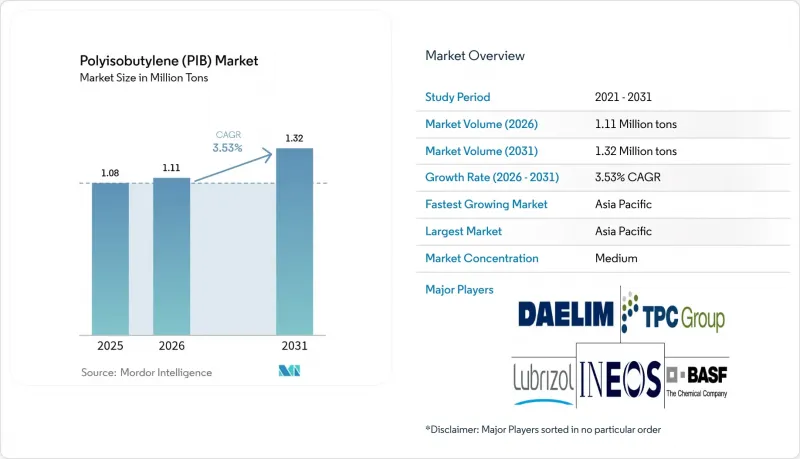
Mordor Intelligence에 의하면, 폴리이소부틸렌 시장 규모는 2025년에 108만 톤으로 평가되어 2026년 111만 톤에서 2031년까지 132만 톤에 이를 것으로 예측되며, 예측 기간(2026-2031년) CAGR은 3.53%를 나타낼 전망입니다.
본 보고서는 용도별(윤활유, 타이어 튜브 등), 최종 이용 산업별(자동차 및 운송, 산업기계, 건설 및 건축자재, 식품, 제약·퍼스널케어, 전기 및 전자), 지역별(아시아태평양, 북미, 유럽, 남미, 중동 및 아프리카)로 분류되어 있습니다. 시장 예측은 수량(톤) 단위로 표시되어 있습니다.
세계 폴리이소부틸렌(PIB) 시장 동향 및 인사이트
접착제 및 실란트 분야 수요 증가
건설용 및 애프터마켓용 접착제의 경우, 폴리이소부틸렌이 폴리우레탄이나 아크릴계 대체재보다 뛰어난 방습 및 가스 차단 성능을 가지고 있어 그 채택이 점점 늘어나고 있습니다. H.B. 풀러(H.B. Fuller)사의 중 Mn 등급을 기반으로 한 복층 유리용 실란트는 EN 1279 열 사이클 시험에서 에지 실링 내구성이 25년을 초과하여, 더욱 엄격해진 유럽의 건축 에너지 기준을 충족하고 있습니다. 감압 테이프 제조업체는 저Mn PIB를 택 파이버와 배합함으로써 20 N/25 mm 이상의 박리 강도를 확보하여, 습도가 높은 아시아 기후 하의 포장 및 자동차 내장재 요건을 충족하고 있습니다. ISO 11600 및 ISO 9047 준수를 통해 중국과 인도의 컨버터에게는 국제적인 조달 경로가 열리게 되어, 성능을 저하시키지 않으면서 국내 판매의 틀을 넘어 사업을 전개할 수 있게 되었습니다. 따라서 폴리이소부틸렌 시장은 신축 공사의 판매량 증가와 수명이 긴 실란트의 높은 가격 책정이라는 이중의 혜택을 누리고 있습니다. 저장성과 광둥성의 생산 능력에 대한 투자는 이러한 수요의 정점을 포착할 수 있도록 시기가 맞추어져 있으며, 전 세계 출하량에서 아시아태평양의 점유율을 확대되고 있습니다.
타이어 내부 라이너 및 튜브리스 컴파운드에서의 사용 확대
각 타이어 제조업체들은 기존의 부틸 소재 내부 라이너를, 투기성을 30-40% 저감하는 할로부틸·PIB 블렌드로 대체하고 있습니다. 이를 통해 공기압 유지 간격이 연장되고 구름 저항이 감소하므로, 연비 규제를 충족할 수 있게 됩니다. 엑슨모빌의 ‘Exxpro(TM)’ 엘라스토머 시리즈는 투과 계수를 20×10-12cm3cm/(cm2s cmHg) 미만으로 억제하고 있으며, 이는 현재 전기차용 타이어의 기준이 되고 있습니다. 굿이어가 2024년에 제출한 문서에 따르면, 저온 유연성이 향상되어 -40°C 이하에서도 라이너의 무결성이 유지되도록 되었습니다. 중국의 GB/T 29042 라벨 표시 기준과 인도의 타이어 수출 22% 증가가 아시아태평양의 판매량 증가를 뒷받침하고 있습니다. 한편, 동남아시아의 신생 기업들은 델림(Delim)과 ENEOS로부터 기술 라이선스를 취득하여 OEM 차량에 타이어를 공급하고 있습니다. 그 결과, 타이어 배합 기술이 폴리이소부틸렌 시장에 새로운 활력을 불어넣어, 판매량 증가가 자동차 전동화 추세를 확실하게 따라갈 수 있게 되었습니다.
원료인 이소부틸렌의 가격 변동
이소부틸렌은 주로 C4 정제분이나 전용 설비를 통한 이소부탄의 탈수소화 과정을 통해 생산되므로, PIB 생산업체들은 2024년부터 2025년까지 톤당 800달러에서 1,400달러에 이르는 75%에 달하는 현물 가격 변동에 직면하게 될 것입니다. 톤당 80-100유로에 달하는 EU 탄소 배출권 가격은 유럽의 나프타 크래커에 추가적인 부담을 주게 되어, 비용 곡선을 에탄이 풍부한 중동의 플랜트에 유리한 방향으로 기울게 하고 있습니다. 의도적인 제조 경로는 공급을 안정화시키지만, 촉매 및 수소 관리에 드는 비용이 수반되므로 대규모 통합형 거점이 아니면 감당할 수 없습니다. Global Bioenergies와 LanzaTech의 바이오 경로는 여전히 시범 단계에 머물러 있으며, 비용이 석유화학 경로에 비해 2-3배 높기 때문에 단기적인 공급 완화에는 한계가 있습니다. 이러한 변동성은 마진을 압박하고, 폴리이소부틸렌 업계 전체의 설비 투자 계획을 억제하고 있습니다.
부문 분석
윤활유는 2025년 생산량의 44.16%를 차지하며, 폴리이소부틸렌 시장에서 가장 큰 점유율을 차지하고 있습니다. 자동차 제조업체들이 미국의 차량 평균 연비 목표인 49 mpg를 달성하기 위해 0W-16 및 0W-20 오일을 채택함에 따라, 이 부문은 연평균 성장률(CAGR) 3.78%로 시장 전체를 상회하는 성장을 보일 것으로 예측됩니다. HR-PIB 기반의 분산제는 슬러지 억제 및 전단 안정성을 유지하여 API SP 및 ILSAC GF-6 준수를 보장합니다. 첨가제 공급업체들은 PIB의 포화 골격을 활용한 내산화성을 통해 에너지 생산자들이 해상 풍력 발전 설비에서 기어 오일 교환 주기를 연장할 수 있도록 지원하고 있습니다.
한편, PIBA계 세정제에 HR-PIB를 사용하는 연료 첨가제는 규모는 작지만 기술 집약도가 높은 부문으로 남아 있습니다. 수요 증가는 가솔린 직접 분사(GDI) 시스템의 보급 확대에 달려 있으며, 특히 신차의 50% 이상이 GDI 시스템을 채택하고 있는 북미와 유럽의 동향이 핵심이 될 것입니다. 접착제 및 실란트는 아시아태평양의 건설 수요에 힘입어 수요량의 약 5분의 1을 차지하고 있지만, 유럽의 VOC 규제의 영향으로 성장이 억제되고 있습니다. 츄잉껌 및 의약품용 캡 분야에서는 감각적 중립성을 유지하기 위해 FDA 승인을 받은 저Mn PIB가 여전히 필수적입니다. 전기 절연 용도(케이블 컴파운드 및 포팅재)는 시장 점유율은 적지만, 재생에너지망의 확대에 따라 꾸준한 성장을 이루고 있습니다. 이러한 틈새 시장들이 종합적으로 폴리이소부틸렌 시장의 기본 생산량을 안정화시키고, 수익원의 다각화에 기여하고 있습니다.
지역별 분석
아시아태평양은 2025년 생산량의 39.42%를 차지하며 시장을 주도하고 있으며, 연평균 성장률(CAGR) 4.12%로 가장 빠르게 성장하고 있습니다. 2024년 상반기 중국 타이어 생산량이 18% 급증한 것과 인도의 비용 경쟁력이 뛰어난 특수 등급 제품 수출이 이 지역의 주도적 지위를 공고히 하고 있습니다. 일본과 한국은 세계 첨가제 공급망에 공급하는 HR-PIB 공장을 통해 기술적 강점을 더하고 있습니다. 말레이시아와 베트남 등 동남아시아의 신생 기업들은 OEM 계약을 확보하기 위해 할로부틸 컴파운딩 라인의 라이선스를 취득하고 있으며, 이로 인해 지역 내 경쟁이 격화되면서 폴리이소부틸렌 시장의 입지가 확대되고 있습니다.
북미에서는 셰일가스를 원료로 하는 우위를 활용하여 시장을 확대되고 있습니다. TPC 그룹이 휴스턴에서 디이소부틸렌 생산 능력을 27% 증설한 것과 루브리졸의 디아파크 내 HR-PIB 생산 라인은 국내 및 수출처 고객을 대상으로 하고 있습니다. 캐나다와 멕시코는 미국의 OEM 제조업체와 제휴한 자동차 부품 공장을 통해 수요를 더욱 끌어올리고 있는 반면, 캘리포니아주의 VOC 규제로 인해 수성 에멀젼의 조기 도입이 촉진되어 제품 구성의 진화가 뒷받침되고 있습니다.
유럽에서는 BASF가 루트비히스하펜 공장의 생산 능력을 25% 확대하여 자동차 및 배터리 틈새 시장을 공략하고 있습니다. 한편, INEOS의 ‘프로젝트 원’ 크래커는 2027년까지 저탄소 원료 실현을 약속하고 있어, 지역의 비용 경쟁력을 높일 가능성이 있습니다. 그러나 REACH 규정과 Decopaint의 VOC 배출 상한선으로 인해 접착제 배합 제조업체들은 하이브리드형 및 수성 시스템으로의 재설계를 강요받고 있으며, 이러한 변화는 단기적인 성장을 억제하는 한편, 고성능이며 규정을 준수하는 등급의 가치를 끌어낼 가능성이 있습니다.
남미에서는 브라질의 자동차 생산과 아르헨티나의 농업 기계 수요가 접착제 및 윤활유 구매를 뒷받침하고 있습니다. 중동 및 아프리카 수요는 사우디 아람코/토탈 및 델림이 주바이르에서 진행하는 80 kt 규모의 HR-PIB 합작 사업이 주도하고 있으며, 이 지역은 저비용 수출 거점으로서의 입지를 확고히 하고 있습니다. 또한, UAE와 사우디아라비아에서 부상하고 있는 수소 회랑은 PIB 기반 개스킷 소재에 대한 틈새 수요를 창출하고 있으며, 폴리이소부틸렌 시장 전망를 내다본 다각화를 시사하고 있습니다.
기타 혜택:
- 엑셀 형식 시장 예측(ME) 시트
- 3개월간의 애널리스트 지원
자주 묻는 질문
목차
제1장 서론
제2장 조사 방법
제3장 주요 요약
제4장 시장 구도
제5장 시장 규모와 성장 예측
제6장 경쟁 구도
제7장 시장 기회와 향후 전망
JHS 26.09.11According to Mordor Intelligence, the polyisobutylene market size was valued at 1.08 Million tons in 2025 and is estimated to grow from 1.11 Million tons in 2026 to reach 1.32 Million tons by 2031, at a CAGR of 3.53% during the forecast period (2026-2031).
This report is Segmented by Application (Lubricants, Tire Tubes, and More), End-Use Industry (Automotive and Transportation, Industrial Machinery, Construction and Building Materials, Food, Pharma and Personal Care, and Electrical and Electronics), and Geography (Asia-Pacific, North America, Europe, South America, and Middle-East and Africa). The Market Forecasts are Provided in Terms of Volume (Tons).
Global Polyisobutylene (PIB) Market Trends and Insights
Growing Demand from Adhesives and Sealants
Construction and aftermarket adhesives increasingly specify polyisobutylene because moisture- and gas-barrier performance surpasses polyurethane and acrylic alternatives. H.B. Fuller's insulated-glass sealants, based on medium-Mn grades, exceed 25-year edge-seal durability under EN 1279 thermal cycling, which aligns with tighter European building-energy codes. Pressure-sensitive-tape makers blend low-Mn PIB with tackifiers to secure >=20 N/25 mm peel strength, satisfying packaging and automotive-trim requirements across humid Asian climates. ISO 11600 and ISO 9047 compliance opens international procurement channels for Chinese and Indian converters, allowing them to move beyond domestic sales without compromising performance. The polyisobutylene market therefore benefits doubly-from higher unit volumes in new construction and from premium pricing for long-life sealants. Capacity investments across Zhejiang and Guangdong are timed to catch this demand crest, amplifying Asia-Pacific's share in global shipments.
Rising Use in Tire Inner-Liners and Tubeless Compounds
Tire makers substitute conventional butyl inner-liners with halobutyl-PIB blends that lower air permeability by 30-40%, lengthening pressure-retention intervals and cutting rolling resistance to satisfy fuel-economy rules. ExxonMobil's Exxpro(TM) elastomer family achieves permeability coefficients below 20 X 10-12 cm3 cm/(cm2 s cmHg), now a baseline for electric-vehicle tires. Goodyear's 2024 filings add cold-flexibility enhancements, preserving liner integrity below -40 °C. China's GB/T 29042 labeling and India's 22% tire-export surge underpin Asia-Pacific volume growth, while Southeast Asian new entrants license technology from Daelim and ENEOS to supply OEM fleets. As a result, tire formulations inject fresh momentum into the polyisobutylene market, ensuring that volume growth keeps pace with vehicle electrification trends.
Feedstock Isobutylene Price Volatility
Isobutylene originates mainly from C4 refinery cuts and on-purpose isobutane dehydrogenation, exposing PIB producers to 75% spot-price swings between USD 800 and USD 1,400 per tonne during 2024-2025. EU carbon permits at EUR 80-100 per tonne of CO2 further tax European naphtha crackers, tilting the cost curve toward ethane-rich Middle-Eastern plants. On-purpose routes stabilize supply but entail catalyst and hydrogen-management costs that only large integrated sites can absorb. Bio-routes from Global Bioenergies and LanzaTech remain pilot-scale, with costs at 2-3X petrochemical pathways, constraining near-term relief. This volatility compresses margins and dampens capital planning across the polyisobutylene industry.
Other drivers and restraints analyzed in the detailed report include:
- Expanding Role as Viscosity Modifier in Next-Generation Lubricants
- Shift Toward Highly Reactive PIB for Fuel and Lubricant Additives
- Intrinsic UV Instability Demanding Costly Stabilizers
For complete list of drivers and restraints, kindly check the Table Of Contents.
Segment Analysis
Lubricants held 44.16% of 2025 volume, accounting for the largest slice of the polyisobutylene market. This segment will outpace the broader market at a 3.78% CAGR as automakers adopt 0W-16 and 0W-20 oils to reach U.S. 49 mpg fleet targets. HR-PIB-based dispersants maintain sludge control and shear stability, ensuring compliance with API SP and ILSAC GF-6. Additive suppliers leverage PIB's saturated backbone to resist oxidation, giving energy producers longer gear-oil drain intervals in offshore wind assets.
Conversely, fuel additives, consuming HR-PIB for PIBA detergents, remain a smaller but technologically intensive segment. Demand growth hinges on increased gasoline direct-injection penetration, especially in North America and Europe where over 50% of new cars employ GDI systems. Adhesives and sealants represent about one-fifth of volume, propelled by Asia-Pacific construction but tempered by VOC mandates in Europe. In chewing-gum and pharmaceutical closures, FDA-cleared low-Mn PIB remains irreplaceable for sensory neutrality. Electrical-insulation uses-cable compounds and potting materials-contribute a modest share yet realize steady growth as renewable-energy grids expand. Collectively, these niches stabilize baseline volume and diversify profit streams within the polyisobutylene market.
Complete Report Scope:
- By Application
- Lubricants
- Tire Tubes
- Adhesive and Sealants
- Plasticizers
- Fuel Additives
- Electrical Insulation
- Other Applications
- By End-use Industry
- Automotive and Transportation
- Industrial Machinery
- Construction and Building Materials
- Food, Pharma and Personal-Care
- Electrical and Electronics
- Geography
- Asia-Pacific
- China
- India
- Japan
- South Korea
- Malaysia
- Thailand
- Indonesia
- Vietnam
- Rest of Asia-Pacific
- North America
- United States
- Canada
- Mexico
- Europe
- Germany
- United Kingdom
- Italy
- France
- Russia
- Spain
- Turkey
- NORDIC Countries
- Rest of Europe
- South America
- Brazil
- Argentina
- Colombia
- Rest of South America
- Middle-East and Africa
- Saudi Arabia
- United Arab Emirates
- Qatar
- Egypt
- Nigeria
- South Africa
- Rest of Middle-East and Africa
- Asia-Pacific
Geography Analysis
Asia-Pacific dominated with 39.42% of 2025 volume and is the fastest-growing at 4.12% CAGR. China's 18% H1 2024 spike in tire output and India's cost-advantaged specialty-grade exports cement regional leadership. Japan and South Korea add technology heft via HR-PIB plants that feed global additive chains. Southeast Asian newcomers in Malaysia and Vietnam license halobutyl compounding lines to win OEM contracts, broadening intra-regional competition and expanding the polyisobutylene market footprint.
North America is expanding on shale-gas feedstock advantages. TPC Group's 27% Houston di-isobutylene augmentation and Lubrizol's Deer Park HR-PIB line cater to domestic and export customers. Canada and Mexico add incremental pulls through automotive-component factories tied to U.S. OEMs, while California's VOC rules drive early adoption of water-borne emulsions, nudging product-mix evolution.
In Europe, BASF's 25% Ludwigshafen expansion targets automotive and battery niches, while INEOS' Project ONE cracker promises lower-carbon feedstocks by 2027, potentially lifting regional cost competitiveness. However, REACH and Decopaint VOC caps prompt adhesive formulators to re-engineer toward hybrid or aqueous systems, a shift that restrains near-term growth but may unlock value for high-performance, compliant grades.
In South America, Brazil's vehicle production and Argentina's agricultural-equipment needs underpin adhesive and lubricant purchases. Middle-East and Africa demand is led by Saudi Aramco/Total and Daelim's 80 kt HR-PIB venture in Jubail, positioning the region as a low-cost export springboard. Emerging hydrogen corridors in the UAE and Saudi Arabia also create niche demand for PIB-based gasket materials, signaling future-ready diversification in the polyisobutylene market.
- BASF
- Braskem
- Chevron Oronite LLC
- Daelim Co., Ltd.
- Dowpol Corporation
- INEOS
- Group of companies Titan
- Infineum International Limited
- Kemipex
- Lubrizol
- TPC Group
- Zhejiang Shunda New Material Co.
Additional Benefits:
- The market estimate (ME) sheet in Excel format
- 3 months of analyst support
TABLE OF CONTENTS
1 Introduction
- 1.1 Study Assumptions and Market Definition
- 1.2 Scope of the Study
2 Research Methodology
3 Executive Summary
4 Market Landscape
- 4.1 Market Overview
- 4.2 Market Drivers
- 4.2.1 Growing demand from adhesives and sealants
- 4.2.2 Rising use in tire inner-liners and tubeless compounds
- 4.2.3 Expanding role as viscosity modifier in next-gen lubricants
- 4.2.4 Shift toward highly-reactive PIB for fuel/lube additives
- 4.2.5 Hydrogen infrastructure gaskets and seals requiring PIB barrier films
- 4.3 Market Restraints
- 4.3.1 Feedstock isobutylene price volatility
- 4.3.2 Intrinsic UV instability demanding costly stabilizers
- 4.3.3 Tightening VOC/REACH limits on solvent-borne PIB systems
- 4.4 Value Chain Analysis
- 4.5 Porter's Five Forces
- 4.5.1 Bargaining Power of Suppliers
- 4.5.2 Bargaining Power of Buyers
- 4.5.3 Threat of New Entrants
- 4.5.4 Threat of Substitutes
- 4.5.5 Degree of Competition
5 Market Size and Growth Forecasts (Volume)
- 5.1 By Application
- 5.1.1 Lubricants
- 5.1.2 Tire Tubes
- 5.1.3 Adhesive and Sealants
- 5.1.4 Plasticizers
- 5.1.5 Fuel Additives
- 5.1.6 Electrical Insulation
- 5.1.7 Other Applications
- 5.2 By End-use Industry
- 5.2.1 Automotive and Transportation
- 5.2.2 Industrial Machinery
- 5.2.3 Construction and Building Materials
- 5.2.4 Food, Pharma and Personal-Care
- 5.2.5 Electrical and Electronics
- 5.3 Geography
- 5.3.1 Asia-Pacific
- 5.3.1.1 China
- 5.3.1.2 India
- 5.3.1.3 Japan
- 5.3.1.4 South Korea
- 5.3.1.5 Malaysia
- 5.3.1.6 Thailand
- 5.3.1.7 Indonesia
- 5.3.1.8 Vietnam
- 5.3.1.9 Rest of Asia-Pacific
- 5.3.2 North America
- 5.3.2.1 United States
- 5.3.2.2 Canada
- 5.3.2.3 Mexico
- 5.3.3 Europe
- 5.3.3.1 Germany
- 5.3.3.2 United Kingdom
- 5.3.3.3 Italy
- 5.3.3.4 France
- 5.3.3.5 Russia
- 5.3.3.6 Spain
- 5.3.3.7 Turkey
- 5.3.3.8 NORDIC Countries
- 5.3.3.9 Rest of Europe
- 5.3.4 South America
- 5.3.4.1 Brazil
- 5.3.4.2 Argentina
- 5.3.4.3 Colombia
- 5.3.4.4 Rest of South America
- 5.3.5 Middle-East and Africa
- 5.3.5.1 Saudi Arabia
- 5.3.5.2 United Arab Emirates
- 5.3.5.3 Qatar
- 5.3.5.4 Egypt
- 5.3.5.5 Nigeria
- 5.3.5.6 South Africa
- 5.3.5.7 Rest of Middle-East and Africa
- 5.3.1 Asia-Pacific
6 Competitive Landscape
- 6.1 Market Concentration
- 6.2 Strategic Moves
- 6.3 Market Share (%)/Ranking Analysis
- 6.4 Company Profiles (includes Global-level Overview, Market-level Overview, Core Segments, Financials as available, Strategic Information, Products and Services, Recent Developments)
- 6.4.1 BASF
- 6.4.2 Braskem
- 6.4.3 Chevron Oronite LLC
- 6.4.4 Daelim Co., Ltd.
- 6.4.5 Dowpol Corporation
- 6.4.6 INEOS
- 6.4.7 Group of companies Titan
- 6.4.8 Infineum International Limited
- 6.4.10 Kemipex
- 6.4.11 Lubrizol
- 6.4.12 TPC Group
- 6.4.13 Zhejiang Shunda New Material Co.
7 Market Opportunities and Future Outlook
- 7.1 PIB as substitute for wool-fat in leather stuffing agents
- 7.2 PIB-based binder technologies for next-gen battery anodes
- 7.3 White-space and Unmet-Need Assessment


