|
시장보고서
상품코드
2124133
AI 인프라 시장 : 시장 점유율 분석, 업계 동향 및 통계, 성장 예측(2026-2031년)AI Infrastructure - Market Share Analysis, Industry Trends & Statistics, Growth Forecasts (2026 - 2031) |
||||||
 Mordor Intelligence
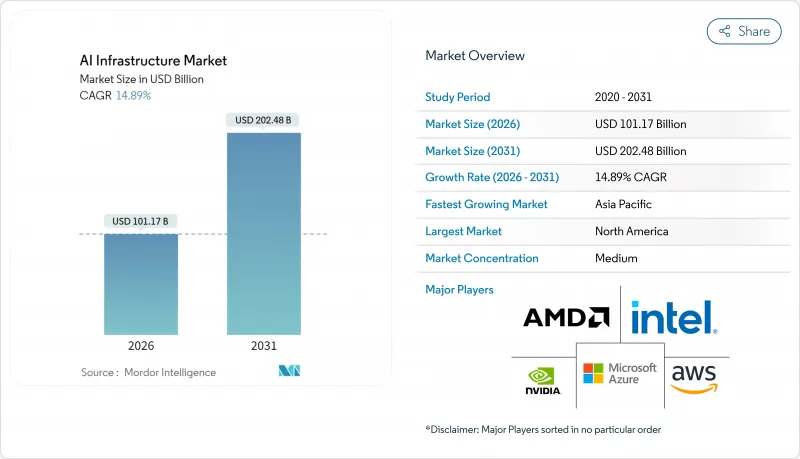
Mordor Intelligence에 의하면, AI 인프라 시장 규모는 2026년에 1,011억 7,000만 달러로 추정되고, 2031년까지 2,024억 8,000만 달러에 이를 것으로 예측되며, 이것은 예측 기간 중 CAGR이 14.89%로 성장할 것을 나타내고 있습니다.
본 보고서는 제품별(하드웨어 (프로세서, 스토리지, 메모리), 소프트웨어 (시스템 최적화, AI 미들웨어, MLOps)), 도입 형태별(온프레미스, 클라우드), 최종 사용자별(기업, 정부·국방, 클라우드 서비스 제공업체), 프로세서 아키텍처별(CPU, GPU, FPGA/ASIC(TPU, Gaudi 등), 기타), 지역별로 분류되어 있습니다. 시장 예측은 금액(달러) 기준으로 제시되어 있습니다.
세계의 AI 인프라 시장 동향 및 인사이트
하이퍼스케일러 간 H100 및 H200 GPU 미결 주문량이 급증
NVIDIA의 보고에 따르면, H100 및 H200 디바이스의 2025년 분 사전 주문량이 공급 가능량의 3배에 달함에 따라,마이크로소프트는 다년간의 조달 계획에 800억 달러를 배정했으며, AWS는 2028년까지 인프라 예산을 1,000억 달러 확대하기로 결정했습니다. SK하이닉스와 삼성이 HBM3E 생산량의 95%를 독점하고 있었기 때문에 고대역폭 메모리(HBM)의 병목 현상으로 인해 이러한 수급 불균형이 더욱 심화되었습니다. 현재 하이퍼스케일러 각사는 팹과 직접 협력하여 메모리 패키징을 공동 설계하고 있어, 기존 GPU 벤더의 협상력이 약화되고 있습니다. TSMC의 3나노미터 공정 수주는 계속해서 공급량을 상회하고 있으며, 디바이스 리드타임이 12개월을 초과함에 따라 Google TPU v6e와 같은 맞춤형 ASIC으로의 전환이 가속화되고 있습니다. 예측 불가능한 납기일에 직면한 기업들은 8GPU 번들의 온디맨드 가격이 시간당 30달러를 초과하는 경우에도 클라우드 제공업체로부터 보장된 인스턴스를 임대하는 사례가 늘고 있습니다.
AI 전용 네트워크 패브릭의 급속한 보급(InfiniBand NDR, 이더넷 800G)
InfiniBand NDR은 400 Gbps로 작동하며, 2025년 AI 훈련 클러스터의 약 70%를 연결하고, 기존 이더넷보다 40% 낮은 지연 시간을 실현했습니다. 그러나 각 하이퍼스케일러 기업들은 브로드컴의 ‘Tomahawk 5’와 ‘Spectrum-X’가 자본 비용을 25% 절감하면서도 경쟁력 있는 지연 시간으로 트래픽을 스위칭할 수 있다는 점에 주목하여 800Gbps 이더넷에 대한 평가를 시작했습니다. Meta는 1만 대의 GPU를 탑재한 AI 연구용 슈퍼클러스터를 800 Gbps 링크를 통해 확장함으로써 이더넷의 성능을 입증하고, 벤더 선택의 폭을 넓히는 동시에 인피니밴드에 대한 종속성을 완화했습니다. 1.6 Tbps 이더넷에 관한 IEEE 802.3df 작업은 계속되고 있으며, 이는 AI와 표준 데이터센터 워크로드 간의 추가적인 융합을 시사합니다.
2026년까지 AI용 GPU는 만성적인 공급 부족이 지속될 전망
2025년에는 H200 카드의 리드 타임이 52주를 초과했으며, AMD의 MI300X 주문 잔고도 이와 유사한 공급 제약을 반영했습니다. TSMC의 CoWoS 패키징 생산 능력은 월 3만 5,000장의 웨이퍼 스타트에 도달했지만, 이는 10만 장에 달하는 수요 예측을 크게 밑도는 수준입니다. 각 H100 디바이스에는 5층으로 적층된 80GB의 HBM3가 필요하기 때문에 고대역폭 메모리는 여전히 부족합니다. 그 결과, 기업들은 대규모 도입을 연기하고 필요한 매개변수 수가 적은 모델 아키텍처를 우선시하게 되었습니다. 이에 반해, 클라우드 플랫폼 측은 재고를 과도하게 확보하고 가동률을 낮추며 현물 가격을 높게 책정하는 대응을 취했습니다. 이러한 전략은 공급 신호를 왜곡시켜 단기적인 시장 보급을 억제하고 있습니다.
부문 분석
2025년 지출 중 하드웨어가 68.42%를 차지했습니다. 이는 자본 집약적인 GPU 클러스터, 고대역폭 메모리, 그리고 랙 밀도를 100kW 이상으로 끌어올리는 NVMe 패브릭을 반영한 결과입니다. 기업들이 추론 효율성, 모델 가시성, MLOps 자동화를 중시함에 따라 소프트웨어 지출은 2031년까지 연평균 성장률(CAGR) 16.02%로 증가할 것으로 예측됩니다. Triton Inference Server와 같은 도구는 양자화 및 커널 융합을 통해 지연 시간을 최대 50% 단축합니다. 벤더들은 현재 오케스트레이션 프레임워크와 가시성 대시보드를 번들로 제공하며, 일회성 라이선스를 구독 모델로 전환하고 있습니다. 그 결과, 가속기에 대한 절대적인 지출은 여전히 크지만, 소프트웨어에 기인한 AI 인프라 시장 규모는 GPU에 대한 설비 투자보다 빠르게 확대되고 있습니다. 훈련 워크로드는 여전히 GPU 중심이지만, 추론은 이미 프로덕션 파이프라인의 총 소유 비용(TCO)을 낮추는 전용 ASIC으로 전환되고 있습니다. 비용 절감을 실현한 기업들은 확보된 예산을 데이터 품질 개선 노력이나 검색 강화 생성(RAG) 파이프라인에 재분배하고 있으며, 이로 인해 미들웨어 채택이 더욱 확대되고 있습니다.
두 번째 촉매는 컨텐츠 안전성 및 편향 완화를 위한 가드레일을 통합한 대규모 언어 모델 서비스(LLMaaS)의 부상입니다. 사전 학습된 모델과 미들웨어를 패키지로 묶은 벤더들은 지속적인 수익을 확보하고 고객 락인을 강화하고 있습니다. 이에 대응하여 독립 소프트웨어 공급업체들은 오픈소스 배포 스택을 강화함으로써, 독점적인 라이선싱이 모델의 이식성을 저해하지 않도록 보장하고 있습니다. 이러한 새로운 동향으로 인해 소프트웨어의 매출 총이익률은 75% 가까이 상승하여 하드웨어 재판매 수준을 크게 상회하고 있습니다. 이는 투자자들이 후기 단계 자금 조달 라운드에서 실리콘보다 코드를 선호하는 이유를 여실히 보여줍니다. 따라서 AI 인프라 시장은 자본 지출(CAPEX) 중심의 사이클에서 구독 수익이 수익을 안정시키고 하드웨어 교체에 따른 변동을 완화하는 하이브리드 모델로 전환되고 있습니다.
2025년에는 데이터 상주 요건 및 HIPAA와 같은 산업별 프레임워크에 힘입어 온프레미스형 인프라가 지출의 57.46%를 차지했습니다. AWS Trainium2와 Google TPU v6e 인스턴스가 경제적으로 유리한 조건에서 멀티 페타플롭급 성능을 제공함에 따라, 클라우드 도입은 연평균 성장률(CAGR) 15.76%로 확대될 것으로 예측됩니다. 따라서 클라우드 서비스와 관련된 AI 인프라 시장 규모는 특히 하이퍼스케일러 기업들이 추론당 과금 모델을 표준화하고 있는 점에 힘입어 기업의 자본 지출(CAPEX)보다 빠르게 확대되고 있습니다. 한때 자국 내 호스팅을 주장하던 금융 기관들도 현재는 암호화 키를 고객의 관리 하에 두는 ‘기밀 컴퓨팅 엔클레이브’의 시범 운영을 시작했으며, 이를 통해 규제상의 마찰이 완화되고 있습니다.
기업이 기밀성이 높은 모델을 온프레미스에서 훈련한 후, 최종 사용자의 지연을 줄이기 위해 지리적으로 분산된 엣지 노드로 추론 처리를 이전함에 따라 하이브리드 도입 형태가 보급되고 있습니다. 사우디아라비아와 아랍에미리트의 주권 AI 이니셔티브는 국내 하이퍼스케일 캠퍼스 건설에 1,400억 달러 이상을 투자하고 있으며, 이는 현지 배포에 대한 상쇄적 수요를 뒷받침하고 있습니다. 클라우드 제공업체는 관할 구역별로 네트워크를 분리하고, 인증 및 감사 체계를 갖춘 전용 리전을 제공함으로써 주권 요건을 충족하고 있습니다. 그러나 장기적으로는 18-24개월에 달하는 하드웨어 노후화 주기로 인해 비용 곡선이 공유 인프라 쪽으로 기울게 되며, 온프레미스 환경을 유지하는 기업들은 홀 전체의 배선을 다시 하지 않고도 노드 보드를 교체할 수 있는 모듈식 설계를 채택할 수밖에 없습니다.
지역별 분석
북미는 CHIPS법에 따른 527억 달러의 보조금과 전 세계 AI 처리 능력의 약 60%를 운영하는 하이퍼스케일러의 지원에 힘입어 2025년 지출의 39.56%를 차지했습니다. 반도체산업협회(SIA)는 2030년까지 6만 7,000명의 인력 부족이 발생할 것이라고 경고하고 있으며, 자본이 풍부함에도 불구하고 팹의 생산 확대가 둔화될 가능성이 있습니다. 캐나다는 적극적인 이민 정책에 힘입어 토론토와 몬트리올을 연구 거점으로 삼고 있는 반면, 멕시코에서는 전력망의 신뢰성에 대한 우려가 대규모 인프라 구축의 걸림돌이 되고 있습니다. 미국 국방부는 아마존에 500억 달러 규모의 클라우드 계약을 수주했으나, 이는 국가 안보상의 우려와 중앙 집중식 컴퓨팅으로의 광범위한 전환이 공존하고 있음을 여실히 드러내고 있습니다.
아시아태평양은 중국의 500억 달러 규모 반도체 펀드와 인도의 150억 달러 규모 하이퍼스케일러 투자를 원동력으로 삼아 2031년까지 연평균 성장률(CAGR) 16.44%를 나타낼 것으로 예측됩니다. 알리바바는 2025년에 화웨이산 ‘Ascend 910C’ 가속기 10만 대를 도입할 예정이며, 이는 수출 규제에도 불구하고 자국 내 기술 개발이 빠르게 진행되고 있음을 보여줍니다. 일본은 지정학적 리스크에 대한 헤지 수단으로 TSMC의 구마모토 거점 및 2나노미터 연구개발에 2조 엔(135억 달러)을 배정했습니다. 한국은 AI 공급망의 주요 병목 현상인 HBM3E 공급 점유율의 95%를 차지하고 있습니다. 호주에서는 높은 전기 요금이 하이퍼스케일 확장을 제한하고 있지만, 시드니와 멜버른은 해저 케이블에 대한 안정적인 연결을 요구하는 코로케이션 사업자들을 계속해서 유치하고 있습니다.
유럽의 성장세는 둔화되는 추세입니다. AI 법규 준수로 인해 다국적 확장 시마다 500만-1,500만 유로(550만-1,650만 달러)의 추가 비용이 발생하기 때문입니다. 독일과 프랑스가 반도체 보조금을 주도하는 한편, 스웨덴은 추운 기후와 수력 발전을 활용하여 하이퍼스케일러 기업을 유치하고 있으며, 마이크로소프트는 2026년에 32억 달러를 투자해 스톡홀름에 캠퍼스를 건설할 것이라고 확인했습니다. 영국은 브렉시트 이후 데이터 전송에 있어 마찰에 직면해 있으며, 이로 인해 유럽 전역을 대상으로 하는 서비스에 지연과 법적 부담이 발생하고 있습니다. 중동의 정부계 펀드는 에너지 우위와 AI에 대한 야망을 융합하기 위해 1,400억 달러를 투자하여, 주로 서유럽의 수출 통제 체제 적용 대상에서 제외되어 운영되는 리야드와 아부다비의 데이터센터 회랑을 지원하고 있습니다.
기타 혜택 :
- 엑셀 형식 시장 전망(ME) 시트
- 3개월간의 애널리스트 지원
자주 묻는 질문
목차
제1장 서론
제2장 조사 방법
제3장 주요 요약
제4장 시장 구도
제5장 시장 규모 및 성장 예측
제6장 경쟁 구도
제7장 시장 기회 및 향후 전망
AJY 26.09.09According to Mordor Intelligence, the AI infrastructure market size reached USD 101.17 billion in 2026 and is projected to reach USD 202.48 billion by 2031, reflecting a 14.89% CAGR over the forecast period.
This report is Segmented by Offering (Hardware [Processor, Storage, and Memory], and Software [System Optimization, and AI Middleware and MLOps]), Deployment (On-Premises, and Cloud), End User (Enterprises, Government and Defense, and Cloud Service Providers), Processor Architecture (CPU, GPU, FPGA/ASIC (TPU, Gaudi, and More), and More), and Geography. The Market Forecasts are Provided in Terms of Value (USD).
Global AI Infrastructure Market Trends and Insights
Soaring H100 and H200 GPU Backlogs Among Hyperscalers
NVIDIA reported that 2025 pre-orders for H100 and H200 devices tripled available supply, prompting Microsoft to earmark USD 80 billion for multi-year allocations and AWS to expand its infrastructure budget by USD 100 billion through 2028. High-bandwidth memory bottlenecks intensified the imbalance, as SK Hynix and Samsung controlled 95% of HBM3E output. Hyperscalers now co-design memory packaging directly with fabs, weakening the negotiating leverage of traditional GPU vendors. TSMC's 3-nanometer capacity remained oversubscribed, extending device lead times past 12 months and accelerating a pivot toward custom ASICs such as Google TPU v6e. Enterprises, facing unpredictable delivery schedules, increasingly rent guaranteed instances from cloud providers even when on-demand prices exceed USD 30 per hour for eight-GPU bundles.
Rapid AI-Specific Network Fabrics (InfiniBand NDR, Ethernet 800G)
InfiniBand NDR operated at 400 Gbps and connected about 70% of 2025 AI training clusters, delivering latency that was 40% lower than traditional Ethernet. Hyperscalers, however, began evaluating 800 Gbps Ethernet as Broadcom's Tomahawk 5 and Spectrum-X switched traffic at competitive latencies with a 25% reduction in capital cost. Meta validated Ethernet performance by scaling its 10,000-GPU AI Research SuperCluster on 800 Gbps links, widening vendor choice and eroding InfiniBand lock-in. IEEE 802.3df work on 1.6 Tbps Ethernet continues, signaling more convergence between AI and standard data-center workloads.
AI-Class GPUs in Chronic Short Supply Through 2026
Lead times for H200 cards lengthened past 52 weeks in 2025, while AMD's MI300X backlog mirrored the constraint. CoWoS packaging capacity at TSMC hit 35,000 wafer starts per month, far below demand estimates above 100,000 equivalents. High-bandwidth memory remains scarce because each H100 device needs 80 GB of HBM3 stacked across five layers. Enterprises consequently delayed large-scale deployments and reprioritized model architectures that require fewer parameters. Cloud platforms countered by over-provisioning inventory, dropping utilization rates, and charging elevated spot prices, a tactic that distorts supply signals and suppresses near-term market adoption.
Other drivers and restraints analyzed in the detailed report include:
- Energy-Efficient Liquid Cooling Adoption
- Government CHIPS-Type Subsidies for AI Fabs
- Sovereign-AI Export Controls
For complete list of drivers and restraints, kindly check the Table Of Contents.
Segment Analysis
Hardware commanded 68.42% of 2025 spending, reflecting capital-intensive GPU clusters, high-bandwidth memory, and NVMe fabrics that push rack densities beyond 100 kilowatts. Software is projected to rise at a 16.02% CAGR to 2031 as enterprises emphasize inferencing efficiency, model observability, and MLOps automation. Tools like Triton Inference Server compress latency by as much as 50% through quantization and kernel fusion. System vendors now bundle orchestration frameworks with observability dashboards, converting one-off licenses into subscriptions. The AI infrastructure market size attributed to software is therefore expanding faster than GPU capital investment, even though absolute spending on accelerators remains larger. Training workloads will stay GPU-centric, but inference is already moving toward purpose-built ASICs that lower total cost of ownership for production pipelines. Enterprises gaining cost relief redeploy freed budgets into data-quality initiatives and retrieval-augmented generation pipelines, pushing middleware adoption higher.
A second catalyst is the rise of large-language-model-as-a-service offerings that embed guardrails for content safety and bias mitigation. Vendors who package middleware with pre-trained models secure recurring revenue and deepen customer lock-in. Independent software providers respond by hardening open-source deployment stacks, ensuring that proprietary licensing does not impede model portability. The emergent dynamic elevates software gross margins toward 75%, well above hardware reselling levels, underscoring why investors favor code over silicon in later-stage funding rounds. The AI infrastructure market therefore shifts from a capital-expenditure cycle to a blended model where subscription revenue stabilizes earnings and mitigates hardware refresh volatility.
On-premise infrastructure held 57.46% of spending in 2025, driven by data-residency mandates and sectoral frameworks like HIPAA. Cloud deployments are forecast to grow at 15.76% CAGR as AWS Trainium2 and Google TPU v6e instances deliver multi-petaflop performance at favorable economics. The AI infrastructure market size associated with cloud offerings is thus expanding faster than enterprise capex, especially as hyperscalers standardize pay-per-inference pricing. Financial institutions that once insisted on sovereign hosting now pilot confidential-compute enclaves that keep encryption keys under customer control, reducing regulatory friction.
Hybrid patterns proliferate as enterprises train sensitive models on-premise then shift inference to geographic edge nodes that lower latency for end users. Sovereign AI initiatives in Saudi Arabia and the United Arab Emirates inject more than USD 140 billion to build domestic hyperscale campuses, sustaining a countervailing demand for local deployments. Cloud providers accommodate sovereignty by offering dedicated regions with jurisdictionally ring-fenced networking, certifications, and auditing. Over the long term, however, hardware obsolescence cycles of 18-24 months tilt the cost curve toward shared infrastructure, compelling on-premise defenders to adopt modular designs that swap node boards without re-cabling entire halls.
Complete Report Scope:
- By Offering
- Hardware
- Processor
- Storage
- Memory
- Software
- System Optimisation
- AI Middleware and MLOps
- Hardware
- By Deployment
- On-Premise
- Cloud
- By End User
- Enterprises
- Government and Defence
- Cloud Service Providers
- By Processor Architecture
- CPU
- GPU
- FPGA/ASIC (TPU, Inferentia, Gaudi, Cerebras)
- Other Processor Architectures
- By Geography
- North America
- United States
- Canada
- Mexico
- South America
- Brazil
- Argentina
- Rest of South America
- Europe
- United Kingdom
- Germany
- France
- Sweden
- Rest of Europe
- Asia Pacific
- China
- Japan
- India
- Australia
- South Korea
- Rest of Asia Pacific
- Middle East
- Saudi Arabia
- United Arab Emirates
- Turkey
- Rest of Middle East
- Africa
- South Africa
- Nigeria
- Rest of Africa
- North America
Geography Analysis
North America commanded 39.56% of 2025 spending, supported by USD 52.7 billion in CHIPS Act grants and by hyperscalers that operate roughly 60% of global AI capacity. The Semiconductor Industry Association warns of a 67,000-worker talent shortage by 2030, which could slow fab ramp-ups even as capital is plentiful. Canada positions Toronto and Montreal as research hubs backed by supportive immigration policy, whereas Mexico's grid reliability questions dampen large-scale build-outs. The United States Department of Defense awarded Amazon a USD 50 billion cloud contract, underscoring that sovereign security concerns coexist with a broader shift toward centrally managed compute.
Asia Pacific is expected to grow at a 16.44% CAGR through 2031, propelled by China's USD 50 billion semiconductor fund and India's USD 15 billion hyperscaler commitments. Alibaba deployed 100,000 Huawei Ascend 910C accelerators in 2025, illustrating rapid indigenous progress despite export curbs. Japan allocated JPY 2 trillion (USD 13.5 billion) for TSMC's Kumamoto site and 2-nanometer R&D to hedge geopolitical exposure. South Korea enjoys 95% share of HBM3E supply, an essential choke point in the AI supply chain. Australia's high power tariffs limit hyperscale, but Sydney and Melbourne still attract colocation players looking for resilient connectivity to submarine cables.
Europe's growth moderates as AI Act compliance layers EUR 5-15 million (USD 5.5-16.5 million) in incremental cost per multi-nation deployment. Germany and France lead semiconductor subsidies, while Sweden leverages cold climate and hydroelectric power to tempt hyperscalers; Microsoft confirmed a USD 3.2 billion Stockholm campus for 2026. The United Kingdom confronts post-Brexit data transfer frictions that add latency and legal overhead to continent-wide services. Middle East sovereign wealth funds pledge USD 140 billion to converge energy advantage with AI ambitions, supporting Riyadh and Abu Dhabi data center corridors that operate largely outside Western export control regimes.
- NVIDIA Corporation
- Intel Corporation
- Advanced Micro Devices (AMD)
- Amazon Web Services, Inc.
- Microsoft Corporation
- Google LLC
- IBM Corporation
- Cisco Systems, Inc.
- Hewlett Packard Enterprise
- Dell Technologies, Inc.
- Samsung Electronics Co., Ltd.
- Micron Technology, Inc.
- Arm Holdings plc
- Synopsys, Inc.
- Baidu, Inc.
- Alibaba Cloud
- Tencent Cloud
- Cerebras Systems
- Graphcore
- Huawei Technologies Co., Ltd.
Additional Benefits:
- The market estimate (ME) sheet in Excel format
- 3 months of analyst support
TABLE OF CONTENTS
1 INTRODUCTION
- 1.1 Study Assumptions and Market Definition
- 1.2 Scope of the Study
2 RESEARCH METHODOLOGY
3 EXECUTIVE SUMMARY
4 MARKET LANDSCAPE
- 4.1 Market Overview
- 4.2 Market Drivers
- 4.2.1 Soaring H100/G100 GPU Backlogs Among Hyperscalers
- 4.2.2 Rapid AI-Specific Network Fabrics (InfiniBand NDR, Ethernet 800 G)
- 4.2.3 Energy-Efficient Liquid Cooling Adoption
- 4.2.4 Government CHIPS-Type Subsidies for AI Fabs
- 4.2.5 Cloud-Native AI Accelerator Instances Democratise Access
- 4.2.6 Open-Source AI Framework Optimisation (e.g., Triton, TVM)
- 4.3 Market Restraints
- 4.3.1 AI-Class GPUs in Chronic Short Supply Through 2026
- 4.3.2 400 V / 48 V Power-Conversion Limitations in Legacy Data Centres
- 4.3.3 Sovereign-AI Export Controls (US-China, EU)
- 4.3.4 Rising Scope-2 Emissions Compliance Costs
- 4.4 Industry Value Chain Analysis
- 4.5 Regulatory Landscape
- 4.6 Technological Outlook
- 4.7 Porter's Five Forces Analysis
- 4.7.1 Bargaining Power of Buyers
- 4.7.2 Bargaining Power of Suppliers
- 4.7.3 Threat of New Entrants
- 4.7.4 Threat of Substitutes
- 4.7.5 Competitive Rivalry
- 4.8 Impact of Macroeconomic Factors on the Market
5 MARKET SIZE AND GROWTH FORECASTS (VALUE)
- 5.1 By Offering
- 5.1.1 Hardware
- 5.1.1.1 Processor
- 5.1.1.2 Storage
- 5.1.1.3 Memory
- 5.1.2 Software
- 5.1.2.1 System Optimisation
- 5.1.2.2 AI Middleware and MLOps
- 5.1.1 Hardware
- 5.2 By Deployment
- 5.2.1 On-Premise
- 5.2.2 Cloud
- 5.3 By End User
- 5.3.1 Enterprises
- 5.3.2 Government and Defence
- 5.3.3 Cloud Service Providers
- 5.4 By Processor Architecture
- 5.4.1 CPU
- 5.4.2 GPU
- 5.4.3 FPGA/ASIC (TPU, Inferentia, Gaudi, Cerebras)
- 5.4.4 Other Processor Architectures
- 5.5 By Geography
- 5.5.1 North America
- 5.5.1.1 United States
- 5.5.1.2 Canada
- 5.5.1.3 Mexico
- 5.5.2 South America
- 5.5.2.1 Brazil
- 5.5.2.2 Argentina
- 5.5.2.3 Rest of South America
- 5.5.3 Europe
- 5.5.3.1 United Kingdom
- 5.5.3.2 Germany
- 5.5.3.3 France
- 5.5.3.4 Sweden
- 5.5.3.5 Rest of Europe
- 5.5.4 Asia Pacific
- 5.5.4.1 China
- 5.5.4.2 Japan
- 5.5.4.3 India
- 5.5.4.4 Australia
- 5.5.4.5 South Korea
- 5.5.4.6 Rest of Asia Pacific
- 5.5.5 Middle East
- 5.5.5.1 Saudi Arabia
- 5.5.5.2 United Arab Emirates
- 5.5.5.3 Turkey
- 5.5.5.4 Rest of Middle East
- 5.5.6 Africa
- 5.5.6.1 South Africa
- 5.5.6.2 Nigeria
- 5.5.6.3 Rest of Africa
- 5.5.1 North America
6 COMPETITIVE LANDSCAPE
- 6.1 Market Concentration
- 6.2 Strategic Moves
- 6.3 Market Share Analysis
- 6.4 Company Profiles (includes Global Level Overview, Market Level Overview, Core Segments, Financials as Available, Strategic Information, Market Rank/Share for Key Companies, Products and Services, Recent Developments)
- 6.4.1 NVIDIA Corporation
- 6.4.2 Intel Corporation
- 6.4.3 Advanced Micro Devices (AMD)
- 6.4.4 Amazon Web Services, Inc.
- 6.4.5 Microsoft Corporation
- 6.4.6 Google LLC
- 6.4.7 IBM Corporation
- 6.4.8 Cisco Systems, Inc.
- 6.4.9 Hewlett Packard Enterprise
- 6.4.10 Dell Technologies, Inc.
- 6.4.11 Samsung Electronics Co., Ltd.
- 6.4.12 Micron Technology, Inc.
- 6.4.13 Arm Holdings plc
- 6.4.14 Synopsys, Inc.
- 6.4.15 Baidu, Inc.
- 6.4.16 Alibaba Cloud
- 6.4.17 Tencent Cloud
- 6.4.18 Cerebras Systems
- 6.4.19 Graphcore
- 6.4.20 Huawei Technologies Co., Ltd.
7 MARKET OPPORTUNITIES AND FUTURE OUTLOOK
- 7.1 White-Space and Unmet-Need Assessment