

|
시장보고서
상품코드
2124360
람노리피드 시장 : 점유율 분석, 업계 동향과 통계, 성장 예측(2026-2031년)Rhamnolipids - Market Share Analysis, Industry Trends & Statistics, Growth Forecasts (2026 - 2031) |
||||||
 Mordor Intelligence
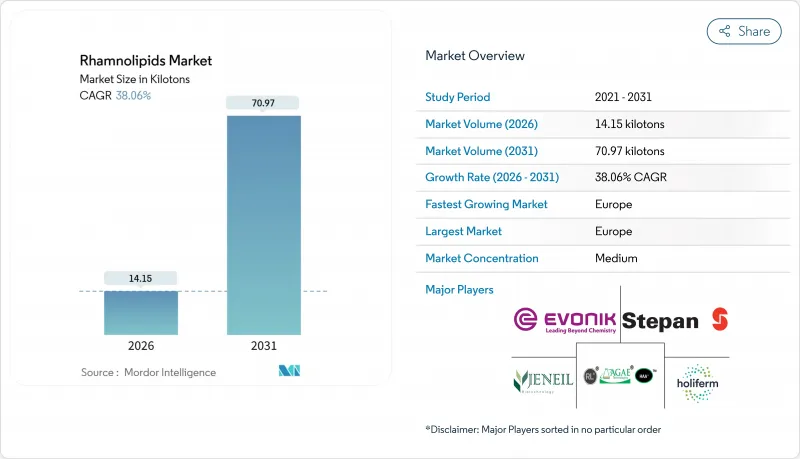
에 의하면, 람노리피드 시장 규모는 2026년에 14.15 킬로톤으로 추정되고 있어 예측 기간(2026-2031년)에서 CAGR 38.06%로 확대되어 2031년에는 70.97 킬로톤에 이를 전망입니다.
본 보고서는 제품 유형별(모노-람노리피드, 디-람노리피드), 원료별(식물성 기름 유래, 폐글리세롤/조글리세린, 설탕계, 탄화수소계), 용도별(계면활성제, 화장품, 농업, 식품, 의약품, 기타),지역별(아시아태평양, 북미, 유럽, 남미, 중동 및 아프리카)로 분류되어 있습니다. 시장 예측은 수량(톤) 기준으로 제시되어 있습니다.
전 세계 람노리피드 시장 동향 및 인사이트
홈 & 퍼스널케어 부문에서 친환경 계면활성제에 대한 수요 증가
2025년, 밀레니얼 세대와 Z세대 소비자들이 성분의 투명성을 중시한 결과, 독일, 프랑스, 영국에서 인증된 친환경 라벨이 부착된 세제 시장 침투율은 28%를 넘어섰습니다. Holiferm과 Trichem South의 제휴는 거품 발생이나 기름때 제거력을 저해하지 않으면서도 피부 친화성과 지속가능성을 추구하는 2급 세제 브랜드의 채택을 뒷받침하고 있습니다. 피부과에서 실시한 패치 테스트를 통해 람노리피드의 자극성이 낮은 것으로 확인되어, 베이비 케어 제품 및 민감성 피부용 제품에의 채택이 촉진되고 있습니다. 바이오 유래 미셀 워터 및 샤워 젤의 15-20% 소매 가격 프리미엄은 가격 탄력성을 낮추며, 라우릴 에테르 황산나트륨 매출의 대체로 직접 연결되고 있습니다. 프라이빗 브랜드와 대중 브랜드가 선도 기업을 모방함에 따라, 9.2%의 효과는 2029년까지 뚜렷하게 지속되어 라만노리피드 시장의 성장 궤도를 더욱 공고히할 것으로 보입니다.
생분해성이며 독성이 낮은 성분에 대한 규제 당국의 추진
2024년 REACH 부속서 XIV의 개정에 따라 3가지 유형의 알킬페놀 에톡실레이트가 유럽 승인 목록에 추가되어, 2027년까지 사실상 단계적으로 폐지되게 되었습니다. 미국 환경보호청(EPA)의 ‘Safer Choice’ 개정에 따라,대수옴(Daphnia magna)의 LC50 요건이 10 mg/L 이상으로 상향 조정됨에 따라, LC50 값이 100 mg/L를 초과하고 28일 이내에 90% 이상의 생분해성을 나타내는 람노리피드의 채택이 배합 개발자들에게 권장되고 있습니다. 2026-2027년 기한을 맞추기 위한 브랜드 제품의 재처방이 단기적인 시장 성장의 원동력이 되고 있지만, 2028년 이후에는 규제를 준수한 처방이 널리 보급됨에 따라 그 성장세는 안정화될 전망입니다.
산업 규모에서의 발포 및 후공정 비용
발효로 인한 거품은 반응기 용량의 3-5배에 달할 수 있어, 기계식 거품 제거기나 소포제 사용이 필요하기 때문에 정제 공정이 복잡해집니다. AGAE Technologies는 수율을 유지하기 위해 아시아 공장에 고속 거품 재활용 루프와 압력 제어식 통기 시스템을 도입했습니다. 후공정, 즉 용매 추출, 한외 여과, 분무 건조는 여전히 제품 원가의 50%를 차지하고 있으며, 이는 구연산의 벤치마크의 2배에 해당합니다. 연속식 막 컨택터와 현장 제품 회수를 통해 2028년까지 회수 비용을 절반으로 줄일 수 있지만, 단기적으로는 학습 곡선의 영향으로 인해 여전히 6.4%의 비용 증가 요인으로 작용하고 있습니다.
부문 분석
모노-람노리피드는 2025년에 수량 기준으로 57.09%를 차지했으며, 수용성과 낮은 임계 미셀 농도(CMC) 덕분에 람노리피드 시장에서 가장 큰 점유율을 차지했습니다. 모노 라만노리피드 시장 점유율은 예측 기간(2026-2031년) 동안 연평균 성장률(CAGR) 40.42%로 확대될 것으로 예측됩니다. Evonik의 pH 제어 발효 기술은 비용이 많이 드는 분획 공정을 거치지 않고도 모노형과 디형 비율을 조절하여 생산 비용을 15-18% 절감합니다. 폐기되는 글리세롤 기질은 수율을 모노형으로 더욱 높이기 위해 원료 전략과 제품 구성이 연동되어 있습니다. 특허 출원은 람노실 트랜스퍼라제 유전자의 최적화에 초점을 맞추고 있으며, AGAE Technologies는 85% 이상의 모노형 순도를 목표로 하고 있습니다. 디-람노리피드는 막 파괴 작용이 강하기 때문에 항균 화장품이나 산업용 탈지제와 같은 틈새 시장에서 수요를 유지하고 있지만, 신속한 용해가 필수적인 상황에서는 점도가 높아 채택이 제한되고 있습니다.
공급업체들이 성능과 비용의 균형을 추구함에 따라, 두 유형을 모두 활용한 2세대 혼합물이 등장할 가능성이 있습니다. 경쟁하는 생합성 경로의 유전자 녹아웃을 통해 디-람노리피드의 함량이 향상된다면, 제형 개발자들은 씻어내지 않는 스킨케어 제품이나 소독제용으로 최적의 비율을 채택하게 될 것이며, 람노리피드 시장의 제품 유형 다양화가 더욱 진행될 것으로 예측됩니다.
지역별 분석
2025년, 유럽은 람노리피드 시장 규모의 62.76%를 차지하며, 2031년까지 연평균 성장률(CAGR) 43.76%를 나타낼 것으로 예측됩니다. 독일과 프랑스가 수요의 중심을 이루고 있으며, 2030년까지 석유화학계 계면활성제의 50%를 대체하겠다는 헨켈(Henkel)과 유니레버(Unilever)의 노력이 이를 뒷받침하고 있습니다. 에보닉(Evonik)의 슬로바키아 공장은 유니레버의 전 세계 식기 세척제에 원료를 공급하고 있으며, 지역 공급망을 EU의 지속가능성 규정에 부합하도록 조정하고 있습니다. 브렉시트 이후 영국의 규제로 인해 바이오 유래 성분의 심사 주기가 단축되어 시장 진입이 가속화되는 한편, 이탈리아와 스페인의 자사 브랜드 제조업체들의 채택이 촉진되고 있습니다.
아시아태평양은 생산량 기준으로 가장 빠르게 성장하고 있는 지역입니다. 2025년에 가동을 시작하는 AGAE Technologies의 1,000톤 규모 공장을 통해, 퍼스널케어 제품 소비 확대에 힘입어 이 지역은 공급 거점으로서의 입지를 확고히 하게 될 것입니다. 중국의 ‘2025년 화장품 원료 안전 기준’ 개정에 따라, 씻어내지 않는 제품에 라므노리피드의 배합이 2.0%까지 허용되며, 5% 시장 침투율이 달성된다면 연간 1만 톤 규모의 잠재 시장이 개척될 것입니다. 일본은 2025년 5월, 람노리피드를 식품용 유화제로 0.5% 배합하는 것을 승인하며, 식품과의 직접 접촉을 허용하는 승인 측면에서 선구적인 역할을 수행했습니다. 인도는 농업을 중시하고 있으며, ‘지속 가능한 농업 국가 미션’의 일환으로 람노리피드를 활용한 생물 농약을 도입하고 있습니다.
북미에서는 EPA의 ‘Safer Choice’ 프로그램에 따라 인증된 산업용 및 시설용 세정제가 주도적인 역할을 하고 있습니다. 국내에서의 본격적인 생산은 여전히 전망 단계이지만, AGAE는 아시아에서의 거품 억제 기술 노하우를 활용하여 미국에 공장을 건설할 계획입니다. 캐나다에서 채택이 주저되는 이유는 퍼스널케어 제품 제조가 제한적이기 때문이지만, 수출업체들이 REACH 규정을 준수하는 배합을 요구함에 따라 수요가 급증할 가능성이 있습니다. 멕시코는 저렴한 합성 제품의 수입으로 인해 도입이 지연되고 있으나, USMCA 규정에 따라 지역 내 바이오 계면활성제 생산이 촉진될 가능성이 있습니다.
기타 혜택
- 엑셀 형식 시장 예측(ME) 시트
- 3개월간의 애널리스트 지원
자주 묻는 질문
목차
제1장 서론
제2장 조사 방법
제3장 주요 요약
제4장 시장 구도
제5장 시장 규모와 성장 예측
제6장 경쟁 구도
제7장 시장 기회와 향후 전망
JHS 26.09.11According to Mordor Intelligence, the rhamnolipids market size is estimated at 14.15 kilotons in 2026, and is expected to reach 70.97 kilotons by 2031, at a CAGR of 38.06% during the forecast period (2026-2031).
This report is Segmented by Product Type (Mono-Rhamnolipids, Di-Rhamnolipids), Feedstock (Vegetable-Oil Derived, Waste Glycerol/Crude Glycerin, Sugar-Based, Hydrocarbon-Based), Application (Surfactants, Cosmetics, Agriculture, Food, Pharmaceutical, and More), and Geography (Asia-Pacific, North America, Europe, South America, Middle East and Africa). Market Forecasts are Provided in Terms of Volume (tons).
Global Rhamnolipids Market Trends and Insights
Rising Demand for Eco-Friendly Surfactants in Home & Personal Care
Penetration of certified eco-label detergents exceeded 28% in Germany, France, and the United Kingdom during 2025 as millennials and Gen Z consumers prioritized ingredient transparency. Holiferm's partnership with Trichem South illustrates adoption by tier-two detergent brands seeking mildness and sustainability without compromising foam or grease cutting.. Dermatological patch tests confirm rhamnolipids' reduced irritation, supporting deployment in baby-care and sensitive-skin products. Retail price premiums of 15-20% for bio-based micellar waters and shower gels reduce price elasticity, translating directly to volume displacement of sodium lauryl ether sulfate. As private-label and mass brands emulate early movers, the +9.2 percentage-point effect will remain visible through 2029, reinforcing the rhamnolipids market trajectory.
Regulatory Push for Biodegradable, Low-Toxicity Ingredients
The 2024 REACH Annex XIV update added three alkylphenol ethoxylates to Europe's authorization list, effectively phasing them out by 2027. The U.S. EPA's Safer Choice revisions tightened Daphnia magna LC50 requirements above 10 mg/L, spurring formulators to adopt rhamnolipids, which display LC50 values over 100 mg/L and >90% biodegradation within 28 days. Brand reformulations to meet 2026-2027 cut-off dates anchor near-term market growth, though momentum stabilizes post-2028 as compliant formulations gain wide penetration.
Foaming & Downstream-Processing Costs at Industrial Scale
Fermentation foam can exceed reactor capacity by 3-5 times, demanding mechanical breakers or antifoams that complicate purification. AGAE Technologies installed rapid foam-recycling loops and pressure-modulated aeration at its Asian plant to keep yields intact. Downstream operations, solvent extraction, ultrafiltration, and spray drying still account for as much as 50% of the cost of goods, double the citric acid benchmarks. Continuous membrane contactors and in-situ product removal could halve recovery costs by 2028, but the learning curve remains a -6.4 percentage-point drag in the near term.
Other drivers and restraints analyzed in the detailed report include:
- Increasing Usage in Agriculture and Biopesticide Applications
- Adoption of Rhamnolipid Nano-Micelles as Alcohol-Free Hospital Sanitizers
- Safety Concerns Over Endotoxins
For complete list of drivers and restraints, kindly check the Table Of Contents.
Segment Analysis
Mono-rhamnolipids commanded 57.09% volume in 2025, capturing the largest rhamnolipids market share due to water solubility and lower critical micelle concentration. Mono-rhamnolipids' market share is expected to increase at a CAGR of 40.425 during the forecast period (2026-2031). Evonik's pH-controlled fermentation tunes mono-to-di ratios without costly fractionation, trimming production costs 15-18%. Waste glycerol substrates further tilt yields toward mono species, linking raw-material strategy to product mix. Patent filings center on rhamnosyltransferase gene optimization, with AGAE Technologies targeting more than 85% mono purity. Di-rhamnolipids retain a niche for antimicrobial cosmetics and industrial degreasers owing to heightened membrane disruption, but viscosity limits adoption where quick dissolution is critical.
Second-generation blends leveraging both species could emerge as suppliers pursue performance-cost trade-offs. If di-rhamnolipid titers improve through genetic knockouts of competing pathways, formulators may adopt tailored ratios for leave-on skincare and disinfectants, reinforcing product-type diversification within the rhamnolipids market.
Complete Report Scope:
- By Product Type
- Mono-Rhamnolipids
- Di-Rhamnolipids
- By Feedstock
- Vegetable-Oil Derived
- Waste Glycerol / Crude Glycerin
- Sugar-Based
- Hydrocarbon-Based
- By Application
- Surfactants
- Cosmetics
- Agriculture
- Food
- Pharmaceutical
- Other Applications (Enhanced Oil Recovery & Bioremediation, etc.)
- By Geography
- Asia-Pacifc
- China
- India
- Japan
- South Korea
- ASEAN Countries
- Rest of Asia-Pacific
- North America
- United States
- Canada
- Mexico
- Europe
- Germany
- United Kingdom
- France
- Italy
- Russia
- Rest of Europe
- South America
- Brazil
- Argentina
- Rest of South America
- Middle East and Africa
- Saudi Arabia
- South Africa
- Rest of Middle East and Africa
- Asia-Pacifc
Geography Analysis
Europe accounted for 62.76% of the Rhamnolipids market size in 2025 and is set to grow at a 43.76% CAGR through 2031. Germany and France anchor demand, supported by Henkel and Unilever commitments to replace 50% of petrochemical surfactants by 2030. Evonik's Slovakian plant supplies Unilever's global dishwashing liquids, aligning regional supply chains with EU sustainability mandates. Post-Brexit UK regulations shorten review cycles for bio-based ingredients, accelerating market entry and spurring adoption by private-label producers in Italy and Spain.
Asia-Pacific is the fastest-growing region by volume. AGAE Technologies' 1,000-t plant, commissioned in 2025, positions the region as a supply hub amid rising personal-care consumption. China's 2025 Cosmetic Ingredient Safety update allows 2.0% rhamnolipid inclusion in leave-on products, unlocking a potential 10,000 t annual market if 5 % penetration is achieved. Japan authorized rhamnolipids as food emulsifiers at 0.5% in May 2025, pioneering direct food-contact approvals. India emphasizes agriculture, integrating rhamnolipid biopesticides under its National Mission for Sustainable Agriculture.
North America is led by industrial and institutional cleaners certified under EPA's Safer Choice program. Domestic full-scale production remains prospective; AGAE plans a US plant leveraging foam-control learnings from Asia. Canada's modest adoption reflects limited personal-care manufacturing but could surge as exporters seek REACH-compliant formulations. Mexico lags given cheap synthetic imports, though USMCA rules may spur regional biosurfactant production.
- AGAE Technologies, LLC
- BASF SE
- Biotensidon GmbH
- DEGUAN Biosurfactant Supplier
- Evonik Industries AG
- GlycoSurf Inc.
- Holiferm Ltd
- Jeneil Biotech
- Stepan Company
- TensioGreen LLC
Additional Benefits:
- The market estimate (ME) sheet in Excel format
- 3 months of analyst support
TABLE OF CONTENTS
1 Introduction
- 1.1 Study Assumptions & Market Definition
- 1.2 Scope of the Study
2 Research Methodology
3 Executive Summary
4 Market Landscape
- 4.1 Market Overview
- 4.2 Market Drivers
- 4.2.1 Rising demand for eco-friendly surfactants in Home & Personal Care
- 4.2.2 Regulatory push for biodegradable, low-toxicity ingredients
- 4.2.3 Increasing usage in agriculture and biopesticide applications
- 4.2.4 Adoption of rhamnolipid nano-micelles as alcohol-free hospital sanitizers
- 4.2.5 Increasing demand from oil recovery and remediation application
- 4.3 Market Restraints
- 4.3.1 Foaming & downstream-processing costs at industrial scale
- 4.3.2 Safety concerns over endotoxins
- 4.3.3 Vegetable-oil price volatility competing with food supply
- 4.4 Value Chain Analysis
- 4.5 Porter's Five Forces
- 4.5.1 Threat of New Entrants
- 4.5.2 Bargaining Power of Buyers
- 4.5.3 Bargaining Power of Suppliers
- 4.5.4 Threat of Substitutes
- 4.5.5 Degree of Competition
5 Market Size & Growth Forecasts
- 5.1 By Product Type
- 5.1.1 Mono-Rhamnolipids
- 5.1.2 Di-Rhamnolipids
- 5.2 By Feedstock
- 5.2.1 Vegetable-Oil Derived
- 5.2.2 Waste Glycerol / Crude Glycerin
- 5.2.3 Sugar-Based
- 5.2.4 Hydrocarbon-Based
- 5.3 By Application
- 5.3.1 Surfactants
- 5.3.2 Cosmetics
- 5.3.3 Agriculture
- 5.3.4 Food
- 5.3.5 Pharmaceutical
- 5.3.6 Other Applications (Enhanced Oil Recovery & Bioremediation, etc.)
- 5.4 By Geography
- 5.4.1 Asia-Pacifc
- 5.4.1.1 China
- 5.4.1.2 India
- 5.4.1.3 Japan
- 5.4.1.4 South Korea
- 5.4.1.5 ASEAN Countries
- 5.4.1.6 Rest of Asia-Pacific
- 5.4.2 North America
- 5.4.2.1 United States
- 5.4.2.2 Canada
- 5.4.2.3 Mexico
- 5.4.3 Europe
- 5.4.3.1 Germany
- 5.4.3.2 United Kingdom
- 5.4.3.3 France
- 5.4.3.4 Italy
- 5.4.3.5 Russia
- 5.4.3.6 Rest of Europe
- 5.4.4 South America
- 5.4.4.1 Brazil
- 5.4.4.2 Argentina
- 5.4.4.3 Rest of South America
- 5.4.5 Middle East and Africa
- 5.4.5.1 Saudi Arabia
- 5.4.5.2 South Africa
- 5.4.5.3 Rest of Middle East and Africa
- 5.4.1 Asia-Pacifc
6 Competitive Landscape
- 6.1 Market Concentration
- 6.2 Strategic Moves
- 6.3 Market Share(%)/Ranking Analysis
- 6.4 Company Profiles (includes Global level Overview, Market level overview, Core Segments, Financials, Strategic Info, Market Rank/Share, Products & Services, Recent Developments)
- 6.4.1 AGAE Technologies, LLC
- 6.4.2 BASF SE
- 6.4.3 Biotensidon GmbH
- 6.4.4 DEGUAN Biosurfactant Supplier
- 6.4.5 Evonik Industries AG
- 6.4.6 GlycoSurf Inc.
- 6.4.7 Holiferm Ltd
- 6.4.8 Jeneil Biotech
- 6.4.9 Stepan Company
- 6.4.10 TensioGreen LLC
7 Market Opportunities & Future Outlook
- 7.1 White-Space & Unmet-Need Assessment
- 7.2 Rapid Uptake of Glycerin in E-cigarette Liquids in Asia and Middle-East


