|
시장보고서
상품코드
2124432
타이어 코드 패브릭 시장 : 점유율 분석, 업계 동향과 통계, 성장 예측(2026-2031년)Tire Cord Fabrics - Market Share Analysis, Industry Trends & Statistics, Growth Forecasts (2026 - 2031) |
||||||
 Mordor Intelligence
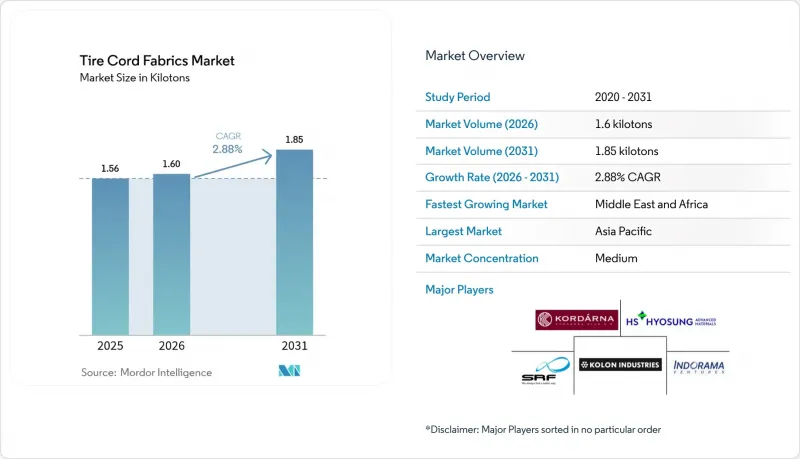
Mordor Intelligence에 의하면, 타이어 코드 패브릭 시장 규모는 2025년에 1.56 킬로톤이라고 평가되어 2026년 1.6 킬로톤에서 2031년까지 1.85 킬로톤에 이를 것으로 예측되며, 예측 기간(2026-2031년) CAGR은 2.88%를 나타낼 전망입니다.
본 보고서는 섬유별(나일론, 폴리에스터, 레이온, 아라미드, 유리, PVA), 타이어 유형별(바이애스/대각선, 세미레이디얼, 레이디얼), 차량 유형별(자동차, 항공기, 산업용 제품, 기타),지역별(아시아태평양, 북미, 유럽, 남미, 중동 및 아프리카)로 분류되어 있습니다. 시장 예측은 수량(톤) 기준으로 제시되어 있습니다.
전 세계 타이어 코드 패브릭 시장 동향 및 인사이트
전 세계 자동차 생산 대수 증가 및 보유 대수 확대
업계 전반의 자동차 생산 회복에 따라, 타이어 제조업체들이 최근 공급망 혼란으로 감소한 재고를 보충하기 위해 보강용 섬유의 대량 발주가 촉진되고 있습니다. 대형 트럭, 버스, 트레일러는 승용차에 비해 타이어 1개당 사용되는 코드 패브릭의 양이 많기 때문에 수요 증가세가 더욱 확대되고 있습니다. 전 세계적으로 꾸준히 증가하는 자동차 보유 대수는 특히 거시경제의 역풍에도 불구하고 소유율이 계속 상승하고 있는 신흥 경제국에서 교체용 타이어 수요를 뒷받침하고 있습니다. 물류 차량의 전동화 프로그램도 수요를 더욱 끌어올리고 있는데, 이는 전기 트럭에는 더 높은 강성을 가진 카카스와 높은 코드 밀도가 요구되기 때문입니다. 주요 타이어 제조업체들의 병행된 생산 능력 확충이 타이어 코드 패브릭 시장의 중기적 성장을 뒷받침하는 동기화된 상승 추세를 만들어내고 있습니다.
신흥 시장의 레이디얼 타이어 급속한 보급
인도 및 동남아시아 전역에서 바이애스 타이어는 타이어 1개당 약 40% 더 많은 코드 패브릭을 필요로 하는 레이디얼 타이어로 대체되고 있습니다. 정부의 연비 규제와 더 긴 수명을 원하는 소비자 수요가 이러한 전환을 가속화하고 있습니다. 농업 기계 부문에서는 이러한 경향이 더욱 두드러집니다. IF·VF 레이디얼 기술에서는 높은 인장 강도의 코드를 사용한 더욱 견고한 카커스가 요구되기 때문입니다. 이러한 전환은 2030년까지 진행되어, 북미와 유럽의 성숙한 수요 동향을 보완하는 지속적인 수요의 호재를 창출할 것입니다. 현지 타이어 생산 거점 근처에서 폴리에스터나 나일론 생산량을 확대할 수 있는 공급업체가 이 시장 점유율을 확보하는 데 가장 유리한 입장에 있습니다.
석유화학 원료 가격의 변동
폴리에스터와 나일론은 파라자일렌, 아디핀산, 카프로락탐에 의존하고 있으며, 이들 모두 원유 가격 변동에 연동되어 가격이 변동합니다. 급격한 가격 급등은 코드 패브릭 제조업체의 이익률을 압박하는 반면, 급격한 가격 하락은 업스트림 공정에 대한 투자를 위축시켜 공급 안정성에 대한 위험을 초래합니다. 섬유 중간재 시장에서 중국의 지배적인 지위로 인해, 지역적인 공급 중단이나 무역 마찰이 즉시 전 세계적인 가격 변동으로 이어질 가능성이 있습니다. 대형 타이어 제조업체는 헤지가 가능하지만, 중소규모의 직물 제조업체는 운전 자금 부족에 직면해 있어, 이것이 단기적인 공급을 제약할 우려가 있습니다.
부문 분석
폴리에스터는 승용차용 및 상용차용 타이어 모두에서 비용과 성능의 균형이 뛰어나, 2025년 시점에서 타이어 코드 패브릭 시장의 42.05% 점유율을 유지했습니다. 이 부문의 뛰어난 경제성, 풍부한 원료, 자동 직조기와의 호환성이 그 주도적 지위를 뒷받침하고 있습니다. 아라미드는 생산량은 적지만, 폴리에스터의 한계를 뛰어넘는 내열성과 인장 강도가 필요한 EV 및 초고성능 타이어 수요에 힘입어 2031년까지 연평균 성장률(CAGR) 3.14%로 성장을 지속하고, 있습니다. 나일론은 바이어스 구조나 특수 오프로드 타이어에서 여전히 중요한 위치를 차지하고 있지만, 레이디얼 타이어의 보급이 진행됨에 따라 생산량은 점차 감소하고 있습니다. 레이온은 공급 제약과 피로 수명의 짧음으로 인해 계속해서 시장 점유율이 축소되고 있지만, 유리 섬유나 PVA 코드 같은 틈새 시장은 산업용 및 항공기 용도에서 안정적인 상태를 유지하고 있습니다. 지속가능성에 대한 요구가 높아지는 가운데, 바이오 유래 폴리에스터와 재생 모노머의 시험적 도입이 진행되고 있으며, 향후 10년 후반에는 혁신적인 기업들이 섬유 계층 구조를 재정의하는 입장에 서게 될 것으로 예측됩니다.
폴리에스터의 HMLS 등급은 주요 제조업체들이 전 세계 타이어 OEM 제조업체와 장기 계약을 체결함으로써 원자재 가격 변동으로부터 보호받는 데 기여하고 있습니다. 아라미드 공급업체들은 높은 이익률을 확보하고 있으며, 공급을 안정화하기 위해 섬유 전구체의 화학 분야로 업스트림 공정을 통합하는 사례도 적지 않습니다. 폴리에스터와 아라미드 또는 유리를 조합한 하이브리드 코드는 승차감을 미세하게 조정하기 위한 최적의 강성을 실현하며, 차별화된 성장의 길을 제시하고 있습니다.
지역별 분석
2025년 아시아태평양의 점유율 48.10%는 석유화학 원료, 고속 직물 공장, 주요 타이어 공장이 동일 지역에 집적된 생산 클러스터를 반영하고 있습니다. 중국은 HMLS 폴리에스테르 및 RFF 디핑 분야에서 규모와 높아지는 기술력을 모두 갖추고 있는 반면, 인도의 자동차 산업 성장은 국내 소비 기반을 공고히 하고 있습니다. 태국과 인도네시아 등 동남아시아 국가들은 수출 지향형 타이어 공장을 통해 공급망을 확장하고 있으며, 이는 해당 지역이 타이어 코드 패브릭 시장의 핵심이 되는 데 기여하고 있습니다.
중동 및 아프리카은 세계 최고 수준인 연평균 성장률(CAGR) 2.96%로 성장을 지속하고, 있습니다. 각국 정부는 석유 수입을 타이어 및 부품 생산을 포함한 다각화 프로그램에 투자하고 있습니다. 사우디아라비아의 산업단지는 외국 기업과의 합작 투자를 유치하고 있는 반면, 모로코는 EU 및 미국과의 무역 협정을 활용하여 북아프리카의 수출 거점으로서의 위상을 확립해 가고 있습니다. 자동차 산업이 확립된 튀르키예와 남아프리카공화국은 성장을 뒷받침하는 또 다른 거점이 되고 있습니다.
북미와 유럽은 여전히 혁신의 거점이며, 낮은 구름 저항과 지속 가능한 소재를 요구하는 규제적 압력으로 인해 첨단 코드 솔루션에 대한 수요가 견인되고 있습니다. 전기차(EV)의 높은 보급률, 엄격한 연비 기준, 에어리스 타이어의 조기 시험 등이 전 세계 공급망 전반에 파급되는 프리미엄 사양의 형성에 기여하고 있습니다. 라틴아메리카는 농업 기계 수요를 배경으로 꾸준히 성장하고 있지만, 환율 변동이나 경기 순환에 따라 때때로 수요 둔화가 관찰됩니다. 전반적으로 지리적 전개 변화에 따라 코드 공급업체들은 저비용 생산과 고사양 고객과의 근접성 사이에서 균형을 맞추어야 할 필요에 직면해 있으며, 이에 따라 타이어 코드 패브릭 시장은 지역별로 계속 다양화될 것으로 전망됩니다.
기타 혜택:
- 엑셀 형식 시장 예측(ME) 시트
- 3개월간의 애널리스트 지원
자주 묻는 질문
목차
제1장 서론
제2장 조사 방법
제3장 주요 요약
제4장 시장 구도
제5장 시장 규모와 성장 예측
제6장 경쟁 구도
제7장 시장 기회와 향후 전망
제1장 서론
제2장 조사 방법
제3장 주요 요약
제4장 시장 구도
제5장 시장 규모와 성장 예측
제6장 경쟁 구도
제7장 시장 기회와 향후 전망
JHSAccording to Mordor Intelligence, the tire cord fabrics market size was valued at 1.56 kilotons in 2025 and estimated to grow from 1.6 kilotons in 2026 to reach 1.85 kilotons by 2031, at a CAGR of 2.88% during the forecast period (2026-2031).
This report is Segmented by Fiber (Nylon, Polyester, Rayon, Aramid, Glass, and PVA), Tire Type (Bias/Diagonal, Semi-Radial, and Radial), Vehicle Type (Automotive, Aircrafts, Industrial Products, and Others), and Geography (Asia-Pacific, North America, Europe, South America, and Middle-East and Africa). The Market Forecasts are Provided in Terms of Volume (Tons).
Global Tire Cord Fabrics Market Trends and Insights
Rising Global Vehicle Production and Parc Expansion
Industry-wide vehicle output recovery is driving bulk orders for reinforcement textiles as tire factories rebuild inventories that ran down during recent supply-chain disruptions. Heavy-duty trucks, buses, and trailers consume greater quantities of cord fabric per tire than passenger cars, magnifying demand gains. A steadily expanding global vehicle parc sustains replacement volumes, especially in emerging economies where ownership rates continue to climb despite macroeconomic headwinds. Electrification programs in logistics fleets add incremental pull because electric trucks require stiffer carcasses and higher cord density. Parallel capacity additions at leading tire makers create a synchronized upswing that underpins medium-term growth for the tire cord fabrics market.
Rapid Radial-Tire Adoption in Emerging Markets
Across India and Southeast Asia, bias-ply tires are giving way to radial designs that need roughly 40% more cord fabric per unit. Government fuel-efficiency mandates and user demand for longer service life accelerate the changeover. Farm-equipment segments amplify the effect because IF and VF radial technologies require stronger carcasses built with high-tensile cords. The conversion progresses through 2030, producing a durable volume tailwind that compensates for mature demand profiles in North America and Europe. Suppliers capable of ramping polyester and nylon output near local tire clusters are best placed to capture this share.
Petrochemical Feedstock Price Volatility
Polyester and nylon rely on paraxylene, adipic acid, and caprolactam, all of which fluctuate with crude-oil cycles. Sudden surges compress margins for cord weavers, while sharp declines discourage upstream investment, creating supply-security risks. China's dominant position in fiber intermediates means regional outages or trade tensions can translate quickly into global price swings. Although large tire companies can hedge, smaller fabric producers face working-capital stress that may constrain near-term supply.
Other drivers and restraints analyzed in the detailed report include:
- Lightweight HMLS and Hybrid-Cord Demand for Lower Rolling Resistance
- Adoption of RFF "Green" Adhesion Chemistries
- Cyclical Over-/Under-Capacity in Auto Production
For complete list of drivers and restraints, kindly check the Table Of Contents.
Segment Analysis
Polyester retained 42.05% of tire cord fabrics market share in 2025 owing to its cost-to-performance balance across passenger and commercial tires. The segment's favorable economics, abundant feedstock, and compatibility with automated weaving underpin its leadership. Aramid, while accounting for a smaller volume base, records a 3.14% CAGR through 2031, powered by EV and ultra-high-performance fitments that demand heat resistance and tensile strength beyond polyester's ceiling. Nylon sustains relevance in bias constructions and specialty off-road tires but confronts gradual volume erosion as radial penetration rises. Rayon continues to retreat because of supply constraints and shorter fatigue life, whereas glass and PVA cord niches stay stable in industrial and aircraft applications. Sustainability imperatives encourage trials of bio-derived polyesters and recycled monomer streams, positioning innovators to redefine fiber hierarchies later in the decade.
Polyester's HMLS grades help leading producers lock in long-term contracts with global tire OEMs, cushioning them against raw-material swings. Aramid suppliers command premium margins and often integrate backward into fiber precursor chemistries to secure supply. Hybrid cords combining polyester with aramid or glass enable tailored stiffness for fine-tuned ride comfort, offering an avenue for differentiated growth.
Complete Report Scope:
- By Fiber
- Nylon
- Polyester
- Rayon
- Aramid
- Glass
- PVA
- By Tire Type
- Bias / Diagonal
- Semi-Radial
- Radial
- By Vehicle Type
- Automotive
- Aircrafts
- Industrial Products
- Others
- By Geography
- Asia-Pacific
- China
- India
- Japan
- South Korea
- ASEAN Countries
- Rest of Asia-Pacific
- North America
- United States
- Canada
- Mexico
- Europe
- Germany
- United Kingdom
- France
- Italy
- Russia
- Nordic Countries
- Rest of Europe
- South America
- Brazil
- Argentina
- Rest of South America
- Middle-East and Africa
- Saudi Arabia
- Turkey
- South Africa
- Rest of Middle-East and Africa
- Asia-Pacific
Geography Analysis
Asia-Pacific's 48.10% share in 2025 reflects production clusters that co-locate petrochemical feedstocks, high-speed weaving mills, and major tire plants. China combines scale with rising competency in HMLS polyester and RFF dipping, while India's automotive growth adds a deep domestic consumption layer. Southeast Asian economies such as Thailand and Indonesia extend the supply chain with export-oriented tire plants, helping the region anchor the tire cord fabrics market.
The Middle East and Africa records a 2.96% CAGR, the fastest worldwide. Governments channel oil revenue into diversification programs that include tire and component production. Saudi Arabia's industrial zones attract foreign joint ventures, while Morocco leverages trade pacts with the EU and the United States to become a North-African export base. Turkey and South Africa, with established auto sectors, provide additional anchor points for growth.
North America and Europe remain innovation hubs where regulatory pressure for low-rolling-resistance and sustainable materials drives demand for advanced cord solutions. High adoption of EVs, stringent fuel-economy standards, and early trials of airless tires shape premium specifications that ripple back through global supply chains. Latin America grows steadily on agricultural equipment demand, but currency volatility and economic cycles inject periodic softness. Overall, shifting geographic footprints prompt cord suppliers to balance low-cost manufacturing with proximity to high-spec customers, ensuring the tire cord fabrics market keeps diversifying regionally.
- Beihai Fiberglass
- Bekaert
- Benninger AG
- Century Enka Limited
- Cordenka GmbH & Co KG
- Cordus
- Far Eastern Group
- Firestone Fibers & Textiles
- GURIS
- HYOSUNG ADVANCED MATERIALS
- Indorama Ventures Public Company Limited
- Kolon Industries Inc.
- KORDRNA Plus a.s.
- Milliken & Company
- Oerlikon Management AG
- SRF Limited
- TEIJIN LIMITED
- TORAY INDUSTRIES, INC
Additional Benefits:
- The market estimate (ME) sheet in Excel format
- 3 months of analyst support
TABLE OF CONTENTS
1 Introduction
- 1.1 Study Assumptions and Market Definition
- 1.2 Scope of the Study
2 Research Methodology
3 Executive Summary
4 Market Landscape
- 4.1 Market Overview
- 4.2 Market Drivers
- 4.2.1 Rising global vehicle production and parc expansion
- 4.2.2 Rapid radial-tire adoption in emerging markets
- 4.2.3 Higher EV-related tire-replacement frequency
- 4.2.4 Lightweight HMLS and hybrid-cord demand for lower RR
- 4.2.5 Adoption of RFF "green" adhesion chemistries
- 4.3 Market Restraints
- 4.3.1 Petrochemical feedstock price volatility
- 4.3.2 Cyclical over-/under-capacity in auto production
- 4.3.3 Rise of airless / non-pneumatic tire concepts
- 4.4 Value Chain Analysis
- 4.5 Porter's Five Forces
- 4.5.1 Threat of New Entrants
- 4.5.2 Bargaining Power of Buyers
- 4.5.3 Bargaining Power of Suppliers
- 4.5.4 Threat of Substitute Products
- 4.5.5 Degree of Competition
5 Market Size and Growth Forecasts (Volume)
- 5.1 By Fiber
- 5.1.1 Nylon
- 5.1.2 Polyester
- 5.1.3 Rayon
- 5.1.4 Aramid
- 5.1.5 Glass
- 5.1.6 PVA
- 5.2 By Tire Type
- 5.2.1 Bias / Diagonal
- 5.2.2 Semi-Radial
- 5.2.3 Radial
- 5.3 By Vehicle Type
- 5.3.1 Automotive
- 5.3.2 Aircrafts
- 5.3.3 Industrial Products
- 5.3.4 Others
- 5.4 By Geography
- 5.4.1 Asia-Pacific
- 5.4.1.1 China
- 5.4.1.2 India
- 5.4.1.3 Japan
- 5.4.1.4 South Korea
- 5.4.1.5 ASEAN Countries
- 5.4.1.6 Rest of Asia-Pacific
- 5.4.2 North America
- 5.4.2.1 United States
- 5.4.2.2 Canada
- 5.4.2.3 Mexico
- 5.4.3 Europe
- 5.4.3.1 Germany
- 5.4.3.2 United Kingdom
- 5.4.3.3 France
- 5.4.3.4 Italy
- 5.4.3.5 Russia
- 5.4.3.6 Nordic Countries
- 5.4.3.7 Rest of Europe
- 5.4.4 South America
- 5.4.4.1 Brazil
- 5.4.4.2 Argentina
- 5.4.4.3 Rest of South America
- 5.4.5 Middle-East and Africa
- 5.4.5.1 Saudi Arabia
- 5.4.5.2 Turkey
- 5.4.5.3 South Africa
- 5.4.5.4 Rest of Middle-East and Africa
- 5.4.1 Asia-Pacific
6 Competitive Landscape
- 6.1 Market Concentration
- 6.2 Strategic Moves
- 6.3 Market Share/Ranking Analysis
- 6.4 Company Profiles (includes Global-level Overview, Market-level Overview, Core Segments, Financials, Strategic Info, Market Rank/Share, Products and Services, Recent Developments)
- 6.4.1 Beihai Fiberglass
- 6.4.2 Bekaert
- 6.4.3 Benninger AG
- 6.4.4 Century Enka Limited
- 6.4.5 Cordenka GmbH & Co KG
- 6.4.6 Cordus
- 6.4.7 Far Eastern Group
- 6.4.8 Firestone Fibers & Textiles
- 6.4.9 GURIS
- 6.4.10 HYOSUNG ADVANCED MATERIALS
- 6.4.11 Indorama Ventures Public Company Limited
- 6.4.12 Kolon Industries Inc.
- 6.4.13 KORDRNA Plus a.s.
- 6.4.14 Milliken & Company
- 6.4.15 Oerlikon Management AG
- 6.4.16 SRF Limited
- 6.4.17 TEIJIN LIMITED
- 6.4.18 TORAY INDUSTRIES, INC
7 Market Opportunities and Future Outlook
- 7.1 White-space and Unmet-Need Assessment