
|
시장보고서
상품코드
2124463
일회용 플라스틱 포장 : 시장 점유율 분석, 업계 동향 및 통계, 성장 예측(2026-2031년)Global Single Use Plastic Packaging - Market Share Analysis, Industry Trends & Statistics, Growth Forecasts (2026 - 2031) |
||||||
 Mordor Intelligence
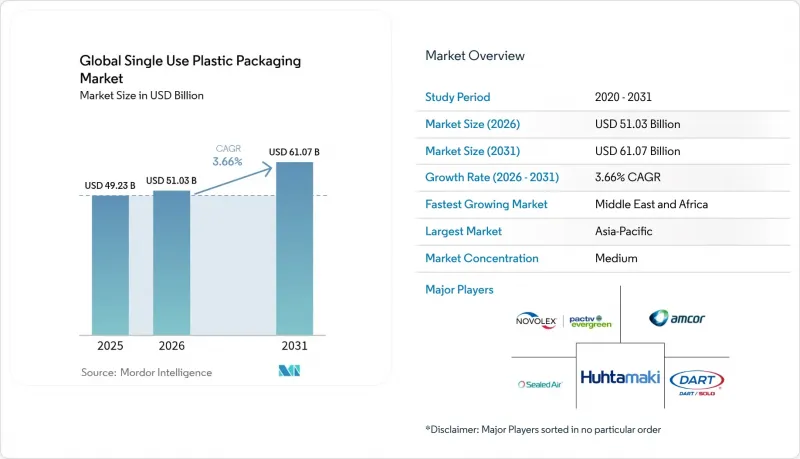
Mordor Intelligence에 의하면, 일회용 플라스틱 포장 시장 규모는 2025년 492억 3,000만 달러로 평가되었습니다. 2026년에는 510억 3,000만 달러로 확대되어 2026년부터 2031년에 걸쳐 CAGR 3.66%로 성장을 지속하여, 2031년에는 610억 7,000만 달러에 이를 것으로 예측됩니다.
본 보고서는 소재별(폴리에틸렌 테레프탈레이트(PET), 폴리에틸렌(PE) 등), 제품 유형별(병, 파우치·소포장 등),최종 이용 산업(퀵서비스 레스토랑(QSR), 풀서비스 레스토랑(FSR), 식품 및 음료 등), 유통 채널(직접 판매, 간접 판매), 지역별로 분류되어 있습니다. 시장 전망은 금액(달러) 기준으로 제시되어 있습니다.
세계의 일회용 플라스틱 포장 시장 동향 및 인사이트
아시아 메가시티의 앱 기반 음식 배달 붐
인도네시아, 태국, 베트남에서는 디지털 음식 배달 거래가 계속해서 두 자릿수 성장률을 보이고 있으며, 오토바이 배송을 견딜 수 있고 누출 방지 및 보온성이 뛰어난 포장에 대한 수요가 증가하고 있습니다. 자카르타의 사업자들은 현재 주문 금액의 15-20%를 포장 비용으로 지출하고 있으며, 이에 따라 공급업체들은 액체 누출을 방지하고 브랜드 가시성을 높이는 적층 가능한 디자인을 개발하고 있습니다. 1인 가구 증가에 따라 소용량 포장이 선호되면서 미니 용기나 2실 구조의 포장이 보급되고 있습니다. 배달 플랫폼의 표준화로 SKU가 간소화되어 규모의 경제가 촉진되는 한편, 지방 자치 단체는 신생 재활용 인프라를 뒷받침하는 사용 후 회수 체계를 추진하고 있습니다. 이러한 요인들이 복합적으로 작용하여 수요량은 증가하는 한편, 다운스트림 공정에서의 선별을 용이하게 하기 위해 단일 소재 라미네이트 소재로의 전환이 가속화되고 있습니다.
EU의 ‘캡 고정화’ 규제가 단일 소재 PET 채택을 가속화
2024년 7월 유럽에서 시행된 테더형 캡 의무화로 인해 병입 라인의 급속한 전환이 진행되고 있습니다. 코카콜라사만 해도 40개 거점에 1억 5,000만 유로를 투자했으며, 소비자의 95%가 이를 긍정적으로 받아들였습니다. 각 공급업체들은 버진 PET, 재생 PET, 바이오 PET 병에 원활하게 호환되는 테더가 부착된 캡을 제공함으로써 이에 대응하고 있으며, 이는 회수율 향상과 PET 재활용 분야의 경쟁력 강화로 이어지고 있습니다. 캘리포니아주도 2027년까지 이에 동참할 전망이며, 대규모 설비 갱신이 가능한 생산자에게 유리한 사실상 세계 표준이 확립될 것입니다. Origin Materials사의 상호 호환 가능한 캡은 규제가 인체공학적 개선이나 위조 개봉 방지 기능과 같은 차별화된 제품 특성을 어떻게 촉진하는지 보여줍니다.
대체품의 쉬운 입수 가능성
섬유 기반 뚜껑, 성형 펄프 트레이, 바이오 유래 필름은 차단 성능에 대한 요구가 그리 엄격하지 않은 분야 수요를 잠식하고 있습니다. 대만의 맥도날드는 2025년에 메뉴의 플라스틱 라미네이트를 폐지하여 연간 86톤의 수지를 절약하고 1만 그루의 나무를 보호했습니다. 2030년까지 재활용 가능성을 의무화하는 EU 규제로 인해, 목재 셀룰로오스를 54% 함유한 퇴비화 가능한 육류 트레이의 브랜드별 시범 도입이 가속화되고 있습니다. 북미에서 다트 컨테이너(Dart Container)사가 도입한 건식 성형 섬유 기술은 에너지 사용량을 80% 절감하여 기존 EPS에 비해 비용 경쟁력을 높이고 있습니다. 금형 전환이 진행됨에 따라 일회용 플라스틱 포장 시장에서는 저온 용도나 수명이 짧은 용도 분야에서 경쟁이 격화되고 있습니다.
부문별 분석
PET는 2025년에 일회용 플라스틱 포장 시장에서 34.68%의 점유율을 차지했으며, ‘병에서 병으로(Bottle-to-Bottle)’ 순환 체계의 성숙에 따라 연평균 성장률(CAGR) 6.95%로 그 선두를 더욱 확대될 전망입니다. 유럽의 음료병에 재활용 소재 30% 함유 의무는 rPET 플레이크에 대한 프리미엄 수요를 뒷받침하고 있으며, 현지 브랜드 할당량을 충족하기 위해 가네샤 에코펫(Ganesha EcoPet)의 연간 4만 2,000톤 생산 능력 확대와 같은 투자를 촉진하고 있습니다. 재활용성, 차단성, 투명성, 테더드 캡과의 호환성이 어우러져 음료 및 퍼스널케어 제품 분야에서 PET의 입지를 확고히 하고 있습니다.
폴리에틸렌과 폴리프로필렌은 그 범용성과 비용 면에서 필름, 봉지, 캡 분야에서 여전히 주력 소재로서의 지위를 유지하고 있지만, 재활용이 어려운 다층 라미네이트 소재를 규제 당국이 표적으로 삼고 있어 그 성장은 둔화되고 있습니다. 폴리스티렌은 규제による 사용 금지 조치의 영향으로 외식 산업에서의 점유율을 잃고 있지만, 한편으로 성능 요건과 퇴비화 요건이 일치하는 분야에서는 바이오 폴리머가 틈새 시장에서 기세를 얻고 있습니다. 대형 기술 기업들은 화학 재활용 시범 사업을 추진하고 있지만, 규모와 경제성이 양립할 때까지는 일회용 플라스틱 포장 시장에서 PET가 실질적인 우위를 계속 유지할 것입니다.
병은 테더가 달린 뚜껑의 보급과 외출 시 수분 보충 트렌드의 뒷받침을 받아 2025년에도 매출의 30.12%를 차지하며 가장 큰 점유율을 유지했습니다. 그럼에도 기능성 음료, 조미료, 퍼스널케어 제품의 리필 용기 수요를 배경으로 파우치와 사셰는 연평균 성장률(CAGR) 4.98%로 다른 제품군을 앞지르고 있습니다. FDA 승인을 받은 초박형 배리어 필름 덕분에 브랜드는 보존성을 유지하면서 포장 무게를 30% 줄일 수 있어, 파우치는 분량 관리 및 전자상거래 분야에서 대표적인 선택지가 되고 있습니다.
클램쉘, 트레이, 컵에 대해서는 평가가 엇갈리고 있습니다. 소매 신선식품 부문에서는 rPET 제 열성형 용기가 선호되는 반면, 퀵서비스 레스토랑에서는 지역 조례를 충족하기 위해 섬유제 그릇의 시범 도입이 진행되고 있습니다. 필름과 랩은 온라인 식료품 판매의 호재를 타고 있지만, 재활용성 문제에 직면해 있어 단일 소재 PE 구조를 표준화하기 위한 컨소시엄의 노력이 진행되고 있습니다. 모든 형태에서 ‘재활용을 고려한 설계’가 주요 선정 기준이 되고 있으며, 주요 지역의 가정별 수거 체계에 대응하는 솔루션에 대한 투자가 촉진되고 있습니다.
지역별 분석
아시아태평양이 일회용 플라스틱 포장 시장의 39.85%를 차지하고 있는 것은 이 지역의 제조업 규모, 도시 인구 증가, 그리고 확대되는 중산층을 반영합니다. 중국의 포장 부문은 EPS 및 rPET 솔루션이 필요한 온라인 식료품 판매 및 콜드체인에 대한 투자 열풍에 힘입어 2024년에 2조 3,000억 위안 규모의 생산액을 기록했습니다. 인도는 블리스터 포장 수출과 음식 배달 시장의 성장에 힘입어 탄력을 받고 있는 반면, 동남아시아에서는 전자상거래 거래가 35% 확대되며 보호용 우편 포장재 수요를 끌어올리고 있습니다.
북미에서는 주 차원의 금지 조치와 재활용 소재 함량 할당 기준에 의해 형성된, 성숙해 가면서도 역동적인 상황이 관찰됩니다. 캘리포니아주의 확대 생산자 책임법은 전미의 브랜드 사양에 영향을 미치며, 연방 지침에 앞서 PCR PET 함량 30%라는 목표를 추진하고 있습니다. 기계적 재활용 및 화학적 재활용에 대한 투자가 확대되고 있으며, 암콜(Amcor)사는 원료의 안정적인 공급을 확보하기 위해 기계적 재활용 PE에 관한 다년 계약을 체결했습니다.
유럽은 여전히 규제의 선구자이며, ‘일회용 플라스틱 지침’, PPWR, 끈이 달린 뚜껑 법안이 전 세계 디자인 템플릿을 주도하고 있습니다. 규정 준수 비용이 업계 재편을 촉진하는 한편, 단일 소재의 유연한 구조나 성형 섬유로 만든 기념용 뚜껑에 대한 혁신도 촉진하고 있습니다.
중동 및 아프리카는 2031년까지 연평균 성장률(CAGR) 5.45%로 성장을 주도하고 있습니다. 사우디아라비아의 ‘비전 2030’ 관광 전략에 힘입어 2024년 관광객 수는 56% 증가했으며, 이는 병입 식수 포장 수요의 급증을 뒷받침했습니다. 마사피(Masafi)사는 호텔 및 레스토랑 업계와의 계약을 이행하기 위해 생산 능력 확충에 1억 2,000만 디르함을 투자했습니다. NEOM과 같은 거대 인프라 프로젝트로 인해 사막의 물류 환경에서 가혹한 조건을 견딜 수 있는 보호재 및 차단재에 대한 수요가 확대되고 있으며, 공급업체들은 지역별로 재활용 거점 설치를 촉진하고 있습니다.
라틴아메리카, 특히 브라질에서는 2024년에 포장 생산량이 8% 증가하는 등 국지적인 확대가 나타났습니다. 환율 변동과 규제 불일치로 인해 해외 투자는 억제되고 있지만, 현지 가공업체들은 국경을 초월한 전자상거래에서 일회용 플라스틱 포장 시장의 기회를 활용하기 위해 설비 업그레이드를 추진하고 있습니다.
기타 혜택 :
- 엑셀 형식 시장 예측(ME) 시트
- 3개월간의 애널리스트 지원
자주 묻는 질문
목차
제1장 서론
제2장 조사 방법
제3장 주요 요약
제4장 시장 구도
제5장 시장 규모 및 성장 예측
제6장 경쟁 구도
제7장 시장 기회 및 향후 전망
KTH 26.09.14According to Mordor Intelligence, the single-use plastic packaging market size is expected to grow from USD 49.23 billion in 2025 to USD 51.03 billion in 2026 and is forecast to reach USD 61.07 billion by 2031 at 3.66% CAGR over 2026-2031.
This report is Segmented by Material (Polyethylene Terephthalate (PET), Polyethylene (PE), and More), Product Type (Bottles, Pouches and Sachets, and More), End-Use Industry (Quick-Service Restaurants (QSR), Full-Service Restaurants (FSR), Food and Beverages, and More), Distribution Channel (Direct Sales, Indirect Sales), and Geography. The Market Forecasts are Provided in Terms of Value (USD).
Global Single Use Plastic Packaging Market Trends and Insights
App-based Food-Delivery Boom in Asian Megacities
Indonesia, Thailand and Vietnam continue to report double-digit growth in digital food-delivery transactions, elevating demand for leak-proof, temperature-retentive packs that survive motorcycle logistics. Jakarta operators now allocate 15-20% of order value to packaging, prompting suppliers to engineer stackable designs that cut spillage and enhance brand visibility. A widening base of single-person households favors smaller portions, spurring mini-tub and two-compartment formats. Delivery-platform standardization simplifies SKUs and aids scale economies, while local governments encourage post-use collection schemes that feed emerging recycling infrastructure. These converging forces lift volume yet accelerate the switch to mono-material laminates to ease downstream sorting.
EU Tethered-Cap Rule Accelerating Mono-Material PET Adoption
Europe's July 2024 tethered-cap mandate has driven rapid conversion of bottling lines; Coca-Cola alone invested EUR 150 million across 40 sites and achieved 95% consumer acceptance. Suppliers respond with tethered closures that mate seamlessly to virgin, recycled and bio-PET bottles, boosting capture rates and reinforcing PET's recycling advantage. California will follow by 2027, creating a de-facto global standard that favors producers able to retrofit at scale. Origin Materials' cross-compatible caps showcase how regulation spurs differentiated product features such as enhanced ergonomics and tamper evidence.
Easy Availability of Substitutes
Fiber-based lids, molded-pulp trays and bio-derived films erode demand where barrier rigor is moderate. McDonald's Taiwan removed plastic lamination from menus in 2025, saving 86 t of resin annually and preserving 10,000 trees. EU rules requiring recyclability by 2030 accelerate brand pilots of compostable meat trays containing 54% wood cellulose. Dry-molded fiber technology introduced by Dart Container in North America cuts energy use by 80%, improving cost competitiveness against legacy EPS. As tooling migrates, the single-use plastic packaging market faces intensified competition in low-temperature or short-life applications.
Other drivers and restraints analyzed in the detailed report include:
- RTD Functional Beverages Spurring Lightweight Barrier Pouches
- India's Pharma Blister Outsourcing Surge
- Crude-Linked Resin Price Volatility
For complete list of drivers and restraints, kindly check the Table Of Contents.
Segment Analysis
PET captured 34.68% of the single-use plastic packaging market share in 2025 and is expected to widen its lead at a 6.95% CAGR as bottle-to-bottle loops mature. Europe's 30% recycled-content order for beverage bottles underpins premium demand for rPET flake, prompting investments like Ganesha Ecopet's 42,000 t pa expansion to meet local brand quotas. Recyclability, barrier clarity and tethered-cap compatibility combine to cement PET's role in beverage and personal-care aisles.
Polyethylene and polypropylene remain workhorses in films, bags and closures thanks to versatility and cost, yet growth lags as regulators target harder-to-recycle multi-layer laminates. Polystyrene loses share in food service due to bans, while bio-based polymers gain niche traction where performance demands align with compostability mandates. Tech giants push chemical recycling pilots, but until scale and economics converge, PET retains its pragmatic superiority in the single-use plastic packaging market.
Bottles retain the largest revenue slice at 30.12% in 2025, benefiting from tethered-cap rollouts and on-the-go hydration trends. Even so, pouches and sachets outpace at 4.98% CAGR, driven by functional drinks, condiments and personal-wash refills. FDA-approved ultra-thin barrier films help brands shed 30% of pack weight while preserving shelf stability, making pouches the go-to for portion control and e-commerce.
Clamshells, trays and cups navigate mixed signals: retail produce favors rPET thermoforms, while quick-service eateries trial fiber bowls to satisfy local ordinances. Films and wraps enjoy e-grocery tailwinds but confront recyclability gaps, prompting consortium efforts to standardize mono-material PE structures. Across formats, design-for-recycling becomes a core selection criterion, steering capital toward solutions compatible with curbside collection in leading regions.
Complete Report Scope:
- By Material
- Polyethylene Terephthalate (PET)
- Polyethylene (PE)
- Polypropylene (PP)
- Polystyrene (PS)
- Other Materials
- By Product Type
- Bottles
- Pouches and Sachets
- Clamshells
- Trays, Cups and Lids
- Films and Wraps
- Other Product Types
- By End-Use Industfy
- Quick-Service Restaurants (QSR)
- Full-Service Restaurants (FSR)
- Food and Beverages
- Healthcare and Pharmaceutical
- Personal Care and Cosmetics
- Other End-Use Industry
- By Distribution Channel
- Direct Sales
- Indirect Sales
- By Geography
- North America
- United States
- Canada
- Mexico
- Europe
- Germany
- United Kingdom
- France
- Italy
- Spain
- Russia
- Rest of Europe
- Asia-Pacific
- China
- India
- Japan
- South Korea
- Australia and New Zealand
- Rest of Asia-Pacific
- Middle East and Africa
- Middle East
- United Arab Emirates
- Saudi Arabia
- Turkey
- Rest of Middle East
- Africa
- South Africa
- Nigeria
- Egypt
- Rest of Africa
- Middle East
- South America
- Brazil
- Argentina
- Rest of South America
- North America
Geography Analysis
Asia-Pacific's 39.85% slice of the single-use plastic packaging market reflects the region's manufacturing heft, urban population growth and expanding middle class. China's packaging sector generated RMB 2.3 trillion in output during 2024, supported by e-grocery and cold-chain investment waves that demand EPS and rPET solutions. India adds momentum through blister exports and food-delivery growth, while Southeast Asia posts 35% e-commerce transaction expansion that lifts protective mailer demand.
North America exhibits mature but dynamic conditions shaped by state-level bans and recycled-content quotas. California's extended producer responsibility law influences brand specifications nationwide, pushing 30% PCR PET targets ahead of federal guidelines. Investments in mechanical and chemical recycling proliferate; Amcor entered a multiyear mechanically-recycled PE deal to secure feedstock continuity.
Europe remains the regulatory vanguard, with the Single-Use Plastics Directive, PPWR and tethered-cap law steering global design templates. Compliance costs drive consolidation yet also catalyze innovation in mono-material flexible structures and molded-fiber keepsake lids.
The Middle East & Africa lead growth at 5.45% CAGR through 2031. Saudi Arabia's Vision 2030 tourism strategy lifted visitor arrivals 56% in 2024, fueling bottled-water packaging spikes; Masafi invested AED 120 million in capacity enhancements to serve hospitality contracts. Infrastructure mega-projects such as NEOM expand demand for protective and barrier materials able to withstand desert logistics stresses, incentivizing suppliers to site recycling hubs regionally.
Latin America delivers pockets of expansion, notably Brazil where packaging production rose 8% in 2024. Currency fluctuations and uneven regulation temper foreign investment, but local processors upgrade equipment to tap the single-use plastic packaging market opportunity in cross-border e-commerce.
- Amcor plc
- Novolex
- Huhtamaki Oyj
- Sealed Air Corp.
- Dart Container Corp.
- Graphic Packaging International LLC
- Winpak Ltd.
- Sonoco Products Co.
- Reynolds Consumer Products
- Sabert Corp.
- Genpak LLC
- Coveris Holdings
- Fabri-Kal
- Inteplast Group
- Hotpack Packaging Industries LLC
- Alpla Werke Alwin Lehner GmbH
- Plastipak Holdings
Additional Benefits:
- The market estimate (ME) sheet in Excel format
- 3 months of analyst support
TABLE OF CONTENTS
1 INTRODUCTION
- 1.1 Study Assumptions and Market Definition
- 1.2 Scope of the Study
2 RESEARCH METHODOLOGY
3 EXECUTIVE SUMMARY
4 MARKET LANDSCAPE
- 4.1 Market Overview
- 4.2 Market Drivers
- 4.2.1 App-based Food-Delivery Boom in Asian Megacities
- 4.2.2 EU Tethered-Cap Rule Accelerating Mono-Material PET Adoption
- 4.2.3 RTD Functional Beverages Spurring Lightweight Barrier Pouches in North America
- 4.2.4 India's Pharma Blister Outsourcing Surge
- 4.2.5 Tourism-Led Bottled-Water Demand Spike in GCC
- 4.2.6 Urban China Cold-Chain Expansion Driving EPS Trays
- 4.3 Market Restraints
- 4.3.1 Easy Availability of Substitutes
- 4.3.2 EU SUP Directive Pushing Brands to Fiber Substitutes
- 4.3.3 Crude-Linked Resin Price Volatility
- 4.3.4 US State-Level Bans on Cutlery and Straws
- 4.4 Supply-Chain Analysis
- 4.5 Regulatory Outlook
- 4.6 Technological Outlook
- 4.7 Porter's Five Forces Analysis
- 4.7.1 Bargaining Power of Suppliers
- 4.7.2 Bargaining Power of Buyers
- 4.7.3 Threat of New Entrants
- 4.7.4 Threat of Substitutes
- 4.7.5 Intensity of Competitive Rivalry
- 4.8 Investment Analysis
5 MARKET SIZE AND GROWTH FORECASTS
- 5.1 By Material
- 5.1.1 Polyethylene Terephthalate (PET)
- 5.1.2 Polyethylene (PE)
- 5.1.3 Polypropylene (PP)
- 5.1.4 Polystyrene (PS)
- 5.1.5 Other Materials
- 5.2 By Product Type
- 5.2.1 Bottles
- 5.2.2 Pouches and Sachets
- 5.2.3 Clamshells
- 5.2.4 Trays, Cups and Lids
- 5.2.5 Films and Wraps
- 5.2.6 Other Product Types
- 5.3 By End-Use Industfy
- 5.3.1 Quick-Service Restaurants (QSR)
- 5.3.2 Full-Service Restaurants (FSR)
- 5.3.3 Food and Beverages
- 5.3.4 Healthcare and Pharmaceutical
- 5.3.5 Personal Care and Cosmetics
- 5.3.6 Other End-Use Industry
- 5.4 By Distribution Channel
- 5.4.1 Direct Sales
- 5.4.2 Indirect Sales
- 5.5 By Geography
- 5.5.1 North America
- 5.5.1.1 United States
- 5.5.1.2 Canada
- 5.5.1.3 Mexico
- 5.5.2 Europe
- 5.5.2.1 Germany
- 5.5.2.2 United Kingdom
- 5.5.2.3 France
- 5.5.2.4 Italy
- 5.5.2.5 Spain
- 5.5.2.6 Russia
- 5.5.2.7 Rest of Europe
- 5.5.3 Asia-Pacific
- 5.5.3.1 China
- 5.5.3.2 India
- 5.5.3.3 Japan
- 5.5.3.4 South Korea
- 5.5.3.5 Australia and New Zealand
- 5.5.3.6 Rest of Asia-Pacific
- 5.5.4 Middle East and Africa
- 5.5.4.1 Middle East
- 5.5.4.1.1 United Arab Emirates
- 5.5.4.1.2 Saudi Arabia
- 5.5.4.1.3 Turkey
- 5.5.4.1.4 Rest of Middle East
- 5.5.4.2 Africa
- 5.5.4.2.1 South Africa
- 5.5.4.2.2 Nigeria
- 5.5.4.2.3 Egypt
- 5.5.4.2.4 Rest of Africa
- 5.5.4.1 Middle East
- 5.5.5 South America
- 5.5.5.1 Brazil
- 5.5.5.2 Argentina
- 5.5.5.3 Rest of South America
- 5.5.1 North America
6 COMPETITIVE LANDSCAPE
- 6.1 Market Concentration
- 6.2 Strategic Moves
- 6.3 Market Share Analysis
- 6.4 Company Profiles (includes Global level Overview, Market level overview, Core Segments, Financials as available, Strategic Information, Market Rank/Share for key companies, Products and Services, and Recent Developments)
- 6.4.1 Amcor plc
- 6.4.2 Novolex
- 6.4.3 Huhtamaki Oyj
- 6.4.4 Sealed Air Corp.
- 6.4.5 Dart Container Corp.
- 6.4.6 Graphic Packaging International LLC
- 6.4.7 Winpak Ltd.
- 6.4.8 Sonoco Products Co.
- 6.4.9 Reynolds Consumer Products
- 6.4.10 Sabert Corp.
- 6.4.11 Genpak LLC
- 6.4.12 Coveris Holdings
- 6.4.13 Fabri-Kal
- 6.4.14 Inteplast Group
- 6.4.15 Hotpack Packaging Industries LLC
- 6.4.16 Alpla Werke Alwin Lehner GmbH
- 6.4.17 Plastipak Holdings
7 MARKET OPPORTUNITIES AND FUTURE OUTLOOK
- 7.1 White-Space and Unmet-Need Assessment