|
시장보고서
상품코드
2124566
스마트홈 안전 : 시장 점유율 분석, 업계 동향과 통계, 성장 예측(2026-2031년)Smart Home Safety - Market Share Analysis, Industry Trends & Statistics, Growth Forecasts (2026 - 2031) |
||||||
 Mordor Intelligence
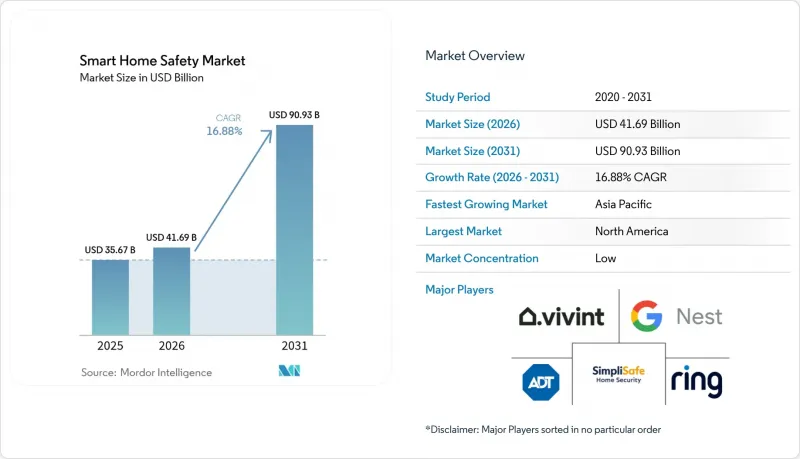
Mordor Intelligence에 의하면, 2026년 스마트홈 보안 시장 규모는 416억 9,000만 달러로 추정되며, 2025년 356억 7,000만 달러에서 확대될 전망입니다.
또한, 2031년 시장 규모는 909억 3,000만 달러에 달할 것으로 예측되며, 2026-2031년 연평균 성장률(CAGR) 16.88%를 기록할 전망입니다.

본 보고서는 기기 유형(스마트 알람, 스마트 잠금장치, 스마트 센서 및 감지기 등), 연결 기술(Wi-Fi, 블루투스 등),설치 유형(DIY(직접 설치) 및 전문가 설치), 판매 채널(온라인, 오프라인-전문점 및 오프라인-대형 마트·홈센터), 그리고 지역별로 분류되어 있습니다. 시장 예측은 금액(달러) 기준으로 제시되어 있습니다.
세계 스마트 홈 안전 시장 동향 및 인사이트
센서 및 카메라의 평균 판매 가격(ASP) 급락
기존 반도체 라인공급 과잉으로 인해 인체 감지 센서, 연기 센서, 일산화탄소(CO) 센서의 부품 비용은 계속 하락하고 있으며, 제조업체는 구독형 모니터링 서비스를 통해 이익률을 유지하면서 엔트리 레벨 키트 세트를 200달러 미만으로 제공할 수 있게 되었습니다. 이에 대응하여 플랫폼 공급업체들은 고객 생애 가치를 높이는 예측 분석 서비스 구독을 번들로 제공하며 대응하고 있습니다. 이러한 동향으로 인해 스마트 홈 안전 시장은 프리미엄 계층 가정에 그치지 않고, 신흥 경제국의 소매업체들도 소액 금융 모델을 통해 스타터 키트를 제공하게 되었습니다. 하드웨어의 상품화는 동시에 기존 기업들이 소프트웨어를 통한 차별화와 서비스 수익 창출로 방향을 전환하도록 만들고 있습니다. 그 결과 발생하는 디플레이션 압력은 스마트 홈 보안 시장에 여전히 결정적인 호재가 되고 있습니다.
보험사와의 제휴를 통한 할인 급증
손해보험사들은 실시간 센서 데이터를 보험 수리상의 ‘보물’로 취급하는 경향이 강해지고 있습니다. 스테이트 팜(State Farm)과 리버티 뮤추얼(Liberty Mutual)을 비롯한 보험사들은 기기 상태를 확인하기 위한 데이터 제공을 대가로, 기기 보조금이나 보험료의 5%-20% 할인을 제공합니다. 이러한 프로그램을 통해 투자 회수 기간은 최단 3년까지 단축되어, 기기 제조업체와 전문 설치 업체에게 지속적인 판매 채널이 창출되고 있습니다. 보험금 청구율의 감소로 보험 수리 모델이 입증되고, 보험사가 누수 센서나 재택 고령자용 모니터링 기기 같은 새로운 제품 카테고리로 인센티브를 확대하도록 유도됨에 따라, 이러한 선순환은 더욱 심화되고 있습니다.
초기 기기 및 설치 비용의 부담
하드웨어 자체의 가격은 저렴해졌지만, 전문 업체의 설치가 포함된 스마트 안전 패키지 전체 비용은 여전히 900달러 전후이며, 여기에월25-50달러의 모니터링 비용이 추가됩니다. 비용에 대한 민감성으로 인해 저소득 주택 소유자나 임차인의 도입은 더딘 임베디드니다. 중국산 수입품에 대한 관세 연동 가격 상승은 보험사가 보험료 크레딧으로 지출의 일부를 상쇄하고 있음에도 불구하고, 높은 가격에 대한 충격을 더욱 가중시키고 있습니다. 이에 대응하여 각 벤더들은 스마트 홈 안전 시장에 대한 접근성을 유지하기 위해, 휴대폰 요금제를 모방한 모델인 다년 계약을 통해 비용을 분산시키는 ‘하드웨어-어즈-어-서비스(HaaS)’ 번들을 제공하며 대응하고 있습니다.
부문 분석
스마트 센서 및 감지기는 2025년 스마트 홈 보안 시장에서 29.78%의 점유율을 차지했습니다. 이는 연기 감지기 및 일산화탄소 경보기에 대한 건축기준법의 의무화가 주된 요인으로 작용했습니다. 통합형 보안 허브는 현재 매출 규모는 작지만, 가정이 단일 앱을 통한 제어를 선호하는 경향에 힘입어 2031년까지 연평균 성장률(CAGR) 18.74%를 나타낼 것으로 예측되는 등 가장 높은 성장세를 보이고 있습니다. 현재의 경쟁 우위는 움직임, 소리, 온도 데이터를 융합하여 예측 경보를 발령하는 AI 알고리즘에 달려 있습니다. 각 벤더는 허브를 프리미엄 클라우드 분석 서비스와 연동함으로써 수익원을 다각화하고, 스마트 홈 안전 시장에서의 서비스 중심 비즈니스 모델을 강화하고 있습니다.
융합 트렌드에 따라 스마트 카메라, 스마트 잠금장치, 환경 모니터가 통합된 인터페이스 아래로 통합되면서 허브 도입률이 확대되고 있습니다. Matter 규격에 부합하는 기기는 향후 호환성에 대해 구매자에게 안심감을 주며, 평균 판매 가격을 끌어올리는 멀티 디바이스 번들 판매를 촉진하고 있습니다. 허브가 실시간 진단 정보를 보험사에 중계함으로써 보험금 청구 처리 시간이 단축되어, 추가 도입을 촉진하는 피드백 루프가 형성되고 있습니다. 스마트 유리 파손 센서 등의 틈새 기기들은 아직 발전 단계에 있지만, 고도화된 보안을 중시하는 상업·주거 복합 시설에서 지지를 넓혀가고 있습니다. 전반적으로, 기반이 되는 센서의 견조한 판매량 증가가 기본 수요를 보장하는 한편, 허브는 스마트 홈 보안 시장에서 그 규모에 비해 큰 수익원을 차지하고 있습니다.
2025년 스마트 홈 보안 시장 규모 중 Wi-Fi가 56.85%를 차지했습니다. 이는 도입을 간소화하는 가정용 라우터의 보급률이 거의 100%에 근접한 것이 요인입니다. 그러나 대역폭 경쟁과 전력 소비 제한으로 인해 Thread로의 전환이 진행되고 있으며, Thread는 연평균 성장률(CAGR) 18.21%로 확대될 것으로 예측됩니다. Thread 1.4는 스타·메쉬 토폴로지를 강화하여, 배터리 구동 센서가 전용 게이트웨이 없이도 네트워크 경로를 자가 복구할 수 있게 해줍니다. Zigbee는 간섭 내성을 우선시하는 전문 업체의 설치 프로젝트에서 여전히 중요한 역할을 하고 있지만, Z-Wave의 독자적인 스택에 대해서는 Matter로의 통합이 진행됨에 따라 OEM의 지원이 감소하는 추세입니다.
현재 멀티프로토콜 허브에는 고해상도 동영상을 위한 Wi-Fi 6, 저전력 주변기기를 위한 Thread, 중복성을 확보하기 위한 셀룰러 페일오버가 통합되어 있습니다. 각 벤더들은 긴급 신호의 지연을 줄이기 위해 2.4GHz 대역과 6GHz 대역 간의 원활한 로밍을 중시하고 있습니다. 광대역 제공업체들이 Thread 보더 라우터를 내장한 Wi-Fi 7 라우터를 출시함에 따라 상호 운용성의 장벽은 지속적으로 낮아지고 있으며, 스마트 홈 안전 시장의 잠재 고객 기반은 확대되고 있습니다.
지역별 분석
북미는 2025년 스마트 홈 안전 시장에서 39.25%의 점유율을 유지했습니다. 이는 정착된 모니터링 서비스의 정기 계약과 하드웨어 가격을 보조하는 통신사 및 보험사 간의 적극적인 제휴에 힘입은 결과입니다. 연방 에너지 기준에서는 규정 준수를 위한 허용 가능한 수단으로 연결형 안전 기기가 점점 더 많이 언급되면서, 간접적인 규제에 따른 수요가 발생하고 있습니다. 관세로 인한 역풍이 있음에도 불구하고, 프리미엄 서비스 수익이 하드웨어 가격 상승을 상쇄하고 있어 이익률은 견조한 추세를 보이고 있습니다. 캐나다도 유사한 추세를 보이고 있으나, 멕시코는 니어쇼어링 추세를 활용하여 국내 가격을 낮추는 장치 조립에 대한 투자를 유치하고 있습니다.
아시아태평양은 가장 성장세가 두드러지는 지역으로, 2031년까지 연평균 성장률(CAGR) 18.45%로 확대되고 있습니다. 일본은 AI가 탑재된 감시 패키지의 비용을 가족에게 환원하는 ‘재택 고령화’ 프로그램을 선도적으로 추진하고 있습니다. 중국에서는 지방자치단체의 스마트시티 예산을 통해 대중 시장으로의 확장을 확대하고 있지만, 세계 벤더들은 데이터 주권에 관한 규제에 직면해 있어 현지 데이터센터 설치를 요구받고 있습니다. 인도와 동남아시아에서는 스마트폰 보급률 상승과 하드웨어 비용을 분산시키는 핀테크를 활용한 소액 할부 계획의 혜택을 받고 있습니다. 호주와 싱가포르는 프리미엄 생체 인증 기술을 조기에 도입하여, 지역 전체로 점차 확산되는 벤치마크를 확립하고 있습니다.
유럽에서는 개인정보 보호 규제와 개보수 의무 간의 균형이 맞추어지고 있습니다. ‘건물의 에너지 성능에 관한 지침’에 따라 공공 자금은 에너지 절약 기술과 안전 기술의 통합에 연계되어 있으며, 자본은 통합형 IoT 패키지로 유도되고 있습니다. 독일의 기술 표준화 기관은 상호 운용 가능한 화재 감지기에 관한 지침을 공식적으로 제정하고 있는 반면, 영국에서는 지역 밀착형 보조금 제도를 통해 인근 지역의 카메라 네트워크 구축을 지원하고 있습니다. 남유럽 시장에서는 EU의 결속 기금이 네트워크화된 경보 장치를 포함한 공동 주택의 개보수를 지원함으로써, 사이클 후반부의 성장이 가속화되고 있습니다. 동유럽은 경쟁력 있는 인건비로 수탁 제조업체를 유치하며, 이 지역을 보다 광범위한 스마트 홈·안전 시장의 수출 거점으로 자리매김하고 있습니다.
기타 혜택:
- 엑셀 형식 시장 예측(ME) 시트
- 3개월간 애널리스트 지원
자주 묻는 질문
목차
제1장 서론
제2장 조사 방법
제3장 주요 요약
제4장 시장 구도
제5장 시장 규모와 성장 예측
제6장 경쟁 구도
제7장 시장 기회와 향후 동향
LSHAccording to Mordor Intelligence, smart home safety market size in 2026 is estimated at USD 41.69 billion, growing from 2025 value of USD 35.67 billion with 2031 projections showing USD 90.93 billion, growing at 16.88% CAGR over 2026-2031.
This report is Segmented by Device Type (Smart Alarms, Smart Locks, Smart Sensors and Detectors, and More), Connectivity Technology (Wi-Fi, Bluetooth, and More), Installation Type (Do-It-Yourself (DIY) and Professional), Sales Channel (Online, Offline - Specialty Stores, and Offline - Mass Retail and Home-Improvement Stores), and Geography. The Market Forecasts are Provided in Terms of Value (USD).
Global Smart Home Safety Market Trends and Insights
Rapid Decline in Sensor and Camera ASPs
Due to oversupply in legacy semiconductor lines, component costs for motion, smoke, and CO sensors continue to fall, letting manufacturers position full entry-level kits below USD 200 while preserving margins through subscription monitoring. Platform vendors respond by bundling predictive analytics subscriptions that lift lifetime customer value. These dynamics broaden the Smart Home Safety market beyond premium households, with emerging-economy retailers now offering starter kits through micro-financing models. Hardware commoditization is simultaneously pushing incumbents toward software differentiation and service revenues. The resulting deflationary pressure remains a decisive tailwind for the Smart Home Safety market.
Surge in Insurance-Partnered Discounts
Property insurers increasingly treat real-time sensor data as actuarial gold. State Farm, Liberty Mutual, and other carriers provide equipment subsidies or 5%-20% premium reductions in exchange for data feeds that verify device status. These programs shorten payback periods to as little as three years and create recurring sales funnels for device makers and professional installers. The virtuous cycle deepens as lower claim ratios validate actuarial modeling, prompting insurers to expand incentives to new product classes such as water-leak sensors and aging-in-place monitors.
High Upfront Device and Installation Cost
Although hardware is cheaper, full-suite smart safety packages with professional installation still start near USD 900, with monitoring fees adding USD 25-USD 50 monthly. Cost sensitivity delays uptake among lower-income homeowners and renters. Tariff-linked price increases on Chinese imports amplify sticker shock, even as insurers partially offset expenditures with premium credits. Vendors respond by offering hardware-as-a-service bundles that spread costs over multi-year contracts-a model emulating mobile phone plans-to keep the Smart Home Safety market accessible.
Other drivers and restraints analyzed in the detailed report include:
- Integration with Voice Assistants and Home Hubs
- Rising Burglary and Fire Incidents in Urban Areas
- Cyber-Vulnerability and Privacy Concerns
For complete list of drivers and restraints, kindly check the Table Of Contents.
Segment Analysis
Smart sensors and detectors secured a 29.78% Smart Home Safety market share in 2025, anchored by building-code mandates for smoke and carbon-monoxide alarms. Integrated safety hubs, though smaller in revenue today, exhibit the highest momentum with a projected 18.74% CAGR through 2031 as households favor single-app control. Competitive positioning now hinges on AI algorithms that fuse motion, acoustic, and temperature data into predictive alerts. Vendors diversify revenue by linking hubs to premium cloud analytics, reinforcing service-centric business models in the Smart Home Safety market.
Convergence trends place smart cameras, locks, and environmental monitors behind unified interfaces, expanding hub attach rates. Matter-compliant devices reassure buyers about forward compatibility, encouraging multi-device bundles that lift average selling prices. As hubs relay real-time diagnostics to insurers, claims processing times fall, creating feedback loops that drive further installations. Niche devices-such as smart glass break sensors-remain nascent but gain traction in commercial-residential hybrid properties keen on high security. Overall, resilient volume growth in foundational sensors guarantees baseline demand, while hubs capture disproportionate profit pools within the Smart Home Safety market.
Wi-Fi accounted for 56.85% of the Smart Home Safety market size in 2025, due to near-universal home router penetration that simplifies onboarding. However, bandwidth contention and power draw limitations spur migration to Thread, which is forecast to expand at an 18.21% CAGR. Thread 1.4 bolsters star-mesh topologies, allowing battery-powered sensors to self-heal network paths without proprietary gateways. Zigbee remains relevant in professionally installed projects that prioritize interference resilience, while Z-Wave's proprietary stack sees diminishing OEM support amid Matter convergence.
Multi-protocol hubs now incorporate Wi-Fi 6 for high-definition video, Thread for low-power peripherals, and cellular failover for redundancy. Vendors emphasize seamless roaming between 2.4 GHz and 6 GHz bands to reduce latency for emergency signals. As broadband providers ship Wi-Fi 7 routers with integrated Thread border routers, interoperability hurdles continue to fall, widening the addressable base of the Smart Home Safety market.
Complete Report Scope:
- By Device Type
- Smart Alarms
- Smart Locks
- Smart Sensors and Detectors
- Smart Cameras and Monitoring Systems
- Integrated Safety Hubs
- Other Device Types
- By Connectivity Technology
- Wi-Fi
- Bluetooth
- Zigbee
- Z-Wave
- Thread
- Cellular/LTE
- Other Connectivity
- By Installation Type
- Do-It-Yourself (DIY)
- Professional
- By Sales Channel
- Online
- Offline - Specialty Stores
- Offline - Mass Retail and Home-Improvement Stores
- By Geography
- North America
- United States
- Canada
- Mexico
- South America
- Brazil
- Argentina
- Chile
- Rest of South America
- Europe
- Germany
- United Kingdom
- France
- Italy
- Spain
- Russia
- Rest of Europe
- Asia-Pacific
- China
- India
- Japan
- South Korea
- Singapore
- Malaysia
- Australia
- Rest of Asia-Pacific
- Middle East and Africa
- Middle East
- United Arab Emirates
- Saudi Arabia
- Turkey
- Rest of Middle East
- Africa
- South Africa
- Nigeria
- Rest of Africa
- Middle East
- North America
Geography Analysis
North America retained 39.25% Smart Home Safety market share in 2025, supported by entrenched monitoring subscriptions and aggressive carrier-insurance collaborations that subsidize hardware. Federal energy standards increasingly reference connected safety devices as acceptable paths for compliance, creating indirect regulatory pull. Margins remain healthy despite tariff headwinds because premium service revenues offset hardware inflation. Canada follows similar patterns, while Mexico leverages near-shoring trends to attract device assembly investments that lower domestic prices.
Asia-Pacific is the fastest-growing region, advancing at an 18.45% CAGR through 2031. Japan pioneers aging-in-place programs that reimburse families for AI-equipped monitoring packages. China scales mass-market deployments through municipal smart-city budgets, though global vendors face data-sovereignty regulations that necessitate local data centers. India and Southeast Asia benefit from rising smartphone penetration and fintech-enabled micro-installment plans that spread hardware costs. Australia and Singapore adopt premium biometrics early, setting benchmarks that gradually diffuse regionally.
Europe balances privacy rules with retrofit mandates. The Energy Performance of Buildings Directive ties public funding to the integration of energy-saving and safety technologies, channeling capital toward bundled IoT packages. Germany's technical standards institution formalizes guidelines for interoperable smoke detectors, whereas the UK deploys community-oriented grants that fund neighborhood camera networks. Southern European markets accelerate late-cycle growth as EU cohesion funds underwrite apartment-block renovations that include connected alarms. Eastern Europe attracts contract manufacturers with competitive labor costs, positioning the sub-region as an export base for the broader Smart Home Safety market.
- ADT Inc.
- Amazon Ring LLC
- Google Nest Labs LLC
- Simplisafe Inc.
- Vivint Smart Home Inc.
- Frontpoint Security Solutions LLC
- Abode Systems Inc.
- CPI Security Systems Inc.
- Johnson Controls International plc
- Honeywell International Inc.
- Hangzhou Hikvision Digital Technology Co. Ltd.
- Arlo Technologies Inc.
- Netatmo (SA Legrand)
- August Home Inc. (Assa Abloy AB)
- Yale Commercial Locks and Hardware
- Kwikset (Spectrum Brands Holdings Inc.)
- Bosch Smart Home GmbH
- Alarm.com Holdings Inc.
- Brinks Home Security
- Wyze Labs Inc.
- Eufy Security (Anker Innovations Ltd.)
- Kangaroo Security Inc.
- Canary Connect Inc.
- Swann Communications Pty Ltd
- TP-Link Technologies Co. Ltd. (Tapo)
Additional Benefits:
- The market estimate (ME) sheet in Excel format
- 3 months of analyst support
TABLE OF CONTENTS
1 INTRODUCTION
- 1.1 Study Assumptions and Market Definition
- 1.2 Scope of the Study
2 RESEARCH METHODOLOGY
3 EXECUTIVE SUMMARY
4 MARKET LANDSCAPE
- 4.1 Market Overview
- 4.2 Market Drivers
- 4.2.1 Rapid decline in sensor and camera ASPs
- 4.2.2 Surge in insurance-partnered discounts
- 4.2.3 Integration with voice assistants and home hubs
- 4.2.4 Rising burglary and fire incidents in urban areas
- 4.2.5 Mandated remote home-care monitoring in ageing nations
- 4.2.6 EU energy-efficiency retrofit funds bundling safety IoT
- 4.3 Market Restraints
- 4.3.1 High upfront device and installation cost
- 4.3.2 Cyber-vulnerability and privacy concerns
- 4.3.3 Radio-spectrum congestion in dense smart-cities
- 4.3.4 Low-income rental regulations limiting fixture changes
- 4.4 Industry Value Chain Analysis
- 4.5 Regulatory Landscape
- 4.6 Technological Outlook
- 4.7 Industry Attractiveness - Porter's Five Forces Analysis
- 4.7.1 Bargaining Power of Suppliers
- 4.7.2 Bargaining Power of Buyers
- 4.7.3 Threat of New Entrants
- 4.7.4 Threat of Substitutes
- 4.7.5 Intensity of Competitive Rivalry
- 4.8 Impact of Macroeconomic Factors on the Market
5 MARKET SIZE AND GROWTH FORECASTS (VALUES)
- 5.1 By Device Type
- 5.1.1 Smart Alarms
- 5.1.2 Smart Locks
- 5.1.3 Smart Sensors and Detectors
- 5.1.4 Smart Cameras and Monitoring Systems
- 5.1.5 Integrated Safety Hubs
- 5.1.6 Other Device Types
- 5.2 By Connectivity Technology
- 5.2.1 Wi-Fi
- 5.2.2 Bluetooth
- 5.2.3 Zigbee
- 5.2.4 Z-Wave
- 5.2.5 Thread
- 5.2.6 Cellular/LTE
- 5.2.7 Other Connectivity
- 5.3 By Installation Type
- 5.3.1 Do-It-Yourself (DIY)
- 5.3.2 Professional
- 5.4 By Sales Channel
- 5.4.1 Online
- 5.4.2 Offline - Specialty Stores
- 5.4.3 Offline - Mass Retail and Home-Improvement Stores
- 5.5 By Geography
- 5.5.1 North America
- 5.5.1.1 United States
- 5.5.1.2 Canada
- 5.5.1.3 Mexico
- 5.5.2 South America
- 5.5.2.1 Brazil
- 5.5.2.2 Argentina
- 5.5.2.3 Chile
- 5.5.2.4 Rest of South America
- 5.5.3 Europe
- 5.5.3.1 Germany
- 5.5.3.2 United Kingdom
- 5.5.3.3 France
- 5.5.3.4 Italy
- 5.5.3.5 Spain
- 5.5.3.6 Russia
- 5.5.3.7 Rest of Europe
- 5.5.4 Asia-Pacific
- 5.5.4.1 China
- 5.5.4.2 India
- 5.5.4.3 Japan
- 5.5.4.4 South Korea
- 5.5.4.5 Singapore
- 5.5.4.6 Malaysia
- 5.5.4.7 Australia
- 5.5.4.8 Rest of Asia-Pacific
- 5.5.5 Middle East and Africa
- 5.5.5.1 Middle East
- 5.5.5.1.1 United Arab Emirates
- 5.5.5.1.2 Saudi Arabia
- 5.5.5.1.3 Turkey
- 5.5.5.1.4 Rest of Middle East
- 5.5.5.2 Africa
- 5.5.5.2.1 South Africa
- 5.5.5.2.2 Nigeria
- 5.5.5.2.3 Rest of Africa
- 5.5.5.1 Middle East
- 5.5.1 North America
6 COMPETITIVE LANDSCAPE
- 6.1 Market Concentration
- 6.2 Strategic Moves
- 6.3 Market Share Analysis
- 6.4 Company Profiles (includes Global level Overview, Market level overview, Core Segments, Financials as available, Strategic Information, Market Rank/Share for key companies, Products and Services, and Recent Developments)
- 6.4.1 ADT Inc.
- 6.4.2 Amazon Ring LLC
- 6.4.3 Google Nest Labs LLC
- 6.4.4 Simplisafe Inc.
- 6.4.5 Vivint Smart Home Inc.
- 6.4.6 Frontpoint Security Solutions LLC
- 6.4.7 Abode Systems Inc.
- 6.4.8 CPI Security Systems Inc.
- 6.4.9 Johnson Controls International plc
- 6.4.10 Honeywell International Inc.
- 6.4.11 Hangzhou Hikvision Digital Technology Co. Ltd.
- 6.4.12 Arlo Technologies Inc.
- 6.4.13 Netatmo (SA Legrand)
- 6.4.14 August Home Inc. (Assa Abloy AB)
- 6.4.15 Yale Commercial Locks and Hardware
- 6.4.16 Kwikset (Spectrum Brands Holdings Inc.)
- 6.4.17 Bosch Smart Home GmbH
- 6.4.18 Alarm.com Holdings Inc.
- 6.4.19 Brinks Home Security
- 6.4.20 Wyze Labs Inc.
- 6.4.21 Eufy Security (Anker Innovations Ltd.)
- 6.4.22 Kangaroo Security Inc.
- 6.4.23 Canary Connect Inc.
- 6.4.24 Swann Communications Pty Ltd
- 6.4.25 TP-Link Technologies Co. Ltd. (Tapo)
7 MARKET OPPORTUNITIES AND FUTURE TRENDS
- 7.1 White-Space and Unmet-Need Assessment