

|
시장보고서
상품코드
2124630
공공 Wi-Fi : 시장 점유율 분석, 업계 동향과 통계, 성장 예측(2026-2031년)Public Wi-Fi - Market Share Analysis, Industry Trends & Statistics, Growth Forecasts (2026 - 2031) |
||||||
 Mordor Intelligence
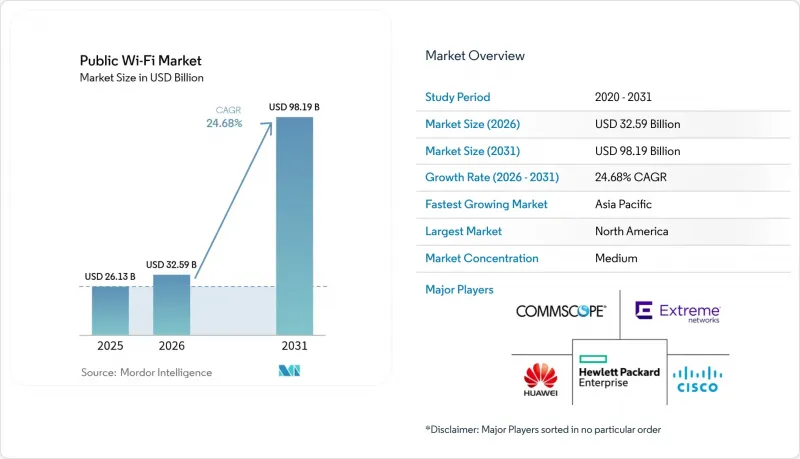
Mordor Intelligence에 의하면, 2026년 공공 Wi-Fi 시장 규모는 325억 9,000만 달러로 추정되며, 2025년 261억 3,000만 달러에서 2031년에는 981억 9,000만 달러에 달할 것으로 예측됩니다.
또한, 2026-2031년 연평균 성장률(CAGR)은 24.68%를 나타낼 전망입니다.
본 보고서는 구성 요소(하드웨어, 소프트웨어, 서비스), 도입 모델(클라우드 관리형, On-Premise형, 하이브리드형), 설치 장소 유형(실내, 실외),최종 사용자 산업(통신 및 IT, 소매 및 전자상거래, 기타), 지역(북미, 남미, 유럽, 아시아태평양, 중동 및 아프리카)별로 분류되어 있습니다. 시장 예측은 금액(달러) 기준으로 제시되어 있습니다.
전 세계 공용 Wi-Fi 시장 동향 및 인사이트
스마트 시티 주도의 공공 Wi-Fi 구축
국가 및 지방 자치 단체는 하드웨어 및 서비스에 대한 다년간 수요를 보장하는 대규모 Wi-Fi 구축 사업을 지원하고 있습니다. 424억 5,000만 달러 규모의 BEAD 프로그램에서는 루이지애나주에 13억 5,500만 달러, 네바다주에 4억 1,660만 달러를 배정하고 있으며, 공공 Wi-Fi를 주요 연결 계층으로 자리매김하고 있습니다. 필리핀과 스페인에서도 유사한 움직임이 나타나고 있으며, EU 지침을 준수하는 에너지 절약형 엔터프라이즈급 액세스 포인트가 안정적으로 공급될 전망입니다. 3-5년 주기의 RFP(제안 요청서) 사이클은 벤더에게 예측 가능한 수익을 가져다주는 한편, 현지 조달 규정 및 전력 소비 상한선은 SKU 로드맵 수립에 영향을 미치고 있습니다. 이러한 공공 자금 지원 프로젝트는 전반적으로 수요의 가시성을 높이고, 공공 Wi-Fi 시장을 안정화시키며, 민간 부문 지출에서 나타나는 주기적인 변동을 상쇄하는 역할을 하고 있습니다.
폭발적으로 증가하는 연결 기기의 트래픽이 네트워크 오프로드를 촉진
현재 평균적인 기업 지점에서는 직원 1인당 15-20대의 연결 기기를 지원하고 있으며, 공공시설에서는 피크 시간대에 액세스 포인트 1개당 1,000명이 넘는 동시 접속 사용자가 일상적으로 관찰됩니다. 혼잡한 셀룰러 네트워크에서 해당 트래픽을 오프로드하는 것은 더 이상 선택 사항이 아닌 전략적 과제가 되었으며, Wi-Fi 6E의 6GHz 대역은 즉각적인 용량 증대 수단으로 자리매김하고 있습니다. 서비스 제공업체의 계획에 따르면, 81%가 2025년까지 OpenRoaming을 도입할 의사를 밝혔으며, 오프로드를 통한 수익을 충분히 확보하기 위해서는 마찰 없는 온보딩이 필수적이라는 점을 인식하고 있습니다. Wi-Fi 7 칩셋이 성숙해짐에 따라, 통신 사업자들은 결정적인 지연 시간과 더 넓은 채널을 통해, 그렇지 않으면 5G 매크로 네트워크에 과도한 부하를 주게 될 실시간 용도를 처리할 수 있을 것으로 기대하고 있습니다.
지속적인 사이버 보안 및 개인정보 보호 취약점
WPA3 악용 사례 증가와 더욱 엄격해진 개인정보 보호 규제로 인해 규정 준수는 더욱 복잡해지고 있습니다. GDPR(EU 개인정보보호규정), HIPAA, PCI-DSS 각 프레임워크에서는 모든 인증 흐름에 대해 명시적인 동의, 감사 추적 및 암호화를 요구하고 있어, 네트워크 사업자들은 제로 트러스트(Zero Trust) 접근 방식을 채택하고 빈번한 패치 적용 주기를 시행할 수밖에 없게 되었습니다. 의료 및 금융 업계는 여전히 신중한 태도를 고수하며, 도입 일정을 연기하거나 규제 대상 데이터를 격리하기 위해 게스트 트래픽을 분리하고 있습니다. 보안 오버레이는 총 소유 비용(TCO)을 높이고 승인 절차를 지연시키기 때문에 공용 Wi-Fi 시장에서 본래라면 강했을 도입 기세를 약화시키고 있습니다.
부문 분석
2025년에는 하드웨어가 61.05%의 점유율을 유지했습니다. 이는 액세스 포인트의 교체 주기에 힘입은 결과로, 물리적 인프라 내 공용 Wi-Fi 시장 규모를 안정화시켰습니다. 액세스 포인트가 단독으로 매출의 가장 큰 비중을 차지하고 있으며, WLAN 컨트롤러의 통합은 클라우드 기반 대시보드로의 전환을 반영하고 있습니다. Wi-Fi 7의 도입, 에너지 효율에 관한 규제, 그리고 유럽 무선 기기 지침에 따른 규정 준수 업데이트는 하드웨어에 대한 지속적인 수요를 뒷받침하며 벤더의 이익률을 보호하고 있습니다. 실내의 전력 제약과 실외의 내후성에 대한 고려는 계속해서 SKU의 다양성에 영향을 미치고 있으며, 벤더들은 ASIC 설계에 적응형 전력 관리 기능을 통합하도록 촉구받고 있습니다.
소프트웨어 부문은 설정, 보증, 수익화 분석을 통합하는 AI 네이티브 클라우드 플랫폼의 견인력에 힘입어 2031년까지 연평균 성장률(CAGR) 26.1%로 확대되고 있습니다. 사용량 기반 과금 모델은 네트워크의 성장에 따라 확대되고 있으며, 그 결과 컨트롤러의 디클러스터링이 진행되고 있음에도 불구하고 클라우드 관리에 할당되는 공용 Wi-Fi 시장 점유율은 확대될 전망입니다. 통합 대시보드는 MSP(관리형 서비스 제공업체)를 위한 제로 터치 프로비저닝을 간소화하고, 고급 로밍 분석을 가능하게 하며, 업계 전반에 걸친 규정 준수 로깅 요건을 충족합니다. 하드웨어의 신뢰성과 소프트웨어의 지능이 결합되어 상호 보완적인 가치 루프를 형성함으로써, 기존 기업의 제품 차별화를 유지하는 동시에 가격만을 내세우는 신규 진출기업의 진입을 저지하고 있습니다.
클라우드 관리형 아키텍처는 2025년 매출의 60.10%를 차지하며, SaaS로 제공되는 제어 플레인이 주류를 이루는 공용 Wi-Fi 시장에서 여전히 큰 시장 점유율을 유지하고 있습니다. 기업들은 현장 방문 없이 가동 시간을 향상시키는 통합된 문제 해결 및 AI를 통한 최적화를 환영하고 있습니다. SOC 2 및 ISO 27001과 같은 인증 획득은 데이터 주권에 대한 우려를 완화하며, 규제 대상 업계가 기밀성이 높은 워크로드를 On-Premise에 유지하면서 게스트 SSID 정책 및 개인을 식별할 수 없는(non-PII) 분석 데이터를 퍼블릭 클라우드로 이전할 수 있게 해줍니다.
조직이 로컬 게이트웨이를 세계 대시보드 아래로 통합함에 따라, 하이브리드형 도입은 연평균 성장률(CAGR) 26.3%로 확대되고 있습니다. 이러한 접근 방식을 통해 병원이나 은행은 환자 정보나 거래 데이터를 로컬에 보관하면서도, 게스트 포털이나 마케팅 분석 분야에서 클라우드 규모의 텔레메트리 혜택을 누릴 수 있게 됩니다. On-Premise 환경이 주류를 유지하는 분야는 국방 분야와 초저지연 자동화 분야로 한정됩니다. 이러한 분야에서는 클라우드의 편의성보다 에어갭 방식의 보안이나 결정론적 지터가 우선시되기 때문입니다. 이러한 동향이 맞물리면서, 퍼블릭 Wi-Fi 시장 전체에서 도입의 유연성이 계속해서 주요 구매 기준으로 자리 잡고 있습니다.
지역별 분석
북미는 2025년 매출의 37.90%를 차지할 것으로 예상되며, 그 배경에는 BEAD 할당, 기업의 Wi-Fi 6E로의 전환, 그리고 경기장 및 대학에서의 Wi-Fi 7 조기 시범 도입이 있습니다. 미국의 각 도시에서는 민간 네트워크와 지자체 네트워크를 통합하기 위한 오픈 로밍 시범 운영이 진행되고 있는 반면, 캐나다에서는 농촌 지역 및 원주민 거주 지역의 공용 Wi-Fi 격차 해소를 목표로 하고 있습니다. 멕시코의 마키라도라(수출가공구역)가 집중된 제조 회랑에서는 설비 투자(CAPEX)의 장벽을 극복하기 위해 WaaS가 도입되고 있으며, 이를 통해 지역 공공 Wi-Fi 시장에 추가 수익이 창출되고 있습니다.
아시아태평양에서는 2031년까지 연평균 성장률(CAGR) 26.2%로 성장이 가속화될 것으로 예측됩니다. 중국에서는 공공 Wi-Fi를 전국적인 스마트 시티 구상에 통합하여 규모의 경제를 실현함으로써 단가(ASP)를 낮추고, 2급 도시에서의 도입을 촉진하고 있습니다. 인도의 ‘디지털 인디아(Digital India)’ Wi-Fi 핫스팟은 농촌 지역의 연결성을 확대하고 전자상거래를 활성화함으로써, 변동이 심한 백홀 환경에서도 작동 가능한 클라우드 관리형 대시보드에 대한 수요를 부추기고 있습니다. 싱가포르, 말레이시아, 태국은 교통 및 관광 인프라 현대화를 추진하며, Wi-Fi 7을 도입해 자율주행 셔틀과 증강현실(AR)을 활용한 관광 가이드를 실현하고 있습니다.
유럽에서는 개인정보 보호를 중시하는 혁신을 통해 수요가 유지되고 있습니다. 독일과 영국은 기업의 클라우드 전환을 주도하고 있으며, 프랑스와 이탈리아는 도심 관광객을 위한 Wi-Fi를 확충하고, 스페인은 지자체 네트워크를 스마트시티 센서망에 통합하고 있습니다. GDPR(EU 개인정보보호규정) 및 에너지 효율 지침 준수에 따라 수출용 벤더들은 데이터 최소화 및 저전력 하드웨어 설계를 통합해야 하는 압박을 받고 있습니다. 이러한 노력들이 맞물려 거시경제적 역풍에도 불구하고 공공 Wi-Fi 시장은 꾸준한 성장을 유지할 것으로 예측됩니다.
기타 혜택:
- 엑셀 형식 시장 예측(ME) 시트
- 3개월간의 애널리스트 지원
자주 묻는 질문
목차
제1장 서론
제2장 조사 방법
제3장 주요 요약
제4장 시장 구도
제5장 시장 규모와 성장 예측
제6장 경쟁 구도
제7장 시장 기회와 향후 전망
LSH 26.09.14According to Mordor Intelligence, public wi-Fi market size in 2026 is estimated at USD 32.59 billion, growing from 2025 value of USD 26.13 billion with 2031 projections showing USD 98.19 billion, growing at 24.68% CAGR over 2026-2031.
This report is Segmented by Component (Hardware, Software, and Services), Deployment Model (Cloud Managed, On-Premises, and Hybrid), Location Type (Indoor, and Outdoor), End-User Vertical (Telecom and IT, Retail and E-Commerce, and More), and Geography (North America, South America, Europe, Asia Pacific, Middle East, and Africa). The Market Forecasts are Provided in Terms of Value (USD).
Global Public Wi-Fi Market Trends and Insights
Smart City-Funded Public Wi-Fi Rollouts
National and municipal governments are underwriting large-scale Wi-Fi buildouts that guarantee multi-year demand for hardware and services. The USD 42.45 billion BEAD program is allocating awards of USD 1.355 billion to Louisiana and USD 416.6 million to Nevada, earmarking public Wi-Fi as the primary connectivity layer. Comparable commitments are emerging in the Philippines and Spain, ensuring a pipeline of enterprise-grade access points with energy-efficient designs that meet EU directives. RFP cycles of 3-5 years generate predictable revenues for vendors, while local content rules and power budget caps influence the development of SKU roadmaps. Collectively, these publicly funded projects enhance demand visibility and stabilize the public Wi-Fi market, counterbalancing the otherwise cyclical patterns of private-sector spending.
Exploding Connected-Device Traffic Driving Network Offload
Average enterprise sites now support 15-20 connected devices per employee, and public venues routinely top 1,000 simultaneous users per access point at peak. Offloading that traffic from congested cellular networks has become strategic rather than optional, positioning Wi-Fi 6E's 6 GHz spectrum as an immediate capacity upgrade. Service-provider plans reveal 81% intend to enable OpenRoaming by 2025, recognizing that friction-free onboarding will be essential when offload revenues well. As Wi-Fi 7 chipsets mature, operators expect deterministic latency and wider channels to keep pace with real-time applications that otherwise hammer 5G macro networks.
Persistent Cyber-Security and Privacy Vulnerabilities
Rising WPA3 exploits and stricter privacy mandates add layers of complexity to compliance. GDPR, HIPAA, and PCI-DSS frameworks require explicit consent, audit trails, and encryption across all authentication flows, compelling network operators to adopt zero-trust postures and implement frequent patching cycles. Healthcare and finance remain cautious, delaying rollout timelines or segmenting guest traffic to isolate regulated data. Security overlays inflate TCO and cut into approval cycles, tempering the otherwise strong adoption momentum in the public Wi-Fi market.
Other drivers and restraints analyzed in the detailed report include:
- Wi-Fi 6E-7 Upgrades and AI Automation Boosting Network ROI
- Subscription-Based Wi-Fi-as-a-Service Trimming CAPEX
- 5G Unlimited-Data Plans Cannibalizing Hotspot Usage
For complete list of drivers and restraints, kindly check the Table Of Contents.
Segment Analysis
Hardware maintained a 61.05% share in 2025, driven by access-point refresh cycles that stabilize the public Wi-Fi market size for physical infrastructure. Access points alone accounted for the largest slice of revenue, and WLAN controller consolidation reflected the shift to cloud-based dashboards. Wi-Fi 7 rollouts, energy-efficiency mandates, and compliance renewals under Europe's Radio Equipment Directive reinforce continuous demand for hardware and protect vendor margins. Indoor power constraints and outdoor weatherization continue to influence SKU variants, prompting vendors to incorporate adaptive power management into their ASIC designs.
Software is expanding at a 26.1% CAGR through 2031, fueled by AI-native cloud platforms that unify configuration, assurance, and monetization analytics. Consumption billing models scale with network growth, and the public Wi-Fi market share allocated to cloud management is therefore set to widen even as controllers decluster. Centralized dashboards simplify zero-touch provisioning for MSPs, enable advanced roaming analytics, and satisfy cross-vertical compliance logging requirements. Combined, hardware reliability and software intelligence form a mutually reinforcing value loop that sustains product differentiation for incumbents and dissuades price-only challengers.
Cloud-managed architectures accounted for 60.10% of 2025 revenue, maintaining a significant market share in the public Wi-Fi market, where SaaS-delivered control planes dominate. Enterprises welcome centralized troubleshooting and AI-guided optimization that lifts uptime without site visits. Certification milestones, such as SOC 2 and ISO 27001, alleviate data-sovereignty concerns, enabling regulated industries to migrate guest SSID policies and non-PII analytics to public clouds while keeping sensitive workloads on-premises.
Hybrid adoption is growing at a 26.3% CAGR as organizations integrate local gateways under a global dashboard. This approach enables hospitals or banks to keep patient and transaction payloads local while benefiting from cloud-scale telemetry for guest portals and marketing analytics. On-premises dominance persists only in defense and ultra-low-latency automation, where air-gapped security or deterministic jitter takes precedence over cloud convenience. Together, these dynamics ensure deployment flexibility remains a core buying criterion across the public Wi-Fi market.
Complete Report Scope:
- By Component
- Hardware
- Access Points
- WLAN Controllers
- Wireless Hotspot Gateways
- Software
- Services
- Hardware
- By Deployment Model
- Cloud Managed
- On-Premises
- Hybrid
- By Location Type
- Indoor
- Outdoor
- By End-User Vertical
- Telecom and IT
- Retail and E-Commerce
- Travel and Hospitality
- Transportation and Logistics
- Government and Public Sector
- Education
- Healthcare
- Other End-User Verticals
- By Geography
- North America
- United States
- Canada
- Mexico
- South America
- Brazil
- Argentina
- Rest of South America
- Europe
- Germany
- United Kingdom
- France
- Italy
- Spain
- Rest of Europe
- Asia Pacific
- China
- Japan
- India
- South Korea
- South-East Asia
- Rest of Asia Pacific
- Middle East
- Saudi Arabia
- United Arab Emirates
- Turkey
- Rest of Middle East
- Africa
- South Africa
- Nigeria
- Rest of Africa
- North America
Geography Analysis
North America accounted for 37.90% of 2025 revenue, driven by BEAD allocations, enterprise migrations to Wi-Fi 6E, and early Wi-Fi 7 trials in stadiums and universities. U.S. cities are piloting open roaming to harmonize private and municipal networks, while Canada aims to close public Wi-Fi gaps in rural and Indigenous areas. Mexico's maquiladora manufacturing corridors are adopting WaaS to overcome CAPEX hurdles, thereby generating incremental revenue for the regional public Wi-Fi market.
The Asia Pacific is expected to accelerate at a 26.2% CAGR through 2031. China bundles public Wi-Fi into nationwide smart-city blueprints, achieving economies of scale that push unit ASPs lower and spur adoption in tier-two cities. India's Digital India Wi-Fi hotspots expand rural connectivity and stimulate e-commerce, reinforcing demand for cloud-managed dashboards that can operate on variable backhaul. Singapore, Malaysia, and Thailand modernize transport and tourism infrastructure, adopting Wi-Fi 7 to enable autonomous shuttles and augmented-reality visitor guides.
Europe sustains demand through privacy-centric innovation. Germany and the United Kingdom lead in enterprise cloud migration, France and Italy expand city-center tourist Wi-Fi, and Spain rolls municipal networks into smart-city sensor grids. Compliance with GDPR and the Energy Efficiency Directive drives exporter vendors to integrate data minimization and low-power hardware designs. Collectively, these initiatives are expected to preserve steady growth for the public Wi-Fi market despite macroeconomic headwinds.
- Cisco Systems Inc.
- Hewlett Packard Enterprise Company
- Huawei Technologies Co., Ltd.
- CommScope Holding Company Inc.
- Extreme Networks Inc.
- Juniper Networks Inc.
- Ubiquiti Inc.
- TP-Link Technologies Co., Ltd.
- D-Link Corporation
- Cambium Networks Corporation
- EnGenius Technologies Inc.
- Fon Wireless Limited
- GoZone WiFi LLC
- Purple WiFi Ltd.
- Cloud4Wi Inc.
- Boingo Wireless Inc.
- Aptilo Networks AB
- Tanaza S.p.A.
- Aerohive Networks Inc.
- Hughes Systique Corporation
Additional Benefits:
- The market estimate (ME) sheet in Excel format
- 3 months of analyst support
TABLE OF CONTENTS
1 INTRODUCTION
- 1.1 Study Assumptions and Market Definition
- 1.2 Scope of the Study
2 RESEARCH METHODOLOGY
3 EXECUTIVE SUMMARY
4 MARKET LANDSCAPE
- 4.1 Market Overview
- 4.2 Market Drivers
- 4.2.1 Smart city-funded public Wi-Fi rollouts
- 4.2.2 Exploding connected-device traffic driving network offload
- 4.2.3 Wi-Fi 6E-7 upgrades and AI automation boosting network ROI
- 4.2.4 Subscription-based Wi-Fi-as-a-Service trimming CAPEX
- 4.2.5 OpenRoaming adoption unlocking seamless monetization
- 4.2.6 Edge analytics-ads revenue streams via user telemetry
- 4.3 Market Restraints
- 4.3.1 Persistent cyber-security and privacy vulnerabilities
- 4.3.2 5G unlimited-data plans cannibalizing hotspot usage
- 4.3.3 Licensing costs for outdoor 6 GHz spectrum
- 4.3.4 Energy-efficiency mandates limiting AP power budgets
- 4.4 Industry Value Chain Analysis
- 4.5 Regulatory Landscape
- 4.6 Impact of Macroeconomic Factors
- 4.7 Technological Outlook
- 4.8 Porter's Five Forces Analysis
- 4.8.1 Threat of New Entrants
- 4.8.2 Bargaining Power of Suppliers
- 4.8.3 Bargaining Power of Buyers
- 4.8.4 Threat of Substitutes
- 4.8.5 Industry Rivalry
5 MARKET SIZE AND GROWTH FORECASTS (VALUE)
- 5.1 By Component
- 5.1.1 Hardware
- 5.1.1.1 Access Points
- 5.1.1.2 WLAN Controllers
- 5.1.1.3 Wireless Hotspot Gateways
- 5.1.2 Software
- 5.1.3 Services
- 5.1.1 Hardware
- 5.2 By Deployment Model
- 5.2.1 Cloud Managed
- 5.2.2 On-Premises
- 5.2.3 Hybrid
- 5.3 By Location Type
- 5.3.1 Indoor
- 5.3.2 Outdoor
- 5.4 By End-User Vertical
- 5.4.1 Telecom and IT
- 5.4.2 Retail and E-Commerce
- 5.4.3 Travel and Hospitality
- 5.4.4 Transportation and Logistics
- 5.4.5 Government and Public Sector
- 5.4.6 Education
- 5.4.7 Healthcare
- 5.4.8 Other End-User Verticals
- 5.5 By Geography
- 5.5.1 North America
- 5.5.1.1 United States
- 5.5.1.2 Canada
- 5.5.1.3 Mexico
- 5.5.2 South America
- 5.5.2.1 Brazil
- 5.5.2.2 Argentina
- 5.5.2.3 Rest of South America
- 5.5.3 Europe
- 5.5.3.1 Germany
- 5.5.3.2 United Kingdom
- 5.5.3.3 France
- 5.5.3.4 Italy
- 5.5.3.5 Spain
- 5.5.3.6 Rest of Europe
- 5.5.4 Asia Pacific
- 5.5.4.1 China
- 5.5.4.2 Japan
- 5.5.4.3 India
- 5.5.4.4 South Korea
- 5.5.4.5 South-East Asia
- 5.5.4.6 Rest of Asia Pacific
- 5.5.5 Middle East
- 5.5.5.1 Saudi Arabia
- 5.5.5.2 United Arab Emirates
- 5.5.5.3 Turkey
- 5.5.5.4 Rest of Middle East
- 5.5.6 Africa
- 5.5.6.1 South Africa
- 5.5.6.2 Nigeria
- 5.5.6.3 Rest of Africa
- 5.5.1 North America
6 COMPETITIVE LANDSCAPE
- 6.1 Market Concentration
- 6.2 Strategic Moves
- 6.3 Market Share Analysis
- 6.4 Company Profiles (includes Global level Overview, Market level overview, Core Segments, Financials as available, Strategic Information, Market Rank/Share for key companies, Products and Services, and Recent Developments)
- 6.4.1 Cisco Systems Inc.
- 6.4.2 Hewlett Packard Enterprise Company
- 6.4.3 Huawei Technologies Co., Ltd.
- 6.4.4 CommScope Holding Company Inc.
- 6.4.5 Extreme Networks Inc.
- 6.4.6 Juniper Networks Inc.
- 6.4.7 Ubiquiti Inc.
- 6.4.8 TP-Link Technologies Co., Ltd.
- 6.4.9 D-Link Corporation
- 6.4.10 Cambium Networks Corporation
- 6.4.11 EnGenius Technologies Inc.
- 6.4.12 Fon Wireless Limited
- 6.4.13 GoZone WiFi LLC
- 6.4.14 Purple WiFi Ltd.
- 6.4.15 Cloud4Wi Inc.
- 6.4.16 Boingo Wireless Inc.
- 6.4.17 Aptilo Networks AB
- 6.4.18 Tanaza S.p.A.
- 6.4.19 Aerohive Networks Inc.
- 6.4.20 Hughes Systique Corporation
7 MARKET OPPORTUNITIES AND FUTURE OUTLOOK
- 7.1 White-space and Unmet-Need Assessment


