|
시장보고서
상품코드
2124724
생체인식 카드 시장 : 시장 점유율 분석, 업계 동향 및 통계, 성장 예측(2026-2031년)Biometric Card - Market Share Analysis, Industry Trends & Statistics, Growth Forecasts (2026 - 2031) |
||||||
 Mordor Intelligence
Mordor Intelligence에 의하면, 생체인식 카드 시장 규모는 2025년에 10억 1,000만 달러로 평가되었고, 2026년 16억 2,000만 달러에서 2031년까지 170억 9,000만 달러에 이를 것으로 예측되며, 예측 기간(2026-2031년) CAGR은 60.2%를 나타낼 전망입니다.
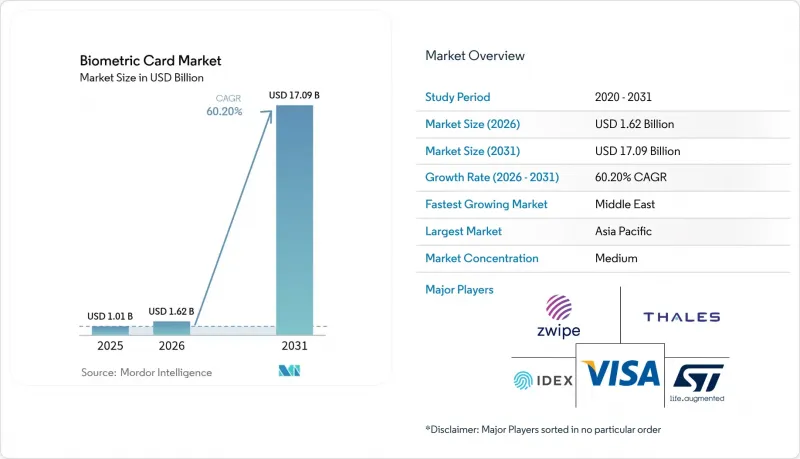
본 보고서는 카드 유형별(신용카드, 직불카드, 하이브리드/듀얼 인터페이스 카드), 용도별(결제, 접근 제어, 정부 발급 신분증 및 금융 포용 등), 최종 사용자 산업별(은행 및 금융 서비스·보험, 소매, 정부, 의료 및 상업 단체), 지역별(북미, 유럽 등)로 분류되어 있습니다. 시장 예측은 금액(달러) 기준으로 제시되어 있습니다.
세계의 생체인식 카드 시장 동향 및 인사이트
비접촉식 결제의 보급 확대
팬데믹 기간 동안 비접촉식 결제의 이용은 단순한 편의 기능에서 선호되는 표준 수단으로 전환되었으며, 그 위상은 확고해졌습니다. 생체인식 카드는 일반적으로 PIN 입력이 요구되는 비접촉식 결제의 금액 제한을 해소하고, 터치 결제의 속도를 유지하면서 상실되었던 부정 방지 대책을 회복시킵니다. 일본의 Life Card 프로그램에서는 고액의 식사비나 교통비 결제 시 소비자들이 지문 인증을 신속하게 수용한 것으로 나타났습니다. 각 결제 네트워크 업체들은 현재, 지갑 기반 생태계에서 실물 카드의 존재 의의를 유지하기 위해 생체인식을 추진하고 있습니다. 소매업체들은 대기 줄 단축 및 차지백(chargeback) 위험 감소라는 이점을 누리고 있으며, 이로 인해 생체인식 카드 시장에 대한 가맹점의 지지가 더욱 강화되고 있습니다.
생체인식 센서 및 보안 요소의 비용 감소
양산화에 따라 지문 센서 가격이 5달러 미만으로 떨어지고 부품 원가가 절감됨에 따라, 발행사는 연회비 없이 생체인식 카드를 대량으로 발행할 수 있게 되었습니다. 인피니언(Infineon)의 Secora Pay Bio와 핑거프린트 카드(Fingerprint Cards)의 단일 칩 아키텍처 덕분에 중복되는 마이크로컨트롤러가 불필요해져 전력 소비를 줄이고 라미네이션 공정을 간소화할 수 있게 되었습니다. 다층 구조에서 수율 향상으로 인해, 한때 20%를 넘었던 불량률이 감소하여 수탁 제조업체에게 새로운 수익원이 열렸습니다. 생산 능력이 두 배로 늘어날 때마다 실리콘 비용이 15-20% 절감된다는 과거의 추세를 고려할 때, 생체 인식 카드 시장은 현재 과거에는 휴대전화에 국한되었던 반도체 업계 특유의 비용 곡선을 누리고 있습니다.
높은 생산 비용과 낮은 제조 수율
복잡한 카드 구조에서는 지문 센서, 보안 요소, 안테나, 배터리가 0.8mm 크기의 폼 팩터에 집적되어 있습니다. 위치 어긋남이나 라미네이션 시 발생하는 공극으로 인해 로트 전체가 사용 불능 상태가 되며, 수율은 기존의 비접촉식 카드보다 낮습니다. Fingerprint Cards는 2024년에 4억 320만 스웨덴 크로나(3,850만 달러)의 매출을 기록했으나, 불량품 증가로 인해 출하량이 억제되면서 매출은 크게 감소했습니다. 2025년 3월 Zwipe의 파산은 생산 확대와 뿌리 깊은 결함이 충돌했을 때 발생하는 자금 사정의 어려움을 여실히 드러내고 있습니다. 자동화 및 인라인 광학 검사가 성숙기에 도달하기 전까지는 제조상의 경제성이 공급 증가를 억제하여 생체 인식 카드 시장의 성장을 둔화시킬 것입니다.
부문별 분석
2025년, 직불카드는 매출의 51.62%를 차지했습니다. 이는 일상적인 결제 빈도가 높다는 점과, 생체인식을 선호하는 발행사로의 부정 사용 책임 이전을 반영한 것입니다. 사용자들은 PIN 입력의 번거로움을 해소하면서도 당좌예금 잔고를 보호할 수 있기 때문에 지문 인증을 수용하고 있습니다. 신용카드는 직불카드에 뒤처지고 있지만, 고액 해외여행 시 오프라인 생체인식이 주는 안정감 덕분에 혜택을 보고 있습니다. 하이브리드형 듀얼 인터페이스 방식은 현재 연평균 성장률(CAGR) 62.1%로 성장을 지속하고, 있으며, 발행사가 접촉식 및 비접촉식 리더 모드를 모두 지원하는 단일 SKU를 선택하는 경향이 있어 생체인식 카드 시장 전체 규모를 웃도는 성장세를 보이고 있습니다. Kona의 PVC 및 금속 카드에 대한 승인은 더 높은 인터체인지 수수료를 얻을 수 있는 프리미엄 계층으로의 확장을 두드러지게 하고 있습니다.
또한 하이브리드 카드는 슈퍼마켓 계산대, 대중교통 개찰구, 레스토랑의 EMV 리더기 등 모든 상황에서 지문 인증 절차가 동일하기 때문에 재고 관리의 효율화와 소비자에 대한 설명의 간소화에도 기여하고 있습니다. 금속 기판은 눈에 띄는 차별화를 추구하는 부유층에게 더욱 어필하고 있지만, 두꺼운 하우징에 대응하기 위해서는 신뢰성 높은 센서의 보정이 필요합니다. 생산량이 증가함에 따라 하이브리드 카드의 수익성이 향상되고 단가 프리미엄이 하락함으로써, 플래티넘급 상품에 그치지 않고 더욱 폭넓은 제품 라인업을 제공할 수 있게 됩니다. 이러한 선순환을 통해 하이브리드 형식은 생체인식 카드 시장에서 경쟁상의 핵심적인 위치를 차지하고 있습니다.
지역별 분석
아시아태평양은 일본의 Life Card와 중국의 디지털 결제 기반이 조기 도입의 선례를 마련함에 따라 2025년 전 세계 매출의 38.10%를 차지했습니다. 현지 생산을 통해 비용을 낮게 억제할 수 있었으며, 규제 당국은 생체인식을 스마트폰 사용에 익숙하지 않은 고령자 및 지방 주민을 위한 포용성 도구로 자리매김했습니다. 국내 칩 제조 능력의 향상으로 인해, 이 지역공급업체들은 현재 국제 입찰에서 유럽의 기존 기업들과 정면으로 경쟁하고 있습니다.
북미가 그 뒤를 잇고 있습니다. 이는 인터체인지 수수료 감소와 부적절한 차지백 위험에 직면한 카드 발급사들에 의해 주도되고 있습니다. 금융 브랜드들은 고소득 여행객을 유치하기 위해 금속 기판을 사용한 지문 인증 카드의 시범 도입을 추진하고 있는 반면, 지역 은행들은 핀테크 기업과의 경쟁 속에서 이 기술을 고객 유지를 위한 혜택으로 간주하고 있습니다. 강력한 고객 인증에 관한 규제의 명확성은 유럽만큼 엄격하지는 않지만, 원활한 보안에 대한 소비자의 기대가 시장의 모멘텀을 뒷받침하고 있습니다.
중동은 사우디아라비아의 ‘비전 2030’과 UAE의 ‘스마트 시티’ 구상에 따라 디지털 ID 및 현금 없는 사회 프로그램에 자금이 투입되고 있어, 연평균 성장률(CAGR) 66.4%로 성장률 1위를 달리고 있습니다. 정부 조달로 인해 인증 사이클이 가속화되고 있으며, Visa가 IDEX Biometrics에 1만 대 규모의 주문을 한 것이 그 증거입니다. 아프리카에서는 결제 기능과 국민 신분증 기능을 융합한 범아프리카적 금융 포용 노력을 통해 성장의 조짐이 보이지만, 불안정한 전력 공급과 POS 단말기 보급률의 저조함이 단기적인 판매량 확대를 억제하고 있습니다. 유럽에서는 PSD2 규제로 인해 계속해서 혜택을 보고 있지만, 시장의 성숙화로 인해 신흥 지역에 비해 상대적인 성장 속도는 둔화되고 있습니다. 그러나 비접촉식 결제의 보급으로 인해 생체인식 카드 시장의 기초적인 수요는 견조하게 유지되고 있습니다.
기타 혜택 :
- 엑셀 형식 시장 예측(ME) 시트
- 3개월간의 애널리스트 지원
자주 묻는 질문
목차
제1장 서론
제2장 조사 방법
제3장 주요 요약
제4장 시장 구도
제5장 시장 규모 및 성장 예측
제6장 경쟁 구도
제7장 시장 기회 및 향후 전망
AJY 26.09.15According to Mordor Intelligence, the biometric card market size was valued at USD 1.01 billion in 2025 and estimated to grow from USD 1.62 billion in 2026 to reach USD 17.09 billion by 2031, at a CAGR of 60.2% during the forecast period (2026-2031).
This report is Segmented by Card Type (Credit Card, Debit Card, and Hybrid/Dual-interface Card), Application (Payments, Access Control, Government ID and Financial Inclusion, and More), End-User Vertical (Banking Financial Services and Insurance, Retail, Government, Healthcare, and Commercial Entities), and Geography (North America, Europe, and More). The Market Forecasts are Provided in Terms of Value (USD).
Global Biometric Card Market Trends and Insights
Rising Adoption of Contactless Payments
Contactless usage shifted from convenience feature to preferred default during the pandemic and remains entrenched. Biometric cards remove the contactless value limit that otherwise triggers PIN entry, preserving tap-and-go speed while restoring lost fraud controls. Japan's Life Card program showed consumers quickly accept fingerprint verification for higher-ticket meals and transit fares. Payment networks now promote biometric authentication to keep the physical card relevant amid wallet-based ecosystems. Retailers benefit from shorter queues and lower chargeback risk, reinforcing merchant support for the biometric card market.
Declining Biometric Sensor and Secure-Element Costs
Volume production pushed fingerprint-sensor prices under USD 5, trimming bill-of-materials costs to the point where issuers can mass-issue biometric cards without annual fees. Infineon's Secora Pay Bio and Fingerprint Cards' single-chip architecture eliminated duplicate microcontrollers, shaving power budgets and simplifying lamination steps. Yield improvements in multi-layer construction reduced scrap rates that once exceeded 20%, unlocking new profit pools for contract manufacturers. As each capacity doubling historically cuts silicon cost 15-20%, the biometric card market now enjoys semiconductor-style cost curves formerly limited to mobile handsets.
High Production Cost and Low Manufacturing Yield
Complex card stacks pair fingerprint sensors, secure elements, antennas, and batteries into a 0.8 mm form factor. Misalignment or lamination voids render entire batches unusable, keeping yields below conventional contactless cards. Fingerprint Cards posted SEK 403.2 million (USD 38.5 million) revenue in 2024, down sharply as rising scrap curtailed volumes. Zwipe's March 2025 bankruptcy underscores the capital strain when production ramp-ups collide with persistent defects. Until automation and inline optical inspection mature, manufacturing economics will cap supply growth and temper the biometric card market.
Other drivers and restraints analyzed in the detailed report include:
- Regulatory Push for Strong Customer Authentication
- Banks Aiming to Reclaim Interchange Lost to OEM Wallets
- Competition from Smartphone Biometrics
For complete list of drivers and restraints, kindly check the Table Of Contents.
Segment Analysis
Debit cards generated 51.62% of revenue in 2025, reflecting everyday payment frequency and fraud-liability shifts toward issuers that favor biometric authentication. Users accept fingerprint verification because it removes PIN-entry friction while guarding checking-account balances. Credit cards trail but benefit from high-ticket international travel where offline biometric verification offers peace of mind. The hybrid dual-interface format now enjoys a 62.1% CAGR, outpacing the overall biometric card market size as issuers choose a single SKU that works in contact and contactless reader modes. Kona's PVC and metal approvals highlight extension into premium tiers carrying higher interchange.
Hybrid cards also streamline inventory and simplify consumer education because the fingerprint ritual stays identical at supermarket terminals, transit gates, or restaurant EMV readers. Metal substrates further appeal to affluent segments seeking tangible differentiation yet demand reliable sensor calibration to handle thicker housings. As volume scales, hybrid yields improve, reducing unit premiums and expanding availability beyond platinum-tier offerings. This feedback loop places hybrid formats at the competitive core of the biometric card market.
Complete Report Scope:
- By Card Type
- Credit Cards
- Debit Cards
- Hybrid / Dual-interface Cards
- By Application
- Payments
- Access Control
- Government ID and Financial Inclusion
- Other Applications
- By End-User Vertical
- Banking, Financial Services and Insurance
- Retail
- Government
- Healthcare
- Commercial Entities
- By Geography
- North America
- United States
- Canada
- Mexico
- South America
- Brazil
- Argentina
- Rest of South America
- Europe
- Germany
- United Kingdom
- France
- Italy
- Rest of Europe
- Asia Pacific
- China
- Japan
- India
- South Korea
- Australia and New Zealand
- Rest of Asia Pacific
- Middle East
- Saudi Arabia
- United Arab Emirates
- Turkey
- Rest of Middle East
- Africa
- South Africa
- Nigeria
- Kenya
- Rest of Africa
- North America
Geography Analysis
Asia Pacific accounted for 38.10% of 2025 global revenue as Japan's Life Card and China's digital-payments backbone set early adoption precedents. Local manufacturing kept costs low, and regulators framed biometrics as an inclusion tool for seniors or rural citizens less comfortable with smartphones. Rising domestic chip capabilities mean regional suppliers now compete head-to-head with European incumbents for international tenders.
North America follows, propelled by issuers facing interchange erosion and stray-chargeback exposure. Financial brands trial fingerprint cards with metal substrates to court affluent travelers, while regional banks view the technology as a retention perk amid fintech competition. Regulatory clarity around strong-customer authentication remains less prescriptive than Europe, but consumer expectation for seamless security provides market momentum.
The Middle East heads growth tables with a 66.4% CAGR as Saudi Vision 2030 and UAE smart-city blueprints funnel funds into digital-ID and cashless-society programs. Government procurement accelerates certification cycles, evidenced by IDEX Biometrics' 10,000-unit Visa order. Africa shows nascent traction through Pan-African financial-inclusion drives that blend payment capability with national-ID features, though unreliable power and POS coverage restrain near-term volume. Europe continues to benefit from PSD2 mandates, but market maturation tempers its relative pace compared with emerging regions, even as contactless ubiquity keeps baseline demand strong in the biometric card market.
- Thales SA
- IDEMIA Group SARL
- IDEX Biometrics ASA
- Zwipe AS
- Fingerprint Cards AB
- STMicroelectronics N.V.
- Infineon Technologies AG
- NXP Semiconductors N.V.
- Giesecke+Devrient GmbH
- Visa Inc.
- Mastercard Incorporated
- Samsung Electronics Co., Ltd. (System LSI Business)
- Goldpac FinTech Holding Limited
- Watchdata Technologies Pte Ltd
- CPI Card Group Inc.
- Seshaasai Business Forms (P) Ltd
- Smartmatic International Holding B.V.
- NEC Corporation
- HID Global Corporation
- Linxens Holding SAS
Additional Benefits:
- The market estimate (ME) sheet in Excel format
- 3 months of analyst support
TABLE OF CONTENTS
1 INTRODUCTION
- 1.1 Study Assumptions and Market Definition
- 1.2 Scope of the Study
2 RESEARCH METHODOLOGY
3 EXECUTIVE SUMMARY
4 MARKET LANDSCAPE
- 4.1 Market Overview
- 4.2 Market Drivers
- 4.2.1 Rising adoption of contactless payments
- 4.2.2 Declining biometric sensor and secure-element costs
- 4.2.3 Regulatory push for strong customer authentication
- 4.2.4 Financial-inclusion programmes in emerging economies
- 4.2.5 Banks aiming to reclaim interchange lost to OEM wallets
- 4.2.6 Demand for biometric cold-wallet crypto storage cards
- 4.3 Market Restraints
- 4.3.1 High production cost and low manufacturing yield
- 4.3.2 Competition from smartphone biometrics
- 4.3.3 Lack of standardised remote-enrolment processes
- 4.3.4 Sustainability concerns over multi-layer card materials
- 4.4 Industry Ecosystem Analysis
- 4.5 Regulatory Landscape
- 4.6 Technological Outlook
- 4.7 Impact of Macroeconomic Factors
- 4.8 Porter's Five Forces Analysis
- 4.8.1 Bargaining Power of Suppliers
- 4.8.2 Bargaining Power of Buyers
- 4.8.3 Threat of New Entrants
- 4.8.4 Threat of Substitutes
- 4.8.5 Intensity of Competitive Rivalry
- 4.9 Evolution of Biometric Cards
5 MARKET SIZE AND GROWTH FORECASTS (VALUE)
- 5.1 By Card Type
- 5.1.1 Credit Cards
- 5.1.2 Debit Cards
- 5.1.3 Hybrid / Dual-interface Cards
- 5.2 By Application
- 5.2.1 Payments
- 5.2.2 Access Control
- 5.2.3 Government ID and Financial Inclusion
- 5.2.4 Other Applications
- 5.3 By End-User Vertical
- 5.3.1 Banking, Financial Services and Insurance
- 5.3.2 Retail
- 5.3.3 Government
- 5.3.4 Healthcare
- 5.3.5 Commercial Entities
- 5.4 By Geography
- 5.4.1 North America
- 5.4.1.1 United States
- 5.4.1.2 Canada
- 5.4.1.3 Mexico
- 5.4.2 South America
- 5.4.2.1 Brazil
- 5.4.2.2 Argentina
- 5.4.2.3 Rest of South America
- 5.4.3 Europe
- 5.4.3.1 Germany
- 5.4.3.2 United Kingdom
- 5.4.3.3 France
- 5.4.3.4 Italy
- 5.4.3.5 Rest of Europe
- 5.4.4 Asia Pacific
- 5.4.4.1 China
- 5.4.4.2 Japan
- 5.4.4.3 India
- 5.4.4.4 South Korea
- 5.4.4.5 Australia and New Zealand
- 5.4.4.6 Rest of Asia Pacific
- 5.4.5 Middle East
- 5.4.5.1 Saudi Arabia
- 5.4.5.2 United Arab Emirates
- 5.4.5.3 Turkey
- 5.4.5.4 Rest of Middle East
- 5.4.6 Africa
- 5.4.6.1 South Africa
- 5.4.6.2 Nigeria
- 5.4.6.3 Kenya
- 5.4.6.4 Rest of Africa
- 5.4.1 North America
6 COMPETITIVE LANDSCAPE
- 6.1 Market Concentration
- 6.2 Strategic Moves
- 6.3 Market Share Analysis
- 6.4 Company Profiles (includes Global level overview, market level overview, core segments, financials as available, strategic information, market rank/share for key companies, products and services, and recent developments)
- 6.4.1 Thales SA
- 6.4.2 IDEMIA Group SARL
- 6.4.3 IDEX Biometrics ASA
- 6.4.4 Zwipe AS
- 6.4.5 Fingerprint Cards AB
- 6.4.6 STMicroelectronics N.V.
- 6.4.7 Infineon Technologies AG
- 6.4.8 NXP Semiconductors N.V.
- 6.4.9 Giesecke+Devrient GmbH
- 6.4.10 Visa Inc.
- 6.4.11 Mastercard Incorporated
- 6.4.12 Samsung Electronics Co., Ltd. (System LSI Business)
- 6.4.13 Goldpac FinTech Holding Limited
- 6.4.14 Watchdata Technologies Pte Ltd
- 6.4.15 CPI Card Group Inc.
- 6.4.16 Seshaasai Business Forms (P) Ltd
- 6.4.17 Smartmatic International Holding B.V.
- 6.4.18 NEC Corporation
- 6.4.19 HID Global Corporation
- 6.4.20 Linxens Holding SAS
7 MARKET OPPORTUNITIES AND FUTURE OUTLOOK
- 7.1 White-space and Unmet-need Assessment