
|
시장보고서
상품코드
2124738
북미의 푸드서비스용 포장 : 시장 점유율 분석, 업계 동향 및 통계, 성장 예측(2026-2031년)North America Foodservice Packaging - Market Share Analysis, Industry Trends & Statistics, Growth Forecasts (2026 - 2031) |
||||||
 Mordor Intelligence
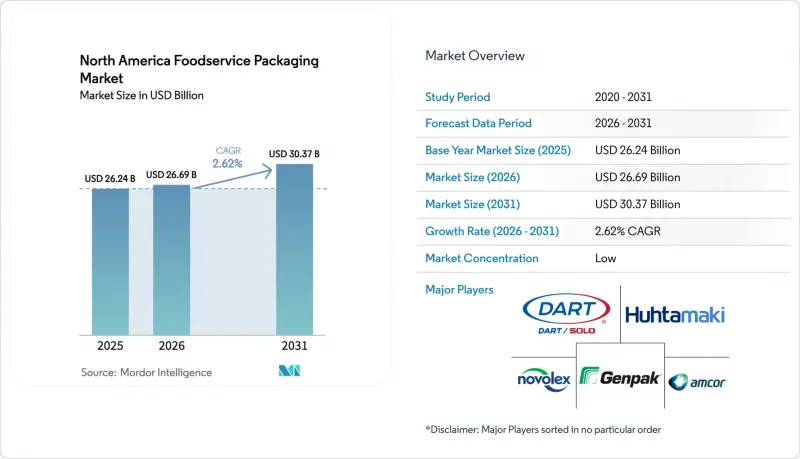
Mordor Intelligence에 의하면, 북미의 푸드서비스용 포장 시장 규모는 2025년 262억 4,000만 달러로 평가되었고, 2026년 266억 9,000만 달러에서 2031년까지 303억 7,000만 달러로 확대될 전망이며, 2026-2031년 CAGR 2.62%를 나타낼 것으로 예측됩니다.
본 보고서는 소재별(종이 및 판지, 플라스틱, 기타), 포장 유형별(클램쉘, 컵·탭, 트레이·용기, 소포장·파우치, 기타),최종 사용자 산업별(QSR, FSR, 기관용 케이터링, 호스피탈리티·카페, 기타), 지속가능성 프로파일별(기존, 지속가능형), 국가별로 분류되어 있습니다. 시장 전망은 금액(달러) 기준으로 제시되어 있습니다.
북미의 푸드서비스용 포장 시장 동향 및 인사이트
편의성과 테이크아웃·외식 수요
2025년에는 미국의 총 식품 지출액 중 외식·테이크아웃 지출이 55%에 달했으며, 휴대 가능한 식사 형태로의 구조적 전환이 두드러졌습니다. 1인용 클램쉘 트레이와 오븐 및 전자레인지 모두에서 사용할 수 있는 판지 트레이는 출퇴근자들이 음식을 접시에 옮겨 담지 않고도 재가열할 수 있기 때문에 현재 아침 샌드위치나 메인 요리 제공에 있어 주류를 이루고 있습니다. 퀵서비스 체인 업체들에 따르면, 메뉴 간소화를 통해 주문 처리 인건비가 12%에서 15% 절감되었고, 평균 주문 처리 속도가 향상되었다고 합니다. 이에 따라 표준화된 패키지 크기에 대한 수요가 더욱 높아지고 있습니다. 한편, 각 컨버터 업체들은 개정된 이행 규정을 준수하는 수성 배리어 소재의 생산을 확대하고 있으며, 불소계 화학 물질에 대한 의존도를 낮추고 있습니다. 이러한 편의성이라는 주제는 고스트 키친 전략과도 밀접하게 연결되어 있으며, SKU 최적화와 경량 포장을 통해 배송비를 절감함으로써, 식품 가격 급등이 재량 지출을 압박하는 상황에서도 판매량을 유지할 수 있게 되었습니다.
음식 배달 및 고스트 키친 모델의 급속한 확대
2025년, DoorDash 북미의 주문 중 3분의 2 이상이 4마일 이상 이동함에 따라, 각 컨버터 기업들은 30분 배송 중 액체가 새지 않도록 뚜껑과 밀봉재를 재설계했습니다. 고스트 키친은 이미 미국 상업용 푸드서비스 주문의 15%를 차지하고 있으며, 임대료가 저렴해 커미셔너리 허브를 입지하기 쉬운 2차 도시권에서 그 보급률이 가장 빠르게 증가하고 있습니다. 모노머 PP나 성형 섬유로 만들어진 배달 최적화 트레이는 자원 회수 시설에서의 오염을 줄이기 위해 현재 가격 프리미엄이 붙고 있습니다. Graphic Packaging은 가상 브랜드와의 계약과 관련된 트레이 출하량이 전년 대비 22% 증가했다고 기록했으며, 이는 내구성과 적재 용이성이 매장 내 식사의 미관보다 우선시된다는 사실을 뒷받침합니다. 단일 소재로 된 트레이는 기존 재활용 흐름에 원활하게 통합될 수 있어, 지자체 재활용 규제가 이러한 추세를 뒷받침하고 있으며, 브랜드 소유자의 순환 경제에 대한 평가 지표를 지지하고 있습니다.
엄격한 일회용 플라스틱 규제 및 금지 조치
캘리포니아주, 콜로라도주, 메인주, 버몬트주, 워싱턴주에서는 이미 폴리스티렌 사용이 제한되거나 발생원에서의 감축이 의무화되어 있습니다. 한편, 캐나다에서는 2023년에 연방 정부의 금지 조치가 발효되었습니다. 이러한 규제의 시행 시기가 겹치면서 가공업체들은 여러 SKU를 관리할 수밖에 없게 되어 재고 평가 손실 위험이 발생하고 있습니다. Dart Container는 2024년에 구형 폴리스티렌용 금형에 대해 4,200만 달러의 감손 손실을 계상했습니다. 규정 준수 비용에는 불균형이 나타납니다. 수직 통합형 공급업체는 제3자 컴파운더에 의존하는 지역 기업보다 시험 및 배합 변경을 더 쉽게 감당할 수 있습니다. 소매업체들은 소비자의 반발을 피하기 위해 법정 기한에 앞서 단계적 폐지를 가속화하고 있습니다. 그 결과, 성형 섬유, 단일 PET, 코팅 판지 등의 대체품이 빠르게 인증을 획득하고 있으며, 기존 발포 컵 시장 규모는 축소되고 있습니다.
부문 분석
섬유, 생분해성 수지, 특수 기판 공급업체들은 규제에 따른 역풍을 시장 점유율 확대의 기회로 전환하고 있습니다. 사업자들이 SB 54를 준수하는 대체재를 모색하는 가운데, 생분해성 소재는 2031년까지 연평균 성장률(CAGR) 4.32%를 기록할 전망입니다. 2025년 매출에서 플라스틱이 차지하는 비중은 여전히 48.42%였지만, 캘리포니아주와 캐나다의 사용 금지 조치로 인해 폴리스티렌 취급량은 이미 감소하고 있습니다. Graphic Packaging의 성형 섬유 클램쉘 용기가 퀵서비스형 샐러드 판매 채널에서 성공을 거두고 있는 것은 내유성과 강성이 향상됨에 따라 기존의 성능 격차가 해소되었음을 보여줍니다. 한편, 알루미늄과 유리는 무게, 비용, 그리고 가정 쓰레기 분리 수거에 따른 과제가 무한한 재활용 가능성이라는 가치 제안을 상회하고 있기 때문에 프리미엄 음료 분야에서는 여전히 틈새 시장에 머물러 있습니다.
NatureWorks가 네브래스카주에서 추진하는 6억 달러 규모의 PLA 생산 확대 계획에 따라, 2027년까지 생산 능력은 2배로 늘어나고 내열 성능은 110°C로 향상될 전망이며, 이를 통해 핫필 방식의 푸드서비스 시장 진출 기회가 열릴 것입니다. Danimer Scientific은 Nodax PHA 오일 배리어 코팅에 대해 FDA 승인을 획득하여, PFAS 불소 화합물을 배제한 섬유제 트레이로 가는 새로운 길을 열었습니다. 하지만 북미 푸드서비스용 포장 시장에서 인증된 퇴비화 가능 제품 시장 규모는 사용 후 처리 방법에 따라 달라집니다. 미국에는 푸드서비스용 용기를 수용하는 산업용 퇴비화 시설이 고작 185곳에 불과합니다. 서부 해안 이외 지역의 사업자들은 대개 어쩔 수 없이 매립 처리에 의존할 수밖에 없으며, 그 결과 환경 보호를 강조하는 주장의 설득력이 약화되고 있습니다. 가정에서 발생하는 유기물 수거가 확대될 때까지는 가공업체들은 연안 지역의 대도시권을 대상으로 퇴비화 가능 제품을 포지셔닝하는 한편, 기타 지역에서는 rPET 및 rPP로의 업그레이드를 추진하고 있습니다.
2025년에는 커피 체인점과 냉동 디저트 체인점의 지원에 힘입어 컵과 용기가 시장 점유율의 39.89%를 차지했습니다. 그러나 배달 수요의 급증으로 인해 트레이 및 용기 분야에서 점진적인 성장이 예상되며, 이 분야는 2031년까지 연평균 성장률(CAGR) 3.46%를 기록하여 북미 외식 산업용 포장 시장 전체의 성장률을 상회할 것으로 전망됩니다. Inline Plastics의 위조 방지 기능을 갖춘 클램쉘 용기는 FDA의 추적성 요건을 충족하며, 현재 밀키트 SKU의 핵심을 이루고 있습니다. 소포장 봉지나 파우치는 경량 포장으로 인해 운송 시 배출량과 단가를 절감할 수 있어 조미료나 소스 용도로 채택이 확대되고 있습니다.
Pactiv Evergreen의 EarthChoice 듀얼 오븐용 종이 트레이는 425°F의 온도를 20분간 견딜 수 있어, 소비자가 별도의 용기를 사용하지 않고도 식사를 재가열할 수 있을 뿐만 아니라, Chipotle에서는 주문 1건당 포장 중량을 18% 줄였습니다. Sabert의 사탕수수 바가스 소재 Pulp-it 시리즈는 ASTM D6868 규격을 준수하며, 단열 성능 면에서 폴리스티렌에 필적하기 때문에 규제가 엄격한 주의 체인점에서 채택되고 있습니다. 캘리포니아주의 SB 1335 법에 따르면, 2028년까지 공공 기관은 퇴비화 가능하거나 재활용 가능한 용기를 사용해야 하며, 이로 인해 단일 섬유 및 단일 PP로 제작된 트레이 설계로의 전환이 더욱 가속화되고 있습니다.
기타 혜택 :
- 엑셀 형식 시장 예측(ME) 시트
- 3개월간의 애널리스트 지원
자주 묻는 질문
목차
제1장 서론
제2장 조사 방법
제3장 주요 요약
제4장 시장 구도
제5장 시장 규모 및 성장 예측
제6장 경쟁 구도
제7장 시장 기회 및 향후 전망
AJY 26.09.15According to Mordor Intelligence, the North America foodservice packaging market size is projected to expand from USD 26.24 billion in 2025 and USD 26.69 billion in 2026 to USD 30.37 billion by 2031, registering a CAGR of 2.62% between 2026 to 2031.
This report is Segmented by Material (Paper and Paperboard, Plastics, and More), Packaging Type (Clamshells, Cups and Tubs, Trays and Containers, Sachets and Pouches, and More), End-User Industry (QSR, FSR, Institutional Catering, Hospitality and Cafes, and More), Sustainability Profile (Conventional, and Sustainable), and Country. The Market Forecasts are Provided in Terms of Value (USD).
North America Foodservice Packaging Market Trends and Insights
Demand for Convenience and On-the-Go Meals
Food-away-from-home spending climbed to 55% of total United States food expenditures in 2025, underlining a structural move toward portable meal formats. Single-serve clamshells and dual-ovenable paperboard trays now dominate breakfast sandwich and entree offerings because they let commuters reheat food without re-plating. Quick-service chains report that menu simplification lowered fulfillment labor by 12% to 15% and raised average order speed, reinforcing the pull for standardized footprints. Converters, in turn, are scaling up water-based barriers that comply with updated migration rules, reducing dependence on fluorochemicals. The convenience theme also dovetails with ghost-kitchen playbooks where SKU discipline and lightweight packaging lower delivery fees, sustaining volume even when food inflation pressures discretionary spending.
Rapid Expansion of Food-Delivery and Ghost-Kitchen Models
More than two-thirds of DoorDash North America orders in 2025 traveled more than 4 miles, so converters redesigned lids and seals to withstand 30-minute trips without leakage. Ghost kitchens already represent 15% of United States commercial foodservice orders, with penetration rising fastest in secondary metros where rents favor commissary hubs. Delivery-optimized trays made from mono-PP or molded fiber now earn price premiums because they reduce contamination at material recovery facilities. Graphic Packaging recorded a 22% year-over-year jump in tray shipments linked to virtual-brand contracts, confirming that durability and stackability trump dine-in aesthetics. Municipal recycling rules amplify the trend, since single-material walls flow more easily into existing streams, supporting circular-economy scorecards for brand owners.
Stringent Single-Use Plastic Regulations and Bans
California, Colorado, Maine, Vermont, and Washington already restrict polystyrene or require source reduction, while Canada's federal ban took effect in 2023. The overlapping timelines force converters to manage multiple SKUs and create inventory write-down risks; Dart Container booked a USD 42 million impairment on legacy polystyrene tooling in 2024. Compliance costs are asymmetric; vertically integrated suppliers absorb testing and reformulation more easily than regional firms that rely on third-party compounders. Retailers are accelerating phase-outs ahead of statutory deadlines to avoid consumer backlash. As a result, molded-fiber, mono-PET, and coated paperboard alternatives are gaining accelerated certifications, shrinking the addressable volume for traditional foam cups.
Other drivers and restraints analyzed in the detailed report include:
- Corporate Net-Zero Mandates Driving Sustainable Packaging Procurement
- Emphasis on Recyclable and Post-Consumer Materials
- Volatility in Polymer and Pulp Input Prices
For complete list of drivers and restraints, kindly check the Table Of Contents.
Segment Analysis
Fiber, biodegradable resin and specialty substrate suppliers are converting regulatory headwinds into share gains. Biodegradable materials are set to register a 4.32% CAGR through 2031 as operators search for SB 54-compliant alternatives. Plastics still account for 48.42% of 2025 revenue, but California and Canada bans have already trimmed polystyrene volumes. Graphic Packaging's molded-fiber clamshell wins in quick-service salad channels demonstrate how improved grease resistance and stiffness close historical performance gaps. Meanwhile, aluminum and glass stay niche in premium beverage formats because weight, cost and curbside sortation challenges offset their infinitely recyclable value proposition.
NatureWorks' USD 600 million Nebraska PLA expansion will double capacity by 2027 and raise heat performance to 110 °C, unlocking hot-fill foodservice opportunities. Danimer Scientific secured FDA approval for Nodax PHA grease-barrier coatings, opening new avenues for fiber trays that bypass PFAS fluorochemicals. Still, the North America foodservice packaging market size for certified compostables hinges on end-of-life access; only 185 industrial composters accept foodservice ware in the United States. Operators outside the West Coast often default to landfill, diluting environmental claims. Until curbside organics pickup expands, converters are positioning compostables for coastal metros while pushing rPET and rPP upgrades elsewhere.
Cups and tubs captured 39.89% of the market share in 2025, buoyed by coffee and frozen-dessert chains. Yet the delivery boom is steering incremental growth toward trays and containers, which are expected to outpace the overall North America foodservice packaging market at a 3.46% CAGR through 2031. Inline Plastics' tamper-evident clamshells meet FDA traceability mandates and now anchor meal-kit SKUs. Sachets and pouches gain in condiment and sauce applications because lighter packages lower freight emissions and unit cost.
Pactiv Evergreen's EarthChoice dual-ovenable paperboard tray withstands 425 °F for 20 minutes, letting consumers reheat meals without secondary dishes and cutting per-order packaging weight 18% at Chipotle. Sabert's sugarcane-bagasse Pulp-it line meets ASTM D6868 and rivals polystyrene on insulating performance, winning chain accounts in legislation-heavy states. California's SB 1335 requirement that public institutions use compostable or recyclable formats by 2028 further tilts the mix to mono-fiber and mono-PP tray designs.
Complete Report Scope:
- By Material
- Paper and Paperboard
- Plastics
- Polyethylene Terephthalate (PET)
- Polypropylene (PP)
- Polystyrene (PS) and Expanded Polystyrene (EPS)
- Other Plastics
- Aluminum
- Glass
- Biodegradable and Specialty Materials
- By Packaging Type
- Clamshells
- Cups and Tubs
- Trays and Containers
- Sachets and Pouches
- Other Packaging Types
- By End-User Industry
- Quick-Service Restaurants (QSR)
- Full-Service Restaurants (FSR)
- Institutional Catering
- Hospitality and Cafes
- Other End-User Industries
- By Sustainability Profile
- Conventional Type
- Sustainable Packaging
- By Country
- United States
- Canada
- Mexico
List of Companies Covered in this Report:
- Novolex Holdings LLC
- Huhtamaki Oyj
- Dart Container Corporation
- Genpak LLC
- Amcor plc
- Silgan Holdings Inc.
- Graphic Packaging Holding Company
- Sonoco Products Company
- Smurfit Westrock
- International Paper Company
- Anchor Packaging Inc.
- Eco-Products LLC
- Fabri-Kal Corporation
- UFP Technologies Inc.
- Inline Plastics Corp.
- Sabert Corporation
- Winpak Ltd.
- ProAmpac LLC
- Pactiv Evergreen Inc.
Additional Benefits:
- The market estimate (ME) sheet in Excel format
- 3 months of analyst support
TABLE OF CONTENTS
1 INTRODUCTION
- 1.1 Study Assumptions and Market Definition
- 1.2 Scope of the Study
2 RESEARCH METHODOLOGY
3 EXECUTIVE SUMMARY
4 MARKET LANDSCAPE
- 4.1 Market Overview
- 4.2 Market Drivers
- 4.2.1 Demand for Convenience and On-the-Go Meals
- 4.2.2 Rapid Expansion of Food-Delivery and Ghost-Kitchen Models
- 4.2.3 Corporate Net-Zero Mandates Driving Sustainable Packaging Procurement
- 4.2.4 Emphasis on Recyclable and Post-Consumer Materials
- 4.2.5 Integration of Smart, Connected Packaging for Waste-Tracking
- 4.2.6 Government Incentives for Domestic Compostable Packaging Capacity
- 4.2.7 Heightened Food-Safety Focus Requiring Tamper-Evident Formats
- 4.3 Market Restraints
- 4.3.1 Stringent Single-Use Plastic Regulations and Bans
- 4.3.2 Volatility in Polymer and Pulp Input Prices
- 4.3.3 Limited Industrial Composting Infrastructure
- 4.3.4 Supplier Consolidation Triggering Contract Renegotiation Risk
- 4.3.5 Operational Challenges from State-Level PFAS Restrictions
- 4.4 Industry Value Chain Analysis
- 4.5 Regulatory Landscape
- 4.6 Technological Outlook
- 4.7 Impact of Macroeconomic Factors on the Market
- 4.8 Porter's Five Forces Analysis
- 4.8.1 Threat of New Entrants
- 4.8.2 Bargaining Power of Buyers
- 4.8.3 Bargaining Power of Suppliers
- 4.8.4 Threat of Substitutes
- 4.8.5 Intensity of Competitive Rivalry
5 MARKET SIZE AND GROWTH FORECASTS (VALUE)
- 5.1 By Material
- 5.1.1 Paper and Paperboard
- 5.1.2 Plastics
- 5.1.2.1 Polyethylene Terephthalate (PET)
- 5.1.2.2 Polypropylene (PP)
- 5.1.2.3 Polystyrene (PS) and Expanded Polystyrene (EPS)
- 5.1.2.4 Other Plastics
- 5.1.3 Aluminum
- 5.1.4 Glass
- 5.1.5 Biodegradable and Specialty Materials
- 5.2 By Packaging Type
- 5.2.1 Clamshells
- 5.2.2 Cups and Tubs
- 5.2.3 Trays and Containers
- 5.2.4 Sachets and Pouches
- 5.2.5 Other Packaging Types
- 5.3 By End-User Industry
- 5.3.1 Quick-Service Restaurants (QSR)
- 5.3.2 Full-Service Restaurants (FSR)
- 5.3.3 Institutional Catering
- 5.3.4 Hospitality and Cafes
- 5.3.5 Other End-User Industries
- 5.4 By Sustainability Profile
- 5.4.1 Conventional Type
- 5.4.2 Sustainable Packaging
- 5.5 By Country
- 5.5.1 United States
- 5.5.2 Canada
- 5.5.3 Mexico
6 COMPETITIVE LANDSCAPE
- 6.1 Market Concentration
- 6.2 Strategic Moves
- 6.3 Market Share Analysis
- 6.4 Company Profiles (Includes Global Level Overview, Market Level Overview, Core Segments, Financials as Available, Strategic Information, Market Rank/Share, Products and Services, and Recent Developments)
- 6.4.1 Novolex Holdings LLC
- 6.4.2 Huhtamaki Oyj
- 6.4.3 Dart Container Corporation
- 6.4.4 Genpak LLC
- 6.4.5 Amcor plc
- 6.4.6 Silgan Holdings Inc.
- 6.4.7 Graphic Packaging Holding Company
- 6.4.8 Sonoco Products Company
- 6.4.9 Smurfit Westrock
- 6.4.10 International Paper Company
- 6.4.11 Anchor Packaging Inc.
- 6.4.12 Eco-Products LLC
- 6.4.13 Fabri-Kal Corporation
- 6.4.14 UFP Technologies Inc.
- 6.4.15 Inline Plastics Corp.
- 6.4.16 Sabert Corporation
- 6.4.17 Winpak Ltd.
- 6.4.18 ProAmpac LLC
- 6.4.19 Pactiv Evergreen Inc.
7 MARKET OPPORTUNITIES AND FUTURE OUTLOOK
- 7.1 White-Space and Unmet-Need Assessment