

|
시장보고서
상품코드
2124773
가정용 환기 시스템 시장 : 시장 점유율 분석, 업계 동향 및 통계, 성장 예측(2026-2031년)Home Ventilation System - Market Share Analysis, Industry Trends & Statistics, Growth Forecasts (2026 - 2031) |
||||||
 Mordor Intelligence
Mordor Intelligence에 의하면, 가정용 환기 시스템 시장 규모는 2025년 273억 달러로 평가되었고, 2026년 292억 3,000만 달러에서 2031년까지 411억 2,000만 달러로 확대될 것으로 예측되며, 2026-2031년 연평균 복합 성장률(CAGR)은 7.06%를 나타낼 전망입니다.
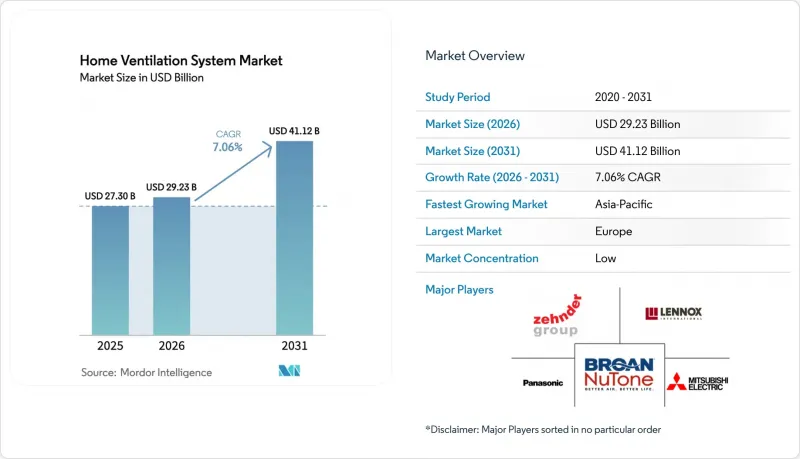
본 보고서는 시스템 유형별(주택 전체형/집중 환기, 스팟형/배기 전용 환기, 기타), 제품 유형별(HVAC 일체형 유닛, 독립형 환기 장치 및 팬, 기타), 설치 유형별(신축, 개보수/리모델링), 지역별(북미, 남미, 유럽, 아시아태평양, 중동 및 아프리카)로 분류되어 있습니다. 시장 예측은 금액(달러)으로 제시되어 있습니다.
세계의 가정용 환기 시스템 시장 동향 및 인사이트
실내 공기질이 주택의 가장 중요한 건강 과제로 부상
2024년 이후, 공기 중 오염 물질에 대한 인식이 지속적으로 높아짐에 따라 실내 공기질은 주택 프로젝트 및 중기적인 개보수에서 단순한 선택적 업그레이드에서 일상적인 필수 요건으로 변화했습니다. 최소 환기량은 각종 건축 기준 및 규격에 반영되어 있으며, 측정 가능한 연속적인 기류 준수를 의무화하는 시행 조치가 마련되어 있어, 대부분의 신축 주택에서 규정 준수에 기반한 환기 능력의 최저 기준이 확립되어 있습니다. 유럽연합(EU)에서는 EPBD 2024개정판에 따라 회원국들이 2026년 5월 29일까지 국내 실내 공기질 대책을 수립해야 할 의무가 부과되었으며, 모든 신규 비주거용 제로 배출 건축물에 대한 모니터링이 포함되어 있습니다. 이에 따라 제로 배출 건축물이 표준화됨에 따라 주택 분야에 대한 기대 방향이 제시되고 있습니다. 미국 에너지부(DOE)의 제로 에너지 레디 홈(Zero Energy Ready Home) 및 관련 라벨 제도와 같은 건강 중심 프로그램에서는 환기를 보다 광범위한 성능 패키지의 일부로 통합하고 있으며,이를 통해 건설업체들은 현재부터 2030년까지 신축 주택에 적절한 규모의 여과 기능을 갖춘 균형 잡힌 시스템을 채택하도록 유도되고 있습니다. 건축 기준과 자발적인 라벨 제도가 통합되는 가운데, 균형 잡힌 환기 시스템은 우발적인 외부 공기 유입에 의존하지 않고도 안정적인 풍량을 확보할 수 있다는 실증 데이터를 바탕으로 ERV 도입이 촉진되고 있습니다. 이를 통해 가정용 환기 시스템 시장은 건강을 중시하는 주택 설계로의 전환으로부터 분명한 혜택을 받게 될 것입니다.
스마트 홈과의 통합이 지능형 환기 수요를 가속화
2024년 이후, 주택용 HVAC 플랫폼에는 더 많은 소프트웨어 기능이 통합되고 있으며, 에너지 최적화의 일환으로 환기 기능이 제어 스택에 포함되는 사례가 늘고 있습니다. 제조업체들의 발표에 따르면, 예측 유지보수, 개방형 연결성, AI를 활용한 제어에 대한 집중이 강조되고 있으며, 이러한 기능들은 냉난방뿐만 아니라 환기 일정 관리 및 수요 제어에도 응용되고 있습니다. 빌딩 자동화 제품 포트폴리오를 보유한 기업들은 소프트웨어를 활용한 차별화로 명확히 초점을 옮기고 있으며, 이는 고정된 설정값이 아닌 측정된 실내 환경에 따라 작동하는 환기 모듈을 뒷받침하고 있습니다. 온도 조절기, 실내 공기질(IAQ) 센서, 환기 유닛을 단일 앱으로 통합하는 제품 생태계는 시공업체와 주택 소유주 사이에서 지지를 얻고 있으며, 이를 통해 시운전 기간이 단축되고 단순한 공기 교환을 넘어서는 부가가치가 제공되고 있습니다. 지능형 기능이 중저가 제품에도 보급됨에 따라, 가정용 환기 시스템 시장에서는 수요 제어형 환기, 원격 진단, 건축 기준 준수 확인 및 유틸리티 프로그램 요건에 따른 성능 검증과 같은 이용 사례가 확대되고 있습니다. 이러한 기능들은 주택 전체의 성능 체계에서 환기가 측정 및 제어 가능한 요소로서의 역할을 강화하며, 스마트 기기의 보급이 이미 주류가 된 지역에서 연결형 ERV 및 HRV 시스템의 가치 창출을 향상시키고 있습니다.
시스템 및 설치 비용의 높이가 대중 시장으로의 보급을 방해하고 있습니다.
열회수 또는 에너지 회수 기능을 갖추고 균형 잡힌 기류를 실현하는 주택 전체 시스템에는 장비비와 인건비가 모두 소요됩니다. 이는 사전에 덕트 배관이 계획되지 않은 주택의 경우 상당한 부담이 될 수 있습니다. 기존 HVAC 시스템과 덕트를 공유할 수 없거나, 독립형 환기 장치를 위해 추가 관통부나 배선이 필요한 경우 설치의 복잡성이 증가합니다. 이로 인해 리모델링 공사 프로젝트 예산이 증가하고, 투자 회수 기간이 길어지게 됩니다. 가격 동향은 저 GWP 냉매로의 전환, 공급망 상황, 그리고 커넥티드 기기로 시장 전환을 반영한 제어 패키지 업그레이드와 같은 구성 부품의 변화에 영향을 받고 있으며, 이 모든 요인이 여러 제조업체가 보고하는 평균 판매 가격 상승에 기여하고 있습니다. 많은 프로그램에서 인센티브를 통해 실질적인 비용이 절감되고 있지만, 가격에 민감한 지역의 주택 소유자들은 여전히 초기 비용과 다른 리모델링 방안을 저울질하며 검토하고 있으며, 그 결과 단계적인 대책이 우선시되어 중앙 덕트식 솔루션의 도입이 지연될 가능성이 있습니다. 신축 주택의 경우 비용을 주택 담보 대출에 포함시키기 쉬워, 가정용 환기 시스템 시장에서 통합형 시스템의 점유율 유지에 기여하고 있습니다. 이 시장에서는 건설사가 종합적인 HVAC 패키지의 일환으로 균형형 환기 시스템을 지정하는 것이 일반적입니다.
부문 분석
2025년에는 주택 전체/집중 환기 시스템이 46.81%를 차지했습니다. 이는 기밀성이 높은 주택에서 여러 구역에 신선한 공기를 공급하는 집중형 덕트식 솔루션이 건설업체의 표준 관행으로 선호되고 있음을 반영합니다. 이 카테고리는 신축 공사에서 덕트 공사 및 제어 시스템이 골조 공사 단계에서 조정되기 때문에 확립된 설치 워크플로우와 강제 환기 인프라와의 호환성이라는 이점을 누리고 있습니다. 에너지 회수 환기 장치(ERV)는 2031년까지 연평균 성장률(CAGR) 7.72%로 가장 빠르게 성장하는 부문입니다. 이는 주택 소유자와 건설업자가 현열 및 잠열 모두의 에너지 이동을 중요시하기 때문이며, 이를 통해 계절에 관계없이 실내 환경이 안정화됩니다. 이러한 특성은 혼합 기후 지역이나 냉방 수요가 주를 이루는 지역에서의 도입을 촉진하고 있습니다. 효율 향상 외에도, 밸런스드 시스템은 규정된 기밀성을 충족하는 주택에 대해 기계 환기를 의무화하는 건축 기준을 준수하고 있어, 에너지 효율과 쾌적성의 이점이 가장 두드러지게 나타나는 기후대에서 ERV 및 HRV의 보급을 촉진하고 있습니다. 이러한 선택지로 인해 가정용 환기 시스템 시장에는 현저한 변화가 일어나고 있으며, 기밀성이 높은 주택, 구획 분리가 필요한 공동 주택 프로젝트, 그리고 여름철 습도 제어를 포함한 쾌적성 목표가 요구되는 경우, 종합적인 에너지 회수 솔루션이 선호되는 추세입니다.
시스템 유형에 대한 보다 광범위한 비교에서 국소 환기 및 배기 전용 환기는 초기 비용이 낮고 설치가 용이하기 때문에 습기가 차기 쉬운 방에서는 여전히 일정한 수요를 유지하고 있습니다. HRV는 환기로 인한 열 손실을 줄여주는 현열 회수 기능을 갖추고 있어 한랭 지역에서 계속해서 활용되고 있으며, 겨울철 난방 부하가 주를 이루는 지역에서 측정 가능한 부가가치를 제공합니다. 신축 건물 전체를 놓고 보면, 성능 기준에 따른 적합 요건 및 기밀성에 따른 감점 제도로 인해 프로젝트의 기밀성 목표가 높아지고 있어, 배기 전용 방식으로는 유지하기 어려운 상황에서 밸런스형 시스템이 주류를 이루는 추세가 나타나고 있습니다. 이러한 배경으로 인해 가정용 환기 시스템 업계에서 ERV의 성장이 가속화되고 있습니다. 이러한 동향은 OEM 제조업체의 제품 로드맵에 의해 강화되고 있으며, 건축 기준 관련 자료, 라벨 표시 프로그램, 건설업자 대상 교육에 의해 뒷받침되고 있어, 높은 에너지 성능과 건강한 주거 환경의 실현을 목표로 할 경우 밸런스형 환기가 기본 선택지가 되고 있습니다. 그 결과, 예측 기간 동안 ERV 및 HRV는 시스템 사양에서 더 큰 점유율을 차지할 것으로 예상되며, ERV는 가정용 환기 시스템 시장에서 실내 습도 제어와 냉방이 주요 고려 사항이 되는 지역을 대상으로 합니다.
지역별 분석
2025년에 31.73%의 점유율로 유럽이 주도적인 위치를 차지하게 된 배경에는 신축 및 대규모 개보수 시 기계 환기가 실질적인 필수 요건이 되는 규제가 있습니다. 건축물의 에너지 성능에 관한 지침(EPBD)의 개정에 따라 제로 배출 건축 기준이 추진되고 있으며, 회원국들에게 실내 공기질 대책의 이행을 의무화하고 있어 기밀성이 높아지는 건축물에서의 환기 필요성이 더욱 커지고 있습니다. 각국의 개보수 전략은 비효율적인 기존 건축물 개보수에 중점을 두고 있으며, 환기 설비의 업그레이드는 단열 및 난방 개선과 자연스럽게 연계되어 있습니다. 독일과 프랑스는 주요 수요 거점으로 자리 잡고 있는 반면, 북유럽 국가들은 추운 기후에 적합한 열회수 및 균형 환기 기술의 혁신을 주도하고 있습니다. 영국에서는 건축 규정 개정 및 과열 완화 조치에 따라, 열회수 기능을 갖춘 기계 환기가 신축 주택에서 권장되는 규정 준수 솔루션으로서 확고한 입지를 다지고 있습니다.
아시아태평양은 현재 점유율이 작지만, 도시 지역의 고밀도화와 신축 건축물에서 기계식 공조 시스템에 대한 의존도 증가를 배경으로, 2031년까지 연평균 성장률(CAGR) 6.71%로 가장 빠르게 성장할 전망입니다. 이 지역의 신축 주택에서는 실내 공기질과 열적 쾌적성을 관리하기 위해 기계식 시스템에 대한 의존도가 높아지고 있습니다. 각 제조업체는 고밀도 주택 수요에 부응하기 위해 현지 생산을 확대하고, 환기와 공조를 통합한 솔루션을 맞춤형으로 제공합니다. 건물의 기밀성이 높아지고 기류 검증이 일반화됨에 따라 균형 환기 시스템이 널리 받아들여지고 있으며, 많은 경우 네트워크로 연결된 제어 시스템이나 공기질 모니터링을 통해 지원되고 있습니다. 일부 국가에서는 에너지 효율 향상 프로그램과 국가 건축 기준의 개정에 따라, 주택 프로젝트에서의 환기가 선택적 기능에서 표준 요건으로 꾸준히 전환되고 있습니다.
북미는 전 세계 수요의 상당 부분을 차지하고 있으며, 건축 기준 및 에너지 프로그램의 발전에 힘입어 꾸준한 성장을 보이고 있습니다. 주택의 기밀성이 높아짐에 따라 개정된 에너지 기준은 기계식 환기를 권장하고 있으며, 이로 인해 환기는 신축 주택에 사실상 필수적으로 포함되고 있습니다. 지역별 규제, 특히 공동주택의 경우 열회수·에너지회수형 환기 장치와 같은 균형형 시스템의 도입이 촉진되고 있습니다. 개정된 건축 기준의 보급과 연방 정부의 에너지 효율화 이니셔티브와의 조화를 통해 다양한 기후대에서 도입 실적이 확대되고 있습니다. 장기적으로는 일관된 시행, 건설업자에 대한 인식 제고, 지역별 인센티브 프로그램을 통해 특히 한랭 지역이나 연립주택에서 수요가 강화되고 있습니다. 이러한 지역에서는 성능과 규제 준수를 위해 기계 환기가 필수적이기 때문입니다.
기타 혜택 :
- 엑셀 형식 시장 예측(ME) 시트
- 3개월간의 애널리스트 지원
자주 묻는 질문
목차
제1장 서론
제2장 조사 방법
제3장 주요 요약
제4장 시장 구도
제5장 시장 규모 및 성장 예측
제6장 경쟁 구도
제7장 시장 기회 및 향후 전망
AJY 26.09.15According to Mordor Intelligence, the home ventilation system market size is projected to expand from USD 27.30 billion in 2025 and USD 29.23 billion in 2026 to USD 41.12 billion by 2031, registering a CAGR of 7.06% between 2026 to 2031.
This report is Segmented by System Type (Whole-Home/Central Ventilation, Spot/Exhaust-Only Ventilation, Others), Product Type (HVAC-Integrated Units, Standalone Ventilators & Fans, Others), Installation Type (New Construction, Retrofit/Renovation), and Geography (North America, South America, Europe, Asia-Pacific, Middle East and Africa). The Market Forecasts are Provided in Terms of Value (USD).
Global Home Ventilation System Market Trends and Insights
Indoor Air Quality Becoming a Core Residential Health Priority
Indoor air quality has moved from an optional upgrade to a routine requirement in residential projects and mid-cycle retrofits, as awareness of airborne contaminants has persisted since 2024. Minimum ventilation rates are embedded across codes and standards with enforcement pathways that tie compliance to measurable continuous airflow, creating a compliance-driven floor for ventilation capacity in most new homes. In the European Union, the EPBD 2024 recast requires member states to establish national indoor air quality measures by May 29, 2026, and embeds monitoring in all new non-residential zero-emission buildings, which sets a tone for residential expectations as zero-emission buildings become the norm. Health-focused programs such as DOE Zero Energy Ready Home and associated labeling frameworks integrate ventilation as part of a broader performance package, which steers builders toward balanced systems with right-sized filtration in new construction now and through the 2030 horizon. As codes and voluntary labels converge, ERV adoption benefits from evidence that balanced ventilation can deliver steady airflow rates without relying on incidental infiltration, which makes the home ventilation system market a clear beneficiary of the shift toward health-centered residential design.
Smart Home Integration Accelerating Demand for Intelligent Ventilation
Residential HVAC platforms have integrated more software features since 2024, and ventilation is increasingly included in the control stack as part of energy optimization. Manufacturer disclosures underscore a focus on predictive maintenance, open connectivity, and AI-assisted control, and these features are being applied to ventilation scheduling and demand control alongside heating and cooling. Companies with building automation portfolios show a clear pivot to software-enabled differentiation, and this supports ventilation modules that respond to measured indoor conditions rather than static setpoints. Product ecosystems that consolidate thermostats, IAQ sensors, and ventilation boxes under a single app are gaining traction with installers and homeowners, which shortens commissioning and supports value propositions beyond air exchange alone. As intelligent features spread across mid-market price points, the home ventilation system market sees expanding use cases for demand-controlled ventilation, remote diagnostics, and performance verification that align with code compliance checks and utility program requirements. These capabilities reinforce ventilation's role as a measurable, controllable element in a whole-home performance stack, improving the value capture for connected ERV and HRV systems across regions where smart device adoption is already mainstream.
High System & Installation Costs Limiting Mass-Market Adoption
Whole-house systems that deliver balanced airflow with heat or energy recovery involve both equipment and labor, which can be significant in homes without pre-planned duct runs. Installation complexity increases when existing HVAC systems cannot share ductwork or when additional penetrations and wiring are needed for a stand-alone ventilator, which adds to project budgets and lengthens payback periods in retrofit scenarios. Price trends have been influenced by component transitions such as low-GWP refrigerants, supply chain conditions, and upgraded control packages that reflect the market's shift toward connected devices, all of which contribute to higher average selling prices reported by several manufacturers. While incentives reduce net costs in many programs, homeowners in price-sensitive regions still weigh upfront outlays against alternative upgrades, which can delay adoption of centrally ducted solutions in favor of incremental measures. In new construction, costs are more easily amortized into mortgages, and this helps sustain share for integrated systems in the home ventilation system market, where builders specify balanced ventilation as part of a comprehensive HVAC package.
Other drivers and restraints analyzed in the detailed report include:
- Mandatory Ventilation Requirements in Energy-Efficient Building Codes
- Renovation-Led Demand from Aging and Poorly Ventilated Housing Stock
- Structural Constraints in Retrofitting Older Residential Buildings
For complete list of drivers and restraints, kindly check the Table Of Contents.
Segment Analysis
Whole-home or central ventilation systems accounted for 46.81% in 2025, reflecting builder preferences for centralized ducted solutions that distribute fresh air across multiple zones as a standard practice in tighter envelopes. The category benefits from established installation workflows and compatibility with forced-air infrastructure in new construction, where ductwork and controls are coordinated at rough-in stages. Energy recovery ventilators are the fastest-growing segment at a 7.72% CAGR through 2031, as owners and builders value both sensible and latent energy transfer, which stabilizes indoor conditions across seasons; this differential supports adoption in mixed and cooling-dominant regions. Alongside efficiency gains, balanced systems align with codes that require mechanical ventilation for homes meeting prescriptive air-sealing, reinforcing ERV and HRV penetration in climates where the energy and comfort payoffs are most visible. These choices create a noticeable shift in the home ventilation system market where total energy recovery solutions are favored when envelopes are tight, multifamily projects require compartmentalization, and comfort goals include humidity control in summer conditions.
In the broader comparison of system types, spot or exhaust-only ventilation retains a base in moisture-prone rooms due to lower upfront costs and ease of installation. HRVs continue to serve cold climates with sensible heat recovery that reduces ventilation heat loss, adding measurable value where winter heating loads dominate. Embedded trends favor balanced systems across new construction because performance-based compliance and airtightness credits push projects toward lower leakage targets, which are harder to maintain with exhaust-only approaches; this context amplifies ERV growth in the home ventilation system industry. These patterns are reinforced by OEM product roadmaps and supported by code resources, labeling programs, and builder training that make balanced ventilation the default selection when targeting higher energy performance and healthy home credentials. As a result, ERVs and HRVs are positioned to capture a larger portion of system specifications over the forecast period, with ERVs addressed to regions where indoor humidity control and cooling are central considerations in the home ventilation system market.
Complete Report Scope:
- By System Type
- Whole-Home / Central Ventilation
- Spot / Exhaust-Only Ventilation
- Energy Recovery Ventilators (ERV)
- Heat Recovery Ventilators (HRV)
- By Product Type
- HVAC-Integrated Units
- Standalone Ventilators & Fans
- Inline Duct Fans & Accessories
- By Installation Type
- New Construction
- Retrofit / Renovation
- By Geography
- North America
- Canada
- United States
- Mexico
- South America
- Brazil
- Peru
- Chile
- Argentina
- Rest of South America
- Europe
- United Kingdom
- Germany
- France
- Spain
- Italy
- BENELUX (Belgium, Netherlands, and Luxembourg)
- NORDICS (Denmark, Finland, Iceland, Norway, and Sweden)
- Rest of Europe
- Asia-Pacific
- India
- China
- Japan
- Australia
- South Korea
- South East Asia (Singapore, Malaysia, Thailand, Indonesia, Vietnam, and Philippines)
- Rest of Asia-Pacific
- Middle East And Africa
- United Arab Emirates
- Saudi Arabia
- South Africa
- Nigeria
- Rest of Middle East And Africa
- North America
Geography Analysis
Europe's leadership at 31.73% in 2025 rests on regulations that make mechanical ventilation a practical necessity for new builds and major renovations. The recast Energy Performance of Buildings Directive pushes zero-emission building standards and requires member states to implement indoor air quality measures, reinforcing the need for ventilation in increasingly airtight buildings. National renovation strategies focus on upgrading inefficient building stock, naturally linking ventilation upgrades with insulation and heating improvements. Germany and France serve as major demand hubs, while Northern European countries lead innovation in heat recovery and balanced ventilation suited to colder climates. In the United Kingdom, updated building regulations and overheating mitigation measures strongly position mechanical ventilation with heat recovery as a preferred compliance solution in new homes.
Asia-Pacific is smaller in its current share but grows the fastest at a 6.71% CAGR through 2031, shaped by urban density and greater reliance on mechanical conditioning in new construction. New construction in the region relies heavily on mechanical systems to manage indoor air quality and thermal comfort. Manufacturers are expanding local production and tailoring integrated ventilation and conditioning solutions to meet the needs of high-density housing. As building envelopes tighten and airflow verification becomes more common, balanced ventilation systems gain wider acceptance, often supported by connected controls and air quality monitoring. Energy efficiency programs and evolving national codes in select countries are steadily shifting ventilation from an optional feature to a standard requirement in residential projects.
North America represents a substantial portion of global demand and shows steady growth supported by evolving building codes and energy programs. Updated energy codes encourage mechanical ventilation as homes become more airtight, effectively embedding ventilation into new residential construction. Regional regulations, particularly in multifamily housing, promote the use of balanced systems such as heat and energy recovery ventilators. Wider adoption of updated codes and alignment with federal efficiency initiatives are expanding the installed base across diverse climate zones. Over time, consistent enforcement, builder education, and localized incentive programs are strengthening demand, especially in colder regions and attached housing, where mechanical ventilation is critical for performance and compliance.
List of Companies Covered in this Report:
- Zehnder Group
- Lennox International
- Panasonic Corporation
- Broan-NuTone LLC
- Mitsubishi Electric
- Daikin Industries
- Honeywell International
- Johnson Controls
- Trane Technologies
- Aldes Group
- Systemair AB
- Greenheck Fan Corporation
- Soler & Palau Ventilation (S&P)
- Blauberg Ventilatoren
- Vent-Axia
- Nuaire
- EnviroVent
- Fantech (Systemair)
- Lunos Luftungstechnik
- TwinFresh
Additional Benefits:
- The market estimate (ME) sheet in Excel format
- 3 months of analyst support
TABLE OF CONTENTS
1 Introduction
- 1.1 Study Assumptions & Market Definition
- 1.2 Scope of the Study
2 Research Methodology
3 Executive Summary
4 Market Landscape
- 4.1 Market Overview
- 4.2 Market Drivers
- 4.2.1 Indoor Air Quality Becoming a Core Residential Health Priority
- 4.2.2 Smart Home Integration Accelerating Demand for Intelligent Ventilation
- 4.2.3 Mandatory Ventilation Requirements in Energy-Efficient Building Codes
- 4.2.4 Renovation-Led Demand from Aging and Poorly Ventilated Housing Stock
- 4.2.5 Airtight Urban Housing Driving Mechanical Ventilation Adoption
- 4.2.6 Rising Penetration of Heat-Recovery & Energy-Efficient Systems
- 4.3 Market Restraints
- 4.3.1 High System & Installation Costs Limiting Mass-Market Adoption
- 4.3.2 Structural Constraints in Retrofitting Older Residential Buildings
- 4.3.3 Fragmented Regulations Across Countries and Building Standards
- 4.3.4 Perceived Maintenance Complexity and Long-Term Cost Concerns
- 4.4 Industry Value Chain Analysis
- 4.5 Regulatory Landscape
- 4.6 Porter's Five Forces
- 4.6.1 Threat of New Entrants
- 4.6.2 Bargaining Power of Buyers
- 4.6.3 Bargaining Power of Suppliers
- 4.6.4 Threat of Substitutes
- 4.6.5 Competitive Rivalry
- 4.7 Insights into the Latest Trends and Innovations in the Market
- 4.8 Insights into Recent Developments (New Product Launches, Strategic Initiatives, Investments, Partnerships, JVs, Expansion, M&As, etc.) in the Market
5 Market Size & Growth Forecasts
- 5.1 By System Type
- 5.1.1 Whole-Home / Central Ventilation
- 5.1.2 Spot / Exhaust-Only Ventilation
- 5.1.3 Energy Recovery Ventilators (ERV)
- 5.1.4 Heat Recovery Ventilators (HRV)
- 5.2 By Product Type
- 5.2.1 HVAC-Integrated Units
- 5.2.2 Standalone Ventilators & Fans
- 5.2.3 Inline Duct Fans & Accessories
- 5.3 By Installation Type
- 5.3.1 New Construction
- 5.3.2 Retrofit / Renovation
- 5.4 By Geography
- 5.4.1 North America
- 5.4.1.1 Canada
- 5.4.1.2 United States
- 5.4.1.3 Mexico
- 5.4.2 South America
- 5.4.2.1 Brazil
- 5.4.2.2 Peru
- 5.4.2.3 Chile
- 5.4.2.4 Argentina
- 5.4.2.5 Rest of South America
- 5.4.3 Europe
- 5.4.3.1 United Kingdom
- 5.4.3.2 Germany
- 5.4.3.3 France
- 5.4.3.4 Spain
- 5.4.3.5 Italy
- 5.4.3.6 BENELUX (Belgium, Netherlands, and Luxembourg)
- 5.4.3.7 NORDICS (Denmark, Finland, Iceland, Norway, and Sweden)
- 5.4.3.8 Rest of Europe
- 5.4.4 Asia-Pacific
- 5.4.4.1 India
- 5.4.4.2 China
- 5.4.4.3 Japan
- 5.4.4.4 Australia
- 5.4.4.5 South Korea
- 5.4.4.6 South East Asia (Singapore, Malaysia, Thailand, Indonesia, Vietnam, and Philippines)
- 5.4.4.7 Rest of Asia-Pacific
- 5.4.5 Middle East And Africa
- 5.4.5.1 United Arab Emirates
- 5.4.5.2 Saudi Arabia
- 5.4.5.3 South Africa
- 5.4.5.4 Nigeria
- 5.4.5.5 Rest of Middle East And Africa
- 5.4.1 North America
6 Competitive Landscape
- 6.1 Market Concentration
- 6.2 Strategic Moves
- 6.3 Market Share Analysis
- 6.4 Company Profiles (includes Global level Overview, Market level overview, Core Segments, Financials as available, Strategic Information, Market Rank/Share for key companies, Products & Services, and Recent Developments)
- 6.4.1 Zehnder Group
- 6.4.2 Lennox International
- 6.4.3 Panasonic Corporation
- 6.4.4 Broan-NuTone LLC
- 6.4.5 Mitsubishi Electric
- 6.4.6 Daikin Industries
- 6.4.7 Honeywell International
- 6.4.8 Johnson Controls
- 6.4.9 Trane Technologies
- 6.4.10 Aldes Group
- 6.4.11 Systemair AB
- 6.4.12 Greenheck Fan Corporation
- 6.4.13 Soler & Palau Ventilation (S&P)
- 6.4.14 Blauberg Ventilatoren
- 6.4.15 Vent-Axia
- 6.4.16 Nuaire
- 6.4.17 EnviroVent
- 6.4.18 Fantech (Systemair)
- 6.4.19 Lunos Luftungstechnik
- 6.4.20 TwinFresh
7 Market Opportunities & Future Outlook
- 7.1 Modular/Decentralized HRV Units for Multifamily Stock
- 7.2 Smart, Sensor-Driven DCV Retrofit Packages


