
|
시장보고서
상품코드
2124789
연속 바이오프로세스 : 시장 점유율 분석, 업계 동향 및 통계, 성장 예측(2026-2031년)Global Continuous Bioprocessing - Market Share Analysis, Industry Trends & Statistics, Growth Forecasts (2026 - 2031) |
||||||
 Mordor Intelligence
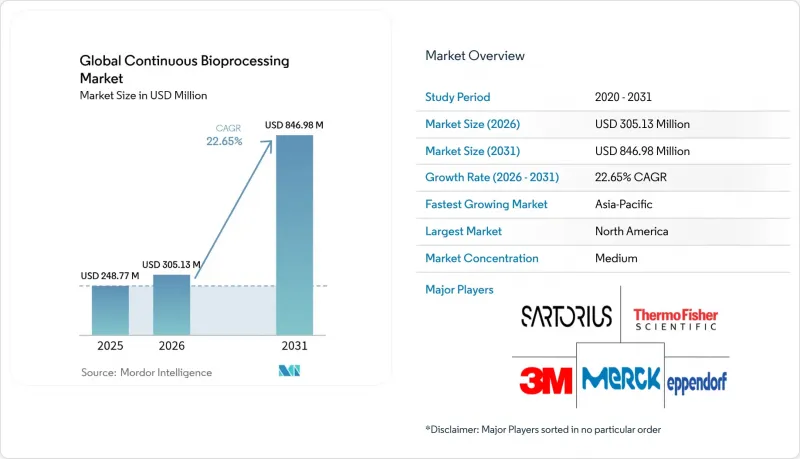
Mordor Intelligence에 의하면, 2026년 연속 바이오프로세스 시장 규모는 3억 513만 달러에 이를 것으로 추정됩니다. 2025년 2억 4,877만 달러에서 성장하여 2031년 8억 4,698만 달러에 달하고, 2026-2031년에 걸쳐 CAGR 22.65%로 성장할 전망입니다.
본 보고서에서는 워크플로우별(업스트림 공정에서의 연속 바이오프로세스, 다운스트림 공정에서의 연속 바이오프로세스), 제품별(연속식 바이오리액터, 기타), 용도별(단일클론 항체, 기타), 최종 사용자별(바이오의약품·생명공학 기업, 기타), 지역별(북미, 기타)로 분류하고 있습니다. 시장 전망은 금액(달러) 기준으로 제시되어 있습니다.
세계의 연속 바이오프로세스 시장 동향 및 인사이트
바이오의약품 및 바이오시밀러에 대한 수요 증가
2024년에는 1,200건 이상의 세포 및 유전자 치료 임상시험이 진행된 반면, 미국에서 승인된 제품은 불과 37건에 그쳐, 이는 수급 격차의 존재를 여실히 드러냈습니다. 연속 플랫폼은 단위 부피당 생산성을 향상시키고 신속한 라인 전환을 가능하게 함으로써 이러한 격차를 해소할 수 있습니다. 삼성바이오로직스는 2024년에 33억 달러 이상의 계약을 수주했으며, 연속 기술을 활용하여 78만 4,000리터의 생산 능력까지 확대했습니다. 이는 대용량 바이오의약품 제조업체들이 집약적이고 안정적인 운영을 얼마나 적극적으로 도입하고 있는지를 보여줍니다. 바이오시밀러 개발 기업들 역시, 특히 유럽에서의 치열한 경쟁 속에서 비용을 절감하기 위해 연속 바이오프로세스을 추구하고 있습니다. 이 방식을 통한 안정적인 생산량과 설치 면적의 축소는 그동안 수요가 높은 치료제 시장 진입을 지연시켜 온 생산 능력의 병목 현상을 완화합니다. 이러한 동향들이 맞물리면서, 선도 지역과 신속 추종 지역 모두에서 연속 바이오프로세스 시장이 주류로 자리 잡는 방향으로 나아가고 있습니다.
제조 비용 및 설치 면적 절감의 필요성
디지털 공정 설계와 연속 가동 강화를 통해 바이오 제조 비용을 최대 70%까지 절감할 수 있으며, 이는 대표적인 블록버스터 바이오의약품의 경우 연간 12억 5,000만 달러의 비용 절감에 해당합니다. 정부의 지원은 산업의 우선순위를 반영하고 있습니다. 중국은 2024년에 새로운 바이오 제조 역량 확충에 41억 7,000만 달러를 배정했으며, 정책 입안자들은 비용 경쟁력이 높은 바이오의약품 생산의 전략적 중요성을 강조하고 있습니다. 연속 바이오프로세스을 통해 여러 대의 대규모 스테인리스 스틸 유닛이 더 이상 필요하지 않게 되어, 더 작고 모듈식인 시설이 가능해짐에 따라 자본 집약도와 운영 비용을 절감할 수 있습니다. 고역가 생산을 통해 다운스트림 공정 기간이 단축되고, 완충액 사용량이 감소하며, 에너지 수요도 줄어들어 1그램당 비용 기준이 더욱 낮아집니다. 이러한 구조적인 비용 절감 덕분에 연속 바이오프로세스 시장은 선진국과 신흥국을 불문하고 신규 플랜트 건설 시 우선적으로 선택되는 대안이 되고 있습니다.
높은 초기 설비 투자(CAPEX)와 기존 설비 개조에 따른 과제
기존의 배치식 플랜트를 연속식으로 전환하려면 유틸리티, 클린룸 레이아웃, 검증 프로토콜을 전면적으로 재검토해야 하므로, 그린필드 건설보다 50-70% 더 높은 비용이 소요될 수 있습니다. 중소 바이오기술 기업들은 자금 조달 제약에 직면해 있어, 3-5년이라는 중기적인 투자 회수가 예상에도 불구하고 투자가 미뤄지고 있습니다. 현재 공급업체들은 자금 수요를 분산시키기 위해 EaaS(Equipment-as-a-Service)나 리스-투-오너(lease-to-owner) 계약을 제공하고 있지만, 가격에 민감한 지역에서는 대차대조표에 미치는 영향이 여전히 도입의 걸림돌이 되고 있습니다. 연속식 장비의 중고 시장이 미성숙하여 자본 위험이 증폭되고, 파이프라인이 변경될 경우의 대안이 제한적입니다. 그 결과, 최상위급 스폰서를 제외한 경우, 설비 투자(CAPEX) 부담이 연속 바이오프로세스 시장의 단기적인 보급을 현저히 저해하는 요인이 되고 있습니다.
부문별 분석
2025년, 업스트림 공정의 연속 바이오프로세스은 고세포 밀도 퍼퓨전 및 피드배치 방식에 비해 역가를 3-5배 높이는 강화형 시드 트레인 덕분에 연속 바이오프로세스 시장 점유율의 56.02%를 차지했습니다. 이러한 주도적 지위는 더 대규모의 퍼퓨전형 바이오리액터 도입 대수, 일회용 소모품을 위한 견고한 공급망, 신규 시장 진출기업의 기술적 장벽을 낮추는 축적된 노하우로 이어지고 있습니다. 다운스트림은 여전히 연속 바이오프로세스 시장 규모에서 비교적 작은 부분을 차지하고 있지만, 크로마토그래피 스키드 공급업체에 의한 멀티 컬럼 시스템의 표준화와 연속 한외여과 도입 확대에 따라 2031년까지 연평균 성장률(CAGR) 24.01%를 나타낼 것으로 예측됩니다.
고밀도 세포 뱅크와 같은 혁신 기술을 통해 생산 탱크에 직접 접종이 가능해져, 전체 생산 기간을 4-5일 단축할 수 있을 뿐만 아니라, 까다로운 임상 공급 일정에도 적절히 대응할 수 있게 되었습니다(bioprocessintl.com). 동시에, 업스트림 공정 라인에 통합된 첨단 PAT 센서는 실시간 대사산물 데이터를 제공하며, 이 데이터는 AI 기반 제어 장치로 전송되어 매개변수의 온더플라이(on-the-fly) 조정에 활용됩니다. 이러한 개선 사항들이 결합되어 업스트림 부문은 엔드투엔드 연속 공정 도입을 주도하는 매우 중요한 역할을 강화하며, 단일클론 항체, 백신, 신흥 세포 치료 워크플로우에서 연속 바이오프로세스 시장의 성장세에 대한 기여를 확고히 하고 있습니다.
2025년 연속 바이오프로세스 시장 규모에서 바이오리액터는 60.74%를 차지하며, 업스트림 공정의 집약화에서 핵심 통합 노드로서의 입지를 공고히 했습니다. 그 구성에는 대규모의 민감한 세포를 처리할 수 있는 교대 접선 유동 관류 장치와 수직 휠 임펠러 설계가 포함됩니다. 그 뒤를 이어, 접선류 여과 모듈이 가장 빠르게 성장하는 제품 라인으로 부상했으며, 최종 사용자가 밀폐형에서 정상 상태의 정제 및 농축 솔루션을 요구함에 따라 2031년까지 연평균 성장률(CAGR) 24.31%로 확대되고 있습니다.
새로운 설계를 통해 1L에서 5,000L에 이르는 확장성과 일관된 전단 프로파일이 실현되어, 공정 개발에서 GMP 시설로의 기술 이전이 간소화되었습니다(pbsbIoTech.com). 연속 크로마토그래피 스키드에는 컬럼의 충전 일관성을 확보하기 위해 UV, 전도도, 풀 용적에 대한 피드백 기능이 통합되었습니다. 한편, 일회용 유로(flow path)는 교차 오염 위험을 줄이고 비용이 많이 드는 세척 주기를 불필요하게 만듭니다. 이러한 제품 혁신은 종합적으로 공급업체 생태계를 강화하고 적용 가능한 용도를 확대함으로써, 연속 바이오프로세스 시장을 뒷받침하는 도입 기반을 심화시키고 있습니다.
지역별 분석
2025년에는 북미가 매출 점유율 42.28%를 차지하며 1위를 차지했으며, 그 배경에는 성숙한 바이오 제조 거점, 지원적인 규제 체계, 견실한 벤처 캐피탈 환경이 있습니다. 후지필름은 노스캐롤라이나주에서 생산 능력 확대에 12억 달러를 투자한 반면, 론자는 제넨테크의 33만 리터 규모 바카빌 공장을 12억 달러에 인수하여 해당 지역의 장기적인 생산 능력 전망을 강화했습니다. 이 클러스터의 산학 컨소시엄은 동종 CAR-T 세포 등 신흥 치료법의 신속한 규모 확대를 촉진하고 있으며, 고도로 복잡한 치료제 분야에서 이 지역의 리더십을 공고히 하고 있습니다.
아시아태평양은 중국의 41억 7,000만 달러 규모의 바이오 제조 촉진책과 한국의 병행된 생산 능력 급증에 힘입어 연평균 성장률(CAGR) 24.86%를 나타낼 것으로 예측되는 가장 빠르게 성장하는 지역입니다. 한국에서는 롯데바이오로직스가 33억 달러를 투자해 제조 거점을 건설 중입니다(pharmamanufacturing.com). 비용 경쟁력이 있는 인력, 합리화된 규제 개혁, 정부의 세제 혜택이 다국적 기업을 유치하여 이 지역에 새로운 연속 생산 라인을 구축하는 요인이 되고 있습니다. 현지 유력 바이오기술 기업들도 마찬가지로, 유럽 및 미국의 동종 업계 경쟁사들과 품질 및 속도 면에서 경쟁하기 위해 연속 워크플로우를 채택하고 있으며, 일회용 소모품 및 첨단 센서공급망 현지화를 추진하고 있습니다.
유럽에서는 지속가능성에 관한 요건이 연속 처리의 장점과 부합하기 때문에 꾸준한 확대가 이어지고 있습니다. 2026년에 EU 생명공학법이 시행되어 실시간 릴리스 및 디지털 기록에 관한 기준이 통일되면, 그 도입은 더욱 가속화될 전망입니다. 유럽공급업체들은 다중 컬럼 크로마토그래피 분야에서 혁신을 주도하고 있으며, 다운스트림 공정의 격차를 해소하여 유럽연합(EU)을 연속 정제 기술의 거점으로 자리매김하고 있습니다. 이러한 지역적 동향이 맞물리면서, 연속 바이오프로세스 시장은 여러 뛰어난 거점에서 발전하고 있으며, 체계적 위험을 줄이는 동시에 건전한 경쟁 관계를 조성하고 있습니다.
기타 혜택
- 엑셀 형식 시장 예측(ME) 시트
- 3개월간의 애널리스트 지원
자주 묻는 질문
목차
제1장 서론
제2장 조사 방법
제3장 주요 요약
제4장 시장 구도
제5장 시장 규모 및 성장 예측(금액, 2024-2030년)
제6장 경쟁 구도
제7장 시장 기회 및 향후 전망
KTH 26.09.14According to Mordor Intelligence, continuous bioprocessing market size in 2026 is estimated at USD 305.13 million, growing from 2025 value of USD 248.77 million with 2031 projections showing USD 846.98 million, growing at 22.65% CAGR over 2026-2031.
This report Segments by Workflow (Upstream Continuous Bioprocessing and Downstream Continuous Bioprocessing), by Product (Continuous Bioreactors and More), by Application (Monoclonal Antibodies, and More), by End User (Pharmaceutical and Biotechnology Companies and More), and Geography (North America, and More). The Market Forecasts are Provided in Terms of Value (USD).
Global Continuous Bioprocessing Market Trends and Insights
Rising Demand for Biologics & Biosimilars
More than 1,200 cell and gene therapy trials were active in 2024 versus just 37 US-approved products, underscoring a supply-demand gap that continuous platforms can close by elevating volumetric productivity and enabling rapid line changeovers. Samsung Biologics won contracts worth over USD 3.3 billion in 2024 and scaled to 784,000 L capacity using continuous technology, illustrating how large-volume biologics producers are embracing intensive, steady-state operations. Biosimilar developers likewise pursue continuous bioprocessing to contain costs amid aggressive price competition, especially in Europe. The modality's steady output and smaller footprint alleviate capacity bottlenecks that have historically delayed market entry for high-demand therapies. Collectively, these trends push the continuous bioprocessing market toward mainstream adoption in both pioneer and fast-follower regions.
Need to Reduce Manufacturing Cost & Footprint
Digital process design and intensified continuous operations can trim biomanufacturing costs by up to 70%, translating to USD 1.25 billion annual savings for a typical blockbuster biologic. Government support mirrors industry priorities: China earmarked USD 4.17 billion for new biomanufacturing capacity in 2024, with policymakers citing the strategic importance of cost-competitive biologics production Continuous bioprocessing eliminates the need for several large-scale stainless-steel units, enabling smaller, modular facilities that reduce capital intensity and operating overhead. Higher titer outputs shorten downstream campaigns, cut buffer volumes and reduce energy demands, further lowering cost-per-gram benchmarks. These structural savings position the continuous bioprocessing market as a preferred route for greenfield plants in both developed and emerging economies.
High Upfront CAPEX & Retrofitting Challenges
Converting a legacy batch plant to continuous can cost 50-70% more than greenfield builds because utilities, clean-room layouts and validation protocols must be overhauled. Smaller biotech firms face liquidity constraints, delaying investment despite medium-term paybacks of 3-5 years. Suppliers now offer equipment-as-a-service and lease-to-own agreements to spread cash requirements, but balance-sheet impact still slows uptake in price-sensitive regions. Capital risk is amplified by immature second-hand markets for continuous gear, limiting fallback options if pipelines shift. Consequently, CAPEX intensity remains a notable drag on the continuous bioprocessing market's near-term penetration outside top-tier sponsors.
Other drivers and restraints analyzed in the detailed report include:
- Accelerated Product Changeover & Flexibility
- Regulatory Encouragement for Continuous Manufacturing
- Limited Proven Downstream Continuous Solutions
For complete list of drivers and restraints, kindly check the Table Of Contents.
Segment Analysis
Upstream continuous bioprocessing held 56.02% of continuous bioprocessing market share in 2025, thanks to high-cell-density perfusion and intensified seed trains that raise titers three- to five-fold over fed-batch alternatives. This leadership translates into larger installed perfusion bioreactor fleets, robust supply chains for single-use consumables and accumulated know-how that lowers technical barriers for new entrants. Downstream still represents a smaller slice of continuous bioprocessing market size but is forecast to grow at 24.01% CAGR to 2031 as chromatography skid vendors standardize multicolumn systems and continuous ultrafiltration deployments expand.
Innovations such as high-density cell banking enable direct inoculation into production vessels, cutting overall production timelines by four to five days and aligning well with tight clinical supply windows bioprocessintl.com. Simultaneously, advanced PAT sensors embedded in upstream lines deliver real-time metabolite data that feed AI-driven controllers for on-the-fly parameter adjustments. Collectively, these refinements reinforce the upstream segment's pivotal role in guiding end-to-end continuous adoption, cementing its contribution to continuous bioprocessing market momentum across monoclonal antibody, vaccine and emerging cell therapy workflows.
Bioreactors constituted 60.74% of continuous bioprocessing market size in 2025, confirming their status as the central integration node for upstream intensification. The footprint includes alternating-tangential-flow perfusion devices and vertical-wheel impeller designs that support sensitive cells at scale. Tangential-flow filtration modules follow as the fastest-growing product line, advancing at 24.31% CAGR through 2031 as end-users seek closed, steady-state clarification and concentration solutions.
Emerging designs allow 1 L to 5,000 L scalability with consistent shear profiles, simplifying tech transfer from process development to GMP suites pbsbiotech.com. Continuous chromatographic skids now integrate UV, conductivity and pool-volume feedback to ensure column loading consistency, while single-use flow-paths curb cross-contamination risk and eliminate costly cleaning cycles. Collectively, these product innovations fortify supplier ecosystems and expand addressable applications, deepening the installed base that sustains the continuous bioprocessing market.
Complete Report Scope:
- By Workflow
- Upstream Continuous Bioprocessing
- Downstream Continuous Bioprocessing
- By Product
- Continuous Bioreactors
- Tangential Flow Filtration (TFF) Systems
- Continuous Chromatography Systems
- Consumables & Single-Use Components
- Process Control & Monitoring Software
- By Application
- Monoclonal Antibodies
- Vaccines
- Cell & Gene Therapies
- Recombinant Proteins
- Others (Biosimilars, Blood Factors)
- By Scale
- Pre-clinical & Pilot Scale
- Clinical Scale
- Commercial Scale
- By End User
- Biopharmaceutical & Biotechnology Companies
- Contract Manufacturing & Development Organizations (CMOs/CDMOs)
- Academic & Research Institutes
- By Region
- North America
- United States
- Canada
- Mexico
- Europe
- South America
- Germany
- Italy
- Spain
- Russia
- Rest of Europe
- Asia-Pacific
- China
- Japan
- India
- South Korea
- Australia
- Rest of Asia-Pacific
- South America
- Brazil
- Argentina
- Rest of South America
- Middle East and Africa
- GCC
- South Africa
- Rest of Middle East and Africa
- North America
Geography Analysis
North America led with 42.28% revenue share in 2025, underpinned by mature biomanufacturing hubs, supportive regulatory frameworks and a robust venture-capital environment. Fujifilm committed USD 1.2 billion to expand capacity in North Carolina, while Lonza acquired Genentech's 330,000-L Vacaville plant for USD 1.2 billion, reinforcing the region's long-term capacity outlook. The cluster's academic-industry consortia foster rapid scale-up of emerging modalities such as allogeneic CAR-T cells, cementing the region's leadership in high-complexity therapeutics.
Asia-Pacific is the fastest-growing region, forecast at 24.86% CAGR, driven by China's USD 4.17 billion biomanufacturing stimulus and South Korea's parallel capacity surge, where Lotte Biologics is building a USD 3.3 billion site pharmamanufacturing.com. Cost-competitive labor, streamlined regulatory reforms and government tax incentives lure multinational sponsors to locate new continuous lines in the region. Local biotech champions likewise adopt continuous workflows to compete on quality and speed with Western peers, pushing supply-chain localization for single-use consumables and advanced sensors.
Europe maintains steady expansion as sustainability mandates align with continuous processing advantages. Adoption accelerates further once the EU Biotech Act takes effect in 2026, harmonizing standards for real-time release and digital records. European vendors lead innovation in multicolumn chromatography, closing the downstream gap and positioning the bloc as a competence hub for continuous purification technologies. Collectively, regional dynamics ensure that the continuous bioprocessing market evolves across multiple centers of excellence, reducing systemic risk and fostering healthy competitive tension.
- Sartorius
- Thermo Fisher Scientific
- Danaher Corporation (Cytiva & Pall)
- Merck KGaA (MilliporeSigma)
- 3M
- Repligen
- Eppendorf
- Getinge AB (Applikon)
- ABEC
- Novasep Holding SAS
- Entegris Inc.
- Asahi Kasei
- Meissner Filtration Products
- PBS Biotech Inc.
- Lonza Group
- AGC Biologics
- Samsung Group
- Wuxi Biologics
- ThermoGenesis Holdings Inc.
- Kuhner Shaker AG
Additional Benefits:
- The market estimate (ME) sheet in Excel format
- 3 months of analyst support
TABLE OF CONTENTS
1 Introduction
- 1.1 Study Assumptions & Market Definition
- 1.2 Scope of the Study
2 Research Methodology
3 Executive Summary
4 Market Landscape
- 4.1 Market Overview
- 4.2 Market Drivers
- 4.2.1 Rising demand for biologics & biosimilars
- 4.2.2 Need to reduce manufacturing cost & footprint
- 4.2.3 Accelerated product changeover & flexibility
- 4.2.4 Regulatory encouragement for continuous manufacturing
- 4.2.5 Integration of PAT with AI-driven real-time release analytics
- 4.2.6 Adoption of perfusion-compatible single-use sensors in emerging markets
- 4.3 Market Restraints
- 4.3.1 High upfront CAPEX & retrofitting challenges
- 4.3.2 Limited proven downstream continuous solutions
- 4.3.3 Regulatory validation complexities for multi-product facilities
- 4.3.4 Scarcity of skilled workforce for hybrid control architectures
- 4.4 Value / Supply-Chain Analysis
- 4.5 Regulatory Landscape
- 4.6 Technological Outlook
- 4.7 Porter's Five Forces
- 4.7.1 Threat of New Entrants
- 4.7.2 Bargaining Power of Suppliers
- 4.7.3 Bargaining Power of Buyers
- 4.7.4 Threat of Substitutes
- 4.7.5 Competitive Rivalry
5 Market Size & Growth Forecasts (Value, 2024-2030)
- 5.1 By Workflow
- 5.1.1 Upstream Continuous Bioprocessing
- 5.1.2 Downstream Continuous Bioprocessing
- 5.2 By Product
- 5.2.1 Continuous Bioreactors
- 5.2.2 Tangential Flow Filtration (TFF) Systems
- 5.2.3 Continuous Chromatography Systems
- 5.2.4 Consumables & Single-Use Components
- 5.2.5 Process Control & Monitoring Software
- 5.3 By Application
- 5.3.1 Monoclonal Antibodies
- 5.3.2 Vaccines
- 5.3.3 Cell & Gene Therapies
- 5.3.4 Recombinant Proteins
- 5.3.5 Others (Biosimilars, Blood Factors)
- 5.4 By Scale
- 5.4.1 Pre-clinical & Pilot Scale
- 5.4.2 Clinical Scale
- 5.4.3 Commercial Scale
- 5.5 By End User
- 5.5.1 Biopharmaceutical & Biotechnology Companies
- 5.5.2 Contract Manufacturing & Development Organizations (CMOs/CDMOs)
- 5.5.3 Academic & Research Institutes
- 5.6 By Region
- 5.6.1 North America
- 5.6.1.1 United States
- 5.6.1.2 Canada
- 5.6.1.3 Mexico
- 5.6.2 Europe
- 5.6.2.1 South America
- 5.6.2.2 Germany
- 5.6.2.3 Italy
- 5.6.2.4 Spain
- 5.6.2.5 Russia
- 5.6.2.6 Rest of Europe
- 5.6.3 Asia-Pacific
- 5.6.3.1 China
- 5.6.3.2 Japan
- 5.6.3.3 India
- 5.6.3.4 South Korea
- 5.6.3.5 Australia
- 5.6.3.6 Rest of Asia-Pacific
- 5.6.4 South America
- 5.6.4.1 Brazil
- 5.6.4.2 Argentina
- 5.6.4.3 Rest of South America
- 5.6.5 Middle East and Africa
- 5.6.5.1 GCC
- 5.6.5.2 South Africa
- 5.6.5.3 Rest of Middle East and Africa
- 5.6.1 North America
6 Competitive Landscape
- 6.1 Market Concentration
- 6.2 Market Share Analysis
- 6.3 Company Profiles {(includes Global level Overview, Market level overview, Core Segments, Financials as available, Strategic Information, Market Rank/Share for key companies, Products & Services, and Recent Developments)}
- 6.3.1 Sartorius AG
- 6.3.2 Thermo Fisher Scientific Inc.
- 6.3.3 Danaher Corporation (Cytiva & Pall)
- 6.3.4 Merck KGaA (MilliporeSigma)
- 6.3.5 3M Company
- 6.3.6 Repligen Corporation
- 6.3.7 Eppendorf SE
- 6.3.8 Getinge AB (Applikon)
- 6.3.9 ABEC Inc.
- 6.3.10 Novasep Holding SAS
- 6.3.11 Entegris Inc.
- 6.3.12 Asahi Kasei Corporation
- 6.3.13 Meissner Filtration Products Inc.
- 6.3.14 PBS Biotech Inc.
- 6.3.15 Lonza Group AG
- 6.3.16 AGC Biologics
- 6.3.17 Samsung Biologics
- 6.3.18 Wuxi Biologics
- 6.3.19 ThermoGenesis Holdings Inc.
- 6.3.20 Kuhner Shaker AG
7 Market Opportunities & Future Outlook
- 7.1 White-space & Unmet-Need Assessment