

|
시장보고서
상품코드
2124797
기복기 : 시장 점유율 분석, 업계 동향 및 통계, 성장 예측(2026-2031년)Insufflation Devices - Market Share Analysis, Industry Trends & Statistics, Growth Forecasts (2026 - 2031) |
||||||
 Mordor Intelligence
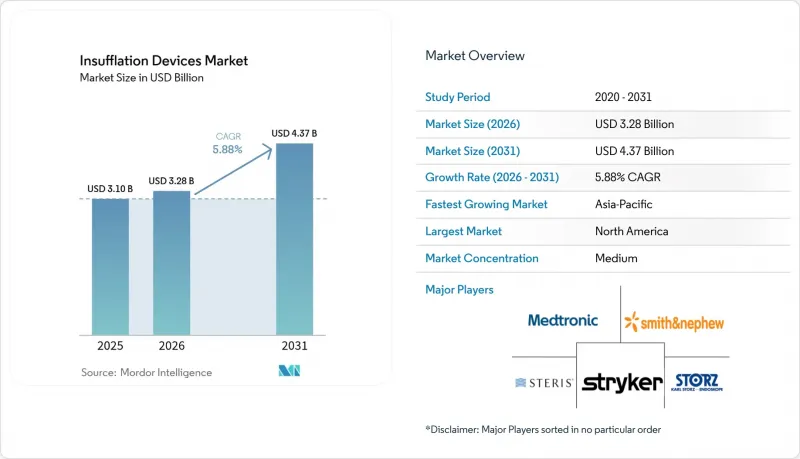
Mordor Intelligence에 의하면, 기복기 시장 규모는 2025년 31억 달러로 평가되었습니다. 2026년에는 32억 8,000만 달러로 확대되어 2026-2031년에 걸쳐 CAGR 5.88%로 성장을 지속하여, 2031년에는 43억 7,000만 달러에 이를 것으로 예측됩니다.
본 보고서는 제품 유형(공기 공급 시스템, 일회용 튜브 및 부속품), 용도(복강경 수술, 기타), 최종 사용자(병원, 외래수술센터(ASC), 전문 클리닉, 기타 최종 사용자), 지역(북미, 유럽, 아시아태평양, 중동 및 아프리카, 남미)별로 분류되어 있습니다. 시장 예측은 금액(달러) 기준으로 제시되어 있습니다.
세계의 기복기 시장 동향 및 인사이트
최소 침습 수술의 보급 확대
2024년까지 미국에서는 적응증이 되는 복부 수술의 65%가 최소 침습 수술을 차지하게 되었지만, 중동 및 아프리카 등 다른 지역에서는 보급 현황에 편차가 나타나, 공급업체들이 외과의사 교육 및 번들형 리스 솔루션을 대상으로 삼을 수 있는 거대한 미개척 시장이 형성되었습니다. 비만 수술에서는 슬리브 위절제술이 주류를 이루고 있으며, 2024년까지 로봇 보조 수술의 비율은 30%를 나타냈습니다. OECD 시장에서 담낭 절제술의 복강경 수술 전환율이 거의 100%에 달한다는 사실은 표준화가 수술 콘솔의 사용을 정착시키고 있음을 보여줍니다. 반면, 동남아시아와 사하라 사막 이남 아프리카의 일부 지역에서는 보급률이 40% 미만에 그치고 있어, 설비 투자와 교육의 격차를 반영하고 있습니다. 510(k) 심사에서는 임상적 유효성보다 안전성이 중시되기 때문에 규제상의 부담은 여전히 미미하며, 도입의 주요 촉진요인은 보험 환급입니다. 단기 입원을 장려하는 종합적 지불 정책은 저압 복강 내 압력 관리를 촉진하기 때문에 10mmHg 이하의 압력을 유지할 수 있는 첨단 콘솔의 구매를 뒷받침하고 있습니다.
공기 공급 플랫폼의 지속적인 기술 발전
혁신은 독립형 하드웨어에서 마취 워크스테이션 및 내비게이션 시스템과 상호 운용 가능한 소프트웨어 정의 모듈로 전환되고 있습니다. 현재 5,857개 의료 기관에 도입되어 800만 건 이상의 수술에 사용되고 있는 CONMED의 ‘AirSeal iFS’는 지속적인 연기 배출과 밸브 없는 압력 제어를 실현하며, 수술 후 어깨 통증을 34% 경감시키는 좋은 사례입니다. AI를 활용한 알고리즘을 통해 상태 변화를 예측하고 압력 급상승을 미연에 방지할 수 있지만, SaMD(Software-as-a-Medical-Device) 승인을 획득하는 과정에서 개발 주기가 18개월 연장되었습니다. ISO 13485 준수는 여전히 기본 요건에 그치고 있지만, 경쟁 우위는 현재 수술실용 대시보드에 데이터를 제공하는 HL7 FHIR 호환 데이터 출력에 달려 있습니다. 연결성을 확보한 벤더는 예측 유지보수 및 분석 서비스 구독을 통해 서비스 수익원을 확보하고 있습니다.
이산화탄소와 관련된 합병증에 대한 임상적 우려
이산화탄소의 장기간 투여는 동맥혈 이산화탄소 분압(PCO2)을 최대 25%까지 상승시켜 호흡성 산증(respiratory acidosis)을 유발하고, 마취를 복잡하게 하며, 회복 기간을 연장시킬 가능성이 있습니다. 2024년에 발표된 메타 분석에 따르면, 12mmHg를 초과하는 압력이 90분 이상 지속될 경우, 최대 20%의 사례에서 폐 합병증이 발생하는 것으로 나타났습니다. 헬륨과 같은 대체 수단은 여전히 승인되지 않았으며, 폐쇄 루프식 압력 제한 기능이 없는 한 임상의들의 신중한 태도로 인해 고유량 기기의 보급은 더딘 양상을 보이고 있습니다. 0.5-2%의 피하 기종 발생률은 병원이 재입원 비용을 부담하는 포괄 정산 제도 하에서 추가적인 면밀한 검토를 요구하고 있습니다. 510(k) 신청에 필수적인 임상시험 데이터가 부족하기 때문에 외과의사는 동료 심사를 거친 연구나 학회 지침에 의존할 수밖에 없으며, 제조업체는 안전성 우려에 대응하기 위해 시판 후 증거를 제시해야 하는 상황에 처해 있습니다.
부문별 분석
일회용 튜브 및 부속품은 2025년에 매출의 27.88%를 차지했으며, 2031년까지 연평균 성장률(CAGR) 7.65%로 확대될 것으로 전망됩니다. 감염 예방 규제로 인해 일회용 부품이 우선시되는 경향이 있어, 일회용 제품용 송기 장치 시장은 꾸준한 성장이 예상됩니다. 수술 1회당 15-45달러 가격대의 독자적으로 개발된 필터 및 튜브 세트는 60%가 넘는 매출 총이익률을 실현하고 있으며, 이로 인해 공급업체들은 소모품 계약을 확보하기 위해 콘솔 가격을 인하하는 경향을 보이고 있습니다. 2024년에 실시된 미국 병원 조사에 따르면, 감염 관리 위원회의 78%가 일회용 튜브 사용을 의무화했으며, 이는 2년 동안 16포인트 증가한 수치입니다. 각 벤더사는 튜브의 유효 기간을 모니터링하는 소프트웨어 라이선스와 일회용 제품을 번들로 제공함으로써 이러한 추세를 활용하여 공급망의 규정 준수를 강화하고 폐기물 감축을 도모하고 있습니다.
한편, 콘솔의 매출액은 7-10년의 교체 주기에 따라 도입 기기가 노후화되고 있어 3-4%의 완만한 성장에 그치고 있습니다. 2025년에도 송기 시스템이 차지하는 송기 장치 시장 점유율은 72.12%로 압도적이었지만, 가격 측면의 역풍과 로봇 플랫폼에의 통합이 진행됨에 따라 단독 수요는 감소 추세를 보이고 있습니다. 따라서 각 제조업체는 콘솔을 수익성이 높은 소모품 판매로의 진입점으로 삼아, ‘면도기와 면도날’ 비즈니스 모델을 모방하고 있습니다. 복강경 수술 건수가 많은 의료기관에서는 예측 유지보수나 폐쇄 루프식 압력 조절을 통해 예기치 못한 가동 중단이나 수술 후 합병증이 줄어들기 때문에 콘솔 업그레이드의 필요성이 정당화되며, 가치 기반 결제 모델 하에서의 조달을 뒷받침하고 있습니다.
지역별 분석
2025년, 북미는 기복기 시장을 주도하며 매출 점유율 42.54%를 차지했고, 같은 해 시장 규모는 약 13억 8,000만 달러에 달했습니다. 전립선 전적출술과 자궁 전적출술에서 로봇 수술의 보급률이 50%를 초과하고 있으며, 비만 수술에 대한 메디케어 지급의 균등화, 디지털 수술실(OR) 생태계의 조기 도입으로 인해 콘솔 교체 수요는 한 자릿수 중반대의 성장세를 유지하고 있습니다. 이 지역을 주도하고 있는 것은 미국으로, 2024년에는 28만 건의 비만 수술이 시행되었습니다. 이 수술 건수에 대응하기 위해서는 공기 공급 시간 연장 및 필터의 빈번한 교체가 필요합니다. 캐나다에서는 2024년부터 2025년에 걸쳐 1억 2,000만 캐나다 달러(8,800만 달러) 규모의 외과 수술 현대화 예산이 편성되어, 45개 병원의 공기 공급 장치 업그레이드에 사용되었습니다. 한편, 멕시코에서는 2024년에 120만 명의 의료 관광객이 방문하여 민간 병원의 고급 의료기기 투자가 촉진되었습니다. 공급업체의 전략은 장비와 소모품을 세트로 묶은 계약에 중점을 두고 있으며, 이를 통해 수술 건수가 많은 미국의 의료시설을 독자 사양의 튜브에 묶어두는 한편, 가격에 민감한 멕시코의 클리닉에는 유연한 리스 옵션을 제공합니다. 2025년에 시행될 FDA의 사이버 보안 규정은 규정 준수 비용을 증가시키는 한편, 타사로의 전환 장벽을 높여 기존 제조업체 시장 점유율을 공고히 하는 결과로 이어질 것입니다.
아시아태평양은 2031년까지 연평균 성장률(CAGR) 6.54%를 나타낼 것으로 예측되며, 이는 공기 공급 장치 시장에서 지역별 가장 빠른 성장 속도입니다. 중국에서는 국가위생건강위원회가 400개의 새로운 최소 침습 수술실에 자금을 지원한 결과, 2024년 복강경 수술 건수는 전년 대비 9.2% 증가한 1,850만 건을 기록했습니다. 인도에서는 ‘아유슈만 바라트’ 보험 제도의 확대로 지방 병원에서도 장비를 조달할 수 있게 되었으나, 콘솔 가격 면에서 국내 브랜드가 다국적 기업보다 40-50% 저렴하기 때문에 시장 점유율이 분산되어 있습니다. 일본에서는 2025년까지 450대의 다빈치가 도입되었으나, 엄격한 보험 급여 상한선으로 인해 수술 건수 증가가 제한되고 있으며, 콘솔의 교체 주기 또한 억제되고 있습니다. 선택적 수술의 60%를 담당하는 호주의 사립 병원에서는 외래 진료 워크플로우에 적합한, 콤팩트하고 배터리 구동 방식의 콘솔이 채택되고 있습니다. 지역 유통업체은 매우 중요한 역할을 수행하고 있으며, 특히 인도네시아나 필리핀에서는 병원 네트워크가 분산되어 있어 현지에서 서비스 및 금융 패키지를 제공할 수 있는 벤더가 우위를 점하고 있습니다. 송기 장치 산업은 중국에서 공동 생산을 의무화하는 현지화 요건에 직면해 있으며, 세계 OEM 기업들은 입찰에서 승리하기 위해 기술 이전 파트너십을 모색하고 있습니다.
유럽은 전 세계 매출의 약 30%를 차지하고 있지만, EU 의료기기 규제의 강화로 인해 인증 기간이 길어지면서 메드트로닉, 칼 슈트루츠, 올림푸스에 의한 시장 점유율 집중이 진행되고 있습니다. 독일에서는 2024년에 180만 건의 복강경 수술이 시행되어 필터에 대한 안정적인 수요를 창출했습니다. 한편, 병원의 DRG 보상 체계에서는 정밀 유량 제어 콘솔을 통해 기록 가능한 낮은 합병증 발생률이 높이 평가되고 있습니다. 영국은 2024-2025년에 걸쳐 수술 기기 교체에 2억 파운드(2억 5,500만 달러)를 투자했으나, 계획된 도입 물량의 30%는 공급망 병목 현상으로 인한 납기 지연에 직면해 있습니다. 프랑스가 2025년까지 외래 수술 비율을 70%로 늘리겠다는 목표를 세운 데 따라, 이동식 카트가 장착된 공간 절약형 콘솔의 판매가 증가하고 있습니다. 아랍에미리트와 사우디아라비아를 필두로 한 걸프협력회의(GCC) 회원국에서는 의료 관광 거점용으로, 외과의사들에게 연기 배출 및 사이버 보안 준수를 통합한 기능을 약속하는 고급 시스템이 수입되고 있습니다. 남미와 아프리카는 절대 수량 면에서는 뒤처져 있지만, 브라질의 SUS 제도에 따른 복강경 수술 시범 프로그램이나 나이지리아 라고스에 위치한 사립 병원 밀집 지역은 장비 금융과 교육을 패키지로 제공할 수 있는 공급업체에게 발판이 되고 있습니다.
기타 혜택
- 엑셀 형식 시장 예측(ME) 시트
- 3개월간의 애널리스트 지원
자주 묻는 질문
목차
제1장 서론
제2장 조사 방법
제3장 주요 요약
제4장 시장 구도
제5장 시장 규모 및 성장 예측
제6장 경쟁 구도
제7장 시장 기회 및 향후 전망
KTH 26.09.14According to Mordor Intelligence, the insufflation devices market size is expected to grow from USD 3.10 billion in 2025 to USD 3.28 billion in 2026 and is forecast to reach USD 4.37 billion by 2031 at 5.88% CAGR over 2026-2031.
This report is Segmented by Product Type (Insufflation Systems and Disposable Tubing & Accessories), Application (Laparoscopic Surgery, and More), End User (Hospitals, Ambulatory Surgical Centers, Specialty Clinics, and Other End Users), and Geography (North America, Europe, Asia-Pacific, Middle East & Africa, and South America). The Market Forecasts are Provided in Terms of Value (USD).
Global Insufflation Devices Market Trends and Insights
Growing Adoption of Minimally Invasive Surgery
Minimally invasive surgery accounted for 65% of eligible abdominal cases in the United States by 2024 and shows uneven uptake elsewhere, producing sizable white spaces for vendors to target surgeon training and bundled leasing solutions. Sleeve gastrectomy led bariatric procedures, with robotic assistance rising to 30% by 2024. Near-complete laparoscopic conversion rates for cholecystectomy in OECD markets demonstrate how standardization cements console utilization, whereas penetration below 40% in parts of Southeast Asia and Sub-Saharan Africa reflects capital and training gaps. Regulatory burden remains light because 510(k) reviews emphasize safety over clinical efficacy, leaving reimbursement as the primary driver of adoption. Bundled payment policies that reward shorter stays favor low-pressure pneumoperitoneum management and therefore stimulate purchases of advanced consoles that sustain pressures below 10 mmHg.
Continuous Technological Advancements in Insufflation Platforms
Innovation is migrating from stand-alone hardware toward software-defined modules that interoperate with anesthesia workstations and navigation systems. CONMED's AirSeal iFS, now installed in 5,857 facilities and used in more than 8 million procedures, exemplifies continuous smoke evacuation and valve-free pressure control that reduces postoperative shoulder pain by 34%. AI-enabled algorithms predict phase transitions and preempt pressure spikes, though Software-as-a-Medical-Device clearances add 18 months to development cycles. ISO 13485 compliance remains entry-level, but competitive advantage now hinges on HL7 FHIR-ready data output that feeds OR dashboards. Vendors that master connectivity gain a service revenue stream from predictive maintenance and analytics subscriptions.
Clinical Concerns Over Carbon Dioxide-Related Complications
Prolonged CO2 insufflation can elevate arterial PCO2 by up to 25%, producing respiratory acidosis that complicates anesthesia and extends recovery. Meta-analysis published in 2024 linked pressures above 12 mmHg for more than 90 minutes to pulmonary complications in up to 20% of cases. Although alternatives such as helium remain unapproved, clinician caution slows uptake of high-flow devices unless they include closed-loop pressure caps. Subcutaneous emphysema incidence of 0.5-2% further heightens scrutiny in bundled-payment environments where hospitals absorb readmission costs. Absent mandatory clinical trial data in 510(k) submissions, surgeons rely on peer-reviewed studies and society guidelines, forcing manufacturers to generate post-market evidence to counter safety concerns.
Other drivers and restraints analyzed in the detailed report include:
- Surge in Bariatric and Gynecologic Procedure Volumes
- Integration with Digital Operating Room Ecosystems
- High Upfront Investment for Next-Generation Console Systems
For complete list of drivers and restraints, kindly check the Table Of Contents.
Segment Analysis
Disposable tubing & accessories accounted for 27.88% revenue in 2025 and are projected to expand at a 7.65% CAGR through 2031. The insufflation devices market for disposables is poised to grow steadily as infection-prevention regulations tilt preference toward single-use components. Proprietary filter and tubing sets priced between USD 15 and USD 45 per procedure deliver gross margins above 60%, encouraging vendors to discount consoles in exchange for consumable contracts. A 2024 U.S. hospital survey revealed that 78% of infection-control committees now require single-use tubing, a 16-percentage-point increase in two years. Vendors exploit this trend by bundling disposables with software licenses that monitor tubing expiration dates, enhancing supply-chain compliance and reducing waste.
Conversely, console revenue grows modestly at 3-4% as the installed base ages across seven-to-ten-year replacement cycles. The insufflation devices market share held by Insufflation Systems remains dominant at 72.12% in 2025, yet pricing headwinds and embedded integration within robotic platforms erode standalone demand. Manufacturers, therefore, position consoles as gateways to higher-margin consumable streams, emulating razor-and-blade economics. Facilities with high laparoscopic case volumes justify console upgrades when predictive maintenance and closed-loop pressure modulation cut unplanned downtime and postoperative complications, supporting procurement under value-based payment models.
Complete Report Scope:
- By Product Type
- Insufflation Systems
- Disposable Tubing & Accessories
- By Application
- Laparoscopic Surgery
- Bariatric Surgery
- Gynecological Surgery
- Cardiac & Thoracic Surgery
- Urological & Renal Surgery
- Pediatric Surgery
- Other Applications
- By End User
- Hospitals (Tier I/II/III)
- Ambulatory Surgical Centers
- Specialty Clinics
- Other End Users
- Geography
- North America
- United States
- Canada
- Mexico
- Europe
- Germany
- United Kingdom
- France
- Italy
- Spain
- Rest of Europe
- Asia-Pacific
- China
- Japan
- India
- Australia
- South Korea
- Rest of Asia-Pacific
- Middle East & Africa
- GCC
- South Africa
- Rest of Middle East & Africa
- South America
- Brazil
- Argentina
- Rest of South America
- North America
Geography Analysis
North America led the insufflation devices market with 42.54% revenue share in 2025, translating to an insufflation devices market size of about USD 1.38 billion that year. Robust robotic-surgery penetration exceeding 50% in prostatectomy and hysterectomy, Medicare payment parity for bariatric procedures, and early deployment of digital OR ecosystems sustain mid-single-digit growth in console replacements. The United States drives the region, performing 280,000 bariatric surgeries in 2024, a volume that demands extended insufflation times and repeat filter changes. Canada's CAD 120 million (USD 88 million) surgical modernization outlay in 2024-2025 funded insufflator upgrades in 45 hospitals, while Mexico's 1.2 million inbound medical tourists in 2024 spurred private-hospital investment in premium equipment. Vendor strategies center on bundled equipment-consumable deals that lock high-volume U.S. centers into proprietary tubing, while offering Mexico's price-sensitive clinics flexible leasing options. FDA cybersecurity rules, effective in 2025, add compliance costs yet also raise switching barriers, cementing incumbent share.
Asia-Pacific is forecast to grow at a 6.54% CAGR through 2031, the fastest regional pace in the insufflation devices market. China logged 18.5 million laparoscopic procedures in 2024, up 9.2% year on year, after the National Health Commission financed 400 new minimally invasive surgery suites. India's Ayushman Bharat insurance expansion unlocked district-hospital procurements, though domestic brands undercut multinationals by 40-50% on console price, fracturing share. Japan counted 450 da Vinci installations by 2025, but tight reimbursement caps limit procedure growth, curbing console refresh cycles. Australia's private hospitals, which are responsible for 60% of elective surgeries, adopt compact, battery-powered consoles that align with ambulatory workflows. Regional distributors play an outsized role, especially in Indonesia and the Philippines, where fragmented hospital networks favor vendors able to offer local service and financing packages. The insufflation devices industry faces localization mandates in China that require joint manufacturing, pushing global OEMs toward technology-transfer partnerships to secure tenders.
Europe accounts for roughly 30% of global revenue, yet EU Medical Device Regulation stringency lengthens certification timelines, consolidating share with Medtronic, Karl Storz, and Olympus. Germany's 1.8 million laparoscopic cases in 2024 generate steady filter demand, while hospital DRG reimbursement tables reward low complication rates that precision-flow consoles can document. The United Kingdom invested GBP 200 million (USD 255 million) in surgical equipment upgrades during 2024-2025, though 30% of planned installs face delivery delays from supply-chain bottlenecks. France's target of 70% ambulatory surgery by 2025 lifts sales of space-saving consoles with mobile carts. Gulf Cooperation Council countries, led by the UAE and Saudi Arabia, import premium systems for medical-tourism hubs that promise surgeons integrated smoke evacuation and cybersecurity compliance. South America and Africa trail in absolute volume; Brazil's pilot laparoscopic programs under the SUS scheme and Nigeria's private-hospital corridor in Lagos represent beachheads for vendors prepared to bundle training with equipment financing.
- Alesi Surgical Ltd.
- Applied Medical Resources
- B. Braun
- Conmed
- Genicon
- Hoya Corp. (Pentax Medical)
- Johnson & Johnson
- Karl Storz
- Lexion Medical
- Medtronic
- Northgate Technologies Inc.
- Olympus
- Richard Wolf
- Smiths Group
- STERIS
- Stryker
- Teleflex
- W.O.M. World Of Medicine GmbH
Additional Benefits:
- The market estimate (ME) sheet in Excel format
- 3 months of analyst support
TABLE OF CONTENTS
1 Introduction
- 1.1 Study Assumptions & Market Definition
- 1.2 Scope of the Study
2 Research Methodology
3 Executive Summary
4 Market Landscape
- 4.1 Market Overview
- 4.2 Market Drivers
- 4.2.1 Growing Adoption of Minimally Invasive Surgery
- 4.2.2 Continuous Technological Advancements in Insufflation Platforms
- 4.2.3 Surge in Bariatric and Gynecologic Procedure Volumes
- 4.2.4 Expansion of Ambulatory Surgery Infrastructure
- 4.2.5 Integration with Digital Operating Room Ecosystems
- 4.2.6 Shift Toward Disposable Insufflation Consumables
- 4.3 Market Restraints
- 4.3.1 Clinical Concerns Over Carbon Dioxide-Related Complications
- 4.3.2 High Upfront Investment for Next-Generation Console Systems
- 4.3.3 Tightening Regulations on Medical-Grade Carbon Dioxide Supply
- 4.3.4 Emerging Cybersecurity Compliance Burden for Connected Devices
- 4.4 Value / Supply-Chain Analysis
- 4.5 Regulatory Landscape
- 4.6 Technological Outlook
- 4.7 Porter's Five Forces Analysis
- 4.7.1 Threat Of New Entrants
- 4.7.2 Bargaining Power Of Buyers
- 4.7.3 Bargaining Power Of Suppliers
- 4.7.4 Threat Of Substitutes
- 4.7.5 Competitive Rivalry
5 Market Size & Growth Forecasts (Value, USD)
- 5.1 By Product Type
- 5.1.1 Insufflation Systems
- 5.1.2 Disposable Tubing & Accessories
- 5.2 By Application
- 5.2.1 Laparoscopic Surgery
- 5.2.2 Bariatric Surgery
- 5.2.3 Gynecological Surgery
- 5.2.4 Cardiac & Thoracic Surgery
- 5.2.5 Urological & Renal Surgery
- 5.2.6 Pediatric Surgery
- 5.2.7 Other Applications
- 5.3 By End User
- 5.3.1 Hospitals (Tier I/II/III)
- 5.3.2 Ambulatory Surgical Centers
- 5.3.3 Specialty Clinics
- 5.3.4 Other End Users
- 5.4 Geography
- 5.4.1 North America
- 5.4.1.1 United States
- 5.4.1.2 Canada
- 5.4.1.3 Mexico
- 5.4.2 Europe
- 5.4.2.1 Germany
- 5.4.2.2 United Kingdom
- 5.4.2.3 France
- 5.4.2.4 Italy
- 5.4.2.5 Spain
- 5.4.2.6 Rest of Europe
- 5.4.3 Asia-Pacific
- 5.4.3.1 China
- 5.4.3.2 Japan
- 5.4.3.3 India
- 5.4.3.4 Australia
- 5.4.3.5 South Korea
- 5.4.3.6 Rest of Asia-Pacific
- 5.4.4 Middle East & Africa
- 5.4.4.1 GCC
- 5.4.4.2 South Africa
- 5.4.4.3 Rest of Middle East & Africa
- 5.4.5 South America
- 5.4.5.1 Brazil
- 5.4.5.2 Argentina
- 5.4.5.3 Rest of South America
- 5.4.1 North America
6 Competitive Landscape
- 6.1 Market Concentration
- 6.2 Market Share Analysis
- 6.3 Company Profiles (Includes Global-Level Overview, Market-Level Overview, Core Segments, Financials As Available, Strategic Information, Market Rank/Share For Key Companies, Products & Services, And Recent Developments)
- 6.3.1 Alesi Surgical Ltd.
- 6.3.2 Applied Medical Resources
- 6.3.3 B. Braun Melsungen AG
- 6.3.4 CONMED Corporation
- 6.3.5 Genicon Inc.
- 6.3.6 Hoya Corp. (Pentax Medical)
- 6.3.7 Johnson & Johnson (Ethicon)
- 6.3.8 Karl Storz SE & Co. KG
- 6.3.9 Lexion Medical
- 6.3.10 Medtronic plc
- 6.3.11 Northgate Technologies Inc.
- 6.3.12 Olympus Corporation
- 6.3.13 Richard Wolf GmbH
- 6.3.14 Smith & Nephew plc
- 6.3.15 STERIS plc
- 6.3.16 Stryker Corporation
- 6.3.17 Teleflex Incorporated
- 6.3.18 W.O.M. World Of Medicine GmbH
7 Market Opportunities & Future Outlook
- 7.1 White-Space & Unmet-Need Assessment


