

|
시장보고서
상품코드
2124819
로직 IC : 시장 점유율 분석, 업계 동향 및 통계, 성장 예측(2026-2031년)Logic IC (Integrated Circuit) - Market Share Analysis, Industry Trends & Statistics, Growth Forecasts (2026 - 2031) |
||||||
 Mordor Intelligence
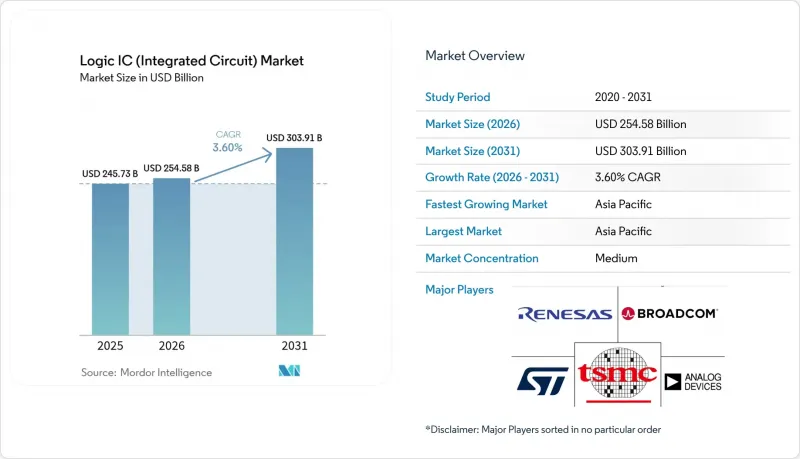
Mordor Intelligence에 의하면, 로직 IC 시장 규모는 2025년에 2,457억 3,000만 달러로 평가되었습니다. 2026년 2,545억 8,000만 달러에서 2031년까지 3,039억 1,000만 달러에 이를 것으로 예상되며, 예측 기간(2026-2031년) CAGR은 3.60%를 나타낼 전망입니다.
본 보고서는 IC 유형(디지털 바이폴라 로직, MOS 로직), 기술 노드(45nm 이상, 20-44nm, 10-19nm, 7-9nm, 5nm 이하),웨이퍼 크기(150mm 이하, 200mm, 300mm), 용도(소비자용 전자기기, 자동차, IT 및 통신 인프라, 컴퓨터·데이터센터, 산업 자동화, 기타), 지역(북미, 유럽, 아시아태평양, 남미, 중동 및 아프리카)별로 분류되어 있습니다.
세계의 로직 IC 시장 동향 및 인사이트
엣지 AI에 따른 초저지연 로직 IC에 대한 수요
엣지 AI의 도입으로 추론 워크로드는 클라우드 데이터센터에서 서브밀리초 수준의 반응 시간을 필요로 하는 디바이스 상의 프로세서로 이동했습니다. 2024년, BrainChip의 ‘Akida Pico’는 0.35TOPS/W를 달성하여 기존 DSP에 비해 전력 소비를 90% 절감했습니다. EdgeCortix의 예측에 따르면, 자율 로봇, 드론, 웨어러블 기기는 50-100밀리초의 클라우드 지연을 허용할 수 없기 때문에 이러한 엣지 AI 디바이스는 2027년까지 AI 반도체 매출의 40%를 차지할 전망입니다. 실시간 지각 시스템에서는 이미지나 LiDAR 데이터를 10밀리초 이내에 처리해야 하기 때문에 로직 IC 설계자들은 스파스 신경망 가속기로 무게중심을 옮겼습니다. 5G 엣지 컴퓨팅과 AI 추론의 융합으로 2028년까지 특수 로직용 150억 달러 규모 시장 기회가 창출되어, 로직 IC 시장의 성장 궤도를 더욱 강화하게 되었습니다.
자동차용 ADAS와 도메인 컨트롤러에는 높은 신뢰성의 로직이 요구됩니다.
소프트웨어 정의 차량(SDV)에서는 여러 ECU가 ISO 26262 안전 규격을 준수하는 중앙 집중형 도메인 컨트롤러로 통합되었습니다. 2024년, 르네사스는 28nm 다이 위에 실시간 제어, AI 추론, 사이버 보안을 융합한 ‘R-Car V4H’ SoC를 발표했습니다. 콘티넨탈의 ADCU 제품군은 AEC-Q100 등급 부품으로 171TOPS를 달성했으며, 테슬라의 ‘Hardware 4.0’ 플랫폼은 1,000TOPS를 목표로 하고 있어 4년 만에 10배의 비약을 이루었습니다. 그 결과, 자동차용 로직 IC는 일반 소비자용 동급 제품에 비해 3-5배의 가격 상승을 보였으며, 성숙한 노드에서의 디플레이션 사이클 속에서도 견조한 이익률을 유지했습니다. 신뢰성의 중요성은 장기 공급 계약을 촉진하고 고객 락인을 강화하는 동시에, 로직 IC 시장 전체 수요를 뒷받침했습니다.
극자외선(EUV) 리소그래피 장비공급 병목 현상
ASML은 여전히 EUV 장비의 유일한 공급업체이며, 각 High-NA 장비의 가격은 3억 5,000만 달러였고, 납기 기간은 18개월이 소요되었습니다. 처리량 제한으로 인해 3nm 이하의 생산 능력 확대가 저해되었습니다. 3대 파운드리 업체는 2030년까지 200대 이상을 필요로 했으나, ASML의 연간 생산 대수는 60대 전후에서 정체되어 있었습니다. 인텔의 18A 로드맵은 고NA 장비공급 상황에 좌우되어, 리스크 생산은 2027년으로 연기되었습니다. 서브 nm 영역에서 오버레이 오차로 인한 수율 저하가 생산 능력 부족을 가속화하여, 차세대 장비가 성숙기에 접어들 때까지 로직 IC 시장공급 측면을 억제하게 되었습니다.
부문별 분석
MOS 전용 로직은 2025년에 로직 IC 시장의 32.12% 점유율을 차지했으며, 2031년까지 연평균 성장률(CAGR) 5.74%로 성장할 전망입니다. 이 부문을 주도하고 있는 것은 범용 프로세서의 비효율성을 보완하는 AI 가속기입니다. Meta가 2024년에 공개한 곱-합 어레이에 관한 정보는 기존 스칼라 코어와 비교하여 특정 용도에서 10배의 처리량 향상을 실현할 수 있음을 보여주었습니다. 각 하이퍼스케일러 기업들이 맞춤형 실리콘 로드맵을 사내에 도입함에 따라, AI용 MOS 디바이스의 로직 IC 시장 규모는 전체 시장보다 빠른 속도로 확대될 것으로 예측됩니다.
MOS 범용 로직, 게이트 어레이, 드라이버/컨트롤러에 대한 수요는 가전제품 및 파워트레인 모듈 분야에서 꾸준히 증가했습니다. 자동차의 전동화로 인해 배터리 시스템을 제어하는 MOS 드라이버 IC 수요가 더욱 확대되었습니다. 한편, 디지털 바이폴라 로직은 내방사선성 항공우주용 회로 분야에서 틈새 시장으로서의 가치를 유지했습니다. Samsung Electronics가 2024년에 발표한 비이진 AI 칩은 전용 로직으로의 추세를 강화하며, 공급업체 환경의 세분화가 진행되고 있음을 시사합니다.
5nm 이하 노드군은 AI, HPC, 급등하는 웨이퍼 비용을 상쇄할 수 있는 프리미엄 모바일 애플리케이션의 성장에 힘입어 2031년까지 연평균 성장률(CAGR) 11.08%로 성장할 전망입니다. 5nm 이하 노드와 관련된 로직 IC 시장 규모는 첨단 패키징 기술의 채택 확대에 따라 급증할 것으로 예측됩니다. 한편, 20-44nm 클래스는 2025년에도 37.02%의 점유율을 유지하며, 인포테인먼트, 산업용 제어, 비용 중심의 IoT 시장을 뒷받침했습니다. TSMC가 2024년에 3nm 공정의 양산을 시작함에 따라 5nm에 비해 60% 높은 집적도가 실현되었으나, 높은 가격 탓에 그 채택은 플래그십 제품으로 한정되었습니다.
10-19nm 노드는 비용과 성능의 격차를 메우는 역할을 수행하며, 중급형 스마트폰이나 엣지 게이트웨이에 채택되었습니다. 45nm 이상의 노드는 모터 구동이나 센서 등 아날로그 회로를 많이 사용하는 시스템용 대량 생산 옵션으로 자리 잡았습니다. 중국의 산업 정책은 14nm 및 28nm 공정의 자급자족을 위해 수십억을 투자하여, 전 세계의 관심이 2-3nm에 쏠리는 와중에도 미드노드 생산 능력을 강화했습니다. 그 결과, 로직 IC 시장은 양극화된 양상을 보였습니다. 생산량은 성숙한 노드에 집중되었지만, 이익의 원천은 최첨단 노드에 집중되었습니다.
지역별 분석
아시아태평양은 2025년 매출의 33.05%를 차지하며 연평균 성장률(CAGR) 4.12%로 성장했습니다. 이는 대만의 파운드리 점유율 64.9%와 중국의 국내 팹 급속한 확충에 힘입은 결과입니다. 정치적 마찰로 인해 다국적 기업들은 대만 해협 양안에서 이중 조달을 실시하게 되었지만, TSMC는 3nm 및 초기 2nm 테이프아웃에서 기술적 리더십을 유지했습니다. 중국은 2030년까지 1,430억 달러를 투자하여 파운드리 역량을 7nm 수준으로 끌어올리고, 최첨단 기술을 보유한 경쟁사들과의 격차를 서서히 좁혀가고 있지만, 여전히 그 격차를 완전히 메우지는 못하고 있습니다.
북미에서는 ‘CHIPS 법’을 활용하여 생산 점유율을 2025년 10%에서 2031년까지 22%로 끌어올릴 방침입니다. 인텔의 오하이오주 복합 단지는 해당 지역 최대 규모의 신규 로직 반도체 제조 거점으로, 2027년까지 2nm 공정의 시범 생산을 시작하는 것을 목표로 하고 있습니다. 미국은 AI 가속기, 항공우주 및 방위용 마이크로일렉트로닉스, 자동차용 도메인 컨트롤러 분야 수요 증가로 혜택을 보았으나, 2030년까지 6만 7,000명의 숙련된 노동자가 부족할 것으로 예측되어 생산 확대에 걸림돌이 될 위험이 있었습니다.
유럽은 자동차 및 산업 분야의 강점을 중심으로 전략을 수립했습니다. 430억 유로(505억 6,000만 달러) 규모의 ‘칩 법’을 통해 독일과 프랑스의 클러스터를 활용하여 2030년까지 세계 생산량의 20%를 차지하는 것을 목표로 설정했습니다. 인피니언(Infineon)과 ST마이크로일렉트로닉스(STMicroelectronics)는 전동화 운송 및 스마트 공장용으로 최적화된, 전력 및 안전성이 극히 중요한 로직 플랫폼으로 사업을 전환했습니다. 일본, 이스라엘, 걸프 국가들에 대한 병행 투자는 골격을 구축하는 것을 목적으로 했으나, 동아시아, 북미, 서유럽이라는 3대 핵심 지역에 비하면 규모가 작아, 로직 IC 시장의 생산 거점이라기보다는 급성장하는 수요 지역으로서의 역할에 그쳤습니다.
기타 혜택
- 엑셀 형식 시장 예측(ME) 시트
- 3개월간의 애널리스트 지원
자주 묻는 질문
목차
제1장 서론
제2장 조사 방법
제3장 주요 요약
제4장 시장 구도
제5장 시장 규모 및 성장 예측
제6장 경쟁 구도
제7장 시장 기회 및 향후 전망
KTH 26.09.14According to Mordor Intelligence, the logic IC market size was valued at USD 245.73 billion in 2025 and estimated to grow from USD 254.58 billion in 2026 to reach USD 303.91 billion by 2031, at a CAGR of 3.60% during the forecast period (2026-2031).
This report is Segmented by IC Type (Digital Bipolar Logic, and MOS Logic), Technology Node (>=45 Nm, 20-44 Nm, 10-19 Nm, 7-9 Nm, and <=5 Nm), Wafer Size (<=150 Mm, 200 Mm, and 300 Mm), Application (Consumer Electronics, Automotive, IT and Communication Infrastructure, Computer/Data-Center, Industrial and Automation, and More), and Geography (North America, Europe, Asia-Pacific, South America, and Middle East and Africa).
Global Logic IC (Integrated Circuit) Market Trends and Insights
Edge-AI-driven demand for ultra-low-latency logic ICs
Edge AI deployment shifted inference workloads away from cloud data centers toward on-device processors that required sub-millisecond reaction times. In 2024, BrainChip's Akida Pico delivered 0.35 TOPS/W, cutting power budgets by 90% versus conventional DSPs. EdgeCortix projected that such edge AI devices could capture 40% of AI semiconductor revenue by 2027, as autonomous robots, drones, and wearables cannot tolerate 50-100 ms cloud latency. With real-time perception systems needing image and LiDAR data processed inside 10 ms, logic IC designers pivoted to sparse neural-network accelerators. The convergence of 5G edge computing and AI inference created a USD 15 billion serviceable opportunity for specialized logic by 2028, reinforcing the growth trajectory of the logic IC market.
Automotive ADAS and domain controllers require high-reliability logic.
Software-defined vehicles consolidated multiple ECUs into centralized domain controllers subject to ISO 26262 safety grades. In 2024, Renesas introduced the R-Car V4H SoC that fused real-time control, AI inference, and cybersecurity on a 28 nm die. Continental's ADCU family hit 171 TOPS with AEC-Q100 grade parts, and Tesla's Hardware 4.0 platform targeted 1,000 TOPS, demonstrating a ten-fold leap in four years. Automotive logic ICs therefore carried 3-5 x price uplifts over consumer equivalents, sustaining margin resilience even in a deflationary cycle for mature nodes. The reliability imperative drove long-lifecycle supply contracts that deepened customer lock-in and underpinned demand across the logic IC market.
Extreme-UV lithography equipment bottlenecks
ASML remained the sole supplier of EUV tools, and each High-NA machine cost USD 350 million while requiring 18 months to deliver. Limited throughput held back sub-3 nm capacity: the big three foundries needed more than 200 units by 2030, but ASML's annual output plateaued near 60 systems. Intel's 18A roadmap hinged on High-NA availability, pushing risk production toward 2027. Yield loss from sub-nanometer overlay error compounded capacity strain, curbing the supply side of the logic IC market until new tool generations matured.
Other drivers and restraints analyzed in the detailed report include:
- Government-backed advanced-node fab incentives
- 3D/2.5D heterogeneous integration accelerating logic IC content per package
- Escalating <5 nm design NRE and IP licensing costs
For complete list of drivers and restraints, kindly check the Table Of Contents.
Segment Analysis
MOS special-purpose logic captured a 32.12% share of the logic IC market in 2025 and is on course for a 5.74% CAGR until 2031. This branch is spearheaded by AI accelerators that offset the inefficiency of general-purpose processors. Meta's 2024 disclosures of multiply-accumulate arrays showcased application-specific throughput gains of 10x over traditional scalar cores. The logic IC market size for AI-oriented MOS devices is projected to climb at a rate faster than the aggregate market as hyperscalers internalize custom silicon roadmaps.
Demand for MOS general-purpose logic, gate arrays, and drivers/controllers grew steadily inside consumer electronics and power-train modules. Automotive electrification injected extra volume into MOS driver ICs that oversee battery systems. Meanwhile, digital bipolar logic held niche value in radiation-hardened aerospace circuits. Samsung's 2024 rollout of non-binary AI chips reinforced the trend toward purpose-built logic, pointing to an increasingly segmented supplier landscape.
The <=5 nm cohort expanded at 11.08% CAGR through 2031, energised by AI, HPC, and premium mobile applications willing to absorb elevated wafer costs. The logic IC market size associated with <=5 nm nodes is expected to jump in tandem with advanced packaging adoption. At the same time, the 20-44 nm class retained a 37.02% share in 2025, supporting infotainment, industrial control, and cost-sensitive IoT. TSMC's 3 nm ramp in 2024 delivered 60% higher density relative to 5 nm, yet the premium contained its use to flagship products.
Nodes at 10-19 nm bridged cost and performance gaps, serving midrange smartphones and edge gateways. The >=45 nm bracket persisted as a high-volume option for analog-heavy systems in motor drives and sensors. China's industrial policy channelled billions toward 14 nm and 28 nm self-reliance, reinforcing mid-node capacity even as global attention gravitated to 2-3 nm. Consequently, the logic IC market displayed a bifurcated profile: volume resided in mature nodes, but profit pools coalesced at the leading edge.
Complete Report Scope:
- By IC Type
- Digital Bipolar Logic
- MOS Logic
- General-Purpose
- Gate Arrays
- Drivers / Controllers
- Standard Cells
- Special-Purpose
- By Technology Node
- >= 45 nm
- 20-44 nm
- 10-19 nm
- 7-9 nm
- <= 5 nm
- By Wafer Size
- <=150 mm
- 200 mm
- 300 mm
- By Application
- Consumer Electronics
- Automotive
- IT and Communication Infrastructure
- Computer / Data-Center
- Industrial and Automation
- Medical and Healthcare Devices
- Other Applications
- By Geography
- North America
- United States
- Canada
- Mexico
- Europe
- Germany
- France
- United Kingdom
- Nordics
- Rest of Europe
- Asia-Pacific
- China
- Taiwan
- South Korea
- Japan
- India
- Rest of Asia-Pacific
- South America
- Brazil
- Mexico
- Argentina
- Rest of South America
- Middle East and Africa
- Middle East
- Saudi Arabia
- United Arab Emirates
- Turkey
- Rest of Middle East
- Africa
- South Africa
- Rest of Africa
- Middle East
- North America
Geography Analysis
Asia-Pacific commanded 33.05% of 2025 revenue and advanced at 4.12% CAGR, anchored by Taiwan's 64.9% foundry share and China's accelerated build-out of domestic fabs. Political friction prompted multinational customers to dual-source outside the Taiwan Strait, yet TSMC retained technical leadership at 3 nm and early 2 nm tape-outs. China invested USD 143 billion up to 2030 to elevate its foundry capability toward 7 nm, gradually narrowing but not closing the gap with leading-edge peers.
North America used the CHIPS Act to push production share from 10% in 2025 toward 22% by 2031. Intel's Ohio complex represented the largest greenfield logic facility in the region, aimed at 2 nm risk production by 2027. The United States benefited from demand in AI accelerators, aerospace-defence microelectronics, and automotive domain controllers, but a projected shortage of 67,000 skilled workers by 2030 risked hampering the ramp.
Europe positioned itself around automotive and industrial strengths. The EUR 43 billion (USD 50.56 billion) Chips Act set a target of 20% global output by 2030, leveraging clusters in Germany and France. Infineon and STMicroelectronics pivoted toward power and safety-critical logic platforms tailored for electrified transport and smart factories. Parallel investments in Japan, Israel, and the Gulf aimed to gain toeholds but remained subscale relative to the tri-polar core of East Asia, North America, and Western Europe, maintaining their roles as fast-growing demand zones rather than production hearts of the logic IC market.
- Intel Corporation
- Taiwan Semiconductor Manufacturing Company Limited (TSMC)
- Samsung Electronics Co., Ltd.
- Texas Instruments Incorporated
- NXP Semiconductors N.V.
- STMicroelectronics N.V.
- onsemi (ON Semiconductor Corp.)
- Renesas Electronics Corporation
- Analog Devices, Inc.
- Broadcom Inc.
- Infineon Technologies AG
- Microchip Technology Incorporated
- Toshiba Electronic Devices & Storage Corp.
- Skyworks Solutions, Inc.
- ROHM Co., Ltd.
- Marvell Technology, Inc.
- MediaTek Inc.
- Silicon Laboratories Inc.
- Lattice Semiconductor Corporation
- Dialog Semiconductor Plc (Renesas)
Additional Benefits:
- The market estimate (ME) sheet in Excel format
- 3 months of analyst support
TABLE OF CONTENTS
1 INTRODUCTION
- 1.1 Study Assumptions and Market Definition
- 1.2 Scope of the Study
2 RESEARCH METHODOLOGY
3 EXECUTIVE SUMMARY
4 MARKET LANDSCAPE
- 4.1 Market Overview
- 4.2 Market Drivers
- 4.2.1 Edge-AI-Driven Demand for Ultra-Low-Latency Logic ICs
- 4.2.2 Automotive ADAS and Domain Controllers Requiring High-Reliability Logic
- 4.2.3 Government-Backed Advanced-Node FAB Incentives (U.S. CHIPS, China IC Fund)
- 4.2.4 3D/2.5D Heterogeneous Integration Accelerating Logic IC Content per Package
- 4.2.5 Rapid Proliferation of Battery-Powered IoT Nodes Demanding Sub-µW Logic
- 4.3 Market Restraints
- 4.3.1 Extreme-UV Lithography Equipment Bottlenecks
- 4.3.2 Escalating <5 nm Design NRE and IP Licensing Costs
- 4.3.3 Geopolitical Export Controls on EDA and Process Equipment
- 4.3.4 Global Talent Crunch in Advanced Logic Design and Verification
- 4.4 Value Chain Analysis
- 4.5 Regulatory or Technological Outlook
- 4.6 Porter's Five Forces Analysis
- 4.6.1 Bargaining Power of Suppliers
- 4.6.2 Bargaining Power of Buyers
- 4.6.3 Threat of New Entrants
- 4.6.4 Intensity of Competitive Rivalry
- 4.6.5 Threat of Substitutes
- 4.7 Investment Analysis
- 4.8 Impact of macroeconomic factors on the market
5 MARKET SIZE AND GROWTH FORECASTS (VALUE AND VOLUME)
- 5.1 By IC Type
- 5.1.1 Digital Bipolar Logic
- 5.1.2 MOS Logic
- 5.1.2.1 General-Purpose
- 5.1.2.2 Gate Arrays
- 5.1.2.3 Drivers / Controllers
- 5.1.2.4 Standard Cells
- 5.1.2.5 Special-Purpose
- 5.2 By Technology Node
- 5.2.1 >= 45 nm
- 5.2.2 20-44 nm
- 5.2.3 10-19 nm
- 5.2.4 7-9 nm
- 5.2.5 <= 5 nm
- 5.3 By Wafer Size
- 5.3.1 <=150 mm
- 5.3.2 200 mm
- 5.3.3 300 mm
- 5.4 By Application
- 5.4.1 Consumer Electronics
- 5.4.2 Automotive
- 5.4.3 IT and Communication Infrastructure
- 5.4.4 Computer / Data-Center
- 5.4.5 Industrial and Automation
- 5.4.6 Medical and Healthcare Devices
- 5.4.7 Other Applications
- 5.5 By Geography
- 5.5.1 North America
- 5.5.1.1 United States
- 5.5.1.2 Canada
- 5.5.1.3 Mexico
- 5.5.2 Europe
- 5.5.2.1 Germany
- 5.5.2.2 France
- 5.5.2.3 United Kingdom
- 5.5.2.4 Nordics
- 5.5.2.5 Rest of Europe
- 5.5.3 Asia-Pacific
- 5.5.3.1 China
- 5.5.3.2 Taiwan
- 5.5.3.3 South Korea
- 5.5.3.4 Japan
- 5.5.3.5 India
- 5.5.3.6 Rest of Asia-Pacific
- 5.5.4 South America
- 5.5.4.1 Brazil
- 5.5.4.2 Mexico
- 5.5.4.3 Argentina
- 5.5.4.4 Rest of South America
- 5.5.5 Middle East and Africa
- 5.5.5.1 Middle East
- 5.5.5.1.1 Saudi Arabia
- 5.5.5.1.2 United Arab Emirates
- 5.5.5.1.3 Turkey
- 5.5.5.1.4 Rest of Middle East
- 5.5.5.2 Africa
- 5.5.5.2.1 South Africa
- 5.5.5.2.2 Rest of Africa
- 5.5.5.1 Middle East
- 5.5.1 North America
6 COMPETITIVE LANDSCAPE
- 6.1 Market Concentration
- 6.2 Strategic Moves
- 6.3 Market Share Analysis
- 6.4 Company Profiles (includes Global-level Overview, Market-level Overview, Core Segments, Financials, Strategic Information, Market Rank/Share, Products and Services, Recent Developments)
- 6.4.1 Intel Corporation
- 6.4.2 Taiwan Semiconductor Manufacturing Company Limited (TSMC)
- 6.4.3 Samsung Electronics Co., Ltd.
- 6.4.4 Texas Instruments Incorporated
- 6.4.5 NXP Semiconductors N.V.
- 6.4.6 STMicroelectronics N.V.
- 6.4.7 onsemi (ON Semiconductor Corp.)
- 6.4.8 Renesas Electronics Corporation
- 6.4.9 Analog Devices, Inc.
- 6.4.10 Broadcom Inc.
- 6.4.11 Infineon Technologies AG
- 6.4.12 Microchip Technology Incorporated
- 6.4.13 Toshiba Electronic Devices & Storage Corp.
- 6.4.14 Skyworks Solutions, Inc.
- 6.4.15 ROHM Co., Ltd.
- 6.4.16 Marvell Technology, Inc.
- 6.4.17 MediaTek Inc.
- 6.4.18 Silicon Laboratories Inc.
- 6.4.19 Lattice Semiconductor Corporation
- 6.4.20 Dialog Semiconductor Plc (Renesas)
7 MARKET OPPORTUNITIES AND FUTURE OUTLOOK
- 7.1 White-space and Unmet-Need Assessment


