

|
시장보고서
상품코드
2124828
고출력 레이저 시스템 : 시장 점유율 분석, 업계 동향과 통계, 성장 예측(2026-2031년)High Power Laser Systems - Market Share Analysis, Industry Trends & Statistics, Growth Forecasts (2026 - 2031) |
||||||
 Mordor Intelligence
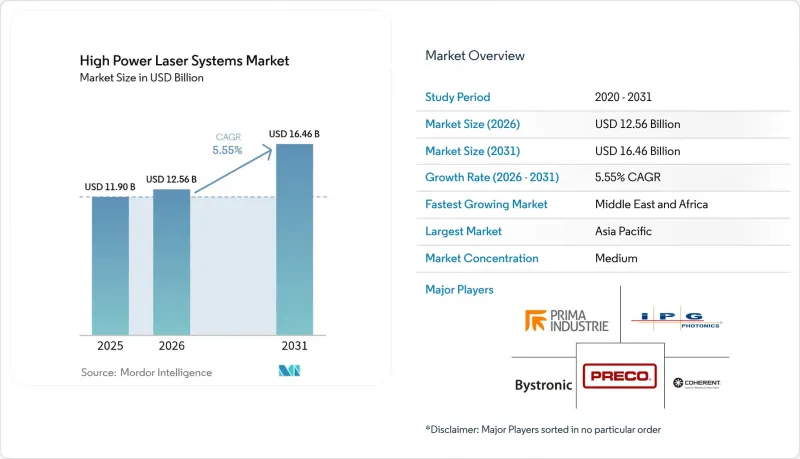
Mordor Intelligence에 의하면, 고출력 레이저 시스템 시장 규모는 2025년 119억 달러에서 2026년에는 125억 6,000만 달러에 이르고, 2026-2031년 CAGR 5.55%로 성장을 지속하여 2031년에는 164억 6,000만 달러에 달할 것으로 예측됩니다.
본 보고서는 레이저 광원의 유형(파이버 레이저, 디스크 레이저, 다이오드 레이저 등), 출력(1-2 kW, 2-6 kW, 6 kW 이상),용도(절단, 용접, 클래딩 등), 최종 사용자 산업(자동차, 항공우주 및 방위 등), 작동 모드(연속파, 펄스, 초고속), 지역별로 분류되어 있습니다. 시장 예측은 금액(달러) 기준으로 제시되어 있습니다.
세계 고출력 레이저 시스템 시장 동향 및 인사이트
전기차(EV)로의 전환에 따른 화이트 바디용 초고출력 절단 라인
전기차(EV) 플랫폼에는 알루미늄 스페이스 프레임과 복합재료 어셈블리가 필요합니다. 이에는 리튬 이온 배터리 셀 주변의 열 부하를 억제하면서 0.1 mm의 정밀도로 레이저 가공을 수행하는 것이 요구됩니다. 테슬라의 오스틴 공장에서는 6kW 이상의 파이버 레이저 시스템을 채택하여, 분당 15m를 초과하는 생산 속도로 배터리 하우징의 용접을 수행하고 있습니다. 중국의 제조업체인 BYD와 CATL도 이러한 추세를 따르고 있으며, BYD의 ‘Blade Battery’ 생산 라인에서는 두께 3.2 mm의 강철 하우징을 위해 10 kW 장비가 도입되었습니다. 그 결과, 시스템 통합사업자와 다이오드 공급업체와는 수년에 걸친 계약이 확정되었습니다.
팬데믹 이후의 리쇼어링이 파이버 레이저 자동화 투자를 촉진
세계 공급망의 혼란으로 인해 반도체, 항공우주, 의료기기 제조업체들은 생산을 국내로 되돌릴 수밖에 없었습니다. ‘CHIPS and Science Act’는 미국의 팹 생산 능력에 520억 달러를 투자하도록 규정하고 있으며, 각 시설에는 레이저 다이싱, 드릴링, 용접 셀이 통합되어 있습니다. Coherent사의 SmartSense+ 플랫폼은 AI 기반 공정 모니터링 기능을 제공하여 작업자의 개입을 줄이는 동시에, 높은 처리량에서도 일관된 품질을 유지합니다. 유럽에서도 유사한 움직임이 나타나고 있으며, 인건비 급등을 상쇄하기 위해 레이저 자동화가 활용되고 있어 초기 공장 건설 단계를 넘어 설비 수요가 지속되고 있습니다.
설비 투자 회수 기간: 소량 생산을 하는 중소기업의 경우, 4년 이상
4kW 파이버 셀의 턴키 총 비용은 50만 달러에 달하며, 가동률이 60% 미만이면 투자 회수 기간은 4년을 초과합니다. 바이스트로닉(Bystronic)이나 지역 은행의 융자 프로그램은 지불액을 운영 예산에 임베디드함으로써 진입 장벽을 낮추고 있지만, 수주 전망이 제한적인 신흥 시장에서는 여전히 위험에 대한 우려가 커지고 있습니다.
부문 분석
파이버 레이저는 50%의월플러그 효율과 밀폐형 파이버의 신뢰성을 강점으로 삼아 2025년에는 매출의 61.25%를 차지했습니다. 초고속 파이버 레이저는 연평균 성장률(CAGR) 6.95%로 성장하고 있으며, 열영향부를 최소화해야 하는 반도체 및 의료용 부품에 대한 수요를 충족시키고 있습니다. CO2 시스템은 두꺼운 비금속 및 목재 절단 분야에서 여전히 활용되고 있는 반면, 디스크 레이저는 탑햇형 빔 프로파일이 보급을 돕는 틈새 시장인 자동차 용접 분야에서 활용되고 있습니다. 다이오드 직접 발광 플랫폼은 표면 경화 라인에서 성장하고 있지만, 5kW라는 출력 상한선이 더 광범위한 보급을 저해하고 있습니다. 자동화가 주요 OEM 제조업체 이외의 분야로 확대됨에 따라, 파이버 플랫폼 고출력 레이저 시스템 시장 규모는 2031년까지 100억 8,000만 달러에 달할 것으로 예측됩니다.
중국 공급업체들의 경쟁력 있는 제품이 평균 판매 가격(ASP)을 낮추고 있지만, 빔 결합, 모드 제어, 실시간 모니터링에 대한 지적 재산권이 시장 선두 주자로서의 입지를 유지하는 데 기여하고 있습니다. IEC 60825와 같은 안전 규격에서는 발산각이 작다는 이유로 파이버를 권장하고 있으며, 이는 대형 보호 케이스가 필요 없는 공장 현장에의 통합을 촉진하고 있습니다. kW급 단일 LED에 대한 지속적인 연구 개발로 새로운 광원 아키텍처가 실현될 전망이지만, 2027년 이전의 상용화는 어려울 것으로 보입니다.
2-6 kW 범위의 시스템은 2025년에 고출력 레이저 시스템 시장 점유율의 48.35%를 차지할 것으로 보이며, 자동차용 강판 두께 측정에 적합하고, 안정적인 절단면 품질을 유지하면서 15 m/min을 초과하는 절단 속도를 실현하고 있습니다. 6 kW를 초과하는 유닛은 조선, 중장비, 방위 분야의 HEL 프로그램에서 더 깊은 천공 및 두꺼운 판재 가공이 요구됨에 따라, 2031년까지 연평균 성장률(CAGR) 7.12%를 나타낼 것으로 예측됩니다. Han's Laser사는 선박용 서브어셈블리 패널을 대상으로 150 kW 멀티빔 제품의 실증에 성공하여, 상용화에서의 출력 상한선을 입증했습니다.
10 kW를 초과하는 영역에서는 열 관리가 여전히 병목 현상으로 작용하고 있어, 빔 품질을 유지하기 위한 마이크로채널 쿨러 및 상변화 소재의 혁신이 추진되고 있습니다. 대조적으로, 1-2 kW 출력원은 낮은 열 입력으로 인해 부품의 변형을 방지할 수 있는 전자기기 및 의료용 도구 분야에서 주류를 이루고 있습니다. 기술 로드맵에 따르면, 출력의 지속적인 확대와 더불어 에너지를 여러 스팟으로 분할하는 적응형 빔 성형 기술이 결합되어 병렬 처리와 라인 택트 타임 단축이 가능해질 것으로 나타났습니다.
지역별 분석
아시아태평양은 2025년 매출의 38.60%를 차지하며, 중국의 규모와 일본의 정밀 기기 기술이 결합되어 성장을 주도하고 있습니다. 베이징의 ‘중국 제조 2025’ 계획은 국내 자동차 제조업체들의 차량 전동화를 뒷받침하며 도입을 촉진하고 있습니다. 한편, 우한 HG 레이저와 레이카스(Raycas)는 현지 가공 업체들에게 투자 회수 기간(ROI)을 단축하는 비용 효율적인 플랫폼을 제공합니다. FANUC(파낙) 등 일본 제조업체들은 반도체 리소그래피 요건에 부합하는 첨단 빔 제어 기능을 통합하여 초고속 레이저 틈새 시장에서 지역 내 리더십을 강화하고 있습니다.
유럽은 시장 규모 면에서는 2위이지만, 정책 주도 분야에서는 주도적인 입지를 차지하고 있습니다. ‘넷-제로 산업법(Net-Zero Industry Act)’은 화학 물질이 환경에 미치는 영향을 줄이기 위해 레이저 세정 및 용접에 보조금을 지급하고 있으며, 독일, 프랑스, 이탈리아에서의 도입을 뒷받침하고 있습니다. 유럽의 방위 기관들은 HEL 실증 프로젝트에 공동 투자하고 있으며, 공급업체 기반을 공유함으로써 민간 제조 분야로 파급 효과를 창출하고 있습니다. 숙련된 노동력 부족은 여전히 제약 요인으로 작용하고 있어, 작업자의 전문성을 덜 필요로 하는 AI 지원형 기계에 대한 관심이 높아지고 있습니다.
중동 및 아프리카는 2031년까지 연평균 성장률(CAGR)이 8.78%로 가장 빠른 성장 궤도를 그리고 있습니다. 사우디아라비아의 ‘비전 2030’은 항공, 재생에너지 및 국내 철강 프로젝트를 추진하고 있으며, 이들 모두 정밀 가공을 위한 고출력 레이저 시스템 시장 솔루션에 의존하고 있습니다. 아랍에미리트(UAE)는 터빈 블레이드 개조에 레이저 클래딩을 채택하는 정비·수리·오버홀(MRO) 허브에 투자하고 있습니다. 국내 부품 공급이 제한적이어서 유럽 및 아시아의 시스템 통합사업자와의 제휴가 요구되고 있으며, 수입 기계와 현지화된 서비스로 구성된 하이브리드 생태계가 형성되고 있습니다.
기타 혜택:
- 엑셀 형식 시장 예측(ME) 시트
- 3개월간의 애널리스트 지원
자주 묻는 질문
목차
제1장 서론
제2장 조사 방법
제3장 주요 요약
제4장 시장 구도
제5장 시장 규모와 성장 예측
제6장 경쟁 구도
제7장 시장 기회와 향후 전망
LSH 26.09.14According to Mordor Intelligence, the high power laser systems market size is expected to grow from USD 11.9 billion in 2025 to USD 12.56 billion in 2026 and is forecast to reach USD 16.46 billion by 2031 at 5.55% CAGR over 2026-2031.
This report is Segmented by Laser Source Type (Fiber Laser, Disk Laser, Diode Laser, and More), Power Output (1-2 KW, 2-6 KW, and Above 6 KW), Application (Cutting, Welding, Cladding, and More), End-User Industry (Automotive, Aerospace and Defense, and More), Mode of Operation (Continuous-Wave, Pulsed, and Ultrafast), and Geography. The Market Forecasts are Provided in Terms of Value (USD).
Global High Power Laser Systems Market Trends and Insights
Shift-to-EV Body-in-White Ultra-High-Power Cutting Lines
Electric-vehicle platforms require aluminum space frames and mixed-material assemblies that demand laser accuracy of 0.1 mm while limiting thermal load near lithium-ion cells. Tesla's Austin plant uses 6 kW+ fiber systems to weld battery enclosures at production speeds above 15 m/min. Chinese makers BYD and CATL extend the trend, with BYD's Blade Battery lines deploying 10 kW equipment for 3.2 mm steel housings. The resulting order flow locks in multi-year contracts for system integrators and diode suppliers.
Post-Pandemic Reshoring Driving Fiber-Laser Automation Investments
Global supply-chain shocks pushed semiconductor, aerospace, and medical manufacturers to reshore production. The CHIPS and Science Act directs USD 52 billion toward U.S. fab capacity, each facility integrating laser dicing, drilling, and welding cells. Coherent's SmartSense+ platform delivers AI process monitoring that reduces operator intervention and supports consistent quality at higher throughput. Similar moves in Europe use laser automation to offset higher labor costs, sustaining equipment demand beyond initial plant buildouts.
Cap-ex payback More than 4 yrs for SMEs in low-volume fabrication
Total turnkey costs for a 4 kW fiber cell approach USD 500,000, driving payback periods beyond 4 years when utilization falls below 60%. Financing programs from Bystronic and regional banks lower entry barriers by shifting payments to operating budgets, yet risk perceptions remain high in emerging markets where order visibility is limited.
Other drivers and restraints analyzed in the detailed report include:
- Demand for sub-50 μm kerf aerospace micro-welding
- AI-enabled closed-loop beam tuning lowers scrap and energy costs
- Gallium-Based Diode Supply Volatility
For complete list of drivers and restraints, kindly check the Table Of Contents.
Segment Analysis
Fiber lasers captured 61.25% revenue in 2025 on the strength of 50% wall-plug efficiency and sealed-fiber reliability. Ultrafast fiber variants advance at a 6.95% CAGR, addressing semiconductor and medical components that require minimal heat-affected zones. CO2 systems persist in thick non-metal and wood cutting, while disk lasers serve niche automotive welding, where top-hat beam profiles aid penetration. Diode direct-emission platforms grow in surface hardening lines, yet their 5 kW ceiling limits broader uptake. The high power laser systems market size for fiber platforms is expected to rise to USD 10.08 billion by 2031 as automation spreads beyond leading OEMs.
Competitive presses from Chinese vendors compress ASPs, but intellectual property in beam-combining, mode control, and real-time monitoring helps market leaders defend positions. Safety standards such as IEC 60825 favor fibers due to lower divergence, supporting factory-floor integration without large protective enclosures. Continuous R&D around kilowatt-class single-emitter diodes would unlock new source architectures, but commercialization is unlikely before 2027.
Systems in the 2-6 kW window commanded 48.35% of the high power laser systems market share in 2025, fitting automotive steel gauges and delivering cut speeds above 15 m/min with stable edge quality. Above-6 kW units are projected to post a 7.12% CAGR to 2031 as shipbuilding, heavy equipment, and defense HEL programs require deeper penetration and thicker plate processing. Han's Laser validated 150 kW multibeam products for ship subassembly panels, demonstrating the upper power limit in commercial deployment.
Thermal management remains a bottleneck beyond 10 kW, driving innovations in micro-channel coolers and phase-change materials that maintain beam quality. In contrast, 1-2 kW sources dominate electronics and medical tooling, where low heat input avoids component distortion. Technology roadmaps indicate continued power scaling paired with adaptive beam shaping that splits energy across multiple spots, enabling parallel processing and higher line takt times.
Complete Report Scope:
- By Laser Source Type
- Fiber Laser
- Disk Laser
- Diode Laser
- CO2 Laser
- Other Laser Source Types
- By Power Output
- 1 - 2 kW
- 2 - 6 kW
- Above 6 kW
- By Application
- Cutting
- Welding
- Cladding
- Hardening
- Cleaning and Ablation
- By End-user Industry
- Automotive
- Aerospace and Defense
- Electronics and Semiconductor
- Medical Devices
- Energy and Power
- Other End-user Industries
- By Mode of Operation
- Continuous-Wave
- Pulsed
- Ultrafast (ps/fs)
- By Geography
- North America
- United States
- Canada
- Mexico
- South America
- Brazil
- Argentina
- Colombia
- Rest of South America
- Europe
- United Kingdom
- Germany
- France
- Italy
- Spain
- Rest of Europe
- Asia-Pacific
- China
- Japan
- South Korea
- India
- Rest of Asia-Pacific
- Middle East and Africa
- Middle East
- Saudi Arabia
- United Arab Emirates
- Rest of Middle East
- Africa
- South Africa
- Egypt
- Rest of Africa
- Middle East
- North America
Geography Analysis
Asia-Pacific generated 38.60% of 2025 revenue, coupling China's scale with Japan's precision equipment capabilities. Beijing's "Made in China 2025" agenda spurs adoption as domestic automakers electrify fleets, while Wuhan HG Laser and Raycus provide cost-effective platforms that shorten ROI for local fabricators. Japanese producers such as FANUC integrate advanced beam control that aligns with semiconductor lithography requirements, reinforcing regional leadership in ultrafast niches.
Europe ranks second in value yet leads policy-driven segments. The Net-Zero Industry Act subsidizes laser cleaning and welding to reduce the environmental impact of chemicals, supporting uptake in Germany, France, and Italy. European defense agencies co-fund HEL demonstrators, creating spill-over to civilian manufacturing through shared supplier bases. Skilled-labor shortages remain a constraint, elevating interest in AI-assisted machines that reduce operator specialization.
Middle East and Africa represent the fastest trajectory with a 8.78% CAGR to 2031. Saudi Arabia's Vision 2030 pushes aviation, renewable energy, and local steel projects, each reliant on high-power laser systems market solutions for precision fabrication. The United Arab Emirates invests in maintenance-repair-overhaul hubs adopting laser cladding for turbine blade refurbishment. Limited domestic component supply urges partnerships with European and Asian integrators, shaping a hybrid ecosystem of imported machinery and localized service.
- TRUMPF SE + Co. KG
- IPG Photonics Corporation
- Coherent Corp.
- Han's Laser Technology Industry Group Co., Ltd.
- Bystronic AG
- Prima Industrie S.p.A.
- EL.EN. S.p.A.
- Preco Inc.
- HSG Laser
- Amada Co., Ltd.
- Mitsubishi Electric Corporation
- Wuhan HG Laser Engineering Co., Ltd.
- Raycus Fiber Laser Technologies Co., Ltd.
- nLIGHT, Inc.
- Lumentum Operations LLC
- Jenoptik AG
- Mazak Optonics Corp.
- FANUC Corporation
- Trotec Laser GmbH
- Universal Laser Systems, Inc.
Additional Benefits:
- The market estimate (ME) sheet in Excel format
- 3 months of analyst support
TABLE OF CONTENTS
1 INTRODUCTION
- 1.1 Study Assumptions and Market Definition
- 1.2 Scope of the Study
2 RESEARCH METHODOLOGY
3 EXECUTIVE SUMMARY
4 MARKET LANDSCAPE
- 4.1 Market Overview
- 4.2 Market Drivers
- 4.2.1 Shift-to-EV body-in-white ultra-high-power cutting lines
- 4.2.2 Post-pandemic reshoring driving fiber-laser automation investments
- 4.2.3 Demand for sub-50 µm kerf aerospace micro-welding
- 4.2.4 AI-enabled closed-loop beam tuning lowers scrap and energy costs
- 4.2.5 Defense HEL upgrade programs (Greater than 100 kW) accelerate procurement
- 4.2.6 EU "Net-Zero Industry Act" incentives for green laser processing
- 4.3 Market Restraints
- 4.3.1 Cap-ex payback More than 4 yrs for SMEs in low-volume fabrication
- 4.3.2 High-power beam safety regulations tightening (IEC 60825-5)
- 4.3.3 Gallium-based diode supply volatility
- 4.3.4 Skilled laser-process engineering talent shortage
- 4.4 Industry Supply Chain Analysis
- 4.5 Regulatory Landscape
- 4.6 Technological Outlook
- 4.7 Porter's Five Forces Analysis
- 4.7.1 Bargaining Power of Suppliers
- 4.7.2 Bargaining Power of Consumers
- 4.7.3 Threat of New Entrants
- 4.7.4 Intensity of Competitive Rivalry
- 4.7.5 Threat of Substitute Products
5 MARKET SIZE AND GROWTH FORECASTS (VALUE)
- 5.1 By Laser Source Type
- 5.1.1 Fiber Laser
- 5.1.2 Disk Laser
- 5.1.3 Diode Laser
- 5.1.4 CO2 Laser
- 5.1.5 Other Laser Source Types
- 5.2 By Power Output
- 5.2.1 1 - 2 kW
- 5.2.2 2 - 6 kW
- 5.2.3 Above 6 kW
- 5.3 By Application
- 5.3.1 Cutting
- 5.3.2 Welding
- 5.3.3 Cladding
- 5.3.4 Hardening
- 5.3.5 Cleaning and Ablation
- 5.4 By End-user Industry
- 5.4.1 Automotive
- 5.4.2 Aerospace and Defense
- 5.4.3 Electronics and Semiconductor
- 5.4.4 Medical Devices
- 5.4.5 Energy and Power
- 5.4.6 Other End-user Industries
- 5.5 By Mode of Operation
- 5.5.1 Continuous-Wave
- 5.5.2 Pulsed
- 5.5.3 Ultrafast (ps/fs)
- 5.6 By Geography
- 5.6.1 North America
- 5.6.1.1 United States
- 5.6.1.2 Canada
- 5.6.1.3 Mexico
- 5.6.2 South America
- 5.6.2.1 Brazil
- 5.6.2.2 Argentina
- 5.6.2.3 Colombia
- 5.6.2.4 Rest of South America
- 5.6.3 Europe
- 5.6.3.1 United Kingdom
- 5.6.3.2 Germany
- 5.6.3.3 France
- 5.6.3.4 Italy
- 5.6.3.5 Spain
- 5.6.3.6 Rest of Europe
- 5.6.4 Asia-Pacific
- 5.6.4.1 China
- 5.6.4.2 Japan
- 5.6.4.3 South Korea
- 5.6.4.4 India
- 5.6.4.5 Rest of Asia-Pacific
- 5.6.5 Middle East and Africa
- 5.6.5.1 Middle East
- 5.6.5.1.1 Saudi Arabia
- 5.6.5.1.2 United Arab Emirates
- 5.6.5.1.3 Rest of Middle East
- 5.6.5.2 Africa
- 5.6.5.2.1 South Africa
- 5.6.5.2.2 Egypt
- 5.6.5.2.3 Rest of Africa
- 5.6.5.1 Middle East
- 5.6.1 North America
6 COMPETITIVE LANDSCAPE
- 6.1 Market Concentration
- 6.2 Strategic Moves
- 6.3 Market Share Analysis
- 6.4 Company Profiles (includes Global level Overview, Market level overview, Core Segments, Financials as available, Strategic Information, Market Rank/Share, Products and Services, Recent Developments)
- 6.4.1 TRUMPF SE + Co. KG
- 6.4.2 IPG Photonics Corporation
- 6.4.3 Coherent Corp.
- 6.4.4 Han's Laser Technology Industry Group Co., Ltd.
- 6.4.5 Bystronic AG
- 6.4.6 Prima Industrie S.p.A.
- 6.4.7 EL.EN. S.p.A.
- 6.4.8 Preco Inc.
- 6.4.9 HSG Laser
- 6.4.10 Amada Co., Ltd.
- 6.4.11 Mitsubishi Electric Corporation
- 6.4.12 Wuhan HG Laser Engineering Co., Ltd.
- 6.4.13 Raycus Fiber Laser Technologies Co., Ltd.
- 6.4.14 nLIGHT, Inc.
- 6.4.15 Lumentum Operations LLC
- 6.4.16 Jenoptik AG
- 6.4.17 Mazak Optonics Corp.
- 6.4.18 FANUC Corporation
- 6.4.19 Trotec Laser GmbH
- 6.4.20 Universal Laser Systems, Inc.
7 MARKET OPPORTUNITIES AND FUTURE OUTLOOK
- 7.1 White-space and Unmet-need Assessment


