
|
시장보고서
상품코드
2124899
유럽의 비디오 감시 시스템 : 시장 점유율 분석, 업계 동향과 통계, 성장 예측(2026-2031년)Europe Video Surveillance Systems - Market Share Analysis, Industry Trends & Statistics, Growth Forecasts (2026 - 2031) |
||||||
 Mordor Intelligence
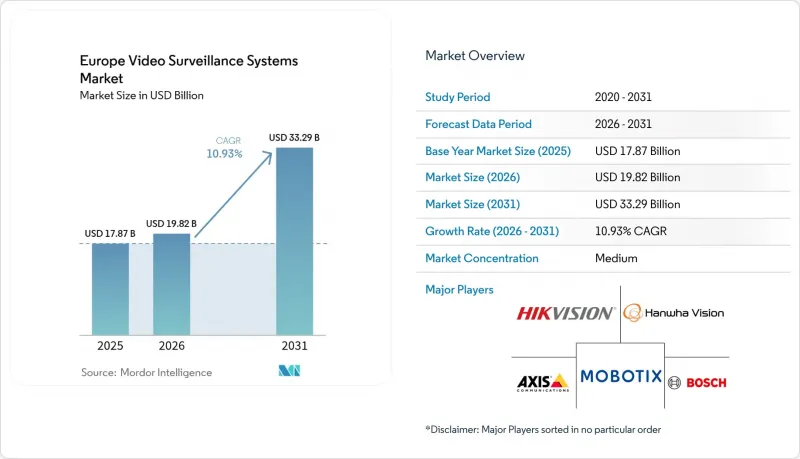
Mordor Intelligence에 의하면, 2026년 유럽의 비디오 감시 시스템 시장 규모는 198억 2,000만 달러로 추정되며, 2025년 178억 7,000만 달러에서 2031년에는 332억 9,000만 달러에 달할 것으로 예측됩니다.
2026-2031년 연평균 성장률(CAGR)은 10.93%를 기록할 것으로 전망됩니다.
본 보고서는 구성 요소(하드웨어, 소프트웨어, Video as a Service), 도입 형태(On-Premise, 클라우드, 하이브리드), 카메라 연결 방식(유선, 무선, 셀룰러/5G), 해상도(SD, HD 등), 최종 사용자(상업, 산업 등),지역(영국, 독일 등)별로 분류되어 있습니다. 시장 예측은 금액(달러) 기준으로 제시되어 있습니다.
유럽의 비디오 감시 시스템 시장 동향 및 인사이트
고급 보안 시스템에 대한 지출 증가
2024년에는 영국이 경찰의 얼굴 인식 시스템 업그레이드에 2억 3,000만 파운드(2억 8,900만 달러)를 배정했고,프랑스가 4,000곳의 도로변에 AI 교통 모니터링 카메라를 설치하기 위해 4,600만 유로(4,900만 달러)를 배정함에 따라 공공 예산이 급증했습니다. 이탈리아에서는 9,770만 유로(1억 430만 달러)를 투입한 로마 5G CCTV 프로그램을 통해 2025년 주빌리 행사에 앞서 2,000대의 아날로그 카메라가 현대화될 예정입니다. 독일의 시민 보안 체계에서는 국내 분석 업체를 우선적으로 선정하는 시범 사업에 자금을 지원하여 기술 주권을 강화하고 있습니다. 상업용 부동산 소유주들도 이러한 추세를 따르며, 보험사 및 임차인이 현재 요구하는 ESG 지표를 충족하기 위해 감시 기능을 건물 관리 시스템에 통합하고 있습니다.
공공 및 민간 인프라의 성장
중요 자산 운영 사업자들은 EU의 복원력 지침을 충족하기 위해 멀티 센서 네트워크 도입을 추진하고 있습니다. 유로폴은 2025년부터 2027년까지 카메라와 여행자 데이터베이스를 연동하는 생체 인식 시스템 업그레이드에 6,780만 유로(7,230만 달러)를 예산으로 편성했습니다. 제노바의 ‘프로젝트 하프니아’에서는 2,700대의 카메라와 NVIDIA 가속기를 탑재한 분석 시스템을 통합하여 실시간 교통 관리를 실현하고 있습니다. 프랑스의 국방 계획에서는 해상 감시를 위해 우주 관련 자금이 배정되었으며, 지상 및 위성 시스템의 융합이 강조되고 있습니다. 영국 국방부의 예산 증액에는 중요 시설의 주변 경비 체계 개편이 포함되어 있습니다. 유틸리티체들은 열화상 카메라와 하이퍼스펙트럼 카메라를 도입하여 물리적 순찰을 40% 줄였습니다.
영상 데이터와 관련된 보안 우려
2024년에는 패치가 적용되지 않은 펌웨어를 표적으로 한 침해가 격화되었으며, 이에 따라 독일의 BSI는 로컬에서 관리되는 키를 이용한 엣지 수준 암호화를 권장했습니다. ENISA의 조사에 따르면, 중요 인프라 사업자의 89%가 감시 시스템의 취약점을 관리하기 위해 인력을 증원하고 있습니다. GDPR(EU 개인정보보호규정) 제44조는 적절한 보호 수준이 확보되지 않은 관할 구역으로의 영상 수출을 제한하고 있어, 클라우드 백업을 복잡하게 만들고 있습니다. 이탈리아의 보안 업계 단체는 숨겨진 백도어에 대한 우려로 인해 서유럽산 하드웨어로의 전환이 진행되고 있다고 보고했으며, 이는 영국이 중국산 장비에 대해 곧 시행할 금지 조치로 인해 더욱 가속화되고 있습니다. 하드웨어 수준의 보안 엔클레이브는 단가를 15-20% 끌어올려, 예산이 제한된 지방자치단체의 구매를 주저하게 만들고 있습니다.
부문 분석
2025년에도 하드웨어는 67.58%의 점유율을 유지했습니다. 카메라, 레코더 및 주변 기기는 유럽의 비디오 감시 시스템 시장에서 이미 도입된 시스템의 대부분을 차지하고 있습니다. 그러나 ‘Video as a Service(VaaS)’는 지자체와 중소기업이 장비, 클라우드 스토리지, 분석 기능을 단일 월별 청구서로 통합한 리스 계약으로 전환함에 따라 구성 요소 중 가장 높은 연평균 성장률(CAGR) 11.48%를 나타낼 것으로 예측됩니다. 소프트웨어 플랫폼은 이종 혼합 장비군을 통합 관리하고, 엣지 측에서 이벤트를 처리하여 대역폭을 줄이는 AI를 탑재하고 있습니다. Axis사는 2024년 3분기에 온보드 추론 엔진을 탑재한 GDPR(EU 개인정보보호규정) 준수 모델 4종을 출시했습니다. 감사인이 에어 갭(air gap) 처리된 증거의 추적을 요구하는 은행 및 국방 분야에서는 스토리지 어플라이언스가 여전히 선호되고 있습니다.
불투명한 거시경제 상황 속에서 기업들이 자금을 보존하는 가운데, 운영 비용을 중시하는 경향이 VSaaS에 호재가 되고 있습니다. Verkada의 런던 지사는 데이터를 30-120일간 로컬에 저장한 후, GDPR(EU 개인정보보호규정)을 준수하는 데이터센터에 아카이브하는 하이브리드 클라우드를 판매하고 있습니다. Eagle Eye는 페더레이티드 러닝(Federated Learning) 지원을 추가하여, AI가 실시간 영상을 열람하지 않고도 모델을 정교화할 수 있도록 했습니다. Genetec의 ‘Security Center 5.12’는 AutoVu ALPR을 통합하여 경찰이 차량의 이동 경로를 추적할 수 있도록 지원하는 동시에, AI 관련 법규의 감사 요건도 충족하고 있습니다. 각 하드웨어 OEM 업체들은 더 고성능의 칩을 탑재하여 대응하고, 하이브리드형 가치 제안을 통해 순수 클라우드 기반 경쟁사들과 경쟁함으로써, 유럽의 영상 감시 시스템 시장을 자본 지출(Capex)과 운영 비용(OpEx)의 균형이 잡힌 상태로 유지하고 있습니다.
2025년에는 On-Premise형 아키텍처가 60.55%의 점유율을 차지했습니다. 이는 퍼블릭 클라우드에 영상을 저장하는 것을 허용하지 않는 금융, 국방, 중요 인프라 분야에서 지지를 받았기 때문입니다. 클라우드 서비스는 IT 자원이 충분하지 않은 중소기업을 대상으로 연평균 성장률(CAGR) 11.95%로 확대될 것으로 예측됩니다. 하이브리드형 아키텍처는 로컬 저장 및 클라우드 분석을 융합하여 GDPR(EU 개인정보보호규정)의 데이터 거주 요건을 충족하는 동시에 확장 가능한 AI에 대한 접근을 실현하고 있습니다. Milestone사의 2024년 버전에서는 운영자가 스트림에 태그를 지정하여 On-Premise 처리와 클라우드 처리 중 하나를 선택할 수 있게 되었습니다. 로마시의 네트워크에서는 로컬 엣지 서버에 30일간 데이터를 보관하고, 그보다 오래된 데이터는 국내 클라우드 시설에 아카이브하고 있습니다.
대역폭의 경제성도 선택에 영향을 미치고 있습니다. 프랑스의 4,000대 교통 모니터링 카메라는 위반 순간을 포착한 스냅샷만 전송함으로써 LTE 오버헤드를 줄이고 있습니다. 독일은 EU 내에 호스팅된 인프라 조달을 우선시하여 해외 의존도를 최소화하고 있습니다. 영국에서 중국산 장비의 단계적 폐지는 동맹국에서 제조된 하이브리드 시스템으로의 전환을 가속화하고 있습니다. 암호화 키를 직접 관리함으로써 제3자에 의한 정보 유출 위험을 더욱 경감시키고, 유럽의 영상 감시 시스템 시장이 연합형 하이브리드 환경으로 나아가는 흐름을 뒷받침하고 있습니다.
기타 혜택:
- 엑셀 형식 시장 예측(ME) 시트
- 3개월간의 애널리스트 지원
자주 묻는 질문
목차
제1장 서론
제2장 조사 방법
제3장 주요 요약
제4장 시장 구도
제5장 시장 규모와 성장 예측
제6장 경쟁 구도
제7장 시장 기회와 향후 전망
LSH 26.09.14According to Mordor Intelligence, the Europe video surveillance systems market size in 2026 is estimated at USD 19.82 billion, growing from 2025 value of USD 17.87 billion with 2031 projections showing USD 33.29 billion, growing at 10.93% CAGR over 2026-2031.
This report is Segmented by Component (Hardware, Software, and Video As A Service), Deployment Mode (On-Premises, Cloud, and Hybrid), Camera Connectivity (Wired, Wireless, and Cellular/5G), Resolution (SD, HD, and More), End-User (Commercial, Industrial, and More), and Geography (United Kingdom, Germany, and More). Market Forecasts are Provided in Terms of Value (USD).
Europe Video Surveillance Systems Market Trends and Insights
Increased Spending in Advanced Security Systems
Public budgets climbed sharply in 2024 as the United Kingdom earmarked GBP 230 million (USD 289 million) for police facial-recognition upgrades, while France set aside EUR 46 million (USD 49 million) to install AI traffic cameras across 4,000 roadside sites. Italy's EUR 97.7 million (USD 104.3 million) Rome 5G CCTV program modernizes 2,000 analog cameras ahead of the 2025 Jubilee. Germany's civil security framework funds pilots that favor domestic analytics vendors, reinforcing technological sovereignty. Commercial real-estate owners are mirroring these moves, embedding surveillance into building-management suites to meet ESG metrics that insurers and tenants now demand.
Growth in Public and Private Infrastructure
Critical-asset operators embrace multi-sensor networks to meet EU resilience directives. Europol budgeted EUR 67.8 million (USD 72.3 million) for biometric upgrades linking cameras to travel databases during 2025-2027. Genoa's Project Hafnia integrates 2,700 cameras with NVIDIA-accelerated analytics for real-time traffic management. France's defense plan allocates space-based funds for maritime surveillance, highlighting terrestrial-to-satellite convergence. The UK Ministry of Defence's rising budget includes perimeter-security overhauls at sensitive sites. Utilities deploy thermal and hyperspectral cameras that cut physical patrols by 40%.
Security Concerns Regarding Video Data
Breaches targeting unpatched firmware intensified in 2024, prompting Germany's BSI to recommend edge-level encryption with locally held keys. ENISA surveys show 89% of critical operators adding staff to manage surveillance vulnerabilities. GDPR Article 44 restricts exporting footage to non-adequate jurisdictions, complicating cloud back-ups. Italy's security trade body reports a pivot to Western hardware amid worries over hidden backdoors, reinforced by the UK's imminent Chinese-equipment ban. Hardware-level secure enclaves raise unit prices 15-20%, slowing purchases by budget-constrained municipalities.
Other drivers and restraints analyzed in the detailed report include:
- Regulatory Push for Public Safety Compliance
- Rapid Adoption of AI-Enabled Video Analytics
- High Implementation and Maintenance Costs
For complete list of drivers and restraints, kindly check the Table Of Contents.
Segment Analysis
Hardware retained 67.58% share in 2025. Cameras, recorders, and ancillary devices underpin most installed systems across the Europe video surveillance systems market. Yet, Video as a Service is projected to log an 11.48% CAGR, the fastest rise among components, as municipalities and SMEs pivot toward bundled leases that encompass equipment, cloud storage, and analytics within a single monthly invoice. Software platforms orchestrate heterogeneous fleets and embed AI that trims bandwidth by processing events at the edge. Axis released four GDPR-compliant models in Q3 2024 with on-board inference engines. Storage appliances still appeal in banking and defense, where auditors demand air-gapped evidence trails.
Operating-expense preferences give VSaaS momentum as enterprises guard cash in uncertain macro conditions. Verkada's London hub markets a hybrid cloud that stores data locally for 30-120 days before archiving it to GDPR-aligned data centers. Eagle Eye has added federated learning support, allowing AI to refine models without viewing raw footage. Genetec's Security Center 5.12 integrates AutoVu ALPR to help police trace vehicle movements while meeting AI Act audit mandates. Hardware OEMs counter by embedding stronger chips, positioning against pure-cloud rivals with hybrid value propositions, thereby sustaining the Europe video surveillance systems market as a balanced capex-opex landscape.
On-premises architectures accounted for 60.55% share in 2025, favored by finance, defense, and critical-infrastructure segments that disallow public-cloud footage. Cloud services are forecast to expand at 11.95% CAGR, tapping SMEs that lack IT resources. Hybrid architectures blend local retention with cloud analytics, satisfying GDPR residency while accessing scalable AI. Milestone's 2024 releases let operators tag streams for on-prem versus cloud processing. Rome's city network keeps 30 days on local edge servers and archives older data inside national cloud facilities.
Bandwidth economics also shape choices. France's 4,000 traffic cameras transmit only violation snapshots, lowering LTE overhead. Germany steers procurement toward EU-hosted infrastructure, minimizing foreign dependency. The UK's Chinese-equipment sunset accelerates swaps to allied hybrid systems. Encryption keys under direct custody further mitigate third-party breach risk, supporting the Europe video surveillance systems market trajectory toward federated hybrid estates.
Complete Report Scope:
- By Component
- Hardware
- Camera
- Storage
- Software
- Video Analytics
- Video Management Software
- Video as a Service (VSaaS)
- Hardware
- By Deployment Mode
- On-Premises
- Cloud
- Hybrid
- By Camera Connectivity
- Wired
- Wireless (Wi-Fi)
- Cellular/5G
- By Resolution
- Standard Definition (SD)
- High Definition (HD)
- Full HD
- 4K Ultra HD
- 8K and Above
- By End-User
- Commercial
- Retail
- Banking, Financial Services and Insurance (BFSI)
- Hospitality
- Industrial
- Manufacturing
- Energy and Utilities
- Residential
- Single-Family
- Multi-Family
- Government
- City Surveillance
- Transportation Infrastructure
- Commercial
- By Country
- United Kingdom
- Germany
- France
- Italy
- Rest of Europe
List of Companies Covered in this Report:
- Hangzhou Hikvision Digital Technology Co. Ltd.
- Robert Bosch GmbH
- Axis Communications AB
- Hanwha Vision Co., Ltd.
- MOBOTIX AG
- Milestone Systems A/S
- Genetec Inc.
- Dahua Technology Co., Ltd.
- Videotec SpA
- ABUS Security Tech Germany GmbH
- Ava Security Ltd.
- Infinova Corporation
- Eagle Eye Networks Inc.
- Verkada Inc.
Additional Benefits:
- The market estimate (ME) sheet in Excel format
- 3 months of analyst support
TABLE OF CONTENTS
1 INTRODUCTION
- 1.1 Study Assumptions and Market Definition
- 1.2 Scope of the Study
2 RESEARCH METHODOLOGY
3 EXECUTIVE SUMMARY
4 MARKET LANDSCAPE
- 4.1 Market Overview
- 4.2 Market Drivers
- 4.2.1 Increased Spending in Advanced Security Systems
- 4.2.2 Growth in Public and Private Infrastructure
- 4.2.3 Regulatory Push for Public Safety Compliance
- 4.2.4 Rapid Adoption of AI-Enabled Video Analytics
- 4.2.5 Integration of Surveillance with ESG-Driven Smart Building Retrofits
- 4.2.6 Demand for GDPR-Compliant Edge Storage Solutions
- 4.3 Market Restraints
- 4.3.1 Security Concerns Regarding Video Data
- 4.3.2 High Implementation and Maintenance Costs
- 4.3.3 Fragmentation of National Procurement Standards
- 4.3.4 Semiconductor Supply Chain Volatility Impacting Camera Availability
- 4.4 Industry Value Chain Analysis
- 4.5 Regulatory Landscape
- 4.6 Technological Outlook
- 4.7 Porter's Five Forces Analysis
- 4.7.1 Bargaining Power of Suppliers
- 4.7.2 Bargaining Power of Consumers
- 4.7.3 Threat of New Entrants
- 4.7.4 Intensity of Competitive Rivalry
- 4.7.5 Threat of Substitutes
- 4.8 Impact of Macroeconomic Factors on the Market
- 4.9 Impact of COVID-19 Outbreak on the Industry
5 MARKET SIZE AND GROWTH FORECASTS (VALUE)
- 5.1 By Component
- 5.1.1 Hardware
- 5.1.1.1 Camera
- 5.1.1.2 Storage
- 5.1.2 Software
- 5.1.2.1 Video Analytics
- 5.1.2.2 Video Management Software
- 5.1.3 Video as a Service (VSaaS)
- 5.1.1 Hardware
- 5.2 By Deployment Mode
- 5.2.1 On-Premises
- 5.2.2 Cloud
- 5.2.3 Hybrid
- 5.3 By Camera Connectivity
- 5.3.1 Wired
- 5.3.2 Wireless (Wi-Fi)
- 5.3.3 Cellular/5G
- 5.4 By Resolution
- 5.4.1 Standard Definition (SD)
- 5.4.2 High Definition (HD)
- 5.4.3 Full HD
- 5.4.4 4K Ultra HD
- 5.4.5 8K and Above
- 5.5 By End-User
- 5.5.1 Commercial
- 5.5.1.1 Retail
- 5.5.1.2 Banking, Financial Services and Insurance (BFSI)
- 5.5.1.3 Hospitality
- 5.5.2 Industrial
- 5.5.2.1 Manufacturing
- 5.5.2.2 Energy and Utilities
- 5.5.3 Residential
- 5.5.3.1 Single-Family
- 5.5.3.2 Multi-Family
- 5.5.4 Government
- 5.5.4.1 City Surveillance
- 5.5.4.2 Transportation Infrastructure
- 5.5.1 Commercial
- 5.6 By Country
- 5.6.1 United Kingdom
- 5.6.2 Germany
- 5.6.3 France
- 5.6.4 Italy
- 5.6.5 Rest of Europe
6 COMPETITIVE LANDSCAPE
- 6.1 Market Concentration
- 6.2 Strategic Moves
- 6.3 Market Share Analysis
- 6.4 Company Profiles (includes Global Level Overview, Market Level Overview, Core Segments, Financials as Available, Strategic Information, Market Rank/Share for Key Companies, Products and Services, and Recent Developments)
- 6.4.1 Hangzhou Hikvision Digital Technology Co. Ltd.
- 6.4.2 Robert Bosch GmbH
- 6.4.3 Axis Communications AB
- 6.4.4 Hanwha Vision Co., Ltd.
- 6.4.5 MOBOTIX AG
- 6.4.6 Milestone Systems A/S
- 6.4.7 Genetec Inc.
- 6.4.8 Dahua Technology Co., Ltd.
- 6.4.9 Videotec SpA
- 6.4.10 ABUS Security Tech Germany GmbH
- 6.4.11 Ava Security Ltd.
- 6.4.12 Infinova Corporation
- 6.4.13 Eagle Eye Networks Inc.
- 6.4.14 Verkada Inc.
7 MARKET OPPORTUNITIES AND FUTURE OUTLOOK
- 7.1 White-Space and Unmet-Need Assessment