
|
시장보고서
상품코드
2124935
중동 및 아프리카의 가변 주파수 드라이브(VFD) : 시장 점유율 분석, 업계 동향 및 통계, 성장 예측(2026-2031년)Middle East And Africa Variable Frequency Drive (VFD) - Market Share Analysis, Industry Trends & Statistics, Growth Forecasts (2026 - 2031) |
||||||
 Mordor Intelligence
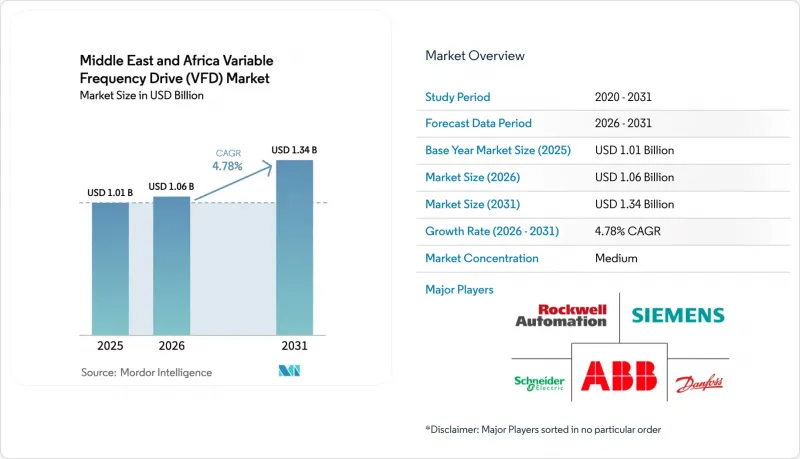
Mordor Intelligence에 의하면, 중동 및 아프리카의 가변 주파수 드라이브(VFD) 시장 규모는 2025년 10억 1,000만 달러로 평가되었습니다. 2026년에는 10억 6,000만 달러로 확대되어 2026-2031년에 걸쳐 CAGR 4.78%로 성장을 지속하여, 2031년까지 13억 4,000만 달러에 이를 것으로 예측됩니다.
본 보고서는 구동 방식(교류 드라이브, DC 드라이브, 서보 드라이브), 정격 출력(5kW 미만, 5-30kW, 30kW 이상), 전압(저전압 690V 이하, 중전압 690V 초과), 최종 사용자(석유 및 가스,화학제품 및 석유화학제품, 기타), 용도(펌프, 팬, 압축기, 기타), 지역별로 분류되어 있습니다. 시장 예측은 금액(달러) 기준으로 제시되어 있습니다.
중동 및 아프리카의 가변 주파수 드라이브(VFD) 시장 동향 및 인사이트
중동 및 아프리카 전역의 에너지 효율 규제 강화
GCC 정부는 현재 신규 설치에 대해 IE3 및 IE4 모터 효율 등급을 규정하고 있으며, 이에 따라 고성능 모터의 더 높은 돌입 전류 요건을 충족하기 위해 인버터 구동 시스템의 보급이 촉진되고 있습니다. 사우디아라비아와 아랍에미리트의 전력 회사 리베이트 프로그램으로 인해 HVAC 개조 시 투자 회수 기간이 3년 미만으로 단축되어, 고정 속도 스타터에서 최신 드라이브로의 교체가 가속화되고 있습니다. 오만의 계통 운영 사업자는 역률이 0.90을 초과할 경우 벌금을 부과하는 조치를 시행하고 있으며, 이로 인해 산업용 사용자들은 액티브 프론트 엔드 정류기가 탑재된 드라이브로 전환하도록 유도되고 있습니다. 다자간 개발 은행은 해수 담수화 및 폐수 처리에 대한 자금 지원 기준에 효율 목표를 반영하고 있으며, 가변 속도 제어는 대출 승인에 필수 조건이 되었습니다. 이러한 조치들이 결합되어 가변 주파수 드라이브(VFD) 시장에 예측 가능한 기반을 마련하는 동시에, 이미 도입된 설비의 점검 및 조정을 중심으로 한 서비스 생태계 육성을 촉진하고 있습니다.
해수 담수화 및 지역 냉방 인프라의 대규모 확충
사우디아라비아의 ‘국가 물 전략’에서는 2030년까지 하루 850만 m³의 해수 담수화 능력 확충을 목표로 하고 있으며,이는 역삼투 방식의 급수 회로와 염수 재순환 회로를 위해 5-75kW 펌프용 드라이브 수천 대가 필요함을 의미합니다. 두바이, 도하, 아부다비의 지역 냉방 사업자들은 스로틀 밸브에서 속도 제어 방식으로의 전환을 통해 20-30%의 에너지 절감 효과를 보고하고 있으며, 이는 자금 제공업체에게 투자 회수 가능성을 더욱 설득력 있게 제시하고 있습니다. 옥상 태양광 발전 및 폐열 회수의 통합으로 인해 부하 프로파일이 복잡해지고 있어, 캐비테이션을 일으키지 않으면서 가변 양압을 추적할 수 있는 디지털 드라이브의 필요성이 높아지고 있습니다. 사양서에는 현재 IEC 61800-9-2의 효율 등급이 일상적으로 기재되어 있으며, 조달 방향은 더 높은 등급의 컨버터 토폴로지로 향하고 있습니다. 냉수 네트워크가 NEOM이나 루사일과 같은 복합 용도의 메가 프로젝트로 확대됨에 따라, 가변 주파수 드라이브(VFD) 시장은 O&M(운영·유지보수) 수익을 확보하는 장기 양도 계약과 연계된 대량 수주를 확보하고 있습니다.
브렌트 원유 가격 변동에 따른 급격한 설비 투자 사이클
EIA의 예측에 따르면, 브렌트 원유 가격은 2025년에 배럴당 74달러에 도달했고 2026년에는 66달러까지 하락할 것으로 예상되며, 이로 인해 석유 의존도가 높은 경제권의 재정적 여유가 축소되어 자동화 예산이 연기될 것입니다. 프로젝트 중단은 중류 부문의 병목 현상 해소나 석유화학 플랜트 확장에 가장 신속하게 파급되어, 중전압 드라이브 수주에 직접적인 타격을 줄 것입니다. 공급업체들은 재고 위험을 헤지하기 위해 프레임 크기 통합을 우선시하고 있지만, LNG 플랜트의 계획 기간이 장기간에 걸쳐 있기 때문에 시기의 차이는 피할 수 없습니다. 신디케이트 대출 기관들은 유틸리티용 달러 표시 부채에 대해 신중한 태도를 강화하고 있어, 이로 인해 단기적인 입찰 물량이 더욱 줄어들고 있습니다. 그 결과, 전체 수명 주기에서 비용 절감 효과가 현저함에도 불구하고, 가변 주파수 드라이브(VFD) 시장에서는 분기별 수요에 편차가 나타나고 있습니다.
부문별 분석
교류 드라이브는 사막의 혹서나 정유시설의 가동 주기에서 입증된 내구성을 바탕으로 2025년 가변 주파수 드라이브(VFD) 시장 규모의 66.12% 점유율을 유지했습니다. 서보 드라이브는 태양광 추적기, 로봇 용접기, 픽 앤 플레이스 장치에서 1° 미만의 위치 결정 정밀도가 요구됨에 따라 연평균 성장률(CAGR) 5.63%를 기록했습니다. DC 드라이브는 토크 제어가 최우선으로 요구되는 광산용 윈치와 같은 틈새 시장에 국한되어 있습니다. 구동 장치의 구성은 진화하는 모터 규격도 반영하고 있습니다. IEC 인증을 받은 IE3 및 IE4 모터의 등장으로, 더 높은 자화 전류에 대응하기 위해 AC 인버터의 설계 조정이 필요해졌으며, 이로 인해 기존 공급업체들이 우위를 유지하고 있습니다.
지역 냉방 플랜트 및 식수 가압 펌프의 업그레이드 전망에 따라 2031년까지 교류 드라이브 출하량은 유지될 전망이지만, 매출 증가분은 엣지 분석 기능을 탑재한 서보 유닛에 편중되는 경향을 보이고 있습니다. 각 벤더사는 통합 패키지를 통해 교차 판매의 가능성을 열어가고 있습니다. ABB의 IE3 대응 제품 라인은 동기 릴랙턴스 모터와 최적화된 드라이브 펌웨어를 결합한 것이며, 한편 WEG의 축류형 모터와 CFW900 인버터의 조합은 옥상 설치형 태양광 트래커의 설치 면적을 축소합니다. 이러한 패키지화는 생태계의 정착도를 높이고, 가변 주파수 드라이브(VFD) 시장에서 서비스 계약의 확대로 이어집니다.
5-30kW 범위의 제품은 2025년 수요의 38.35%를 차지했으며, 이는 지역 냉방 루프 및 지자체 우물장의 펌프 크기와 일치합니다. 31-75kW 등급은 이집트와 모로코의 식품 가공 및 섬유 산업 등 중규모 산업 자동화를 주도하며, 연평균 성장률(CAGR) 5.78%로 가장 빠르게 성장하고 있습니다. 5kW 미만의 장치는 빌딩 관리 부문에서 보급이 확대되고 있으며, 75kW를 초과하는 프레임은 해수 담수화용 고압 펌프와 정유시설의 송풍기를 지원하고 있습니다.
NEOM과 같은 수소 허브는 수 메가와트급 제품에 대해 매우 큰 수요를 창출하고 있지만, 복잡한 EPC 주기가 수량 변동을 완화하고 있습니다. 한편, ISO 50001 에너지 목표 달성을 목표로 하는 중소기업 공장에서는 즉각적인 효과를 볼 수 있는 대책으로 중출력 드라이브가 채택되어, 꾸준한 성장을 뒷받침하고 있습니다. 지역 조립 제조업체들의 생산 능력 투자로 인해 37kW 스키드의 납기 기간이 4주로 단축되면서, 가변 주파수 드라이브(VFD) 시장의 중출력 부문에서 성장세가 더욱 가속화되고 있습니다.
기타 혜택
- 엑셀 형식 시장 예측(ME) 시트
- 3개월간의 애널리스트 지원
자주 묻는 질문
목차
제1장 서론
제2장 조사 방법
제3장 주요 요약
제4장 시장 구도
제5장 시장 규모 및 성장 예측
제6장 경쟁 구도
제7장 시장 기회 및 향후 전망
KTH 26.09.14According to Mordor Intelligence, the variable frequency drive market size in the Middle East and Africa is expected to grow from USD 1.01 billion in 2025 to USD 1.06 billion in 2026 and is forecast to reach USD 1.34 billion by 2031 at 4.78% CAGR over 2026-2031.
This report is Segmented by Drive Type (AC Drives, DC Drives, and Servo Drives), Power Rating (Below 5 KW, 5-30 KW, and More), Voltage (Low-Voltage <=690V and Medium-Voltage >690V), End-User (Oil and Gas, Chemicals and Petrochemicals, and More), Application (Pumps, Fans, Compressors, and More), and Region. The Market Forecasts are Provided in Terms of Value (USD).
Middle East And Africa Variable Frequency Drive (VFD) Market Trends and Insights
Intensifying Energy-Efficiency Mandates Across Middle East and Africa
Governments across GCC states now specify IE3 and IE4 motor efficiency classes for new installations, prompting widespread adoption of inverter-driven systems to match the higher in-rush requirements of premium motors. Utility rebate programs in Saudi Arabia and the UAE cut payback periods for HVAC retrofits to under three years, accelerating replacement of fixed-speed starters with modern drives. Grid operators in Oman have begun applying power-factor penalties above 0.90, nudging industrial users toward drives equipped with active front-end rectifiers. Multilateral development banks have embedded efficiency targets into desalination and wastewater funding criteria, making variable speed control a prerequisite for loan approval. Together, these policies create a predictable baseline for the variable frequency drive market while fostering a services ecosystem around inspection and tuning of installed bases.
Massive Build-Out of Desalination and District-Cooling Infrastructure
Saudi Arabia's National Water Strategy calls for 8.5 million m3/day of incremental desalination by 2030, translating into thousands of 5-75 kW pump drives for reverse-osmosis feed and brine recirculation circuits. District-cooling operators in Dubai, Doha, and Abu Dhabi report 20-30% energy savings after migrating from throttling valves to speed control, bolstering payback narratives for financiers. Integration of rooftop solar and waste-heat recovery complicates load profiles, heightening the need for digital drives that track variable head pressures without cavitation. Specifications now routinely cite IEC 61800-9-2 efficiency classes, steering procurement toward higher-grade converter topologies. As chilled-water networks extend to mixed-use megaprojects like NEOM and Lusail, the variable frequency drive market gains high-volume orders linked to long-dated concession agreements that secure O&M revenues.
Volatile Capex Cycles Tied to Brent-Crude Price Swings
EIA projections place Brent at USD 74 /bbl in 2025 before sliding to USD 66 /bbl in 2026, narrowing fiscal buffers for oil-weighted economies and leading to deferred automation budgets. Project cancellations ripple fastest through mid-stream debottlenecking and petrochemical expansions, directly denting medium-voltage drive orders. Suppliers prioritize frame-size consolidation to hedge inventory risk, yet long planning horizons for LNG trains make timing mismatches inevitable. Loan syndicates become cautious on dollar-denominated debt for utilities, further trimming near-term tender volumes. Consequently, the variable frequency drive market endures uneven quarterly demand despite compelling lifecycle savings.
Other drivers and restraints analyzed in the detailed report include:
- Rapid Solar-PV Integration Driving Need for Variable-Speed Motors
- Government-Funded Localization of Industrial Automation Manufacturing
- Fragmented Aftermarket Service Networks Outside GCC
For complete list of drivers and restraints, kindly check the Table Of Contents.
Segment Analysis
AC drives retained 66.12% share of the 2025 variable frequency drive market size thanks to proven durability in desert heat and refinery duty cycles. Servo drives posted a 5.63% CAGR as solar trackers, robotic welders, and pick-and-place units demanded sub-1° positioning accuracy. DC drives linger in niche mining hoists where torque control is paramount. The drive-type mix also reflects evolving motor standards; IEC-certified IE3 and IE4 motors prompt design tweaks in AC inverters to manage higher magnetizing currents, keeping established suppliers in pole position.
Projected upgrades across district-cooling plants and potable-water boosters sustain AC volume through 2031, yet incremental revenue skews toward servo units embedded with edge analytics. Vendors unlock cross-sell potential via integrated packages. ABB's IE3-ready line couples synchronous reluctance motors with tailored drive firmware, while WEG's axial-flux motor plus CFW900 inverter packs tighten the footprint for rooftop solar trackers. Such packaging deepens ecosystem stickiness and elevates service attachment in the variable frequency drive market.
Products spanning 5-30 kW met 38.35% of 2025 demand, mirroring pump sizes in district-cooling loops and municipal well fields. The 31-75 kW class lifts fastest at 5.78% CAGR, riding medium-scale industrial automation across food processing and textiles in Egypt and Morocco. Sub-5 kW units flourish in building management, while >75 kW frames anchor desalination high-pressure pumps and refinery blowers.
Hydrogen hubs like NEOM create outsized pull for multi-megawatt ratings, but complex EPC cycles temper volume swings. Conversely, SME factories chasing ISO 50001 energy targets adopt mid-range drives as quick wins, reinforcing steady expansion. Capacity investments by regional assemblers shorten delivery to four weeks for 37-kW skids, strengthening the variable frequency drive market's mid-band momentum.
Complete Report Scope:
- By Drive Type
- AC Drives
- DC Drives
- Servo Drives
- By Power Rating
- Below 5 kW
- 5 - 30 kW
- 31 - 75 kW
- Above 75 kW
- By Voltage
- Low-Voltage (<=690 V)
- Medium-Voltage (>690 V)
- By End-User
- Oil and Gas
- Chemicals and Petrochemicals
- Metals and Mining
- Power Generation
- Water and Wastewater
- HVAC
- Pulp and Paper
- Other End-User Industries
- By Application
- Pumps
- Fans
- Compressors
- Conveyors
- HVAC Systems
- Other Applications
- By Region
- Middle East
- Saudi Arabia
- United Arab Emirates
- Qatar
- Kuwait
- Rest of Middle East
- Africa
- South Africa
- Egypt
- Nigeria
- Algeria
- Rest of Africa
- Middle East
List of Companies Covered in this Report:
- ABB Ltd.
- Siemens AG
- Schneider Electric SE
- Rockwell Automation, Inc.
- Danfoss A/S
- Yaskawa Electric Corporation
- Toshiba Mitsubishi Electric Industrial Systems Corporation
- Mitsubishi Electric Corporation
- Fuji Electric Co., Ltd.
- Hitachi Energy Ltd.
- Nidec Corporation
- CG Power and Industrial Solutions Ltd.
- WEG S.A.
- Eaton Corporation plc
- Invertek Drives Ltd.
- Delta Electronics, Inc.
- LS Electric Co., Ltd.
- Bonfiglioli Riduttori S.p.A.
- SEW-Eurodrive GmbH and Co KG
- Leroy-Somer (Emerson Electric Co., Ltd.)
Additional Benefits:
- The market estimate (ME) sheet in Excel format
- 3 months of analyst support
TABLE OF CONTENTS
1 INTRODUCTION
- 1.1 Study Deliverables and Assumptions
- 1.2 Scope of the Study
2 RESEARCH METHODOLOGY
3 EXECUTIVE SUMMARY
4 MARKET LANDSCAPE
- 4.1 Market Overview
- 4.2 Market Drivers
- 4.2.1 Intensifying energy-efficiency mandates across Middle East and Africa
- 4.2.2 Massive build-out of desalination and district-cooling infrastructure
- 4.2.3 Rapid solar-PV integration driving need for variable-speed motors
- 4.2.4 Shift toward electric submersible pumps in mature oilfields
- 4.2.5 Government-funded localization of industrial automation manufacturing
- 4.2.6 Upcoming green-hydrogen mega-projects requiring medium-voltage VFDs
- 4.3 Market Restraints
- 4.3.1 Volatile capex cycles tied to Brent-crude price swings
- 4.3.2 Fragmented aftermarket service networks outside GCC
- 4.3.3 Limited grid-power quality hindering high-frequency inverter adoption
- 4.3.4 Persistent import tariffs on power-electronic components in Africa
- 4.4 Industry Value Chain Analysis
- 4.5 Regulatory Landscape
- 4.6 Technological Outlook
- 4.7 Impact of Macroeconomic Factors
- 4.8 Porter's Five Forces Analysis
- 4.8.1 Bargaining Power of Suppliers
- 4.8.2 Bargaining Power of Buyers
- 4.8.3 Threat of New Entrants
- 4.8.4 Threat of Substitutes
- 4.8.5 Intensity of Competitive Rivalry
5 MARKET SIZE AND GROWTH FORECASTS (VALUES)
- 5.1 By Drive Type
- 5.1.1 AC Drives
- 5.1.2 DC Drives
- 5.1.3 Servo Drives
- 5.2 By Power Rating
- 5.2.1 Below 5 kW
- 5.2.2 5 - 30 kW
- 5.2.3 31 - 75 kW
- 5.2.4 Above 75 kW
- 5.3 By Voltage
- 5.3.1 Low-Voltage (<=690 V)
- 5.3.2 Medium-Voltage (>690 V)
- 5.4 By End-User
- 5.4.1 Oil and Gas
- 5.4.2 Chemicals and Petrochemicals
- 5.4.3 Metals and Mining
- 5.4.4 Power Generation
- 5.4.5 Water and Wastewater
- 5.4.6 HVAC
- 5.4.7 Pulp and Paper
- 5.4.8 Other End-User Industries
- 5.5 By Application
- 5.5.1 Pumps
- 5.5.2 Fans
- 5.5.3 Compressors
- 5.5.4 Conveyors
- 5.5.5 HVAC Systems
- 5.5.6 Other Applications
- 5.6 By Region
- 5.6.1 Middle East
- 5.6.1.1 Saudi Arabia
- 5.6.1.2 United Arab Emirates
- 5.6.1.3 Qatar
- 5.6.1.4 Kuwait
- 5.6.1.5 Rest of Middle East
- 5.6.2 Africa
- 5.6.2.1 South Africa
- 5.6.2.2 Egypt
- 5.6.2.3 Nigeria
- 5.6.2.4 Algeria
- 5.6.2.5 Rest of Africa
- 5.6.1 Middle East
6 COMPETITIVE LANDSCAPE
- 6.1 Market Concentration
- 6.2 Strategic Moves
- 6.3 Market Share Analysis
- 6.4 Company Profiles (includes Global level Overview, Market level overview, Core Segments, Financials as available, Strategic Information, Market Rank/Share for key companies, Products and Services, and Recent Developments)
- 6.4.1 ABB Ltd.
- 6.4.2 Siemens AG
- 6.4.3 Schneider Electric SE
- 6.4.4 Rockwell Automation, Inc.
- 6.4.5 Danfoss A/S
- 6.4.6 Yaskawa Electric Corporation
- 6.4.7 Toshiba Mitsubishi Electric Industrial Systems Corporation
- 6.4.8 Mitsubishi Electric Corporation
- 6.4.9 Fuji Electric Co., Ltd.
- 6.4.10 Hitachi Energy Ltd.
- 6.4.11 Nidec Corporation
- 6.4.12 CG Power and Industrial Solutions Ltd.
- 6.4.13 WEG S.A.
- 6.4.14 Eaton Corporation plc
- 6.4.15 Invertek Drives Ltd.
- 6.4.16 Delta Electronics, Inc.
- 6.4.17 LS Electric Co., Ltd.
- 6.4.18 Bonfiglioli Riduttori S.p.A.
- 6.4.19 SEW-Eurodrive GmbH and Co KG
- 6.4.20 Leroy-Somer (Emerson Electric Co., Ltd.)
7 MARKET OPPORTUNITIES AND FUTURE OUTLOOK
- 7.1 White-space and Unmet-need assessment