
|
시장보고서
상품코드
2125296
아시아태평양의 유도 전동기 : 시장 점유율 분석, 업계 동향과 통계, 성장 예측(2026-2031년)Asia-Pacific Induction Motor - Market Share Analysis, Industry Trends & Statistics, Growth Forecasts (2026 - 2031) |
||||||
 Mordor Intelligence
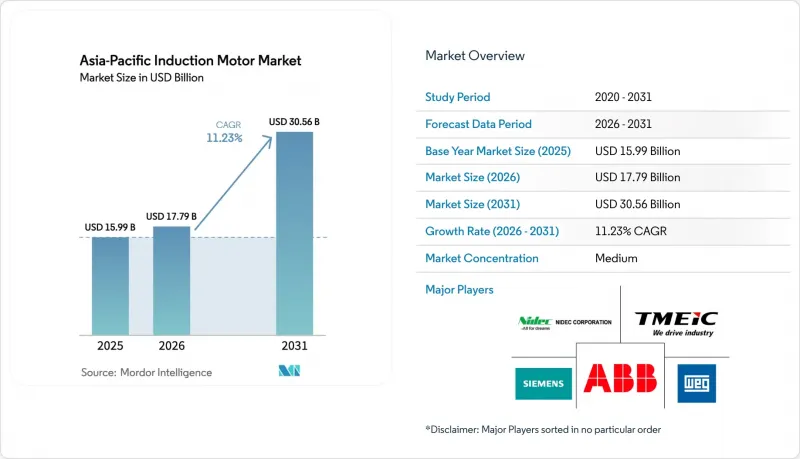
Mordor Intelligence에 따르면 아시아태평양의 유도 전동기 시장 규모는 2025년에 159억 9,000만 달러로 평가되며, 2026년 177억 9,000만 달러에서 2031년까지 305억 6,000만 달러에 달할 것으로 추정되고 있으며, 예측 기간(2026-2031년)에 CAGR은 11.23%에 달할 전망입니다.
이 보고서는 상수(단상 유도 전동기 및 3상 유도 전동기), 정격 출력(0.5 kW 미만, 0.5 kW-7.5 kW, 7.5 kW-37 kW, 37 kW-75 kW 및 75 kW 이상),효율 등급(IE1, IE2, IE3, IE4), 최종사용자 산업(석유 및 가스, 발전, 화학·석유화학, 기타) 및 지역별로 분류되어 있습니다. 시장 예측은 금액(달러) 기준으로 제시되어 있습니다.
아시아태평양 유도 전동기 시장의 동향 및 인사이트
더 높은 에너지 효율에 대한 수요 증가
전력 회사의 수요 반응 프로그램, 탄소 가격 책정 메커니즘, 그리고 기업의 탄소 중립 공약에 따라 아시아태평양 유도 전동기 시장 전반에서 에너지 효율이 조달 기준의 최우선 과제가 되고 있습니다. 전동기 구동 시스템은 전 세계 전력의 약 45%를 소비하고 있으며, 효율 향상은 전력계통의 안정성과 배출량 감축에 매우 중요합니다. 비정질 금속 코어 및 최적화된 자기 회로와 같은 기술적 진보로 인해 효율은 IE4 수준을 상회하는 수준에 도달했습니다. 히타치의 방사형 갭형 프로토타입은 20,000 rpm에서 95%의 효율을 달성하는 동시에 기존 모터의 5분의 1에 불과한 부피만을 차지합니다. 가변 주파수 드라이브 및 스마트 제어 알고리즘과 결합함으로써, 이러한 혁신 기술은 광업, 석유 화학, 데이터 처리 등 에너지 집약적 부문에서 신속한 투자 회수를 가져옵니다. 경제적 인센티브와 환경적 인센티브의 융합을 통해 중기적으로는 프리미엄급 모터에 대한 안정적인 수요가 확보될 것입니다.
아시아태평양의 정부 에너지 효율 규제
규제 기준은 아시아태평양의 유도 전동기 시장을 더 높은 효율 등급으로 이끄는 데 매우 중요합니다. 중국에서는 대부분의 산업용 분야에서 IE3를 최저 기준으로 시행하고 있으며, 일본의 탑러너 제도에서는 기준치가 지속적으로 상향 조정되고 있습니다. 또한 호주에서는 0.73 kW를 초과하는 전동기에 대해 특정 효율 기준이 의무화되어 있습니다. 이러한 정책은 규제 준수를 목적으로 한 교체 주기를 유발하며, 각 OEM 업체들은 규제 대상 시장을 위한 장비에 IE3 및 IE4 전동기를 탑재할 수밖에 없게 되었습니다. 아세안(ASEAN)내 규제 조화에 관한 논의는 유사한 규정의 더 광범위한 채택을 시사하고 있으며, 이로 인해 동남아시아 전역에서 고성능 모터에 대한 수요가 확대될 것으로 예상됩니다. 조기에 제품 라인을 이에 대응하도록 조정하는 제조사는 시장 점유율을 확보할 뿐만 아니라, 엄격한 기한에 직면한 최종사용자의 개조 복잡성을 완화할 수 있습니다.
영구자석 동기 모터의 대체품 가용성
영구 자석 동기 모터(PMSM)는 높은 출력 밀도와 뛰어난 부분 부하 효율을 자랑하며, 이로 인해 정밀 속도 제어 분야에서 유도 모터의 시장 점유율을 잠식하고 있습니다. 중국 자동차 제조사인 GAC가 개발한 효율 98.5%의 e-드라이브는 PMSM의 성능적 우위와 희토류 가격 안정화에 따른 비용 수렴을 입증하고 있습니다. 로봇 공학 및 서보 응용 분야에서 PMSM은 마이크로초 단위의 응답 시간과 소형화를 실현하여 구매자들의 선호도를 유도 모터 기술에서 멀어지게 하고 있습니다. 유도 모터 공급업체들은 하이브리드 설계 및 제어 소프트웨어 개선을 통해 대응하고 있지만, 특히 프리미엄 파워 분야에서는 여전히 경쟁이 지속되고 있습니다.
부문 분석
2025년, 아시아태평양의 유도 전동기 시장에서 3상 전동기는 78.62%의 시장 점유율을 확보하며, 균형 잡힌 전력 공급과 견고한 토크를 중시하는 산업용 운영에서 그 중심적인 역할을 부각시켰습니다. 제조 거점의 자동화 진전에 따라 아시아태평양의 3상 유도 전동기 시장 규모는 꾸준히 확대될 것으로 예상됩니다. 나머지 21.38%를 차지하는 단상 유도 전동기는 설치가 용이하고 표준 상용 전원과 호환성이 높다는 장점을 살려, 분산형 제조 및 주거용 자동화 분야에서 빠르게 보급되고 있습니다.
산업용 로봇, 정밀 가공, 컨베이어 시스템은 특히 중국, 일본, 한국에서 3상 모터 수요를 지속적으로 지원하고 있습니다. 한편, 동남아시아의 소규모 작업장, 주거용 공조(HVAC), 엣지 컴퓨팅 설비의 도입 확대가 단상 모터의 보급을 두 자릿수 연평균 성장률(CAGR)로 견인하고 있습니다. 각 공급업체는 상(相)의 유형에 따라 마케팅 전략을 조정하고 있으며, 3상 모터 구매자에게는 내구성과 정교한 제어 기능을 어필하는 한편, 단상 모터의 잠재 고객에게는 가격과 플러그 앤 플레이의 편의성을 강조하고 있습니다.
2025년, 0.5 kW-7.5 kW 출력 대역은 아시아태평양 유도 전동기 시장 규모의 33.25%를 차지하며, 이는 보조 펌프, 압축기, 범용 기계 등에 대한 도입이 반영된 결과입니다. 0.5kW 미만 기종의 경우, 시장 규모는 작지만 소형 IoT 기기 및 소형화된 HVAC 시스템의 보급에 힘입어 연평균 성장률(CAGR) 11.52%를 기록할 것으로 예측됩니다.
75 kW를 초과하는 고출력 부문은 대규모 광업, 석유화학, 발전 용도에 대응하고 있으나, 설비 용량의 증가세가 완만하고 신규 건설보다 효율 향상을 우선시하는 경향이 있으며, 성장 속도는 제한적입니다. 한편, 자성 재료 및 냉각 기술의 발전으로 전력 밀도가 향상되어, 기존에는 더 큰 프레임으로만 가능했던 작업을 정격이 낮은 모터로도 수행할 수 있게 되었습니다. 이러한 진화는 아시아태평양 유도 전동기 시장에서 ‘이중 성장’이라는 추세를 더욱 강화하고 있습니다.
기타 혜택:
- 엑셀 형식의 시장 예측(ME) 시트
- 3개월간의 애널리스트 지원
자주 묻는 질문
목차
제1장 서론
제2장 조사 방법
제3장 개요
제4장 시장 구도
제5장 시장 규모와 성장 예측
제6장 경쟁 구도
제7장 시장 기회와 향후 전망
KSA 26.09.08According to Mordor Intelligence, the Asia Pacific induction motor market size was valued at USD 15.99 billion in 2025 and estimated to grow from USD 17.79 billion in 2026 to reach USD 30.56 billion by 2031, at a CAGR of 11.23% during the forecast period (2026-2031).
This report is Segmented by Phase (Single Phase Induction Motor, and Three Phase Induction Motor), Power Rating (Below 0. 5 KW, 0. 5 KW - 7. 5 KW, 7. 5 KW - 37 KW, 37 KW - 75 KW, and Above 75 KW), Efficiency Class (IE1, IE2, IE3, IE4), End-User Industry (Oil and Gas, Power Generation, Chemical and Petrochemical, and More), and Geography. The Market Forecasts are Provided in Terms of Value (USD).
Asia-Pacific Induction Motor Market Trends and Insights
Increasing Need for Higher Energy Efficiency
Utility demand-response programs, carbon pricing mechanisms, and corporate net-zero pledges elevate energy efficiency to the top of procurement criteria across the Asia Pacific induction motor market. Motor-driven systems consume nearly 45% of the world's power, making efficiency gains pivotal for grid stability and reducing emissions. Advances such as amorphous-metal cores and optimized magnetic circuits push efficiencies beyond IE4 levels. Hitachi's radial-gap prototype achieves 95% efficiency at 20,000 rpm, while occupying one-fifth the volume of conventional motors. Coupled with variable-frequency drives and smart control algorithms, these innovations yield rapid paybacks in energy-intensive sectors including mining, petrochemicals, and data processing. The convergence of economic and environmental incentives secures steady demand for premium-class motors over the medium term.
Government Energy-Efficiency Mandates Across the Asia Pacific
Regulatory standards are pivotal in steering the Asia Pacific induction motor market toward higher efficiency classes. China enforces IE3 as the minimum standard for most industrial applications, Japan's Top Runner program continually raises benchmarks, and Australia mandates specific efficiency thresholds for motors exceeding 0.73 kW. These policies trigger compliance-driven replacement cycles, compelling OEMs to integrate IE3 and IE4 motors into equipment destined for regulated markets. Harmonization discussions within ASEAN are pointing to the broader adoption of similar rules, which is expected to amplify demand for premium motors across Southeast Asia. Manufacturers that align product lines early capture share and reduce retrofit complexity for end users facing binding deadlines.
Availability of Permanent-Magnet Synchronous Motor Alternatives
Permanent-magnet synchronous motors (PMSMs) boast higher power density and superior part-load efficiency, thereby eroding the induction motor's share in precision-speed applications. Chinese automaker GAC's 98.5% efficient e-drive demonstrates PMSM performance advantages and cost convergence as rare-earth prices stabilize. In robotics and servo duties, PMSMs offer microsecond response times, along with smaller footprints, tilting buyer preference away from induction technology. Induction suppliers counter with hybrid designs and control-software enhancements, yet the competitive threat persists, particularly in premium power segments.
Other drivers and restraints analyzed in the detailed report include:
- Accelerating Industrial Automation Investments
- Rapid Growth in Data Center Construction Across Southeast Asia
- High Initial Cost of Premium-Efficiency (IE4) Induction Motors
For complete list of drivers and restraints, kindly check the Table Of Contents.
Segment Analysis
Three-phase motors secured a 78.62% market share in the Asia Pacific induction motor market in 2025, underscoring their centrality to industrial operations that value balanced power delivery and robust torque. The Asia Pacific induction motor market size for three-phase units is expected to expand steadily as automation intensifies in manufacturing hubs. Single-phase motors, which hold the remaining 21.38%, are rapidly scaling across distributed manufacturing and residential automation, benefiting from their straightforward installation and compatibility with standard utility feeds.
Industrial robotics, precision machining, and conveyor systems continue to anchor three-phase demand, particularly in China, Japan, and South Korea. Conversely, the growth of small workshops, residential HVAC, and edge-computing installations in Southeast Asia propels single-phase uptake at a double-digit CAGR. Suppliers tailor marketing strategies by phase, promoting durability and control sophistication for three-phase buyers while emphasizing price and plug-and-play convenience for single-phase prospects.
The 0.5 kW - 7.5 kW bracket commanded 33.25% of the Asia Pacific induction motor market size in 2025, reflecting its deployment across auxiliary pumps, compressors, and general-purpose machinery. Sub-0.5 kW units, though smaller in value, are projected to register an 11.52% CAGR as compact IoT devices and miniaturized HVAC systems proliferate.
High-power segments above 75 kW cater to large-scale mining, petrochemical, and power generation duties, yet modest capacity additions and a preference for efficiency upgrades over new builds cap their growth pace. In parallel, advances in magnetic materials and cooling techniques elevate power density, enabling lower-rating motors to perform tasks once reserved for larger frames. This evolution reinforces the twin-track growth narrative of the Asia Pacific induction motor market.
Complete Report Scope:
- By Phase
- Single Phase Induction Motor
- Three Phase Induction Motor
- By Power Rating
- Below 0.5 kW
- 0.5 kW - 7.5 kW
- 7.5 kW - 37 kW
- 37 kW - 75 kW
- Above 75 kW
- By Efficiency Class
- IE1 Standard Efficiency
- IE2 High Efficiency
- IE3 Premium Efficiency
- IE4 Super Premium Efficiency
- By End-User Industry
- Oil and Gas
- Chemical and Petrochemical
- Power Generation
- Water and Wastewater
- Metal and Mining
- Food and Beverage
- Discrete Manufacturing
- Heating, Ventilation and Air-Conditioning (HVAC)
- Other End-User Industries
- By Country
- China
- India
- Japan
- South Korea
- Australia and New Zealand
- Rest of Asia Pacific
List of Companies Covered in this Report:
- ABB Ltd.
- Siemens AG
- Nidec Corporation
- Toshiba Mitsubishi-Electric Industrial Systems Corporation (TMEIC)
- WEG S.A.
- Regal Rexnord Corporation
- Fuji Electric Co., Ltd.
- Kirloskar Electric Company Limited
- SEALOCEAN Motor Co., Ltd.
- TECO Electric and Machinery Co., Ltd.
- Hyundai Electric and Energy Systems Co., Ltd.
- CG Power and Industrial Solutions Limited
- Brook Crompton Asia Pacific Pte. Ltd.
- Leroy-Somer (Nidec Leroy-Somer Holding)
- Toshiba Corporation
- Mitsubishi Electric Corporation
- Schneider Electric SE
- Lafert Group S.p.A.
- Bharat Bijlee Limited
- Marathon Electric India Pvt. Ltd.
Additional Benefits:
- The market estimate (ME) sheet in Excel format
- 3 months of analyst support
TABLE OF CONTENTS
1 INTRODUCTION
- 1.1 Study Assumptions and Market Definition
- 1.2 Scope of the Study
2 RESEARCH METHODOLOGY
3 EXECUTIVE SUMMARY
4 MARKET LANDSCAPE
- 4.1 Market Overview
- 4.2 Market Drivers
- 4.2.1 Increasing Need for Higher Energy Efficiency
- 4.2.2 Rising Demand for Power Savings in Residential and Industrial Sectors
- 4.2.3 Government Energy-Efficiency Mandates Across Asia Pacific
- 4.2.4 Accelerating Industrial Automation Investments
- 4.2.5 Rapid Growth in Data Center Construction Across Southeast Asia
- 4.2.6 Plug-and-Play IE4 Motor Retrofits in Brownfield Facilities
- 4.3 Market Restraints
- 4.3.1 Availability of Permanent-Magnet Synchronous Motor Alternatives
- 4.3.2 High Initial Cost of Premium-Efficiency (IE4) Induction Motors
- 4.3.3 Grid Instability in Emerging Economies Limiting Large-Motor Deployment
- 4.3.4 Inverter-Driven Harmonics Causing Early Motor Failures
- 4.4 Industry Value Chain Analysis
- 4.5 Regulatory Landscape
- 4.6 Technological Outlook
- 4.7 Impact of Macroeconomic Factors
- 4.8 Porter's Five Forces Analysis
- 4.8.1 Bargaining Power of Suppliers
- 4.8.2 Bargaining Power of Buyers/Consumers
- 4.8.3 Threat of New Entrants
- 4.8.4 Threat of Substitutes
- 4.8.5 Intensity of Competitive Rivalry
5 MARKET SIZE AND GROWTH FORECASTS (VALUE)
- 5.1 By Phase
- 5.1.1 Single Phase Induction Motor
- 5.1.2 Three Phase Induction Motor
- 5.2 By Power Rating
- 5.2.1 Below 0.5 kW
- 5.2.2 0.5 kW - 7.5 kW
- 5.2.3 7.5 kW - 37 kW
- 5.2.4 37 kW - 75 kW
- 5.2.5 Above 75 kW
- 5.3 By Efficiency Class
- 5.3.1 IE1 Standard Efficiency
- 5.3.2 IE2 High Efficiency
- 5.3.3 IE3 Premium Efficiency
- 5.3.4 IE4 Super Premium Efficiency
- 5.4 By End-User Industry
- 5.4.1 Oil and Gas
- 5.4.2 Chemical and Petrochemical
- 5.4.3 Power Generation
- 5.4.4 Water and Wastewater
- 5.4.5 Metal and Mining
- 5.4.6 Food and Beverage
- 5.4.7 Discrete Manufacturing
- 5.4.8 Heating, Ventilation and Air-Conditioning (HVAC)
- 5.4.9 Other End-User Industries
- 5.5 By Country
- 5.5.1 China
- 5.5.2 India
- 5.5.3 Japan
- 5.5.4 South Korea
- 5.5.5 Australia and New Zealand
- 5.5.6 Rest of Asia Pacific
6 COMPETITIVE LANDSCAPE
- 6.1 Market Concentration
- 6.2 Strategic Moves
- 6.3 Market Share Analysis
- 6.4 Company Profiles (includes Global Level Overview, Market Level Overview, Core Segments, Financials as available, Strategic Information, Market Rank/Share for key companies, Products and Services, and Recent Developments)
- 6.4.1 ABB Ltd.
- 6.4.2 Siemens AG
- 6.4.3 Nidec Corporation
- 6.4.4 Toshiba Mitsubishi-Electric Industrial Systems Corporation (TMEIC)
- 6.4.5 WEG S.A.
- 6.4.6 Regal Rexnord Corporation
- 6.4.7 Fuji Electric Co., Ltd.
- 6.4.8 Kirloskar Electric Company Limited
- 6.4.9 SEALOCEAN Motor Co., Ltd.
- 6.4.10 TECO Electric and Machinery Co., Ltd.
- 6.4.11 Hyundai Electric and Energy Systems Co., Ltd.
- 6.4.12 CG Power and Industrial Solutions Limited
- 6.4.13 Brook Crompton Asia Pacific Pte. Ltd.
- 6.4.14 Leroy-Somer (Nidec Leroy-Somer Holding)
- 6.4.15 Toshiba Corporation
- 6.4.16 Mitsubishi Electric Corporation
- 6.4.17 Schneider Electric SE
- 6.4.18 Lafert Group S.p.A.
- 6.4.19 Bharat Bijlee Limited
- 6.4.20 Marathon Electric India Pvt. Ltd.
7 MARKET OPPORTUNITIES AND FUTURE OUTLOOK
- 7.1 White-Space and Unmet-Need Assessment