|
시장보고서
상품코드
2125354
재활용 탄소섬유 시장 : 시장 점유율 분석, 업계 동향 및 통계, 성장 예측(2026-2031년)Recycled Carbon Fiber - Market Share Analysis, Industry Trends & Statistics, Growth Forecasts (2026 - 2031) |
||||||
 Mordor Intelligence
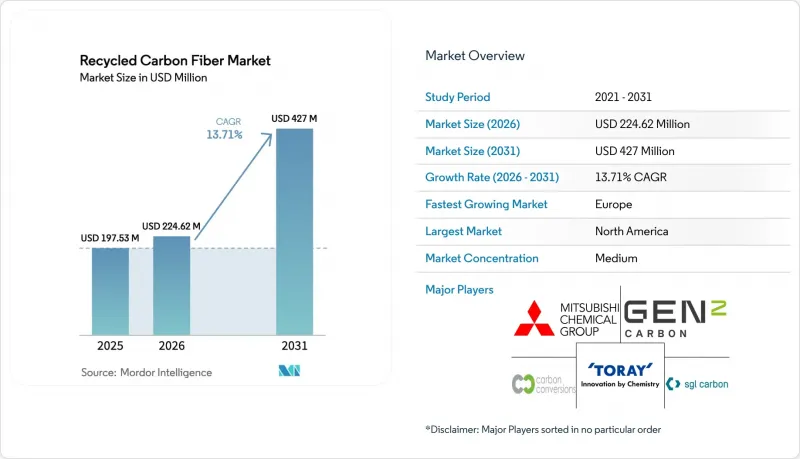
Mordor Intelligence에 의하면, 재활용 탄소섬유 시장 규모는 2025년에 1억 9,753만 달러로 평가되었고, 2026년 2억 2,462만 달러에서 2031년까지 4억 2,700만 달러에 이를 것으로 예측되며, 예측 기간(2026-2031년) CAGR은 13.71%를 나타낼 전망입니다.
본 보고서는 제품 유형별(절단·분쇄), 공급원별(항공우주 등), 재활용 공정별(열분해 등), 매트릭스 적합성별(열경화성 수지·열가소성 수지), 최종 사용자 산업별(자동차, 항공우주 및 방위 등), 지역별(아시아, 북미, 유럽, 남미, 중동 및 아프리카)로 분류되어 있습니다. 시장 예측은 금액(달러) 기준으로 제시되어 있습니다.
세계의 재활용 탄소섬유 시장 동향 및 인사이트
유럽·미국의 순환형 경제 의무화
확대 생산자 책임(EPR) 지침에 따라 복합재료 제조업체는 회수 체계에 자금을 출연해야 합니다. 2024년에 개정된 EU 폐기물 기본 지침에서는 2030년까지 탄소섬유 복합재료의 재활용률을 30%로 높이는 것이 의무화되어 있으며, 독일의 VerpackG(포장물법)에서는 규정을 준수하지 않는 제품에 대해 1톤당 120유로의 과징금이 부과됩니다. 미국에서는 캘리포니아주 상원 법안 제54호에 따라 제조업체는 2028년까지 탄소섬유 함량의 25%에 대해 순환형 재활용을 실현해야 할 의무가 있습니다. 이러한 조치로 인해 서유럽의 매립 처리 비용은 톤당 95유로로 인상되었으며, 비용 면에서의 우위가 인증된 재활용 업체 쪽으로 기울고 있습니다. 그 결과, 가공업체들은 2025년 4분기 이후 장기 스크랩 공급 계약이 40% 증가했다고 보고하고 있습니다.
OEM의 넷제로 목표가 전기차(EV)의 재활용 탄소섬유(rCF) 함유율을 끌어올립니다.
각 자동차 제조업체는 스코프 3 목표를 달성하기 위해 배터리 케이스 및 화이트 바디 부품에 재활용 탄소섬유를 적용하고 있습니다. BMW의 iX는 15%의 재활용 탄소섬유를 사용하여 차량당 내재된 탄소 배출량을 2.3 kg CO2-eq 줄였습니다. 한편, 메르세데스-벤츠는 2030년까지 EQ 모델 전체에서 재활용 복합재 사용 비율을 40%로 높일 계획입니다. 테슬라의 베를린 공장에서는 항공우주 분야의 스크랩을 처리하는 현지 열분해 업체로부터 조달한, 절단된 재활용 탄소섬유를 사용한 언더바디 실드 시험을 시작했습니다. 재활용 등급의 가격은 1kg당 18달러로, 버진 토우에 비해 35% 할인된 가격이며, 금형 통합을 고려하면 알루미늄 압출재와 비용 면에서 경쟁할 수 있는 수준입니다.
대체 경량 소재의 가용성
비용 중심의 자동차 프로젝트에서는 알루미늄, 마그네슘, 유리 섬유가 여전히 재활용 탄소섬유보다 가격 면에서 우위를 점하고 있습니다. 2025년 알루미늄 6000계 압출 성형품의 가격은 Kg당 4.20달러로, 재활용 탄소섬유의 약 5분의 1 수준이었습니다. 북미에서는 작년에 마그네슘 다이캐스팅 수요가 18% 증가하여, 과거 복합재료용으로 할당되었던 전기차 배터리 하우징 수주를 채우고 있습니다. Kg당 2.80달러인 유리섬유 시트 성형 컴파운드는 비구조용 패널의 충돌 에너지 흡수 요건을 충족하고 있으며, 재활용 탄소섬유 시장 침투는 40%의 밀도 우위를 통해 가격 부담을 상쇄할 수 있는 부품으로 제한되고 있습니다. 아시아에서는 조달 결정에 있어 수명 주기 탄소 지표의 중요성이 상대적으로 낮기 때문에 대체재의 위협이 더욱 커지고 있습니다.
부문 분석
2025년 시점에서 잘게 자른 섬유는 재활용 탄소섬유 시장의 61.65% 점유율을 차지했으며, 연평균 성장률(CAGR) 13.91%로 확대될 것으로 예측됩니다. 이에 따라 사출 성형 및 압축 성형 분야에서 주요 보강재로서의 입지가 더욱 공고해질 것입니다. 대부분의 열분해 라인에서는 열가소성 컴파운드 내에서 유동성이 높은 3-12mm 길이의 섬유가 자연적으로 생성되기 때문에 마그나(Magna)와 같은 자동차 1차 공급업체는 금형을 변경하지 않고도 유리섬유 부품에 비해 15-20%의 경량화를 실현할 수 있습니다.
분쇄 섬유는 여전히 틈새 시장에 머물러 있으며, 인장 성능보다는 균일한 분산성을 중시하는 도료, 접착제, 3D 프린팅용 필라멘트의 원료로 활용되고 있습니다. 향후 성장은 적층 가공(애디티브 매뉴팩처링) 수요와, 반구조 부품에 적합한 더 긴 섬유를 생성할 수 있는 용매 분해 기술의 비약적인 발전에 달려 있습니다. 만약 15-25 mm 길이의 섬유 사용 비율이 확대된다면, 잘게 자른 섬유는 특히 연속 섬유의 적층 없이 높은 탄성률을 요구하는 설계자가 많은 배터리 케이스의 리브 분야에서 더욱 치열한 경쟁에 직면할 가능성이 있습니다.
항공우주 분야의 스크랩은 원료의 45.82%를 차지했으며, 아시아태평양의 항공기 퇴역 및 보잉 787·에어버스 A350 생산 라인에서 발생하는 안정적인 트리밍 폐기물에 힘입어 2031년까지 연평균 성장률(CAGR) 14.44%로 성장할 전망입니다. 항공우주용 프리프레그의 수지 함량은 35% 미만이며, 이로 인해 열분해 후 섬유 수율은 92%를 초과하여 25-30%의 가격 프리미엄이 정당화됩니다.
자동차 및 풍력 발전 스크랩은 처리량은 많지만 순도가 낮기 때문에 재활용 업체는 불순물을 제거하기 위한 전처리를 할 수밖에 없습니다. 유럽의 풍력 터빈이 수명을 다함에 따라 블레이드 폐기물이 급증하여 처리량은 늘어나겠지만, 고온 열분해나 용매 분해 라인을 갖추지 않은 소규모 사업자에게는 과제가 될 것입니다. 스포츠 용품 스크랩은 분산되어 있고 소량이지만, 2025년에 시작되는 브랜드 회수 프로그램에 따라 예측 기간 동안 수거량이 개선될 가능성이 있습니다.
지역별 분석
2025년에는 북미가 매출의 38.15%를 차지하며 1위를 차지했습니다. 이는 고품질 스크랩을 공급하는 항공우주 산업의 거점과, 새로운 재활용 역량을 지원하는 연방 세액 공제에 힘입은 결과입니다. 보잉사는 복합재료 폐기물의 68%를 재활용 업체에 위탁했으며, 미국 에너지부는 열분해 및 용매 분해 프로젝트에 대한 공동 자금으로 8,500만 달러를 지원하여 기계적 파쇄 방식에서 벗어나는 전환을 가속화했습니다. 캐나다의 1차 공급업체는 재활용된 탄소섬유를 사용한 배터리 트레이 성형을 시작했습니다. 한편, 멕시코의 항공우주 클러스터에서는 생산 과정에서 발생하는 잔재물을 미국의 용해로에 공급하고 있습니다.
유럽에서는 확대 생산자 책임(EPR) 규제가 본격화되고 풍력 터빈 블레이드의 철거가 가속화됨에 따라 연평균 성장률(CAGR) 14.99%의 궤도에 올랐습니다. 독일은 열분해 능력을 연간 1만 8,000톤으로 확대했고, 프랑스는 전기차(EV) 부품용 폐쇄형 공급망을 구축했으며, 영국은 에어버스 객실 칸막이판에 적합한 용매 분해 섬유의 실증 실험을 진행했습니다. 북유럽 국가들은 잘게 자른 섬유를 이탈리아와 독일의 컴파운더에 수출하여 블레이드 폐기물을 수익화하고 있는 반면, 스페인은 자전거 산업의 거점을 중심으로 스포츠 용품 재활용을 확대되고 있습니다.
아시아태평양은 스크랩 발생과 수요가 교차하는 지점에 위치해 있습니다. 철도 및 자동차 부품용 재활용 탄소섬유에 관한 중국의 기준안, 일본의 생산 능력 35% 증대, 그리고 한국의 ‘아이오닉 6’용 재생 등급 인증이 이 지역의 성장세를 뒷받침하고 있습니다. 그러나 동남아시아와 인도에서 수거 체계가 분산되어 있고 처리 능력이 제한적이어서 본격적인 확장이 지연되고 있으며, 국경을 넘어 스크랩을 집약할 수 있는 신규 진출기업에게 진입의 여지가 생기고 있습니다.
기타 혜택 :
- 엑셀 형식 시장 예측(ME) 시트
- 3개월간의 애널리스트 지원
자주 묻는 질문
목차
제1장 서론
제2장 조사 방법
제3장 주요 요약
제4장 시장 구도
제5장 시장 규모 및 성장 예측
제6장 경쟁 구도
제7장 시장 기회 및 향후 전망
AJY 26.09.15According to Mordor Intelligence, the recycled carbon fiber market size was valued at USD 197.53 million in 2025 and is estimated to grow from USD 224.62 million in 2026 to reach USD 427 million by 2031, at a CAGR of 13.71% during the forecast period (2026-2031).
This report is Segmented by Product Type (Chopped and Milled), Source (Aerospace, and More), Recycling Process (Pyrolysis and More), Matrix Compatibility (Thermoset and Thermoplastic), End-User Industry (Automotive, Aerospace and Defense, and More), and Geography (Asia, North America, Europe, South America, and Middle-East and Africa). The Market Forecasts are Provided in Terms of Value (USD).
Global Recycled Carbon Fiber Market Trends and Insights
Circular-Economy Mandates in Europe and America
Extended Producer Responsibility directives are forcing composite producers to finance take-back schemes. The EU Waste Framework Directive, revised in 2024, requires a 30% recycling rate for carbon-fiber composites by 2030, and Germany's VerpackG collects a EUR 120 per-ton levy on non-compliant products. In the United States, California Senate Bill 54 compels manufacturers to close the loop on 25% of carbon-fiber content by 2028. These measures raise landfill tipping fees to EUR 95 per ton in Western Europe, tilting the cost equation in favor of certified recyclers. As a result, processors report a 40% jump in long-term scrap-supply contracts since Q4 2025.
OEM Net-Zero Targets Boosting rCF Content in EVs
Automakers are embedding recycled carbon fiber into battery enclosures and body-in-white parts to hit Scope 3 goals. BMW's iX uses 15% recycled carbon fiber, trimming embodied carbon by 2.3 kg CO2-eq per vehicle, while Mercedes-Benz plans 40% recycled composite across EQ models by 2030. Tesla's Berlin plant started underbody shield trials with chopped recycled carbon fiber sourced from a local pyrolysis operator that processes aerospace scrap. Recycled grades command USD 18 per kilogram, a 35% discount to virgin tow, making them cost-competitive with aluminum extrusions when tooling consolidation is factored in.
Availability of Substitute Lightweight Materials
Aluminum, magnesium, and glass fiber still undercut recycled carbon fiber on price in cost-sensitive automotive programs. Aluminum 6000-series extrusions stood at USD 4.20 per kilogram in 2025, roughly one-fifth of recycled carbon fiber. Magnesium die-castings grew 18% in North America last year, filling EV battery-enclosure orders once earmarked for composites. Glass-fiber sheet-molding compounds at USD 2.80 per kilogram satisfy crash-energy needs in non-structural panels, limiting recycled carbon fiber market penetration to parts where its 40% density advantage offsets the premium. The substitution threat is magnified in Asia, where lifecycle-carbon metrics carry less weight in sourcing decisions.
Other drivers and restraints analyzed in the detailed report include:
- End-of-Life Wind-Turbine Blades Creating High-Grade Scrap
- Accelerating Aircraft Retirements in Asia-Pacific Unlocking Aerospace Scrap
- Fragmented Scrap-Collection Logistics
For complete list of drivers and restraints, kindly check the Table Of Contents.
Segment Analysis
Chopped fiber commanded 61.65% of the recycled carbon fiber market share in 2025 and is projected to climb at a 13.91% CAGR, reinforcing its status as the go-to reinforcement for injection and compression molding. Most pyrolysis lines naturally produce 3-12 mm fibers that flow easily in thermoplastic compounds, allowing automotive tier-ones such as Magna to cut 15-20% weight versus glass-fiber parts without retooling.
Milled fiber remains a niche, feeding coatings, adhesives, and 3D-printing filaments that value uniform dispersion over tensile performance. Growth depends on additive-manufacturing demand and on solvolysis breakthroughs that can deliver longer fibers suitable for semi-structural parts. If 15-25 mm retention scales, chopped fiber may face stiffer competition, particularly in battery-enclosure ribs where designers seek higher modulus without continuous-fiber lay-up.
Aerospace scrap delivered 45.82% of feedstock and will grow at a 14.44% CAGR through 2031, buoyed by Asia-Pacific fleet retirements and steady trimming waste from Boeing's 787 and Airbus A350 lines. Aerospace prepregs carry resin contents below 35%, which raises fiber yield above 92% after pyrolysis and justifies a 25-30% price premium.
Automotive and wind-energy scrap offer higher tonnage but lower purity, saddling recyclers with pre-processing to strip contaminants. Blade waste will rise sharply as European turbines reach end-of-life, creating volume but challenging small operators that lack high-temperature pyrolysis or solvolysis lines. Sporting goods scrap is dispersed and small-batch, though brand take-back programs initiated in 2025 could improve aggregation over the forecast period.
Complete Report Scope:
- By Product Type
- Chopped Recycled Carbon Fiber
- Milled Recycled Carbon Fiber
- By Source
- Aerospace Scrap
- Automotive Scrap
- Other Sources
- By Recycling Process
- Pyrolysis
- Solvolysis / Chemical Recycling
- Mechanical Shredding and Milling
- By Matrix Compatibility
- Thermoset Composites
- Thermoplastic Composites
- By End-user Industry
- Automotive
- Aerospace and Defense
- Wind Energy
- Sporting Goods
- Others
- By Geography
- Asia
- China
- Japan
- India
- South Korea
- Southeast Asia
- Rest of Asia
- North America
- United States
- Canada
- Mexico
- Europe
- Germany
- United Kingdom
- France
- Italy
- Spain
- Nordic Countries
- Rest of Europe
- South America
- Brazil
- Argentina
- Rest of South America
- Middle-East and Africa
- Saudi Arabia
- United Arab Emirates
- South Africa
- Rest of Middle-East and Africa
- Asia
Geography Analysis
North America led with 38.15% revenue in 2025, underpinned by aerospace hubs that feed high-grade scrap and federal tax credits that subsidize new recycling capacity. Boeing diverted 68% of its composite waste to recyclers, and the US Department of Energy granted USD 85 million to co-fund pyrolysis and solvolysis projects, accelerating the transition away from mechanical shredding. Canada's tier-one suppliers started molding recycled carbon fiber battery trays, while Mexico's aerospace cluster funnels production off-cuts into US furnaces.
Europe is on track for a 14.99% CAGR as Extended Producer Responsibility rules bite and blade decommissioning accelerates. Germany expanded pyrolysis capacity to 18,000 t per year, France forged closed-loop supply chains for EV parts, and the UK demonstrated solvolysis fiber suitable for Airbus cabin partitions. Nordic nations monetize blade waste by exporting chopped fiber to Italian and German compounders, while Spain scales sporting-goods recycling around bicycle hubs.
Asia-Pacific sits at the nexus of scrap generation and demand. China's draft standards for recycled carbon fiber in rail and auto parts, Japan's 35% capacity hike, and South Korea's qualification of recycled grades for the Ioniq 6 underpin regional momentum. However, fragmented collection and limited processing capacity in Southeast Asia and India delay full-scale deployment, creating white-space for new entrants that can aggregate scrap across borders.
- Alpha Recyclage Composites
- Carbon Conversions
- Carbon Fiber Recycling
- Carbon Fiber Remanufacturing
- Carbon Nexus
- ELG Carbon Fibre Ltd.
- Gen 2 Carbon Limited
- Hexcel Corporation
- Mitsubishi Chemical Group Corporation
- Procotex
- RECARBON
- ReFiber ApS
- SGL Carbon
- Shockercomposites
- Sigmatex
- TEIJIN LIMITED
- TORAY INDUSTRIES, INC.
- Vartega Inc.
Additional Benefits:
- The market estimate (ME) sheet in Excel format
- 3 months of analyst support
TABLE OF CONTENTS
1 Introduction
- 1.1 Study Assumptions & Market Definition
- 1.2 Scope of the Study
2 Research Methodology
3 Executive Summary
4 Market Landscape
- 4.1 Market Overview
- 4.2 Market Drivers
- 4.2.1 Circular-economy mandates in the Europe and America
- 4.2.2 OEM net-zero targets boosting rCF content in EVs
- 4.2.3 End-of-life wind-turbine blades creating high-grade scrap
- 4.2.4 Accelerating aircraft retirements in Asia-Pacific unlocking aerospace scrap
- 4.2.5 Break-even cost parity as energy-positive pyrolysis plants scale
- 4.3 Market Restraints
- 4.3.1 Availability of substitute light-weight materials (Al, Mg, GF)
- 4.3.2 Fragmented scrap-collection logistics
- 4.3.3 Variable fiber-length distribution impacting quality control
- 4.4 Value Chain Analysis
- 4.5 Porter's Five Forces
- 4.5.1 Bargaining Power of Suppliers
- 4.5.2 Bargaining Power of Buyers
- 4.5.3 Threat of New Entrants
- 4.5.4 Threat of Substitutes
- 4.5.5 Degree of Competition
5 Market Size and Growth Forecasts (Volume)
- 5.1 By Product Type
- 5.1.1 Chopped Recycled Carbon Fiber
- 5.1.2 Milled Recycled Carbon Fiber
- 5.2 By Source
- 5.2.1 Aerospace Scrap
- 5.2.2 Automotive Scrap
- 5.2.3 Other Sources
- 5.3 By Recycling Process
- 5.3.1 Pyrolysis
- 5.3.2 Solvolysis / Chemical Recycling
- 5.3.3 Mechanical Shredding and Milling
- 5.4 By Matrix Compatibility
- 5.4.1 Thermoset Composites
- 5.4.2 Thermoplastic Composites
- 5.5 By End-user Industry
- 5.5.1 Automotive
- 5.5.2 Aerospace and Defense
- 5.5.3 Wind Energy
- 5.5.4 Sporting Goods
- 5.5.5 Others
- 5.6 By Geography
- 5.6.1 Asia
- 5.6.1.1 China
- 5.6.1.2 Japan
- 5.6.1.3 India
- 5.6.1.4 South Korea
- 5.6.1.5 Southeast Asia
- 5.6.1.6 Rest of Asia
- 5.6.2 North America
- 5.6.2.1 United States
- 5.6.2.2 Canada
- 5.6.2.3 Mexico
- 5.6.3 Europe
- 5.6.3.1 Germany
- 5.6.3.2 United Kingdom
- 5.6.3.3 France
- 5.6.3.4 Italy
- 5.6.3.5 Spain
- 5.6.3.6 Nordic Countries
- 5.6.3.7 Rest of Europe
- 5.6.4 South America
- 5.6.4.1 Brazil
- 5.6.4.2 Argentina
- 5.6.4.3 Rest of South America
- 5.6.5 Middle-East and Africa
- 5.6.5.1 Saudi Arabia
- 5.6.5.2 United Arab Emirates
- 5.6.5.3 South Africa
- 5.6.5.4 Rest of Middle-East and Africa
- 5.6.1 Asia
6 Competitive Landscape
- 6.1 Market Concentration
- 6.2 Strategic Moves
- 6.3 Market Share(%)/Ranking Analysis
- 6.4 Company Profiles (includes Global level Overview, Market level overview, Core Segments, Financials as available, Strategic Information, Products and Services, and Recent Developments)
- 6.4.1 Alpha Recyclage Composites
- 6.4.2 Carbon Conversions
- 6.4.3 Carbon Fiber Recycling
- 6.4.4 Carbon Fiber Remanufacturing
- 6.4.5 Carbon Nexus
- 6.4.6 ELG Carbon Fibre Ltd.
- 6.4.7 Gen 2 Carbon Limited
- 6.4.8 Hexcel Corporation
- 6.4.9 Mitsubishi Chemical Group Corporation
- 6.4.10 Procotex
- 6.4.11 RECARBON
- 6.4.12 ReFiber ApS
- 6.4.13 SGL Carbon
- 6.4.14 Shockercomposites
- 6.4.15 Sigmatex
- 6.4.16 TEIJIN LIMITED
- 6.4.17 TORAY INDUSTRIES, INC.
- 6.4.18 Vartega Inc.
7 Market Opportunities and Future Outlook
- 7.1 White-Space and Unmet-Need Assessment
- 7.2 Increasing Potential Demand from Additive Manufacturing and 3D Printing Sectors