|
시장보고서
상품코드
2125372
북미의 전략 컨설팅 : 시장 점유율 분석, 업계 동향 및 통계, 성장 예측(2026-2031년)North America Strategic Consulting - Market Share Analysis, Industry Trends & Statistics, Growth Forecasts (2026 - 2031) |
||||||
 Mordor Intelligence
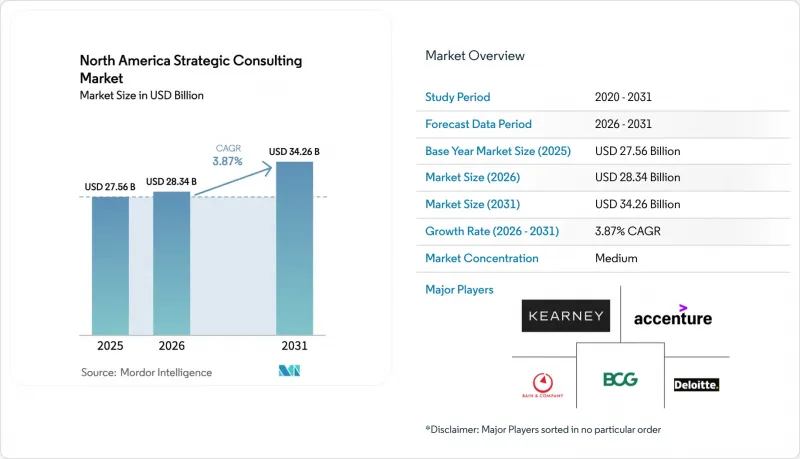
Mordor Intelligence에 의하면, 북미의 전략 컨설팅 시장 규모는 2025년에 275억 6,000만 달러로 평가되었습니다. 2026년에 283억 4,000만 달러에 달하고, 2031년까지 342억 6,000만 달러에 이를 것으로 예측되며, 2026년부터 2031년에 걸쳐 CAGR 3.87%로 성장할 전망입니다.
본 보고서는 서비스 유형별(기업 전략, 비즈니스 모델 혁신 등), 조직 규모별(대기업 등), 계약 형태별(프로젝트 기반 자문, 리테인드 자문 등), 최종 사용자 산업별(금융 서비스, 생명과학 및 헬스케어 등) 및 국가별로 분류되어 있습니다. 시장 전망은 금액(달러)으로 표시되어 있습니다.
북미의 전략 컨설팅 시장 동향 및 인사이트
기업 내 디지털 전략 컨설팅 수요 증가
경영진의 예산에서 2024년 수익의 7.5%가 디지털 전환에 배정되었으나, 생성형 AI 파일럿 프로젝트를 본생산 환경으로 전환한 조직은 고작 22%에 그쳐, 이러한 실행 측면의 격차를 외부 자문사가 비즈니스 기회로 활용하고 있음이 부각되었습니다. 레거시 기술 스택, 분산된 데이터 자산, 신중한 거버넌스가 확장을 방해하고 있기 때문에 컨설팅 업무는 조직 혁신, 기술 부채 시정, 투자 수익률(ROI) 모델링으로 초점을 옮기고 있습니다. 규제 당국이 사이버 보안 복원력 및 데이터 개인정보 보호 조치의 독립적인 검증을 의무화하고 있어, 금융 기관과 의료 서비스 제공업체가 수요를 주도하고 있습니다. 디지털 로드맵이 규정 준수 워크플로우와 밀접하게 연계됨에 따라, 북미의 전략 컨설팅 시장은 기업 거버넌스 구조 내에서 그 역할을 더욱 공고히 하고 있습니다. 컨설팅 기업들은 개념 증명(PoC) 주기를 단축하고, 수개월 이내에 비즈니스에 미치는 영향을 정량화할 수 있는 독자적인 액셀러레이터를 통해 타사와의 차별화를 꾀하고 있습니다.
M&A 활동 확대
2025년 북미의 M&A 거래 총액은 2조 400억 달러에 달하고, 2024년 대비 63% 증가했습니다. 이에 따라 실사, 평가 모델링, 시너지 창출과 관련된, 비록 간헐적이긴 하지만 높은 수익률을 보이는 프로젝트가 창출되고 있습니다. 컨설턴트는 거래 종결 후 최대 24개월 동안 조직에 상주하며, 문화, 시스템, 업무 리듬과 관련된 통합상의 병목 현상 해소에 주력하고 있습니다. 생명과학 분야에서도 유사한 경향이 나타나고 있으며, 제약 기업의 인수 측은 파이프라인 활성화를 요구하고, 규제 경로의 실현 가능성 및 시판 후 증거 생성에 관한 지침을 필요로 하고 있습니다. 미국·멕시코·캐나다 협정(USMCA)에 따라 미국, 캐나다, 멕시코 간의 국경을 초월한 활동이 가속화되고 있으며, 자문가는 서로 다른 세제 및 노동 법규를 해석해야 할 필요가 있습니다. 따라서 북미의 전략 컨설팅 시장의 보수 추이는 해당 지역의 M&A 사이클과 밀접하게 연동되어 있습니다.
사내 전략 팀의 확대
포춘 500대 기업들은 2025년, 기존의 자문 방식을 재현하고 반복적으로 발생하는 지출을 줄이기 위해 사내 ‘센터 오브 엑설런스(Center of Excellence)’를 구축하기 위해 전직 컨설턴트를 대거 채용했습니다. 이러한 변화를 주도하고 있는 것은 기술 기업들로, 외부 조달 주기를 거치지 않고 알고리즘 전문 인력을 각 제품 라인에 재배치하고 있습니다. 일상적인 계획 수립, 시장 조사, 경쟁사 정보 수집은 현재 사내에서 이루어지게 되었으며, 외부 기업들은 복잡하고 위험이 높은 프로젝트 수주를 놓고 경쟁할 수밖에 없는 상황입니다. 이에 대응하여 자문 서비스 제공업체들은 컨설팅과 매니지드 서비스의 경계를 모호하게 만드는 다년간의 변혁 프로그램에 직원을 상주시킴으로써 대처하고 있지만, 그 이익률은 단기 주기의 프로젝트 업무와는 현저히 다릅니다.
부문별 분석
2025년 북미의 전략 컨설팅 시장 규모 중 기능별 전략이 39.53%를 차지했습니다. 이는 인사 체계 재설계나 공급망 회복탄력성 강화와 같은 요구에 힘입은 결과입니다. 한편, 디지털 전략과 혁신은 인공지능(AI) 도입을 둘러싼 기업의 절박한 수요로 인해 4.65%라는 가장 높은 연평균 성장률(CAGR)을 기록했습니다. 고객사 조사에 따르면, 65%의 기업이 생성형 AI의 시범 도입을 실시했으나, 본격적 도입에 이른 곳은 불과 22%에 그쳤습니다. 그 결과, 실험 단계와 본격 운영을 연결해 줄 수 있는 자문가에게는 가격 책정에 대한 재량권이 부여되고 있습니다. 기능별 자문 서비스는 비용 절감 프로그램 분야에서 여전히 규모를 유지하고 있지만, 클라우드 아키텍처와 고급 분석이 현대의 프로세스 엑설런스를 뒷받침하게 되면서 현재는 디지털 팀이 모든 재설계에 영향을 미치고 있습니다. 기업 전략에 관한 의뢰는 여전히 존재하지만, 투자자들은 자본 계획을 승인할 때 기술 활용도를 점점 더 중요하게 여기게 되었으며, 이사회 논의에도 디지털화의 중요성이 반영되고 있습니다. M&A 자문 건수는 거시경제 상황에 따라 변동하며, 일시적인 수익 증대를 가져오는 한편, 기업을 금리 사이클의 변동 위험에 노출시키고 있습니다. 경제·정책 관련 업무는 인프라 및 무역 개혁을 추진하는 정부를 지원하는 역할을 하고 있지만, 조달 절차의 관료주의가 사업 확장의 걸림돌이 되고 있습니다. 전반적으로 디지털의 부상은 북미의 전략 컨설팅 시장에서 알고리즘 기반 역량이 기존의 규모의 경제 논리를 능가하며 주요 경쟁력으로 자리 잡고 있음을 보여줍니다.
2차적인 영향이 디지털화의 기세를 더욱 강화하고 있습니다. 인재들은 AI 도구 구축이나 데이터 사이언스 과제에 도전할 기회를 제공하는 컨설팅 업무를 선호하는 경향이 있으며, 그 결과 디지털에 정통한 컨설팅 회사와 대응이 뒤처진 동종 업계 경쟁사 간의 역량 격차가 더욱 확대되고 있습니다. 생명과학 및 금융 서비스 분야의 고객들은 규제 준수를 디지털 로드맵에 통합한 듀얼 트랙형 프로젝트를 요구하며, 컨설턴트를 보다 장기적인 관점에서 확보하고 있습니다. 그 결과, 기능별 자문 서비스가 차지하는 북미의 전략 컨설팅 시장 점유율은 절대적인 수익이 증가하고 있음에도 불구하고 서서히 하락하고 있으며, 이는 증분 지출에 대한 디지털 분야의 기여도가 현저히 크다는 것을 보여줍니다.
2025년 매출액 중 대기업이 62.89%를 차지하며, 이사회 수준의 승인이 필요한 다년간의 변혁 로드맵을 확보했습니다. 거버넌스 규범에 따라 외부 검증이 의무화되어 있어, 이로 인해 전 세계적으로 통합 업체에 업무를 위탁하는 추세가 유지되고 있습니다. 한편, 여기서는 연간 매출액이 5,000만 달러 미만인 기업을 ‘중소기업’으로 정의하고 있는데, 해당 부문의 지출은 연평균 성장률(CAGR) 4.86%로 확대될 것으로 예측되며, 이는 전체 규모 구분 중 가장 높은 성장률입니다. 클라우드 협업 제품군 및 AI를 활용한 조사를 통해 프로젝트의 최소 수익성 기준선이 대폭 낮아져, 과거에는 규모가 너무 작다고 여겨졌던 프로젝트도 부티크형 컨설팅 회사가 수주할 수 있게 되었습니다. 그 결과, 북미의 전략 컨설팅 시장은 기업 라이프사이클의 더 초기 단계에서 기업이 정신이 풍부한 부문으로 침투하고 있습니다.
중견 기업들은 하이브리드형 경향을 보이고 있는데, 지속적인 자문 계약을 체결할 예산은 없지만 개별적인 성장 진단 서비스를 구매하고 있습니다. 가격에 민감한 탓에 이러한 고객들은 성과 연계형 계약을 선호하게 되었으며, 시장 전반에서 실험적인 시도가 가속화되고 있습니다. 이에 대응하여 컨설턴트들은 시장 진입 청사진부터 도입 플레이북에 이르기까지, 클라이언트의 성숙도에 따라 확장 가능한 모듈식 서비스 카탈로그를 구축함으로써 대응하고 있습니다. 이러한 ‘계단식’ 접근 방식은 고객 생애 가치(CLV)를 연장하는 동시에 대상 시장 규모를 확대합니다. 다만, 소규모 고객사에 서비스를 제공할 경우 프로젝트 규모에 따라 제공 비용이 선형적으로 감소하지 않기 때문에 이익률이 압박을 받습니다. 이로 인해 북미의 전략 컨설팅 업계에서 엔터프라이즈 대상 프로그램의 프리미엄 위상이 더욱 공고해지고 있습니다.
기타 혜택 :
- 엑셀 형식 시장 예측(ME) 시트
- 3개월간의 애널리스트 지원
자주 묻는 질문
목차
제1장 서론
제2장 조사 방법
제3장 주요 요약
제4장 시장 구도
제5장 시장 규모 및 성장 예측
제6장 경쟁 구도
제7장 시장 기회 및 향후 전망
KTH 26.09.14According to Mordor Intelligence, the North America strategic consulting market size is projected to be USD 27.56 billion in 2025, USD 28.34 billion in 2026, and reach USD 34.26 billion by 2031, growing at a CAGR of 3.87% from 2026 to 2031.
This report is Segmented by Service Type (Corporate Strategy, Business-Model Transformation, and More), Organization Size (Large Enterprises, and More), Engagement Model (Project-Based Advisory, Retained Advisory, and More), End-User Industry (Financial Services, Life Sciences and Healthcare, and More), and Country. The Market Forecasts are Provided in Terms of Value (USD).
North America Strategic Consulting Market Trends and Insights
Increasing Demand For Digital Strategy Consulting Among Corporates
C-suite budgets earmarked 7.5% of 2024 revenue for digital transformation, yet only 22% of organizations shifted generative AI pilots into production, underscoring an execution gap that external advisors now monetize. Legacy technology stacks, dispersed data estates, and cautious governance impede scale-up, so engagements pivot toward organizational change, technical-debt remediation, and return-on-investment modeling. Financial institutions and healthcare providers lead demand because regulators require independent validation of cybersecurity resilience and data-privacy safeguards. As digital road maps intertwine with compliance workflows, the North America strategic consulting market deepens its role inside enterprise governance structures. Advisory firms differentiate through proprietary accelerators that compress proof-of-concept cycles and quantify business impact within months.
Growth Of Mergers And Acquisitions Activity
North American deal value reached USD 2.04 trillion in 2025, a 63% jump over 2024, producing episodic but high-margin mandates for due diligence, valuation modeling, and synergy capture. Consultants remain embedded up to 24 months post-close to resolve integration bottlenecks around culture, systems, and operating cadence. Life sciences illustrates the pattern as pharmaceutical acquirers seek pipeline rejuvenation and require guidance on regulatory pathway viability and post-market evidence generation. Cross-border activity among the United States, Canada, and Mexico accelerates under the United States-Mexico-Canada Agreement, compelling advisors to interpret divergent tax regimes and labor codes. The North America strategic consulting market thereby links its own fee trajectory to the region's M&A cycle.
Expansion Of In-House Strategy Teams
Fortune 500 enterprises hired former consultants en masse during 2025 to build internal centers of excellence that replicate traditional advisory methods and lower repeat spend. Technology companies lead the shift, redeploying algorithmic talent across product lines without external procurement cycles. Routine planning, market scans, and competitor intelligence now migrate in-house, leaving external firms to fight for complex, high-stakes mandates. Advisory providers counter by embedding staff for multiyear transformation programs that blur boundaries between consulting and managed services, but margin profiles differ markedly from short-cycle project work.
Other drivers and restraints analyzed in the detailed report include:
- Accelerated Adoption Of Advanced Analytics And AI-Powered Strategic Modeling
- Rising Complexity In Regulatory Compliance
- Commoditization Of Traditional Strategy Frameworks Via Generative AI Tools
For complete list of drivers and restraints, kindly check the Table Of Contents.
Segment Analysis
The functional strategy accounted for 39.53% of the North America strategic consulting market size in 2025, driven by human-resources redesign and supply-chain resilience mandates. Digital strategy and innovation, however, posts the swiftest 4.65% CAGR thanks to enterprise urgency around artificial intelligence deployment. Clients acknowledge that 65% of firms piloted generative AI yet only 22% scaled it, so advisors who can bridge experimentation and production enjoy pricing latitude. Functional advisory retains scale for cost-takeout programs, but digital teams now influence every redesign because cloud architectures and advanced analytics underpin modern process excellence. Corporate-strategy mandates still appear, but investors increasingly evaluate technology leverage when approving capital plans, blending digital imperatives into boardroom conversations. M&A advisory volumes fluctuate with macro conditions, supplying episodic upside yet exposing firms to rate-cycle volatility. Economic and policy engagements serve governments navigating infrastructure or trade reform, but procurement bureaucracy tempers expansion. In aggregate, digital's rise signals that algorithmic capability eclipses classical economies-of-scale logic as the chief competitive weapon inside the North America strategic consulting market.
Second-order effects reinforce digital's pull. Talent migration favors practices offering exposure to AI tool-building and data-science problems, thereby deepening capability gaps between digitally fluent consultancies and slower peers. Clients in life-sciences and financial services request dual-track projects that embed regulatory compliance into digital road maps, anchoring consultants for longer horizons. The North America strategic consulting market share held by functional advisory therefore slides gradually even as its absolute revenue grows, a testament to digital's disproportionate contribution to incremental spend.
Large enterprises represented 62.89% of 2025 revenue, securing multiyear transformation road maps that require board-level sign-off. Governance norms oblige external validation, sustaining engagement flow to global integrators. Yet small enterprises, defined here as firms below USD 50 million in annual revenue, are projected to expand their spend at a 4.86% CAGR, the fastest across size tiers. Cloud collaboration suites and AI-assisted research have slashed minimum project economics, letting boutiques win deals once considered too small. As a result, the North America strategic consulting market penetrates entrepreneurial segments earlier in company life cycles.
Medium enterprises exhibit hybrid patterns, purchasing discrete growth diagnostics while lacking budgets for continuous retainers. Price sensitivity pushes these clients toward outcome-linked contracts, accelerating experimentation across the market. Consultants respond by curating modular service catalogs that scale with client maturity, from market-entry blueprints to implementation playbooks. This staircase approach lengthens customer lifetime value while expanding addressable volume. Margins, however, compress when serving smaller clients because delivery costs do not fall linearly with project size, reinforcing the premium positioning of enterprise programs inside the North America strategic consulting industry.
Complete Report Scope:
- By Service Type
- Corporate Strategy
- Business-Model Transformation
- M&A and Corporate Finance Strategy
- Digital Strategy and Innovation
- Functional Strategy (HR, SCM, etc.)
- Economic and Policy Advisory
- By Organization Size
- Large Enterprises
- Medium Enterprises
- Small Enterprises
- By Engagement Model
- Project-based Advisory
- Retained Advisory
- Managed / Implementation Services
- Outcome-based / Success-fee Consulting
- Digital / Platform-enabled Consulting
- By End-user Industry
- Financial Services
- Life Sciences and Healthcare
- Technology, Media and Telecom
- Energy and Resources
- Government and Public Sector
- Consumer and Retail
- Industrial and Manufacturing
- Other End-user Industries
- By Country
- United States
- Canada
- Mexico
List of Companies Covered in this Report:
- Accenture plc
- A.T. Kearney Inc.
- McKinsey & Company Inc.
- The Boston Consulting Group Inc.
- Bain & Company Inc.
- Deloitte Touche Tohmatsu Limited
- PricewaterhouseCoopers International Limited
- Marsh & McLennan Companies Inc.
- Roland Berger GmbH
- KPMG International Limited
- Ernst & Young Global Limited
- Booz Allen Hamilton Holding Corporation
- Oliver Wyman Inc.
- L.E.K. Consulting LLC
- AlixPartners LLP
- Strategy&
- ZS Associates
- IBM Corporation (IBM Consulting)
- CGI Inc.
- Capgemini SE
Additional Benefits:
- The market estimate (ME) sheet in Excel format
- 3 months of analyst support
TABLE OF CONTENTS
1 INTRODUCTION
- 1.1 Study Assumptions and Market Definition
- 1.2 Scope of the Study
2 RESEARCH METHODOLOGY
3 EXECUTIVE SUMMARY
4 MARKET LANDSCAPE
- 4.1 Market Overview
- 4.2 Market Drivers
- 4.2.1 Increasing Demand for Digital Strategy Consulting Among Corporates
- 4.2.2 Growth of Mergers and Acquisitions Activity
- 4.2.3 Rising Complexity in Regulatory Compliance
- 4.2.4 Need for Cost Optimization and Operational Efficiency
- 4.2.5 Accelerated Adoption of Advanced Analytics and AI-Powered Strategic Modeling
- 4.2.6 Emergence of Sustainability-Linked Corporate Strategy Mandates
- 4.3 Market Restraints
- 4.3.1 Expansion of In-House Strategy Teams
- 4.3.2 Talent Shortages and High Consultant Turnover
- 4.3.3 Commoditization of Traditional Strategy Frameworks via Generative AI Tools
- 4.3.4 Increasing Client Preference for Outcome-Based Pricing Models Reducing Margins
- 4.4 Investment Analysis
- 4.5 Regulatory Landscape
- 4.6 Impact of Macroeconomic Factors on the Market
- 4.7 Technological Outlook
- 4.8 Porter's Five Forces Analysis
- 4.8.1 Threat of New Entrants
- 4.8.2 Bargaining Power of Buyers
- 4.8.3 Bargaining Power of Suppliers
- 4.8.4 Threat of Substitute Products
- 4.8.5 Intensity of Competitive Rivalry
5 MARKET SIZE AND GROWTH FORECASTS (VALUE)
- 5.1 By Service Type
- 5.1.1 Corporate Strategy
- 5.1.2 Business-Model Transformation
- 5.1.3 M&A and Corporate Finance Strategy
- 5.1.4 Digital Strategy and Innovation
- 5.1.5 Functional Strategy (HR, SCM, etc.)
- 5.1.6 Economic and Policy Advisory
- 5.2 By Organization Size
- 5.2.1 Large Enterprises
- 5.2.2 Medium Enterprises
- 5.2.3 Small Enterprises
- 5.3 By Engagement Model
- 5.3.1 Project-based Advisory
- 5.3.2 Retained Advisory
- 5.3.3 Managed / Implementation Services
- 5.3.4 Outcome-based / Success-fee Consulting
- 5.3.5 Digital / Platform-enabled Consulting
- 5.4 By End-user Industry
- 5.4.1 Financial Services
- 5.4.2 Life Sciences and Healthcare
- 5.4.3 Technology, Media and Telecom
- 5.4.4 Energy and Resources
- 5.4.5 Government and Public Sector
- 5.4.6 Consumer and Retail
- 5.4.7 Industrial and Manufacturing
- 5.4.8 Other End-user Industries
- 5.5 By Country
- 5.5.1 United States
- 5.5.2 Canada
- 5.5.3 Mexico
6 COMPETITIVE LANDSCAPE
- 6.1 Market Concentration
- 6.2 Strategic Moves
- 6.3 Market Share Analysis
- 6.4 Company Profiles (Includes Global Level Overview, Market Level Overview, Core Segments, Financials as Available, Strategic Information, Market Rank/Share, Products and Services, and Recent Developments)
- 6.4.1 Accenture plc
- 6.4.2 A.T. Kearney Inc.
- 6.4.3 McKinsey & Company Inc.
- 6.4.4 The Boston Consulting Group Inc.
- 6.4.5 Bain & Company Inc.
- 6.4.6 Deloitte Touche Tohmatsu Limited
- 6.4.7 PricewaterhouseCoopers International Limited
- 6.4.8 Marsh & McLennan Companies Inc.
- 6.4.9 Roland Berger GmbH
- 6.4.10 KPMG International Limited
- 6.4.11 Ernst & Young Global Limited
- 6.4.12 Booz Allen Hamilton Holding Corporation
- 6.4.13 Oliver Wyman Inc.
- 6.4.14 L.E.K. Consulting LLC
- 6.4.15 AlixPartners LLP
- 6.4.16 Strategy&
- 6.4.17 ZS Associates
- 6.4.18 IBM Corporation (IBM Consulting)
- 6.4.19 CGI Inc.
- 6.4.20 Capgemini SE
7 MARKET OPPORTUNITIES AND FUTURE OUTLOOK
- 7.1 White-Space and Unmet-Need Assessment